Method and system for encryption of messages in land mobile radio systems
Summary by NHIP
LMR Message Encryption
The method authenticates land mobile radio sites and encrypts their exchanged messages. A trusted authority creates a certificate by applying a hash function to a site public key to generate a reduced representation, then encrypts this representation with the authority's private key.
Claim Score by NHIP
Abstract
A method and system for authentication of sites in a land mobile radio (LMR) system and encryption of messages exchanged by the sites. In some embodiments, the method includes transmitting a certificate created by a trusted authority by applying a function to a first site public key using the trusted authority's private key to generate a reduced representation, which is encrypted with the trusted authority's private key. Other sites may receive the certificate, decrypt it using the trusted authority's public key, and authenticate the first site. The method may further include generating a session key, encrypting it with the public key of the first site, and transmitting the encrypted session key to the first site. The first site decrypts the encrypted session key with the first site's private key, and transmits a message encrypted with the shared session key to other sites for decryption using the session key.
Term
1.1 yearsleft in the term
Expires 15 November 2027.
- Priority
- Filed
- Granted
- Today
- Expires
33 claims: 3 independent, 30 dependent
- 1Broadest claimClaim Score 62, broad(NHIP)A method for authenticating a plurality of sites in a land mobile radio (LMR) system and encrypting messages exchanged by the sites, the plurality of sites being connected by a data network, the method comprising:receiving, by one or more of the plurality of sites in the LMR system, a certificate transmitted by a first site, wherein the certificate is encrypted;decrypting, by the one or more of the plurality of sites, the certificate transmitted by the first site;authenticating the first site;generating a shared session key that is valid across a group of sites in the LMR system;encrypting the shared session key;and transmitting the encrypted shared session key to the first site for use by the first site to encrypt a message for multicast transmission.
- 19A computer-implemented method for authenticating a plurality of sites in a land mobile radio (LMR) system and for encrypting messages exchanged by the sites, the plurality of sites being connected by an IP network, the computer-implemented method comprising:transmitting, by a first site, a certificate of the first site;generating a shared session key that is valid across a group of sites in the LMR system;receiving, by the first site, the shared session key, wherein the shared session key is encrypted;decrypting, by the first site, the encrypted shared session key with a private key of the first site;and transmitting, by the first site, a multicast message encrypted with the shared session key.
- 26A system for authenticating a plurality of sites in a land mobile radio (LMR) system and for encrypting messages exchanged by the sites, the plurality of sites being connected by an IP network, the system utilizing a plurality of method steps comprising:transmitting, by a first site, a certificate of the first site;generating a shared session key that is valid across a group of sites in the LMR system;receiving, by the first site, the shared session key, wherein the shared session key is encrypted;decrypting, by the first site, the encrypted shared session key with a private key of the first site;and transmitting, by the first site, a multicast message encrypted with the shared session key.
Independent claims3
31 paragraphs in 5 sections, as filed
CROSS-REFERENCE TO RELATED APPLICATIONS
Pursuant to 35 U.S.C. §120, this application is a continuation of U.S. patent application Ser. No. 13/595,981, entitled “Method and System for Encryption of Messages in Land Mobile Radio Systems,” filed Aug. 27, 2012 and naming Jeffery Benshetler and Arindam Roy as inventors, which is a continuation of U.S. patent application Ser. No. 11/940,936, entitled “Method and System for Encryption of Messages in Land Mobile Radio Systems,” filed Nov. 15, 2007, which claims priority from, and hereby incorporates by reference for all purposes, U.S. Provisional Patent Application Ser. No. 60/950,868, entitled “Method and System for Encryption of Messages in Land Mobile Radio Systems,” filed Jul. 19, 2007, and U.S. Provisional Patent Application Ser. No. 60/963,131, entitled “APCO 07 Brochure for End-to-End Encryption and Peer-to-Peer Communication,” filed Aug. 2, 2007, both naming Arindam Roy and Jeffery Benshetler as inventors, all of which are hereby incorporated by reference for all purposes.
TECHNICAL FIELD
The invention relates generally to communication systems. More specifically, the invention relates to a method and system for encryption of messages in Land Mobile Radio Systems.
BACKGROUND
Land Mobile Radio (LMR) systems are deployed by organizations requiring instant communication between geographically dispersed and mobile personnel. Typical users of LMR systems include police departments, fire departments, medical personnel, EMS, and the military.
Current LMR systems can be configured to provide for radio communications between a site and subscriber units in the field. A subscriber unit may be a mobile unit or a portable unit. LMR systems can be as simple as two subscriber units communicating between themselves and a site over preset channels, or they can be complex consisting of tens of thousands of subscriber units and multiple sites.
LMR systems may be configured to cover a large geographical area by providing hundreds of sites. For security purpose, when a previously unknown site intends to communicate with other sites in an LMR system, the previously unknown site needs to be authenticated. Current methods for authentication of a previously unknown site generally require manual configuration of all sites in an LMR system. Also, in order to provide secure communication among the sites, messages among the sites need to be encrypted. At present, encrypted messages are generally unicast, requiring high bandwidth. Multicast messaging is the most bandwidth efficient form of one-to-many IP communications. However, the standard method of multicast encryption, IPSec, is a point-to-point tunneling protocol; multicast over IPSec is converted to unicast. While messages encrypted with a public key may be multicast, however it is generally more computationally expensive to use public key encryption for voice packet transmission.
BRIEF DESCRIPTION OF THE DRAWINGS
For a more complete understanding of the features and advantages of the present invention, reference is now made to the detailed description of the invention along with the accompanying figures and in which:
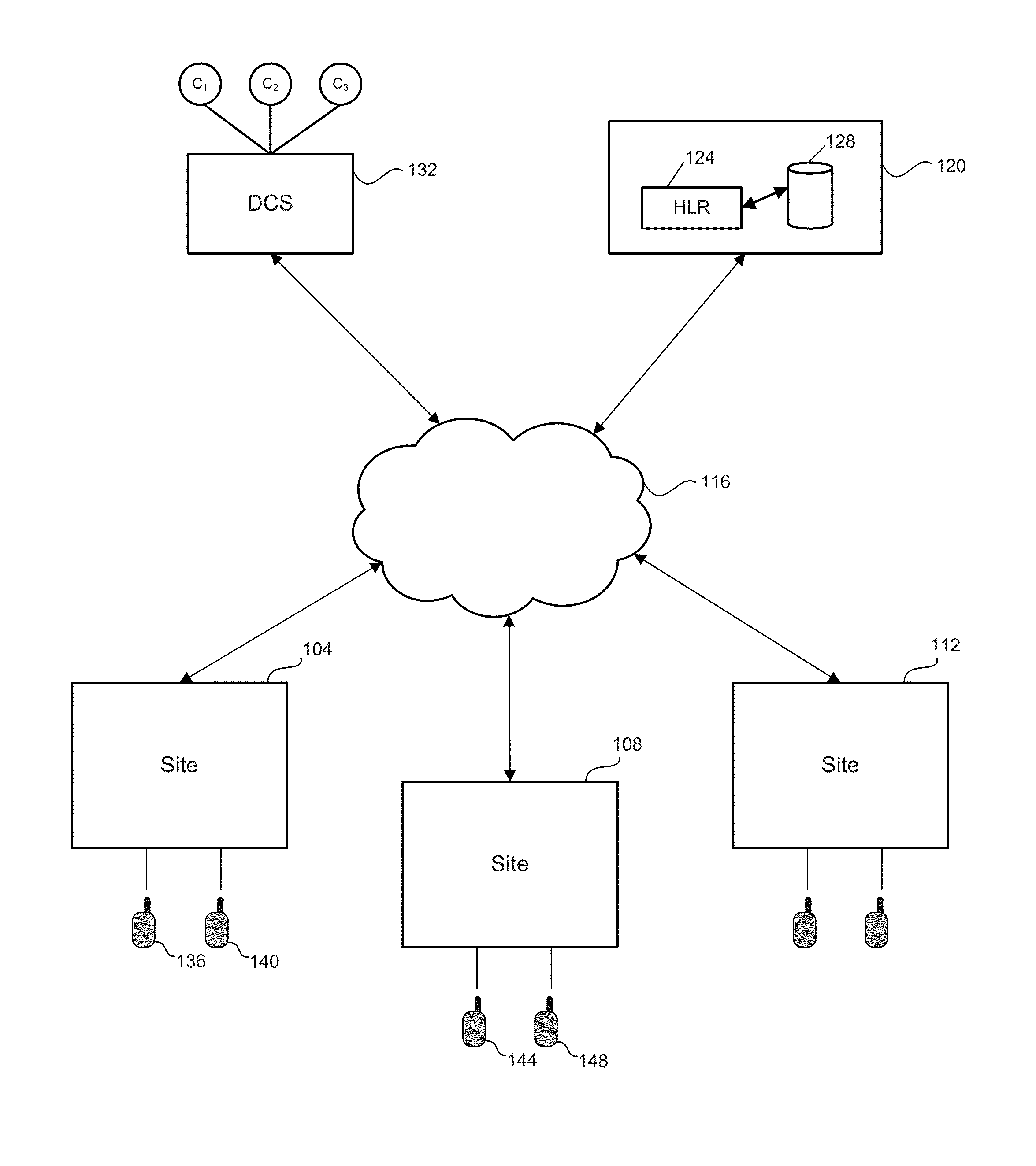
<figref idref="DRAWINGS">FIG. 1</figref> illustrates a Land Mobile Radio system in accordance with an embodiment of the invention.
<figref idref="DRAWINGS">FIG. 2</figref> is an exemplary flow diagram of the steps of authenticating a previously unknown site or end point in accordance with one embodiment.
<figref idref="DRAWINGS">FIG. 3</figref> is an exemplary flow diagram of the steps for generating a digital certificate for a site.
<figref idref="DRAWINGS">FIG. 4</figref> is an exemplary flow diagram of the steps for transmission and reception of messages.
DETAILED DESCRIPTION OF THE DRAWINGS
<figref idref="DRAWINGS">FIG. 1</figref> illustrates an LMR system <b>100</b> including sites <b>104</b>, <b>108</b> and <b>112</b> in accordance with an embodiment of the invention. The sites <b>104</b>, <b>108</b> and <b>112</b> are interconnected by a data network <b>116</b>. The data network can be an IP network. However, the data network may also be any other type of network (e.g., packet switched network, ATM network). The system <b>100</b> includes a network management system <b>120</b>. The network management system <b>120</b> includes a home location register (HLR) <b>124</b> and a database <b>128</b>. The system <b>200</b> may also include a digital console subsystem <b>132</b> having one or more consoles (C1-C3). The function and operation of the network management system <b>120</b> and the console subsystem <b>132</b> are understood by those skilled in the art. One or more subscriber units (e.g., mobile units) may operate under the control of a site.
In order to prevent unauthorized sites or other elements gain access to the LMR system, when a previously unknown site intends to communicate with other sites in the LMR system <b>100</b>, the site must be authenticated. More specifically, before allowing a previously unknown site to communicate with other sites in the LMR system <b>100</b>, the previously unknown site must be authenticated. Also, for secure communication among the sites, messages among the sites must be encrypted. While P25 standard supports encrypted voice packets, meta-data and control plane messages are not encrypted, thereby allowing unauthorized listeners to intercept the meta-data and control plane messages.
In one embodiment, secured communication is provided by encrypting messages (also referred to as “IP traffic”) in the LMR system <b>100</b>. Both bearer plane traffic and control plane traffic are encrypted.
In one embodiment, a method provides improved end-to-end security by combining a public key cryptographic method with a secret session key cryptographic method. More specifically, the public key cryptography is utilized to authenticate previously unknown sites in a dynamic discovery process. Authenticated sites are provided with a secret session key to encrypt and decrypt messages in order to communicate with other sites in the LMR system <b>100</b>. In one embodiment, authenticated sites are provided with a rapidly varying symmetric session key that can be interpreted only by the authenticated sites.
In one embodiment, when a previously unknown site intends to communicate with other sites in an LMR system, the site broadcasts its certificate (e.g., digital certificate) over the IP network <b>116</b>. The digital certificate may be created by a trusted authority or an independent third party engaged in verification and authentication of traffic over the Internet. The digital certificate must be signed by an entity trusted by all participants to be useful. For example, the digital certificate may be created by Verisign, a well known trusted authority. In another embodiment, the digital certificate may be created by the network management system of the LMR system or any designated certificate authority. As will be apparent to those skilled in the art, the network management system can be a dedicated server that performs various network management function including creating digital certificates. Thus, the network management system may perform the function of a trusted authority by creating the digital certificate.
In one embodiment, the trusted authority applies a selected function to the site's public key, its ID and other relevant information to generate a reduced representation of the information, which is also referred to as a message digest. The selected function may be a non-invertible function (e.g., a hash function) or any other well known function to generate a reduced representation of the information. A reduced representation of the information, i.e., message digest, provides improved security while significantly lowering bandwidth requirement.
As will be understood by those skilled in the art, the public key of a site is available to the public. As discussed above, the trusted authority creates a message digest from the public key, the ID and other relevant information of the site. The message digest is then encrypted by the trusted authority's private key, generating a digital signature of the particular site. The digital signature thus includes the public key, the ID and other relevant information of the particular site.
A digital certificate of a site includes its digital signature and its public key. In one embodiment, each site is provided with its own digital certificate or each site may create its own digital certificate that must be signed by a community trusted authority. The other relevant information may include the date when the digital certificate becomes valid and the date the digital certificate expires.
In one embodiment, when a previously unknown site intends to participate in LMR communication (i.e., intends to communicate with other sites), the site first transmits its digital certificate. The digital certificate is received by the other sites in the LMR system. The other sites in the LMR system decrypt the digital certificate with the public key of the trusted authority in order to retrieve the enclosed message digest. The message digest is used to verify the site. In one embodiment, the enclosed message digest is a hash that is compared with a locally calculated hash for verification purpose. The authentication of a previously unknown site using a digital certificate is also referred to as the dynamic discovery process.
In another embodiment, a trusted authority may create a “certificate” for a site by encrypting only the public key of that site with the trusted authority's private key. Alternatively, a trusted authority may create a “certificate” for a site by encrypting the public key and the ID of that site. The site may then transmit its own “certificate” for authentication purposes if the site intends to communicate with other sites. The other sites in the LMR system may decrypt the “certificate” using the public key of the trusted authority.
In one embodiment, after the public key of the previously unknown site is authenticated, the site is provided with a session key that is encrypted with the public key of the particular site. In one embodiment, the session key is a secret symmetric session key. In one embodiment, the authenticated site is provided with a rapidly varying secret symmetric session key to encrypt and decrypt messages. As will be understood by those skilled in the art, a message encrypted by a symmetric session key can only be decrypted by the same session key. Also, it is less computationally expensive to use public key cryptography to establish shared keys for symmetric cryptography.
In one embodiment, the site may be provided with a session key that varies periodically or that varies each LMR session. In another embodiment, the site may be provided with a session key that varies each time the site intends to transmit a message. As will be apparent to those skilled in the art, the session key may be varied in other manner in order to provide security in the LMR communication.
After the site is authenticated and is provided with the encrypted symmetric session key, the site decrypts the session key with its own private key and is ready to transmit and receive messages, i.e., participate in the LMR communication. Thus, the digital certificate is multicast to all listening sites. These sites validate the digital certificate and add the new site to the active site list. When a call is brought up, the initiating site multicasts an inquiry asking which sites want to participate in the call. The participating sites unicast back a desire to participate. The participating sites then each receive the session key encrypted with that sites public key via unicast. The participating sites can decrypt the session key using their own private key and participate in the communication.
The site may then transmit a message encrypted with the session key. In one embodiment, the encrypted message is multicast over the IP network. In one embodiment, the message is encrypted by a symmetric session key, thus allowing the encrypted message to be multicast over the IP network, thereby reducing bandwidth. The recipients of the multicast encrypted message can decrypt the message with the same session key. As will be appreciated, by utilizing a symmetric session key to encrypt the message, a site is able to multicast the message without requiring high bandwidth. In contrast, because existing implementations are point to point requiring conversion of multicast into unicast at the transport layer, the bandwidth requirement is significantly higher. Also, since the session key can only be decrypted by the intended recipient using its private key, a message encrypted by the session key and transmitted cannot be subsequently repudiated by the transmitting site. Accordingly, the encryption method also provides non-repudiation of transmitted messages.
<figref idref="DRAWINGS">FIG. 2</figref> is an exemplary flow diagram of the steps of authenticating a previously unknown site in accordance with one embodiment. In step <b>204</b>, the site or end point is provided with a digital certificate. As discussed before, in one embodiment the digital certificate is created by a trusted authority by applying a selected function (e.g., non-invertible function) to the public key, the ID and other relevant information (e.g., start and expiration dates of digital certificate) of the particular site to create a reduced representation or message digest and then encrypting the reduced representation with the trusted authority's private key. In one embodiment, the digital certificate is created by applying a hash function to the public key, the ID and other relevant information of the particular site to generate a hash or reduced representation and then encrypting the hash or reduced representation with the trusted authority's private key.
In step <b>208</b>, the site transmits its digital certificate. In step <b>212</b>, the digital certificate is received by other sites in the LMR system. In step <b>216</b>, the digital certificate is decrypted by the recipients with the public key of the trusted authority. As discussed before, the digital certificate is decrypted to retrieve the enclosed reduced representation (e.g., hash). In one embodiment, the enclosed hash is compared with a locally calculated hash to authenticate the site.
<figref idref="DRAWINGS">FIG. 3</figref> is an exemplary flow diagram of the steps for generating a digital certificate for a site. In step <b>304</b>, the public key, the ID and other relevant information (collectively referred to as “site information”) of the site is provided to a trusted authority. In step <b>308</b>, the trusted authority applies a selected function (e.g., non-invertible function) to the site information to create a reduced representation (e.g., hash) of the site information. In step <b>312</b>, the reduced representation is encrypted with the private key of the trusted authority to create a digital signature. As discussed before, a digital certificate includes a digital signature of the site along with the public key of the site. In step <b>316</b>, a digital certificate is created and is provided to the site.
<figref idref="DRAWINGS">FIG. 4</figref> is an exemplary flow diagram of the steps of transmission and reception of messages in the LMR system. In step <b>404</b>, a current session key is generated. As discussed before, the current session key is a secret session key. In one embodiment, the current session key is a secret symmetric key that can be varied rapidly. In step <b>408</b>, the current session key is encrypted with the public key of each authenticated site to create an encrypted session key for each site. In step <b>412</b>, each authenticated site is provided with the encrypted session key. In step <b>416</b>, the session key is decrypted by the authenticated sites using their respective private keys. As discussed before, in one embodiment the authenticated sites are provided with a symmetric session key. In step <b>420</b>, a site encrypts a message with the session key. In step <b>424</b>, the site transmits the encrypted message. Since the message is encrypted with a symmetric session key, the message can be multicast without requiring a large bandwidth. In step <b>428</b>, the other participating sites receive and decrypt the encrypted message with the session key. As discussed before, in order to improved security, the session key can be varied rapidly.
By way of examples, but not limitations, various aspects of the invention, such as authentication, dynamic discovery, and encryption of messages have been described above in connection with sites. However, it will be apparent to those skilled the art that the various aspects of the invention can be used in connection with radio frequency sub-systems (RFSS), repeaters, transceivers and high level systems comprising a plurality of RFSS. For example, the authentication and dynamic discovery process can be used to authenticate and dynamically discover RFSS, repeaters, high level systems comprising a plurality of RFSS, or other elements of a communication system. Likewise, the encryption of messages described above can be used to encrypt messages among RFSS, repeaters, high level systems comprising a plurality of RFSS, or other elements of a communication system.
Also, by way of examples, but not limitations, various aspects of the invention, such as authentication, dynamic discovery, and encryption of messages have been described above in connection with a land mobile radio (LMR) system. However, it will be apparent to those skilled the art that the various aspects of the invention can be used in connection with other types of communication systems (i.e., non-LMR-type communication systems). For example, the authentication and dynamic discovery process can be used to authenticate and dynamically discover sites and other elements of a non-LMR-type communication system. Likewise, the encryption of messages described above can be used to encrypt messages among sites or among other elements of a non-LMR-type communication system.
It will be appreciated by those skilled in the art that changes could be made to the embodiments described above without departing from the broad inventive concept thereof. It is understood, therefore, that this invention is not limited to the particular embodiments disclosed, but it is intended to cover modifications within the spirit and scope of the present invention as defined by the appended claims.
Contents5
6 sheets
Sheet 1 Sheet 2 Sheet 3 Sheet 4 Sheet 5 Sheet 6
Every citation, both waysCites: the store holds 51 of 52
| Document | Relation | Office | Cited during |
|---|---|---|---|
| US10880000B2 | Cited by | United States of America | Applicant |
| US11936466B2 | Cited by | United States of America | Applicant |
| US10461846B2 | Cited by | United States of America | Applicant |
| US12316437B2 | Cited by | United States of America | Applicant |
| US10548025B2 | Cited by | United States of America | Applicant |
| US9800460B2 | Cited by | United States of America | Applicant |
| US9763260B2 | Cited by | United States of America | Applicant |
| US10212026B2 | Cited by | United States of America | Applicant |
| US10117111B2 | Cited by | United States of America | Applicant |
| US10749737B2 | Cited by | United States of America | Applicant |
| US9319362B1 | Cited by | United States of America | Search report |
| US9774386B2 | Cited by | United States of America | Applicant |
| US10004082B2 | Cited by | United States of America | Applicant |
| US11496212B2 | Cited by | United States of America | Applicant |
| US10791566B2 | Cited by | United States of America | Applicant |
| US2002114302A1 | Cites | United States of America | Applicant |
| US2003058858A1 | Cites | United States of America | Applicant |
| US2003063569A1 | Cites | United States of America | Applicant |
| US2003095510A1 | Cites | United States of America | Applicant |
| US2004070515A1 | Cites | United States of America | Applicant |
| US2005180448A1 | Cites | United States of America | Applicant |
| US2005198359A1 | Cites | United States of America | Applicant |
| US2005281208A1 | Cites | United States of America | Applicant |
| US2006262800A1 | Cites | United States of America | Applicant |
| US2007104121A1 | Cites | United States of America | Applicant |
| US2007242670A1 | Cites | United States of America | Applicant |
| US2007259692A1 | Cites | United States of America | Applicant |
| US2008123650A1 | Cites | United States of America | Applicant |
| US2008144644A1 | Cites | United States of America | Applicant |
| US2009024845A1 | Cites | United States of America | Applicant |
| US2010020735A1 | Cites | United States of America | Applicant |
| US2012083307A1 | Cites | United States of America | Applicant |
| US2013294323A1 | Cites | United States of America | Applicant |
| US5850444A | Cites | United States of America | Search report |
| US6754224B1 | Cites | United States of America | Applicant |
| US6941457B1 | Cites | United States of America | Search report |
| US7056217B1 | Cites | United States of America | Applicant |
| US7184790B2 | Cites | United States of America | Applicant |
| US7221660B1 | Cites | United States of America | Applicant |
| US7636339B2 | Cites | United States of America | Applicant |
| US7764633B2 | Cites | United States of America | Applicant |
| US7929475B2 | Cites | United States of America | Applicant |
| US7970425B2 | Cites | United States of America | Applicant |
| US8059574B2 | Cites | United States of America | Applicant |
| US8160076B1 | Cites | United States of America | Applicant |
| US8255684B2 | Cites | United States of America | Applicant |
| US8483114B2 | Cites | United States of America | Applicant |
| US8694774B2 | Cites | United States of America | Applicant |
| US20020114302A1 | Cites | United States of America | Applicant |
| US20030058858A1 | Cites | United States of America | Applicant |
| US20030063569A1 | Cites | United States of America | Applicant |
| US20030095510A1 | Cites | United States of America | Applicant |
| US20040070515A1 | Cites | United States of America | Applicant |
| US20050180448A1 | Cites | United States of America | Applicant |
| US20050198359A1 | Cites | United States of America | Applicant |
| US20050281208A1 | Cites | United States of America | Applicant |
| US20060262800A1 | Cites | United States of America | Applicant |
| US20070104121A1 | Cites | United States of America | Applicant |
| US20070242670A1 | Cites | United States of America | Applicant |
| US20070259692A1 | Cites | United States of America | Applicant |
| US20080123650A1 | Cites | United States of America | Applicant |
| US20080144644A1 | Cites | United States of America | Applicant |
| US20090024845A1 | Cites | United States of America | Applicant |
| US20100020735A1 | Cites | United States of America | Applicant |
| US20120083307A1 | Cites | United States of America | Applicant |
| US20130294323A1 | Cites | United States of America | Applicant |
| Telecommunications Industry Association (TIA) with Electronic Industries Alliance (EIA), TIA/EIA Telecommunications Systems Bulletin, APCO Project 25-Trunking Overview (TSB102.AABA), Apr. 1995, Telecommunications Industry Association (TIA), Arlington, VA (12 pages). | Non-patent | – | Applicant |
| Office Action dated Dec. 17, 2010 issued in U.S. Appl. No. 11/940,936 (12 pages). | Non-patent | – | Applicant |
| Final Office Action dated Jul. 1, 2011 issued in U.S. Appl. No. 11/940,936 (16 pages). | Non-patent | – | Applicant |
| Telecommunications Industry Association (TIA) with Electronic Industries Alliance (EIA), TIA/EIA Standard: Project 25-Trunking Control Channel Messages New Technology Standards Project Digital Radio Technical Standards (ANSI/TIA/EIA-102.AABC), May 2000, Telecommunications Industry Association (TIA), Arlington, VA (150 pages). | Non-patent | – | Applicant |
| Telecommunications Industry Association (TIA) with Electronic Industries Alliance (EIA), TIA/EIA Standard: Project 25-Trunking Control Channel Messages, Addendum 1, SNDCP Trunking Control Channel Messages (ANSI/TIA/EIA-102.AABC-1), Sep. 2001, Telecommunications Industry Association (TIA), Arlington, VA (11 pages). | Non-patent | – | Applicant |
| Telecommunications Industry Association (TIA) with Electronic Industries Alliance (EIA), TIA Standard: Project 25-Trunking Control Channel Messages, Addendum 2-Multiband Operations, New Technology Standards Project Digital Radio Technical Standards (ANSI/TIA-102.AABC-2), Dec. 2002, Telecommunications Industry Association (TIA), Arlington, VA (39 pages). | Non-patent | – | Applicant |
| 2nd Notice of Allowance dated Jul. 1, 2011 issued in U.S. Appl. No. 11/937,963 (7 pages). | Non-patent | – | Applicant |
| 1st Notice of Allowance dated Mar. 4, 2011 issued in U.S. Appl. No. 11/937,963 (5 pages). | Non-patent | – | Applicant |
| Office Action dated Oct. 15, 2010 issued in U.S. Appl. No. 11/937,963 (15 pages). | Non-patent | – | Applicant |
| copending U.S. Appl. No. 14/217,150, filed Mar. 17, 2014; first-named inventor: Arindam Roy. | Non-patent | – | Applicant |
| U.S. Appl. No. 61/790,588, filed Mar. 15, 2013; first-named inventor: Arindam Roy. | Non-patent | – | Applicant |
| copending U.S. Appl. No. 14/200,812, filed Mar. 7, 2014, first-named inventor: Jeffery E. Benshetler. | Non-patent | – | Applicant |
| Telecommunications Industry Association (TIA) with Electronic Industries Alliance (EIA), TIA/EIA Telecommunications Systems Bulletin, APCO Project 25—Trunking Overview (TSB102.AABA), Apr. 1995, Telecommunications Industry Association (TIA), Arlington, VA (12 pages). | Non-patent | – | Applicant |
| Office Action dated Dec. 17, 2010 issued in U.S. Appl. No. 11/940,936 (12 pages). | Non-patent | – | Applicant |
| Final Office Action dated Jul. 1, 2011 issued in U.S. Appl. No. 11/940,936 (16 pages). | Non-patent | – | Applicant |
| Telecommunications Industry Association (TIA) with Electronic Industries Alliance (EIA), TIA/EIA Standard: Project 25—Trunking Control Channel Messages New Technology Standards Project Digital Radio Technical Standards (ANSI/TIA/EIA-102.AABC), May 2000, Telecommunications Industry Association (TIA), Arlington, VA (150 pages). | Non-patent | – | Applicant |
| Telecommunications Industry Association (TIA) with Electronic Industries Alliance (EIA), TIA/EIA Standard: Project 25—Trunking Control Channel Messages, Addendum 1, SNDCP Trunking Control Channel Messages (ANSI/TIA/EIA-102.AABC-1), Sep. 2001, Telecommunications Industry Association (TIA), Arlington, VA (11 pages). | Non-patent | – | Applicant |
| Telecommunications Industry Association (TIA) with Electronic Industries Alliance (EIA), TIA Standard: Project 25—Trunking Control Channel Messages, Addendum 2—Multiband Operations, New Technology Standards Project Digital Radio Technical Standards (ANSI/TIA-102.AABC-2), Dec. 2002, Telecommunications Industry Association (TIA), Arlington, VA (39 pages). | Non-patent | – | Applicant |
| 2nd Notice of Allowance dated Jul. 1, 2011 issued in U.S. Appl. No. 11/937,963 (7 pages). | Non-patent | – | Applicant |
| 1st Notice of Allowance dated Mar. 4, 2011 issued in U.S. Appl. No. 11/937,963 (5 pages). | Non-patent | – | Applicant |
| Office Action dated Oct. 15, 2010 issued in U.S. Appl. No. 11/937,963 (15 pages). | Non-patent | – | Applicant |
| copending U.S. Appl. No. 14/217,150, filed Mar. 17, 2014; first-named inventor: Arindam Roy. | Non-patent | – | Applicant |
| U.S. Appl. No. 61/790,588, filed Mar. 15, 2013; first-named inventor: Arindam Roy. | Non-patent | – | Applicant |
| copending U.S. Appl. No. 14/200,812, filed Mar. 7, 2014, first-named inventor: Jeffery E. Benshetler. | Non-patent | – | Applicant |
12 members in 1 office
Priority claims18
| Document | Office | Kind | Date |
|---|---|---|---|
| 95086807 | United States of America | P | |
| 95086807 | United States of America | P | |
| 96313107 | United States of America | P | |
| 96313107 | United States of America | P | |
| 94093607 | United States of America | A | |
| 94093607 | United States of America | A | |
| 201213595981 | United States of America | A | |
| 201213595981 | United States of America | A | |
| 201414200812 | United States of America | A | |
| 11940936 | – | – | – |
| 13595981 | – | – | – |
| 60950868 | – | – | – |
| 60963131 | – | – | – |
| US20070940936 | – | – | – |
| US20070950868P | – | – | – |
| US20070963131P | – | – | – |
| US201213595981 | – | – | – |
| US201414200812 | – | – | – |
Members12
| Document | Office | Kind | |
|---|---|---|---|
| US2009024845A1 | United States of America | A1 | |
| US2010020735A1 | United States of America | A1 | |
| US8059574B2 | United States of America | B2 | |
| US2012083307A1 | United States of America | A1 | |
| US8255684B2 | United States of America | B2 | |
| US2012331289A1 | United States of America | A1 | |
| US8483114B2 | United States of America | B2 | |
| US2013294323A1 | United States of America | A1 | |
| US8694774B2 | United States of America | B2 | |
| US2014195801A1 | United States of America | A1 | |
| US9148421B2This record | United States of America | B2 | |
| US9516475B2 | United States of America | B2 |
56 transactions on the USPTO file
Allowed after 1 non-final rejection.
- Non-final rejections
- 1
- Final rejections
- 0
- RCEs
- 0
- Appeals
- 0
Over time
Point at a mark for the transactionTransactions
| Event | Code | |
|---|---|---|
| Payment of Maintenance Fee, 8th Year, Large EntityM1552 | M1552 | |
| Surcharge for Late Payment, Large EntityM1554 | M1554 | |
| Payment of Maintenance Fee, 4th Year, Large EntityM1551 | M1551 | |
| Recordation of Patent Grant MailedPGM/ | PGM/ | |
| Patent Issue Date Used in PTA CalculationAllowedPTAC | PTAC | |
| Email NotificationEML_NTR | EML_NTR | |
| Issue Notification MailedAllowedWPIR | WPIR | |
| Application ready for PDX access by participating foreign officesCCRDY | CCRDY | |
| Dispatch to FDCD1935 | D1935 | |
| Application Is Considered Ready for IssuePILS | PILS | |
| Issue Fee Payment VerifiedN084 | N084 | |
| Issue Fee Payment ReceivedIFEE | IFEE | |
| Electronic ReviewELC_RVW | ELC_RVW | |
| Email NotificationEML_NTF | EML_NTF | |
| Mail Notice of AllowanceAllowedMN/=. | MN/=. | |
| Notice of Allowance Data Verification CompletedAllowedN/=. | N/=. | |
| Reasons for AllowanceEX.R | EX.R | |
| Information Disclosure Statement consideredIDSC | IDSC | |
| Reference capture on IDSRCAP | RCAP | |
| Information Disclosure Statement (IDS) FiledM844 | M844 | |
| Information Disclosure Statement (IDS) FiledWIDS | WIDS | |
| Paralegal or electronic terminal disclaimer approvedP574 | P574 | |
| Date Forwarded to ExaminerFWDX | FWDX | |
| Terminal Disclaimer FiledDIST | DIST | |
| Response after Non-Final ActionA... | A... | |
| Request for Extension of Time - GrantedXT/G | XT/G | |
| Electronic ReviewELC_RVW | ELC_RVW | |
| Email NotificationEML_NTF | EML_NTF | |
| Mail Non-Final RejectionNon-final rejectionMCTNF | MCTNF | |
| Non-Final RejectionNon-final rejectionCTNF | CTNF | |
| Information Disclosure Statement consideredIDSC | IDSC | |
| Email NotificationEML_NTR | EML_NTR | |
| PG-Pub Issue NotificationPG-ISSUE | PG-ISSUE | |
| Case Docketed to Examiner in GAUDOCK | DOCK | |
| Email NotificationEML_NTR | EML_NTR | |
| Change in Power of Attorney (May Include Associate POA)PA.. | PA.. | |
| Reference capture on IDSRCAP | RCAP | |
| Information Disclosure Statement (IDS) FiledM844 | M844 | |
| Information Disclosure Statement (IDS) FiledWIDS | WIDS | |
| Electronic ReviewELC_RVW | ELC_RVW | |
| Email NotificationEML_NTF | EML_NTF | |
| PG-Pub Notice of new or Revised projected publication datePG-PB-DT | PG-PB-DT | |
| Receipt of all Acknowledgement LettersL130 | L130 | |
| Receipt of Acknowledgment LetterL197 | L197 | |
| Email NotificationEML_NTR | EML_NTR | |
| Application Is Now CompleteCOMP | COMP | |
| Application Is Now CompleteCOMP | COMP | |
| Filing ReceiptFLRCPT.O | FLRCPT.O | |
| FITF set to NO - revise initial settingFTFI | FTFI | |
| Application Dispatched from OIPEOIPE | OIPE | |
| Miscellaneous Incoming LetterLET. | LET. | |
| Patent Term Adjustment - Ready for ExaminationPTA.RFE | PTA.RFE | |
| Applicants have given acceptable permission for participating foreignAPPERMS | APPERMS | |
| Referred to Level 2 (LARS) by OIPE CSRL198 | L198 | |
| Entity Status Set To Undiscounted (Initial Default Setting or Status Change)BIG. | BIG. | |
| Initial Exam Team nnIEXX | IEXX |
5 legal events, as the office reported them to INPADOC
Over the term
Point at a mark for the eventEvents
| Event | Code | |
|---|---|---|
| Maintenance fee paymentMAFP | MAFP | |
| Fee payment procedureSURCHARGE FOR LATE PAYMENT, LARGE ENTITY (ORIGINAL EVENT CODE: M1554); ENTITY STATUS OF PATENT OWNER: LARGE ENTITYFEPP | FEPP | |
| Maintenance fee paymentMAFP | MAFP | |
| Information on status: patent grantGrantedPATENTED CASESTCF | STCF | |
| AssignmentAS | AS |
Numbers
- Publication
- 09148421
- Publication, DOCDB
- 9148421
- Publication, EPODOC
- US9148421
- Application
- 14200812
- Application, DOCDB
- 201414200812
- Application, EPODOC
- US201414200812
Titles
- English
- Method and system for encryption of messages in land mobile radio systems
Patent term adjustment
- Applicant delay
- −36 days
- Net adjustment
- 0 days
Classification
- CPC, 9
- H04L63/0823
- H04L9/0825
- H04L9/321
- H04L9/3263
- H04L2209/80
- H04W12/06
- H04W12/069
- H04L9/00
- H04L29/06
- IPC, 5
- H04L9 00
- H04L9 08
- H04L9 32
- H04L29 06
- H04W12 06
- USPC, 1
- 001001000