Method and system for peer-to-peer communication among sites
Summary by NHIP
Peer-to-peer LMR communication
The method enables peer-to-peer communication among land mobile radio sites interconnected by a data network. Sites dynamically operate as control points by broadcasting identity and target group lists, allowing the initiating site to negotiate multicasting source roles without a central bridge device.
Claim Score by NHIP
Abstract
A method and system for peer-to-peer communication among a plurality of sites in a land mobile radio (LMR) system. The sites are interconnected by a data network, such as an IP network. Each site transmits a periodic broadcast message, which includes the identity of the transmitting site and a list of target groups that the transmitting site is interested in participating. The message is received by the other sites, thus each site becoming aware of the presence of all other sites in the system and Talk Groups they are interested in. When a site, referred to as the initiating site, intends to communicate with other sites, the initiating site transmits a call request message. The call request message is multicast over the data network to the intended recipients. The initiating site receives an acknowledgement message from the other sites confirming their willingness to communicate with the initiating site. The initiating site then sends a voice message, via multicasting, to the other sites interested in the call. Among various advantages, the system reduces hop counts for the call setup, and latency is decreased because call control is distributed among the sites. Furthermore, the system does not have a single point of failure since control and bearer plane traffic need no longer go through a bridge device.
Term
3.3 yearsleft in the term
Expires 9 January 2030, including 792 days of term adjustment.
- Priority
- Filed
- Granted
- Today
- Expires
25 claims: 5 independent, 20 dependent
- 1A method for communication among a plurality of sites in a land mobile radio (LMR) system, the plurality of sites being interconnected by a data network, the method comprising:configuring the sites to dynamically operate as control points on the data network by periodically broadcasting talk group participation information to one another over the data network and maintaining the talk group participation information at each site, including: (a) transmitting by the sites a respective first message, the respective first message including the identity of the transmitting site and a list of one or more sites from which each of the sites will accept messages;and (b) receiving at the sites the transmitted first messages, wherein each site having a list of a group of sites including from whom each member of the group will accept messages;causing a site initiating a call request to operate as the control point for setting up a call within one of the talk groups and thereby negotiate among participants of the talk group an assignment of multicasting source role for the call within the talk group to the site initiating the call request, including: (a) transmitting a call request message by an initiating site that intends to communicate with one or more sites in the system, the call request message being multicast over the data network to the participants of the talk group;and (b) receiving, by the initiating site, an acknowledgement message from the other sites that are participants in the talk group confirming their willingness to communicate with the initiating site, the acknowledgement message being unicast over the data network;and conducting the call within the talk group, wherein the site initiating the call request and receiving the acknowledgement message assumes the multicasting source role for the call, including: (a) transmitting, by the initiating site, a voice message, the voice message being multicast over the data network to the participants of the talk group;and (b) receiving the multicast voice message at the other sites.
- 12A method for communication among a plurality of sites in a land mobile radio (LMR) system, the plurality of sites being interconnected by a data network, comprising:configuring the sites to dynamically operate as control points on the data network by periodically broadcasting talk group participation information to one another over the data network and maintaining the talk group participation information at each site, including: (a) transmitting by the sites a respective first message, the respective first message including the identity of the transmitting site and a list of one or more sites from which each of the sites will accept messages;and (b) receiving at the sites the transmitted first messages, wherein each site having a list of a group of sites including from whom each member of the group will accept messages;causing a site initiating a call request to operate as the control point for setting up a call within one of the talk groups and thereby negotiate among participants of the talk group an assignment of multicasting source role for the call within the talk group to the site initiating the call request, including: (a) transmitting a call request message by an initiating site that intends to communicate with one or more sites in the system, the call request message being multicast over the data network to the participants of the talk group;and (b) receiving, by the initiating site, an acknowledgement message from the other sites that are participants in the talk group confirming their willingness to communicate with the initiating site, the acknowledgement message being unicast over the data network.
- 16A system for communication among a plurality of sites in a land mobile radio (LMR) system, the plurality of sites being interconnected by a data network, the system utilizing a plurality of method steps comprising:configuring the sites to dynamically operate as control points on the data network by periodically broadcasting talk group participation information to one another over the data network and maintaining the talk group participation information at each site, including: (a) transmitting by the sites a respective first message, the respective first message including the identity of the transmitting site and a list of one or more sites from which each of the sites will accept messages;and (b) receiving at the sites the transmitted first messages, wherein each site having a list of a group of sites including from whom each member of the group will accept messages;causing a site initiating a call request to operate as the control point for setting up a call within one of the talk groups and thereby negotiate among participants of the talk group an assignment of multicasting source role for the call within the talk group to the site initiating the call request, including: (a) transmitting a call request message by an initiating site that intends to communicate with one or more sites in the system, the call request message being multicast over the data network to the participants of the talk group;and (b) receiving, by the initiating site, an acknowledgement message from the other sites that are participants in the talk group confirming their willingness to communicate with the initiating site, the acknowledgement message being unicast over the data network.
- 23Broadest claimClaim Score 33, narrow(NHIP)A method for communication among a plurality of sites in a land mobile radio (LMR) system, the plurality of sites being interconnected by a data network, comprising:configuring the sites to dynamically operate as control points on the data network by periodically broadcasting talk group participation information to one another over the data network and maintaining the talk group participation information at each site, including: (a) transmitting by the sites their respective identity information including a list of one or more sites from which each site will accept messages;and (b) receiving at the sites the transmitted identity information, wherein each site becomes a member of a talk group having a plurality of sites that accept messages from each other;causing a site initiating a call request to operate as the control point for setting up a call within one of the talk groups and thereby negotiate among participants of the talk group an assignment of multicasting source role for the call within the talk group to the site initiating the call request, including: (a) transmitting a call request message by an initiating site that intends to communicate with one or more sites in the system, the call request message being multicast over the data network to the participants of the talk group;and (b) receiving, by the initiating site, an acknowledgement message from the other sites that are participants in the talk group confirming their willingness to communicate with the initiating site, the acknowledgement message being unicast over the data network.
- 25A method for communication among a plurality of sites in a land mobile radio (LMR) system, the plurality of sites being interconnected by a data network, comprising:configuring the sites to dynamically operate as control points on the data network by periodically broadcasting talk group participation information to one another over the data network and maintaining the talk group participation information at each site, including: (a) transmitting by the sites their respective identity information including a list of one or more sites from which each site will accept messages;and (b) receiving at the sites the transmitted identity information, wherein each site becomes a member of a talk group having a plurality of sites that accept messages from each other;causing a site initiating a call request to operate as the control point for setting up a call within one of the talk groups and thereby negotiate among participants of the talk group an assignment of multicasting source role for the call within the talk group to the site initiating the call request, including: (a) transmitting a call request message by an initiating site that intends to communicate with one or more sites in the system, the call request message being multicast over the data network to the participants of the talk group as call request packets;and (b) receiving, by the initiating site, an acknowledgement message from the other sites that are participants in the talk group confirming their willingness to communicate with the initiating site, the acknowledgement message being unicast over the data network as acknowledgement packets;and conducting the call within the talk group, wherein the site initiating the call request and receiving the acknowledgement message assumes the multicasting source role for the call, including: (a) transmitting, by the initiating site, a voice message, the voice message being multicast over the data network to the participants of the talk group as voice packets;and (b) receiving the multicast voice packets at the other sites.
Independent claims5
29 paragraphs in 6 sections, as filed
CROSS-REFERENCE TO RELATED APPLICATIONS
Pursuant to 35 U.S.C. §119 (e), this application claims priority from, and hereby incorporates by reference for all purposes, U.S. Provisional Patent Application Ser. No. 60/950,870, entitled Method and System for Peer-to-Peer Communication Among Control Stations naming Jeffery E. Benshetler and Arindam Roy as inventors, and filed Jul. 19, 2007, and U.S. Provisional Patent Application Ser. No. 60/963,131 entitled APCO 07 Brochure for End-To-End Encryption and Peer-To-Peer Communication naming Jeffery E. Benshetler and Arindam Roy as inventors, and filed Aug. 2, 2007,
TECHNICAL FIELD OF THE INVENTION
The invention relates generally to communication systems. More specifically, but not by way of limitation, the invention relates to a method and system for peer-to-peer communication among sites such as, for example, those sites in a Land Mobile Radio (LMR) communication systems.
BACKGROUND OF THE INVENTION
LMR systems are deployed by organizations requiring instant communication between geographically dispersed and mobile personnel. Typical users of LMR systems include police departments, fire departments, medical personnel, EMS and the military.
Current LMR systems can be configured to provide for radio communications between a site and subscriber units in the field. A subscriber unit may be a mobile unit or a portable unit. LMR systems can be as simple as two subscriber units communicating between themselves and a site over preset channels, or they can be complex consisting of hundreds of subscriber units and multiple sites.
LMR systems may be configured to cover a large geographical area by providing hundred of sites. Communication among the sites is necessary in various situations. At present, sites generally cannot communicate directly with each other, but require the assistance of a bridge device to facilitate communication among the sites. As will be explained below, the requirement of a bridge device to facilitate communication among the sites has numerous disadvantages.
<figref idrefs="DRAWINGS">FIGS. 1-4</figref> illustrate communication among sites <b>104</b>, <b>108</b> and <b>112</b> via a bridge device <b>116</b>. The sites <b>104</b>, <b>108</b>, <b>112</b> and the bridge device <b>116</b> are interconnected by a data network (not shown in <figref idrefs="DRAWINGS">FIGS. 1-4</figref>). The data network can be an IP network. However, the data network may also be any other type of network (e.g., packet switched network, ATM network).
Consider, for example, that the site <b>104</b> desires to exchange voice messages with the sites <b>108</b> and <b>112</b>. Prior to the exchange of any voice messages, the bridge device <b>116</b> must setup the call. Referring now to <figref idrefs="DRAWINGS">FIG. 1</figref>, the site <b>104</b> first sends a request message to the bridge device <b>116</b> that it intends to communicate with the sites <b>108</b> and <b>112</b>. Next, the bridge device <b>116</b> forwards the request message to each of the sites <b>108</b> and <b>112</b> inquiring if they would like to participate in a call. Note that the bridge device <b>116</b> must forward the request message to each of the sites <b>108</b> and <b>112</b> separately since the bridge device <b>116</b> can only send one request message at a time. Next, the bridge device <b>116</b> receives response messages from the sites <b>108</b> and <b>112</b> confirming or acknowledging that they would participate in the call. Again, note that the bridge device <b>116</b> can only receive one response message at a time. The call setup concludes when the bridge <b>116</b> notifies the site <b>104</b> that the sites <b>108</b> and <b>112</b> are willing to participate in the call. As can be seen, the call setup involves at least six hops. Also the bridge introduces additional latency due to the increased hop count resulting in increased call setup time for every setup message that is processed by the bridge device <b>116</b>. Further, the bridge device <b>116</b> is a single point of failure because a failure of the bridge device <b>116</b> will shut down communication among the sites, thus making the system less reliable. The signals exchanged among the bridge device <b>116</b> and the sites <b>104</b>, <b>108</b> and <b>112</b> during the call setup are sometimes referred to as “control plane” signals.
After the call setup, communication among the sites <b>104</b>, <b>108</b> and <b>112</b> may proceed. <figref idrefs="DRAWINGS">FIG. 2</figref> illustrates the transmission of a voice message from the site <b>104</b> to the sites <b>108</b> and <b>112</b>. A voice message originating from the site <b>104</b> is first transmitted to the bridge device <b>116</b>. The bridge device then separately forwards the voice message to each of the sites <b>108</b> and <b>112</b>.
Consider that the site <b>108</b> desires to respond back to the site <b>104</b> and also communicate with the site <b>112</b>. Referring now to <figref idrefs="DRAWINGS">FIG. 3</figref>, the site <b>108</b> sends a request message to the bridge device <b>116</b> that it wants to communicate with the sites <b>104</b> and <b>112</b>. Next, the bridge device <b>116</b> forwards the request message to each of the sites <b>104</b> and <b>112</b> inquiring if they would like to participate in a call. Next, the bridge device <b>116</b> receives response messages from the sites <b>104</b> and <b>112</b> confirming or acknowledging that they would participate in the call. The call setup concludes when the bridge <b>116</b> notifies the site <b>108</b> that the sites <b>104</b> and <b>112</b> are willing to participate in the call. As can be seen, the call setup involves at least six hops.
After the call setup process described above, communication among the sites <b>104</b>, <b>108</b> and <b>112</b> may proceed. <figref idrefs="DRAWINGS">FIG. 4</figref> illustrates the transmission of voice messages from the site <b>108</b> to the site <b>104</b> and <b>112</b>. Again, the bridge device <b>116</b> first receives a voice message from the site <b>108</b>, which is forwarded to the sites <b>104</b> and <b>112</b>.
In the control plane, the bridge device <b>116</b> introduces undesired latency during the call setup due to increased hop count. In the bearer plane, voice messages must go through the bridge device <b>116</b>, introducing an extra hop and latency. Also, since all control plane and bearer plane traffic must go through the bridge device <b>116</b>, a single point of failure is created at the bridge device <b>116</b> for both call setup and voice communications. Furthermore, the bridge device <b>116</b> is typically heavily loaded as all control plane and bearer plane traffic must go through the bridge device <b>116</b>. This often results in a requirement that the bridge device <b>116</b> be high capacity and extremely robust, and, hence, very expensive.
Also since the bridge device forwards the voice messages to the other sites, the bridge device requires additional bandwidth for each additional site that it needs to forward voice messages. Moreover, the bridge device must be aware of all sites in a particular deployment. As a result, when a new site is deployed in a system, the bridge device needs to be notified about the site.
SUMMARY OF THE INVENTION
A method and system for communication among a plurality of sites may be used in a land mobile radio (LMR) system or any other type of communication system. The plurality of sites are interconnected by a data network such as an IP network.
The method includes transmitting by the sites their respective identity information. The identity information includes a list of one or more sites from which each site will accept messages. The method further includes receiving at the sites the transmitted identity information. Each site becomes a member of a talk group comprising a plurality of sites that accept messages from each other. The method further includes transmitting a call request message by an initiating site that intends to communicate with one or more sites in the system. The call request message is being multicast over the data network as call request packets. The method further includes receiving, by the initiating site, an acknowledgement message from the other sites confirming their willingness to communicate with the initiating site. The acknowledgement message is unicast over the data network as acknowledgement packets. The method further includes transmitting, by the initiating site, a voice message. The voice message is multicast over the data network as voice packets. The method further includes receiving the multicast voice packets at the other sites.
BRIEF DESCRIPTION OF THE DRAWINGS
For a more complete understanding of the features, example embodiments and possible advantages of the present invention, reference is now made to the detailed description of the invention along with the accompanying figures and in which:
<figref idrefs="DRAWINGS">FIGS. 1-4</figref> illustrate a conventional call setup and communication involving three sites and a bridge device.
<figref idrefs="DRAWINGS">FIGS. 5 and 7</figref> illustrate a call setup in a Land Mobile Radio system in accordance with an embodiment of the invention.
<figref idrefs="DRAWINGS">FIGS. 6 and 8</figref> illustrate transmission and reception of voice messages among sites in accordance with one embodiment of the invention.
DETAILED DESCRIPTION OF THE INVENTION
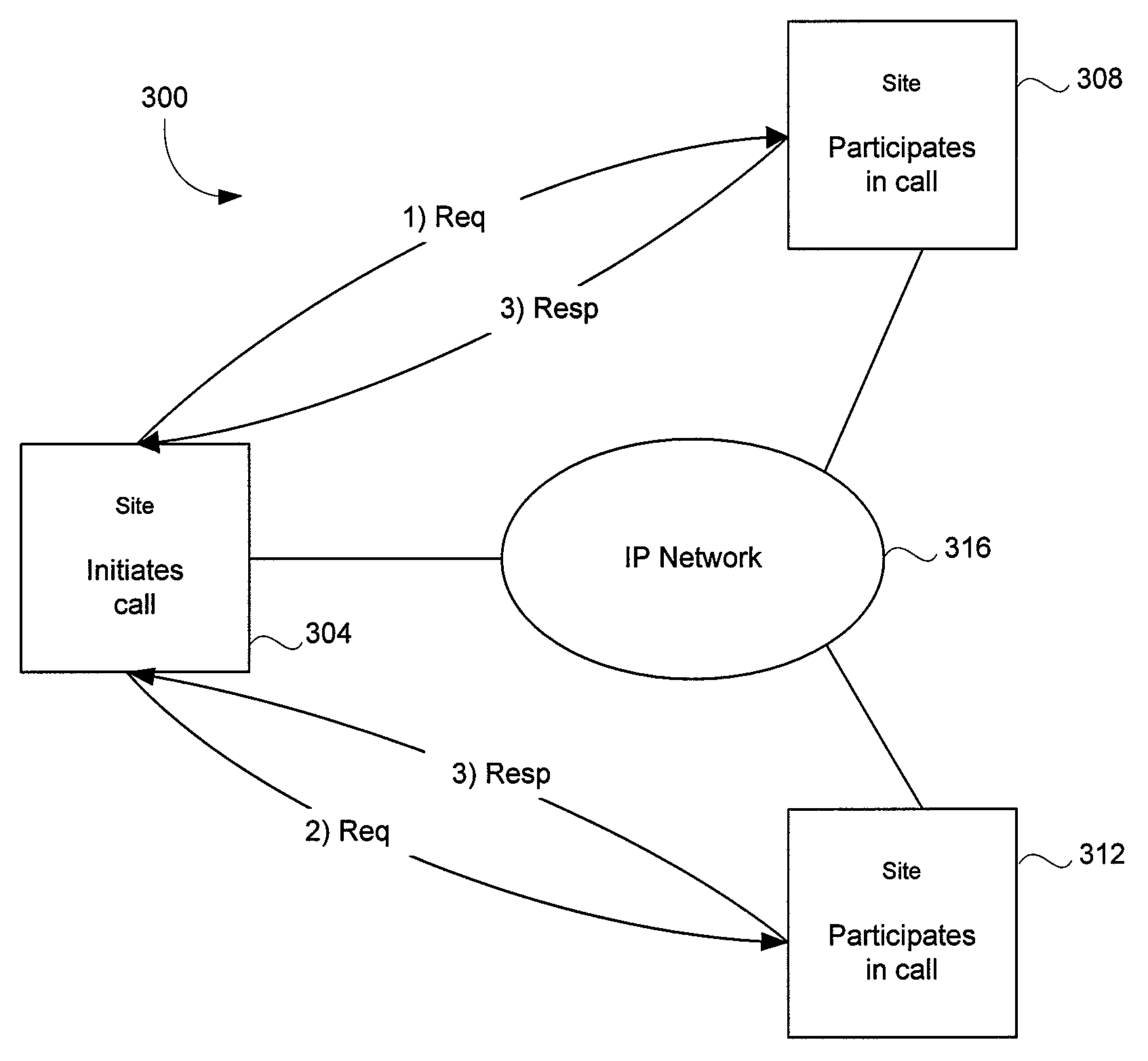
<figref idrefs="DRAWINGS">FIG. 5</figref> illustrates an LMR system <b>300</b> that includes sites <b>304</b>, <b>308</b> and <b>312</b> in accordance with an embodiment of the invention. The LMR system <b>300</b> does not require a bridge device for call setup or for voice traffic. The sites <b>304</b>, <b>308</b> and <b>312</b> are interconnected by a data network such as an IP network <b>316</b>. In one embodiment, each site may interface with the IP network <b>316</b> by a standard IP gateway router (not expressly shown in <figref idrefs="DRAWINGS">FIG. 5</figref>).
When a particular site is deployed in the system (e.g., system <b>300</b>), it broadcasts a message periodically that is received by the other sites in the system. The broadcast message indicates the newly-deployed site's interest in a particular call or a set of calls. Additionally the newly-deployed site receives a similar message from other sites that informs the newly-deployed site about the interest of the other sites in a particular call or a set of calls. Consequently, all sites in the system become aware of all other sites and the talk group these sites are interested in. As will be appreciated, this dynamic auto discovery of newly-deployed sites allows deployment of sites without informing or configuring the existing sites.
Consider, for example, a scenario where the site <b>304</b> desires to initiate a call to the other sites in the LMR system <b>300</b>. In other words, the site <b>304</b> wants to send voice messages to the sites <b>308</b> and <b>312</b>. Prior to sending a voice message, the site <b>304</b> needs to send a request message via standard IP multicasting to each of the sites <b>308</b> and <b>312</b> and wait for an acknowledgement message from the sites <b>308</b> and <b>312</b>. The request message asks if the site <b>304</b> may communicate with the sites <b>308</b> and <b>312</b>, and the acknowledgement message confirms that the sites <b>308</b> and <b>312</b> are each willing to communicate with the site <b>304</b>, thus essentially forming a talk group comprising the sites <b>304</b>, <b>308</b> and <b>312</b>.
In one embodiment, the request message includes the identification of the requesting site and the requested target group. Thus, the request message from the site <b>304</b> includes its own identification as well as the identification of the group that the site <b>304</b> is interested in. In one embodiment, the acknowledgement message from the sites <b>308</b> and <b>312</b> include their own identifications and an indication of their willingness to participate in the call.
Referring back to <figref idrefs="DRAWINGS">FIG. 5</figref>, it will be appreciated that in contrast to existing LMR systems, the call setup is performed without the assistance of a bridge device. Since the embodiment illustrated in <figref idrefs="DRAWINGS">FIG. 5</figref> does not require a bridge device, the hop count for the call setup is significantly reduced. Also, call setup latency is decreased because call control is distributed among the sites, thus reducing a single choke point. Furthermore, removal of the bridge device removes a single point of failure since control and bearer plane traffic need no longer go through a bridge device.
After the call setup is completed, a site proceeds to send voice messages to the other sites. <figref idrefs="DRAWINGS">FIG. 6</figref> illustrates a voice message originating from the site <b>304</b> being transmitted to the sites <b>308</b> and <b>312</b>. As discussed before, the sites <b>304</b>, <b>308</b> and <b>312</b> are interconnected by the IP network <b>316</b>. In one embodiment, a voice message originating from the site <b>304</b> is first packaged in standards based Real-Time Transport (RTP) packets.
In one embodiment, the voice message is sampled and encoded with a standard audio codec. The voice message samples are then packaged in RTP packets suitable for transport over the IP network <b>316</b>. The RTP packets are then sent across the network.
In one embodiment, a standard Internet feature known as multicasting is employed to simultaneously send the voice packets to the sites <b>308</b> and <b>312</b>. As will be understood by those skilled in the art, using multicasting, the same information can be sent simultaneously to many recipients using just one data stream. The multicast connection leverages the power of IP multicast to provide one-to-many, and by extension, a many-to-many communication mechanism. Thus, any site on the IP network <b>316</b> that is capable of listening or sending voice packets can participate in the talk group. The multicasting can be done by a standard IP gateway router on the IP network <b>316</b>. The voice packets are simultaneously received and processed by the sites <b>308</b> and <b>312</b>. Through the use of multicast, the bandwidth use for each site becomes uniform because the use of bandwidth by a particular site depends on the number of call the site is participating instead of the number sites in the system.
Once the site <b>304</b> completes transmitting the voice packets, the site <b>308</b> may desire to send voice packets to the sites <b>304</b> and <b>312</b>. As illustrated in <figref idrefs="DRAWINGS">FIG. 7</figref>, the site <b>308</b> sends a call request message to the sites <b>304</b> and <b>312</b>. Note that there is no need for a central controller or a bridge device, and the site initiating a call is responsible for the call setup. The sites <b>304</b> and <b>312</b> respond with call response message indicating that they are ready to receive the call. As illustrated in <figref idrefs="DRAWINGS">FIG. 8</figref>, once the call is set up, the site <b>308</b> sends the voice packets through standard IP multicasting to the sites <b>304</b> and <b>312</b>. As can be appreciated, the site willing to initiate a call is responsible for setting up the call without the need for a central bridge device or a central controller. As a result, failure at one site limits the failure to that site only and does not affect the operation and performance of the remaining sites.
By way of examples, but not limitations, various aspects of the invention, such as peer-to-peer communication and dynamic discovery have been described above in connection with the sites. It will be apparent, however, to those skilled in the art that the various aspects of the invention can be used in connection with radio frequency sub-systems (RFSS), transceivers, high level elements comprising a plurality of RFSS or other elements of a communication system. Also, by way of examples, but not limitations, various aspects of the invention have been described in connection with a land mobile radio system. It will be apparent to those skilled in the art that the various aspects of the invention can be used in connection with other types of communication systems (i.e., non-LMR-type communication system).
It will be appreciated by those skilled in the art that changes could be made to the embodiments described above without departing from the broad inventive concept thereof. It is understood, therefore, that this invention is not limited to the particular embodiments disclosed, but it is intended to cover modifications within the spirit and scope of the present invention as defined by the appended claims.
Contents6
9 sheets
Sheet 1 Sheet 2 Sheet 3 Sheet 4 Sheet 5 Sheet 6 Sheet 7 Sheet 8 Sheet 9
Every citation, both waysCites: the store holds 15 of 16
| Document | Relation | Office | Cited during |
|---|---|---|---|
| US11496212B2 | Cited by | United States of America | Applicant |
| US9774386B2 | Cited by | United States of America | Applicant |
| US11936466B2 | Cited by | United States of America | Applicant |
| US10461846B2 | Cited by | United States of America | Applicant |
| US10548025B2 | Cited by | United States of America | Applicant |
| US10003932B2 | Cited by | United States of America | Search report |
| US2017064520A1 | Cited by | United States of America | Pre-grant |
| US8483114B2 | Cited by | United States of America | Applicant |
| US9413689B1 | Cited by | United States of America | Applicant |
| US8694774B2 | Cited by | United States of America | Applicant |
| US10749737B2 | Cited by | United States of America | Applicant |
| US10880000B2 | Cited by | United States of America | Applicant |
| US9763260B2 | Cited by | United States of America | Applicant |
| US9860725B1 | Cited by | United States of America | Applicant |
| US10117111B2 | Cited by | United States of America | Applicant |
| US9516475B2 | Cited by | United States of America | Applicant |
| US10212026B2 | Cited by | United States of America | Applicant |
| US9800460B2 | Cited by | United States of America | Applicant |
| US9148421B2 | Cited by | United States of America | Applicant |
| US10791566B2 | Cited by | United States of America | Applicant |
| US10004082B2 | Cited by | United States of America | Applicant |
| US12316437B2 | Cited by | United States of America | Applicant |
| US2005180448A1 | Cites | United States of America | Search report |
| US2006262800A1 | Cites | United States of America | Search report |
| US2007104121A1 | Cites | United States of America | Search report |
| US2007242670A1 | Cites | United States of America | Applicant |
| US2007259692A1 | Cites | United States of America | Search report |
| US2008123650A1 | Cites | United States of America | Search report |
| US2008144644A1 | Cites | United States of America | Search report |
| US2009024845A1 | Cites | United States of America | Applicant |
| US5850444A | Cites | United States of America | Applicant |
| US6941457B1 | Cites | United States of America | Applicant |
| US7056217B1 | Cites | United States of America | Search report |
| US7221660B1 | Cites | United States of America | Applicant |
| US7636339B2 | Cites | United States of America | Search report |
| US7764633B2 | Cites | United States of America | Search report |
| US7929475B2 | Cites | United States of America | Applicant |
| Telecommunications Industry Association (TIA) with Electronic Industries Alliance (EIA), TIA/EIA Standard: Project 25-Trunking Control Channel Messages New Technology Standards Project Digital Radio Technical Standards (ANSI/TIA/EIA-102.AABC), May 2000, Telecommunications Industry Association (TIA), Arlington, VA (150 pages). | Non-patent | – | Applicant |
| Telecommunications Industry Association (TIA) with Electronic Industries Alliance (EIA), TIA/EIA Standard: Project 25-Trunking Control Channel Messages, Addendum 1, SNDCP Trunking Control Cannel Messages (ANSI/TIA/EIA-102.AABC-1), Sep. 2001, Telecommunications Industry Association (TIA), Arlington, VA (11 pages). | Non-patent | – | Applicant |
| Telecommunications Industry Association (TIA) with Electronic Industries Alliance (EIA), TIA Standard: Project 25-Trunking Control Channel Messages, Addendum 2-Multiband Operations, New Technology Standards Project Digital Radio Technical Standards (ANSI/TIA-102.AABC-2), Dec. 2002, Telecommunications Industry Association (TIA), Arlington, VA (39 pages). | Non-patent | – | Applicant |
| Telecommunications Industry Association (TIA) with Electronic Industries Alliance (EIA), TIA/EIA Telecommunications Systems Bulletin, APCO Project 25-Trunking Overview (TSB102.AABA), Apr. 1995, Telecommunications Industry Association (TIA), Arlington, VA (12 pages). | Non-patent | – | Applicant |
| Office Action dated Dec. 17, 2010 issued in U.S. Appl. No. 11/940,936 (12 pages). | Non-patent | – | Applicant |
| Final Office Action dated Jul. 1, 2011 issued in U.S. Appl. No. 11/940,936 (16 pages). | Non-patent | – | Applicant |
12 members in 1 office
Priority claims10
| Document | Office | Kind | Date |
|---|---|---|---|
| 95087007 | United States of America | P | |
| 95087007 | United States of America | P | |
| 96313107 | United States of America | P | |
| 96313107 | United States of America | P | |
| 93796307 | United States of America | A | |
| 60950870 | – | – | – |
| 60963131 | – | – | – |
| US20070937963 | – | – | – |
| US20070950870P | – | – | – |
| US20070963131P | – | – | – |
Members12
| Document | Office | Kind | |
|---|---|---|---|
| US2009024845A1 | United States of America | A1 | |
| US2010020735A1 | United States of America | A1 | |
| US8059574B2This record | United States of America | B2 | |
| US2012083307A1 | United States of America | A1 | |
| US8255684B2 | United States of America | B2 | |
| US2012331289A1 | United States of America | A1 | |
| US8483114B2 | United States of America | B2 | |
| US2013294323A1 | United States of America | A1 | |
| US8694774B2 | United States of America | B2 | |
| US2014195801A1 | United States of America | A1 | |
| US9148421B2 | United States of America | B2 | |
| US9516475B2 | United States of America | B2 |
52 transactions on the USPTO file
Allowed after 1 non-final rejection and 1 RCE.
- Non-final rejections
- 1
- Final rejections
- 0
- RCEs
- 1
- Appeals
- 0
Over time
Point at a mark for the transactionTransactions
| Event | Code | |
|---|---|---|
| Payment of Maintenance Fee, 12th Year, Large EntityM1553 | M1553 | |
| Payment of Maintenance Fee, 8th Year, Large EntityM1552 | M1552 | |
| Recordation of Patent Grant MailedPGM/ | PGM/ | |
| Patent Issue Date Used in PTA CalculationAllowedPTAC | PTAC | |
| Issue Notification MailedAllowedWPIR | WPIR | |
| Dispatch to FDCD1935 | D1935 | |
| Application Is Considered Ready for IssuePILS | PILS | |
| Supplemental Papers - Oath or DeclarationC600 | C600 | |
| Issue Fee Payment VerifiedN084 | N084 | |
| Issue Fee Payment ReceivedIFEE | IFEE | |
| Mail Miscellaneous Communication to ApplicantMM327 | MM327 | |
| Miscellaneous Communication to Applicant - No Action CountM327 | M327 | |
| Information Disclosure Statement consideredIDSC | IDSC | |
| Reference capture on IDSRCAP | RCAP | |
| Information Disclosure Statement (IDS) FiledM844 | M844 | |
| Information Disclosure Statement (IDS) FiledWIDS | WIDS | |
| Mail Notice of AllowanceAllowedMN/=. | MN/=. | |
| Notice of Allowance Data Verification CompletedAllowedN/=. | N/=. | |
| Disposal for a RCE / CPA / R129AbandonedABN9 | ABN9 | |
| Information Disclosure Statement consideredIDSC | IDSC | |
| Electronic Information Disclosure StatementEIDS. | EIDS. | |
| Request for Continued Examination (RCE)RCEX | RCEX | |
| Information Disclosure Statement (IDS) FiledWIDS | WIDS | |
| Workflow - Request for RCE - BeginBRCE | BRCE | |
| Mail Notice of AllowanceAllowedMN/=. | MN/=. | |
| Reference capture on IDSRCAP | RCAP | |
| Notice of Allowance Data Verification CompletedAllowedN/=. | N/=. | |
| Date Forwarded to ExaminerFWDX | FWDX | |
| Information Disclosure Statement consideredIDSC | IDSC | |
| Electronic Information Disclosure StatementEIDS. | EIDS. | |
| New or Additional Drawing FiledC614 | C614 | |
| Response after Non-Final ActionA... | A... | |
| Information Disclosure Statement (IDS) FiledWIDS | WIDS | |
| Mail Non-Final RejectionNon-final rejectionMCTNF | MCTNF | |
| Non-Final RejectionNon-final rejectionCTNF | CTNF | |
| Case Docketed to Examiner in GAUDOCK | DOCK | |
| Case Docketed to Examiner in GAUDOCK | DOCK | |
| Case Docketed to Examiner in GAUDOCK | DOCK | |
| PG-Pub Issue NotificationPG-ISSUE | PG-ISSUE | |
| Case Docketed to Examiner in GAUDOCK | DOCK | |
| Application Dispatched from OIPEOIPE | OIPE | |
| PG-Pub Notice of new or Revised projected publication datePG-PB-DT | PG-PB-DT | |
| Sent to Classification ContractorPGPC | PGPC | |
| Receipt of all Acknowledgement LettersL130 | L130 | |
| Receipt of Acknowledgment LetterL197 | L197 | |
| Waiting LR clearancePGPW | PGPW | |
| Filing ReceiptFLRCPT.O | FLRCPT.O | |
| Agency Referral Letter MailedML196 | ML196 | |
| Referred by L&R for Third-Level Security Review. Agency Referral Letter GeneratedL196 | L196 | |
| Referred to Level 2 (LARS) by OIPE CSRL198 | L198 | |
| IFW Scan & PACR Auto Security ReviewSCAN | SCAN | |
| Initial Exam Team nnIEXX | IEXX |
8 legal events, as the office reported them to INPADOC
Over the term
Point at a mark for the eventEvents
| Event | Code | |
|---|---|---|
| Maintenance fee paymentMAFP | MAFP | |
| Maintenance fee paymentMAFP | MAFP | |
| Fee paymentFPAY | FPAY | |
| AssignmentAS | AS | |
| AssignmentAS | AS | |
| Information on status: patent grantGrantedPATENTED CASESTCF | STCF | |
| AssignmentAS | AS | |
| AssignmentAS | AS |
Numbers
- Publication
- 08059574
- Publication, DOCDB
- 8059574
- Publication, EPODOC
- US8059574
- Application
- 11937963
- Application, DOCDB
- 93796307
- Application, EPODOC
- US20070937963
Titles
- English
- Method and system for peer-to-peer communication among sites
Patent term adjustment
- A delay
- +644 daysthe office missed an examination deadline
- B delay
- +205 dayspendency past three years
- Applicant delay
- −57 days
- Net adjustment
- 792 days
Classification
- CPC, 3
- H04W4/06
- H04W76/10
- H04W72/30
- IPC, 4
- H04J3 16
- H04H20 71
- H04J3 26
- H04W4 00
- USPC, 6
- 370312000
- 370261000
- 370263000
- 370329000
- 370432000
- 370437000