Method for fixing an amorphous type titanium peroxide layer on a substrate and method for preparing a viscous amorphous type titanium peroxide
Abstract
Fixing the viscous amorphous titanium peroxide to the substrate for use as a binder layer can eliminate the need for hydrophilization treatment with a surfactant or the like, even if the substrate has a water-repellent surface or is thermoplastic. Adhering fine particles of a photocatalytic semiconductor, dielectric ceramic material or conductive ceramic material to the viscous amorphous titanium peroxide layer as a binder layer in a uniformly dispersed state in the air can facilitate the formation of a thin layer of the photocatalytic semiconductor, dielectric or conductive ceramic material. have. In addition, the viscous amorphous titanium peroxide is fixed to the gas to form a titanium oxide layer having a photocatalytic function.
Term
Term ended
Expired 6 April 2018, 8.5 years ago.
- Priority
- Filed
- Granted
- Expired
- Today
11 claims: 7 independent, 4 dependent
- 1기체 (基體) 를 무정형 과산화티탄 졸로 코팅한 후, 코팅된 기체를 상온 내지 250 ℃ 미만의 온도에서 건조 및 소성하는 단계들을 포함하는, 무정형 과산화티탄 층을 기체에 고정시키는 방법.
- 2기체 표면을 계면활성제 등으로 친수성화 처리하지 않고, 기체를 점조성 무정형 과산화티탄으로 코팅한 후, 코팅된 기체를 상온 내지 250 ℃ 미만의 온도에서 건조, 소성하는 단계들을 포함하는, 무정형 과산화티탄 층을 기체에 고정시키는 방법.
- 3제 1 항 또는 제 2 항에 기재된 방법에 의해 얻어진 무정형 과산화티탄 층을 가진 기판.
- 4기체를 무정형 과산화티탄 졸로 코팅한 후, 코팅된 기체를 250 ℃ 이상의 온도에서 건조, 소성하는 단계들을 포함하는, 산화티탄 층을 기체에 고정시키는 방법.
- 5기체 표면을 계면활성제 등으로 친수성화 처리하지 않고, 기체를 점조성 무정형 과산화티탄으로 코팅한 후, 코팅된 기체를 250 ℃ 이상의 온도에서 건조, 소성하는 단계들을 포함하는, 산화티탄 층을 기체에 고정시키는 방법.
- 6제 4 항 또는 제 5 항에 기재된 방법에 의해 얻어진 산화티탄 층을 가진 기판.
- 7기체를 무정형 과산화티탄 졸로 코팅하여 무정형 과산화티탄 층을 형성시킨 후, 무정형 과산화티탄 층이 부착성을 지니고 있는 동안, 가스 중 균일하게 산란된 상태의, 광촉매 반도체, 유전체 세라믹 물질 또는 전도체 세라믹 물질의 미립자를 무정형 과산화티탄 층에 붙이는 단계들을 포함하는, 광촉매 반도체, 유전체 세라믹 물질 또는 전도체 세라믹 물질의 박층을 기체에 고정시키는 방법.
- 8기체 표면을 계면활성제 등으로 친수성화 처리하지 않고, 기체를 점조성 무정형 과산화티탄으로 코팅하여 무정형 과산화티탄 층을 형성시킨 후, 무정형 과산화티탄 층이 부착성을 지니고 있는 동안, 가스 중 균일하게 산란된 상태의 광촉매 반도체, 유전체 세라믹 물질 또는 전도체 세라믹 물질의 미립자를 무정형 과산화티탄 층에 붙이는 단계들을 포함하는, 광촉매 반도체, 유전체 세라믹 물질 또는 전도체 세라믹 물질의 박층을 기체에 고정시키는 방법.
- 9제 7 항 또는 제 8 항에 기재된 방법에 의해 얻어진, 기체, 기체에 형성된 무정형 과산화티탄 층, 및 무정형 과산화티탄 층에 형성된 광촉매 반도체, 유전체 세라믹 물질 또는 전도체 세라믹 물질의 박층을 함유하는 기판.
- 10사염화티탄 용액을 pH 2 내지 6 의 산성 영역에서 수산화암모늄 용액과 반응시키고, 수성 과산화수소를 침강된 밝은 청백색 오르토티탄산 수화물에 첨가하고, 저온에서 교반하며 반응을 진행시킨 후, 상온에서 경화시키는 단계들을 포함하는 점조성 무정형 과산화티탄의 제조 방법.
- 11제 10 항에 기재된 방법에 의해 제조된 점조성 무정형 과산화티탄.
Independent claims11
65 paragraphs, as filed
Method for fixing amorphous titanium peroxide layer to gas and manufacturing method for viscous amorphous titanium peroxide
The present invention relates to a method for coating a gas with amorphous titanium peroxide. More specifically, the present invention relates to a method for coating a gas having a water-repellent surface with a viscous amorphous titanium peroxide having excellent adhesion, and a photocatalytic semiconductor in which titanium peroxide is used as a binder, or a thin layer of dielectric-conductor ceramic material. It's about the board.
Until now, as methods for coating a substrate with a photocatalytic semiconductor and dielectric-conductor ceramic material, there have been techniques such as sputtering, vapor deposition, and high-temperature sintering using a transfer printing film.
As a method of fixing a photocatalytic semiconductor, a method including thermal processing after adding various organic binders and silica gel (Japanese Patent Application Laid-Open No. 7-171408), glaze, inorganic glass, thermoplastic resin, solder, etc. are used as binders (Japanese Patent Application Laid-Open No. 7-232080), and SnO as a coagulant<sub>2</sub> A method (Japanese Patent Laid-Open No. 7-155598) comprising fixing a photocatalytic semiconductor to a substrate using
However, the sputtering method and the deposition method require a high cost for the coating apparatus, and the thermal stress applied to the substrate or the like must be considered in the transfer printing method, and the selection of materials is limited.
Also in the method of fixing the photocatalytic semiconductor and dielectric-conductor ceramic material using a binder, if the surface of the substrate is water-repellent, it is necessary to pre-treat the surface with a surfactant and a caustic soda solution. In addition, since particles of the photocatalytic semiconductor and dielectric-conductor ceramic material are embedded in the binder, it is difficult to sufficiently perform the oxidation-reduction function and the dielectric-conduction function.
Japanese Patent Application Laid-Open No. 7-286114 mentions a coating liquid for film formation containing peroxopolytitanic acid, a polymer of peroxotitanic acid, as titanium peroxide. Here, the peroxopolytitanic acid is obtained by adding hydrogen peroxide to a gel or sol of titanium oxide hydrate, or a mixture thereof, and then treating at room temperature or heating at 90° C. or lower (in Example 1, heating at 80° C. for 1 hour) It has also been disclosed that can be obtained.
It is also known that a viscous or jelly-like product can be obtained by condensing an aqueous titanium peroxide solution (Japanese Patent Application Laid-Open No. 62-252319). The document describes that this product is obtained as a yellow film by adding aqueous hydrogen peroxide to fine powder of titanium hydride to prepare a yellow aqueous titanium peroxide solution, which is then left at room temperature to slowly evaporate water and condense the solute.
However, the peroxopolytitanic acid described in Japanese Patent Application Laid-Open No. 7-286114 can be obtained by adding hydrogen peroxide to a gel or sol of titanium oxide hydrate or a mixed dispersion thereof and then treating at room temperature or heating at 90° C. or lower. Therefore, this peroxopolytitanic acid is the "viscous amorphous titanium peroxide" The manufacturing method is different from Moreover, their physical properties, especially viscosity, are greatly different from each other, and conventional products do not function well as binders, making it difficult to form thin layers of photocatalytic semiconductor and dielectric-conductor ceramic materials.
In addition, the viscous or jelly-like product obtained by condensing the aqueous titanium peroxide solution described in Japanese Patent Application Laid-Open No. 62-252319 can be obtained by adding aqueous hydrogen peroxide to fine powder of titanium hydride to prepare a yellow titanium peroxide solution, It can be obtained as a yellow film by evaporating water from this yellow aqueous titanium peroxide solution. Therefore, this conventional product is the "viscous amorphous titanium peroxide" The manufacturing method is different from Moreover, their physical properties are different from each other. As described in the above Japanese Patent Application Laid-Open No. 7-286114 (Section 2), the conventional product is stable only when its concentration is very low, and there is a problem that it cannot exist in a stable state for a long time. Moreover, thin layers formed from conventional products in the gas phase are easily cracked or peeled off, and the thin layers become porous after high temperature firing.
<u>Summary of the invention</u>
An object of the present invention is to provide a coating material that is not limited by the thermoplasticity of the substrate, which does not require hydrophilization treatment by use of a surfactant or the like even when the surface of the substrate is water repellent or when the substrate is thermoplastic. .
Another object of the present invention is to provide a method for forming a film in which a photocatalyst semiconductor or dielectric-conductor ceramic material can be easily formed, the thickness can be easily controlled, and a photocatalyst or the like is not covered by a binder.
The present inventors have made intensive efforts to achieve the above objects, and as a result, by fixing viscous amorphous titanium peroxide or the like to the gas as a binder layer, or by uniformly scattering fine particles of a photocatalytic semiconductor, dielectric ceramic material or conductor ceramic material in the gas The present invention was completed by attaching the viscous amorphous titanium peroxide layer to the viscous amorphous titanium peroxide layer, or by fixing the viscous amorphous titanium peroxide to a gas and then heating and firing to form a titanium oxide layer having photocatalytic activity.
That is, in the present invention, the gas is coated with viscous amorphous titanium peroxide without coating the gas with an amorphous titanium peroxide sol or the surface of the gas is hydrophilized with a surfactant, etc., and then drying at a temperature from room temperature to less than 250 ° C. a method of fixing an amorphous titanium peroxide layer to a gas comprising the steps of calcining; and a substrate having an amorphous titanium peroxide layer obtained by this method.
In addition, the present invention comprises the steps of coating the gas with the viscous amorphous titanium peroxide without coating the gas with an amorphous titanium peroxide sol or hydrophilizing the surface of the gas with a surfactant, etc., and then drying and calcining at a temperature of 250 ° C. or higher. a method of fixing a titanium oxide layer to a gas, comprising: and a substrate having a titanium oxide layer obtained by this method.
The present invention also provides an amorphous titanium peroxide layer by coating the gas with an amorphous titanium peroxide sol or coating the gas with a viscous amorphous titanium peroxide without hydrophilizing the surface of the gas with a surfactant or the like to form an amorphous titanium peroxide layer. A photocatalytic semiconductor, dielectric ceramic material or conductor ceramic comprising the steps of attaching to the layer of amorphous titanium peroxide particulates of the photocatalytic semiconductor, dielectric ceramic material or conductor ceramic material, in a uniformly scattered state in a gas, while retaining this adhesion. a method of fixing a thin layer of material to a substrate; and a substrate, obtainable by the method, comprising a gas, an amorphous titanium peroxide layer formed on the substrate, and a thin layer of a photocatalytic semiconductor, dielectric ceramic material or conductor ceramic material formed on the amorphous titanium peroxide layer.
The present invention also relates to reacting a titanium tetrachloride solution with an ammonium hydroxide solution in an acidic region of pH 2 to 6, washing the precipitated light blue-white orthotitanic acid hydrate, and adjusting the solid concentration to 0.2 to 0.6 wt% to dilute or concentrate the solution and adding aqueous hydrogen peroxide to the aqueous solution, proceeding the reaction with stirring at a low temperature, preferably 15° C. or less, particularly preferably about 5 to 8° C., and then curing at room temperature. a method for producing titanium peroxide; and viscous amorphous titanium peroxide produced by the above method.
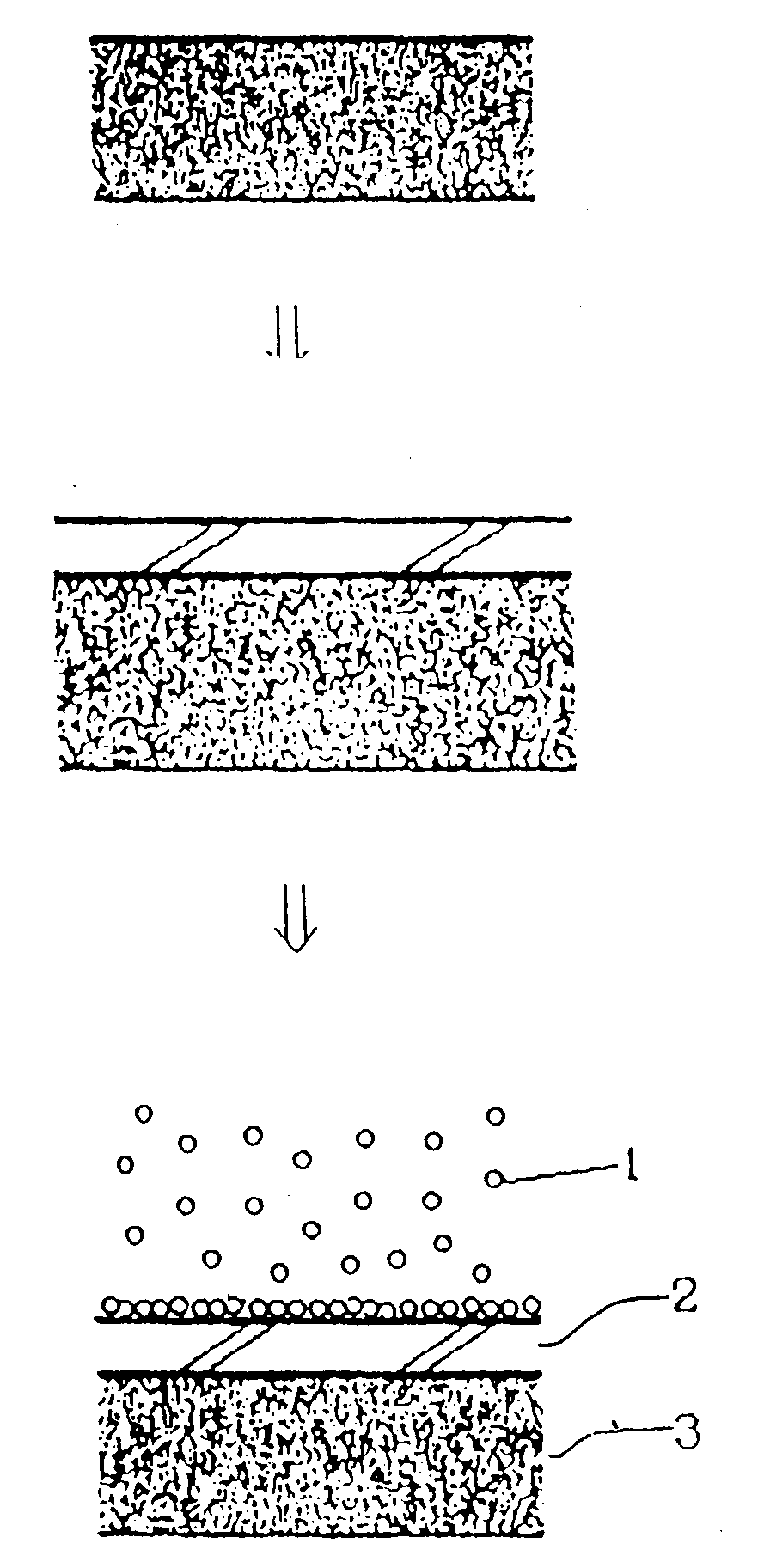
BRIEF DESCRIPTION OF THE DRAWINGS Fig. 1 is a diagram showing a method for fixing a gas to a thin layer of a photocatalytic semiconductor, a dielectric ceramic material or a conductive ceramic material.
"Amorphous titanium peroxide sol" of the present invention; can be prepared, for example, as follows. An aqueous ammonium or alkali hydroxide, for example sodium hydroxide, is mixed with a titanium salt, for example titanium tetrachloride TiCl<sub>4</sub> is added to the aqueous solution, and the reaction proceeds while maintaining the pH of the reaction solution at 6 to 7. Produced bright blue-white amorphous amorphous titanium hydroxide Ti(OH)<sub>4</sub> (Orthotitanic acid H<sub>4</sub>TiO<sub>4</sub> after washing and separation, treatment with aqueous hydrogen peroxide to obtain an amorphous titanium peroxide sol.
The "amorphous titanium peroxide sol" of the present invention thus obtained has a pH of 6 to 7, a particle size of 8 to 20 nm, an appearance of a transparent yellow solution, and is stable even when stored for a long time at room temperature. Also, the sol concentration is usually adjusted to 1.4 to 6% by weight, but this concentration may be adjusted as necessary. If a lower concentration is used, it can be diluted with distilled water or the like.
In addition, since the amorphous titanium peroxide sol is amorphous at room temperature and does not crystallize into anatase-type titanium oxide, it has excellent adhesion and high film-forming properties. It is also possible to form a uniformly flat thin film therefrom, the dry film of which is insoluble in water.
On the other hand, when the amorphous titanium peroxide sol is heated at a temperature of 100° C. or higher for several hours, an anatase-type titanium oxide sol is obtained. Iz-type titanium oxide is obtained.
"viscous amorphous titanium peroxide" referred to in the present invention; can be prepared, for example, as follows. An ammonium solution or an alkali hydroxide, for example sodium hydroxide, is mixed with a titanium salt, for example titanium tetrachloride TiCl<sub>4</sub> is added to the aqueous solution, and the reaction proceeds while maintaining the pH of the reaction solution in an acidic region, preferably 2 to 6, particularly 2. Precipitated light blue-white amorphous amorphous titanium hydroxide Ti(OH)<sub>4</sub> (Orthotitanic acid H<sub>4</sub>TiO<sub>4 </sub> after washing and separating), treated with a solution with hydrogen peroxide and stirred at a low temperature, preferably 15 ° C or less, particularly preferably 5 to 8 ° C. .
The "viscous amorphous titanium peroxide" of the present invention thus obtained has a pH of 2 to 4 and a particle size of about 8 to 20 nm. That is, it has various viscosities and very strong adhesion, and is stable even when stored at room temperature for a long time. Also, the solid concentration is generally 0.2 to 0.6% by weight, preferably 0.3% by weight, but this concentration may be adjusted as necessary.
"Viscous amorphous titanium peroxide" of the present invention having various viscosities; A silver titanium salt solution such as titanium tetrachloride TiCl<sub>4</sub> Obtained by changing the pH to an acidic region, preferably 2 to 6, in the reaction of an alkali hydroxide, for example aqueous ammonium or sodium hydroxide, or by varying the solids concentration in the range of 0.2 to 0.6% by weight during the preparation can get It can be used for various purposes depending on the viscosity, but in order to form a thin film having a uniform thickness, it is preferable that the product has a viscosity that is uniform and can be in a semi-jelly state.
In addition, when the pH of the reaction exceeds 6, a problem of changing into an amorphous titanium peroxide sol having a low viscosity may occur. It is necessary to carry out a chemical treatment, and if the pH of the reaction is less than 2, the amount of precipitation of orthotitanic acid is extremely small.
When the solid concentration exceeds 0.6% by weight, there is a problem that the compound changes to a non-uniform semi-jelly state, so that it is difficult to form a thin layer having the same thickness, while when the solid concentration is less than 0.2% by weight, gas There is a problem in that a hydrophilic treatment using a surfactant or the like is required when the surface is coated.
Therefore, the viscous amorphous titanium peroxide of the present invention is obtained as described above as a new type of yellow transparent viscous material, is in an amorphous state at room temperature, does not crystallize into an anatized titanium oxide, It has very good viscosity and adhesion. Furthermore, the viscous amorphous titanium peroxide of the present invention has excellent film-forming ability and easily forms a uniform and flat thin layer. Its dry film is insoluble in water.
In addition, when the viscous amorphous titanium peroxide is coated on a substrate, dried at room temperature and calcined at a temperature of 250° C. or lower, it forms an amorphous titanium peroxide layer having excellent adhesion. And when heated, dried, and fired at a temperature of 250 to 940 ° C, an anatase-type titanium oxide layer is formed, while when heated at a temperature of 940 ° C or higher, a rutile-type titanium oxide is formed and actually a photocatalyst lose activity.
In the present invention, inorganic materials such as ceramic materials and glass, organic materials such as plastics, rubber, and wood, and metallic materials such as aluminum and steel are "gas" can be used as Of these, organic polymer resin materials such as acrylonitrile resin, vinyl chloride resin, polycarbonate resin, methyl methacrylate (acrylic resin), polyester resin, and polyurethane resin exhibit excellent effects.
The dimensions and shape of the gas are not critical. Therefore, the gas may be in the form of a film, honeycomb, fiber, filter paper, bead or foam, or a combination thereof. Also, when the gas is UV-transmissive, its inner surface can be used, and a painted molded article can also be used.
Known methods such as, for example, dipping and spraying can be used to coat the gas with the amorphous titanium peroxide sol and the viscous amorphous titanium peroxide.
After coating the gas by application or spraying as described above, it can be dried, calcined and solidified at a temperature of less than 250° C. to prepare the gas having the aforementioned amorphous titanium peroxide layer of the present invention.
Furthermore, it is also possible to prepare a supported gas in which the anatized titanium oxide layer is solidified and supported by sintering at a temperature of about 250° C. to 400° C. after coating. Since the gas thus obtained has photocatalytic properties, an organic polymer resin in which the gas is easily decomposed by the photocatalyst, for example, polytetrafluoroethylene (PTFE), a high-performance plastic, polyamideimide (PAI), or polyimide, which is a super heat-resistant plastic When made of (PI), the photocatalytic ability of titanium oxide is lowered by sodium ions, by washing the surface of the resin with a material having sodium ions such as sodium hydroxide prior to use. It is desirable to make the raw material present.
A coating composition comprising amorphous titanium peroxide sol or viscous amorphous titanium peroxide can form a layer of a desired thickness by a single coating. In addition, the thickness of the thin layer of titanium peroxide formed by this coating or the titanium oxide layer obtained by heating and firing at a temperature of 250 ° C. or higher is determined by controlling the solid concentration of titanium peroxide in the viscous amorphous titanium peroxide (weight %), and It can be adjusted by adjusting the viscosity and thickness of the coating before the drying step. Also, the coating step can be repeated as needed.
The gas having the above-described amorphous titanium peroxide layer has excellent weather resistance, protects a gas made of an organic polymer material, etc. from UV rays, and when laminated with a photocatalytic semiconductor, a gas made of an organic polymer material that is easily decomposed by photocatalysis can protect
"Photocatalytic semiconductor" of the present invention; As an example of TiO<sub>2</sub>, ZnO, SrTiO<sub>3</sub>, CdS, CdO, CaP, InP, In<sub>2</sub>O<sub>3</sub>, CaAs, BaTiO<sub>3</sub>, K<sub>2</sub>NbO<sub>3</sub>, Fe<sub>2</sub>O<sub>3</sub>, Ta<sub>2</sub>O<sub>5</sub>, WO<sub>3</sub>, SaO<sub>2</sub>, Bi<sub>2</sub>O<sub>3</sub>, NiO, Cu<sub>2</sub>O, SiC, SiO<sub>2</sub>, MoS<sub>2</sub>, MoS<sub>3</sub>, InPb, RuO<sub>2</sub> and CeO<sub>2 </sub>is included Among them, titanium oxide TiO<sub>2</sub> Preferably, the photocatalytic semiconductor should be used in the form of fine particles or fine powders having a diameter of 0.001 to 20 μm.
Also as additives, Pt, Ag, Rh, RuO<sub>2</sub>, Nb, Cu, Sn, and NiO can be used to supplement the photocatalytic function.
"Dielectric ceramic" of the present invention The material is SiO<sub>2</sub>, Ta<sub>2</sub>O<sub>5</sub>, TiO<sub>2</sub>, SrTiO<sub>3</sub>, BaTiO<sub>3</sub> and Pb-based perovskite compounds.
In addition, "Conductor Ceramic" Materials include alloys of gaseous metals such as copper, nickel, chromium, titanium and aluminum.
These ceramic materials should be used in the form of fine particles or fine powders with a diameter of 0.001 to 20 μm. These fine particles or powders can be uniformly dispersed in the air.
In the present invention, "a method of fixing a gas to a layer of a photocatalytic semiconductor, a dielectric ceramic material or a conductive ceramic material" will be described with reference to FIG. 1 . In one embodiment of the method, gas 3 made hydrophilic using a surfactant or the like is coated with an amorphous titanium peroxide sol, or gas 3 is directly coated with viscous amorphous titanium peroxide without hydrophilization treatment to form an amorphous titanium peroxide layer form; While the amorphous titanium peroxide layer 2 has adhesion (generally within 1 to 10 minutes at room temperature after coating), in a state uniformly scattered in gas by use of a closed-atmospheric pressure vessel, the photocatalytic semiconductor, dielectric ceramic material or particulate 1 of the conductive ceramic material is attached to the amorphous titanium peroxide layer by natural adhesion or airflow pressure adhesion; Excess particulates are removed. Also, the adhesion between the layers can be greatly increased by fixing the amorphous titanium peroxide layer with a thin layer of a photocatalytic semiconductor, dielectric ceramic material or conductive ceramic material and then pressing. In this way, a uniform thin layer is formed.
It is possible to reduce the volume and weight of an electric device or the like by forming a thin layer made of a photocatalytic semiconductor, a dielectric ceramic material, or a conductive ceramic material. And, with the help of a laminated thin film of a photocatalytic semiconductor, a gas having a photocatalytic function reduces the functional degradation caused by mutual interference of photocatalytic semiconductor surface particles when electrons move during an oxidation-reduction reaction, and economic loss due to the formation of a thick film has a reducing effect.
Next, the present invention will be described in more detail by way of Examples. The scope of the present invention will not be limited by the examples.
<u>Reference Example 1</u> (Preparation of amorphous titanium peroxide sol)
100 mL of 50% Titanium Tetrachloride TiCl<sub>4</sub> The solution (manufactured by SUMITOMO SITX CO.) was diluted 70-fold with distilled water, and 25% ammonium hydroxide NH<sub>4</sub>The OH solution (manufactured by TAKASUGI PURECHEMICAL INDUSTRY Ltd.) is diluted 10-fold with distilled water, and then mixed with each other to adjust the pH to 6.5 to 6.8, and the reaction proceeds. After the reaction was completed, it was left for a while, and the supernatant was removed. Residual Ti(OH)<sub>4</sub> To the gel, distilled water in an amount equivalent to about 4 times the amount of the gel is added, and the solution is sufficiently stirred and allowed to stand. Then, after washing repeatedly until the conductivity becomes 2 to 10 μS in the conduction system, the supernatant is removed to leave only a precipitate. In some cases, concentration treatment is performed using a concentrator. Then divide 210 mL of 35% aqueous hydrogen peroxide solution into 2 parts, and divide them into 3600 mL of light bluish-white Ti(OH) each every 30 minutes.<sub>4</sub> After addition to the solution, the solution is stirred at a temperature of about 5°C overnight to obtain about 3800 mL of a yellow transparent amorphous titanium peroxide sol.
Since substances insoluble in water, such as metatitanic acid, are precipitated unless the generation of heat is limited, it is preferable that the generation of heat is limited in all of the above steps.
<u>Example 1</u> (Production of viscous amorphous titanium peroxide)
100 mL of 50% Titanium Tetrachloride TiCl<sub>4</sub> The solution (manufactured by SUMITOMO SITX CO.) was diluted 70-fold with distilled water, and 25% ammonium hydroxide NH<sub>4</sub>The OH solution (manufactured by TAKASUGI PURECHEMICAL INDUSTRY Ltd.) was diluted 10-fold with distilled water, and then mixed with each other to adjust the pH to 2.0 and the reaction proceeds. After the reaction was completed, it was left for a while, and the supernatant was removed. Residual Ti(OH)<sub>4</sub> To the gel, distilled water in an amount equivalent to about 4 times the amount of the gel is added, and the solution is sufficiently stirred and allowed to stand. Then, after washing repeatedly until the conductivity becomes 2 to 10 μS in the conduction system, the supernatant is removed to leave only a precipitate. In some cases, concentration treatment is performed using a concentrator. Then, divide 200 mL of 35% aqueous hydrogen peroxide solution into 2 parts, and divide them into 2550 mL of light bluish-white Ti(OH) each every 30 minutes.<sub>4</sub> After adding the solution, the solution is stirred at a temperature of about 5°C overnight and cured at room temperature for 7 to 10 days to obtain about 2800 mL of a yellow transparent jelly amorphous titanium peroxide sol.
<u>Example 2</u> (Preparation of viscous amorphous titanium peroxide with various viscosities)
The same procedure as in Example 1 was performed except that the pH of the reaction solution was maintained at 3,4 and 5, and as the pH increased, it was harder than the viscous amorphous titanium peroxide obtained in Example 1 and the solid concentration also increased. A jelly product is obtained.
<u>Example 3</u>
A plate of acrylic resin, a plate of methacrylic resin and a plate of methyl methacrylate resin are used as substrates. After the surface of the resin plate was washed and dried, it was coated by dipping with 0.3 wt % of the viscous titanium peroxide obtained in Example 1. Anatase-type titanium peroxide powder ST-01 (manufactured by ISHIHARA SANGYOU KAISYA Ltd.) was attached to the plate while the coated surface was wet, while uniformly floating in the container, dried at 50° C., and then, while applying pressure A photocatalytic semiconductor gas is prepared by heating and washing at 200°C.
Unlike the conventional gas, the gas has no risk of peeling off because the photocatalyst layer is a thin film, and has an excellent function of decomposing organic compounds.
<u>Example 4</u>
Tiles coated with semi-porceline (manufactured by INAX Co., Ltd.: 100 x 100 x 5 mm), steel plates coated with ceramic (210 x 296 x 0.8 mm) and keramit plates (coated type: 157 x 223 x 4 mm) was used as a gas. After washing the surface of the gas, it is dried at room temperature and coated with a squeezed plate composed of 0.3 wt% of the viscous titanium peroxide obtained in Example 1. Semi-porceline coated tiles, ceramic coated steel plates and keramites plates are coated with plates weighing 0.1 to 0.2 g/sheet, 2.0 to 2.3 g/sheet and 1.5 to 1.8 g/sheet, respectively. Anatase Titanium Peroxide Powder ST-01 (ISHIHARA SANGYOU KAISYA Ltd. Preparation) of 0.01 to 0.02 g/sheet on a tile coated with semi-porceline, 0.1 to 0.2 on a steel plate coated with ceramic, for 1 minute while the coated surface is wet while uniformly suspended in a container g/sheet and keramit plate in an amount of 0.1 g/sheet, dried at 50° C., and heated at 500° C. to prepare a photocatalyst semiconductor substrate.
The substrate thus obtained is very good in that it is easily processed and has high adhesion.
<u>Example 5</u>
A polyester-rayon-based coarse fiber fabric (300 x 300 mm) was used as a substrate. After washing this fabric with water and drying it, it was coated by dipping with 0.3% by weight of the viscous titanium peroxide obtained in Example 1. Next, anatase-type titanium peroxide powder ST-01 (manufactured by ISHIHARA SANGYOU KAISYA Ltd.) is adhered to the fabric in a state uniformly dispersed in the container, dried at 50°C, and fixed. Then, pressure is applied to the dried fabric with an iron at 120° C. to 150° C. to increase the interlayer adhesion.
The gas is easily processed, has high adhesion, and is particularly excellent in that it has high decomposition power.
<u>Example 6</u>
The decomposition power of organic materials was tested as follows. Paraglass (methacrylic resin manufactured by KURARAY Co., Ltd.: 210 x 296 mm) was used as a substrate. This was coated by dipping with 0.3 wt% of the viscous titanium peroxide obtained in Example 1. Next, anatase-type titanium peroxide powder ST-01 (manufactured by ISHIHARA SANGYOU KAISYA Ltd.) is adhered to the resin in a uniformly sorted state in the container, dried at 50°C, and fixed. Then, pressure is applied to the dried resin with an iron at 120° C. to 150° C. to increase interlayer adhesion, thereby obtaining a photocatalyst supported photocatalyst material. After that, the photocatalyst material is placed in a test container, and a dark-colored solution of the organic material to be decomposed is placed in the container so that the depth of the solution is 1 cm. Since the coloring solution was prepared by diluting pollucite red PM-R (manufactured by SUMIKA COLOR Co., Ltd.), which is a water-dispersion compound of monoazored (monoazored; red liquid state), its volume is 30 times am. Next, the container is sealed with a floating glass to prevent evaporation of the coloring solution. On a test vessel 5 cm away from the gas by 9.5 cm, two ultraviolet emitters (20 w of blue fluorescent light) were installed at an interval of 13 cm to radiate to the photocatalytic material. After that, the moment the color of the coloring solution disappears is considered to be the end of the decomposition of organic matter. As a result, 2 days after starting the test, the color completely disappeared, and it was proved that it had an excellent function as a photocatalyst.
<u>Industrial Applications</u>
In the present invention, an amorphous titanium peroxide layer is formed, so that the gas does not need to be hydrophilized with a surfactant, etc., and excellent adhesion makes it possible to fix a thin layer of a photocatalytic semiconductor, a dielectric ceramic material or a conductive ceramic material, and the obtained thin layer is It can be used to reduce the volume and weight of equipment, etc. And, with the help of a stacked thin film of a photocatalytic semiconductor, a gas having a photocatalytic function reduces the functional degradation caused by mutual interference of photocatalytic semiconductor surface particles when electrons move during an oxidation-reduction reaction, and economic loss due to the formation of a thick film has a reducing effect.
1 sheet
Sheet 1
15 members in 7 offices
Priority claims3
| Document | Office | Kind | Date |
|---|---|---|---|
| 96207049 | Japan | – | |
| 20704996 | Japan | A | |
| 9702677 | Japan | W |
Members15
| Document | Office | Kind | |
|---|---|---|---|
| CA2233876A1 | Canada | A1 | |
| WO9805589A1 | World Intellectual Property Organization (WIPO) | A1 | |
| JPH1053437A | Japan | A | |
| EP0854112A1 | European Patent Office (EPO) | A1 | |
| EP0854112A4 | European Patent Office (EPO) | A4 | |
| TW349981B | Taiwan Province of China | B | |
| KR19990064064A | Republic of Korea | A | |
| US6235401B1 | United States of America | B1 | |
| US2001019776A1 | United States of America | A1 | |
| US6344277B1 | United States of America | B1 | |
| US6344278B1 | United States of America | B1 | |
| US6379811B2 | United States of America | B2 | |
| KR100356933B1This record | Republic of Korea | B1 | |
| CA2233876C | Canada | C | |
| JP3863599B2 | Japan | B2 |
9 legal events, as the office reported them to INPADOC
Over the term
Point at a mark for the eventEvents
| Event | Code | |
|---|---|---|
| Lapse due to unpaid annual feeLapsedLAPS | LAPS | |
| Annual fee paymentFPAY | FPAY | |
| Annual fee paymentFPAY | FPAY | |
| Written decision to grantGRNT | GRNT | |
| Decision to grant or registration of patent rightE701 | E701 | |
| Notification of change of applicantN231 | N231 | |
| Notification of change of applicantN231 | N231 | |
| Notification of reason for refusalE902 | E902 | |
| Request for examinationA201 | A201 |
Numbers
- Publication
- 10-0356933
- Application
- 100702543
Titles4
- Korean
- 무정형과산화티탄층의기체에의고정방법및점조성무정형과산화티탄의제조방법
- English
- Method for fixing amorphous titanium peroxide layer to gas and manufacturing method for viscous amorphous titanium peroxide
- Unlabeled
- 무정형 과산화티탄층의 기체에의 고정방법 및 점조성 무정형 과산화티탄의 제조방법{METHOD FOR FIXING AN AMORPHOUS TYPE TITANIUM PEROXIDE LAYER ON A SUBSTRATE AND METHOD FOR PREPARING A VISCOUS AMORPHOUS TYPE TITANIUM PEROXIDE}
- Unlabeled
- Method for fixing amorphous titanium peroxide layer to gas and manufacturing method for viscous amorphous titanium peroxide
Classification
- CPC, 34
- C23C26/02
- C01B25/047
- B01J21/063
- B01J37/0215
- B01J37/0244
- C01B15/047
- C03C17/007
- C03C17/256
- C03C2217/212
- C03C2217/42
- C03C2217/71
- C03C2218/11
- C03C2218/113
- C04B41/009
- C04B41/5041
- C04B41/52
- C04B41/87
- C04B41/89
- C04B2111/00827
- C08J7/06
- C09D1/00
- C23C2/04
- C23C18/1216
- C23C18/1295
- C23C26/00
- C23C4/123
- C23C18/1233
- C23C18/1254
- Y10T428/24917
- C08J7/043
- C08J7/044
- B01J35/30
- B01J35/39
- B01J35/80
- IPC, 23
- B01J21 06
- B01J35 30
- B01J35 80
- B01J37 02
- B05D3 02
- C01B15 047
- C01G23 04
- C03C17 00
- C03C17 25
- C04B41 50
- C04B41 52
- C04B41 87
- C04B41 89
- C08J7 043
- C08J7 044
- C08J7 06
- C09D1 00
- C23C2 04
- C23C4 12
- C23C18 12
- C23C26 00
- C23C26 02
- H10P14 22