High temperature stable anatase phase titanium dioxide
Abstract
A process for synthesising visible light active high temperature stable anatase phase undoped titanium dioxide photocatalyst comprising the step of reacting hydrated titanium dioxide with hydrogen peroxide in an aqueous solution to form a sol. The titanium dioxide may be anatase stable to at least 900 °C. The titanium dioxide may be anatase stable to about 1000 °C. A visible light active dopant free anatase phase titanium dioxide that is stable up to about 900 °C such as up to about 1000°C is also described.
Term
No projected expiry on record.
- Priority and filed
- Published
- Today
26 claims: 14 independent, 12 dependent
- 1Claims 1. A process for synthesising visible light active high temperature stable anatase phase undoped titanium dioxide photocatalyst comprising the step of reacting hydrated titanium dioxide with hydrogen peroxide in an aqueous solution to form a sol.
- 13A visible light active dopant free anatase phase titanium dioxide that is stable up to about 900 0 C.
- 16A visible light active dopant free anatase phase titanium dioxide that is stable up to about 1000 0 C.
Independent claims14
124 paragraphs, as filed
0001"High temperature stable anatase phase titanium dioxide"
0002Introduction
0003The invention relates to a process for synthesising a high temperature stable titanium dioxide photocatalyst. The invention further relates to a high temperature stable anatase phase titanium dioxide and uses thereof.
0004Titanium dioxide photocatalyst exist in three phases: anatase, rutile and brookite. Among the three polymorphs, anatase exhibits highest photocatalytic activity. On heating, anatase and brookite irreversibly transform to the thermodynamically more stable rutile phase. Anatase to rutile transformation usually takes place at temperatures in the range of 500 - 700°C. Most of the ceramic processing technologies involve high temperature treatment and under these conditions anatase phase titanium dioxide transforms into the less photoactive rutile phase. Doping titanium dioxide with metals and non-metals stabilizes the anatase phase at higher temperatures, however the addition of dopants leads to the formation of secondary phases which have decreased photocatalytic activity.
0005There is a need for a high temperature stable anatase phase titanium dioxide photocatalyst with improved photocatalytic activity.
0006Statements of Invention
0007According to the present invention there is provided a process for synthesising visible light active high temperature stable anatase phase undoped titanium dioxide photocatalyst comprising the step of reacting hydrated titanium dioxide with hydrogen peroxide in an aqueous solution to form a sol.
0008The titanium dioxide may be anatase stable to at least 900°C. The titanium dioxide may be anatase stable to about 1000°C. The molar ratio of titanium dioxide to hydrogen peroxide may be about 1 :16. The process may be performed at a temperature between about -20 and about 100°C. The process may be performed at about room temperature. The process may be performed at a pH of between about 5 to about 8. The process may be performed at a pH of about 7. The process may further comprise the step of heating the sol to form a gel. The sol may be heated to a temperature of up to about 1000°C. The process may further comprise the step of drying the gel to form a powder. The gel may be dried at a temperature of about 100°C. The invention also provides a visible light active dopant free anatase phase titanium dioxide that is stable up to about 900°C, the titanium dioxide may be 100% anatase phase. The titanium dioxide may have a band gap of about 2.82 eV.
0009The invention also provides a visible light active dopant free anatase phase titanium dioxide that is stable up to about 1000°C. The titanium dioxide may be about 5% anatase phase.
0010The titanium dioxide may be hydrogen peroxide modified. The molar ratio of titanium dioxide to hydrogen peroxide may be about 1 :16.
0011The invention further provides a powder, film or coating comprising titanium dioxide synthesised by the process as described herein or a visible light active dopant free anatase phase titanium dioxide as described herein. The powder, film or coating may be antimicrobial. The powder, film or coating may be self cleaning.
0012The invention also provides an article comprising a powder, film or coating as described herein.
0013The invention also provides for the use of a powder, film or coating as described herein for water purification.
0014The invention further provides for the use of a visible light active dopant free anatase phase titanium dioxide as described herein as an antimicrobial agent.
0015The invention further sill provides for the use of a visible light active dopant free anatase phase titanium dioxide as described herein for air purification.
0016Described herein is a process for synthesising undoped high temperature stable anatase phase titanium dioxide comprising the step of reacting hydrated titanium dioxide with hydrogen peroxide. The high temperature stable anatase phase titanium dioxide may be a visible light active photocatalyst. The titanium dioxide may be 100% anatase stable at at least 600<sup>0</sup>C. The titanium dioxide may be 100% anatase stable at at least 800<sup>0</sup>C. The titanium dioxide may be 100% anatase stable at at least 900<sup>0</sup>C. The titanium dioxide may be 5% anatase stable at at least 1000 <sup>0</sup>C. The molar ratio of titanium dioxide to hydrogen peroxide may be between about 1 :0.01 and 1 :100. The molar ratio of titanium dioxide to hydrogen peroxide may be between about 1 :0.1 and 1:60. The molar ratio of titanium dioxide to hydrogen peroxide may be between 1 :1 and 1 :40. The molar ratio of titanium dioxide to hydrogen peroxide may be between 1 :4 and 1 :20. The molar ratio of titanium dioxide to hydrogen peroxide may be about 1 :16.
0017The process may be performed at a temperature between about -50° to 150 °C such as between about -25° to 100 <sup>0</sup>C or between about -20° to 20 <sup>0</sup>C, for example between about-10° to 30 °C.
0018The sol may comprise an excess of up to 5000 molar times water. The sol may comprise an excess of up to about 1000 molar times water.
0019The process may further comprise the step of heating the sol to form a gel then a xerogel. The sol or xerogel may be heated to a temperature of about 400 <sup>0</sup>C. The sol or xerogel may be heated to a temperature of about 500 °C. The sol or xerogel may be heated to a temperature of about 600 °C. The sol or xerogel may be heated to a temperature of about 800 °C. The sol or xerogel may be heated to a temperature of about 900 <sup>0</sup>C. The sol or xerogel may be heated to a temperature of about 1000 <sup>0</sup>C. The sol or xerogel may be heated to a temperature of about 1200 °C.
0020The process may further comprise the step of drying the sol or gel or xerogel to form a film or a powder. The sol or gel or xerogel may be dried at a temperature range of 100 °C to 1400 <sup>0</sup>C.
0021Also described is an anatase phase undoped titanium dioxide photocatalyst which has a band gap of less than about 3.15 eV at a temperature range of 100 to 1400 <sup>0</sup>C. The high temperature stable photocatalyst may comprise hydrogen peroxide modified titanium dioxide. The high temperature stable photocatalyst may comprise a molar ratio of titanium dioxide to hydrogen peroxide of between about 1 :0.01 and about 1:100 such as between about 1 :0.01 and 1 :100, for example between about 1 :0.1 and 1 :60 or between 1 :1 and 1 :40 or between 1 :4 and 1:20 such as about 1 :16. The high temperature stable photocatalyst may be a visible light active photocatalyst.
0022The titanium dioxide may be in a stable anatase phase formed at a temperature of at least 100<sup>0</sup>C. The titanium dioxide may contain the anatase phase at a temperature of about 1400<sup>0</sup>C. The titanium dioxide may have less oxygen vacancy at higher temperature. Also described is a coating, powder or additive comprising a photocatalyst synthesised by the process described herein.
0023The photocatalyst described herein may have applications in: an antimicrobial agent, self- cleaning properties, water purification, air purification, hygiene and food preservations.
0024The photocatalyst may be in the form of a powder. The photocatalyst may be in the form of a coating. The photocatalyst may be in the form of a thin film or thick film. The photocatalyst may be in the form of an additive.
0025Also described is a high temperature stable (up to 1000 °C) anatase phase titanium dioxide prepared by the modification of amorphous titanium dioxide with various amount of hydrogen peroxide (up to 1 :16) followed by heat treatment. The hydrogen peroxide modified titanium dioxide photocatalyst prepared through peroxo method may have a low band gap compared to the control sample. The visible light active titanium dioxide photocatalyst prepared through the peroxo method may contain less oxygen vacancies compared to control samples. The titanium dioxide photocatalyst prepared through the peroxo method may have slow electron hole recombination rate compared to the control sample.
0026Titania photocatalyst prepared through the peroxo method may have stronger Ti-O-Ti bonds compared to the control sample.
0027Also described is a visible light active pure anatase or anatase rutile composite titania photocatalyst.
0028We describe a process for synthesising high temperature stable anatase phase titanium dioxide comprising the step of reacting hydrated titanium dioxide with hydrogen peroxide in an aqueous solution to form a sol.
0029The titanium dioxide may be anatase stable to at least 800<sup>0</sup>C.
0030The molar ratio of titanium dioxide to hydrogen peroxide may be between about 1 :2 and about 1 :16. The molar ratio of titanium dioxide to hydrogen peroxide may be about 1 :16. The process may be performed at room temperature. The process may be performed at a pH of about 7.
0031The sol may comprise an excess of up to about 100 molar times water.
0032The process may further comprise the step of heating the sol to form a gel. The sol may be heated to a temperature of about 900 <sup>0</sup>C.
0033The process may further comprise the step of drying the gel to form a powder. The gel may be dried at a temperature of about 100°C.
0034Also described is an anatase phase undoped titanium dioxide photocatalyst which has a band gap of less than 3.15 eV at 600<sup>0</sup>C. The high temperature stable photocatalyst comprise hydrogen peroxide modified titanium dioxide. The molar ratio of titanium dioxide to hydrogen peroxide may be between about 1 :2 and about 1 :16. The molar ratio of titanium dioxide may be about 1 :16.
0035The titanium dioxide is in a stable anatase phase at a temperature of at least 500°C. The titanium dioxide may be in a stable anatase phase at a temperature of up to about 1000°C.
0036Also described is a coating comprising a photocatalyst synthesised by the process described herein.
0037The coating may be an antimicrobial coating. The coating may be a self cleaning coating.
0038Also described is an article comprising a coating as described herein.
0039Some of the advantages associated with the process described herein include:
0040• Environmentally friendly: the process uses water as a solvent, whereas the conventional sol - gel process use alcohol as solvent and use acids or bases and other stabilising agents for the synthesis of sol. • The process is suitable for scale up for large batch production making the process a commercially and industrially viable process. The conventional sol - gel processes have limitations for scale up.
0041• The process forms high temperature stable anatase titanium dioxide that can be used to form thin coatings, the conventional sol - gel process forms thermally less stable thick coatings.
0042• The process forms high temperature stable undoped anatase phase titania dioxide with high purity. Conventional metal and non metal doped titania form secondary phases at high temperature which results in reduced photocatalytic activity.
0043• The high temperature stability of the titanium dioxide photocatalyst can be controlled by adjusting the amount of hydrogen peroxide present in the process. In conventional sol - gel process and / or metal non-metal doping, there are limitations for the maximum amount of dopant that can be added.
0044• The anatase phase of the titanium dioxide can be tuned by using various ratios of hydrogen peroxide, for example 100 % anatase phase titanium dioxide is obtained at 900<sup>0</sup>C as a result of hydrogen peroxide modification (without any doping) of the titanium dioxide.
0045• The process forms a dopant free high temperature stable (100% anatase phase up to 900°C) and visible light active titanium dioxide.
0046• The process forms a transparent sprayable sol or a powder or a dispersion and high temperature stable titanium dioxide. The titanium dioxide is photocatalytically active up to temperature of about 1000°C.
0047• The process synthesises high temperature stable anatase phase titanium dioxide by in- situ generation of oxygen from hydrogen peroxide. The band gap can be controlled by adjusting the ratio of titanium dioxide precursor to hydrogen peroxide. • The titanium dioxide photocatalyst formed by the process has very low photo emission.
0048• High temperature stable anatase phase titanium dioxide is formed without the formation of any composite secondary phases.
0049• The process forms a sprayable sol of high temperature stable anatase phase titanium dioxide. The sprayable sol is stable up to at least 6 months. The solution phase synthesis results in the formation of a sol that provides a uniform and homogeneous coating.
0050• The process is a high yield process with a yield of about 88%.
0051Brief Description of the Drawings The invention will be more clearly understood from the following description of an embodiment thereof, given by way of example only, with reference to the accompanying drawings, in which:-
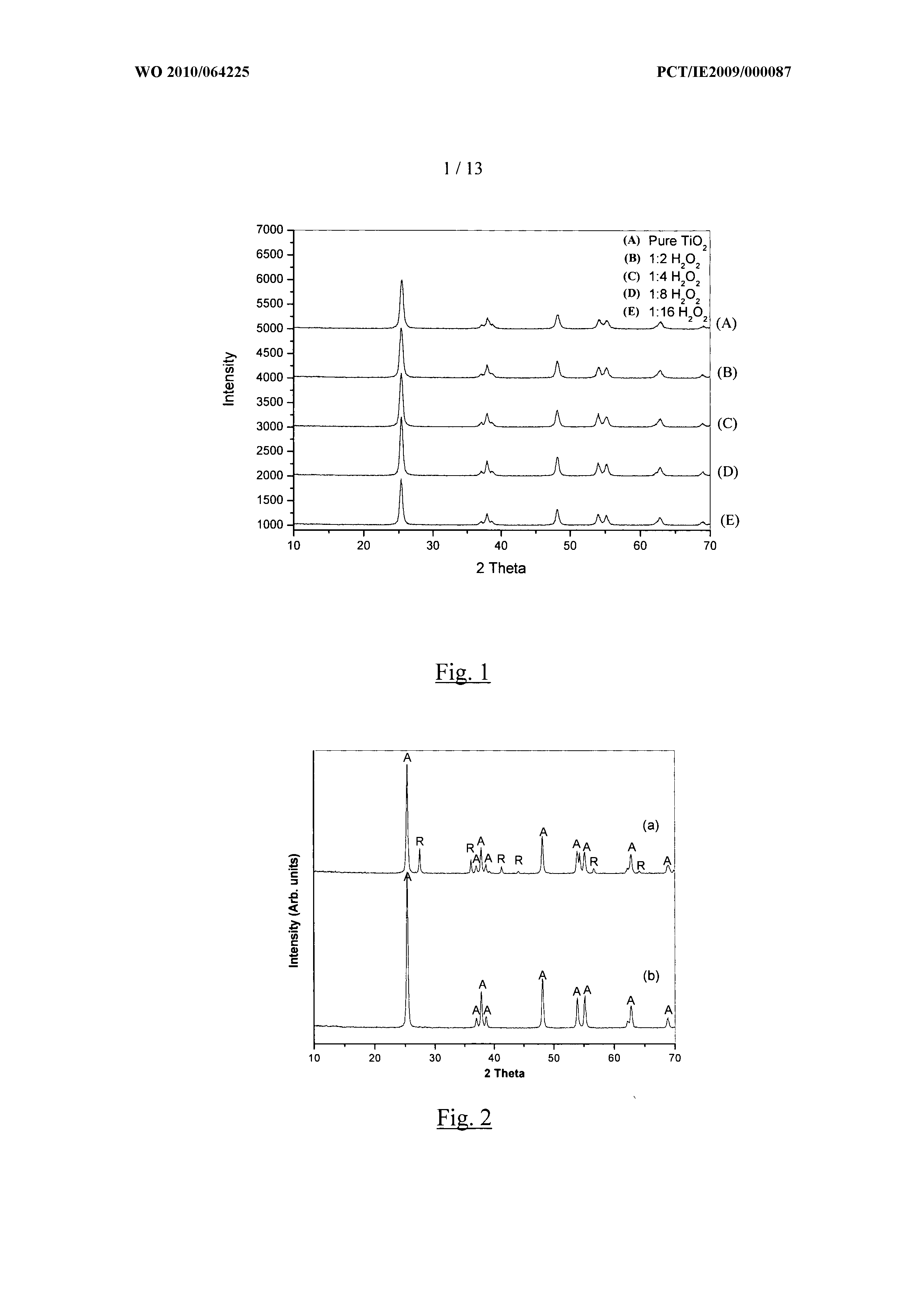
0052Fig. 1 is a trace showing the X-ray diffraction patterns of pure titanium dioxide and hydrogen peroxide modified titanium dioxide samples calcined at 600°C;
0053Fig. 2 is a trace showing the X-ray diffraction pattern of pure titanium dioxide (a) and 1 :2 hydrogen peroxide modified titanium dioxide (b) samples calcined at 800°C. (A = anatase and R = rutile);
0054Fig. 3 is a trace showing the X-ray diffraction pattern of pure titanium dioxide (a) and
00551 :16 hydrogen peroxide modified titanium dioxide (b) samples calcined at 900°C (A = anatase and R = rutile);
0056Fig. 4 is a trace showing the X-ray diffraction pattern of pure titanium dioxide (a) and 1 :16 hydrogen peroxide modified titanium dioxide (b) samples calcined at 1000°C;
0057Fig. 5 is a Raman spectra of pure titanium dioxide (a) and 1 :2 hydrogen peroxide modified titanium dioxide (b) samples calcined at 800°C (A = anatase and R = rutile); Fig. 6 is a Raman spectra of pure titanium dioxide (a) and 1:16 hydrogen peroxide modified titanium dioxide (b) samples calcined at 900°C (A = anatase and R = rutile);
0058Fig. 7 is a photoluminescence spectra of pure titanium dioxide (a) and 1 :16 hydrogen peroxide modified titanium dioxide (b) samples calcined at 600°C;
0059Fig. 8 is a photoluminescence spectra of pure titanium dioxide (a) and 1 :16 hydrogen peroxide modified titanium dioxide (b) samples calcined at 700°C;
0060Fig. 9 is a photoluminescence spectra of pure titanium dioxide (a) and 1 :16 hydrogen peroxide modified titanium dioxide (b) samples calcined at 900<sup>0</sup>C;
0061Fig. 10 is a photoluminescence spectra of 1 :16 hydrogen peroxide modified titanium dioxide samples calcined at 600°C (a), 700°C (b), 800°C (c) and 900°C (d);
0062Fig. 11 is a photoluminescence spectra of pure titanium dioxide samples calcined at 600°C (A), 700°C (B), 800°C (C) and 900<sup>0</sup>C (D);
0063Fig. 12 is a UV - visible absorption spectra of pure and hydrogen peroxide modified titanium dioxide samples calcined at 600<sup>0</sup>C;
0064Fig. 13 is a UV - visible absorption spectra of pure and hydrogen peroxide modified titanium dioxide samples calcined at 700<sup>0</sup>C;
0065Fig. 14 is a UV - visible absorption spectra of pure and hydrogen peroxide modified titanium dioxide samples calcined at 800<sup>0</sup>C;
0066Fig. 15 is a UV - visible absorption spectra of pure and hydrogen peroxide modified titanium dioxide samples calcined at 900<sup>0</sup>C;
0067Fig. 16 is a FT-IR spectrum of titanium dioxide prepared through the peroxo titania method described herein (A) and a control sample (B), both samples were calcined at 600 °C; Fig. 17 is a graph showing the rates of visible light photocatalysis of a hydrogen peroxide modified titanium dioxide sample and a commercially available Degussa P-25 photocatalyst (Degussa P-25 photocatalyst comprises 75% anatase phase titanium dioxide and 25% rutile phase titanium dioxide);
0068Fig. 18 (A) is a photograph of a spray coating process for a tile and (B) is a photograph of a tile that has been coated with a photocatalyst;
0069Fig. 19 is a photograph of a piece of glass that has been dip coated in a photocatalyst;
0070Fig. 20 is a photograph of a door handle that has been dip coated in a photocatalyst.
0071Fig. 21 is a UV-visible absorption spectra of methylene blue decanted into a non-coated glass bottle (A) and a hydrogen peroxide modified titania sol coated glass bottle (B) prior to light irradiation;
0072Fig. 22 is a UV-visible absorption spectra of methylene blue in the bottles of Fig. 21 following 3 hours of light irradiation in which (A) is the non-coated glass bottle and (B) is the hydrogen peroxide modified titania sol coated glass bottle;
0073Fig. 23 is a photograph of an agar plate on which Staphylococcus aureus were grown in the presence of (A) 1 : 16 TiO<sub>2</sub> : H<sub>2</sub>O<sub>2</sub> coated tile calcined at 900 <sup>0</sup>C and (B) uncoated tile; and
0074Figure 24 is a photograph of an agar plate on which Methicillin-resistant Staphylococcus aureus were grown in the presence of (A) an uncoated tile and (B) 1 : 16 TiO<sub>2</sub> : H<sub>2</sub>O<sub>2</sub> coated tile calcined at 900 <sup>0</sup>C.
0075Detailed Description
0076We describe a process for synthesising high temperature stable titanium dioxide through a peroxo titania route. In the process, hydrated titanium dioxide reacts with various molar ratios of hydrogen peroxide to form peroxo titanium complex in an excess of water (up to 100 mole times). The resultant sol is transparent and sprayable and upon heat treatment forms anatase phase titanium dioxide. Titanium dioxide prepared through this process is pure (non-doped) and anatase phase stable at high temperatures. Hydrogen peroxide modified titania shows high temperature anatase phase stability. A gradual increase in anatase phase stability was observed with an increase in the amount of hydrogen peroxide used in the process. The composition 1 :16 Tio<sub>2</sub> : H<sub>2</sub>O<sub>2</sub> shows 100% anatase even at 900°C whereas unmodified titania is 100% rutile at 900°C. Titanium dioxide prepared through this process shows improved visible light photocatalytic activity when compared to the commercially available Degussa P-25 standard photocatalyst which comprises 75% anatase phase titanium dioxide and 25% rutile phase titanium dioxide.
0077The process can be used to synthesise high temperature stable titanium dioxide nano powder, high temperature stable titania thin and thick films, and high temperature stable humidity oxygen sensors.
0078The invention will be more clearly understood from the following examples.
0079Examples
0080Example 1 - Synthesis of hydrogen peroxide modified titanium dioxide Hydrogen peroxide modified titanium dioxide was prepared by a reaction between hydrated titanium dioxide and 30 vol% hydrogen peroxide. The molar ratio between hydrated titanium dioxide and hydrogen peroxide was varied at 1 :0, 1 :2, 1 :4, 1 :8 and 1 :16 titanium dioxide : hydrogen peroxide.
0081In a typical synthesis, 5.5 ml of titanium tetra chloride was added to water to form titanium oxychloride. 15 ml ammonium hydroxide was added slowly to the titania precursor solution to precipitate hydrated titanium dioxide. The precipitated hydrated titanium dioxide was washed with water to free chloride ions. The precipitate obtained was then treated with 250 ml water and different amounts of 30 vol % hydrogen peroxide to form an orange coloured transparent solution. This solution on heating undergoes gelation. The gel obtained was dried at 100 <sup>0</sup>C and the xerogel obtained was calcined at 600, 700, 800, 900 and 1000 °C.
0082A yield of about 88 % was observed for the synthesis process. Example 2 - Physical properties of hydrogen peroxide modified titanium dioxide
0083High temperature stability
0084Anatase to rutile transformation in an unmodified titania occurs at 500-700 <sup>0</sup>C. Hydrogen peroxide modified titania exhibits anatase to rutile transformation at a much higher temperature.
0085As the amount of H<sub>2</sub>O<sub>2</sub> increases the transformation temperature of the hydrogen peroxide modified titanium dioxide also increases. All samples calcined at 600°C and 700°C show 100% anatase phase (Fig. 1). Unmodified sample shows 30% rutile phase at 800<sup>0</sup>C whereas the sample
00861 :2 TiO<sub>2</sub> : H<sub>2</sub>O<sub>2</sub> was completely anatase (Fig. 2). 100 % rutile phase was observed in unmodified sample calcined at 900°C whereas 1:16 TiO<sub>2</sub> : H<sub>2</sub>O<sub>2</sub> shows 100% anatase (Fig. 3). Samples 1 :8
0087TiO<sub>2</sub> : H<sub>2</sub>O<sub>2</sub> and 1 :16 TiO<sub>2</sub> : H<sub>2</sub>O<sub>2</sub> contains 5 % anatase phase even after calcinations at 1000<sup>0</sup>C
0088(Fig. 4). All other samples were 100% rutile.
0089Results obtained from X-ray diffraction (XRD) were confirmed using laser Raman spectroscopy. The Raman active modes for anatase, Alg+2Blg+3Eg at 147, 197, 396, 515 and 638 cm-1, and rutile, Alg+Blg+B2g+Eg at 144, 238, 447 and 611 cm-1 were used as fingerprints. All samples calcined at 600 and 700<sup>0</sup>C showed 100% anatase phase. Control sample (non-modified titanium dioxide) calcined at 800<sup>0</sup>C shows a peak characteristic of rutile at 447 cm<sup>"1</sup> and a shoulder at the anatase peak corresponding to a Raman shift of 611cm<sup>"1</sup> (Fig. 5). Control sample calcined at 900<sup>0</sup>C shows main peaks at 61 1, 447, 238, and a less intense peak at 144 cm<sup>"1</sup> (Fig. 6). Peaks of pure anatase were observed for the modified sample 1 :16 H<sub>2</sub>O<sub>2</sub> at 147, 197, 396, 515 and 638 cm<sup>"1</sup>. Thus results observed from X-Ray diffraction studies were confirmed using laser Raman spectroscopy.
0090Low intensity Photoluminescence
0091Photoluminescence spectroscopy is a powerful tool for analyzing the surface defects and energy levels of luminescent nanoparticles. Wavelength values in the emission spectrum obtained were converted in to band gap values in electron volt according to equation eV=1239.8/λ. Luminescence emission spectra of unmodified sample shows peaks at 3.2 eV and 3eV both corresponding to indirect electronic transitions. All H<sub>2</sub>O<sub>2</sub> modified samples calcined at 600<sup>0</sup>C shows less intense bands at 3 and 3.2 eV. In the control sample intensity of 3.2 eV peak was higher than that of 3 eV peak. Band observed at 2.59 eV for unmodified sample corresponds to oxygen vacancy. Oxygen vacancies can act as electron hole recombination sites. This may be the reason for high intensity peak for unmodified sample. All modified samples shows less intense peaks at 3.2 and 3eV. Intensity of 3 eV peak was high in all modified samples compared to 3.2 eV peak. Band corresponding to oxygen vacancy was less intense in H<sub>2</sub>O<sub>2</sub> modified samples. Less oxygen vacancy may be the reason for less intense luminescent peaks of modified samples. Unmodified sample calcined at 900<sup>0</sup>C shows a 3eV peak corresponding to rutile and another peak at 3.69 indicating direct transition. 1 :16 TiO<sub>2</sub> : H<sub>2</sub>O<sub>2</sub> modified sample shows peaks characteristic of pure anatase (Fig. 9). Figs. 10 and 11 shows the effect of calcination temperature on the peak intensities of 1 :16 TiO<sub>2</sub> : H<sub>2</sub>O<sub>2</sub> modified sample and unmodified sample respectively. It can be seen that the total intensity and the intensity of the 2 bands increases with calcination temperature and intensity of the peak at 2.59 eV also increases. This indicates an increase of oxygen vacancies with temperature. It is clear from Figs. 10 and 11 that 1 :16 TiO<sub>2</sub> : H<sub>2</sub>O<sub>2</sub> modified sample contains less oxygen vacancies at all calcination temperatures compared to unmodified sample. Thus it is clear from the phospholuminescent spectra that H<sub>2</sub>O<sub>2</sub> modified samples contain less oxygen vacancies, which is the reason for the high temperature anatase stability of hydrogen peroxide modified titanium dioxide samples.
0092Lower band sap
0093Absorption spectrum of pure and H<sub>2</sub>O<sub>2</sub> modified samples (Fig. 12 to 15) was recorded using Perkin Elmer Lambda 900 UV /VIS Spectrometer in the diffused reflectance mode. An increase in absorption wavelength indicates the band gap lowering of hydrogen peroxide modified samples. When calcined at 600<sup>0</sup>C, the control sample absorbs at 395 nm, which correspond to a band gap of 3.15 eV. As the amount of hydrogen peroxide increases, the absorption edge of the spectrum gradually shift to longer wavelength. The lowest band gap was obtained for 1 :16 TiO<sub>2</sub> :H<sub>2</sub>O<sub>2</sub> modified sample calcined at 600<sup>0</sup>C (Table.1), 700<sup>0</sup>C (Table 3), 800<sup>0</sup>C (Table 5), and 900<sup>0</sup>C (Table 7).
0094Table. 1 Absorption wavelength and band gap values of H<sub>2</sub>O<sub>2</sub> modified samples calcined at 600 °C
0095<img file="WO2010064225A1_D0001.tif" />
0096Table 2. Composition of H<sub>2</sub>O<sub>2</sub> modified samples calcined at 600 <sup>0</sup>C <img file="WO2010064225A1_D0002.tif" />
0097Table 3. Band gap values Of H<sub>2</sub>O<sub>2</sub> modified samples calcined at 700 °C
0098<img file="WO2010064225A1_D0003.tif" />
0099Table 4. Composition of H<sub>2</sub>O<sub>2</sub> modified samples calcined at 700 °C
0100<img file="WO2010064225A1_D0004.tif" />
0101Table 5. Band gap values Of H<sub>2</sub>O<sub>2</sub> modified samples calcined at 800 °C
0102<img file="WO2010064225A1_D0005.tif" />
0103Table 6. Composition Of H<sub>2</sub>O<sub>2</sub> modified samples calcined at 800 °C <img file="WO2010064225A1_D0006.tif" /><img file="WO2010064225A1_D0007.tif" />
0104Table 7. Band gap values of H<sub>2</sub>O<sub>2</sub> modified samples calcined at 900 °C
0105<img file="WO2010064225A1_D0008.tif" />
0106Table 8. Composition of H<sub>2</sub>O<sub>2</sub> modified samples calcined at 900 °C
0107<img file="WO2010064225A1_D0009.tif" />
0108Table 9. Composition of H<sub>2</sub>O<sub>2</sub> modified samples calcined at 1000 <sup>0</sup>C
0109<img file="WO2010064225A1_D0010.tif" />
0110Stronger Ti-O-Ti bonds
0111FTIR spectra of the control and 1 :16 titanium dioxide : hydrogen peroxide modified titania samples were recorded before and after calcination at 600°C. Referring to Fig. 16 the calcined samples shows a broad band at 500 cm<sup>"1</sup> which is characteristic of Ti-O-Ti stretching vibrations. Titania photocatalyst prepared through peroxo method showed stronger Ti-O-Ti bonds (compared to the control sample).
0112Example 3 - Photocatalytic properties of hydrogen peroxide modified titanium dioxide. In a typical visible light photo catalytic study, 0.06 g of titania powder was mixed with 50 ml methylene blue solution (I xIO<sup>"5</sup> M ). The suspension obtained was stirred in dark for 15 minutes. This was to ensure homogeneous mixing and to avoid any decrease in concentration of dye during the reaction as a result of adsorption. The suspension was then irradiated with visible light (450 nm) while stirring. Visible light was produced using a 450 nm cut off filter and a Q-Sun solar simulator. Degradation of the dye was monitored by withdrawing 5 ml aliquots at regular intervals. These aliquots were centrifuged and absorption spectra of the samples were recorded using a UV/Vis spectrometer. The rate of degradation was assumed to obey pseudo-first order kinetics. Rate constant for degradation, k, was calculated from the first order plot (Equation 1.1). <img file="WO2010064225A1_D0011.tif" />
0113Where A<sub>0</sub> is the initial absorbance, A is absorbance after a time (t) and k is the first order rate constant.
0114Referring to Fig. 17, hydrogen peroxide modified titanium dioxide exhibits visible light photocatalytic properties that are comparable to the photocatalytic properties of the commercially available Degussa P-25 photocatalyst.
0115Example 4 - Photocatalytic coatings
0116Hydrated titanium dioxide reacts with hydrogen peroxide to form a peroxo complex. This complex exists as an orange coloured homogeneous solution. Therefore the precursor itself is a solution which can be used for coating applications. On heat treatment, this complex decomposes to form titanium dioxide photo catalyst.
0117The coatings were applied using dip and spray coating techniques. For dip coating (Figs. 19 and 20), downward movement of the glass was adjusted as 2mm per minute. The coated glass was then dried at 50°C. This results in a fine transparent coating on the glass surface. Coated glass slides were calcined at 400°C using a heating rate of I<sup>0</sup>C. Spray coating were carried out in compressed air as carrier gas. Sprayer was kept at 30 cm away from the samples (Fig. 18A). Sprayed samples were first dried at room temperature followed by high temperature treatment.
0118Example 5 - Photocatalytic coating of a glass bottle
0119Hydrogen peroxide modified titania sol was used for the fabrication of a photoactive antibacterial titania thin film coating inside glass bottles. In a typical experiment, glass bottles were filled with titania sol and decanted to form a thin film coating inside the bottle. Coated bottles were first dried at room temperature and then calcined at 600<sup>0</sup>C. Photocatalytic activity of the coatings was analysed using the methylene blue degredation technique. In a typical photocatalytic study, 50 ml of methylene blue solution (1 x 10<sup>"5</sup> M) was dispensed into the hydrogen peroxide modified titania coated glass bottle. The bottle was irradiated with solar light using a Q-sun solar simulator, the light intensity was adjusted as 0.68 W/m<sup>2</sup>. Visible light was produced using a 450 nm cut off filter. A non-coated glass bottle was used as a control. Decomposition of methylene blue was observed using UV/VIS spectroscopy. Methylene blue in the hydrogen peroxide modified titania coated glass bottle become colourless after 3 hours of light irradiation, whereas methylene blue in the non-coated glass bottle remained coloured (Figs. 21 and 22). These observations indicate that hydrogen peroxide modified titania can be used as a photoactive antibacterial coating for glass bottles. The photocatalytic coating may be used to sterilise the contents of a bottle.
0120Example 6 - Antimicrobial study
0121Staphylococcus aureus The antibacterial activity of the hydrogen peroxide modified titanium dioxide against Staphylococcus aureus (ATCC 259220) was determined using the following methodology. A stock culture of the bacterium was grown on overnight in nutrient rich broth PCA-3 w/v% tryptone, 1 w/v% glucose, 2.5 w/v% yeast, 9 w/v% agar, Oxoid) to give a concentration of approximately 10<sup>8</sup> CFU/ml. Bacteria was diluted one in a hundred with maximum recovery diluent (MRD - lw/v% Peptone, 8.5w/v% NaCl, Oxoid) to give working cultures of approximately 10<sup>6</sup> CFU/ml. A tile sample coated with 1:16 TiO<sub>2</sub> : H<sub>2</sub>O<sub>2</sub> calcined at 900<sup>0</sup>C and an uncoated tile sample (225 cm<sup>2</sup>) were inoculated with 3 mis of the bacterial culture respectively and exposed to indoor light (fluorescent light from ceiling) for 6 hours. The samples were subsequently incubated at 37<sup>0</sup>C overnight. The samples were then agitated with MRD (50 mls) in sterile stomacher bags. To determine the number of organisms, the MRD was serially diluted tenfold and the resulting dilutions plated (lOOμl) onto plate count agar (PCA) for overnight incubation at 37°C. Samples and dilutions were performed in duplicate. Referring to Fig. 23, no growth of 5". aureus was observed with the hydrogen peroxide modified titanium dioxide (Fig. 23A) whereas growth was observed in the presence uncoated tile samples. This demonstrates that the hydrogen peroxide modified titanium dioxide is antibacterial.
0122Methicillin-resistant Staphylococcus aureus
0123The antibacterial activity of the hydrogen peroxide modified titanium dioxide against Methicillin-resistant Staphylococcus aureus (MRSA ATCC 43300) was determined using the following methodology. A stock culture of the bacterium was grown on overnight in nutrient rich broth (PCA-3 w/v% tryptone, 1 w/v% glucose, 2.5 w/v% yeast, 9 w/v% agar, Oxoid) to give a concentration of approximately 10<sup>8</sup> CFU/ml. Bacteria was diluted one in a hundred with maximum recovery diluent (MRD - lw/v% Peptone, 8.5w/v% NaCl, Oxoid) to give working cultures of approximately 10<sup>6</sup> CFU/ml. A tile sample coated with 1 :16 TiO<sub>2</sub> : H<sub>2</sub>O<sub>2</sub> calcined at 900<sup>0</sup>C and a uncoated tile sample (225 cm ) were inoculated with 3 mis of the bacterial culture respectively and exposed to indoor light (fluorescent light from ceiling) for 6 hours. The samples were subsequently incubated at 37<sup>0</sup>C overnight. The samples were then agitated with MRD (50 mis) in sterile stomacher bags. To determine the number of organisms, the MRD was serially diluted tenfold and the resulting dilutions plated (lOOμl) onto plate count agar (PCA) for overnight incubation at 37°C. Samples and dilutions were performed in duplicate. Referring to Fig. 24, no growth of MRSA was observed with the hydrogen peroxide modified titanium dioxide (Fig. 24B) whereas growth was observed in the presence uncoated tile samples (Fig. 24A). This demonstrates that the hydrogen peroxide modified titanium dioxide is antibacterial.
0124The invention is not limited to the embodiment hereinbefore described, with reference to the accompanying drawings, which may be varied in construction and detail.
24 sheets
Sheet 1 Sheet 2 Sheet 3 Sheet 4 Sheet 5 Sheet 6 Sheet 7 Sheet 8 Sheet 9 Sheet 10 Sheet 11 Sheet 12 Sheet 13 Sheet 14 Sheet 15 Sheet 16 Sheet 17 Sheet 18 Sheet 19 Sheet 20 Sheet 21 Sheet 22 Sheet 23 Sheet 24
Every citation, both ways
| Document | Relation | Office | Category | Cited during | Relevant claims |
|---|---|---|---|---|---|
| CN103521204A | Cited by | China | – | Search report | – |
| CN103232066A | Cited by | China | – | Search report | – |
| CN113308268A | Cited by | China | – | Search report | – |
| WO2022090708A1 | Cited by | World Intellectual Property Organization (WIPO) | – | International search | – |
| US6344278B1 | Cites | United States of America | XI | International search | 1-3,5-10,13-23 |
| LEI GE ET AL: "Fabrication and characterization of TiO2 photocatalytic thin film prepared from peroxo titanic acid sol", JOURNAL OF SOL-GEL SCIENCE AND TECHNOLOGY, KLUWER ACADEMIC PUBLISHERS, BO LNKD- DOI:10.1007/S10971-007-1545-7, vol. 43, no. 1, 6 April 2007 (2007-04-06), pages 1 - 7, XP019505482, ISSN: 1573-4846 | Non-patent | – | – | International search | – |
| GE L ET AL: "Synthesis and characterization of TiO2 photocatalytic thin films prepared from refluxed PTA sols", MATERIALS LETTERS, NORTH HOLLAND PUBLISHING COMPANY. AMSTERDAM, NL LNKD- DOI:10.1016/J.MATLET.2005.08.036, vol. 60, no. 2, 1 January 2006 (2006-01-01), pages 287 - 290, XP025036608, ISSN: 0167-577X, [retrieved on 20060101] | Non-patent | – | – | International search | – |
| MELGHIT ET AL: "Low temperature preparation and characterization of nanospherical anatase TiO2 and its photocatalytic activity on Congo red degradation under sunlight", CERAMICS INTERNATIONAL, ELSEVIER, AMSTERDAM, NL LNKD- DOI:10.1016/0022-1139(96)03438-0, vol. 34, no. 3, 11 February 2008 (2008-02-11), pages 479 - 483, XP022476456, ISSN: 0272-8842 | Non-patent | – | – | International search | – |
| GE ET AL: "Fabrication, characterization and photocatalytic activities of TiO2 thin films from autoclaved-sol", THIN SOLID FILMS, ELSEVIER-SEQUOIA S.A. LAUSANNE, CH LNKD- DOI:10.1016/J.TSF.2006.10.002, vol. 515, no. 7-8, 15 February 2007 (2007-02-15), pages 3414 - 3420, XP005890730, ISSN: 0040-6090 | Non-patent | – | – | International search | – |
| LIU B ET AL: "The study of photocatalysis under ultraviolet+visible two-beam light irradiation using undoped nano-titanium dioxide", MATERIALS CHEMISTRY AND PHYSICS, ELSEVIER LNKD- DOI:10.1016/J.MATCHEMPHYS.2008.04.029, vol. 112, no. 1, 15 November 2008 (2008-11-15), pages 35 - 40, XP025676569, ISSN: 0254-0584, [retrieved on 20080725] | Non-patent | – | – | International search | – |
3 members in 3 offices; this record represents the family
Members3
| Document | Office | Kind | |
|---|---|---|---|
| WO2010064225A1This record | World Intellectual Property Organization (WIPO) | A1 | |
| IE20090914A1 | Ireland | A1 | |
| EP2370361A1 | European Patent Office (EPO) | A1 |
4 legal events, as 2 offices reported them to INPADOC
Over the term
Point at a mark for the eventEvents
| Event | Code | Office | |
|---|---|---|---|
| Request for entry into the european phaseREEP | REEP | WO | |
| Wipo information: entry into national phaseWWE | WWE | WO | |
| Non-entry into the national phaseNENP | NENP | DE | |
| Ep: the epo has been informed by wipo that ep was designated in this application121 | 121 | WO |
Numbers
- Publication
- 2010/064225
- Application
- 87
Titles2
- English
- HIGH TEMPERATURE STABLE ANATASE PHASE TITANIUM DIOXIDE
- French
- DIOXYDE DE TITANE EN PHASE ANATASE STABLE À HAUTE TEMPÉRATURE
Classification
- CPC, 21
- C01G23/0536
- A01N59/16
- B01D53/8687
- B01D2255/802
- B01J21/063
- B01J37/036
- C01G23/08
- C01P2002/72
- C01P2002/82
- C01P2002/84
- C01P2006/37
- C01P2006/90
- C02F1/30
- C02F1/725
- C02F2303/04
- C02F2305/10
- C08K3/22
- C08K9/02
- C09D5/14
- C09D7/62
- B01J35/39
- IPC, 2
- B01J35 00
- C01G23 053
Designated states140
- Regional, 75
- Botswana
- Ghana
- Gambia
- Kenya
- Lesotho
- Malawi
- Mozambique
- Namibia
- Sudan
- Sierra Leone
- Eswatini
- United Republic of Tanzania
- Uganda
- Zambia
- Zimbabwe
- Armenia
- Azerbaijan
- Belarus
- Kyrgyzstan
- Kazakhstan
- Republic of Moldova
- Russian Federation
- Tajikistan
- Turkmenistan
and 51 moreShow fewer
- Austria
- Belgium
- Bulgaria
- Switzerland
- Cyprus
- Czechia
- Germany
- Denmark
- Estonia
- Spain
- Finland
- France
- United Kingdom
- Greece
- Croatia
- Hungary
- Ireland
- Iceland
- Italy
- Lithuania
- Luxembourg
- Latvia
- Monaco
- North Macedonia
- Malta
- Netherlands (Kingdom of the)
- Norway
- Poland
- Portugal
- Romania
- Sweden
- Slovenia
- Slovakia
- San Marino
- Türkiye
- Burkina Faso
- Benin
- Central African Republic
- Congo
- Côte d’Ivoire
- Cameroon
- Gabon
- Guinea
- Equatorial Guinea
- Guinea-Bissau
- Mali
- Mauritania
- Niger
- Senegal
- Chad
- Togo
- National, 65
- United Arab Emirates
- Antigua and Barbuda
- Albania
- Angola
- Australia
- Bosnia and Herzegovina
- Barbados
- Bahrain
- Brazil
- Belize
- Canada
- Chile
- China
- Colombia
- Costa Rica
- Cuba
- Dominica
- Dominican Republic
- Algeria
- Ecuador
- Egypt
- Grenada
- Georgia
- Guatemala
and 41 moreShow fewer
- Honduras
- Indonesia
- Israel
- India
- Japan
- Comoros
- Saint Kitts and Nevis
- Democratic People’s Republic of Korea
- Republic of Korea
- Lao People’s Democratic Republic
- Saint Lucia
- Sri Lanka
- Liberia
- Libya
- Morocco
- Montenegro
- Madagascar
- Mongolia
- Mexico
- Malaysia
- Nigeria
- Nicaragua
- New Zealand
- Oman
- Peru
- Papua New Guinea
- Philippines
- Serbia
- Seychelles
- Singapore
- Sao Tome and Principe
- El Salvador
- Syrian Arab Republic
- Tunisia
- Trinidad and Tobago
- Ukraine
- United States of America
- Uzbekistan
- Saint Vincent and the Grenadines
- Viet Nam
- South Africa