Preparation method of strong adsorptive mixed crystal titanium dioxide
Abstract
A visible light of titanium dioxide with strong adsorption properties should respond to the photocatalytic material. Its crystal form composition can be adjusted in a wide range (continuously controllable modulation can be carried out from 4% to 100% of anatase ratio). Preparation process: Mix a certain amount of titanium precursor and oxyalcohol under a water bath condition of 30°C-100°C, add a certain concentration of hydrogen peroxide complexing agent for complexation after mixing, and maintain the temperature. React for 0.5-4 hours, after which drying and calcination are performed. The material is used for visible light photocatalytic degradation of trace organic pollutants, and has excellent intrinsic catalytic performance in the reaction. And it has strong adsorption performance in the catalytic process.
Term
No projected expiry on record.
- Priority and filed
- Published
- Today
6 claims: 1 independent, 5 dependent
- 1一种强吸附混晶二氧化钛光催化材料的制备方法,为一种晶形可控调变,具有强吸 附性能的可见光响应二氧化钛混晶光催化材料的制备方法,其特征在于: 其制备过程如下: 1) 取钛的前驱体,加入0. 25-10倍前驱体体积的氧基醇类溶剂,在水浴中加热至 30Ό -100Ό ; 2) 将H 2 0 2 溶液加入到混合溶液中去,并进行搅拌,保温0. 5-4小时; 3 )将获得的凝胶进行干燥,研磨,锻烧。
- 2根据权利要求1所述的制备方法,其特征在于: 所述氧基醇类为乙氧基乙醇,乙氧基丙醇,甲氧基乙醇中的一种;所述钛的前驱体为钛 酸四异丙酯、钛酸四异丁酯、四氯化钛中的一种。
- 3根据权利要求2所述的制备方法,其特征在于: 所述步骤2)反应体系中钛的浓度为l-20mMo
- 4根据权利要求1或2所述的制备方法,其特征在于: 步骤1)加入的氧基醇类的体积为钛前驱体的1到2倍。
- 5根据权利要求1所述的制备方法,其特征在于: H 2 0 2 溶液质量浓度3-30 % ο
- 6根据权利要求1所述的制备方法,其特征在于: 锻烧于 300-500°C, 2-8hο
Independent claims6
52 paragraphs, as filed
A kind of preparation method of strong adsorption mixed crystal titanium dioxideTechnical field
[0001] The present invention relates to a method for preparing a highly adsorbed visible light-responsive titanium dioxide photocatalytic material with adjustable crystal shape and its application in the field of photocatalysis.
Background technique
[0002] Titanium dioxide, as a highly efficient, non-toxic, chemically and physically stable photocatalytic material, has attracted people's attention widely, and it has been used in the production of hydrogen by water splitting, photoreduction of carbon dioxide to produce fuel, and the degradation of organic pollutants in the environment. A certain degree of progress. The current practical applications of titanium dioxide mainly focus on the photocatalytic degradation of environmental organic pollutants. In terms of the degradation of organic pollutants, there are two main limitations to the wide application of titanium dioxide: First, the band gap of titanium dioxide is relatively wide (3.2 eV), so it can only use the ultraviolet part of sunlight, which only accounts for sunlight energy. The second is that the adsorption performance of titanium dioxide itself is poor, and the degradation reaction occurs on the surface of the photocatalyst. Therefore, only the organic pollutants that come into contact with the surface can be degraded in the reaction. In order to improve its adsorption performance, most reports adopt a method of combining titanium dioxide with strong adsorption materials (such as apatite, activated carbon, graphene, etc.) to form a composite material to improve its adsorption performance, and at the same time it has strong adsorption performance. There are still few reports about pure titanium dioxide with high visible light catalytic activity.
Summary of the invention
[0003] The purpose of the present invention is to provide a visible light responsive mixed crystal titanium dioxide nanoparticles with strong adsorption performance, the crystal shape of the material can be adjusted in a wide range, and has a higher performance in the visible light photocatalytic reaction Reactivity and strong adsorption performance.
[0004] The present invention provides a method for preparing a titanium dioxide photocatalyst with an adjustable crystal shape with strong adsorption properties, and the specific steps are:
[0005] 1) Take a certain amount of titanium precursor, add it to 0.25-10 times the volume of the precursor in an oxyalcohol solvent, and heat it in a water bath to 30°C -100Ό;
[0006] 2) Add an appropriate amount of H202 solution with a certain concentration to the mixed solution and stir to mix evenly.
30Ό -100Ό heat preservation in a water bath for 0.5-4 hours;
[0007] 3) Put the obtained gel in an oven above 60°C for drying;
[0008] 4) Grind the dried powder and burn it at 300-500°M for 2-8h.
[0009] The oxyalcohol is one of ethoxyethanol, ethoxypropanol, and methoxyethanol; the precursor of titanium is tetraisopropyl titanate and tetraisobutyl titanate One of ester and titanium tetrachloride.
[0010] The methods for evaluating the adsorption performance and photocatalytic performance of titanium dioxide provided by the present invention are as follows:
[0011] Evaluation of adsorption performance: the titanium dioxide photocatalytic material was added to the 10 ppm methylene blue solution according to lg/L, and stirred in the dark for 30 minutes to reach adsorption equilibrium, and then sampled for centrifugal separation and then the supernatant was taken , Use an ultraviolet-visible spectrophotometer to measure the absorbance of the supernatant and compare the absorbance of the initial solution.
[0012] Evaluation of photocatalytic performance: After the adsorption reached equilibrium for half an hour, a 500W lamp loaded with a 385nm long-wave filter was turned on to irradiate the reaction vessel, and a visible light degradation experiment was performed, and the reaction was performed at regular intervals during the reaction.
Sampling was taken, centrifuged to take the supernatant and measured with an ultraviolet-visible spectrophotometer to determine the degradation degree of the methylene blue solution.
[0013] The prepared titanium dioxide has strong adsorption performance and activity in the photocatalytic reaction of visible light photocatalytic degradation of organic pollutants. In the visible light photocatalytic reaction of trace gas phase and liquid phase, the same proportion of titanium dioxide photocatalytic material has extremely high adsorption performance and activity. And the crystal composition can be continuously adjusted in a larger range.
[0014] The present invention has the following advantages:
[0015] The crystalline form of the prepared titanium dioxide photocatalytic material can be adjusted in a large range (rutile ratio 0%-96%); the prepared titanium dioxide has strong adsorption performance and photocatalytic performance in the catalytic reaction under visible light.
Description of the drawings
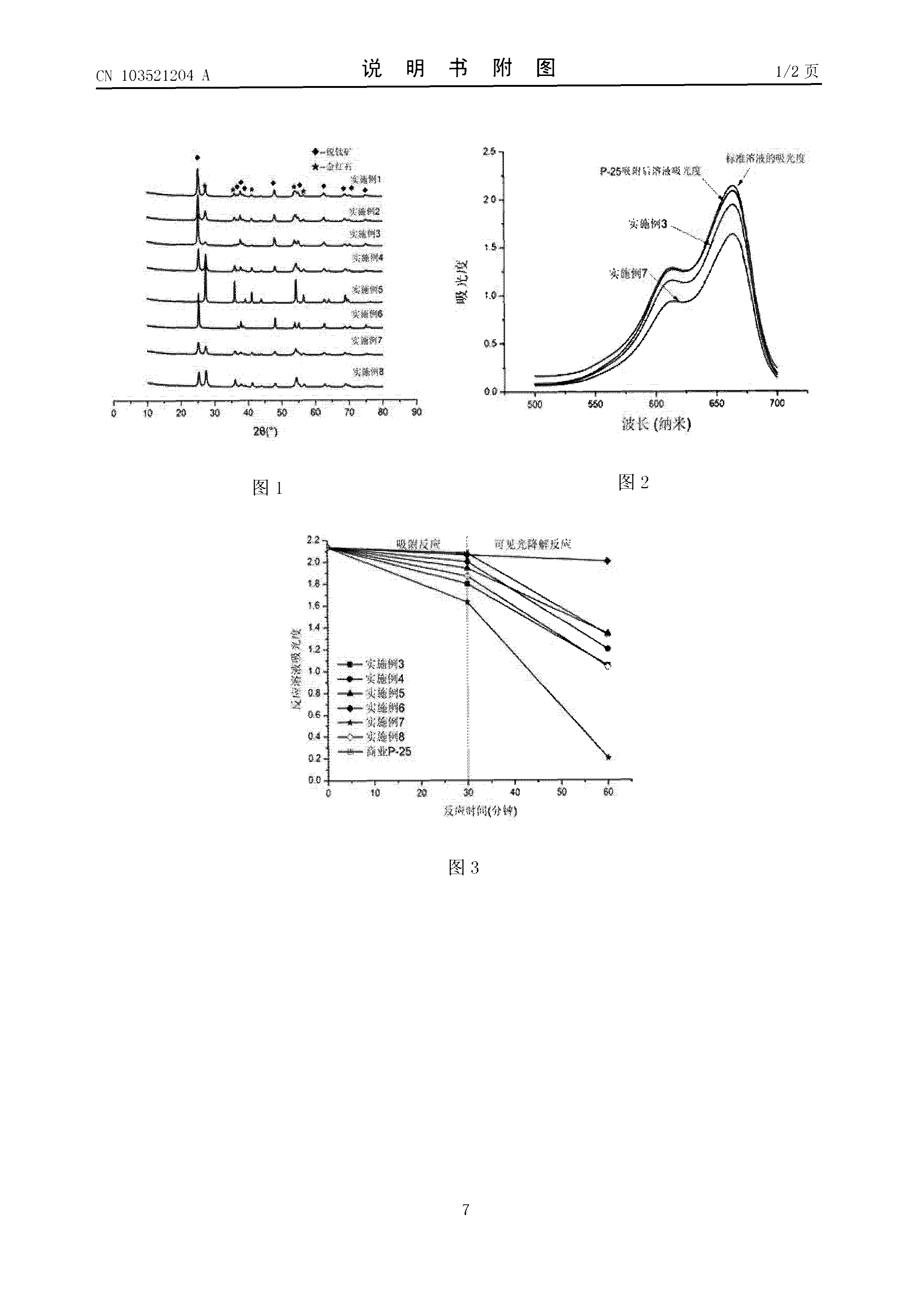
[0016] FIG. 1 is the XRD spectra of the following eight examples. From the spectra, it can be found that the prepared titanium dioxide photocatalysts are all mixed crystals of anatase and rutile. And calculated according to Schiller's formula, it is found that the size of the particles are all around 20nm. And according to the formula Fr=1/[1+0.8*I<sub>a</sub>(101)/Ir(110)], it can be calculated that the proportion of anatase ranges from 4% to 100%, and its composition ratio is continuously adjustable within this interval.
[0017] FIG. 2 is an evaluation spectrum of the adsorption performance of the titanium dioxide photocatalytic nanoparticles prepared in Examples 3 and 7 and the comparative commercial titanium dioxide P-25 (Degus sa). It can be seen from the figure that the adsorption performance of the titanium dioxide photocatalyst prepared according to the method described in the patent is significantly better than that of commercial P-25, and the best is about 10 times that of P-25.
[0018] FIG. 3 is a photocatalytic performance evaluation spectrum of the titanium dioxide photocatalytic nanoparticles of Examples 3 to 8 and the comparative commercial titanium dioxide P-25 (Degus sa). It can be drawn from the figure that Example 7 not only has strong adsorption performance, but also has higher photocatalytic activity under visible light than commercial P-25<sub>O</sub>
[0019] FIG. 4 is a TEM electron micrograph, A, B, C, and D are the TEM electron micrographs of the samples prepared in Examples 3, 4, 6, and 7 at a magnification of 250,000 times. It can be seen from the TEM photos that the size of the particles is about 20nm, which is in good agreement with the XRD results.
Detailed ways
Example 1
[0021] In a 1L beaker, add 20ml of ethoxyethanol, and then add 2ml of tetraisopropyl titanate, turn on the stirring to make it evenly mixed, and slowly increase the temperature to 50°C to maintain this temperature for a period of time until it remains stable. Then slowly add 30ml of H with a mass fraction of 30%<sub>2</sub>0<sub>2</sub>A gel was formed, and the reaction was stirred for 30 minutes. After that, the gel was placed in an oven at 60°C to dry. The dried powder was ground and burned in a muffle furnace at 500°M for 4h. And the obtained powder is tested for adsorption performance and photocatalytic performance.
Example 2
[0023] In a 1L beaker, 7ml of ethoxyethanol was added, and then 2ml of tetraisopropyl titanate was added, stirring was turned on to make it evenly mixed, and the temperature was slowly raised to 100°C to maintain this temperature for a period of time until it remained stable. After that, slowly add 30ml of 30% mass fraction. 2 A gel is formed, and the reaction is stirred for 30 minutes. After that, the gel was placed in an oven at 80°C to dry. The dried powder was ground and burned in a muffle furnace at 500°M for 4 hours. And the obtained powder is tested for adsorption performance and photocatalytic performance.
Embodiment 3
[0025] In a 1L beaker, 5ml of ethoxyethanol was added, and then 2ml of tetraisopropyl titanate was added, and the stirring was turned on to mix
Mix uniformly and slowly heat up to 50Ό. Maintain this temperature for a period of time until it remains stable. After that, slowly add 30ml% with a mass fraction of 30%. 2 A gel is formed, and the reaction is stirred for 30 minutes. After that, the gel was placed in an oven at 120°C to dry. The dried powder was ground and burned in a muffle furnace at 500°M for 4 hours. And the obtained powder is tested for adsorption performance and photocatalytic performance. And the obtained powder is tested for adsorption performance and photocatalytic performance.
Example 4
[0027] In a 1L beaker, 3ml of ethoxyethanol was added, and then 2ml of tetraisopropyl titanate was added, and the stirring was turned on to make it evenly mixed, and the temperature was slowly raised to 50°. Maintain this temperature for a period of time until it remains stable. After that, slowly add 30ml% with a mass fraction of 30%. 2 A gel is formed, and the reaction is stirred for 30 minutes. After that, the gel was placed in an oven at 120°C to dry. The dried powder was ground and burned in a muffle furnace at 500°M for 4 hours. And the obtained powder is tested for adsorption performance and photocatalytic performance.
Example 5
[0029] In a 1L beaker, 0.5ml of ethoxyethanol was added, and then 2ml of tetraisopropyl titanate was added, stirring was turned on to make it evenly mixed, and the temperature was slowly raised to 50°C to maintain this temperature for a period of time until it remained stable. Then slowly add 30ml of H with a mass fraction of 30%<sub>2</sub>0<sub>2</sub>A gel was formed, and the reaction was stirred for 30 minutes. After that, the gel was placed in an oven at 120°C to dry. The dried powder was ground and burned in a muffle furnace at 500°M for 4 hours. And the obtained powder is tested for adsorption performance and photocatalytic performance.
Example 6
[0031] In a 1L beaker, 0ml of ethoxyethanol was added, and then 2ml of tetraisopropyl titanate was added, and the stirring was turned on to make it evenly mixed, and the temperature was slowly raised to 50°C. Maintain this temperature for a period of time until it remains stable. After that, slowly add 30ml% with a mass fraction of 30%. 2 A gel is formed, and the reaction is stirred for 30 minutes. After that, the gel was placed in an oven at 120°C to dry. The dried powder was ground and burned in a muffle furnace at 500°M for 4 hours. And the obtained powder is tested for adsorption performance and photocatalytic performance.
Example 7
[0033] In a 1L beaker, 3ml of ethoxyethanol was added, and then 2ml of tetraisopropyl titanate was added, and the stirring was turned on to make it evenly mixed, and the temperature was slowly raised to 50°C. Maintain this temperature for a period of time until it remains stable. Then slowly add 20ml of 3% O2 to form a gel, and stir the reaction for 30 minutes. After that, the gel was placed in an oven at 120°C to dry. The dried powder was ground and burned in a muffle furnace at 500°M for 4 hours. And the obtained powder is tested for adsorption performance and photocatalytic performance.
Embodiment 8
[0035] In a 1L beaker, 3ml of ethoxyethanol was added, and then 2ml of tetraisopropyl titanate was added, and the stirring was turned on to make it uniformly mixed, and the temperature was slowly raised to 50°C. Maintain this temperature for a period of time until it remains stable. Then slowly add 20ml% with a mass fraction of 15%. 2 A gel is formed, and the reaction is stirred for 30 minutes. After that, the gel was placed in an oven at 120°C to dry. The dried powder was ground and burned in a muffle furnace at 500°M for 4 hours. And the obtained powder is tested for adsorption performance and photocatalytic performance.
[0036]
<td>Example</td><td>Rutile phase content (%)</td>
<td>Example 6</td><td>0</td>
<td>Example 2</td><td>29</td>
<td>Example 3</td><td>46</td>
<td>Example 4</td><td>58</td>
<td>Example 5</td><td>96</td>
[0037] Table 1
[0038] Table 1 is the XRD formula F of Examples 2 to 8<sub>e</sub>=1/[1+0.8 is called (101) /1/110)] the calculated crystal composition. It can be found from the table that the proportion of anatase in the prepared titanium dioxide can be continuously adjusted in the range of 4% to 100%.
2 sheets
Sheet 1 Sheet 2
Every citation, both ways
| Document | Relation | Office | Cited during |
|---|---|---|---|
| CN106040211A | Cited by | China | Search report |
| CN101306838A | Cites | China | Search report |
| CN101462042A | Cites | China | Search report |
| CN101643242A | Cites | China | Search report |
| WO2010064225A1 | Cites | World Intellectual Property Organization (WIPO) | Search report |
2 priority claims, no other members on record
Priority claims2
| Document | Office | Kind | Date |
|---|---|---|---|
| 201210235651 | China | A | |
| CN20121235651 | – | – | – |
3 legal events, as the office reported them to INPADOC
Over the term
Point at a mark for the eventEvents
| Event | Code | |
|---|---|---|
| Deemed withdrawal of patent application after publication (patent law 2001)C02 | C02 | |
| Entry into substantive examinationC10 | C10 | |
| PublicationC06 | C06 |
Numbers
- Publication
- 103521204
- Publication, DOCDB
- 103521204
- Publication, EPODOC
- CN103521204
- Application
- 10235651
- Application, DOCDB
- 201210235651
- Application, EPODOC
- CN20121235651
Titles3
- English
- Preparation method of strong adsorptive mixed crystal titanium dioxide
- English
- Method for preparing strong adsorption mixed crystal titanium dioxide
- Chinese
- 一种强吸附混晶二氧化钛的制备方法
Classification
- IPC, 2
- B01J21 06
- C02F1 30