Preparation method and application of H2O2-modified TiO2/mesoporous glass catalyst
Abstract
The present invention provides a H2O2Modified TiO2/ Preparation method and application of mesoporous glass catalyst, which relates to a kind of photocatalytic oxidation-adsorption in-situ coupling dual-functional catalyst for removing thiophene sulfide in fuel. Pass H2O2Modified and regulated TiO2/The morphology of the mesoporous glass catalyst makes the particle size distribution of the active components narrower; the mesoporous glass with a large specific surface area is used as the carrier, which is TiO2The dispersion and fixation of the photocatalyst and the mass transfer between the catalyst and the sulfide provide a larger reaction interface; TiO2The photocatalytic oxidation-adsorption in-situ coupling system constructed with mesoporous glass provides a solution to the problem of low desulfurization efficiency caused by the competitive adsorption of aromatic hydrocarbons in the desulfurization process. In addition, compared with the desulfurization method with external oxidant, the photocatalytic oxidation-adsorption catalyst provided by the present invention does not need to introduce additional oxidant, which solves the problem of low mass transfer efficiency caused by fuel oil compared with extreme oxidant liquid, and is green and safe. ,low cost.
Term
14.7 yearsto projected expiry
Projected expiry 8 June 2041, counted from filing; an application has no term until it is granted.
- Priority and filed
- Published
- Today
- Projected expiry
9 claims: 3 independent, 6 dependent
- 1一种H 2 O 2 改性TiO 2 /介孔玻璃催化剂,其特征在于:本催化剂以介孔玻璃作为载体,介 孔玻璃具有纤维丝状结构,纳米TiO 2 作为光催化活性组分,均匀分散于载体表面。
- 2根据权利要求1所述的一种H 2 O 2 改性TiO 2 /介孔玻璃催化剂,其特征在于:所述催化剂 以载体为基准,TiO 2 负载量为0〜25wt %。
- 3一种H 2 O 2 改性TiO 2 /介孔玻璃催化剂的制备方法,其特征在于:包括如下步骤: (1)介孔玻璃载体的制备: 将直径为100um左右的实心玻璃微球和去离子水置于高温高压反应器中,将反应器压 力升至4.5〜12.5MPa,在该亚临界状态保持1〜3h,待反应器温度降至室温后,通过过滤将 刻蚀后的玻璃微球与水分离,并用去离子水洗涤数次至PH=7后烘干备用; (2)向过氧化氢与异丙醇的混合溶液中滴加钛酸四丁酯,得到黄色透明溶液后加入十 六烷基澳化铵和所述介孔玻璃载体,超声分散均匀后逐滴加入去离子水与异丙醇的混合溶 液,加热至30〜60℃水解1〜3h,将所得混合物转移至不锈钢高压釜中,在100〜150℃晶化 反应2〜6h,产物离心、洗涤并干燥,在空气条件下,350〜550℃焙烧2〜6h,得到目标催化 剂。
- 4根据权利要求3所述的一种H 2 O 2 改性TiO 2 /介孔玻璃催化剂的制备方法,其特征在于: 步骤⑴中,介孔玻璃载体刻蚀压力为11.2〜12.5MPa,时间为2〜3h。
- 5根据权利要求3所述的一种H 2 O 2 改性TiO 2 /介孔玻璃催化剂的制备方法,其特征在于: 所述钛酸四丁酯加入量为0.49〜0.92mL;所述过氧化氢加入量为10〜15mL,异丙醇溶剂加 入量为20〜30mL ;所述十六烷基澳化铵加入量为0.03〜0.05g,介孔玻璃载体加入量为0.5 〜0.7g ;所述去离子水加入量为3〜7mL,异丙醇加入量为10〜20mL。
- 6根据权利要求3所述的一种H 2 O 2 改性TiO 2 /介孔玻璃催化剂的制备方法,其特征在于:步骤⑵中,TiO 2 的掺杂量以载体为基准,优选后的负载量为20〜25wt%;所述钛酸四丁酯 水解温度为45〜55℃,水解时间为1〜2h;所述晶化反应温度为130〜140℃,晶化时间为4〜 5h;所述煅烧温度为400〜450 ℃ ,煅烧时间为2〜3h。
- 7将权力要求1或2所述的一种H 2 O 2 改性TiO 2 /介孔玻璃催化剂应用于噻吩类含硫化合 物的脱除。
- 8根据权利要求7所述的应用,其特征在于:包括如下步骤: (1)将待脱硫液、光催化氧化-吸附脱硫催化剂混合后,在暗反应条件下达到吸附平衡 后,进行光催化氧化反应,完成脱硫过程; ⑵将所述脱硫过程所得反应液进行固液分离,得到脱硫液和使用后的催化剂; (3)将所述脱硫液经滤膜过滤后,在三级串联四极杆质谱仪中进行残留硫化物含量的 测定。
- 9根据权利要求7所述的一种H 2 O 2 改性TiO 2 /介孔玻璃催化剂的应用,其特征在于:噻吩 类来源为二苯并噻吩;硫化物浓度为300ppm;硫化物加入量为50mL;催化剂加入量为0.1g。
Independent claims9
103 paragraphs, as filed
A kind of H<sub>2</sub>O<sub>2</sub>Modified Ti o<sub>2</sub>/Mesoporous glass catalyst preparation method and application technical field
[0001] The present invention belongs to the technical field of oil processing, and specifically relates to a H<sub>2</sub>O<sub>2</sub>Modified TiO<sub>2</sub>/Mesoporous glass catalyst preparation method and application is a preparation method and application of photocatalytic oxidation-adsorption coupled desulfurization catalyst.
Background technique
[0002] Many organic sulfides remaining in refined petroleum products such as gasoline and diesel will release a large amount of SOx gas after combustion. The accumulation of these gases in the air is one of the most important reasons for acid rain and air pollution. In order to reduce the damage of sulfides to the environment, the development and production of ultra-clean fuels has become more and more important. The industrialized hydrodesulfurization process is currently widely used desulfurization technology, but the hydrodesulfurization process conditions are harsh, usually running at high temperature and high pressure, and are only effective for the removal of simple acyclic and aliphatic sulfides, and for more complex thiophenes. The removal efficiency of the class is insufficient. In addition, in order to increase the depth of hydrodesulfurization, it is usually at the expense of octane number and increased hydrogen consumption and energy consumption. Therefore, it is of great significance to develop non-hydrodesulfurization technologies with mild reaction conditions such as extractive desulfurization, adsorption desulfurization, and oxidative desulfurization.
[0003] The adsorption desulfurization process carried out under environmental conditions is considered to be an effective method for the production of clean fuels, but in actual oil products, due to the strong competitive adsorption of coexisting aromatic compounds (such as polyaromatic hydrocarbons and nitrogen compounds) with thiophenes, desulfurization is caused The problem of low efficiency cannot be ignored. In order to improve the adsorption selectivity of the adsorbent and expand its potential application value, people have adopted a variety of methods to functionalize the adsorbent material. Among them, the photocatalytic oxidation-adsorption coupled desulfurization technology has the most promising development. [0004] Nano TiO<sub>2</sub>Because of its high photocatalytic activity, stable properties and low cost, it is widely used in photocatalytic desulfurization processes. However, due to its small particle size, it is easy to agglomerate by itself, resulting in a reduction in specific surface area, resulting in a small reaction contact area between the catalyst and fuel and low light absorption efficiency. In addition, nano-scale catalysts are difficult to recycle after use, and the separation cost is relatively high. These shortcomings all limit nano-scale TiO<sub>2</sub>The photocatalytic oxidation desulfurization activity. Therefore, the carrier is used to disperse and fix nano-scale TiO<sub>2</sub>, While dispersing nanoparticles uniformly, it can also adsorb sulfide, effectively enhancing mass transfer. Through TiO<sub>2</sub>The photocatalytic oxidation-adsorption synergistic effect with the carrier further improves the desulfurization activity of the catalyst.
Summary of the invention
[0005] The object of the present invention is to provide a H<sub>2</sub>O<sub>2</sub>Modified TiO<sub>2</sub>/The preparation method and application of mesoporous glass catalyst are applied to the removal of thiophene sulfide in fuel oil. The present invention takes the removal of dibenzothiophene as an example to realize the effect of sulfide without introducing oxidant. Removal provides a solution to the problem of low mass transfer efficiency caused by extreme fluid comparison between fuel and oxidizer. By constructing a photocatalytic oxidation-adsorption in-situ coupling reaction system, the competitive adsorption caused by aromatic hydrocarbons in oils can be effectively suppressed, and the initial conversion rate has hardly changed after multiple regenerations. The preparation method of the catalyst provided by the invention is simple and convenient, and the process operation requirements required by the application are not high, and the requirements of industrialized production are met.
[0006] The technical solution adopted by the present invention to solve its technical problem is: a H<sub>2</sub>O<sub>2</sub>Modified TiO<sub>2</sub>/Mesoporous glass catalyst, the said catalyst uses mesoporous glass as the carrier, the mesoporous glass has a fibrous filament structure, and nano-TiO<sub>2</sub>As a photocatalytic active component, uniformly dispersed on the surface of the carrier, based on the carrier, TiO<sub>2</sub>The load is 0-25wt%.
[0007] The preparation method of the above-mentioned mesoporous glass carrier is as follows: solid glass microspheres with a diameter of about 100um and deionized water are placed in a high-temperature and high-pressure reactor, and the reactor pressure is increased to 4.5~12.5MPa, at the subcritical level The state remains for 1~3h. After the reactor temperature drops to room temperature, the etched glass microspheres are separated from water by filtration, and washed with deionized water
After several times to PH=7, dry it for later use.
[0008] One H<sub>2</sub>O<sub>2</sub>Modified TiO<sub>2</sub>The preparation method of the mesoporous glass catalyst is as follows: add 0.15~0.92mL tetrabutyl titanate to 5~20mL hydrogen peroxide and 10~30mL isopropanol solvent to obtain a yellow transparent solution and then add 0.01~0.1g sixteen Alkyl ammonium hydroxide and 0.5~1.0g mesoporous glass carrier, ultrasonically dispersed, add 1~10mL deionized water and 5~25mL isopropanol mixed solution dropwise, and heat to 30~60°C to hydrolyze for 1~3h, The resulting mixture was transferred to a stainless steel autoclave, crystallized at 100~150°C for 2~6h, the product was centrifuged, washed with acetone three times and dried at 60°C for 24h, and calcined at 350~550°C under air condition. ~6h, get the target catalyst.
[0009] Preferably, the etching pressure of the mesoporous glass carrier is 11.2 to 12.5 MPa, and the time is 2 to 3 h.
[0010] Preferably, the added amount of tetrabutyl titanate is 0.49~0.92mL, TiO<sub>2</sub>The load is 15-25wt%.
[0011] Preferably, the added amount of hydrogen peroxide is 10-15 mL, and the added amount of isopropanol solvent is 20-30 mL.
[0012] Preferably, the addition amount of cetyl ammonium chloride is 0.03~0.05g, and the addition amount of the mesoporous glass carrier is 0.5~0.7g.
[0013] Preferably, the amount of deionized water added is 3 to 7 mL, and the amount of isopropanol added is 10 to 20 mL.
[0014] Preferably, the hydrolysis temperature of the tetrabutyl titanate is 45~55°C, and the hydrolysis time is 1~2h.
[0015] Preferably, the crystallization reaction temperature is 130~140°C, and the crystallization time is 4~5h.
[0016] Preferably, the calcination temperature is 400~450°C, and the calcination time is 2~3h.
[0017] The present invention also provides the application of the photocatalytic oxidation-adsorption desulfurization catalyst prepared by the preparation method described in the above technical scheme in the removal of thiophene sulfur-containing compounds.
[0018] Preferably, the application includes the following steps:
[0019] Dibenzothiophene was added to n-octane to configure a sulfur content of 300Ppm to be desulfurized liquid, and 50mL to be desulfurized liquid and 0.1g of the photocatalyst prepared by the preparation method described in the above technical solution were added to the reactor Oxidation-adsorption desulfurization catalyst, reacted for 1h under dark reaction conditions, and irradiated it with a 500W mercury lamp as a light source for 4.5h to complete the desulfurization process.
[0020] The reaction liquid obtained from the desulfurization process is subjected to solid-liquid separation to obtain a desulfurization liquid and a used catalyst.
[0021] After the desulfurization liquid is filtered through a filter membrane, the residual sulfide content is determined in a three-stage tandem quadrupole mass spectrometer.
[0022] Using adsorption kinetics to determine the sulfide concentration: the photocatalytic oxidation-adsorption desulfurization catalyst was added to a concentration of 300Ppm to be desulfurized for 5h, samples were taken out every 0.5h, separated and filtered to determine the sulfide concentration .
[0023] Using adsorption thermodynamics to determine the sulfide concentration: the photocatalytic oxidation-adsorption desulfurization catalyst was added to the desulfurization liquid (150, 200, 250, 300, 350, and 400 ppm) at various concentrations. Stir at 150 rpm for 4 h at 30°C. Samples were taken out every 0.5h, separated and filtered to determine the sulfide concentration.
[0024] The present invention also provides a method for regenerating the photocatalytic oxidation-adsorption desulfurization catalyst prepared by the preparation method described in the above technical scheme.
[0025] Preferably, the steps of the regeneration method are as follows: the used catalyst obtained after the solid-liquid separation is washed three times with acetone, dried at 60°C for 24h, and calcined at 450°C for 3h to obtain a regenerated photocatalytic oxidation-adsorption Desulfurization catalyst.
[0026] The beneficial effects of the present invention are:
[0027] The catalyst provided by the present invention, with H<sub>2</sub>O<sub>2</sub>Modified hydrothermal synthesis of TiO<sub>2</sub>Loaded mesoporous glass microspheres, the modified TiO<sub>2</sub>Nanoparticles undergo a process of hydrolysis, condensation, and polymerization, and pass H<sub>2</sub>O<sub>2</sub>The strong interaction with the titanium source regulates its morphology, and synthesizes TiO with large specific surface area, narrow particle size distribution and uniform dispersion.<sub>2</sub>/The mesoporous glass core-shell structure improves the reaction contact area and light absorption capacity between the catalyst and the fuel, and improves the photocatalytic oxidation-adsorption desulfurization performance.
[0028] The catalyst provided by the present invention uses mesoporous glass with an ordered fibrous filament structure as a carrier. The large specific surface area of the carrier can accelerate the mass transfer of sulfide through physical adsorption and can effectively disperse And fixed nanometer TiO<sub>2</sub>Particles, together to build a photocatalytic oxidation-adsorption in-situ coupling system. The TiO<sub>2</sub>The particles serve as the photocatalytic active center to oxidize thiophene sulfides into more polar sulfones. The sulfones have higher polarity than aromatic hydrocarbons. Therefore, they are selectively adsorbed on the catalyst adsorption center, which effectively solves the problem. The problem of low desulfurization efficiency caused by the competitive adsorption of aromatics.
[0029] (3) The application of the catalyst provided by the present invention in the removal of thiophene sulfur compounds does not require additional introduction of oxidants (such as h<sub>2</sub>o<sub>2</sub>Etc.), compared with the desulfurization method of adding oxidant, it solves the problem of low mass transfer efficiency caused by fuel oil compared with oxidant extreme liquid. In addition, the addition of no oxidant makes the operation easier and safer, and reduces the post-processing steps.
[0030] (4) The application of the catalyst provided by the present invention in the removal of thiophene sulfur compounds has low application requirements, mild reaction conditions, and is environmentally friendly. After the desulfurization process is completed, the catalyst can be combined with the catalyst by centrifugation. The desulfurization liquid is separated, and the catalyst can be regenerated only by simple heat treatment, which provides a new way for green and low-cost desulfurization.
Description of the drawings
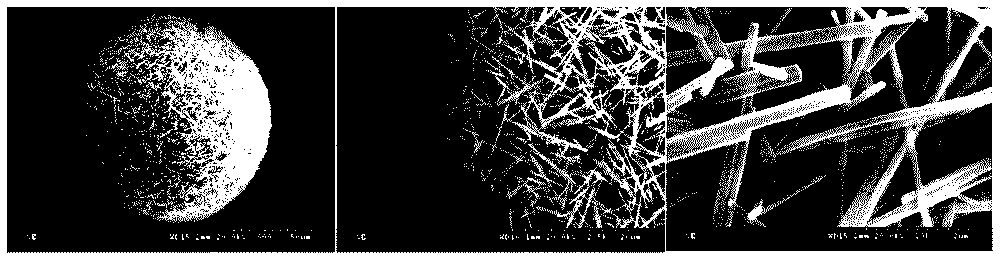
[0031] FIG. 1 is a scanning electron micrograph of the mesoporous glass carrier prepared in Example 1;
[0032] Figure 2 is the H prepared in Example 1<sub>2</sub>O<sub>2</sub>Modified TiO<sub>2</sub>/Scanning electron micrograph of mesoporous glass catalyst;
[0033] FIG. 3 is the TiO prepared in Comparative Example 2<sub>2</sub>/Scanning electron micrograph of mesoporous glass catalyst;
[0034] FIG. 4 is a mesoporous glass carrier prepared in Examples 1 to 5 and different loadings of H<sub>2</sub>O<sub>2</sub>Modified TiO<sub>2</sub>/Mesoporous glass catalyst (5, 10, 15, 20 and 25wt%) and H prepared in Comparative Example 1<sub>2</sub>O<sub>2</sub>Modified TiO<sub>2</sub>The XRD pattern of the catalyst;
[0035] FIG. 5 is an adsorption kinetic curve obtained by fitting the data in Example 6, Comparative Example 3 and Comparative Example 4 through a membrane diffusion model;
[0036] FIG. 6 is an adsorption kinetic curve obtained by fitting the internal diffusion model to the data in Example 6, Comparative Example 3 and Comparative Example 4;
[0037] FIG. 7 is an adsorption thermodynamic curve obtained by fitting Langmuir model to the data in Example 7 and Comparative Example 5.
Detailed ways
[0038] The present invention will be described in detail below in conjunction with specific embodiments. The embodiments of the present invention are not limited to the scope shown in the examples.
Example 1
[0040] Put 5g of glass microspheres and 200mL of deionized water in a high-temperature and high-pressure reactor, increase the pressure of the reactor to 12.5MPa, and a temperature of 325° C., keep it in this subcritical state for 2h, and wait until the temperature of the reactor drops to room temperature Afterwards, the etched glass microspheres are separated from water by filtration, washed several times with deionized water to pH=7, and then dried for use.
[0041] 0.15mL of tetrabutyl titanate was added to the mixed solution of 13mL of hydrogen peroxide and 20mL of isopropanol to obtain a yellow transparent solution and then 0.03g of cetyl ammonium and 0.65g of mesoporous glass carrier were added, After uniform ultrasonic dispersion, add dropwise to the mixed solution of 5mL deionized water and 10mL isopropanol, heat to 50°C to hydrolyze for 1h, transfer the resulting mixture to a stainless steel autoclave, crystallize reaction at 140°C for 4h, centrifuge and wash the product And dried, calcined at 450°C for 3h under air condition to obtain 5wt% H<sub>2</sub>O<sub>2</sub>Modified TiO2/Mesoporous glass photocatalytic oxidation-adsorption desulfurization catalyst.
Example 2
[0043] Prepare H according to the method of Example 1<sub>2</sub>O<sub>2</sub>Modified TiO<sub>2</sub>/Mesoporous glass photocatalytic oxidation-adsorption desulfurization catalyst, no
The same is that the added amount of tetrabutyl titanate is 0.31mL, and the titanium dioxide loading amount of the obtained catalyst is 10wt%.
Example 3
[0045] Prepared according to the method of Example 1. 2Modified Ticy mesoporous glass photocatalytic oxidation-adsorption desulfurization catalyst, the difference is that the added amount of tetrabutyl titanate is 0.49mL, and the titanium dioxide loading of the obtained catalyst is 15wt%.
Example 4
[0047] Η? was prepared according to the method of Example 1. ?Modified TiO?/Mesoporous glass photocatalytic oxidation-adsorption desulfurization catalyst, the difference is that the added amount of tetrabutyl titanate is 0.69mL, and the titanium dioxide loading of the obtained catalyst is 20wt%.
Example 5
[0049] Prepared according to the method of Example 1. 2Modified TiO?/Mesoporous glass photocatalytic oxidation-adsorption desulfurization catalyst, the difference is that the addition of tetrabutyl titanate is 0.92mL, and the titanium dioxide loading of the obtained catalyst is 25wt%.
[0050] Comparative Example 1
[0051] Prepared according to the method of Example 1. 2 Modified TiO?/Mesoporous glass photocatalytic oxidation-adsorption desulfurization catalyst, the difference is that the mesoporous glass carrier is not added, and it is obtained. 2 Modified TiO2 catalyst.
[0052] Comparative Example 2
[0053] Prepared according to the method of Example 1. 2 Modified Ticy mesoporous glass photocatalytic oxidation-adsorption desulfurization catalyst, the difference is that it is not added. 2. Obtain TiO2/Mesoporous glass catalyst.
[0054] FIG. 1 is a scanning electron micrograph of the mesoporous glass carrier prepared in Example 1. It can be seen from FIG. 1 that the mesoporous glass carrier has a fibrous filament structure, and the fiber gap forms a pore structure. The fiber diameter is 0.18 (±0.055). ) Um, the average diameter of the mesoporous glass carrier is 125.0 (±8.36) Um. Figure 2 is a scanning electron micrograph of the modified butane/mesoporous glass catalyst prepared in Example 1, and Figure 3 is a scanning electron microscope photograph of the butane/mesoporous glass catalyst prepared in Comparative Example 2. The two images can be compared. It is found that there are a large number of aggregated TiO? clusters in the TiO2/mesoporous glass catalyst, but in Η?. ? Modified TiO? / mesoporous glass catalyst can be observed that the distribution of TiO2 nanoparticles is more uniform. As tetrabutyl titanate and %. The strong interaction between the two can slow down the hydrolysis, inhibit the growth of NO2 particle size, and increase the specific surface area of the catalyst.
[0055] For verification as. 2. For the inhibitory effect of 2, the catalysts prepared in Examples 1 to 5 and Comparative Examples 1 and 2 were subjected to a so-called "adsorption test. The specific surface area, average pore size, and pore volume changes obtained are shown in the following table. From the data in the table, it can be seen that with With the increase of the loading of TiO2, the specific surface area of the Η?.?modified TiO?/mesoporous glass catalyst showed a trend of first increasing and then decreasing, and an inflection point appeared when the loading was 15wt%.
<td></td><td>project</td><td>BET specific surface area (m7g)</td><td>Average pore size (nm)</td><td>Pore volume (n?/g)</td>
<td></td><td>Comparative example 2</td><td>172.573</td><td>3. 661</td><td>0. 264</td>
<td></td><td>Example 1</td><td>186.184</td><td>4. 228</td><td>0. 334</td>
<td>[0056]</td><td>Example 2</td><td>259.033</td><td>4, 203</td><td>0. 266</td>
<td></td><td>Example 3</td><td>299.127</td><td>3. 626</td><td>0. 276</td>
<td></td><td>Example 4</td><td>242, 029</td><td>3. 667</td><td>0. 220</td>
<td></td><td>Example 5</td><td>216.766</td><td>3. 866</td><td>0. 303</td>
<td></td><td>Comparative example 1</td><td>90, 415</td><td>18.316</td><td>0. 173</td>
[0057] FIG. 4 shows the mesoporous glass carriers prepared in Examples 1 to 5 and H? with different loadings. ? Modified TiO?/Mesoporous glass catalyst (5, 10, 15, 20 and 25 sub 1%) and the *1 «) diagram of the modified 702 catalyst prepared in Comparative Example 1. No clear crystallization peak was observed on the mesoporous glass carrier, which indicates that the mesoporous glass carrier is amorphous. Η?. ? The peak position of the modified TiO2 diffraction peak conforms to the standard card (JCPDS 867157) for the anatase phase. The TiO2 loading is 5wt% ash. ?The characteristic peak of TiO? is not observed in the modified TiO2/mesoporous glass catalyst, which may be because TiO? is highly dispersed on the surface of the support and the crystal size is small, which exceeds the detection limit. When the TiO? loading is greater than 5wt%, a strong characteristic peak appears at the anatase phase TiO2, and the intensity of the characteristic peak gradually increases with the increase of TiO? content.
[0058] The dibenzo-n-octane was added to n-octane to configure a simulated oil with a sulfur content of 300 Ppm, and 50 mL of simulated oil and 0.1 g of the photocatalytic oxidation prepared by the preparation method described in the above technical solution were added to the reactor. -The adsorption desulfurization catalyst uses a 500W mercury lamp as a light source to radiate it for 4.5 hours, and a three-stage tandem quadrupole mass spectrometer is used to test the concentration of dibenzophene in the solution and calculate the desulfurization rate.
Item F1 Example 1 Example 2 Example 3 Example 4 Example 5 Comparative Example 1 Comparative Example 2
[0059] ----------------------------------------------- ------------------------------------------Desulfurization rate (hope 61.4 86.5 94.2 99.7 96.2 78.4 91.1
Example 6
[0061] The 20wt% photocatalytic oxidation-adsorption desulfurization catalyst prepared in Example 4 was added to the solution to be desulfurized at a concentration of 300Ppm for 5h, and a sample was taken out every 0.5h, separated, filtered and measured Sulfide concentration.
[0062] Comparative Example 3
[0063] The adsorption kinetic curve of the catalyst was measured according to the method of Example 6, except that the catalyst added was in Comparative Example 1. 2 Modified Ti. 2.
[0064] Comparative Example 4
[0065] The adsorption kinetic curve of the catalyst was measured according to the method of Example 6, except that the catalyst added was the mesoporous glass support in Example 1.
[0066] A membrane diffusion model and an internal diffusion model were used to process and fit the data. The linear expression of the membrane diffusion model is as follows:
Πηίΐ -wide)= -kt
Μ I
[0068] Among them, k is the adsorption rate constant, F is the realization index of equilibrium, t is the reaction time, is the adsorption amount at time t, and Qet is the adsorption amount when equilibrium is reached.
[0069] The linear expression of the internal diffusion model is as follows:
[0070] q<sub>t</sub> = k · Among them, t and the above definition are consistent, k is the rate constant, the unit is mg/ (g · min<sup>0</sup>'<sup>5</sup>)。
[0071] The data fitting results are shown in the diagrams (Figure 5 and Figure 6), and the relevant fitting parameters are listed in the following table. It can be seen from the fitting results that the membrane diffusion model describes the adsorption process more appropriately than the internal diffusion model. In other words, the molecular diffusion process in the adsorption process of sulfide is a decisive step, while the internal diffusion process of particles only has a certain influence.
<td rowspan="2"></td><td rowspan="2">project</td><td>Membrane diffusion model</td><td colspan="2">Internal diffusion model</td>
<td>k/min R<sup>2</sup></td><td>k/(mg. g. min <sup>0 &</sup>)</td><td>furnace</td>
<td>[0072]</td><td>Example 6</td><td>0.0331 0.9884</td><td>7.1038</td><td>0. 7314</td>
<td></td><td>Comparative example 3</td><td>0.0157 0.9875</td><td>7.2442</td><td>0. 8920</td>
<td></td><td>Comparative example 4</td><td>0.0188 0,9907</td><td>4. 1568</td><td>0.9325</td>
[0073] The photocatalytic oxidation-adsorption desulfurization catalyst prepared in Example 4 with a loading amount of 20wt% was added to the desulfurization solution of various concentrations (150, 200, 250, 300, 350 ~ 400 ppm). Stir at 150rpm for 4h at 30°C. Samples were taken out every 0.5h, separated and filtered to determine the sulfide concentration.
[0074] Comparative Example 5
[0075] The adsorption thermodynamic curve of the catalyst was measured according to the method of Example 7, except that the catalyst added was the mesoporous glass support in Example 1.
[0076] The Langmuir model was used to process and fit the data. The linear expression of the Langmuir model is as follows:% C<sub>e</sub> 1
[0077] - = - + --Qer 9m, spoon 9m
[0078] Wherein, Ce is the concentration of the liquid to be desulfurized under equilibrium, in mg/L, qet and respectively are the adsorption capacity and saturated adsorption capacity of the adsorbent after the adsorption reaches equilibrium, and the units are both mg/g, and are adsorption Equilibrium constant.
[0079] The data fitting results are shown in the figure (Figure 7), and the relevant fitting parameters are listed in the table below. It can be seen from the fitting results that the data of Example 4 and Comparative Example 5 are in line with the Langmuir model. Compared with the mesoporous glass carrier used in Comparative Example 5, the catalytic oxidation-adsorption of the modified butane/mesoporous glass used in Example 4 The addition of Q and q of the catalyst both increased, indicating that the adsorption capacity and the density of adsorption sites of the catalyst increased after loading dicyandiamide.
<td></td><td rowspan="2">project</td><td></td><td>Langmuir model</td><td></td>
<td></td><td>q J (mg. g)</td><td>KJ (L. g<sup>1</sup>)</td><td>R<sup>2</sup></td>
<td>|_UUOUJ</td><td>Example 7</td><td>87. 95</td><td>0. 142</td><td>0.9923</td>
<td></td><td>Comparative example 5</td><td>40. 91</td><td>0.016</td><td>0. 9879</td>
[0081] After the one-way reaction is over, the catalyst is washed with acetone, dried, and regenerated at 450°C for 3h00.1g regenerated photocatalytic oxidation-adsorption desulfurization catalyst and continue to be poured into a simulated oil (50mL) with a sulfur content of 300Ppm at 500W mercury The light source radiates for 4.5 hours to complete another desulfurization cycle. In the cycle, the initial conversion rate of the photocatalytic oxidation-adsorption desulfurization catalyst is basically unchanged after three regenerations, and a beneficial regeneration phenomenon occurs.
1 sheet
Sheet 1
Every citation, both ways
| Document | Relation | Office | Category | Cited during | Relevant claims |
|---|---|---|---|---|---|
| CN114515553A | Cited by | China | – | Search report | – |
| CN117138835A | Cited by | China | – | Search report | – |
| WO0076660A1 | Cites | World Intellectual Property Organization (WIPO) | A | Search report | 1-9 |
| CN109897459A | Cites | China | A | Search report | 1-9 |
| CN109930136A | Cites | China | A | Search report | 1-9 |
| CN111471481A | Cites | China | A | Search report | 1-9 |
| WO2010064225A1 | Cites | World Intellectual Property Organization (WIPO) | Y | Search report | 1-2,7 |
| 张彩云等: "微波辅助法制备H2O2改性TiO2及其光催化性能", 《印染》 | Non-patent | – | – | Search report | – |
2 members in 1 office
Priority claims3
| Document | Office | Kind | Date |
|---|---|---|---|
| 202110636580 | China | A | |
| CN202110636580 | – | – | – |
| CN20211636580 | – | – | – |
Members2
| Document | Office | Kind | |
|---|---|---|---|
| CN113308268AThis record | China | A | |
| CN113308268B | China | B |
3 legal events, as the office reported them to INPADOC
Over the term
Point at a mark for the eventEvents
| Event | Code | |
|---|---|---|
| Patent grantGrantedGR01 | GR01 | |
| Entry into force of request for substantive examinationSE01 | SE01 | |
| PublicationPB01 | PB01 |
Numbers
- Publication
- 113308268
- Publication, DOCDB
- 113308268
- Publication, EPODOC
- CN113308268
- Application
- 106365803
- Application, DOCDB
- 202110636580
- Application, EPODOC
- CN202110636580
Titles2
- Chinese
- /介孔玻璃催化剂的制备方法及应用
- English
- /Mesoporous Glass Catalyst Preparation Method and Application
Classification
- CPC, 4
- C10G29/00
- C10G25/00
- B01J20/103
- B01J21/08
- IPC, 4
- C10G29 00
- C10G25 00
- B01J21 08
- B01J20 10