Self-repairing and self-lubricating difunctional microcapsule as well as preparation method and application thereof
Abstract
The invention relates to a novel self-repairing and self-lubricating difunctional microcapsule as well as a preparation method and application thereof. Specifically, the invention provides a method for preparing a difunctional microcapsule, which comprises the following steps: impregnating hollow porous microspheres with a self-repairing agent to obtain a self-repairing agent impregnated microsphere capsule; uniformly mixing a self-lubricating agent in a molten state with the self-repairing agent impregnated microbead capsule to obtain a difunctional mixture; spraying the difunctional mixture on a collecting plate, and then collecting the cooled difunctional mixture from the collecting plate to obtain the difunctional microcapsule. The invention also provides the microcapsule prepared by the method, a method for preparing the self-repairing and self-lubricating difunctional composite material by using the microcapsule and the self-repairing and self-lubricating difunctional composite material prepared by the method. The preparation method has the advantages of being green and environmentally friendly, and the microcapsule with excellent self-repairing and self-lubricating functions or a composite material based on the microcapsule can be prepared.
Term
15.3 yearsto projected expiry
Projected expiry 17 January 2042, counted from filing; an application has no term until it is granted.
- Priority and filed
- Published
- Today
- Projected expiry
10 claims: 2 independent, 8 dependent
- 1A method for preparing self-healing self-lubricating bifunctional microcapsules, characterized in that the method comprises the steps:(1) impregnating hollow porous microbeads with a self-healing agent to obtain self-healing agent-impregnated microbead capsules;The self-lubricating agent in the molten state is mixed with the self-healing agent-impregnated microbead capsules to obtain a bifunctional mixture;(3) The bifunctional mixture is sprayed on the collecting plate, and then collected from the collecting plate after cooling. The bifunctional mixture was obtained to obtain bifunctional microcapsules. 1 .一种制备自修复自润滑双功能微胶囊的方法,其特征在于,所述方法包括如下步骤: ⑴使用自修复剂浸渍空心多孔微珠,得到自修复剂浸渍微珠胶囊; (2)将处于熔融状态的自润滑剂与所述自修复剂浸渍微珠胶囊混合均匀,得到双功能 混合料; ⑶将所述双功能混合料喷涂在收集板上,然后从所述收集板上收集冷却后的双功能 混合料,获得双功能微胶囊。
- 8A method for preparing a self-healing self-lubricating bifunctional composite material, characterized in that the method comprises:(1) preparing a resin matrix mixture comprising a resin matrix, a curing agent and a solvent;8 . 一种制备自修复自润滑双功能复合材料的方法,其特征在于,所述方法包括: ⑴制备包含树脂基体、固化剂和溶剂的树脂基体混合物; (2) While stirring the resin matrix mixture, the bifunctional microcapsules according to claim 7 are sprayed into the resin matrix mixture and dispersed uniformly to obtain a resin mixture;(3) The resin mixture is cured to obtain a Repair self-lubricating bifunctional composites. ⑵在搅拌所述树脂基体混合物的同时,将权利要求7所述的双功能微胶囊喷入到所述 树脂基体混合物中并分散均匀,制得树脂混合物; ⑶将所述树脂混合物固化,得到自修复自润滑双功能复合材料。
Independent claims2
109 paragraphs in 1 section, as filed
A self-healing and self-lubricating bifunctional microcapsule and its preparation method and application technical field
The present invention relates to new material technical field, be specifically related to a kind of novel self-healing self-lubricating bifunctional microcapsule and preparation method and application thereof.
Background technique
[0002] Microcapsules are microparticles with a core-shell structure, and their cores (cores) and shells (walls) can be designed according to different application requirements. In recent years, microcapsules have been widely used in the field of self-healing and self-lubricating materials. Among them, the application of microcapsules in the field of self-healing is mainly the preparation of self-healing polymer matrix composites, self-healing anti-corrosion coatings and self-healing concrete.
In the preparation process of the microcapsules, the repairing agent is used as the core material, and then the organic or inorganic material or the organic/inorganic hybrid material is used as the wall material, and the main function of the wall material is to protect the core material or make the microcapsules. With slow release function. The microcapsules are embedded in the matrix material. When the matrix material is damaged or microcracks occur, the microcapsules are broken, and the released repairing agent fills the microcracks and forms a self-healing film at the microcracks to repair the cracks. Self-healing of the matrix material.
[0004] The application of microcapsules in the field of self-lubricating is mainly to prepare self-lubricating polymer-based composite materials, wherein the lubricant is used as the core material, and the microcapsules are prepared with organic or inorganic materials or organic/inorganic hybrid materials as the wall material. When microcapsules are added to the matrix of the composite material, the microcapsules are ruptured under the action of friction and wear, and the released lubricant will form a self-lubricating transfer film on the friction surface, thereby effectively improving the friction and wear resistance of the material.
[0005] The commonly used wall materials of the microcapsules reported in the literature at present mainly include organic wall materials, such as urea-formaldehyde resin, melamine resin, polyurethane, polyurea, polysulfone, polystyrene and the like. When these organic substances are used as the wall materials of the microcapsules, the microcapsules are generally synthesized by chemical methods such as in-situ polymerization, interfacial polymerization, and solvent volatilization or by physical and chemical methods. In the process of microencapsulation, the use of various chemical reagents will be involved. For the inorganic wall materials commonly used in microcapsules such as silica or organic-inorganic hybrid wall materials such as polysulfone/silica, polystyrene/silica, etc., they should also be prepared by the sol-gel method or a combination of other chemical methods. have to. Therefore, the use of various chemical reagents is involved in the microencapsulation process, resulting in the production of microcapsules and microcapsule-based composites being a burden on the environment. Therefore, environmentally friendly microcapsules and microcapsule-based composite materials and its preparation method.
[0006] The present invention develops an environmentally friendly microencapsulation method that does not use or use trace amounts of chemical reagents in the preparation of the microcapsules. At the same time, a self-healing agent and a self-lubricating agent are respectively introduced into the core and wall structures of the microcapsules, so that the prepared microcapsules have both self-healing and self-lubricating functions, which can be used in polymer matrix composites. , to prepare polymer matrix composites or coatings with dual functions of self-healing and self-lubricating.
SUMMARY OF THE INVENTION
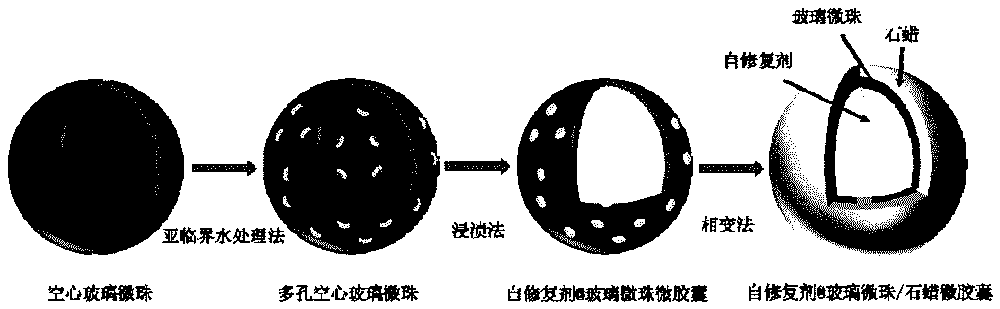
[0007] The present invention provides a novel self-healing and self-lubricating bifunctional microcapsule and its preparation method and application in the polymer-based composite material. The microcapsules use hollow porous glass microspheres as the carrier, and impregnate the self-healing agent (drying oils, isocyanates, epoxy resins, etc.) Microcapsules; phase change materials (such as paraffin) are then coated on the outer surface of the glass microbeads impregnated with the self-healing agent by the phase change method, and finally the self-healing agent@glass microbeads/self-lubricant double-walled microcapsules are prepared ( See Figure 1), the phase change material wall layer is not only suitable for glass
The porous structure on the surface of the microbeads is encapsulated to prevent the leakage of the core material repair agent, and the phase change material acts as a lubricant, which also makes the microcapsules have a self-lubricating function at the same time.
Specifically, the present invention provides a kind of method of preparing self-healing self-lubricating bifunctional microcapsules in the first aspect, and described method comprises the steps:
(1) use self-healing agent to impregnate hollow porous microbeads to obtain self-healing agent-impregnated microbead capsules;
(2) the self-lubricating agent in molten state and the self-healing agent impregnated microbead capsules are mixed to obtain bifunctional mixture;
(3) The bifunctional mixture is sprayed on the collection plate, and then the cooled bifunctional mixture is collected from the collection plate to obtain bifunctional microcapsules.
[0012] The present invention provides, in a second aspect, self-healing and self-lubricating bifunctional microcapsules prepared by the method according to the first aspect of the present invention.
The present invention provides, in a third aspect, a method for preparing a self-healing self-lubricating bifunctional composite material, the method comprising:
(1) preparing a resin matrix mixture comprising a resin matrix, a curing agent and a solvent;
(2) while stirring the resin matrix mixture, the bifunctional microcapsules described in claim 7 are sprayed into the resin matrix mixture and uniformly dispersed to obtain the resin mixture;
(3) curing the resin mixture to obtain a self-healing self-lubricating bifunctional composite material.
[0017] The present invention provides, in a fourth aspect, a self-healing and self-lubricating bifunctional composite material prepared by the method according to the third aspect of the present invention.
Relative to prior art, the present invention has following beneficial technical effect:
(1) The present invention is in microencapsulation process, and the preparation of porous glass microbead adopts subcritical water treatment method, and whole process only carries out in water or adds a small amount of sodium hydroxide; The present invention is in self-healing agent@microbead The physical impregnation method is adopted in the preparation process of the microcapsules, which does not involve the use of chemical reagents. Therefore, compared with the self-healing or self-lubricating microcapsules reported in the current literature, the microcapsule preparation method of the present invention is environmentally friendly.
(2) in the preparation process of self-healing agent@glass microbeads/phase change material double-walled microcapsules, the present invention adopts phase change method to carry out microcapsule coating under the molten state of phase change material, and after cooling, phase change material is composed of The liquid phase is transformed into a solid phase, and finally a glass microbead/phase change material double-wall layer structure can be formed. Compared with the self-healing or self-lubricating microcapsules reported in the current literature, the microcapsule core material prepared by the microcapsule preparation method of the present invention has a self-healing effect, and the wall material has a self-lubricating effect, which can meet the requirements of bifunctional composite materials or coatings. Applications.
(3) The polymer-based composite material or coating containing the microcapsules prepared by the present invention shows excellent self-healing and self-lubricating properties.
Description of drawings
Fig. 1 is the preparation process schematic diagram of novel self-repairing self-lubricating bifunctional microcapsules of the present invention
Fig. 2 shows the SEM figure of glass microbeads and microcapsules, wherein, what figure (a) shows is the SEM figure of glass microbeads; Figure (b) shows the SEM figure of porous glass microbeads; Figure (c) SEM images showing linseed oil@glass microbeads/paraffin microcapsules.
Figure 3 shows epoxy coatings with different microcapsule contents (ad: 0, 5, 10, 15 wt. %) soaked in 3.5 wt. % NaCl brine (1-4: 1, 5, 10, Corrosion at the scratch after 15 days).
Detailed ways
In order to make the purposes, technical solutions and advantages of the embodiments of the present invention clearer, the technical solutions in the embodiments of the present invention will be described clearly and completely below in conjunction with the accompanying drawings in the embodiments of the present invention. Obviously, the described The embodiments of the present invention are some of the embodiments of the present invention, but not all of the embodiments. Based on the embodiments of the present invention, all other embodiments obtained by those of ordinary skill in the art without creative work fall within the protection scope of the present invention.
The present invention provides a kind of method of preparing self-repairing self-lubricating bifunctional microcapsules in a first aspect, and described method comprises the steps:
(1) use self-healing agent to impregnate hollow porous microbeads to obtain self-healing agent-impregnated microbead capsules;
(2) the self-lubricating agent in molten state and the self-healing agent-impregnated microbead capsules are mixed uniformly to obtain bifunctional mixture;
(3) The bifunctional mixture is sprayed on the collection plate, and then the cooled bifunctional mixture is collected from the collection plate to obtain bifunctional microcapsules.
[0030] In some preferred embodiments, the self-healing agent is one or more self-healing agents selected from drying oils, isocyanates and epoxy resins.
In other preferred embodiments, the self-lubricating agent is a phase change material, preferably, the phase change material is a paraffin wax in a solid state at room temperature, more preferably, the melting point of the paraffin wax 45 to 70°C (eg 50 or 60°C).
In other preferred embodiments, the hollow porous microbeads are spherical microbeads with an outer diameter of 5 to 200 microns and an inner diameter of 2 to 180 microns. Preferably, the hollow porous microbeads are hollow porous glass microbeads. More preferably, the hollow porous microbeads are prepared by the following method: the hollow glass microbeads are put into lye to obtain a hollow microbead mixture, the hollow glass microbead mixture is put into a reaction kettle, and the temperature is raised to 100°C. to a temperature of 150 to 300 ° C (eg 200 or 250 ° C) and the pressure in the reactor is raised to a pressure of 0.5 to 9 MPa (eg 1, 2 or 5 MPa) and maintained for 1 to 3 hours (eg 2 hours) , and then cooled to room temperature to obtain hollow porous glass beads. Further preferably, the alkaline solution is an aqueous sodium hydroxide solution or an aqueous potassium hydroxide solution with a concentration of 0.1 to 1M (eg, 0.5M). Of course, a porous structure can also be obtained if water is used instead of the lye. However, from the viewpoint of production efficiency and the like, it is preferable to use an alkaline solution rather than pure water.
In other preferred embodiments, step (1) is carried out in the following manner: the hollow porous microbeads are added to the self-healing agent and dispersed uniformly, and then put into a vacuum oven to remove the air bubbles in the hollow porous microbeads , so that the self-healing agent is impregnated into the hollow porous microbeads, and then placed at room temperature for 3 to 24 hours (for example, 6, 9, 12, 15, 18 or 21 hours), and the obtained product is filtered and washed to obtain the Self-healing agent impregnated microbead capsules. Preferably, the mass ratio of the hollow porous microbeads to the self-healing agent is 1:(2~10), for example, 1:(3, 4, 5, 6, 7, 8 or 9). More preferably, the dispersion is carried out by means of ultrasonic dispersion, the power of ultrasonic dispersion is 50W to 360W; the time of ultrasonic dispersion is 10 to 30 minutes (eg 20 minutes). Further preferably, the temperature of the vacuum oven is room temperature to 80° C., the vacuum degree is 0.01-0.09 MPa, and the immersion time is 0.5 to 2 hours (for example, 1 or 1.5 hours).
In other preferred embodiments, in step (2), the phase change material is incubated at 80 to 120° C. (for example, 90, 100 or 110° C.) for 5 to 20 minutes (for example, 10 or 15 minutes) to make The phase change material is in a sufficiently molten state. Preferably, in step (2), the mass ratio of the self-healing agent-impregnated microbead capsules to the phase change material is 1: (0.4~0.8), such as 1: (0.4, 0.5, 0.6 or 0.7). If the amount of phase change material is too low, it may not be able to fully coat the self-healing agent-impregnated microbead capsules; if the amount of phase change material is too large, the thickness of the coated phase change material layer may be too large, making the self-healing agent in it too thick. When the microcapsules are damaged, the self-healing agent cannot be released smoothly to perform the self-healing function.
In other preferred embodiments, in step (3), described spraying is by pouring described bifunctional mixture
This is achieved by spraying in a spray gun preheated at 80 to 120°C (eg 90, 100 or 110°C). Preferably, in step (3), the collection plate is a glass plate.
[0036] Referring now to FIG. 1 . Figure 1 shows some more specific embodiments of the method according to the first aspect of the invention. As shown in Figure 1, the method includes the following steps:
(1) adopt subcritical water treatment method to prepare porous glass beads
Hollow glass microbeads are put into 0 to 1mol/L sodium hydroxide aqueous solution (glass microbeads and sodium hydroxide aqueous solution mass ratio 1:(20-100), obtain hollow microbead mixture; Put it into a high temperature and high pressure reaction kettle with magnetic stirring, raise the temperature of the reaction kettle to 150-300 ° C, and the pressure in the reaction kettle also increases to 0.5 to 9 MPa with the increase of temperature, and maintain 1 to 3 in this state. After one hour, the reaction kettle was naturally cooled to room temperature, the product was washed with deionized water, and immersed in a vacuum oven at a temperature from room temperature to 80°C and a vacuum degree of 0.01-0.09MPa to obtain hollow porous glass beads;
(2) adopt dipping method to prepare self-healing agent@glass microbead microcapsules
The hollow porous glass microspheres after drying are put into self-healing agent (mass ratio 1:(2-10)), ultrasonic dispersion 1030min (ultrasonic power is 50W to 360W), put into vacuum oven again at room temperature to The temperature of 80°C and the vacuum degree of 0.01-0.09MPa are immersed for 0.5 to 2 hours to fully remove the air bubbles in the hollow glass beads. 3 to 24 hours to increase the self-healing agent impregnation rate. After the impregnated product is filtered and solvent washed to remove the self-healing agent remaining on the outer surface of the glass beads, the self-healing agent@glass bead microcapsules are obtained; [0041] (3) Self-healing agent@glass beads/self-lubricating agent Preparation of double-walled microcapsules
[0042] The paraffin wax is heated to 80-120 DEG C and then incubated for 5-20min, so that the paraffin wax is fully melted. Add the self-healing agent@glass microbead microcapsules into molten paraffin (the mass ratio of microcapsules to paraffin wax is 1:0.4-0.8), after stirring evenly, pour the mixture into a spray gun preheated at 80-120°C , spray the mixture in the spray gun onto the glass plate, collect the product after natural cooling, and obtain the self-healing agent@glass microbeads/paraffin double-walled microcapsules (ie, dual-function microcapsules).
[0043] The present invention provides, in a second aspect, self-healing and self-lubricating bifunctional microcapsules prepared by the method according to the first aspect of the present invention.
The present invention provides, in a third aspect, a method for preparing a self-healing self-lubricating bifunctional composite material, the method comprising:
(1) preparing a resin matrix mixture comprising a resin matrix, a curing agent and a solvent;
(2) while stirring the resin matrix mixture, the bifunctional microcapsules described in claim 7 are sprayed into the resin matrix mixture and uniformly dispersed to obtain a resin mixture;
(3) curing the resin mixture to obtain a self-healing self-lubricating bifunctional composite material.
[0048] In some preferred embodiments, the resin matrix is selected from one or more of epoxy resins, polyurethane resins, and alkyd resins.
[0049] The choice of curing agent is determined by the choice of resin matrix. Generally, when the resin matrix is sold, it will be equipped with the corresponding curing agent. Therefore, in the present invention, the curing agent does not need to list the corresponding curing agent for various resin matrices, and those skilled in the art are fully capable of selecting the corresponding curing agent according to the selection of the resin matrix.
[0050] In other preferred embodiments, the resin matrix mixture comprises a resin matrix, a curing agent and a solvent in a mass ratio of 3:1:1.
In other preferred embodiments, described solvent is selected from one or more in ethanol, Virahol.
[0052] In other preferred embodiments, the added amount of the microcapsules is 1 to 20% by mass.
In other preferred embodiments, curing is room temperature curing, and curing time is 24 to 72 hours.
In some more specific embodiments, what the method makes is a self-healing/self-lubricating bifunctional composite material in the form of a mold-forming material, the method comprising the steps of:
(1) preparing a resin matrix mixture comprising a resin matrix, a curing agent and a solvent;
(2) while stirring the resin matrix mixture, the bifunctional microcapsules described in the second aspect of the present invention are sprayed into the resin matrix mixture by a spray gun, the addition of the microcapsules is 1-20wt.% (based on the total weight of the resin matrix and the curing agent) to obtain a resin mixture, wherein the resin matrix can be epoxy resin, polyurethane resin, alkyd resin, etc.;
(3) The resin mixture is injected into the molding die, and cured at room temperature for 24 to 72 hours to obtain a polymer-based self-healing and self-lubricating bifunctional composite material.
In other more specific embodiments, what described method makes is self-healing self-lubricating bifunctional composite material in coating form, and comprises the steps:
(1) the coated substrate (usually can be a metal plate) is polished with sandpaper, then cleaned with deionized water and ethanol, and dried in an oven for subsequent use;
(2) preparing a resin matrix mixture comprising a resin matrix, a curing agent and a solvent;
(3) the bifunctional microcapsules described in the second aspect of the present invention are sprayed to the resin matrix mixture (in the total weight of the resin matrix and the curing agent, the addition of the bifunctional microcapsules is 1-20wt.%) and stir evenly (the resin matrix mixture container can be accompanied by magnetic stirring during the spraying process) to obtain a resin mixture containing microcapsules, wherein the resin matrix can be epoxy resin, polyurethane resin or alkyd resin Wait;
(4) the resin mixture containing microcapsules is evenly coated on the surface of the substrate (the dry film thickness of the coating can be adjusted between 50-500um as required), cured at room temperature for 24-72h, and self-repairing and self-lubricating double-layers are prepared. Functional composite coating.
[0063] In other more specific embodiments, the method produces a self-healing self-lubricating bifunctional composite coating in the form of alternating coatings, and the method comprises the steps of:
(1) The coated substrate (usually metal plate) is polished with sandpaper, then cleaned with deionized water and ethanol, and dried in an oven for subsequent use;
(2) formulating a resin matrix mixture comprising resin matrix, curing agent and solvent.
(3) Two spray guns are prepared, the resin matrix mixture is added in the spray gun 1, and the spray gun 2 adds the bifunctional microcapsules described in the second aspect of the present invention (the temperature in the spray gun remains in the temperature range of 80-120 ° C). Put the coated substrate on the heating table, the temperature of the heating table is controlled within the temperature range of room temperature -50 ° C, spray the resin mixture in the spray gun 1 on the surface of the substrate to form a layer of resin coating, and leave it for 5-30 minutes until the solvent evaporates Then, spray the microcapsules in the spray gun 2 on the surface of the above-mentioned coating (the addition amount of the microcapsules is 1-20 wt.%), repeat the above operation, and spray the resin layer and the microcapsules as many times as needed, and then spray the resin layer on the last layer. After spraying, the coating is cured at room temperature for 24-72 hours, and a self-healing and self-lubricating bifunctional composite coating is finally prepared.
[0067] In some embodiments, the bifunctional microcapsules can be replaced by the bifunctional mixture obtained in step (2) of the method described in the first aspect of the present invention.
[0068] The present invention provides, in a fourth aspect, a self-healing and self-lubricating bifunctional composite material prepared by the method according to the third aspect of the present invention.
[0069] In some preferred embodiments, the material is a mold-cured molding material.
In other preferred embodiments, the material is a coating material, more preferably, the coating material is
The thickness is 50 to 500 microns (eg 100, 200, 300 or 400 microns).
Embodiment
Preparation example 1
1g outer diameter is 20um, inner diameter is 18um hollow glass microbeads (referring to the figure (a) of Fig. 2) and 40mL (0.1mol/L) sodium hydroxide aqueous solution is joined in the reactor, heat up under airtight state After maintaining at this temperature for 2 hours, the reaction kettle was naturally cooled to room temperature, filtered, washed with deionized water, and dried to obtain porous hollow glass beads.
Disperse 1g of porous hollow glass microspheres into 10g of linseed oil as self-healing agent, disperse ultrasonically for 20min with the ultrasonic power of 180W, put it in a vacuum oven at 50°C temperature, immerse it under 0.06MPa vacuum for 30min, and then immerse it for 30min. It was placed in the air for 12 h, filtered and washed with ethyl acetate solvent to remove the linseed oil on the outer surface of the glass microbeads to obtain the self-healing agent@glass microbead microcapsules (see Figure 2 (b)).
1.2g solid paraffin (melting point is 70 °C) is melted at 120 °C for 10min, the spray gun is put into 120 °C oven and fully preheated (preheated to 120 °C), 2g self-healing agent@glass beads micro The capsules are added to the molten paraffin, and after stirring evenly, pour it into the preheated spray gun, use the smooth glass plate as the collecting plate, and spray the mixture in the spray gun onto the glass plate, and the paraffin wax changes from molten liquid to solid at room temperature. , and wrapped on the outer surface of the self-healing agent@glass microbeads microcapsules, and the self-healing agent@glass microbeads/paraffin microcapsules were obtained after collecting the product (see Figure 2(c)).
Preparation example 2
[0077] The method is basically the same as that of Preparation Example 1, except that isocyanate is used instead of linseed oil as a self-healing agent.
Preparation example 3
[0079] The method is basically the same as that of Preparation Example 1, except that epoxy resin is used instead of linseed oil as a self-healing agent.
Preparation example 4
[0081] The method is basically the same as that of the preparation example 1, and the difference is that the consumption of the porous hollow glass microbeads is 5g.
Preparation example 5
Adopt the method substantially identical with preparation example 1 to carry out, difference is that the consumption of paraffin wax is 1.6g.
Preparation example 6
[0085] The method is basically the same as that of Preparation Example 1, except that the consumption of paraffin wax is 0.8 g.
[0086] The results found that the structural integrity of the bifunctional microcapsules prepared in Preparation Examples 1 to 6.
Application example 1
Epoxy resin, curing agent (epoxy resin and curing agent are purchased from Heilongjiang Academy of Sciences Institute of Petroleum Chemistry) and ethanol solvent are uniformly mixed according to 3:1:1 mass ratio to obtain resin matrix mixture. While stirring the resin matrix mixture, the microcapsules prepared in Preparation Example 1 were sprayed into the resin matrix mixture from a spray gun, so that the microcapsules were uniformly dispersed in the resin mixture to obtain an epoxy resin mixture, wherein the microcapsules were %. The mass percentage of the resin matrix mixture is 5wt.%. The epoxy resin mixture was poured into a molding mold and cured at room temperature for 24 hours to prepare a self-healing and self-lubricating bifunctional composite material.
Application example 2
[0090] The stainless steel plate is polished with sandpaper, cleaned with deionized water and ethanol, and dried in an oven for subsequent use.
With epoxy resin, curing agent (epoxy resin and curing agent Heilongjiang Academy of Sciences Petrochemical Research Institute) and ethanol
The solvent is uniformly mixed in a mass ratio of 3:1:1 to obtain a resin matrix mixture. While stirring the resin matrix mixture, the microcapsules prepared in Preparation Example 1 were sprayed into the resin matrix mixture from a spray gun, so that the microcapsules were uniformly dispersed in the resin mixture to obtain an epoxy resin mixture, wherein the microcapsules were %. With resin mixture mass ratio of 10wt.%. The epoxy resin mixture was evenly coated on the treated steel plate with a dry film thickness of about 300um, and cured at room temperature for 48 hours to prepare a self-healing and self-lubricating bifunctional composite coating.
Application example 3
[0093] The stainless steel plate is polished with sandpaper, cleaned with deionized water and ethanol, and dried in an oven for subsequent use.
Epoxy resin, curing agent (epoxy resin and curing agent Heilongjiang Academy of Sciences Institute of Petroleum Chemistry) and ethanol solvent are uniformly mixed according to 3:1:1 mass ratio to obtain resin matrix mixture.
[0095] Then, the resin matrix mixture was placed in the spray gun 1. The microcapsules prepared in Preparation Example 1 were put into spray gun 2 (the temperature in the spray gun was kept in the temperature range of 80-120°C). The stainless steel plate was placed on the heating stage, and the heating stage was heated to 40 °C. The resin matrix mixture in the spray gun 1 was sprayed on the surface of the stainless steel plate to form a layer of resin coating, placed for 10min to wait for the solvent to volatilize and then the microcapsules in the spray gun 2 were sprayed on the surface of the above-mentioned coating (calculated by the total weight of the resin matrix and the curing agent). , the added amount of microcapsules is 10wt.%, and the full text involves the amount of added microcapsules, all based on the total weight of the resin matrix and the curing agent) to form a microcapsule layer. The resin coating, the microcapsule layer and the resin coating are sprayed in sequence according to the above method. After spraying, the coating was cured at room temperature for 72 h to prepare a self-healing and self-lubricating bifunctional composite coating.
Test example 1: the self-lubricating property of epoxy resin coating
[0097] Using friction and wear experiments, the self-lubricating properties of epoxy resin composite coatings were evaluated by changes in friction coefficient and wear amount. The linseed oil@glass microbeads/paraffin microcapsules prepared in Preparation Example 1 were added to the epoxy resin coating (the preparation method was the same as that of Application Example 2), and the addition amounts were 0, 5, 10, and 15 wt. The friction coefficient and wear amount of the material coating gradually decreased with the increase of the microcapsule addition, and the friction coefficient of the epoxy resin composite coating with 10wt.% linseed oil@glass microbeads/paraffin microcapsules decreased from 0.5156 to 0.0662 , the friction loss decreased from 0.2854g/0.5h to 0.098g/0.5h. However, when the microcapsule content continues to increase to 15wt.%, the friction coefficient and wear amount of the composite coating will increase again. This is mainly because the excessive addition of microcapsules will affect the mechanical properties of the resin matrix, and the mechanical properties also affect the material. A major cause of friction and wear performance. The results of this set of experiments show that the epoxy resin composite coating has the best anti-friction and wear-resisting effect, namely self-lubricating performance, when adding linseed oil@glass microbeads/paraffin microcapsules with a particle size of about 20um.
Test example 2: the self-healing performance of epoxy resin coating
Adopt salt spray test, by soaking coating in the NaCl salt solution of 3.5wt.% for 15 days, observe the self-healing performance of epoxy resin composite material coating (referring to table 1 below) ). Add linseed oil@glass microbeads/paraffin microcapsules to the epoxy resin coating, the addition amount is 0, 5, 10, 15wt.%, respectively, prepare the coating according to the method of application example 2, and then scratch the coating surface. Cross scratches, the depth of scratches reaches the metal substrate. The coating was then placed at room temperature for 72h, allowing the scratches to achieve self-healing. During this process, the microcapsules at the scratches are broken, and the released linseed oil undergoes a cross-linking reaction after encountering oxygen in the air to form a self-healing film, which repairs the scratches. The corrosion of the coating after 1, 5, 10 and 15 days of immersion was observed and recorded. Figures (a1 to a4) show the corrosion of pure epoxy coatings. It can be considered that the scratches of the coatings without microcapsules began to corrode on the first day of immersion, and there was obvious rust on the scratches. The soaking time The longer it is, the more serious the corrosion phenomenon is. Figures (b1 to b4) show the corrosion of the epoxy coating with 5wt.% microcapsules added. Compared with the pure epoxy coating, the corrosion is slightly improved, but the corrosion at the scratch is still serious after 15 days of immersion , which indicates that the linseed oil repairing agent released by the 5wt.% microcapsules is not sufficient to repair the scratches. Figures (c1 to c4) show the corrosion of epoxy coatings with 10wt.% microcapsules added. It can be observed that there is almost no corrosion phenomenon of the coating during the entire immersion period, indicating that new scratches have formed at the scratches.
The self-healing film prevents the penetration of corrosive media, thereby inhibiting the corrosion of metal substrates. Figures (dl to d4) show the corrosion of epoxy coatings with 15wt. % microcapsules added. It can be observed that the coating found corrosion on the 10th day of immersion. Although its anti-corrosion effect is worse than that of pure epoxy coatings, However, the anti-corrosion effect of the epoxy coating with 10wt.% microcapsules is not as good as that of the epoxy coating, which is mainly because the high content of microcapsules will affect the mechanical properties of the resin matrix and the interfacial bonding properties with the substrate, thereby affecting the coating. Overall corrosion resistance. This set of experimental results showed that adding linseed oil@glass microparticles with a particle size of about 20μ1η
<img file="CN114515553A_D0001.tif" />
Finally it should be noted that: above embodiment is only in order to illustrate technical scheme of the present invention, rather than its limitation; Although the present invention has been described in detail with reference to foregoing embodiment, those of ordinary skill in the art should understand: It can still modify the technical solutions recorded in the foregoing embodiments, or perform equivalent replacements to some of the technical features; and these modifications or replacements do not make the essence of the corresponding technical solutions depart from the spirit of the technical solutions of the embodiments of the present invention. and range.
2 sheets
Sheet 1 Sheet 2
Every citation, both waysCites: the store holds 23 of 24
| Document | Relation | Office | Category | Cited during | Relevant claims |
|---|---|---|---|---|---|
| CN115558539A | Cited by | China | – | Search report | – |
| CN115382741A | Cited by | China | – | Search report | – |
| CN116677018A | Cited by | China | – | Search report | – |
| CN102250419A | Cites | China | A | Search report | 1-10 |
| CN102580729A | Cites | China | A | Search report | 1-10 |
| CN104043464A | Cites | China | A | Search report | 1-10 |
| CN107446502A | Cites | China | A | Search report | 1-10 |
| CN108272119A | Cites | China | A | Search report | 1-10 |
| CN109929363A | Cites | China | A | Search report | 1-10 |
| CN110052230A | Cites | China | A | Search report | 1-10 |
| CN110845169A | Cites | China | A | Search report | 1-10 |
| CN111569794A | Cites | China | A | Search report | 1-10 |
| CN112780247A | Cites | China | A | Search report | 1-10 |
| CN113308268A | Cites | China | A | Search report | 1-10 |
| EP1884358A1 | Cites | European Patent Office (EPO) | A | Search report | 1-10 |
| US2002083959A1 | Cites | United States of America | A | Search report | 1-10 |
| US2003018118A1 | Cites | United States of America | A | Search report | 1-10 |
| US2004118812A1 | Cites | United States of America | A | Search report | 1-10 |
| US2006217622A1 | Cites | United States of America | A | Search report | 1-10 |
| US2014134426A1 | Cites | United States of America | A | Search report | 1-10 |
| WO2015032816A1 | Cites | World Intellectual Property Organization (WIPO) | A | Search report | 1-10 |
| TW201643941A | Cites | Taiwan Province of China | A | Search report | 1-10 |
| US2017030077A1 | Cites | United States of America | X | Search report | 1-10 |
| TW201737361A | Cites | Taiwan Province of China | A | Search report | 1-10 |
| JPH053910A | Cites | Japan | A | Search report | 1-10 |
| JPS63119846A | Cites | Japan | A | Search report | 1-10 |
1 member in 1 office
Priority claims2
| Document | Office | Kind | Date |
|---|---|---|---|
| 202210047985 | China | A | |
| CN20221047985 | – | – | – |
Members1
| Document | Office | Kind | |
|---|---|---|---|
| CN114515553AThis record | China | A |
3 legal events, as the office reported them to INPADOC
Over the term
Point at a mark for the eventEvents
| Event | Code | |
|---|---|---|
| Patent grantGrantedGR01 | GR01 | |
| Entry into force of request for substantive examinationSE01 | SE01 | |
| PublicationPB01 | PB01 |
Numbers
- Publication
- 114515553
- Publication, DOCDB
- 114515553
- Publication, EPODOC
- CN114515553
- Application
- 100479858
- Application, DOCDB
- 202210047985
- Application, EPODOC
- CN202210047985
Titles2
- Chinese
- 一种自修复自润滑双功能微胶囊及其制备方法和应用
- English
- A kind of self-healing and self-lubricating bifunctional microcapsule and its preparation method and application
Classification
- CPC, 14
- B01J13/02
- C08K9/10
- C08K7/28
- C08L91/00
- C08L91/06
- C08L63/00
- C08K5/29
- C09D163/00
- C09D7/62
- C09D7/70
- C09D7/65
- C09D7/63
- C09D5/08
- Y02E60/14
- IPC, 12
- B01J13 02
- C08K9 10
- C08K7 28
- C08L91 00
- C08L91 06
- C08L63 00
- C08K5 29
- C09D163 00
- C09D7 62
- C09D7 65
- C09D7 63
- C09D5 08