Communication units, cell-based communication system and method for frequency planning therein
Abstract
A method (300) of frequency re-planning in a cellular communication system that comprises multiple cells with a first cell that is contained within, or overlapping with, or adjacent to, a second cell. The method comprises the step of identifying a frequency re-plan operation of the second cell. The method further comprises the steps of receiving (345), by a wireless communication unit operating in the first cell, one or more broadcast transmissions from the second cell to identify one or more frequencies used in the second cell; and performing (355) a frequency re-planning operation of the first cell based on the one or more identified frequencies used in the cell. In this manner, when applied to a pico-cell/macro-cell scenario, the preferred mechanism reduces reliance on external (macro-cell) network traffic, thus enabling more efficient management of pico-cell frequency re-plans. A communication system (100) and a communication unit are also provided.
Term
No projected expiry on record.
- Priority
- Filed
- Published
- Today
23 claims: 7 independent, 16 dependent
- 1Claims 1. A method (300) of frequency re-planning in a cellular communication system (100) that comprises multiple cells with a first cell (165) that is contained within or overlapping with or adjacent to a second cell (160), the method comprising the step of:identifying, in the first cell, a frequency re- plan operation of the second cell (160) ;the method characterised by the steps of: receiving (345) , by a wireless communication unit operating in the first cell (165) , one or more broadcast transmissions from the second cell (160) ;decoding the one or more broadcast transmissions to identify one or more frequencies used in the second cell (160) ;and performing (355) a frequency re-planning operation of the first cell (165) based on the one or more identified frequencies.
- 2The method (300) of frequency re-planning in a cellular communication system (100) according to Claim 1, the method further characterised in that the first cell (165) is substantially a pico-cell in a context that the second cell (160) is substantially a micro-cell or substantially a macro-cell.
- 3The method (300) of frequency re-planning in a cellular communication system (100) according to Claim 1, the method further characterised in that the first cell (165) is substantially a micro cell in a context that the second cell (160) is substantially a macro cell.
- 5The method (300) of frequency re-planning in a cellular communication system (100) according to Claim 4, wherein the step of decoding is performed by the serving base transceiver station (170) , to identify cell identity information of the second cell (160) in one or more broadcast transmissions.
- 8The method (300) of frequency re-planning in a cellular communication system according to Claim 7, the method further characterised by the step of employing pre-emptive triggers (325) to initiate the step of:scanning (340) , by the wireless communication unit, in response to identifying a frequency re-plan operation of the second cell (160) .
- 13A cellular communication unit (172) operating in a cellular communication system that comprises multiple cells with a first cell (165) that is contained within or overlapping with or adjacent to a second cell (160), wherein the cellular communication unit (172) operates in a first cell (165) , the cellular communication unit (172) characterised by:a receiving function for receiving information relating to one or more broadcast transmissions from a second cell (160) that identify one or more frequencies used in the second cell (160) following a frequency re- plan operation;and a processor, operably coupled to the receiving function, to process the received information and perform (355) a frequency re-plan operation of the first cell (165) based on the one or more identified frequencies used in the second cell (160) .
- 14The communication unit (172) according to Claim 13 i wherein the communication unit is an operations and management centre configured to generate a pico-cell frequency plan in response to downlink broadcast control channel monitoring of macro-cell or micro-cell requencies .
- 16A wireless serving communication unit (170) operating in a cellular communication system (100) that comprises multiple cells with a first cell (165) that is contained within or overlapping with or adjacent to a second cell (160), wherein the wireless serving communication unit (170) operates in a first cell (165) , the wireless serving communication unit (170) characterised by:a receiving function (182) receiving one or more broadcast transmissions from a second cell;and a processor (184), operably coupled to the receiving function (182) . decoding and identifying one or more frequencies used in the second cell (160) following a frequency re-plan operation.
- 17The wireless serving communication unit (170) according to Claim 16, wherein the wireless serving communication unit is able to communicate on a GSM, GPRS iDEN, or TDMA cellular communication system.
- 18A cellular communication system (100) comprising multiple cells with a first cell (165) that is contained within, or overlapping with, or adjacent to, a second cell (160) , wherein the cellular communication system (100) comprises a cellular communication unit operating in the first cell (165) and identifying a frequency re- plan operation of the second cell (160) ;wherein the cellular communication system (100) is characterised by the cellular communication unit receiving and decoding one or more broadcast transmissions from the second cell (160) to identify one or more frequencies used in the second cell (160) following a frequency re-plan, and a frequency re-plan function performing a frequency re-planning operation of the first cell (165) based on the one or more identified frequencies.
- 19The cellular communication system (100) according to Claim 18, the cellular communication system (100) further characterised in that the first cell (165) is substantially a pico-cell in a context that the second cell (160) is substantially a micro-cell or substantially a macro-cell.
- 20The cellular communication system (100) of frequency re-planning in a cellular communication system (100) according to Claim 18, the cellular communication system (100) further characterised in that the first cell (165) is substantially a micro cell in a context that the second cell (160) is substantially a macro cell.
- 22The cellular communication system (100) according to Claim 21, wherein the serving base transceiver station (170) decodes one or more broadcast transmissions to identify cell identity information of the second cell (160).
Independent claims17
66 paragraphs, as filed
0001COMMUNICATION UNITS, CELL-BASED COMMUNICATION SYSTEM AND METHOD FOR FREQUENCY PLANNING THEREIN
0002Field of the Invention
0003This invention relates to frequency planning in a cell- based wireless communication system. The invention is applicable to, but not limited to, frequency planning in a pico-cell environment, when the pico-cell's radio propagation characteristics are affected by a higher layer's radio propagation characteristics.
0004Background of the Invention
0005Wireless communication systems, for example cellular telephony or private mobile radio communication systems, typically provide for radio telecommunication links to be arranged between a plurality of base transceiver stations (BTSs) and a plurality of subscriber units, often termed mobile stations (MSs) .
0006Wireless communication systems are distinguished over fixed communication systems,, such as the public switched telephone network (PSTN), principally in that subscriber units/mobile stations move between coverage areas, where communications in the different coverage areas are served by different BTS (and/or different service providers) . In doing so, the subscriber units/mobile stations encounter varying radio propagation environments.
0007In a wireless communication system, each BTS has associated with it a particular geographical coverage area (or cell) . Primarily, a particular transmitter power level defines a coverage area where a BTS can maintain acceptable communications with MSs operating within its serving cell. In addition, receiver sensitivity performance of receiving wireless communication units also affects a given coverage area. In large cellular communication systems, these cells are combined and often overlapped to produce an extensive and contiguous signal coverage area, whilst the subscriber units/mobile stations move between cells. The cell overlap region is deliberately designed into the system plan to ensure that subscriber units/mobile stations can successfully handover between cells.
0008The cellular communication system may cover a very large geographical area. In such scenarios, the cellular communication system may be termed a macro-cell system. It is known that the macro-cell system may support an underlay of a micro-cellular environment (or the like), with a plurality of micro-cells operationally controllable by a BSC of the macro-cell system. The micro-cells may operate an identical air-interface to the macro-cell, but this need not be the case. Furthermore, it is known that an even lower cell-based system may be used, for example where the communications are limited to within a building. Such a cell-based system is termed a pico-cell system. In this regard, the pico-cell system may be considered as an underlay cellular system to a macro-cell or micro-cell system.
0009A system design based on cells is typically based on an ideal cell pattern. However, an idealised cell pattern never occurs in practice, due to the nature of the terrain and the fact that cell sites and antennae are not ideally located on a regular grid pattern. The network designer therefore uses frequency-planning tools to estimate the radio propagation for each cell and predict a corresponding coverage area. Based on these propagation models, the network designer is able to develop a frequency plan for the network that is intended to minimise the expected interference.
0010Frequency planning is arguably the most challenging and time consuming task in designing a mobile communication network. Effective usage of the frequency spectrum, one of the scarcest resources for any operator, leads to both better network quality and increased capacity. In this regard, the frequency plan considers such factors as antenna heights and location, terrain topology, transmitted power levels and the anticipated number of subscriber units.
0011In the context of frequency planning, recent developments in simulation tools have provided the opportunity to ^automatically' perform a frequency re-planning operation, based on analysis of measured data and system parameters such as transmit power, subscriber receiver sensitivity, etc. Automating a frequency planning process typically produces better quality frequency plans and yields a multitude of benefits, such as (i) A better quality of service may be achieved in networks with minimal opportunity for frequency reuse, particularly in networks with tight frequency reuse; (ii) A major capital expenditure in infrastructure may be deferred, as the current network is able to handle more traffic at a given quality of service; and
0012(iii) The time for frequency planning is reduced - enabling system designers enough time to concentrate on other, more complex enhancements to network quality.
0013In particular, automatic frequency planning (AFP) is a useful feature in the planned widespread deployment of in-building pico-cellular systems. To ensure seamless connectivity between pico-cells, handover functionality must be maintained. For systems supporting AFP applications, there is a requirement on active subscriber units to scan as many frequencies as possible to aid frequency planning. This information, in the form of measurement reports, is fed into an AFP application that is able to determine an optimal frequency plan for that particular layer of the cellular communication system.
0014A known problem in multi-layer cellular communication systems is that in-building (pico-cell) wireless communication systems are generally allocated frequencies based on an available subset of those frequencies being used in the external macro-cell (or micro-cell) environment. With the recent expansion in the numbers of in-building wireless systems, it has made it impossible for the macro-cell Frequency Planner to take the consequent effect on the pico-cell into account when designing the macro plan. In this scenario, it is therefore necessary for the in- building (pico-cell) wireless communication system to autonomously respond to the external plan, when detecting a change in the macro-cell frequency plan. The pico-cell frequency re-plan requires pico-cell subscriber units to monitor macro-cell traffic and send measurement reports (MRs) to a central processor in the pico-cell to determine those frequencies that are now being used by the macro-cell following its macro-cell frequency re-plan operation.
0015The currently favoured solution is for the pico-cell (in- building) system to then perform its own frequency re- plan based on a sufficient number of new pico-cell MRs. As the pico-cell system has to wait until a sufficient number of newly generated MRs are available following the macro-cell (or micro-cell) frequency re-plan, there exists a long period of time when the pico-cells' frequencies may suffer interference from the same, or adjacent, frequencies used in the external macro-cell.
0016A further problem with such pico-cell re-planning results from the fact that most macro-cell re-planning operations are performed in the early hours of the morning. In this scenario, there is a limited number of operational pico- cell subscriber units able to generate MRs. Furthermore, there is also a low level of macro-cell traffic, from which to base the MRs .
0017The above problems are particularly prevalent for time division multiple access (TDMA) communication systems, such as the global system for mobile communications (GSM) and Motorola's integrated digitally enhanced network (iDEN™) , where the system is deployed in a multi layer fashion, i.e. macro-cells, micro-cells and pico-cells.
0018In summary, existing Frequency Planning methods use MRs or predictive tools, which do not respond adequately to a dynamically changing radio frequency (RF) environment. Furthermore, the re-planning of pico-cell wireless systems relies on an accumulated knowledge of the macro- cell frequency plan. The inventors of the present invention have therefore both recognised and appreciated that the current reliance on MRs in such situations provides for sub-optimal frequency planning.
0019Thus, there exists a need in the field of the present invention to provide a cell-based communication system and method for frequency re-planning; wherein the aforementioned disadvantages may be alleviated.
0020Statement of Invention
0021In accordance with a first aspect of the present invention there is provided a method of frequency re- planning in a cellular communication system, as claimed in Claim 1.
0022In accordance with a second aspect of the present invention, there is provided a storage medium, as claimed in Claim 10. In accordance with a third aspect of the present invention, there is provided a cellular communication system, as claimed in Claim 11.
0023In accordance with a fourth aspect of the present invention, there is provided a communication unit, as claimed in Claim 12.
0024In accordance with a fifth aspect of the present invention, there is provided a cellular communication unit, as claimed in Claim 13.
0025In accordance with a sixth aspect of the present invention, there is provided a wireless serving communication unit, as claimed in Claim 16.
0026In accordance with a seventh aspect of the present invention, there is provided a cellular communication system, as claimed in Claim 18.
0027In summary, the inventive concepts of the present invention propose a mechanism to perform a more rapid frequency plan when the existing set of frequencies are affected by external influences, for example for a pico- cell system when having to react to an adjacent macro- cell frequency re-plan operation. The preferred embodiment of the present invention utilises broadcast transmissions on the macro-cell to identify changes in the macro-cell frequencies, for example to enable the re- mapping of existing Cell interference frequency matrices to new Cell frequencies. These are then relayed to the pico-cell network element, for example a mini-OMC, to perform an automatic pico-cell frequency re-plan operation. Advantageously, the present invention utilises an enhanced form of pico-cell BTS, to reverse its frequency of operation to enable detection and decoding of a macro-cell's BTS broadcast transmissions. The reverse operation enables the BTS RF head to receive broadcast transmissions in the subscriber unit's receive frequency range.
0028Brief Description of the Drawings
0029Exemplary embodiments of the present invention will now be described, with reference to the accompanying drawings, in which:
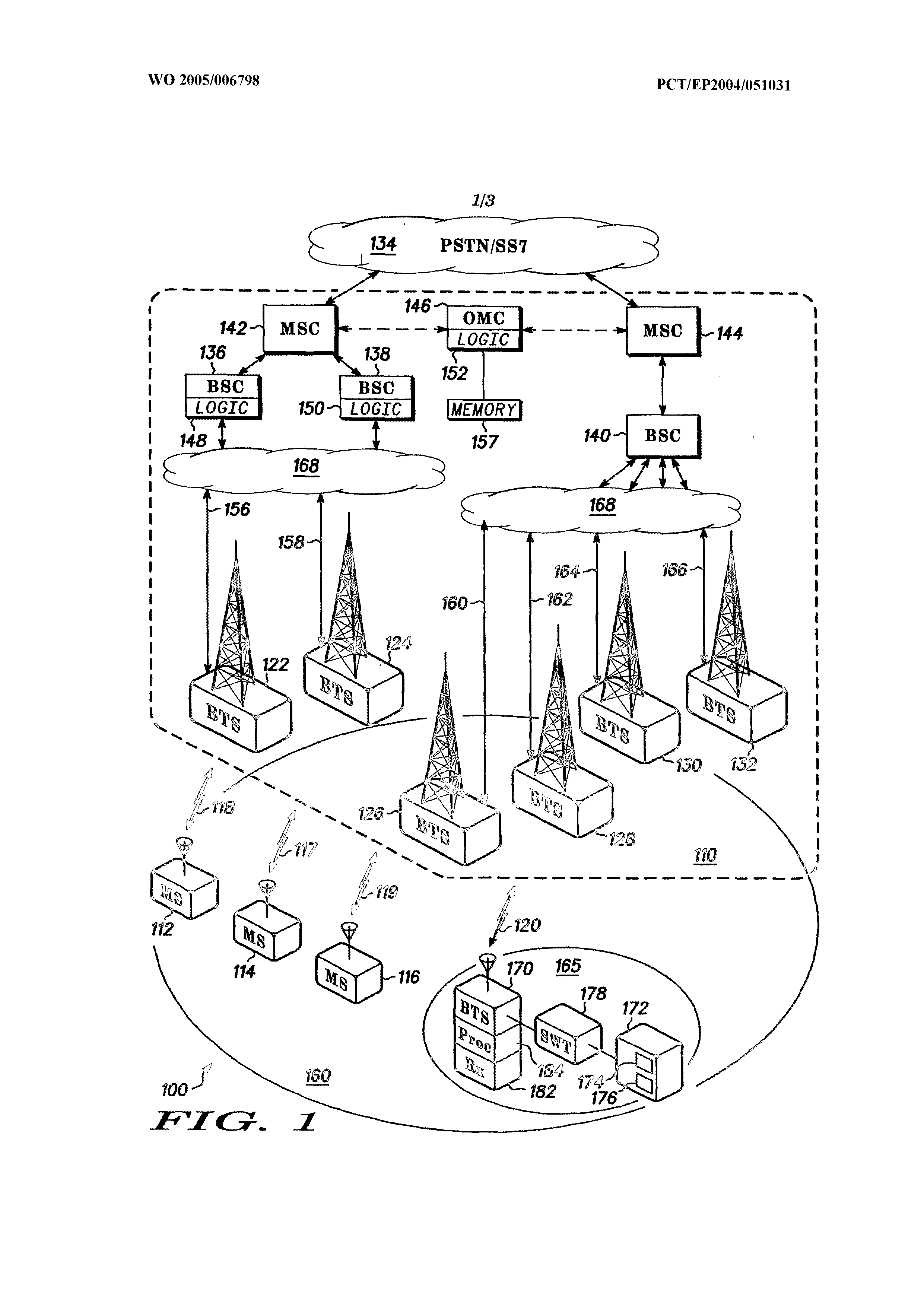
0030FIG. 1 illustrates a block diagram of a cellular radio communications system adapted to support the various inventive concepts of a preferred embodiment of the present invention;
0031FIG. 2 illustrates a simplified functional block diagram of a pico-cell architecture adapted to support the various inventive concepts of a preferred embodiment of the present invention; and
0032FIG. 3 illustrates a flowchart of a pico-cell automatic frequency re-planning process, in accordance with a preferred embodiment of the present invention. Description of Preferred Embodiments
0033Referring first to FIG. 1, a multi-layer cellular telephone communication system 100 is shown, in outline, supporting a Global System for Mobile communication (GSM) air-interface, in accordance with a preferred embodiment of the invention. The European Telecommunications Standards Institute (ETSI) has defined the GSM air- interface. The multi-layer cellular system is shown in a simplified form, comprising a macro-cell and an adjacent pico-cell 165, with associated infrastructure and supported wireless subscriber units. A limited number of network elements are shown for clarity purposes only.
0034Generally, the air-interface protocol is administered from base transceiver sites, within the network architecture 110, that are geographically spaced apart - one base site supporting a cell (or, for example, sectors of a cell) .
0035Referring first to the macro-cell wireless communication system 110, a plurality of subscriber units 112-116 is shown as communicating over the selected macro-cell air- interface 117-119 with a plurality of base transceiver stations (BTS) 122-132. A limited number of MSs 112-116 and BTSs 122-132 are shown for clarity purposes only. The BTSs 122-132 may be connected to a conventional public-switched telephone network (PSTN) 134 through base site controllers (BSCs) 136-140 and mobile switching centres (MSCs) 142-144. Each BTS 122-132 is principally designed to serve its primary cell, with each BTS 122-132 containing one or more transceiver units and communicating 156-166 with the rest of the cellular system infrastructure
0036Each MSC 142-144 provides a gateway to the PSTN 134, with MSCs 142-144 interconnected through an operations and management centre (OMC) 146 that administers general control of the cellular telephone communication system 100, as will be understood by those skilled in the art.
0037The various system elements, such as BSCs 136-138 and OMC 146, include control logic 148, 150, 152, with the various system elements usually having an associated memory function 154 (shown only in relation to BSC 138 for the sake of clarity) . A memory function 157 of the OMC 146 typically stores historically compiled operational data as well as in-call data; system information such as neighbouring cell-site lists and control algorithms such as a list of frequencies to be scanned by the respective MSs.
0038Referring now to the pico-cell system 165, a much- simplified pico-cell architecture is shown. The pico- cell architecture may be a streamlined version of the macro-cell architecture. The pico-cell architecture comprises a ini-OMC 172 that has been adapted to perform the pico-cell frequency re-planning operation according to the preferred embodiment of the present invention. The mini-OMC 172 comprises an adapted compatibility matrix 176, which holds frequency and interference data for the pico-cell and adjacent (or overlaid) micro-cell or macro-cell systems. The mini-OMC 172 also comprises a processing function 174 to perform the pico-cell frequency re-plan simulation, based on supplied data such as system parameters, received MRs, etc. relating to the adjacent micro-cell or macro-cell system. A pico-cell BTS (or preferably a BTS radio frequency (RF) head) 170 is shown, which is operably coupled to the mini-OMC 172 via a pico-switch function 178. For example, as a preferred embodiment of the present invention, the pico- cell architecture is a trimmed GSM (macro-cell) architecture, such that the pico-switch may perform some of the functionality normally associated with a MSC.
0039In accordance with the preferred embodiment of the present invention, the BTS RF head 170 has been configured to receive 120 broadcast control channel (BCCH) transmissions on macro-cell BTS transmit frequencies on its receiver 182. Such an operation of a BTS RF head 170 is a significant enhancement over the known application of BTS RF heads, which have previously only been used for voltage standing wave ratio (VS R) measurements to check a received signal level without any decoding intelligence. A BTS processor 184 then decodes system information messages and assesses them to identify the cells that are using the frequencies observed by the pico BTS RF head 170. This information is included in a message that is sent to the mini-OMC 172. The mini-OMC 172 processes this information and performs a pico-cell frequency re-plan operation, when appropriate, based on the message. It is known that measurement reports from subscriber units can be used to determine how macro-cells in the external network interfere with subscriber units using the in-building cells. However, as indicated previously, it is undesirable to wait for calls to be made, in either the macro-cell or pico-cell, before determining the consequent affect on calls in the pico-cell. Any delay in performing the pico-cell frequency re-planning operation means that these pico-cell calls may, in the meantime, suffer poor quality.
0040Therefore, the inventors of the present invention have recognised that when an external (macro-cell) frequency re-plan operation occurs, the potential for interference between the macro cells and the pico-cell will remain the same, but the frequencies on which this interference occurs will change. Hence, in accordance with the preferred embodiment of the present invention, the in- building pico-cell network has been adapted to detect quickly the new frequencies that the external cells are operating on, without relying on a large number of VS R measurements of macro-cell traffic.
0041In accordance with the preferred embodiment of the present invention, the mini-OMC 172 in the pico-cell architecture, or an optimisation function adjunct to the mini-OMC 172, has been adapted to derive a new in- building pico-cell frequency plan based on downlink broadcast control channel (BCCH) monitoring of the acro- cell frequencies. A pico-cell BTS is advantageously configured to scan through the available set of macro- cell frequencies and record sys-info details on all frequencies for which the GSM broadcast system identification code (bsic) , otherwise known as the colour code, can be successfully decoded. The pico-cell BTS then sends one or more MRs to the pico-cell' s mini-OMC 172 reporting the monitored, and successfully decoded, macro-cell frequencies. With this information, the mini- OMC 172 preferably updates the compatibility matrix 176. Furthermore, the mini-OMC 172 is able to determine the subsequent impact of the new macro-cell plan on the pico- cell frequency plan using the updated in-building compatibility matrix 176.
0042Once the compatibility matrix 176 has been updated, the internal pico-cell (s) can be re-planned using the revised data sets. Before deploying the new pico-cell frequency plan, the results of the external scan need to be checked to determine whether any new macro-cells have been deployed with levels that could affect the new pico-cell frequency plan. If so, the pico-cell frequency plan would need to be adjusted to compensate for these.
0043Advantageously, in accordance with the preferred embodiment of the present invention, a pico-cell BTS RF Head is re-configured to emulate a subscriber unit in idle mode. The BTS RF head is a remote Receive/Transmit part of the pico-cell BTS. It is envisaged that there are a number of these, functioning as mini-cells, distributed around the building, and preferably located near the outside walls. Notably, the pico-cell BTS RF head 170 is capable of operating in a reverse frequency mode, i.e. the BTS RF head 170 can be configured to 'receive' on the macro-cell's BTS Transmit frequencies. In particular, the pico-cell BTS RF head 170 has been adapted to receive 182, process and decode 184 broadcast transmissions from the adjacent macro-cell (or micro- cell) .
0044Therefore, in accordance with the preferred embodiment of the present invention, the pico-cell BTS RF head 170 is configured to emulate a subscriber unit receiving on the macro-cells' BTS transmit frequency range. In this manner, the BTS RF Head 170 is configured to have significantly more functionality than current RF heads, in that it is configured to decode <sup>Λ</sup>information' received on the macro-cell (s) broadcast' channel of all cells in its most recent neighbour list. Furthermore, the pico- cell BTS RF head is able to use, for example, Sys-info-3 information transmitted in a GSM system, to identify the respective macro-cell frequencies now being used. This cell identity information can then be used to update the compatibility matrix 176 to enable an automatic re-plan of the in-building (pico-cell) system.
0045This approach in re-configuring an operation of a pico- cell BTS RF head 170 to monitor the macro-cell BCCH, in order to determine changes in the macro frequency plan, is a much less expensive exercise than the approach of deploying a number of remote mobiles around the building.
0046It is known that transmissions on macro-cell BCCH frequencies have constant transmit power. Hence, preferably the pico-cell BTS RF Head 170 scanning operation is predominantly performed in the early hours of the morning when there is little moving clutter. In this manner, the BCCH signal level experiences fewer fluctuations, thereby enabling it to be correlated with previous signal strengths measurements. Neighbour relations can be updated accordingly.
0047In accordance with an enhanced embodiment of the present invention, one or more pre-emptive triggers are employed to instigate the pico-cell AFP operation. In this regard, a pre-emptive trigger is a simple monitoring algorithm configured to respond to the measurement report stream in detecting a significant and/or sudden change in interference from the macro-cell system. Such a significant and/or sudden change suggests that a macro- cell frequency re-plan operation has occurred. Advantageously, it is envisaged that the use of preemptive triggers can be used in conjunction with the scheduled use of downlink scanning during the night.
0048Although the inventive concepts of the present invention have been described with regard to an implementation in a mini-OMC 172, utilising an enhanced BTS RF head 170, it is envisaged that such concepts could be implemented in software in an improved pico-cell re-planning function 174 located within, or operably coupled to, the mini-OMC 172. Alternatively, the pico-cell re-planning function 174 may be located within any other element within the pico-cell infrastructure, such as a separate analysis platform or even distributed within a number of elements, if appropriate. For example, the pico-cell re-planning function 174 could be implemented within the radio access network (RAN) of the cellular infrastructure equipment and/or it may be implemented as a stand-alone element/function on an adjunct platform.
0049In a preferred embodiment of the present invention, it is also envisaged that one or more BTS RF heads 170 may be adapted to regularly or intermittently perform such macro-cell BCCH monitoring functions. This information would then be forwarded to the mini-OMC 172 (or indeed any other associated element) where the pico-cell re- planning function 174 resides.
0050More generally, a pico-cell re-planning function 174 may be programmed into, say, the mini-OMC 172 according to the preferred embodiment of the present invention, in any suitable manner. For example, new apparatus may be added to a conventional communication unit. Alternatively existing parts of a conventional communication unit may be adapted, for example, by reprogram ing one or more processors therein. As such the required adaptation may be implemented in the form of processor-implementable instructions stored on a storage medium, such as a floppy disk, hard disk, programmable read only memory (PROM) , random access memory (RAM) or any combination of these or other storage media.
0051Referring now to FIG. 2, a simplified block diagram 200 of a pico-cell architecture 210, adapted in accordance with the preferred embodiment of the present invention, is illustrated. It is envisaged that the pico-cell architecture 210 will contain a trimmed down version of the macro-cell architecture 205, with the particular functions/elements used primarily dependent upon the type and size of the pico-cell, the amount of traffic it is to support, the pico-cell location, etc. Thus, a skilled artisan will appreciate that the configuration 200 shown in FIG. 2 is merely a representative and preferred example of an architecture that is able to benefit from the inventive concepts described herein.
0052The preferred pico-cell architecture 210 comprises, inter-alia, a local routing gateway 212 that acts as a mini mobile switching centre (MSC) on behalf of the pico- cell network. A local Operations and Management (O&M) terminal 230 provides basic PABX like feature configuration for the building's Telecommunications Manager. The O&M terminal 230 also provides a minimal Status overview of the pico-cell network, and is connected to an O&M agent 225 within a network element (NE) 220. The O&M agent 225 acts as a mediator between the macro Network's OMC 146 and the pico network 210. This is necessary to support the pico network's ability to autonomously decide its own frequency plan, and control the selection of neighbouring cell scanning operations .
0053The Network Element control software 215 performs control of the neighbour cell selection and RF Head reverse frequency monitoring. The Measurement Report Processing function 245 populates and updates the Compatibility Database 235. The Measurement Report Processing function 245 also creates the updated frequency plans for the network and communicates these to the NE Control software 215. The compatibility database 235 contains data for each cell that defines its interference compatibility with each of the other pico cells and neighbouring macro cells.
0054The NE 220 is also operably coupled via a trimmed BSC 240 to a cluster control function 242 that links the pico- cell NE 220 to a number of remote pico-cell BTS RF Heads 250-260. These pico-cell BTS RF Heads 250-260 are preferably located throughout the building (s) and configured to monitor external macro-cell BCCH transmissions.
0055Referring now to FIG. 3, a flowchart 300 illustrates an overview of the preferred automatic frequency planning process. The flowchart includes a typical detection loop process, indicated in sub-routine 305. The known pico- cell automatic frequency re-planning operation comprises a serving macro-cell' s interference being detected in the pico-cell, as shown in step 310. The detection process may include receiving measurement reports (MRs) or Interference On Idle (IOI) monitoring. If no macro-cell generated interference is detected by the pico cell, in step 310, a determination is made as to whether the MRs indicate external interference on any neighbouring channels, in step 315. If interference is detected by the pico-cell on neighbouring channels in step 315, then a frequency re-planning operation is triggered in step 317.
0056If no interference is detected by the pico-cell on neighbouring channels in step 315, then a determination is made as to whether a macro-cell frequency re-planning operation has been performed, in step 320. If no macro- cell frequency re-planning operation has been performed, in step 320, the normal pico-cell frequency re-planning process loops back to step 310, as shown.
0057In accordance with the preferred embodiment of the present invention, when a serving macro-cell's interference is detected in the pico-cell, in step 310, or when a macro-cell frequency re-planning operation has been detected, in step 320, a determination is made as to whether the pico-cell carrier is busy, as shown in step 330. When the pico-cell' s carrier frequency is busy, no re-planning operation is performed and the process loops, in step 335.
0058When the pico-cell' s carrier is determined as being 'quiet' , the pico-cell infrastructure instructs one or more pico-cell BTS RF heads to scan the macro-cell downlink frequencies for the BCCH, as shown in step 340. Once the BCCH information has been received and processed, the pico-cell mini-OMC compares the macro- frequency plan iith its prior understanding of the macro- frequency plan. If necessary, the macro- equency plan in the compatibility database is updated, in step 350. An automatic frequency re-planning operation is then performed for the pico-cell, with the pico-cell carrier frequencies re-tuned to currently unused (or sufficiently unused to not cause interference) macro-cell frequencies, as shown in step 355.
0059In accordance with an enhanced embodiment of the present invention, pre-emptive triggers may be used to indicate the automatic frequency re-planning operation of the pico-cell. Such triggers may be created following detection of interference on a server channel's neighbouring cell, as shown in step 325. Alternatively, or additionally, the pre-emptive triggers may be used to initiate the step of scanning the macro-cell frequencies on a broadcast downlink channel, in step 340, to identify a frequency re-planning operation of the macro-cell.
0060Thus, in this manner, a mini-OMC determines rapidly, and puts into effect, an optimal set of new pico-cell frequencies following a detection of a new macro-cell frequency re-planning operation.
0061The preferred embodiment of the present invention has been described with regard to a cellular telephony communication system, such as the global system for mobile communications (GSM) . It is envisaged that the invention is equally applicable to other wireless TDMA communication systems, such as an integrated digitally enhanced network (iDEN)™, as supplied by Motorola<sup>151</sup>. It is also within the contemplation of the invention that alternative radio communication architectures,, such as private or public mobile radio communication systems could benefit from the inventive concepts described herein.
0062It is also within the contemplation of the present invention that the inventive concepts are not limited to a pico-cell/macro-cell relationship. Indeed, it is envisaged that the inventive concepts can be applied to any wireless cellular network that comprises one cell whose frequencies are affected by the frequencies operated by a neighbouring or overlaid cellular network. For example, it is envisaged that the first cell may be a pico-cell in a context that said higher layer (or neighbouring) cell is substantially of a micro-cell or substantially of a macro-cell configuration. Alternatively, the first cell may be substantially of a micro-cell configuration in a context that the higher layer (or neighbouring) cell is substantially a macro cell.
0063It will be understood that the wireless communication system, improved mini-OMC and BTS RF head, and improved method for frequency re-planning, as described above, provides at least some of the following advantages that could not be reliably obtained using existing coverage prediction methods:
0064(i) External neighbour relationships can be automatically monitored without OMC co-ordination.
0065(ii) It reduces reliance on external network traffic, thus enabling more efficient management of pico- cell frequency re-plans. (iii) The aforementioned principles can be extended to encompass a number of different cellular air interfaces, including analogue cellular systems.
0066Whilst the specific and preferred implementations of the embodiments of the present invention are described above, it is clear that a skilled artisan could readily apply variations and modifications of such inventive concepts. Thus, a communication system, improved mini-OMC and BTS RF head, and a method for frequency re-planning have been provided wherein the aforementioned disadvantages associated with prior art arrangements have been substantially alleviated.
3 sheets
Sheet 1 Sheet 2 Sheet 3
Every citation, both ways
| Document | Relation | Office | Category | Cited during | Relevant claims |
|---|---|---|---|---|---|
| US12089218B2 | Cited by | United States of America | – | Applicant | – |
| WO2009022975A1 | Cited by | World Intellectual Property Organization (WIPO) | – | International search | – |
| US10548025B2 | Cited by | United States of America | – | Applicant | – |
| US9949239B2 | Cited by | United States of America | – | Applicant | – |
| US8588759B2 | Cited by | United States of America | – | Applicant | – |
| US8355728B2 | Cited by | United States of America | – | Applicant | – |
| US10004082B2 | Cited by | United States of America | – | Applicant | – |
| US10749737B2 | Cited by | United States of America | – | Applicant | – |
| EP3096569A1 | Cited by | European Patent Office (EPO) | – | Search report | – |
| US11496212B2 | Cited by | United States of America | – | Applicant | – |
| CN102612046A | Cited by | China | – | Search report | – |
| WO2008098898A3 | Cited by | World Intellectual Property Organization (WIPO) | – | International search | – |
| US11330567B2 | Cited by | United States of America | – | Applicant | – |
| US10461846B2 | Cited by | United States of America | – | Applicant | – |
| WO2010079960A2 | Cited by | World Intellectual Property Organization (WIPO) | – | International search | – |
| US11330567B2 | Cited by | United States of America | – | Applicant | – |
| US9800460B2 | Cited by | United States of America | – | Applicant | – |
| US9949239B2 | Cited by | United States of America | – | Applicant | – |
| US8559952B2 | Cited by | United States of America | – | Applicant | – |
| US10791566B2 | Cited by | United States of America | – | Applicant | – |
| US11936466B2 | Cited by | United States of America | – | Applicant | – |
| US9210593B2 | Cited by | United States of America | – | Applicant | – |
| US8271040B2 | Cited by | United States of America | – | Applicant | – |
| US10117111B2 | Cited by | United States of America | – | Applicant | – |
| US10880000B2 | Cited by | United States of America | – | Applicant | – |
| WO2010079960A3 | Cited by | World Intellectual Property Organization (WIPO) | – | International search | – |
| US10212026B2 | Cited by | United States of America | – | Applicant | – |
| US12316437B2 | Cited by | United States of America | – | Applicant | – |
| WO0193617A1 | Cites | World Intellectual Property Organization (WIPO) | A | International search | 1-23 |
3 members in 2 offices
Priority claims3
| Document | Office | Kind | Date |
|---|---|---|---|
| 0316421 | United Kingdom | A | |
| GB20030016421 | – | – | – |
| 03164217 | – | – | – |
Members3
| Document | Office | Kind | |
|---|---|---|---|
| GB2404113A | United Kingdom | A | |
| WO2005006798A1This record | World Intellectual Property Organization (WIPO) | A1 | |
| GB2404113B | United Kingdom | B |
4 legal events, as the office reported them to INPADOC
Over the term
Point at a mark for the eventEvents
| Event | Code | |
|---|---|---|
| Ep: pct application non-entry in european phase122 | 122 | |
| Ep: the epo has been informed by wipo that ep was designated in this application121 | 121 | |
| Designated statesAK | AK | |
| Designated countries for regional patentsAL | AL |
Numbers
- Publication
- 2005/006798
- Publication, DOCDB
- 2005006798
- Publication, EPODOC
- WO2005006798
- Application
- 51031
- Application, DOCDB
- 2004051031
- Application, EPODOC
- WO2004EP51031
Titles2
- English
- COMMUNICATION UNITS, CELL-BASED COMMUNICATION SYSTEM AND METHOD FOR FREQUENCY PLANNING THEREIN
- French
- UNITES DE COMMUNICATION, SYSTEME DE COMMUNICATION CELLULAIRE ET PROCEDE POUR LA PLANIFICATION DE FREQUENCE DANS UN TEL SYSTEME
Classification
- CPC, 2
- H04W16/18
- H04W24/02
- IPC, 2
- H04W16 18
- H04W24 02
Designated states4
- Regional, 4
- Zimbabwe
- Turkmenistan
- Türkiye
- Togo