Antibacterial and anti-staining substrate and its manufacturing method
Abstract
Problem to be solved.To simultaneously impart antibacterial property and antifouling property to a substrate surface.
Solution.A film having at least a siloxane bond is formed on the entire surface of a film having at least antibacterial particles and having surface hydroxyl groups exposed in an island shape. As a result, the particles having antibacterial ability are eluted through the film having a siloxane bond, so that antibacterial property and antifouling property can be imparted to the substrate surface at the same time. [Selection diagram] Fig. 1
Term
Term ended
Projected expiry passed 14 October 2023, 2.9 years ago.
- Priority and filed
- Published
- Projected expiry
- Today
21 claims: 4 independent, 17 dependent
- 1少なくとも抗菌能を有する粒子を含み、それが島状に露出している表面水酸基を有する膜の全表面上に少なくともシロキサン結合を有する膜が形成された抗菌、防汚基体。
- 2抗菌能を有する粒子が、Zn、Cu、Agの酸化物およびそれらの複合酸化物であることを特徴とする請求項1記載の抗菌、防汚基体。
- 3少なくとも抗菌能を有する粒子を含み、それが島状に露出している表面水酸基を有する膜のその粒子が露出していない表面上にシロキサンを有する膜が形成された抗菌、防汚基体。
- 4抗菌能を有する粒子が、Zn、Cu、Agおよびそれらの合金であることを特徴とする請求項3記載の抗菌、防汚基体。
- 5シロキサン結合を有する膜がフルオロアルキル基を有することを特徴とする請求項1~4のいずれか1項に記載の抗菌、防汚基体。
- 6シロキサン結合を有する膜が単分子膜であることを特徴とする請求項1~5のいずれか1項に記載の抗菌、防汚基体。
- 7表面水酸基を有する膜に対してZn、Cu、Agの合計の含有率が0.0001~1wt%であることを特徴とする請求項2または4記載の抗菌、防汚基体。
- 8表面水酸基を有する膜が、Si、Al、Ti、Zrの酸化物、窒化物、あるいはそれらの複合酸化物、複合窒化物であることを特徴とする請求項1~7のいずれか1項に記載の抗菌、防汚基体。
- 9表面水酸基を有する膜が、樹脂であることを特徴とする請求項1~7のいずれか1項に記載の抗菌、防汚基体。
- 10表面水酸機を有する膜の膜厚が、抗菌能を有する粒子の粒径より小さいことを特徴とする請求項1~9のいずれか1項に記載の抗菌、防汚基体。
- 11表面水酸機を有する膜の膜厚が、抗菌能を有する粒子の粒径よりの半分より大きいことを特徴とする請求項1~10のいずれか1項に記載の抗菌、防汚基体。
- 12表面水酸機を有する膜が透明であることを特徴とする請求項1~10のいずれか1項に記載の抗菌、防汚基体。
- 13自身が透明であることを特徴とする請求項10記載の抗菌、防汚基体。
- 14基板上に少なくとも抗菌能を有する粒子を含み、それが島状に露出する膜を形成する工程と、少なくともシラン化合物を含む溶液に浸漬する工程を含む抗菌、防汚基体の製造方法。
- 15基板上に少なくとも抗菌能を有する粒子を含み、それが島状に露出する膜を形成する工程と、膜に表面水酸基を形成する工程と、少なくともシラン化合物を含む溶液に浸漬する工程を含む抗菌、防汚基体の製造方法。
- 16表面水酸基を形成する工程がプラズマ処理、コロナ処理、オゾン処理のいずれかであることを特徴とする請求項15記載の抗菌、防汚基体の製造方法。
- 17シラン化合物がクロロシランであることを特徴とする請求項14~16のいずれか1項に記載の抗菌、防汚基体の製造方法。
- 18シラン化合物を含む溶液の溶媒が非水溶媒であることを特徴とする請求項14~17のいずれか1項に記載の抗菌、防汚基体の製造方法。
- 19シラン化合物を含む溶液を浸漬する工程が湿度35%以下の無水雰囲気下であることを特徴とする請求項14~18のいずれか1項に記載の抗菌、防汚基体の製造方法。
- 20シラン化合物を含む溶液を浸漬する工程の後に過剰な未反応のシラン化合物を洗浄する工程を含むことを特徴とする請求項14~19のいずれか1項に記載の抗菌、防汚基体の製造方法。
- 21自身がステンレスであることを特徴とする請求項1~20のいずれか1項に記載の抗菌、防汚基体。
Independent claims21
59 paragraphs, as filed
The present invention relates to an antibacterial and antifouling substrate having antibacterial properties while maintaining its performance as well as antibacterial properties on the surface, and a method for producing the same.
Conventionally, in order to give antibacterial properties to the surface of a substrate, for example, stainless steel, there has been a method of impregnating an oxide film of stainless steel with antibacterial particles and exposing the particles to the surface (see, for example, Patent Document 1). On the other hand, a silicone-based or fluorine-based coating is generally used to give the surface of stainless steel antifouling properties.<patcit num="1"><text>Japanese Patent No. 3398591</text></patcit>
<p> Therefore, in order to have both of these, for example, when antibacterial particles are contained and a silicone-based or fluorine-based coating is applied to the surface of the stainless steel exposed to the surface, this coating provides antibacterial particles. Since it is coated, antifouling property is imparted, but there is a problem that antibacterial property is not imparted.</p>
<p> The present inventor has conducted diligent research on these issues, and a film containing at least siloxane bonds was formed on the entire surface of a film containing particles having at least antibacterial activity and exposed in an island shape. The composition of the substrate was used. As a result, it has been found that particles having antibacterial activity can be imparted with antibacterial and antifouling properties to the surface of the substrate at the same time by eluting through a film having a siloxane bond.</p>
<p> According to the present invention, antibacterial and antifouling properties can be imparted to the surface of the substrate at the same time. The substrate referred to here has a wide range of versatility, such as metals such as aluminum, iron, and stainless steel, oxides such as glass, ceramics, and pottery, and resins, and therefore the effect of the present invention is very large.</p>
The first invention is an antibacterial and antifouling substrate containing particles having at least antibacterial activity and having a film having at least a siloxane bond formed on the entire surface of the film exposed in an island shape. With this configuration, the particles having antibacterial ability are eluted through the film having a siloxane bond, so that antibacterial property and antifouling property can be imparted to the surface of the substrate at the same time.
In the second invention, the particles having antibacterial activity are oxides of Zn, Cu, and Ag and composite oxides thereof. With this configuration, a film having a stable siloxane bond on the particles having an antibacterial ability can be formed, and moreover, it can be eluted through the film having a siloxane bond.
The third invention is an antibacterial and antifouling substrate in which a film having siloxane is formed on a surface of a film containing particles having at least antibacterial activity and the particles are exposed in an island shape. is there. With this configuration, since the particles having antibacterial activity are not coated on the film having a siloxane bond, they can be easily eluted, and antibacterial and antifouling properties can be imparted to the stainless steel surface at the same time.
In the fourth invention, the particles having antibacterial activity are Zn, Cu, Ag and alloys thereof. With this configuration, a film having a siloxane bond is not formed on the particles having antibacterial activity, so that the particles can be easily eluted.
The fifth invention is characterized in that the film having a siloxane bond has a fluoroalkyl group. With this configuration, the surface energy of the stainless steel surface is reduced, and the surface becomes water-repellent and oil-repellent, so that the antifouling property is improved.
The sixth invention is characterized in that the film having a siloxane bond is a monolayer film. With this configuration, since the film thickness is an ultrathin film at the molecular level and uniform, particles having antibacterial activity can be stably and uniformly eluted through the film having a siloxane bond.
The seventh invention is characterized in that the total content of Zn, Cu and Ag is 0.0001 to 1 wt% with respect to the film having a surface hydroxyl group. With this configuration, antibacterial activity can be exhibited while maintaining the durability of the film having a surface hydroxyl group and the siloxane bond on the film.
The eighth invention is characterized in that the film having a surface hydroxyl group is an oxide or nitride of Si, Al, Ti, Zr, or a composite oxide or composite nitride thereof. With this configuration, since the film itself has a surface hydroxyl group having excellent durability, the durability of the film having a siloxane bond and the particles having antibacterial activity can be maintained.
The ninth invention is characterized in that the film having a surface hydroxyl group is a resin. With this configuration, antibacterial and antifouling properties can be imparted even if the substrate itself is a resin.
The tenth invention is characterized in that the film thickness of the film having a surface hydroacid machine is smaller than the particle size of particles having antibacterial activity. With this configuration, the particles having antibacterial activity are always exposed on the surface of the membrane having the surface hydroic acid machine, and have antifouling property.
The eleventh invention is characterized in that the film thickness of the film having the surface hydroacid machine is larger than half the particle size of the particles having antibacterial activity. With this configuration, the particles having antibacterial activity are fixed to the membrane having the surface hydrous acid machine, are hard to fall off, and have antifouling property.
The twelfth invention is characterized in that the membrane having a surface hydroacid machine is transparent. With this configuration, the film having a siloxane bond is also transparent, so that it becomes an antibacterial and antifouling substrate that makes the best use of the color of the substrate.
The thirteenth invention is characterized in that it is transparent. According to this configuration, the substrate itself is also transparent, so that it becomes a transparent antibacterial and antifouling substrate.
A fourteenth invention of an antibacterial and antifouling substrate comprises a step of forming a film containing particles having at least antibacterial activity on a substrate and exposing the particles in an island shape, and a step of immersing the particles in a solution containing at least a silane compound. It is a manufacturing method. According to this method, it is possible to provide a substrate capable of simultaneously imparting antibacterial and antifouling properties to the surface by easily eluting particles having antibacterial activity through a film having a siloxane bond or directly. ..
The fifteenth invention is a step of forming a film containing particles having at least antibacterial activity on a substrate and exposing them in an island shape, a step of forming surface hydroxyl groups on the film, and immersion in a solution containing at least a silane compound. This is a method for producing an antibacterial and antifouling substrate, which includes a step of: According to this method, the film having a siloxane bond with the surface hydroxyl group formed on the film is fixed by a chemical bond, so that the durability of the film having a siloxane bond is significantly improved.
The sixteenth invention is characterized in that the step of forming a surface hydroxyl group is any one of plasma treatment, corona treatment, and ozone treatment. According to this method, a surface hydroxyl group can be easily formed even on a substrate having no surface hydroxyl group.
The seventeenth invention is characterized in that the silane compound is chlorosilane. By using chlorosilane, the silane compound reacts with the surface hydroxyl group on the stainless steel surface, and the silane compound is strongly chemisorbed and fixed, so that the durability of the film having the formed siloxane bond can be significantly improved.
The eighteenth invention is characterized in that the solvent of the solution containing the silane compound is a non-aqueous solvent. By using a non-aqueous solvent, the silane compound such as chlorosilane is not hydrolyzed by water, so that the silane compound is firmly chemically adsorbed and fixed on the stainless steel surface, so that a film having a siloxane bond is formed. Durability can be greatly improved.
The nineteenth invention is characterized in that the step of immersing the solution containing the silane compound is in an anhydrous atmosphere with a humidity of 35% or less. By reducing the humidity to 35% or less, the solution of the silane compound such as chlorosilane does not hydrolyze due to moisture absorption, so that the silane compound is strongly chemically adsorbed and fixed on the stainless steel surface, so that a siloxane bond is formed. The durability of the film having silane can be greatly improved.
The twentieth invention is characterized by including a step of washing an excess of unreacted silane compound after a step of immersing a solution containing a silane compound. By washing the unreacted silane compound, the thickness of the film having a siloxane bond becomes an ultra-thin film at the molecular level and becomes uniform, so that the particles having antibacterial activity are stably and uniformly eluted through the film having a siloxane bond. can do.
The twenty-first invention is characterized in that it is made of stainless steel, and can simultaneously impart antibacterial properties and antifouling properties to the surface of stainless steel.
Hereinafter, embodiments of the present invention will be described with reference to the drawings. The present invention is not limited to the present embodiment.
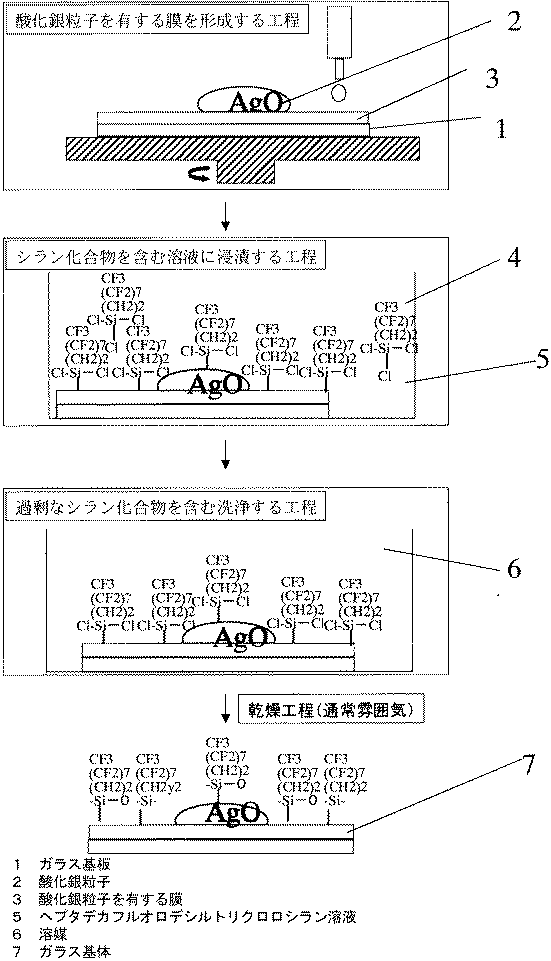
(Embodiment 1) FIG. 1 shows an antibacterial and antifouling substrate and a manufacturing process thereof according to the first embodiment of the present invention. An aqueous solution containing tetraethoxysilane containing silver oxide particles having antibacterial activity is applied to the glass substrate 1 under a nitrogen atmosphere (anhydrous) so that the film thickness is equal to or greater than the radius of the silver oxide particles 2 having antibacterial activity. By firing, a substrate having a film 3 in which silver oxide particles having antibacterial activity are exposed in an island shape is obtained, and this is immersed in a solution 5 containing heptadecafluotodecyltrichlorosilane 4, and after immersion, excess hepta is used. The glass substrate 7 of the present invention is produced by washing decafluotodecyltrichlorosilane 4 with solvent 6 and drying it in a normal atmosphere. In this glass substrate, silver oxide particles having antibacterial activity are eluted through a film having a heptadecafluotodecyl group and a siloxane bond, so that the surface of the substrate is protected by the antibacterial property of silver oxide and the heptadecafluotodecyl group. Dirt can be imparted at the same time.
(Embodiment 2) FIG. 2 shows an antibacterial and antifouling substrate and a manufacturing process thereof in the second embodiment of the present invention. An aqueous solution containing tetraethoxysilane containing silver particles having antibacterial activity is applied to a glass substrate 11 under a nitrogen atmosphere (anhydrous) so that the film thickness is equal to or greater than the radius of silver oxide particles 12 having antibacterial activity and fired. By doing so, a substrate having a film 13 in which silver particles having antibacterial activity are exposed in an island shape is obtained, and this is immersed in a solution 15 containing heptadecafluotodecyltrichlorosilane 14, and after immersion, excess heptadecaflu is immersed. The glass substrate 17 of the present invention is produced by washing the otodecyltrichlorosilane 13 with the solvent 16 and drying it in a normal atmosphere. In this glass substrate, silver particles having antibacterial activity are eluted through a film having a heptadecafluotodecyl group and a siloxane bond, so that the surface of the substrate has antibacterial properties due to silver and antifouling properties due to heptadecafluotodecyl groups. Can be given at the same time.
As the silane compound of the present invention, the following are effective. (1) SiX<sub>4</sub> (Equivalent to n = 0) (2) SiX<sub>3</sub>-O-SiX<sub>3</sub> (Equivalent to n = 1) As a more specific compound, (3) Si (OC)<sub>2</sub>H<sub>5</sub>)<sub>4</sub>(4) Si (OCH<sub>3</sub>)<sub>3</sub>-O-Si (OCH)<sub>3</sub>)<sub>3</sub>(5) Si (OC)<sub>2</sub>H<sub>5</sub>)<sub>3</sub>-O-Si (OCH)<sub>3</sub>)<sub>3</sub>(6) Si (OC)<sub>2</sub>H<sub>5</sub>)<sub>3</sub>-O-Si (OC)<sub>2</sub>H<sub>5</sub>)<sub>3</sub>(7) Si (NCO)<sub>4</sub>(8) Si (NCO)<sub>3</sub>-O-Si (NCO)<sub>3</sub>(9) SiCl<sub>4</sub>(10) SiCl<sub>3</sub>-O-SiCl<sub>3</sub>Can be mentioned.
Moreover, the following can be exemplified as a silane compound which can be used in this invention. (11) SiY<sub>p</sub>Cl<sub>4-p</sub>(12) CH<sub>3</sub>(CH<sub>2</sub>)<sub>s</sub>O (CH<sub>2</sub>)<sub>t</sub>SiY<sub>q</sub>Cl<sub>3-q</sub>(13) CH<sub>3</sub>(CH<sub>2</sub>)<sub>u</sub>-Si (CH)<sub>3</sub>)<sub>2</sub>(CH<sub>2</sub>)<sub>v</sub>-SiY<sub>q</sub>Cl<sub>3-q</sub>(14) CF<sub>3</sub>COO (CH)<sub>2</sub>)<sub>w</sub>SiY<sub>q</sub>Cl<sub>3-q</sub> However, p is an integer of 1 to 3, q is an integer of 0 to 2, r is an integer of 1 to 25, s is an integer of 0 to 12, t is an integer of 1 to 20, u is an integer of 0 to 12, v is an integer from 1 to 20, and w is an integer from 1 to 25. Further, Y is a hydrogen, an alkyl group, an alkoxyl group, a fluorine-containing alkyl group or a fluorine-containing alkoxy group.
Further, specific silane compounds include (15)-(21) shown below. (15) CH<sub>3</sub>CH<sub>2</sub>O (CH<sub>2</sub>)<sub>15</sub>SiCl<sub>3</sub>(16) CH<sub>3</sub>(CH<sub>2</sub>)<sub>2</sub>Si (CH<sub>3</sub>)<sub>2</sub>(CH<sub>2</sub>)<sub>15</sub>SiCl<sub>3</sub>(17) CH<sub>3</sub>(CH<sub>2</sub>)<sub>6</sub>Si (CH<sub>3</sub>)<sub>2</sub>(CH<sub>2</sub>)<sub>9</sub>SiCl<sub>3</sub>(18) CH<sub>3</sub>COO (CH)<sub>2</sub>)<sub>15</sub>SiCl<sub>3</sub>(19) CF<sub>3</sub>(CF<sub>2</sub>)<sub>7</sub>-(CH<sub>2</sub>)<sub>2</sub>-SiCl<sub>3</sub>(20) CF<sub>3</sub>(CF<sub>2</sub>)<sub>5</sub>-(CH<sub>2</sub>)<sub>2</sub>-SiCl<sub>3</sub>(21) CF<sub>3</sub>(CF<sub>2</sub>)<sub>7</sub>-C<sub>6</sub>H<sub>4</sub>-SiCl<sub>3</sub> Further, instead of the above-mentioned chlorosilane-based compound, an isocyanate-based compound in which all chlorosilyl groups can be placed on the isocyanate group, for example, (22)-(26) shown below may be used. (22) SiY<sub>p</sub>(NCO)<sub>4-p</sub>(23) CH<sub>3</sub>-(CH<sub>2</sub>)<sub>r</sub>SiY<sub>p</sub>(NCO)<sub>3-p</sub>(24) CH<sub>3</sub>(CH<sub>2</sub>)<sub>s</sub>O (CH<sub>2</sub>)<sub>t</sub>SiY<sub>q</sub>(NCO)<sub>qp</sub>(25) CH<sub>3</sub>(CH<sub>2</sub>)<sub>u</sub>-Si (CH)<sub>3</sub>)<sub>2</sub>(CH<sub>2</sub>)<sub>v</sub>-SiY<sub>q</sub>(NCO)<sub>3-q</sub>(26) CF<sub>3</sub>COO (CH)<sub>2</sub>)<sub>v</sub>SiY<sub>q</sub>(NCO)<sub>3-q</sub> However, p, q, r, s, t, u, v, w and X are the same as described above.
Instead of the above-mentioned silane-based compound, the silane-based compound specifically exemplified in the following (27)-(33) may be used. (27) CH<sub>3</sub>CH<sub>2</sub>O (CH<sub>2</sub>)<sub>15</sub>Si (NCO)<sub>3</sub>(28) CH<sub>3</sub>(CH<sub>2</sub>)<sub>2</sub>Si (CH<sub>3</sub>)<sub>2</sub>(CH<sub>2</sub>)<sub>15</sub>Si (NCO)<sub>3</sub>(29) CH<sub>3</sub>(CH<sub>2</sub>)<sub>6</sub>Si (CH<sub>3</sub>)<sub>2</sub>(CH<sub>2</sub>)<sub>9</sub>Si (NCO)<sub>3</sub>(30) CH<sub>3</sub>COO (CH)<sub>2</sub>)<sub>15</sub>Si (NCO)<sub>3</sub>(31) CF<sub>3</sub>(CF<sub>2</sub>)<sub>7</sub>-(CH<sub>2</sub>)<sub>2-</sub>Si (NCO)<sub>3</sub>(32) CF<sub>3</sub>(CF<sub>2</sub>)<sub>5</sub>-(CH<sub>2</sub>)<sub>2-</sub>Si (NCO)<sub>3</sub>(33) CF<sub>3</sub>(CF<sub>2</sub>)<sub>7</sub>-C<sub>6</sub>H<sub>4</sub>-Si (NCO)<sub>3</sub> In addition, as a silane compound, SiY is generally used.<sub>k</sub>(OA)<sub>4-k</sub>(Y is the same as above, A is an alkyl group, k is 0, 1, 2 or 3). Above all, CF<sub>3</sub>-(CF<sub>2</sub>)<sub>n</sub>-(R)<sub>l</sub>-SiY<sub>q</sub>(OA)<sub>3-q</sub>(n is an integer greater than or equal to 1, preferably an integer from 1 to 22, R is an alkyl group, vinyl group, ethynyl group, aryl group, substituent containing silicon or oxygen atom, l is 0 or 1, Y, A and q Can form a better antifouling film by using a substance represented by (similar to the above), but is not limited to this, and other than this, CH<sub>3</sub>-(CH<sub>2</sub>)<sub>r</sub>-SiY<sub>q</sub>(OA)<sub>3-q</sub>And CH<sub>3</sub>-(CH<sub>2</sub>)<sub>s</sub>-0-(CH<sub>2</sub>)<sub>t</sub>-SiY<sub>q</sub>(OA)<sub>3-q</sub>, CH<sub>3</sub>-(CH<sub>2</sub>)<sub>u</sub>-Si (CH)<sub>3</sub>)<sub>2</sub>-(CH<sub>2</sub>)<sub>v</sub>-SiY<sub>q</sub>(OA)<sub>3-q</sub>, CF<sub>3</sub>COO- (CH<sub>2</sub>)<sub>v</sub>-SiY<sub>q</sub>(OA)<sub>3-q</sub>(However, q, r, s, t, u, v, w, Y and A are the same as above) and the like can be used.
Further, more specific silane compounds include (34)-(57) shown below. (34) CH<sub>3</sub>CH<sub>2</sub>O (CH<sub>2</sub>)<sub>15</sub>Si (OCH<sub>3</sub>)<sub>3</sub>(35) CF<sub>3</sub>CH<sub>2</sub>O (CH<sub>2</sub>)<sub>15</sub>Si (OCH<sub>3</sub>)<sub>3</sub>(36) CH<sub>3</sub>(CH<sub>2</sub>)<sub>2</sub>Si (CH<sub>3</sub>)<sub>2</sub>(CH<sub>2</sub>)<sub>15</sub>Si (OCH<sub>3</sub>)<sub>3</sub>(37) CH<sub>3</sub>(CH<sub>2</sub>)<sub>6</sub>Si (CH<sub>3</sub>)<sub>2</sub>(CH<sub>2</sub>)<sub>9</sub>Si (OCH<sub>3</sub>)<sub>3</sub>(38) CH<sub>3</sub>COO (CH)<sub>2</sub>)<sub>15</sub>Si (OCH<sub>3</sub>)<sub>3</sub>(39) CF<sub>3</sub>(CF<sub>2</sub>)<sub>5</sub>(CH<sub>2</sub>)<sub>2</sub>Si (OCH<sub>3</sub>)<sub>3</sub>(40) CF<sub>3</sub>(CF<sub>2</sub>)<sub>7</sub>-C<sub>6</sub>H<sub>4</sub>-Si (OCH<sub>3</sub>)<sub>3</sub>(41) CH<sub>3</sub>CH<sub>2</sub>O (CH<sub>2</sub>)<sub>15</sub>Si (OC<sub>2</sub>H<sub>5</sub>)<sub>3</sub>(42) CH<sub>3</sub>(CH<sub>2</sub>)<sub>2</sub>Si (CH<sub>3</sub>)<sub>2</sub>(CH<sub>2</sub>)<sub>15</sub>Si (OC<sub>2</sub>H<sub>5</sub>)<sub>3</sub>(43) CH<sub>3</sub>(CH<sub>2</sub>)<sub>6</sub>Si (CH<sub>3</sub>)<sub>2</sub>(CH<sub>2</sub>)<sub>9</sub>Si (OC<sub>2</sub>H<sub>5</sub>)<sub>3</sub>(44) CF<sub>3</sub>(CH<sub>2</sub>)<sub>6</sub>Si (CH<sub>3</sub>)<sub>2</sub>(CH<sub>2</sub>)<sub>9</sub>Si (OC<sub>2</sub>H<sub>5</sub>)<sub>3</sub>(45) CH<sub>3</sub>COO (CH)<sub>2</sub>)<sub>15</sub>Si (OC<sub>2</sub>H<sub>5</sub>)<sub>3</sub>(46) CF<sub>3</sub>COO (CH)<sub>2</sub>)<sub>15</sub>Si (OC<sub>2</sub>H<sub>5</sub>)<sub>3</sub>(47) CF<sub>3</sub>COO (CH)<sub>2</sub>)<sub>15</sub>Si (OCH<sub>3</sub>)<sub>3</sub>(48) CF<sub>3</sub>(CF<sub>2</sub>)<sub>9</sub>(CH<sub>2</sub>)<sub>2</sub>Si (OC<sub>2</sub>H<sub>5</sub>)<sub>3</sub>(49) CF<sub>3</sub>(CF<sub>2</sub>)<sub>7</sub>(CH<sub>2</sub>)<sub>2</sub>Si (OC<sub>2</sub>H<sub>5</sub>)<sub>3</sub>(50) CF<sub>3</sub>(CF<sub>2</sub>)<sub>5</sub>(CH<sub>2</sub>)<sub>2</sub>Si (OC<sub>2</sub>H<sub>5</sub>)<sub>3</sub>(5l) CF<sub>3</sub>(CF<sub>2</sub>)<sub>7</sub>C<sub>6</sub>H<sub>4</sub>Si (OC<sub>2</sub>H<sub>5</sub>)<sub>3</sub>(52) CF<sub>3</sub>(CF<sub>2</sub>)<sub>9</sub>(CH<sub>2</sub>)<sub>2</sub>Si (OCH<sub>3</sub>)<sub>3</sub>(53) CF<sub>3</sub>(CF<sub>2</sub>)<sub>5</sub>(CH<sub>2</sub>)<sub>2</sub>Si (OCH<sub>3</sub>)<sub>3</sub>(54) CF<sub>3</sub>(CF<sub>2</sub>)<sub>7</sub>(CH<sub>2</sub>)<sub>2</sub>SiCH<sub>3</sub>(OC<sub>2</sub>H<sub>5</sub>)<sub>2</sub>(55) CF<sub>3</sub>(CF<sub>2</sub>)<sub>7</sub>(CH<sub>2</sub>)<sub>2</sub>SiCH<sub>3</sub>(OCH<sub>3</sub>)<sub>2</sub>(56) CF<sub>3</sub>(CF<sub>2</sub>)<sub>7</sub>(CH<sub>2</sub>)<sub>2</sub>Si (CH<sub>3</sub>)<sub>2</sub>OC<sub>2</sub>H<sub>5</sub>(57) CF<sub>3</sub>(CF<sub>2</sub>)<sub>7</sub>(CH<sub>2</sub>)<sub>2</sub>Si (CH<sub>3</sub>)<sub>2</sub>OCH<sub>3</sub>When the compounds of (22)-(57) are used, hydrochloric acid is not generated, so there are merits in equipment maintenance and work.
Further, for elution of particles having antibacterial activity, those having an alkyl chain of 1 to 20 are desirable.
The first reaction step (dehydrochlorination reaction) shown in the step of immersing the silane compound in FIG. 1 is generally called a chemisorption reaction.
Next, as the solvent, it is preferable to use a non-aqueous solvent that does not contain active hydrogen, and a hydrocarbon solvent that does not contain water, a fluorocarbon solvent, a silicone solvent, or the like can be used. In addition to petroleum-based solvents, those that can be specifically used are petroleum naphtha, solvent naphtha, petroleum ether, petroleum benzine, isoparaffin, normal paraffin, decalin, industrial gasoline, kerosene, ligroin, dimethyl millicorn, and phenyl silicone. , Alkyl-modified silicone, polyester silicone and the like. Fluorocarbon-based solvents include chlorofluorocarbon-based solvents, fluorinert (3M's product), and afluide (Asahi Glass's product). It should be noted that these may be used alone or in combination of two or more as long as they are well mixed.
Further, as particles having antibacterial activity, Co, Mo, V and oxides thereof are effective in addition to Ag, Cu, Zn and oxides thereof of the present invention. The content of these substances is preferably 0.0001 to less than 0.5 wt% when antifouling property is emphasized, and 0.5 to 1 wt% when antibacterial property is emphasized.
Further, as the substrate, a metal such as aluminum, iron or stainless steel, an oxide such as glass, ceramic or pottery, a solvent for forming a film, or the like can be applied as long as it can withstand firing.
(Example 1) A liquid having a weight ratio of silver oxide particles / tetraethoxysilane / nitric acid having antibacterial activity of 1/2000/2000 is applied to a glass substrate, and the film thickness is equal to or greater than the radius of the silver oxide particles having antibacterial activity. By applying and firing in this manner, a substrate having a surface in which silver oxide particles having antibacterial activity are exposed in an island shape is prepared. The glass substrate A of the present invention was prepared by immersing this in a solution containing heptadecafluotodecyltrichlorosilane and the solvent hexamethylsiloxane under a nitrogen atmosphere (anhydrous).
(Example 2) A liquid having a weight ratio of 1/2000/2000 of silver oxide particles / tetraethoxysilane / nitric acid having antibacterial activity is applied to a glass substrate, and the film thickness is equal to or greater than the radius of the silver oxide particles having antibacterial activity. By applying and firing in this manner, a substrate having a surface in which silver oxide particles having antibacterial activity are exposed in an island shape is prepared. This is immersed in a solution containing heptadecafluotodecyltrichlorosilane and the solvent hexamethylsiloxane under a nitrogen atmosphere (anhydrous), and after immersion, excess heptadecafluotodecyltrichlorosilane is washed with a solvent and dried in a normal atmosphere. By doing so, the glass substrate B of the present invention was produced.
(Example 3) A liquid having a weight ratio of 1/2000/2000 of silver particles / tetraethoxysilane / nitric acid having antibacterial activity is applied to a glass substrate so that the film thickness is equal to or greater than the radius of the silver particles having antibacterial activity. By applying and firing, a substrate having a surface in which silver particles having antibacterial activity are exposed in an island shape is prepared. This is immersed in a solution containing heptadecafluotodecyltrichlorosilane and the solvent hexamethylsiloxane under a nitrogen atmosphere (anhydrous), and after immersion, excess heptadecafluotodecyltrichlorosilane is washed with a solvent and dried in a normal atmosphere. By doing so, the glass substrate C of the present invention was produced.
(Example 4) A liquid having a weight ratio of 1/100/100 of silver oxide particles / tetraethoxysilane / nitric acid having antibacterial activity is applied to a glass substrate, and the film thickness is equal to or greater than the radius of the silver oxide particles having antibacterial activity. By applying and firing in this manner, a substrate having a surface in which silver oxide particles having antibacterial activity are exposed in an island shape is prepared. This is immersed in a solution containing heptadecafluotodecyltrichlorosilane and the solvent hexamethylsiloxane under a nitrogen atmosphere (anhydrous), and after immersion, excess heptadecafluotodecyltrichlorosilane is washed with a solvent and dried in a normal atmosphere. By doing so, the glass substrate D of the present invention was produced.
(Example 5) A liquid having a weight ratio of 1/2000/2000 of silver oxide particles / aluminum ethylate / nitric acid having antibacterial activity is applied to a glass substrate, and the film thickness is equal to or greater than the radius of the silver oxide particles having antibacterial activity. By applying and firing in this manner, a substrate having a surface in which silver oxide particles having antibacterial activity are exposed in an island shape is prepared. This is immersed in a solution containing heptadecafluotodecyltrichlorosilane and the solvent hexamethylsiloxane under a nitrogen atmosphere (anhydrous), and after immersion, excess heptadecafluotodecyltrichlorosilane is washed with a solvent and dried in a normal atmosphere. By doing so, the glass substrate E of the present invention was produced.
(Example 6) A liquid having a weight ratio of silver oxide particles / tetraethoxysilane / nitric acid having antibacterial activity of 1/2000/2000 is applied to an acrylic substrate, and the film thickness is equal to or greater than the radius of the silver oxide particles having antibacterial activity. By applying and firing in this manner, a substrate having a surface in which silver oxide particles having antibacterial activity are exposed in an island shape is prepared. This is immersed in a solution containing heptadecafluotodecyltrichlorosilane and the solvent hexamethylsiloxane under a nitrogen atmosphere (anhydrous), and after immersion, excess heptadecafluotodecyltrichlorosilane is washed with a solvent and dried in a normal atmosphere. By doing so, the resin substrate F of the present invention was produced.
(Example 7) The thickness of a polypropylene substrate plasma-treated with a liquid having a weight ratio of 1/2000/2000 of silver oxide particles / tetraethoxysilane / nitric acid having antibacterial activity is equal to or larger than the radius of silver oxide particles having antibacterial activity. By applying and firing as follows, a substrate having a surface in which silver oxide particles having antibacterial activity are exposed in an island shape is prepared. This is immersed in a solution containing heptadecafluotodecyltrichlorosilane and the solvent hexamethylsiloxane under a nitrogen atmosphere (anhydrous), and after immersion, excess heptadecafluotodecyltrichlorosilane is washed with a solvent and dried in a normal atmosphere. By doing so, the resin substrate G of the present invention was produced. The plasma-treated polypropylene substrate could not be applied because the liquid having a weight ratio of silver oxide particles / tetraethoxysilane / nitric acid having antibacterial activity of 1/2000/2000 was repelled.
(Comparative Example 1) A liquid having a weight ratio of silver oxide particles / tetraethoxysilane / nitric acid having antibacterial activity of 1/2000/2000 is applied to a glass substrate, and the film thickness is equal to or greater than the radius of the silver oxide particles having antibacterial activity. By applying and firing in this manner, a glass substrate R1 having a surface in which silver oxide particles having antibacterial activity were exposed in an island shape was prepared.
(Comparative Example 2) A glass substrate is immersed in a solution containing heptadecafluotodecyltrichlorosilane and a solvent hexamethylsiloxane solvent under a nitrogen atmosphere (anhydrous), and after immersion, excess heptadecafluotodecyltrichlorosilane is washed with a solvent. Then, the glass substrate R2 was prepared by drying in a normal atmosphere.
(Comparative Example 3) A liquid having a weight ratio of 1/2000/2000 of silver oxide particles / tetraethoxysilane / nitric acid having antibacterial activity is applied to a glass substrate so that the film thickness is equal to or larger than the diameter of silver oxide particles having antibacterial activity. By applying and firing, a substrate having a surface in which silver oxide particles having antibacterial activity are exposed in an island shape is prepared. This is immersed in a solution containing heptadecafluotodecyltrichlorosilane and the solvent hexamethylsiloxane under a nitrogen atmosphere (anhydrous), and after immersion, excess heptadecafluotodecyltrichlorosilane is washed with a solvent and dried in a normal atmosphere. By doing so, the glass substrate R3 of the present invention was prepared.
(Evaluation of antibacterial property of the present invention and the comparative example and evaluation of water repellency durability) The antibacterial property of the stainless steel of the present invention and the comparative example was evaluated by the JIS-compliant film evaluation method shown below. (1) 25cm<sup>3</sup>Wash and degreas with cotton wool soaked with ethanol containing 99.5% or more of stainless steel. (2) Disperse Escherichia coli in 1/500 ordinary bouillon solution (the number of bacteria is 2.0 x 10)<sup>5</sup>~1.0×10<sup>6</sup>Adjusted to cfu / ml. A 1/500 ordinary bouillon solution is a 500-fold dilution of ordinary bouillon medium with sterile purified water. Ordinary bouillon medium refers to meat extract 5.0 g, sodium chloride 5.0 g, peptone 10.0 g, purified water 1000 mL, pH: 7.0 ± 0.2). (3) 0.5 mL / 25 cm of bacterial solution<sup>3</sup>Apply on stainless steel (3 pieces for each level) at the ratio of. (4) Cover the stainless steel surface with a coating film. (5) Store the test piece under the conditions of 35 ± 1.0 ° C and 90% RH for 24 hours. (6) Measure the viable cell count by the agar culture method (35 ± 1.0 ° C 40 to 48 hours). (7) Calculate the sterilization rate. Sterilization rate = (Number of bacteria in reference-Number of bacteria after test) / (Number of bacteria in reference) x 100 The number of bacteria in reference is the viable number of bacteria in the above test performed on a sterilized petri dish. 9.30 × 10<sup>7</sup>Met.
The antifouling property was evaluated by the contact angle of water.
To evaluate these durability, the substrate was left at 120 ° C. for 100 hours, and the antibacterial properties and contact angles at that time were evaluated.
The above results are shown in Table 1.
<tables num="1"><img file="JP2005119026A_D0001.tif" /></tables>
From the above results, it was found that the antibacterial / antifouling substrate of the present invention has high antibacterial properties and excellent antifouling performance as compared with Comparative Examples. In particular, the substrate C exhibits higher antibacterial properties because the silver particles do not have a monolayer on the silver particles, so that the silver particles easily flow out, and the substrate D has a high content of silver oxide. In addition, E has extremely high durability because the film having a siloxane bond firmly adheres to the film formed from aluminum ethylate. Further, although the heat resistance is inferior, it is possible to use resins such as the substrates E and F.
The antibacterial and antifouling substrate and the method for producing the same according to the present invention make it possible to simultaneously impart antibacterial and antifouling properties to the surfaces of metal, glass, ceramics and resins, so that kitchen sinks, bathtubs, toilets and washing machines can be provided with antibacterial and antifouling properties at the same time. It can be applied to hygiene and antifouling products such as machines, dishwashers, and cookers.
<figref num="1">Process diagram of the method for producing an antibacterial and antifouling substrate according to the first embodiment of the present invention.</figref><figref num="2">Process diagram of the method for manufacturing an antibacterial and antifouling substrate according to the second embodiment of the present invention.</figref>
Code description
1 Glass substrate 2 Silver oxide particles 3 Film with silver oxide particles 4 Heptadecafluotodecyltrichlorosilane 5 Heptadecafluotodecyltrichlorosilane solution 6 Solvent 7 Glass substrate 11 Glass substrate 12 Silver particles 13 Film with silver particles 14 Hepta Decafluotodecyltrichlorosilane 15 Heptadecafluotodecyltrichlorosilane solution 16 solvent 17 glass substrate
4 sheets
Sheet 1 Sheet 2 Sheet 3 Sheet 4
Every citation, both ways
| Document | Relation | Office | Cited during |
|---|---|---|---|
| US9439439B2 | Cited by | United States of America | Applicant |
| US9028962B2 | Cited by | United States of America | Applicant |
| WO2021260370A1 | Cited by | World Intellectual Property Organization (WIPO) | Applicant |
| CN103443042A | Cited by | China | Search report |
| JP2014511814A | Cited by | Japan | Search report |
| JP2014511814A | Cited by | Japan | Examiner |
| JP2019025918A | Cited by | Japan | Search report |
| WO2020183204A1 | Cited by | World Intellectual Property Organization (WIPO) | Applicant |
| CN103459338A | Cited by | China | Search report |
| KR20220004875A | Cited by | Republic of Korea | Search report |
| WO2012135294A3 | Cited by | World Intellectual Property Organization (WIPO) | International search |
| US12459857B2 | Cited by | United States of America | Applicant |
| WO2012135294A2 | Cited by | World Intellectual Property Organization (WIPO) | International search |
| WO2022090708A1 | Cited by | World Intellectual Property Organization (WIPO) | Applicant |
| GB202011249D0 | Cited by | United Kingdom | Applicant |
1 member in 1 office
Members1
| Document | Office | Kind | |
|---|---|---|---|
| JP2005119026AThis record | Japan | A |
3 legal events, as the office reported them to INPADOC
Over the term
Point at a mark for the eventEvents
| Event | Code | |
|---|---|---|
| Written withdrawal of applicationJAPANESE INTERMEDIATE CODE: A761A761 | A761 | |
| Notification of change of attorneyJAPANESE INTERMEDIATE CODE: A7421RD01 | RD01 | |
| Written request for application examinationJAPANESE INTERMEDIATE CODE: A621A621 | A621 |
Numbers
- Publication
- 2005119026
- Application
- 353436
Titles2
- Japanese
- 抗菌、防汚基体およびその製造方法
- English
- Antibacterial, antifouling substrate and its manufacturing method
Classification
- IPC, 2
- B32B9 00
- C03C17 38