Radio network-simulation method for radio network, traffic flow analysis and for movement of generalized objects in simulation, involves covering cellular radio network, which is modeled by voronoi-cell polygon in simulation area
Abstract
The method involves covering cellular radio network, which is modeled by voronoi-cell polygon in a simulation area and is overlaid with user mobility models or terrain models or radio network usage models. The simulation area is formed in a conventional manner with the voronoi-cell polygons and the swapping models on a ball surface are projected. The another simulation estimation is conducted on the ball surface in a manner which corresponds to the conventional plane simulation area.
Term
Projected expiry 19 February 2027.
- Priority and filed
- Published
- Today
- Projected expiry
6 claims: 4 independent, 2 dependent
- 1Radio network simulation method in which the radio network coverage the cellular radio network by adjacent Voronoi cell polygons in a simulation area modeled and there with user mobility models and / or terrain models and / or Radio network usage models is superimposed, thereby marked That both the in ?page 4? conventionally designed as a flat surface simulation face with Voronoi cell polygons as well as to be superimposed on the Models on a then serving as the simulation space sphere ( 5 ;9 projected) be and that further simulation analysis on the spherical surface in a Example is carried out to that of the conventional on flat surface simulation equivalent.
- 4Using the wireless network simulation procedure to one of the preceding claims in commercial simulation tools for wireless networks.
Independent claims4
23 paragraphs, as filed
The Invention relates to a radio network simulation procedure, in which the Radio coverage of the cellular network by adjacent Voronoi cell polygons in a simulation area modeled and there with user mobility models and / or terrain models and / or radio network usage models is superimposed.
The Radio coverage cellular radio networks is usually strung together, hexagonal cell models, the size and number of cells on statistical Parameters are described. If such a radio network coverage with Terrain models, User mobility models or also radio network usage models superimposed, as such. as can thus issues, those concerning anticipated average number of users in the cell, that according to the expected traffic load, or that the number answer the cell change (handover).
If you want to these simulations as realistically perform to about an actually existing Radio coverage replicate, so prove the regular hexagonal Cells to be too inflexible. For example, compaction of a radio network by placing a further base station to the need the displacement of existing base stations to the regularity of hexagonal cells to guarantee.
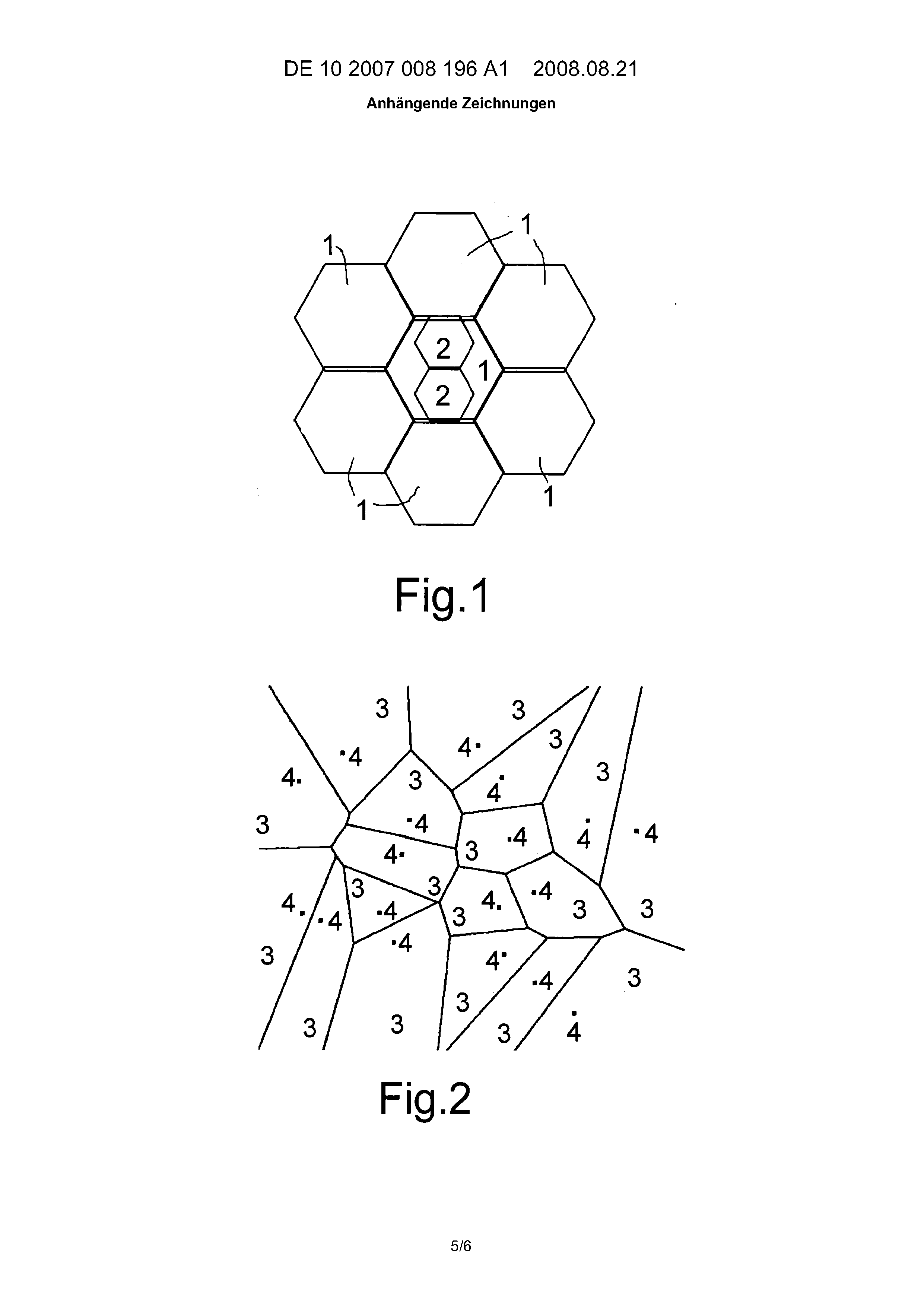
<figref idrefs="S10">1</figref> shows In this context, by the example of a common modeling of radio cells Hexagone (hexagons). The original radio network coverage done in the example by seven approximately equal sized, contiguous hexagonal radio cells <figref>1</figref>, Out<figref idrefs="S10">1</figref> is clear, that a compression of the retention of hexa gonal radio cell structure not readily possible is. The resultant compression at a kleinflächigeren hexagonal radio cells <figref>2</figref> complement to the original hexagonal cell <figref>1</figref> no longer in a regular manner, so that a total restructuring of the cellular, hexagonally structured would require radio network.
remedy creates in this regard, the modeling of the radio cells in As so-called Voronoi polygons which also called Thiessen polygons will. Unlike Hexagon cells have Voronoi polygon cells the shape of polygons whose area sizes to inverse relationship to the density of nodes. In transmission on wireless networks, this means that a compression of the node lying base stations leads to a reduction of the cells. Voronoi polygon cells mathematically as so-called dual representation of the Delaunay triangulation be accurately described. Voronoi polygons from a set of central polygon points (Node) generated. The Voronoi polygon of such a node is obtained by Calculate the median perpendicular of the links to all Neighboring nodes of the examined node. The intersections of these Bisectors intersect at the Voronoi vertices, their connection then gives the Voronoi polygon. These vertices is again the center points of the circumferences to the Delaunay triangles.
process for computing the Voronoi polygon cells are both the surface (2D) as well as for the Space (3D) known.
at modeling with Voronoi polygon cells performs a compression of the network by adding of nodes only in a recalculation of the immediate neighborhood the new node without any displacement of existing kno th / base stations necessary would, as required in the case of using hexagonal cells would.
The known radio network simulation methods work in flat surfaces. The "world" of the simulation but in the flat surface limited. Usually is a rectangular area for placement of the simulated Base stations selected. Possible start and end points of the moving objects for user mobility modeling be under statistical Distributions chosen. Without further measures, performs this Method in an undesirable Concentration of the movements in the center of the flat surface simulation. As countermeasure although you can implement a so-called "wrap-around" which means that a motion of an object passing over the edge and on the opposite Page continues. However it can be in the on Voronoi polygons based flat surfaces in this way no "wrap around" to carry out, without that the proportions changed the cells will. Especially with small simulated worlds such. As for cellular picocells or wireless LAN in an interior, these edge effects are significant and distort the simulation result significantly.
<figref idrefs="S10">2</figref> shows a valid in this context as an example of a flat surface Cellular network coverage diagram of Voronoi polygon cells <figref>3</figref>. in their nodes <figref>4</figref> are respectively a base station should. From this it be clearly seen that the edge of the flat surface toward the polygonal cells <figref>3</figref> not are limited.
task of the present invention, it is, using Voronoi polygon cells to provide a radio network simulation method that the aforementioned negative Edge Effects does not have and <?page 3?>with therefore a better simulation result is achieved.
According to the invention, relating to a radio network simulation method of the type mentioned refers, this object is achieved by the fact that both in conventional Manner designed as a flat surface simulation area the Voronoi cell polygons as well as to be superimposed on a model then as a simulation area serving spherical surface are projected and that the further simulation evaluation on the spherical surface is carried out in a manner similar to that conventional on the flat surface simulation equivalent.
The The basic idea of the invention is to combine the use of Voronoi polygon cells with user mobility simulation on the spherical surface. It can on the set with Voronoi polygon cells spherical surface also a terrain modeling or a radio Using modeling run. Since a spherical surface by definition not edges has omitted in the present according to the Invention working radio network simulation method advantageously Thus, the otherwise incurred in a flat surface simulation interfering edge effects.
at the radio network simulation method of the present invention is to be implemented the projection of the simulation area from the plane into a spherical surface, as appropriate, by means of suitable mathematical relaying software, z. B. Matlab<sup>TM</sup> or Java3D<sup>TM</sup>,
Appropriate uses of the inventive method exist with commercial simulation tools for wireless networks, generalized in the field of traffic flow analysis and also during movement Object in a simulated or gained through measurements environment.
advantageous Developments and refinements of the invention are in themselves back relating directly or indirectly to claim 1 subclaims indicated.
The Invention will be explained with reference to drawings. It show:
<figref idrefs="S10">1</figref> the explained previously Modeling of cells by hexagons (hexagons) with inserted central Compression,
<figref idrefs="S10">2</figref> the also previously explained Chart with Voronoi polygon cells in a planar surface,
<figref idrefs="S11">3</figref> on using mathematical relaying software from a flat surface a spherical surface projected diagram Voronoi polygon cells, and
<figref idrefs="S11">4</figref> in perspective view to be overlaid as an example of a User mobility model Tracks (traces) the movement of objects on a spherical surface.
In <figref idrefs="S11">3</figref> is a means of a mathematical software, z. B. Matlab<sup>TM</sup>. from a flat surface simulation on a spherical surface <figref>5</figref> unreacted Voronoi diagram for modeling and simulation of radio coverage of a cellular Radio network shown. The diagram consists of a Plurality of spherical Voronoi polygon cells <figref>6</figref>, Each in its central node <figref>7</figref> a base station aufwei sen. The in plane simulation area occurring, disturbing Edge effects of planar Voronoi polygon cells in the simulation on the spherical surface <figref>5</figref> avoided. The on the ball surface converted by projection Voronoi polygon cells <figref>6</figref> can be according to the invention with a mobility simulation superimposed on the same spherical surface.
In <figref idrefs="S11">4</figref> is to an example of a user mobility model in the form of tracks (Traces) <figref>8th</figref> the movement of objects, eg. as individuals or Vehicles, on a spherical surface <figref>9</figref> shown. The superimposition the movement traces <figref>8th</figref> with z. B. <figref idrefs="S11">3</figref> illustrated Voronoi polygon cells, for example, provide radio coverage represent an area can for each time point and for each Object that radio cell are determined, in which the object is. Further evaluation of the movement trace files (Trace Files) is similar to the simulation in the flat surface.
<dl><dt>1</dt><dd>Hexagonal radio cells</dd><dt>2</dt><dd>small-area hexagonal radio cells</dd><dt>3</dt><dd>Voronoi polygon cells</dd><dt>4</dt><dd>node</dd><dt>5</dt><dd>spherical surface</dd><dt>6</dt><dd>spherical Voronoi polygon cells</dd><dt>7</dt><dd>node</dd><dt>8th</dt><dd>Bewegungsspuren (Traces)</dd><dt>9</dt><dd>spherical surface</dd></dl>
2 sheets
Sheet 1 Sheet 2
Every citation, both waysCites: the store holds 0 of 1
| Document | Relation | Office | Cited during |
|---|---|---|---|
| US10749737B2 | Cited by | United States of America | Applicant |
| US10004082B2 | Cited by | United States of America | Applicant |
| US10461846B2 | Cited by | United States of America | Applicant |
| US9277410B2 | Cited by | United States of America | Applicant |
| US11936466B2 | Cited by | United States of America | Applicant |
| WO2011146180A1 | Cited by | World Intellectual Property Organization (WIPO) | International search |
| US10117111B2 | Cited by | United States of America | Applicant |
| EP2869622A1 | Cited by | European Patent Office (EPO) | Search report |
| US10212026B2 | Cited by | United States of America | Applicant |
| US12316437B2 | Cited by | United States of America | Applicant |
| US9800460B2 | Cited by | United States of America | Applicant |
| US10548025B2 | Cited by | United States of America | Applicant |
| US10791566B2 | Cited by | United States of America | Applicant |
| US9252982B2 | Cited by | United States of America | Applicant |
| US10616074B2 | Cited by | United States of America | Applicant |
| CN108307394A | Cited by | China | Search report |
| US8433327B2 | Cited by | United States of America | Applicant |
| US11496212B2 | Cited by | United States of America | Applicant |
| US10880000B2 | Cited by | United States of America | Applicant |
| WO2011146180A1 | Cited by | World Intellectual Property Organization (WIPO) | International search |
| Stamm,Christoph: Algorithms and software for Radio Signal coverage Prediction in Terrains. Dissertation an der ETH Zürich. Diss ETH No.14283, 2001, (recherchiert am 01.02.2008). Im Internet: <Url: http://e-collection.ethbib.ethz.ch/ecol-pool/diss/ fulltext/eth14283.pdf> | Non-patent | – | Search report |
| Amit,P. (u.a.): Real-World Environment Models for Mobile Network Evaluation. In: IEEE Journal on Selected Areas in Communications, Vol.23, No.3, März 2005, S.622-632,(recherchiert am 01.02.2008). Im Internet: <Url: http://ieeexplore.ieee.org/ie15 /49/30451/01402589.pdf?arnumber=1402589> | Non-patent | – | Search report |
| Gold,Christopher (u.a.): Torwards the global GIS. In: ISPRS Journal of Photogrammetry and Remote Sensing, Volume 55, Issue 3, September 2000, S. 150-163. (recherchiert am 01.02.2008). Im Internet: <Url: http://www.sciencedirect.com/scien ce?_ob=ArticleURL&_udi=B6VF4-41BV8F0-3&_user=86096 6&_rdoc=1&_fmt=&_orig=search&_sort=d&view=c&_acct= C000046399&_version=1&_urlVersion=0&_userid=860966 | Non-patent | – | Search report |
| Gold,Christopher (u.a.): Torwards the global GIS. In: ISPRS Journal of Photogrammetry and Remote Sensing, Volume 55, Issue 3, September 2000, S. 150-163. (recherchiert am 01.02.2008). Im Internet: <Url: http://www.sciencedirect.com/scien ce?_ob=ArticleURL&_udi=B6VF4-41BV8F0-3&_user=86096 6&_rdoc=1&_fmt=&_orig=search&_sort=d&view=c&_acct= C000046399&_version=1&_urlVersion=0&_userid=860966 | Non-patent | – | Search report |
| Gold,Christopher (u.a.): Torwards the global GIS. In: ISPRS Journal of Photogrammetry and Remote Sensing, Volume 55, Issue 3, September 2000, S.150-163. (rech. am 01.02.2008). Im Internet: | Non-patent | – | – |
| Stamm,Christoph: Algorithms and software for Radio Signal coverage Prediction in Terrains. Dissertation an der ETH Zürich. Diss ETH No.14283, 2001, (recherchiert am 01.02.2008). Im Internet: <Url: http://e-collection.ethbib.ethz.ch/ecol-pool/diss/ fulltext/eth14283.pdf> | Non-patent | – | Search report |
| Amit,P. (u.a.): Real-World Environment Models for Mobile Network Evaluation. In: IEEE Journal on Selected Areas in Communications, Vol.23, No.3, März 2005, S.622-632,(recherchiert am 01.02.2008). Im Internet: <Url: http://ieeexplore.ieee.org/ie15 /49/30451/01402589.pdf?arnumber=1402589> | Non-patent | – | Search report |
| Stamm,Christoph: Algorithms and software for Radio Signal coverage Prediction in Terrains. Dissertation an der ETH Zürich. Diss ETH No.14283, 2001, (rech. am 01.02.2008). Im Internet: <Url: http://e-collection.ethbib.ethz.ch/ecol-pool/diss/ fulltext/eth14283.pdf> | Non-patent | – | – |
| Amit,P. (u.a.): Real-World Environment Models for Mobile Network Evaluation. In: IEEE Journal on Selected Areas in Communications, Vol.23, No.3, März 2005, S.622-632,(rech. am 01.02.2008) | Non-patent | – | – |
2 priority claims, no other members on record
Priority claims2
| Document | Office | Kind | Date |
|---|---|---|---|
| 102007008196 | Germany | A | |
| DE20071008196 | – | – | – |
5 legal events, as the office reported them to INPADOC
Over the term
Point at a mark for the eventEvents
| Event | Code | |
|---|---|---|
| Application deemed withdrawn, or ip right lapsed, due to non-payment of renewal feeWithdrawnR119 | R119 | |
| Patent grant now finalGrantedR020 | R020 | |
| Grant decision by examination section/examining divisionR018 | R018 | |
| Amendment of ipc main classPREVIOUS MAIN CLASS: H04Q0007360000R079 | R079 | |
| Request for examination as to paragraph 44 patent lawOP8 | OP8 |
Numbers
- Publication
- 102007008196
- Publication, DOCDB
- 102007008196
- Publication, EPODOC
- DE102007008196
- Application
- 10008196
- Application, DOCDB
- 102007008196
- Application, EPODOC
- DE20071008196
Titles2
- German
- Funknetz-Simulationsverfahren
- English
- Radio network-simulation method for radio network, traffic flow analysis and for movement of generalized objects in simulation, involves covering cellular radio network, which is modeled by voronoi-cell polygon in simulation area
Classification
- IPC, 3
- H04L12 24
- H04W16 18
- H04W16 22