Wireless communication system, wireless device and wireless communication method
Abstract
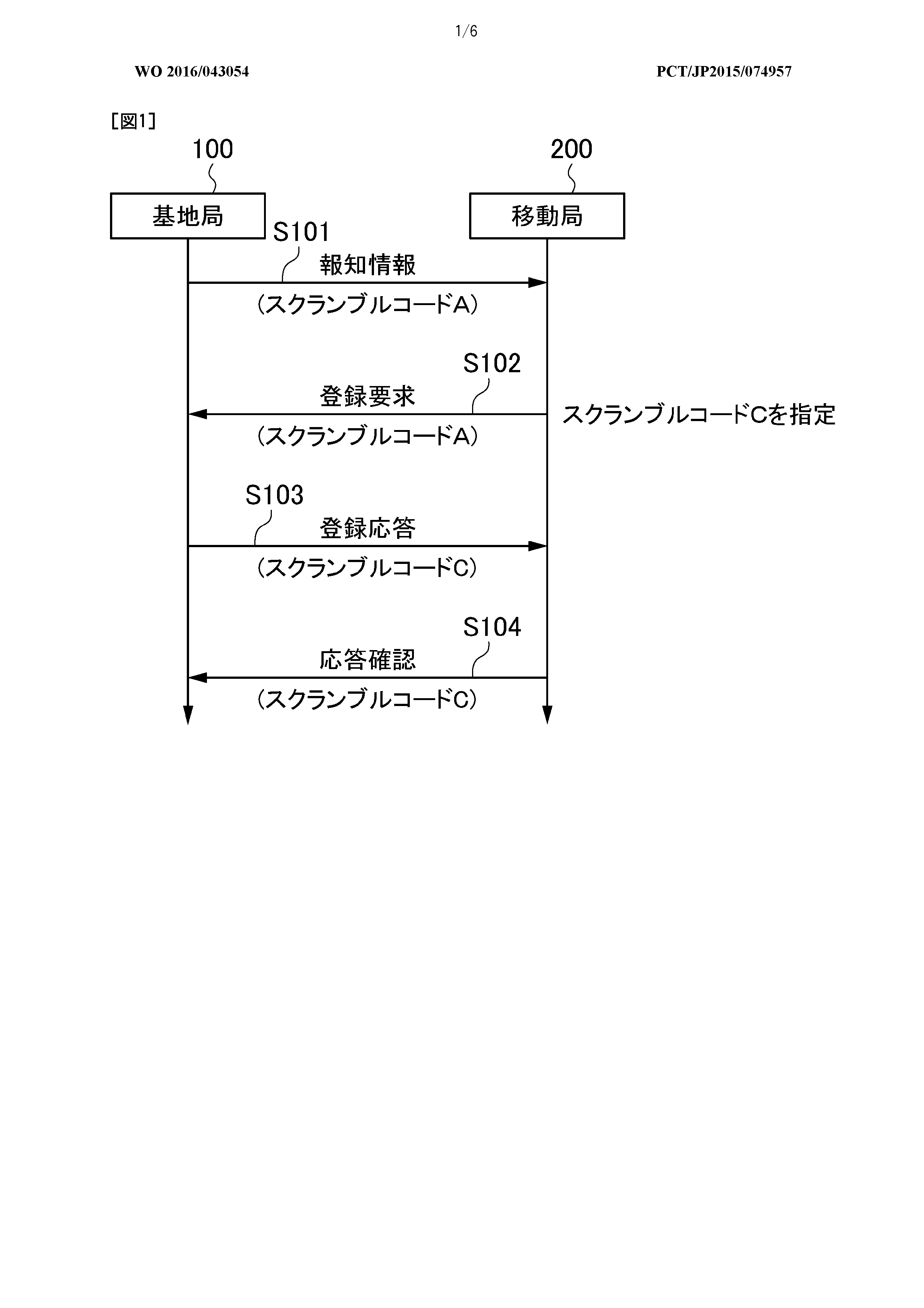
A radio communications system prevented from establishing communication with a mobile station using an electric wave reproduced by third party is provided. Base station 100 transmits "information information" to mobile station 200 at Step S101. Mobile station 200 returns "a registration demand" which set up scramble code C to base station 100 at Step S102. "Information information" and "a registration demand" give scramble in scramble code A for which it opts beforehand. Base station 100 returns "a registration response" to mobile station 200 at Step S103. Mobile station 200 returns "a response check" to base station 100 at Step S104. "A registration response" and "a registration response" give scramble in scramble code C set as "a registration demand. "If base station 100 receives "a response check", communication of base station 100 and mobile station 200 is established, and scramble will be given by scramble code C when transmitting subsequent signals.
Term
No projected expiry on record.
- Priority and filed
- Published
- Today
8 claims: 3 independent, 5 dependent
- 1無線通信を行う親局と子局を有する無線通信システムにおいて、 前記親局は、 報知情報を予め決められた第1のスクランブルコードでスクランブルを施して前記子局に送信する報知情報送信手段を備え、 前記子局は、 前記報知情報を受信すると第2のスクランブルコードを設定した登録要求を前記第1のスクランブルコードでスクランブルを施して前記親局に送信する登録要求送信手段を備え、 前記親局と前記子局との以降の通信データを前記第2のスクランブルコードでスクランブルを施すことを特徴とする無線通信システム。
- 2前記第2のスクランブルコードは、前記子局の個別番号を用いることを特徴とする請求項1に記載の無線通信システム。
- 3前記第2のスクランブルコードは、前記子局の電源オンからの時間を用いることを特徴とする請求項1に記載の無線通信システム。
- 4前記第2のスクランブルコードは、前記子局の電源オンからの時間を用いることを特徴とする請求項2に記載の無線通信システム。
- 5前記子局の電源オンからの時間は、予め決められた単位時間でカウントされることを特徴とする請求項3に記載の無線通信システム。
- 6前記子局の電源オンからの時間は、予め決められた単位時間でカウントされることを特徴とする請求項4に記載の無線通信システム。
- 7無線通信システムの子局に設けられる無線機であって、 予め決められた第1のスクランブルコードでスクランブルが施された報知情報を親局から受信する報知情報受信手段と、 前記報知情報を受信すると第2のスクランブルコードを設定した登録要求を前記第1のスクランブルコードでスクランブルを施して送信する登録要求送信手段とを備え、 以降の前記親局との通信データを前記第2のスクランブルコードでスクランブルを施すことを特徴とする無線機。
- 8無線通信システムの子局における無線通信方法であって、 予め決められた第1のスクランブルコードでスクランブルが施された報知情報を親局から受信する報知情報受信工程と、 前記報知情報を受信すると第2のスクランブルコードを設定した登録要求を前記第1のスクランブルコードでスクランブルを施して送信する登録要求送信工程とを備え、 以降の前記親局との通信データを前記第2のスクランブルコードでスクランブルを施すことを特徴とする無線通信方法。
Independent claims8
38 paragraphs, as filed
A radio communications system, a walkie-talkie, and a wireless communication method
0001The present invention is analog FM (frequency*modulation), for example. A radio communications system, a walkie-talkie, and a wireless communication method using a frequency modulation method are started, It is related with a radio communications system, a walkie-talkie, and a wireless communication method which are prevented from decoding communication data by giving scramble to an audio signal which communicates especially by radio, and data (henceforth "communication data").
0002For example, in a radio communications system of an analog FM method, in order to prevent disclosure of communication data, scramble processing which performs various secrecy-ization is provided in recent years. Scramble processing of conventional technology for such secrecy-izing is explained with reference to drawings. Composition of radio communications system (henceforth a "radio communications system") 10 of an analog FM method by conventional technology is shown in Drawing 5. Radio communications system 10 comprises mobile stations 200, such as a plurality of personal digital assistants as base station 100 and a child office as a key station, and base station 100 and mobile station 200 communicate on radio.
0003Processing of the transmitting side of walkie-talkie 300 of base station 100 in such a radio communications system 10 and mobile station 200 and a receiving side is explained using Drawing 6.
0004First, processing of the transmitting side of walkie-talkie 300 is explained using Drawing 6 (1). DSP (Digital*Signal*Processing) 20 will output an audio signal with which audio signal scramble processing section 21 gave scramble of an audio signal, and gave scramble to FM modulation processing part 24, if an audio signal is outputted to audio signal scramble processing section 21. If DSP20 outputs data to data scramble processing section 22, data scramble processing section 22 will output data which gave scramble of data and gave scramble to MSK (minimum-shift*keying) modulation processing part 23. If data in which scramble was given is inputted, MSK modulation processing part 23 will perform the minimum deviation abnormal conditions which narrow an occupancy zone, and will output them to FM modulation processing part 24. Thus, noise can be lessened by performing the minimum deviation abnormal conditions which narrow an occupancy zone. If an audio signal or data in which scramble was given is inputted, FM modulation processing part 24 will modulate an audio signal or data to a subcarrier (electric wave), and will transmit with antenna 25.
0005Next, processing of a receiving side of walkie-talkie 300 is explained using Drawing 6 (2). If a subcarrier of an audio signal with which scramble which antenna 25 received was given, or data is inputted, FM recovery treating part 29 restores to a subcarrier, when a subcarrier is an audio signal, it outputs it to audio signal desk ramble treating part 26, and when a subcarrier is data, it will be outputted to MSK recovery treating part 28. Audio signal desk ramble treating part 26 will output to DSP20 an audio signal of which scramble was canceled, if scramble of an audio signal with which scramble was given is canceled. If MSK recovery treating part 28 carries out the minimum deviation recovery of the data in which scramble was given, it will be outputted to data desk ramble treating part 27. Data desk ramble treating part 27 will output to DSP20 data of which scramble was canceled, if scramble of data in which scramble was given is canceled.
0006Next, base station 100 and mobile station 200 explain communication using Drawing 7 which is a sequence figure to establishment about a procedure of delivering a scramble code in base station 100 and mobile station 200 of radio communications system 10. As shown in Drawing 7, in Step S201, base station 100 transmits first "information information" which set up scramble code A to mobile station 200, when specifying scramble code B. About this "information information", scramble is given in scramble code A for which it opts beforehand. Subsequently, in Step S202, if "information information" is received, mobile station 200 will return "a registration demand" to base station 100, when mobile station 200 requires registration. About this "registration demand", scramble is given in scramble code A for which it opts beforehand. Subsequently, in Step S203, base station 100 will return "a registration response" which reports that it has agreed on "a registration demand" to mobile station 200, if "a registration demand" is received. About this "registration response", scramble is given in scramble code B set as "information information. "Subsequently, in Step S204, mobile station 200 will return "a response check" which reports that "a registration response" was checked to base station 100, if "a registration response" is received. About this "response check", scramble is given in scramble code B. If base station 100 receives "a response check", communication of base station 100 and mobile station 200 is established, when transmitting subsequent communication data, scramble is given by scramble code B, and scramble will be canceled by scramble code B when receiving communication data.
0007Conventionally, base station 100 which is an upper device in radio communications system 10 in this way specified a scramble code, and base station 100 and mobile station 200 have established communication in this specified scramble code. In for example, a digital-mobile-radio system of patent documents 1, An office is changing a scramble code of an office in the end of the non-end of line in scramble code set as "information information" transmitted from a base transceiver station in the end of the non-end of line, It enables it to establish other base transceiver stations and communication which use different scramble codes from a radio system to which an office belongs from the first in the end of the non-end of line for communication CH (channel).
<p num="0008"><patcit num="1"><text>JP, 2005-244575, A</text></patcit></p>
<p num="0009">Measuring instrument 30 of functional composition shown in Drawing 8 generally used can reproduce an electric wave of the transmitting side using an analog FM method by conventional technology. A procedure in which measuring instrument 30 reproduces an electric wave of base station 100 is explained using Drawing 8. First, it restores to an electric wave of base station 100 which modulation analyzer 32 receives from antenna 31, and outputs an audio signal to which it restored to receiving side recorder 33. Receiving side recorder 33 records a received audio signal as an audio signal, and reproduces a recorded audio signal into transmitting side recorder 34. Transmitting side recorder 34 will output an audio signal to signal generator 35, if a duplicate of a recorded audio signal is completed. Signal generator 35 restores to an inputted audio signal, and transmits from antenna 31. Thus, in radio communications system 10 using an analog FM method, when base station 100 which is an upper device of the transmitting side like a digital method specifies a scramble code, a third party can reproduce an electric wave transmitted from base station 100 with measuring instrument 30. Thereby, since mobile station 200 and communication were established, there was a problem that an electric wave jack between non-railroad sections by a third party who is not permitted became possible.</p><p num="0010">The present invention is made in view of such a situation, and it aims at providing a radio communications system, a walkie-talkie, and a wireless communication method which can solve the above-mentioned subject.</p>
<p num="0011">In a radio communications system which has a key station which performs wireless communications, and a child office, a radio communications system of the present invention is the key station, It has an information information transmission means which gives scramble in 1st scramble code that was able to determine information information beforehand, and transmits to the child office, and is the child office, Reception of the information information will be provided with a registration demand transmitting means which gives scramble in the 1st scramble code, and transmits a registration demand which set up the 2nd scramble code to the key station, It is characterized by giving scramble for communication data after the key station and the child office in the 2nd scramble code. The 2nd scramble code of a radio communications system is characterized by using an individual number of the child office. The 2nd scramble code of a radio communications system is characterized by using time from power supply ON of the child office. Time from power supply ON of the child office of a radio communications system is characterized by counting by unit time decided beforehand. An information information receiving means which receives information information to which a walkie-talkie of the present invention is a walkie-talkie formed in a child office of a radio communications system, and scramble was given in 1st scramble code decided beforehand from a key station, Reception of the information information will be provided with a registration demand transmitting means which gives scramble in the 1st scramble code, and transmits a registration demand which set up the 2nd scramble code, It is characterized by giving scramble for communication data with the subsequent key stations in the 2nd scramble code. An information information receiving process of receiving information information to which a wireless communication method of the present invention is a wireless communication method in a child office of a radio communications system, and scramble was given in 1st scramble code decided beforehand from a key station, Reception of the information information will be provided with a registration demand transmitting process of giving scramble in the 1st scramble code, and transmitting a registration demand which set up the 2nd scramble code, It is characterized by giving scramble for communication data with the subsequent key stations in the 2nd scramble code.</p>
<p num="0012">According to the present invention, even when a third party reproduces an electric wave from a key station and transmits, a radio communications system, a walkie-talkie, and a wireless communication method which are prevented from establishing communication with a child office using an electric wave reproduced by third party are provided.</p>
0013<figref num="1">A base station concerning an embodiment of the invention and a mobile station are the figures showing a sequence to establishment for communication.</figref><figref num="2">an embodiment of the invention -- it is a figure explaining composition and a scramble procedure of a Related air format.</figref><figref num="3">an embodiment of the invention -- it is a figure showing composition of Related PN (15, 14).</figref><figref num="4">It is a flow chart of scramble processing and desk ramble processing concerning an embodiment of the invention.</figref><figref num="5">It is a figure showing composition of a radio communications system.</figref><figref num="6">It is a figure showing a flow of processing of the transmitting side of a walkie-talkie, and a receiving side.</figref><figref num="7">A base station concerning conventional technology and a mobile station are the figures showing a sequence to establishment for communication.</figref><figref num="8">It is a figure showing functional composition of a measuring instrument concerning conventional technology.</figref>
0014Composition of radio communications system 10 in an embodiment of the invention is the same as radio communications system 10 shown in Drawing 5, and a flow of processing of the transmitting side of base station 100 and mobile station 200 and a receiving side is the same as that of processing of the transmitting side of base station 100 shown in Drawing 6, and mobile station 200, and a receiving side. In an embodiment of the invention, a procedure of delivering a scramble code of radio communications system 10 differs from a procedure of delivering the conventional scramble code. Although mobile station 200 is mentioned as an example in radio communications system 10 as an embodiment shown in Drawing 5 as base station 100 and a child office as a key station, in the present invention, a key station is not restricted to a base station. For example, a key station may be a walkie-talkie which becomes main [two or more children office] (two or more children office has a special function which it does not have), and may be a key station walkie-talkie which carries out control management of the mobile station 200 (for example, restriction of operation etc. are performed). When a key station is what performs restriction of operation, mobile station 200 may be constituted by performing communication shown in a key station and Drawing 1 so that restriction of operation may be canceled for a predetermined period. Although a mobile station is mentioned as an example in a radio communications system of Drawing 5 as a non-end-of-line end as a child office, it may not necessarily be not a mobile station but a walkie-talkie used fixed.
0015First, base station 100 and mobile station 200 explain communication using Drawing 1 which is a sequence to establishment about a procedure of delivering a scramble code in base station 100 of radio communications system 10 in an embodiment of the invention, and mobile station 200. As shown in Drawing 1, in Step S101, base station 100 transmits "information information" to mobile station 200 first. About this "information information", scramble is given in scramble code A for which it opts beforehand. Subsequently, in Step S102, mobile station 200 returns "a registration demand" which set up scramble code C to base station 100, when mobile station 200 will require registration and will specify scramble code C, if "information information" is received. About this "registration demand", scramble is given in scramble code A for which it opts beforehand. Subsequently, in Step S103, base station 100 will return "a registration response" which reports that it has agreed on "a registration demand" to mobile station 200, if "a registration demand" is received. About this "registration response", scramble is given in scramble code C set as "a registration demand. "Subsequently, in Step S104, mobile station 200 will return "a response check" which reports that "a registration response" was checked to base station 100, if "a registration response" is received. About this "response check", scramble is given in scramble code C. Scramble will be canceled by scramble code C, if scramble is given by scramble code C and communication data is received, when communication of base station 100 and mobile station 200 will be established and subsequent communication data will be transmitted, if base station 100 receives "a response check. "
0016Next, scramble processing of walkie-talkie 300 and desk ramble processing of mobile station 200 are explained. Scramble processing is performed by audio signal scramble processing section 21 or data scramble processing section 22 (henceforth a "scramble processing section") shown in Drawing 6 (1). Desk ramble processing is performed by audio signal desk ramble treating part 26 or data desk ramble treating part 27 (henceforth a "desk ramble treating part") shown in Drawing 6 (1).
0017First, signal format (henceforth "an air format") 40 of communication data transmitted and received between non-railroad sections of base station 100 and mobile station 200 is explained using Drawing 2 (1). As shown in Drawing 2 (1), air format 40 comprises bit synchronization signal 41, frame synchronization signal 42, and message signal 43. A MSK format of analog simple radio is used for bit synchronization signal 41 and frame synchronization signal 42. A modulation rate is 1200 bps and mark frequency of such air format 40 is 1200H, for example.<sub>Z</sub>"1" and space frequency are 1800H.<sub>Z</sub>It is "0. "Bit synchronization signal 41 is a 48-bit bit sequence which consists of two values of 1 and 0 as shown in Drawing 2 (1) and (a) for telling a receiving side about bit detection timing of a signal transmitted. Frame synchronization signal, It is the bit sequence made random by 31-bit M series numerals (Maximum*period*sequence: the maximum periodic system sequence numerals) which consist of two values of 1 and 0 as shown in Drawing 2 (1) and (b) for telling a receiving side about frame detection timing of a signal transmitted. M series numerals are the false random number series in PN numerals (Pseudo*Noise: false random code) which are the keys to encryption. Message signal 43 is a bit sequence which comprises message wording of a telegram (64 bits) and CRC numerals (16 bits), as shown in Drawing 2 (1) and (c). A generating polynomial from which CRC numerals detect a signal error of message wording of a telegram (1+X)<sup>5</sup>+X<sup>12</sup>+X<sup>16</sup>It is.
0018A scramble procedure to such air format 40 is explained using Drawing 2 (2). First, as shown in Drawing 2 (2) (a), message signal 43 which comprises message wording of a telegram and CRC numerals is taken from air format 40. Subsequently, as shown in Drawing 2 (2) (b), scramble is given to message signal 43 in scramble code C. Subsequently, a message signal which gave scramble as shown in Drawing 2 (2) (c) is stored in air format 40. About a desk ramble procedure, it is the same as a scramble procedure of a figure (2) in Drawing 2 (2) (Lee) except changing into "it is release about scramble by scramble code C in message signal 43. "
0019Next, scramble code A and scramble code C which are shown in Drawing 1 are explained. Scramble code A can be considered as arbitrary codes for which base station 100 and mobile station 200 opt beforehand. For example, a part of serial number of base station 100 or mobile station 200 can be considered as scramble code A. Scramble code C is a scramble code specified by mobile station 200, and it makes it become a value from which it is considered as a value different every mobile station 200, and a capital degree differs also in the same mobile station 200 as for "registration demand" transmission. For this reason, an initial value of scramble code C is determined using an individual number of mobile station 100, and time after a power supply of mobile station 100 is turned on.
0020When scramble code C generated from time after an individual number of such a mobile station 100 and a power supply of mobile station 100 are turned on is a bit sequence which is 15 bits, it assigns so that an individual number will be 3 bits and count time may be 12 bits, for example. In such a case, it is 8 (=2) by 3 bits of an individual number.<sup>3</sup>Mobile station 200 of a stand is discriminable. 12 bits of count time (4096= 2)<sup>12</sup>If a count is performed and 1 count time is set to 5msec, it will become 1 round by 4095x5msec=20475msec (20.475 seconds).
0021In order to give scramble to message signal 43, an initial value hangs PN (15, 14) which is PN numerals shown in Drawing 3 which is scramble code C on a bit sequence of message signal 43, and performs random-ization of a bit sequence of message signal 43 in it. PN (15, 14) is S as shown in Drawing 3.<sub>0</sub>S, Or et al.<sub>14</sub>It is the bit sequence provided with 15 bits of of. It shifts 1 bit of this PN (15, 14) at a time to the right in order, and is S.<sub>0</sub>A bit and S<sub>1</sub>It is S about a value of ExOR (exclusive OR) of a bit.<sub>14</sub>One false random number after another is generated by considering it as a value of a bit and carrying out by repeating this. That is, if scramble code C is set to an initial value of PN numerals, a false random number of scramble code C will be generated.
0022Next, a scramble procedure of message signal 43 by PN (15, 14) which a scramble processing section performs is explained in order of the step of a flow chart shown in Drawing 4 (1).
0023(Step S11) First, a scramble processing section creates scramble code C which consists of an individual number and count time. The present count time is set to count time. A pattern number is attached to scramble code C, and a pattern number is matched with message signal 43, and is memorized by storage parts (not shown), such as an auxiliary storage unit.
0024(Step S12) Subsequently, a scramble processing section sets to a register initial value of PN (15, 14) scramble code C created at Step S11.
0025(Step S13) Subsequently, a scramble processing section is S of a bit sequence of a register of PN (15, 14).<sub>0</sub>S<sub>1</sub>S<sub>2</sub>S<sub>3</sub>..... is outputted in order.
0026(Step S14) Subsequently, S of a bit sequence of PN (15, 14) which will be outputted at Step S13 from a head of message signal 43 if a scramble processing section inputs message signal 43<sub>0</sub>S<sub>1</sub>S<sub>2</sub>S<sub>3</sub>An ExOR (exclusive OR) operation for every bit, ....., is performed, and scramble processing will be ended if message signal 43 which gave scramble is outputted.
0027Next, a desk ramble procedure of message signal 43 by PN (15, 14) which a desk ramble treating part performs is explained in order of the step of a flow chart shown in Drawing 4 (2).
0028(Step S21) First, a desk ramble treating part takes out scramble code C of a pattern number corresponding to message signal 43 from storage part 20a.
0029(Step S22) Subsequently, a desk ramble treating part sets in a register of PN (15, 14) scramble code C taken out at Step S21.
0030(Step S23) Subsequently, a desk ramble treating part is S of a bit sequence of PN (15, 14).<sub>0</sub>S<sub>1</sub>S<sub>2</sub>S<sub>3</sub>..... is outputted in order.
0031(Step S24) Subsequently, S of a bit sequence of PN (15, 14) which will be outputted at Step S23 from a head of message signal 43 if a desk ramble treating part inputs message signal 43 with which scramble was given<sub>0</sub>S<sub>1</sub>S<sub>2</sub>S<sub>3</sub>An ExOR (exclusive OR) operation for every bit, ....., is performed, and if message signal 43 of which scramble was canceled is outputted, desk ramble processing will be ended.
0032Since base station 100 which is an upper device of the transmitting side does not specify a scramble code but mobile station 200 specifies a scramble code in radio communications system 10 by the above, Even when a third party reproduces an electric wave transmitted from base station 100 with measuring instrument 30, it does not come out to reproduce a scramble code. Therefore, since mobile station 200 and communication are unestablishable, an electric wave jack between non-railroad sections by a third party who is not permitted can be prevented.
0033It is although explained as scramble code C which consists of an individual number of mobile station 100, and count time after a power supply of mobile station 100 is turned on in an embodiment, It is possible to consider other data used as a value which differs every mobile station 200 and as for which a capital degree differs in "registration demand" transmission as scramble code C. Although scramble code C was made into a 15-bit bit sequence, 3 bits was assigned to an individual number and 12 bits was assigned at count time, it is not limited to this. For example, it is also possible to assign 5 bits to an individual number and to assign 10 bits at count time.
0034Such a radio communications system of the present invention, a walkie-talkie, and a wireless communication method can be prevented from establishing communication with a mobile station using an electric wave reproduced by third party, even when a third party reproduces an electric wave from a base station and transmits.
0035As mentioned above, although a concrete embodiment explained the present invention, the above-mentioned embodiment is illustration of the present invention, and it cannot be overemphasized that it is not limited to this embodiment.
0036It is as follows when the feature of the above embodiment is summarized. (1) In a radio communications system which has a key station which performs wireless communications, and a child office, a radio communications system of the present invention is the key station, It has an information information transmission means which gives * scramble in 1st scramble code that was able to determine information information beforehand, and transmits to the child office, and is the child office, Reception of the information information will be provided with a registration demand transmitting means which gives scramble in the 1st scramble code, and transmits a registration demand which set up the 2nd scramble code to the key station, It is characterized by giving scramble for communication data after the key station and the child office in the 2nd scramble code. A radio communications system of (2) and (1) is characterized by the 2nd scramble code using an individual number of the child office. A radio communications system of (3), (1), or (2) is characterized by the 2nd scramble code using time from power supply ON of the child office. A radio communications system of (4) and (3) is characterized by counting time from power supply ON of the child office by unit time decided beforehand. One radio communications system of (5) and (1) to (4) is characterized by giving the scramble to a message signal of an air format. Communication data in which scramble was given to one radio communications system of (6) and (1) to (5) in the 1st scramble code is characterized by canceling scramble in the 1st scramble code. Communication data in which scramble was given to one radio communications system of (7) and (1) to (5) in the 2nd scramble code is characterized by canceling scramble in the 2nd scramble code. (8) An information information receiving means which receives information information to which a walkie-talkie of the present invention is a walkie-talkie formed in a child office of a radio communications system, and scramble was given in 1st scramble code decided beforehand from a key station, Reception of the information information will be provided with a registration demand transmitting means which gives scramble in the 1st scramble code, and transmits a registration demand which set up the 2nd scramble code, It is characterized by giving scramble for communication data with the subsequent key stations in the 2nd scramble code. (9) An information information receiving process of receiving information information to which a wireless communication method of the present invention is a wireless communication method in a child office of a radio communications system, and scramble was given in 1st scramble code decided beforehand from a key station, Reception of the information information will be provided with a registration demand transmitting process of giving scramble in the 1st scramble code, and transmitting a registration demand which set up the 2nd scramble code, It is characterized by giving scramble for communication data with the subsequent key stations in the 2nd scramble code.
0037Although the present invention is suitable for a radio communications system, a walkie-talkie, and a wireless communication method, it is not limited to a radio communications system, a walkie-talkie, and a wireless communication method, and can be applied to a communications system and a communication apparatus which give scramble, and a general correspondence procedure.
003810...... Radio communications system20...... DSP20a..... Storage part21...... Audio signal scramble processing section22...... Data scramble processing section23...... MSK modulation processing part24...... FM modulation processing part25...... Antenna26...... Audio signal desk ramble treating part27...... Data desk ramble treating part28...... MSK recovery treating part29...... FM recovery treating part30...... Measuring instrument31...... Antenna32...... Modulation analyzer33...... Receiving side recorder34...... Transmitting side recorder35...... Signal generator40...... Air format41...... Bit synchronization signal42...... Frame synchronization signal43...... Message signal43a..... Message wording of a telegram43 b..... CRC numerals100..... Base station (key station) 200..... Mobile station (child office) 300..... Walkie-talkie
6 sheets
Sheet 1 Sheet 2 Sheet 3 Sheet 4 Sheet 5 Sheet 6
Every citation, both ways
| Document | Relation | Office | Category | Cited during | Relevant claims |
|---|---|---|---|---|---|
| JP2004048540A | Cites | Japan | Y | International search | 2, 4, 6 |
| JP2006191452A | Cites | Japan | Y | International search | 1-8 |
| WO2008087833A1 | Cites | World Intellectual Property Organization (WIPO) | Y | International search | 1-8 |
| JP2008306282A | Cites | Japan | Y | International search | 1-8 |
| US5850444A | Cites | United States of America | A | International search | 1-8 |
| JPH09146761A | Cites | Japan | Y | International search | 3-6 |
| JPH1075486A | Cites | Japan | A | International search | 1-8 |
2 members in 2 offices; this record represents the family
Members2
| Document | Office | Kind | |
|---|---|---|---|
| WO2016043054A1This record | World Intellectual Property Organization (WIPO) | A1 | |
| JPWO2016043054A1 | Japan | A1 |
Numbers
- Publication
- 2016/043054
- Application
- 74957
Titles5
- English
- SYSTEME DE COMMUNICATION SANS FIL, DISPOSITIF SANS FIL ET PROCEDE DE COMMUNICATION SANS FIL
- French
- SYSTEME DE COMMUNICATION SANS FIL, DISPOSITIF SANS FIL ET PROCEDE DE COMMUNICATION SANS FIL
- Japanese
- 無線通信システム、無線機、及び無線通信方法
- Unlabeled
- 無線通信システム、無線機、及び無線通信方法
- Japanese
- A radio communications system, a walkie-talkie, and a wireless communication method
Classification
- CPC, 2
- H04L9/08
- H04M11/00
- IPC, 3
- H04L9 08
- H04M11 00
- H04W12 08
Designated states147
- Regional, 80
- Botswana
- Ghana
- Gambia
- Kenya
- Liberia
- Lesotho
- Malawi
- Mozambique
- Namibia
- Rwanda
- Sudan
- Sierra Leone
- Eswatini
- United Republic of Tanzania
- Uganda
- Zambia
- Zimbabwe
- Armenia
- Azerbaijan
- Belarus
- Kyrgyzstan
- Kazakhstan
- Russian Federation
- Tajikistan
and 56 moreShow fewer
- Turkmenistan
- Albania
- Austria
- Belgium
- Bulgaria
- Switzerland
- Cyprus
- Czechia
- Germany
- Denmark
- Estonia
- Spain
- Finland
- France
- United Kingdom
- Greece
- Croatia
- Hungary
- Ireland
- Iceland
- Italy
- Lithuania
- Luxembourg
- Latvia
- Monaco
- North Macedonia
- Malta
- Netherlands (Kingdom of the)
- Norway
- Poland
- Portugal
- Romania
- Serbia
- Sweden
- Slovenia
- Slovakia
- San Marino
- Türkiye
- Burkina Faso
- Benin
- Central African Republic
- Congo
- Côte d’Ivoire
- Cameroon
- Gabon
- Guinea
- Equatorial Guinea
- Guinea-Bissau
- Comoros
- Mali
- Mauritania
- Niger
- Senegal
- Chad
- Togo
- Sao Tome and Principe
- National, 67
- United Arab Emirates
- Antigua and Barbuda
- Angola
- Australia
- Bosnia and Herzegovina
- Barbados
- Bahrain
- Brunei Darussalam
- Brazil
- Belize
- Canada
- Chile
- China
- Colombia
- Costa Rica
- Cuba
- Dominica
- Dominican Republic
- Algeria
- Ecuador
- Egypt
- Grenada
- Georgia
- Guatemala
and 43 moreShow fewer
- Honduras
- Indonesia
- Israel
- India
- Iran (Islamic Republic of)
- Japan
- Saint Kitts and Nevis
- Democratic People’s Republic of Korea
- Republic of Korea
- Lao People’s Democratic Republic
- Saint Lucia
- Sri Lanka
- Libya
- Morocco
- Republic of Moldova
- Montenegro
- Madagascar
- Mongolia
- Mexico
- Malaysia
- Nigeria
- Nicaragua
- New Zealand
- Oman
- Panama
- Peru
- Papua New Guinea
- Philippines
- Qatar
- Saudi Arabia
- Seychelles
- Singapore
- El Salvador
- Syrian Arab Republic
- Thailand
- Tunisia
- Trinidad and Tobago
- Ukraine
- United States of America
- Uzbekistan
- Saint Vincent and the Grenadines
- Viet Nam
- South Africa