Radio network design apparatus and method
Abstract
A cell balance is easily set among cells by optimum processing of radio parameters as object-function parameters. An object-function extracting section (11) treats radio parameters of a base station as parameters of object functions and sets conditions including at least the object functions. The object functions use cell-balance values between subject cells changed in characteristics in response to the parameters and adjacent cells in the vicinity of the subject cells and the values for optimum processing to balance the subject cells of traffic loads. An optimization section (12) carries out the optimum processing in accordance with the conditions set in the object-function extracting section (11) to seek a solution of parameter values.
Term
No projected expiry on record.
- Priority
- Filed
- Published
- Today
23 claims: 23 independent, 0 dependent
- 1What is claimed is:-- [1] base-station power The wireless network which covers a plurality of cells with a radio electric wave is designed. it is a wireless network designing device -- making the radio parameter of the above-mentioned base station into the parameter of an objective function -- change of the parameter SE between the object cell from which the intermediary characteristic changes, and the neighboring cell which exists in the neighborhood of the object cell it uses for the optimization processing which balances the cells of traffic load using the Luba Reims value -- wireless network designing device which has an optimizing part which calculates the value of the above-mentioned parameter which performs optimization processing according to the above-mentioned optimization conditions set up in the objective-function extraction part which sets up the optimization conditions which contain an objective function at least, and the above-mentioned objective-function extraction part, and serves as and a solution 請求の範囲 [1] 基地局力 の無線電波で複数のセルをカバーする無線ネットワークの設計を行なう 無線ネットワーク設計装置であって、 前記基地局の無線パラメータを目的関数のパラメータとし、該パラメータの変更によ つて特性の変化する対象セルと該対象セルの近隣に存在する近隣セルとの間のセ ルバランス値を用い、トラヒック負荷のセル間のバランスをとる最適化処理に用いる、 少なくとも目的関数を含む最適化条件の設定を行なう目的関数抽出部と、 前記目的関数抽出部にて設定された前記最適化条件に従って最適化処理を行い 、解となる前記パラメータの値を求める最適化部とを有する無線ネットワーク設計装置
- 2[2] the above-mentioned objective-function extraction part has balanced cells, so that it is close to a predetermined desired value the objective function which shows things is set up as the above-mentioned optimization conditions -- the above-mentioned optimizing part, It is said desired value about said objective function by changing said parameter. Wireless network designing device given in Claim 1 which optimizes so that it may bring close. [2] 前記目的関数抽出部は、所定の目標値に近いほどセル間のバランスがとれている ことを示す目的関数を前記最適化条件として設定し、 前記最適化部は、前記パラメータを変更することにより前記目的関数を前記目標値 に近づけるように最適化を行なう、請求項 1に記載の無線ネットワーク設計装置。
- 3[3] Cell balance value between said neighboring cells of said object cell and plurality Wireless network designing device given in Claim 2 which is a central value. [ objective function / said ] [3] 前記目的関数は、前記対象セルと複数の前記近隣セルとの間のセルバランス値の 代表値である、請求項 2に記載の無線ネットワーク設計装置。
- 4[4] Said neighboring SE of said object cell and plurality Radio given in Claim 3 which is the maximum and the minimum in the cell balance value between Les Network designing device. [ central value / which is used as said objective function / said ] [4] 前記目的関数として用いられる前記代表値は、前記対象セルと複数の前記近隣セ ルとの間のセルバランス値の中の最大値と最小値である、請求項 3に記載の無線ネ ットワーク設計装置。
- 5[5] The objective function with which the above-mentioned objective-function extraction part shows the degradation rate of important area, predetermined desired value Make into the above-mentioned optimization conditions the constraints which can balance Near and a degree cell and show and That. Set is carried out -- the above-mentioned optimizing part, By changing said parameter within limits with which said constraints fill said desired value and a predetermined relation, it is optimization so that the value of said objective function may be reduced. Wireless network designing device given in Claim 1 to perform. [5] 前記目的関数抽出部は、重要エリアの劣化率を示す目的関数と、所定の目標値に 近 、ほどセル間のバランスがとれて 、ることを示す制約条件とを前記最適化条件とし て設定し、 前記最適化部は、前記制約条件が前記目標値と所定の関係を満たす範囲内で、 前記パラメータを変更することにより、前記目的関数の値を低減するように最適化を おこなう、請求項 1に記載の無線ネットワーク設計装置。
- 6[6] Cell balance value between said neighboring cells of said object cell and plurality Wireless network designing device given in Claim 5 which is a central value. [ constraints / said ] [6] 前記制約条件は、前記対象セルと複数の前記近隣セルとの間のセルバランス値の 代表値である、請求項 5に記載の無線ネットワーク設計装置。
- 7[7] Said neighboring SE of said object cell and plurality Radio given in Claim 6 which is the maximum and the minimum in the cell balance value between Les Network designing device. [ central value / which is used as said constraints / said ] [7] 前記制約条件として用いられる前記代表値は、前記対象セルと複数の前記近隣セ ルとの間のセルバランス値の中の最大値と最小値である、請求項 6に記載の無線ネ ットワーク設計装置。
- 9[9] Petition whose above-mentioned cell balance value is a cell area ratio of the above-mentioned object cell and the above-mentioned neighboring cell Request 1-7 is a wireless network designing device given in the 1st paragraph either. [9] 前記セルバランス値は、前記対象セルと前記近隣セルとのセル面積比である、請 求項 1から 7のいずれか 1項に記載の無線ネットワーク設計装置。
- 12[12] Base station power In order to design the wireless network which covers a plurality of cells with a radio electric wave It is a wireless network designing method, The radio parameter of the above-mentioned base station is made into the parameter of an objective function, and it is change of the parameter. SE between the object cell from which the intermediary characteristic changes, and the neighboring cell which exists in the neighborhood of the object cell The Luba Reims value is used, it uses for the optimization processing which balances the cells of traffic load -- the step which sets up the optimization conditions which contain an objective function at least, The above-mentioned parameter which performs optimization processing according to the set-up above-mentioned optimization conditions, and serves as a solution Wireless network designing method which has a step which calculates a value. [12] 基地局力 の無線電波で複数のセルをカバーする無線ネットワークを設計するため の無線ネットワーク設計方法であって、 前記基地局の無線パラメータを目的関数のパラメータとし、該パラメータの変更によ つて特性の変化する対象セルと該対象セルの近隣に存在する近隣セルとの間のセ ルバランス値を用い、トラヒック負荷のセル間のバランスをとる最適化処理に用いる、 少なくとも目的関数を含む最適化条件の設定を行なうステップと、 設定された前記最適化条件に従って最適化処理を行い、解となる前記パラメータ の値を求めるステップとを有する無線ネットワーク設計方法。
- 13[13] Norrance between Near! and a degree cell can be taken to a predetermined desired value. the objective function which shows That is set up as said optimization conditions -- said objective function is brought close to said desired value by changing said parameter -- as -- Wireless network designing method given in Claim 12 which optimizes. [13] 所定の目標値に近!、ほどセル間のノランスがとれて 、ることを示す目的関数を前 記最適化条件として設定し、 前記パラメータを変更することにより前記目的関数を前記目標値に近づけるように 最適化を行なう、請求項 12に記載の無線ネットワーク設計方法。
- 14[14] Cell balance value between said neighboring cells of said object cell and plurality Wireless network designing method given in Claim 13 which is a central value. [ objective function / said ] [14] 前記目的関数は、前記対象セルと複数の前記近隣セルとの間のセルバランス値の 代表値である、請求項 13に記載の無線ネットワーク設計方法。
- 15[15] Said neighboring SE of said object cell and plurality Radio given in Claim 14 which is the maximum and the minimum in the cell balance value between Les Network designing method. [ central value / which is used as said objective function / said ] [15] 前記目的関数として用いられる前記代表値は、前記対象セルと複数の前記近隣セ ルとの間のセルバランス値の中の最大値と最小値である、請求項 14に記載の無線ネ ットワーク設計方法。
- 16[16] It is [ the objective function which shows the degradation rate of important area, and ] Bas-Rhin between cells, so that it is close to a predetermined desired value. The constraints which show that The can be taken are set up as the above-mentioned optimization conditions, Within limits which fill said desired value and a predetermined relation, said constraints are strange in said parameter. Wireless network designing method given in Claim 12 which optimizes so that the value of said objective function may be reduced by carrying out Further. [16] 重要エリアの劣化率を示す目的関数と、所定の目標値に近いほどセル間のバラン スがとれていることを示す制約条件とを前記最適化条件として設定し、 前記制約条件が前記目標値と所定の関係を満たす範囲内で、前記パラメータを変 更することにより、前記目的関数の値を低減するように最適化をおこなう、請求項 12 に記載の無線ネットワーク設計方法。
- 17[17] Cell balance value between said neighboring cells of said object cell and plurality Wireless network designing method given in Claim 16 which is a central value. [ constraints / said ] [17] 前記制約条件は、前記対象セルと複数の前記近隣セルとの間のセルバランス値の 代表値である、請求項 16に記載の無線ネットワーク設計方法。
- 18[18] Said neighboring SE of said object cell and plurality Radio given in Claim 17 which is the maximum and the minimum in the cell balance value between Les Network designing method. [ central value / which is used as said constraints / said ] [18] 前記制約条件として用いられる前記代表値は、前記対象セルと複数の前記近隣セ ルとの間のセルバランス値の中の最大値と最小値である、請求項 17に記載の無線ネ ットワーク設計方法。
- 20[20] Petition whose above-mentioned cell balance value is a cell area ratio of the above-mentioned object cell and the above-mentioned neighboring cell Request 12-18 is a wireless network designing method given in power 1 paragraph someday. [20] 前記セルバランス値は、前記対象セルと前記近隣セルとのセル面積比である、請 求項 12から 18のいずれ力 1項に記載の無線ネットワーク設計方法。
- 23[23] Base station power He is a pair about the design of the wireless network which covers a plurality of cells with a radio electric wave. It is a wireless network design program for performing Utah, The radio parameter of the above-mentioned base station is made into the parameter of an objective function, and it is change of the parameter. SE between the object cell from which the intermediary characteristic changes, and the neighboring cell which exists in the neighborhood of the object cell The Luba Reims value is used, it uses for the optimization processing which balances the cells of traffic load -- the procedure of setting up the optimization conditions which contain an objective function at least, The above-mentioned parameter which performs optimization processing according to the set-up above-mentioned optimization conditions, and serves as a solution Wireless network design Prodala for making a computer perform the procedure of calculating a value Mu. [23] 基地局力 の無線電波で複数のセルをカバーする無線ネットワークの設計をコンビ ユータに実行させるための無線ネットワーク設計プログラムであって、 前記基地局の無線パラメータを目的関数のパラメータとし、該パラメータの変更によ つて特性の変化する対象セルと該対象セルの近隣に存在する近隣セルとの間のセ ルバランス値を用い、トラヒック負荷のセル間のバランスをとる最適化処理に用いる、 少なくとも目的関数を含む最適化条件の設定を行なう手順と、 設定された前記最適化条件に従って最適化処理を行い、解となる前記パラメータ の値を求める手順とをコンピュータに実行させるための無線ネットワーク設計プロダラ ム。
Independent claims23
244 paragraphs, as filed
Specification
A wireless network designing device and a method
Technical field
[0001] The present invention relates to the device and method of designing the wireless-communications network which has a plurality of cells.
Background art
[0002] Is the load by traffic in each cell in the wireless-communications network which has a plurality of cells? To. In the high cell of load, the probability that cancellation of call loss or a packet will occur becomes high. Therefore, in the design of such a wireless-communications network, it is preferred that traffic load is appropriately set up to the traffic carrying capacity of each cell. It has a plurality of cells. In a wireless-communications network, it is each cell power. It is communication quality when a transmitted signal interferes. There is a deteriorating point. Therefore, communication quality deteriorates in predetermined area. It is desirable to lessen a point. To degrade of the communication quality which accounts for predetermined area here The rate of Point is considered as a degradation rate, for example, SIR (signal power pair interference electric power ratio) is predetermined. A value is fulfilled. Let a point be a point where communication quality deteriorates.
[0003] For example, carry out the degradation rate etc. which carry out traffic carrying capacity of each cell, etc., and are demanded in the area of All, and, in [ cell / each ] and traffic load, power or To of V and a case is [ the viewpoint power of load sharing ] DesirableU. Conventionally, the art which controls the load of each cell of a wireless network is proposed (for example, refer to No. provisional-publication-of-a-patent 2005 - 117357 gazette).
[0004] The traffic load of each cell serves as a product with "traffic volume [ generating is assumed to be per unit area ] (anticipation traffic volume per unit side product)" When' cell area." Therefore, for example, unit side When the anticipation traffic volume per product is distributed uniformly, traffic load of each cell, etc. are carried out. In order to carry out To, performing a wireless network design so that the area of all the cells may become equal It is desirable.
[0005] It is a cell about rationalizing the traffic load of each cell in a wireless network design. Suppose that Norance is taken. Specifically carrying out the degradation rate etc. which are demanded in all the area, and making traffic load of each cell into Near and a value mutually at V and a case, and Prediction per unit area It hits it that Idea traffic volume is distributed uniformly and makes the cell area of each cell Near and a value mutually at a and To case.
[0006] Simulation usually according [ the traffic load of each cell ] to a wireless network design tool It asks. Specifically, a wireless network design tool is an antenna first. A Tilt angle, antenna power Power, such as ups and downs of transmission power and geographical feature, and mutual interference of each cell It asks for the cell boundary of each cell, and calculates a cell area. Next, A added to each cell by multiplying a cell area to a wireless network design tool and the anticipation traffic volume per unit area Rahik load is calculated.
[0007] With the conventional wireless network design tool, while repeating the work of calculating traffic load by the operator of a wireless network design tool changing a parameter called the Tilt angle and transmission power of an antenna -- the balance of a cell -- Ivy -- it was asking for the proper parameter.
[0008] by the way, wireless network design Well , The, and the degradation rate of important area -- other area -- low -- There may be a demand called I want to suppress it. On the other hand, wireless network design tool Degradation Rate of force and the method of tearing of setting up a parameter automatically so that it may become of important area propose. It is carried out.
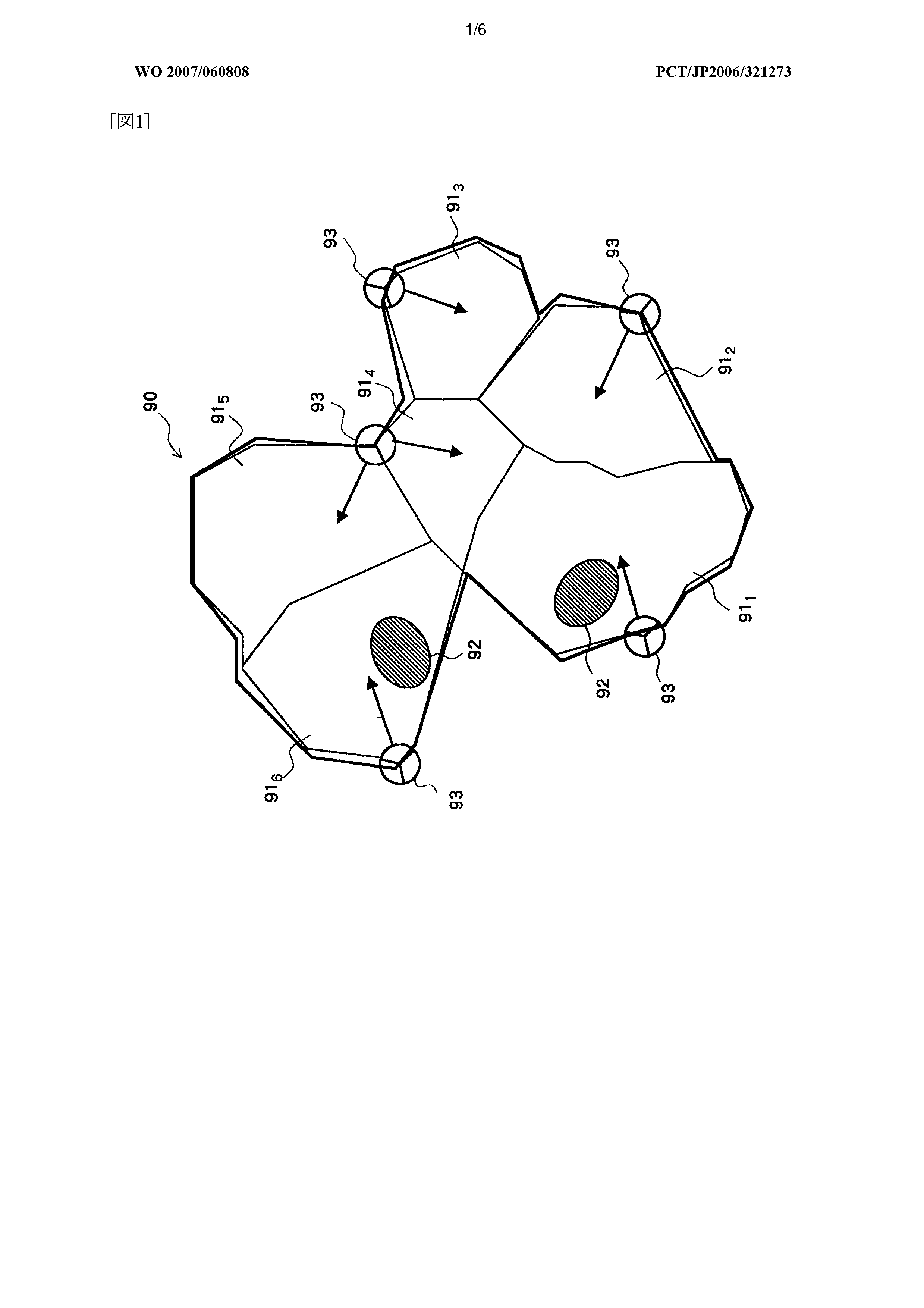
[0009] a figure -- 1 is a figure showing an example of distribution of important area. Figure It is Surround with , The, Thick , and a solid line to 1. In the whole Was done area 90, a plurality of cells 91*91 surrounded as the thin solid line are constituted.
1 6 ing. As for cell number j = l and cell 91, in cell 91, cell number j = 2 and cell 91 are cell number j =.
1 2 3
3, Senorare 91 * Ma senore number j = 4, and Senorare 91 * Ma senore number j = 5 and Senorare 91 * Ma senore number j = 6
4 5 Six Suppose that it is. And the portion to which it added shading is important area 92. each base station 93 -- 3 sectors it can constitute -- a figure -- 1 -- the sector and the relation of cell 91 to cover of each base station 93 It is shown by the arrow.
[0010] For example, consider the Tilt angle of an antenna by the conventional method about the case where it is going to stop the degradation rate of important area as a parameter lower than other area. Important area 92 exists in cell 91 of cell number j = l, and cell 91 of cell number j = 6. Therefore, cell 91 and S
1 6 One It is Tilt of Antenna of Cell 91, and Antenna of Cell 91 so that Degradation Rate of Le 91 May be Made Low.
6 1 6
An angle is changed into a big value. If a Tilt angle is enlarged here, a cell area shall become small and traffic load shall be reduced.
The indication of an invention
[0011] Those who design a wireless network in the conventional method for balancing a cell are Co. Change of a parameter and calculation of traffic load were repeated, operating Computer. When designing a wireless network with many base stations to the number of multi-Tooth cells, an operator needs to repeat change of Parame 1 Tha, and calculation of traffic load repeatedly, and, as for a design, it requires a long time. It had been working.
[0012] By the conventional method for stopping the degradation rate of important area low, it is traffic negative [ of each cell ]. The balance of the load might collapse extremely. In the conventional method, when reducing the degradation rate of important area, in consideration of balance with other cells, they are also and Power.
[0013] Therefore, after the operator of a wireless network design tool reduces the degradation rate of important area automatically by the conventional method, in order to balance the traffic load of each cell, it is necessary to repeat change and calculation of a parameter, and the design serves as work which requires a long time. It was.
[0014] The object of the present invention is to provide the device and method of balancing a cell easily in the design of the wireless-communications network which has a plurality of cells.
[0015] to achieve the above objects, radio Network which designs the wireless network where the wireless network designing device of the present invention covers a plurality of cells with the radio electric wave from a base station it is a The designing device -- it has an objective-function extraction part and an optimizing part.
[0016] An objective-function extraction part makes the radio parameter of a base station the parameter of an objective function, it exists in the neighborhood of the object cell from which the characteristic changes with change of the parameter, and its object cell the cells of traffic load are balanced using the cell balance value between neighboring cells -- the maximum -- The optimization conditions which are used for Suitable-ized processing and which contain an objective function at least are set up.
[0017] Perform optimization processing according to the optimization conditions set up in the optimizing part and the objective-function extraction part, and calculate the value of the parameter used as a solution.
[0018] According to the present invention, it is a wireless network designing device, Since it asks for the objective function which makes the radio parameter of a base station a parameter and an optimizing part performs optimization processing in an objective-function extraction part using optimization algorithm, Establishment of the wireless network where an operator has two or more cells In the total, the traffic load between cells can be balanced easily. Brief explanation of the drawings
[0019] [Drawing 1] It is a figure showing an example of distribution of important area.
[figure 2] It is a block diagram showing the composition of the wireless network designing device by the embodiment of The 1.
[figure 3] It is Frochia which shows outline operation of the wireless network designing device by the embodiment of The 1 - A.
[figure 4] It is a flow chart which shows the extraction method of the objective function in the embodiment of The 1.
[figure 5] It is a figure showing an example of distribution of the cell in area.
[figure 6] flow chart which shows the optimization processing to the whole area in the embodiment of The 1 it is .
[figure 7] It is a flow chart which shows the optimization processing of the whole area in the embodiment of The 2. The best form for inventing
[0020] Explain the form for carrying out the present invention in detail with reference to drawings.
[0021] (Embodiment of The 1)
It is Suitable about the Tilt angle of the antenna which is a typical radio parameter in a base station here. It becomes positive and illustrates the form which balances a cell. This wireless network design is optimized. An algorithm is used and it is A. It is [ changing Later and ] a predetermined desired value about the value of an objective function. It is carried out by bringing close.
[0022] a figure -- block diagram showing the composition of the wireless network designing device according [ 2 ] to the embodiment of The 1 It is. Figure If 2 is referred to, wireless network designing device 10 has objective-function extraction part 11, optimizing part 12, and storage 13.
[0023] Storage 13 stores the data for computing extraction of an objective function, and the value of an objective function. There are fixed data and a parameter which can be changed in this data. Fixed data There is geographical feature data in which ups and downs of the geographical feature in area are shown as an example. At this embodiment, it is A. Since only the Tilt angle of A person is made into a variable parameter, it is arrangement and transmission power of a base station. It will belong to fixed data. In this embodiment, only the Tilt angle of an antenna is Parame - Tha. However, the initial value (initial Tilt angle) of the Tilt angle of an antenna is an operator, for example. It is inputted into wireless network designing device 10, and is a rank to storage 13 as fixed data. Chi is good as carrying out in thread.
[0024] S of the data in which objective-function extraction part 11 is stored in storage 13 to traffic load The objective function used as the index which shows the grade of the balance between Les is extracted. It is shown that cells can be balanced, so that an objective function is close to a predetermined desired value. The Tinoretto angle of this objective function and an antenna is made into a parameter, and it is To go.
[0025] Optimizing part 12 changes the Tilt angle which is a parameter, and outputs as a solution the value of the parameter obtained by searching for the parameter comparing the calculated value and desired value of an objective function, and that an objective function approaches a desired value repeatedly two or more times. The traffic load of each cell can be rationalized by search of this parameter, and cells can be balanced. This processing is optimization processing and the algorithm used for this is optimization algorithm. As optimization algorithm, a round robin method (method one-by-one), a genetic algorithm, and the other general-purpose existing algorithms can be used.
[0026] In addition, objective-function extraction part 11 and optimizing part 12 are also realizable, when a computer runs the software program for realizing the function of each part.
[0027] a figure -- 3 is a flow chart which shows outline operation of the wireless network designing device by the embodiment of The 1. Figure If 3 is referred to, wireless network designing device 10 will extract first the objective function used for optimization processing (Step 101). and wireless network designing device 1 0 changes a parameter and brings the calculated value of the objective function close to a predetermined desired value -- as -- Optimization processing is performed (Step 102).
[0028] a figure -- 4 is a flow chart which shows the extraction method of the objective function in the embodiment of The 1. An objective function is defined by the relation between the traffic load of the cell (object cell: cell number j) which is the target of the objective function, and the traffic load of the neighboring cell of the object cell. An object cell is a cell from which the characteristic changes with change of NORIMETER, and specifically changes a Tilt angle. It is utterly covered with the electric wave from and a To antenna! They are /and a To cell.
[0029] For example, when a base station is not sector-ized but the indirectional antenna is used, supposing a neighboring cell is a cell formed by the antenna which is within a predetermined distance from the antenna which forms the object cell of cell number j, it is good. [0030] It is object S, when the base station is sector-ized and the directional antenna is used. Antenna power which forms Le It is within prescribed distance and is the direction of a beam peak in the level surface. It is good supposing it is a cell which counters the direction of a beam peak of an object cell. Method of a beam peak Solid that Toward counters indicates the direction of the beam peak in the level surface of two antennas to be The angle which Toru makes is more than a predetermined angle, And method of the beam peak in a plane of one antenna That the relation that the antenna of another side is in a predetermined angle range consists of Toward mutually, and if is good.
[0031] a figure -- 5 is a figure showing an example of distribution of the cell in area. Figure The example of the wireless-communications network where the base station was formed into 3 sectors is shown in 5. Figure In 5, the arrow shows the direction of a beam peak in the level surface from Angela, and the sector and the relation of cell 21 to cover of each base station 22 understand it with this arrow.
[0032] a figure -- neighboring S by which a plurality of cells 21*21 surrounded as the solid line were surrounded by the dotted line in 5
1 6
It is classified into the group of Le. in this example, it belongs to the group to which an object cell belongs others -- the cell is a neighboring cell. cell 21 and 21 -- one group -- composition [ for example, ]
5 6
In that of Being done, cell 21 is a neighboring cell of cell 21, and cell 21 is neighboring S of cell 21.
5 6 6 Five It is Le. Similarly, one group comprises cell 21*21.
1 4
[0033] a figure -- if 4 is referred to -- wireless network designing device 10 -- first -- each cell (cell number j) -- One It is and determines K neighboring cells (K*0) (Step 201). The set of a neighboring cell to the object cell of cell number j is set to Z. The number of set elements of set Z is K. determination of a neighboring cell To -- the arrangement data in which arrangement of the base station which constitutes each cell is shown, for example, and finger of an antenna The inclination direction data in which the Toward direction is shown may be used. In that case, this arrangement data and a finger The Toward direction data shall be beforehand stored in fixed-data storage 11.
[0034] Next, wireless network designing devices 10 are K neighboring cell traffic about each cell. A load ratio is computed (Step 202). Here, a neighboring cell traffic load ratio is a neighboring cell. It is a ratio of the traffic load of an object cell to that. This neighboring cell traffic A load ratio is a cell balance value which an object cell realizes what traffic load balance in comparison with a neighboring cell, and shows whether they are and To. It can ask for neighboring cell traffic load ratio R of the object cell of cell number j, and the neighboring cell of cell number k by a formula (1). [0035] [One number]
R<sub>ik</sub>= (<sup>k</sup>≡<sup>Z</sup>j) W
However, it is referred to as R = 1.0 when Z is an empty set.
j jk
[0036] In a formula (1), L is the traffic load of the object cell of cell number j. L is a cell.
cell and ] It is the traffic load of cell and the neighboring cell of k number k. Traffic load is a wireless network design two. It is calculable by Nollet.
[0037] the calculation method of traffic load -- a figure -- explain with reference to 5. Here, it is A of cell 21. The example which calculates Rahik load is shown. First, on area, a lattice point is arranged and the assumption traffic volume per lattice point is set up beforehand. Figure On cell 21 which is a candidate for calculation 5 Only the lattice point is shown. or [ that each lattice point exists in which cell ] -- the lattice point -- The signal with which the receiving level to kick serves as the maximum is sent out from which base station (existing , the Is antenna). It becomes settled by whether it is. Assumption traffic volume of the lattice point which exists in cell 21 of cell number j = l It can ask for traffic load L of cell 21 by calculating total.
1 cell, 1
[0038] a figure -- it returns to 4, next sets wireless network designing device 10 in each cell -- ask for the objective function used as the index for evaluating the balance between cells of traffic load based on K neighboring cell traffic load ratios. It is good Up U to make the central value showing the feature statistical as an evaluation index of the traffic load balance between an object cell and a neighboring cell into an objective function.
[0039] In this embodiment, it is the inside power of being concrete and K neighboring cell traffic load ratios. It asks for the greatest thing and the minimum thing, and let these two be an objective function (Step 203). Here, it is the maximum traffic load ratio R about the greatest thing in K neighboring cell traffic load ratios. It is with (j).
max
it is -- the minimum thing in K neighboring cell traffic load ratios -- the minimum traffic load ratio R (j)
] It min t and obtains and considers it as things. The maximum traffic load ratio R (j) is shown in a formula (2) and it is the minimum traffic load ratio R.
max
(j) is shown in a formula (3).
mm
[0040] [Two number]<img file="WO2007060808A1_D0001.tif" />If the Tilt angle of an antenna is changed, a cell area will change, and it is Trahi of a cell as the result. R which is a ratio of traffic load since A load changes (j) and R (j) is Chi of an antenna.
max min
It can be said that it is the function which made the Lut angle the parameter.
[0041] Wireless network designing devices 10 of this embodiment are these objective functions R. (j) and R (j)
Optimization processing is performed so that max min may be brought close to "1." Objective function R (j) and R (j) is close to "1."
max mm
A degree can say that the difference of the traffic load of an object cell and the traffic load of a neighboring cell is small. Therefore, it will be S, if it optimizes so that the calculated value of this objective function may be brought close to desired value" 1". Les can be balanced.
[0042] In addition at this embodiment, it is the inside power of K traffic load ratios. Power which chose the greatest thing and the minimum thing as a representative, and was made into the objective function The present invention is not limited to this. others Include in evaluation the cell in which the balance of traffic load collapsed extremely as an example. -- obtaining It is good also as an objective function by a policy to choose as the 2nd a large thing and what is [ 2nd ] the smallest. Average value of the larger traffic load ratio as other examples than "1" and A smaller than "1" It is good also considering the average value of a Rahik load ratio as an objective function.
[0043] Wireless network designing device 10 of this embodiment is the maximum traffic load ratio R first as an example of optimization processing to the whole area. It optimizes to (j) and then is the minimum Trahi.
max
A load ratio R Suppose optimization that line ! and it are repeated two or more times to (j).
mm
[0044] a figure -- 6 is a flow chart which shows the optimization processing to the whole area in the embodiment of The 1. Figure If 6 is referred to, wireless network designing device 10 will set up the initial Tilt angle of the antenna of each cell first (Step 301). Next, wireless network designing device 10 determines K neighboring cells of each cell (Step 302).
[0045] Next, wireless network designing device 10 calculates the neighboring cell traffic load ratio of each cell (Step 303). The number of the neighboring cell traffic load ratios of each cell (cell number j) is K.
[0046] Next, wireless network designing devices 10 are the K neighborhoods about each cell (cell number j). Cell traffic load ratio power is also the maximum traffic load ratio R. It asks for (j) (Step 304). Further
max
Wireless network designing device 10 is the maximum traffic load ratio R. (j) is cell Selection to large order.
max
Selection order is determined (Step 305). And wireless network designing device 10 chooses Based and a The cell in order of the determined cell selection (Step 306).
[0047] Next, wireless network designing device 10 is 1ToR about the selected cell. (j) is materialized.
max
It is judged whether it is Impartiality to carry out (Step 307). 1 <R Tilt Angle is Strange if (J) is not Materialized.
max
More is not performed. It is because it is not necessary to make it still smaller if the maximum traffic load ratio is smaller than "1."
[0048] KR If (j) is materialized, wireless network designing device 10 will be R. It is R about the value of (j).
It sets to max max current (Step 308), only as for a steady value, size comes a Tilt angle (for example, 1 time), and they are a comb (Step 309) and R. (j) is calculated again (Step 310). It is small max about a cell area to enlarge a Tilt angle.
It tears and the tendency to reduce traffic load is shown. And wireless network designing device 10 is R. The value of (j) is set as R (Step 311), and 1*R <R is materialized, or it judges in non-max temp temp current (Step 312).
[0049] Wireless network designing device 10 will maintain a Tilt angle, if 1*R <R is materialized.
temp current
It carries out, and a Tilt angle is returned if 1*R <R is not materialized (Step 313). 1*R
temp current te
It is thought that maximum traffic load specific force' 1" is not approached, and it is mp current that <R is not materialized.
By that of To, it is supposed that a Tilt angle will be returned.
[0050] Next, wireless network designing device 10 finished choosing all the cells, and carries out a Powerlessness judging.
(Step 314). If it has not finished choosing all cells, wireless network designing device 10 returns to processing of Step 306, and chooses the following cell. On the other hand, all the cells are chosen. If it has finished, wireless network designing device 10 is predetermined about processing of Step 303*314. It judges in Impartiality which the time (Na time) repeated (Step 315). By a repetition of Na time finishing, if there is no , wireless network designing device 10 will return to Step 303.
[0051] On the other hand, if the repetition of Na time has finished, wireless network designing device 10 is each cell. A neighboring cell traffic load ratio is calculated (Step 316). Neighboring S of each cell (cell number j) The number of Traffic load ratios is K.
j
[0052] Next, wireless network designing devices 10 are the K neighborhoods about each cell (cell number j). Cell traffic load ratio power is also the minimum traffic load ratio R. It asks for (j) (Step 317). Further
mm
Wireless network designing device 10 is the maximum traffic load ratio R. (j) is cell Selection to small order.
mm
Selection order is determined (Step 318). And wireless network designing device 10 is Based to the determined cell selection order! /and a The cell are chosen (Step 319).
[0053] Next, wireless network designing device 10 is R about the selected cell. It is judged whether it is Impartiality in which (j) To 1 is materialized (Step 320). R (j) It is radio Network if < 1 is not materialized.
mm
- The designing device 10 does not change a Tilt angle. It is that above the minimum traffic load specific force ^. It is because it is not necessary to enlarge The and it further.
[0054] R (j) If < l is materialized, wireless network designing device 10 will be R. It is R about the value of (j).
it sets to mm min current (Step 321), and only a steady value makes a Tilt angle small (Step 322) -- (for example, 1 time) R (j) is calculated again (Step 323). It is large mm about a cell area to make a Tilt angle small.
It hears and the tendency which makes traffic load high is shown. And wireless network designing device 10
R It is [ whether the value of (j) is set as R (Step 324), and R < R*1 is materialized, and ] min temp current temp.
It judges (Step 325). R <R It is the minimum traffic load that *1 is not materialized.
current temp
It is Approaching to 1 in a ratio. They are and To as returning a Tilt angle, since it thinks.
[0055] Wireless network designing device 10 will maintain a Tilt angle, if R < R*1 is materialized.
current temp
It carries out, and a Tilt angle is returned if R < R*1 is not materialized (Step 326).
current temp
[0056] Next, wireless network designing device 10 finished choosing all the cells, and carries out a Powerlessness judging.
(Step 327). If it has not finished choosing all cells, wireless network designing device 10 returns to processing of Step 319, and chooses the following cell. On the other hand, all the cells are chosen. If it has finished, wireless network designing device 10 is predetermined about processing of Step 316*327. It judges in Impartiality which the time (Nb time) repeated (Step 328). By a repetition of Nb time finishing, if there is no , wireless network designing device 10 will return to Step 316.
[0057] If the repetition of Nb time has finished, it will be judged whether as for wireless network designing device 10, the predetermined time (Nab time) repeated processing of Step 303*328 (Step 329). Nab time If the repetition has not finished, wireless network designing device 10 is to Step 303. It returns.
[0058] If the repetition of a Nab time has finished, wireless network designing device 10 will output the Tilt angle of each antenna after optimization (Step 330).
[0059] As explained above, according to this embodiment, wireless network designing device 10 is, Let the radio parameter which can be changed in a base station be a parameter by objective-function extraction part 11, it asks for the objective function which shows the grade of the balance between cells by difference with a desired value, and changes the parameter of an objective function by optimizing part 12 using optimization algorithm -- an objective function -- desired value Since it brings close In the design of the wireless network which has two or more cells, an operator is troublesome. are . In the necessity of repeating work, balancing the traffic load between non-Tooth cells easily It can do.
[0060] In the wireless network which comprises a plurality of cells, the traffic load of an object cell is neighboring S. Le distributes and there is character which cells influence mutually and suits. Optimization processing which took this character into consideration since this embodiment estimated the balance between an object cell and a neighboring cell Cells can be balanced satisfactorily.
[0061] Traffic load specific force with the neighboring-with this embodiment cell of an object cell and plurality Since it uses for optimization processing by making the calculated central value into an objective function, the number of objective functions is reduced and processing It is easy-ized.
[0062] moreover -- since the maximum and the minimum of the traffic load ratio with each neighboring cell are made into the central value, it comes out to maintain cell balance satisfactorily including a plurality of neighboring cells represented with the central value -- last .
[0063] moreover -- according to this embodiment -- case the maximum traffic load ratio is smaller than 1 -- it -- small -- Do not change a parameter (Tilt angle) which carries out a fence. Since a parameter change which enlarges it is not made when the minimum traffic load ratio is larger than 1, it is Trahi. It can search for a parameter from which the balance between cells of A load becomes good.
[0064] It is since according to this embodiment a parameter is returned when changing a parameter only when the maximum traffic load ratio or the minimum traffic load ratio approaches 1, and not becoming so, It is Search about a good parameter, checking that the balance between cells of traffic load is improved. Cord can be carried out.
[0065] In addition, the embodiment of The 1 explained, using the Tilt angle of the antenna of a base station as an example of the parameter of the objective function of optimization algorithm. However, the present invention is not limited to this. As other examples of the parameter of an objective function, it is Transmission power from each antenna. Power may be used.
[0066] As general character, when making transmission power from each antenna into a parameter, if transmission power is made small, a cell area will contract and the traffic load of a cell will decrease. If transmission power is enlarged, a cell area will be expanded and the traffic load of a cell will increase. Therefore, even if Tilt sumo also makes the parameter of an objective function transmission power, the embodiment of The 1 is general. A sex is not lost but can be carried out similarly.
[0067] (Embodiment of The 2)
Degree of degradation in a communication network including a wireless network of the communication quality in area It is Show by the degradation rate which is the rate of a point that the communication quality which accounts for power predetermined area deteriorates. It is carried out. Ground by which SIR (signal power pair interference electric power ratio) does not fulfill a predetermined value here, for example Let a point be a point where communication quality deteriorates. At this embodiment, it is low about the degradation rate of important area. It is A between cells of traffic load, stopping. The form which takes a lance is illustrated. embodiment of The 2 the wireless network designing device to twist -- a figure -- which is the same composition as the embodiment of The 1 shown in 2. outline operation of the wireless network designing device by the embodiment of The 2 -- a figure -- it was shown in 3 It is the same as that of a 1st embodiment.
[0068] However, differ from the embodiment of The 1 in that an objective function and constraints are used in processing of optimization at the embodiment of The 2. At this embodiment, objective-function extraction part 11 is object Seki. In addition to extraction of a number, extraction of constraints is also performed. At this embodiment, it is a degradation rate of important area. The maximum A which is a central value of the neighboring cell traffic load ratio which considers it as an objective function and shows cell balance Rahik load ratio R (j) and the maximum traffic load ratio R It is Constraint of optimization algorithm about (j).
max min
It is considered as an affair. The Tilt angle of an antenna is used for the parameter of an objective function as well as the embodiment of The 1.
[0069] The constraints of optimization algorithm are conditions imposed when searching for the parameter which improves the value of an objective function. it is like [ the optimization algorithm in the embodiment of The 2 ] the same Tooth method one-by-one as a 1st embodiment, or a genetic algorithm -- general-purpose -- the optimal A-izing algorithm can be used.
[0070] Make the degradation rate of all the area small first in the embodiment of The 2, and it is a degradation rate of all the area after that. The optimization algorithm of making the degradation rate of important area still smaller is illustrated, taking into consideration.
[0071] a figure -- 7 is a flow chart which shows the optimization processing of the whole area in the embodiment of The 2. Here, after reducing the degradation rate of all the area, the example which reduces the degradation rate of important area is shown. although the degradation rate of important area is made into an objective function -- the one where this degradation rate is lower -- good -- better -- There. Therefore, optimization place which brings an objective function close to desired value" 0" in this embodiment Reason is carried out. However, in the optimization processing, it is the maximum traffic load ratio R (j).
max and the minimum Traffic load ratio R The constraints by (j) are imposed. Figure Step 401*413 is in 7.
min
It is the stage of reducing the degradation rate of all the area, and Step 414*432 is a degradation rate of important area. It is a stage to reduce.
[0072] a figure -- if 7 is referred to -- wireless network designing device 10 -- first -- early stages of the antenna of each cell A Tilt angle is set up (Step 401). next, wireless network designing device 10 -- area -- all -- Bodily degradation rate Pb is calculated (Step 402).
[0073] Next, wireless network designing device 10 sets the value of degradation rate Pb as P1 (Steps).
current
Renewal of A 403 and the Tilt angle of temporary is carried out (Step 404), and it is Calculate again about degradation rate Pb of the whole area. To (Step 405). The renewal of temporary changes the Tilt angle of one of antennas temporarily only a predetermined value. It is carrying out. Although there are change to enlarge and change to change made small, it is at this embodiment. Since renewal of temporary and its decision of a Tilt angle are repeated two or more times, it is made small with change to enlarge. It is preferred to combine change. for example, the number of times of a repetition is made into 60 times -- 1*: LO time if it is eyes, the 21*30th time, or the 41*50th time -- a Tinoretto angle -- /J -- To it tears -- the 11*20th time3 If it is the 1*40th time or the 51*60th time, it is good also as enlarging a Tilt angle.
[0074] Various selection methods can be considered about of which antenna a Tilt angle is changed. For example, when making a Tilt angle small, it is good also as the degradation rate of a cell choosing the antenna beyond a predetermined value, and making the Tilt angle small. When enlarging a Tilt angle, the degradation rate of a cell chooses the antenna of less than a predetermined value, it supposes that the Tilt angle is enlarged, and Chi is good.
[0075] Power arbitrary about how many Tilt angles of an antenna are changed For example, it is good supposing it is a fixed angle. [0076] It is business about the method of others [ determination / the selection of an antenna which carries out renewal of temporary, and / of the angle which carries out renewal of the Tilt angle of temporary ]. General optimization in the field of the combination optimization which makes a degradation rate an objective function when it is If an algorithm or a genetic algorithm is used, it will be Yo .
[0077] Next, wireless network designing device 10 sets degradation rate Pb as P1 (Step 406).
temp
P1 It is judged whether it is smaller than power P1 (Step 407). This is More temp current of a Tilt angle.
It is judged whether it is new and is Impartiality by which degradation rate Pb of the whole area is improved.
[0078] P1 If not smaller than power SP1, wireless network designing device 10 is Destruction about renewal of temporary.
temp current
It Discard and does not update a Tilt angle (Step 408). on the other hand -- PI power P1 -- smallness
If temp current kicks, wireless network designing device 10 will update a Tilt angle by the contents of renewal of temporary (Step 409), and will set P1 as PI (Step 410).
temp current
[0079] Step 404*410 is repeated until predetermined end conditions are fulfilled. For example, it is possible to make for the number of times of a repetition to have reached the predetermined number into end conditions. As other examples, it is P 1.
It is possible to make for current to be less than a predetermined value into end conditions. Wireless network designing device 10 is judged in Impartiality by which end conditions were fulfilled (Step 411). End conditions If not filled, wireless network designing device 10 returns to Step 404.
[0080] If end conditions are fulfilled, wireless network designing device 10 is a value of P1 next.
current is set as PI (Step 412). Thereby, the degradation rate minimum by old processing is P opt.
1
It is set to opt. At the time, a Tilt angle is degradation rate PI of the whole area.
opt is realized. It is a value to carry out.
[0081] And next, wireless network designing device 10 sets up an increase allowable parameter (Step 413). If an increase allowable parameter has an improvement of the degradation rate of how much when optimizing the degradation rate of important area, it will be a value which shows whether renewal of the Tilt angle is permitted. A value becomes settled on the basis of this increase allowable parameter and Plopt. As an example, it is increase permission. with the sufficient parameter also as that into which an operator inputs A and B in proportionality value A, constant value B Power ゝ and others. the degradation rate of the whole area -- A X P1 +B -- also depending -- a condition [ be / it / a small value ] -- Tilt angle
opt
Updating is permitted.
[0082] Next, wireless network designing device 10 calculates degradation rate Pa of important area (Step 4 14), and sets the value of the degradation rate as P2 (Step 415). [0083] Next, wireless network designing device 10 is limit value R of a neighboring cell traffic load ratio. It sets up (Step 416). The maximum traffic load ratio R in which this limit value R is constraints
limit
(j) and the maximum traffic load ratio R It is a value which restricts (j). It is the optimal maxmm about the degradation rate of important area.
When changing, it is the maximum traffic load ratio R. (j) and the maximum traffic load ratio R (j) is limit value R.
A Tilt angle which fills a predetermined relation between max min limit is permitted. The value of limit value R is operated. Also as a person doing human power! /
[0084] Next, wireless network designing device 10 determines K neighboring cells of each cell (Step 417). And wireless network designing device 10 carries out renewal of the Tilt angle of temporary (Step 418), and re-calculates degradation rate Pa of important area (Step 419), and also calculates degradation rate Pb of the whole area (Step 420). The method of the renewal of temporary of a Tilt angle may be the same as the method used at Step 404.
[0085] Next, wireless network designing device 10 is Establishment to P2 about the value of degradation rate Pa of important area.
temp -- the value of degradation rate Pb of the whole area is set as P1 probably (Step 421) (Step 422)
temp
. Next, wireless network designing device 10 calculates the neighboring cell traffic load ratio of each cell. It carries out (Step 423). The number of the neighboring cell traffic load ratios of each cell (cell number j) is K.
[0086] Next, wireless network designing devices 10 are the K neighborhoods about each cell (cell number j). Cell traffic load ratio power The maximum traffic load ratio R (j) and the minimum traffic load ratio R (j)
max min asks (Step 424).
[0087] Next, Impartiality or To judge of which, as for wireless network designing device 10, P2 < P2 consists
temp current
To (Step 425). Impartiality by which the degradation rate of important area is improved by the renewal of temporary of a Tilt angle as for this or -- it judges. It is Wireless network setup if P2 < P2 are not realized.
temp current
Total device 10 cancels renewal of temporary, and does not update a Tilt angle (Step 426). On the other hand, if and P2 < P2 are realized, wireless network designing device 10 will be PI <A temp current temp next.
X Judge whether Pl+B is realized or not (Step 427). This is degradation rate opt of the whole area.
By the judgment of Impartiality which is a value smaller than But P2 < P2, renewal of a Tilt angle is permission temp current.
It is judged whether it is Impartiality carried out.
[0088] P1 ToAX P1 If +B is not realized, wireless network designing device 10 is Temporary change.
temp opt
new is canceled and a Tilt angle is not updated (Step 426). On the other hand, it is P1ToA X P1.
if temp opt+B is realized -- wireless network designing device 10 -- next -- they are all the cells -- R (j) <
max
R and lZR <R It is judged whether (j) is realized or not (Step 428). This is Eli limit limit min.
By the judgment of Impartiality which is a value whose degradation rate of the whole A is smaller than P2 < P2, it is Tilt.
temp current
It is judged whether it is Impartiality by which renewal of an angle is permitted. This is small To say and the maximum traffic load ratio R from maximum traffic load ratio R (j) and limit value R. (j) is larger max limit mm limit than 1ZR.
Things are judged. A Tilt angle is updated in the range which the traffic load balance of all the cells becomes by this in less than a steady value. Therefore, the state where the traffic load balance within fixed was maintained in all the cells is maintained.
[0089] R (j) <R and lZR <R If (j) is not realized, it is a wireless network design.
max limit limit min
Device 10 progresses to Step 426. On the other hand, it is R. (j) <R and lZR <R (j) changes.
max limit limit mm
If it stands, a Tilt angle is updated by the contents of renewal of temporary (Step 429), P2 will be set as P2 and, as for wireless network designing device 10, it will set P1 as P1 (Step 430). Step
temp current temp current
414*431 is repeated until predetermined end conditions are fulfilled. For example, the number of times of a repetition It is possible to make to have reached the predetermined number into end conditions.
[0090] End wireless network designing device 10 after Step 426 or Step 430. The non-power judging of whether conditions were fulfilled is carried out (Step 431). For example, it is possible to make for the number of times of a repetition to have reached the predetermined number into end conditions. As other examples, P2 is a predetermined value sheep.
current
It is possible to make a certain thing into end conditions by Full. end conditions are fulfilled [ ] -- if there is nothing, wireless network designing device 10 will return to Step 414. If end conditions are fulfilled, and wireless network designing device 10 are PI, P2, and a Tilt angle of each antenna.
current current
It outputs (Step 432). P1 is a degradation rate of the whole area after an improvement, and is P2.
current current is a degradation rate of the important area after an improvement.
[0091] As explained above, according to this embodiment, wireless network designing device 10 is, let the radio parameter which can be changed in a base station be a parameter -- asking for the objective function which shows the grade of the degradation rate of important area by difference with a desired value It is S by the optimization processing of the objective function. It asks for the constraints for balancing the traffic load between Les, constraints were imposed -- the optimal the parameter of an objective function is changed using a-izing algorithm -- an objective function -- a desired value -- Close in the design of the wireless network which has two or more cells since it kicks -- easy -- Ba between cells The degradation rate of important area can be reduced, taking a lance.
[0092] In addition, the embodiment of The 2 explained, using the Tilt angle of the antenna of a base station as an example of the parameter of the objective function of optimization algorithm. However, the present invention is not limited to this. As other examples of the parameter of an objective function, it is Transmission power from each antenna. Power may be used.
[0093] As general character, when making transmission power from each antenna into a parameter, if transmission power is made small, an electric wave will become difficult to spread round cover area, and a degradation rate will rise. If transmission power is enlarged, an electric wave will spread round cover area easily, and a degradation rate will be reduced. Therefore, even if it makes the parameter of an objective function into Tilt angle forceゝ transmission power, the generality of the embodiment of The 2 is not lost, and it can carry out similarly.
[0094] (Embodiment of The 3)
If distribution of traffic load is uniform, traffic load is proportional to a cell area. There A 3rd embodiment is replaced with the traffic load in the embodiment of The 1, and a cell area is used for it. It is Configuration. They are cell sides cell and j of the cell of cell number j instead of L in the embodiment of The 1.
The cell area of the cell of cell number k may be used instead of L using a product. Cell area cell, k
It can express with the number of the lattice points arranged on Is and its cell.
[0095] According to this, in the design of the wireless network which has two or more cells, the traffic load between cells can be easily balanced like the embodiment of The 1.
[0096] (Embodiment of The 4)
It replaces with the traffic load in the embodiment of The 2, and a 4th embodiment is business about a cell area. It is the required composition. They are cell cell of the cell of cell number j, and] instead of L in the embodiment of The 2.
The cell area of the cell of cell number k may be used instead of L using area. Cell sides cell and k
A product can be denoted by the number of the lattice points arranged on the cell. It is constraints and Ah. Maximum traffic load ratio R (j)
max and the minimum traffic load ratio R (j)
Instead of min, it is an object cell. It will be Yo! if the maximum of surface ratio with a neighboring cell and the minimum are used.
[0097] According to this, reduce the degradation rate of important area easily like the embodiment of The 2 in the design of the wireless network which has two or more cells, balancing cells. Things are made. [0098] (A 5th embodiment)
Chia by which circuit performance is accommodatively changed in time by SIR which shows the quality of a received signal It is the present invention to HSDPA (High Speed Downlink Packet Access) using flannel. The example to apply is shown.
[0099] The embodiment of The 5 differs in the calculation method of traffic load from the embodiment of The 1. Operation of The 5 The calculation method of the traffic load in a form is explained. First, radio circuit A which calculated SIR of the base station power thing received signal in each lattice point of evaluation area, and was matched with each SIR It asks for the reciprocal of the average value within the cell of a roux put. Next, in a lattice point, it is the bit rate. Traffic volume expressed is made into the data volume which occurs per unit time, and it is total in the cell. It asks. [ of the average value within the cell of a radio circuit throughput / this / unit time / the reciprocal and ] Let a product with the total in the cell of the data volume which occurs for it to be sufficient be traffic load.
[0100] HSDPA using the traffic load calculated by this gentleman method, and the channel by which circuit performance is accommodatively changed in time by SIR -- the time usage rate of and a The channel -- namely, -- Traffic load is shown.
[0101] According to this, maintaining the balance between cells of traffic load easily in HSDPA It can do.
[0102] (Embodiment of The 6)
A 6th embodiment differs in the calculation method of traffic load from the embodiment of The 2. Operation of The 6 The calculation method of the traffic load in a form is the same as the embodiment of The 5. By this method Circuit performance is accommodatively changed in time by the traffic load calculated and SIR. It is to HSDPA using a channel, the time usage rate, i.e., the traffic load, of and a The channel. It is shown.
[0103] according to this -- HSDPA -- and The -- the balance between cells of traffic load can be maintained easily, reducing the degradation rate of important area easily.
[0104] Power which showed the balance of traffic load or a cell area as an example of the balance between cells in each embodiment described above The present invention is not limited to these.
[0105] The example which brings a neighboring cell traffic load ratio close to 1 in the embodiment of The 1 is shown, and it is the 2nd. Although the embodiment showed the example which restrains it to the value near "1", the present invention is not limited to this. Transceiver machine arranged in a neighboring cell traffic load ratio at each cell Suppose that it brings close to other numerical values, or restrains according to the resource of each base station, such as a number. The is also good.
7 sheets
Sheet 1 Sheet 2 Sheet 3 Sheet 4 Sheet 5 Sheet 6 Sheet 7
Every citation, both ways
| Document | Relation | Office | Category | Cited during |
|---|---|---|---|---|
| US9047570B2 | Cited by | United States of America | – | Applicant |
| JP2012529816A | Cited by | Japan | – | Examiner |
| US10749737B2 | Cited by | United States of America | – | Applicant |
| JP2009152699A | Cited by | Japan | – | Examiner |
| US10880000B2 | Cited by | United States of America | – | Applicant |
| US11496212B2 | Cited by | United States of America | – | Applicant |
| US9800460B2 | Cited by | United States of America | – | Applicant |
| US10461846B2 | Cited by | United States of America | – | Applicant |
| US9294968B2 | Cited by | United States of America | – | Applicant |
| JP2014204433A | Cited by | Japan | – | Examiner |
| US10791566B2 | Cited by | United States of America | – | Applicant |
| US10117111B2 | Cited by | United States of America | – | Applicant |
| CN102413510A | Cited by | China | – | Search report |
| WO2011067862A1 | Cited by | World Intellectual Property Organization (WIPO) | – | Applicant |
| JP2014241689A | Cited by | Japan | – | Search report |
| US10548025B2 | Cited by | United States of America | – | Applicant |
| US10212026B2 | Cited by | United States of America | – | Applicant |
| US9439108B2 | Cited by | United States of America | – | Applicant |
| US10004082B2 | Cited by | United States of America | – | Applicant |
| JP2000156885A | Cites | Japan | A | International search |
| JP2001203631A | Cites | Japan | A | International search |
| JP2003111133A | Cites | Japan | Y | International search |
| JP2004201269A | Cites | Japan | Y | International search |
| JP2005117357A | Cites | Japan | – | Applicant |
4 priority claims, no other members on record
Priority claims4
| Document | Office | Kind | Date |
|---|---|---|---|
| 2005336909 | Japan | A | |
| 2005336909 | Japan | A | |
| 2005336909 | – | – | – |
| JP20050336909 | – | – | – |
7 legal events, as 2 offices reported them to INPADOC
Over the term
Point at a mark for the eventEvents
| Event | Code | Office | |
|---|---|---|---|
| Non-entry into the national phaseNENP | NENP | DE | |
| Wipo information: entry into national phaseWWE | WWE | WO | |
| Wipo information: entry into national phaseWWE | WWE | WO | |
| Wipo information: entry into national phaseWWE | WWE | WO | |
| Wipo information: entry into national phaseWWE | WWE | WO | |
| Ep: the epo has been informed by wipo that ep was designated in this application121 | 121 | WO | |
| Wipo information: entry into national phaseWWE | WWE | WO |
Numbers
- Publication
- 2007/060808
- Publication, DOCDB
- 2007060808
- Publication, EPODOC
- WO2007060808
- Application
- 321273
- Application, DOCDB
- 2006321273
- Application, EPODOC
- WO2006JP321273
Titles2
- English
- RADIO NETWORK DESIGN APPARATUS AND METHOD
- French
- APPAREIL ET PROCEDE DE CONCEPTION DE RESEAU RADIO
Classification
- CPC, 1
- H04W16/18
- IPC, 1
- H04B7 26
Designated states136
- Regional, 74
- African Regional Intellectual Property Organization (ARIPO)
- Botswana
- Ghana
- Gambia
- Kenya
- Lesotho
- Malawi
- Mozambique
- Namibia
- Sudan
- Sierra Leone
- Eswatini
- United Republic of Tanzania
- Uganda
- Zambia
- Zimbabwe
- Eurasian Patent Organization (EAPO)
- Armenia
- Azerbaijan
- Belarus
- Kyrgyzstan
- Kazakhstan
- Republic of Moldova
- Russian Federation
and 50 moreShow fewer
- Tajikistan
- Turkmenistan
- European Patent Office (EPO)
- Austria
- Belgium
- Bulgaria
- Switzerland
- Cyprus
- Czechia
- Germany
- Denmark
- Estonia
- Spain
- Finland
- France
- United Kingdom
- Greece
- Hungary
- Ireland
- Iceland
- Italy
- Lithuania
- Luxembourg
- Latvia
- Monaco
- Netherlands (Kingdom of the)
- Poland
- Portugal
- Romania
- Sweden
- Slovenia
- Slovakia
- Türkiye
- African Intellectual Property Organization (OAPI)
- Burkina Faso
- Benin
- Central African Republic
- Congo
- Côte d’Ivoire
- Cameroon
- Gabon
- Guinea
- Equatorial Guinea
- Guinea-Bissau
- Mali
- Mauritania
- Niger
- Senegal
- Chad
- Togo
- National, 62
- United Arab Emirates
- Antigua and Barbuda
- Albania
- Australia
- Bosnia and Herzegovina
- Barbados
- Brazil
- Belize
- Canada
- China
- Colombia
- Costa Rica
- Cuba
- Dominica
- Algeria
- Ecuador
- Egypt
- Grenada
- Georgia
- Guatemala
- Honduras
- Croatia
- Indonesia
- Israel
and 38 moreShow fewer
- India
- Japan
- Comoros
- Saint Kitts and Nevis
- Democratic People’s Republic of Korea
- Republic of Korea
- Lao People’s Democratic Republic
- Saint Lucia
- Sri Lanka
- Liberia
- Libya
- Morocco
- Madagascar
- North Macedonia
- Mongolia
- Mexico
- Malaysia
- Nigeria
- Nicaragua
- Norway
- New Zealand
- Oman
- Papua New Guinea
- Philippines
- Serbia
- Seychelles
- Singapore
- San Marino
- El Salvador
- Syrian Arab Republic
- Tunisia
- Trinidad and Tobago
- Ukraine
- United States of America
- Uzbekistan
- Saint Vincent and the Grenadines
- Viet Nam
- South Africa