Dynamic resource sharing among multiple wireless devices
Summary by NHIP
Wireless resource sharing system
The method shares client resources among multiple devices in a digital communication system by establishing a shared session and managing active or inactive hosts. It allocates portions of the resource based on a client resource allocation vector while negotiating permissions and preferences between hosts.
Claim Score by NHIP
Abstract
A system and method that enables two or more hosts so that they can share a resource, such as a display. Client allocates a portion of the resource to each of the eligible hosts. This allocated size is negotiable among host(s) and the client. Client may request the hosts to scale down/up resource utilization based on the allocated portion of the resource being shared. This helps keep the client implementation simple. In this case, client maintains the allocation vector for each host. This allocation vector is used to keep track of the resource sharing. While this is a preferred approach, it is possible that “intelligent” client may actually modify resource utilization for a given host based on the negotiated allocation.
Term
Projected expiry 11 December 2028.
- Priority and filed
- Granted
- Today
- Projected expiry
72 claims: 9 independent, 63 dependent
- 1A method for sharing resources among at least two devices in a digital communication system, the method comprising:establishing a shared session;receiving a request to share a client resource from at least one active host in a first predetermined share mode;receiving a request to share the client resource from at least one inactive host in a second predetermined share mode;requesting permission from the at least one active host to share the client resource with the at least one inactive host;receiving a response to the request for permission from the at least one active host;sending a client resource allocation vector to the at least one active host and the at least one newly active host;allocating a first portion of the client resource to the at least one active host and a second portion of the client resource to the at least one newly active host;and negotiating the allocation with the at least one active host and the at least one newly active host, wherein the step of negotiating further comprises transferring of permissions and preferences.
- 16An apparatus for sharing resources among at least two devices in a digital communication system, comprising:means for establishing a shared session;means for receiving a request to share a client resource from at least one active host in a first predetermined share mode;means for receiving a request to share the client resource from at least one inactive host in a second predetermined share mode;means for requesting permission from the at least one active host to share the client resource with the at least one inactive host;means for receiving a response to the request for permission from the at least one active host;means for sending a client resource allocation vector to the at least one active host and the at least one newly active host;means for allocating a first portion of the client resource to the at least one active host and a second portion of the client resource to the at least one newly active host;and means for negotiating the allocation with the at least one active host and the at least one newly active host, wherein the means for negotiating further comprises means for transferring of permissions and preferences.
- 31A non-transitory storage media comprising program instructions which are computer-executable to implement sharing of resources among at least two devices in a digital communication system, the storage media comprising:program instructions to establish a shared session;program instructions to receive request to share a client resource from at least one active host in a first predetermined share mode;program instructions to receive a request to share the client resource from at least one inactive host in a second predetermined share mode;program instructions to request permission from the at least one active host to share the client resource with the at least one inactive host;program instructions to receive a response to the request for permission from the at least one active host;program instructions to send a client resource allocation vector to the at least one active host and the at least one newly active host;program instructions to allocate a first portion of the client resource to the at least one active host and a second portion of the client resource to the at least one newly active host;and program instructions to negotiate the allocation with the at least one active host and the at least one newly active host, wherein the program instructions to negotiate further comprise program instructions to transfer permissions and preferences.
- 46A method for sharing resources among at least two devices in a digital communication system, the method comprising:establishing a shared session;requesting a client resource by a first host from a client in a first predetermined share mode;receiving a request for permission from the client to share the client resource with a next host;providing a response to the request for permission to the client;negotiating an allocation of the client resource with the next host, wherein the negotiating further comprises transferring of permissions and preferences;and receiving a client resource allocation vector from the client.
- 51An apparatus for sharing resources among at least two devices in a digital communication system, comprising:means for establishing a shared session;means for requesting a client resource by a first host from a client in a first predetermined share mode;means for receiving a request for permission from the client to share the client resource with a next host;means for providing a response to the request for permission to the client;means for negotiating an allocation of the client resource with the next host, wherein the means for negotiating further comprises a means for transferring of permissions and preferences;and means for receiving a client resource allocation vector from the client.
- 56A non-transitory storage media comprising program instructions which are computer-executable to implement sharing of resources among at least two devices in a digital communication system, the storage media comprising:program instructions to establish a shared session;program instructions to request a client resource by a first host from a client in a first predetermined share mode;program instructions to receive a request for permission from the client to share the client resource with a next host;program instructions to provide a response to the request for permission to the client;program instructions to negotiate an allocation of the client resource with the next host, wherein the program instructions to negotiate further comprise program instructions to transfer permissions and preferences;and program instructions to receive a client resource allocation vector from the client.
- 61Broadest claimClaim Score 66, broad(NHIP)A method for sharing resources among at least two devices in a digital communication system, the method comprising:requesting a client resource from a client in a first predetermined share mode, wherein at least a first portion of the client resource is allocated to at least one active host;negotiating an allocation of the client resource, wherein the step of negotiating further comprises transferring of permissions and preferences;receiving an allocation of a second portion of the client resource from the client;and receiving a client resource allocation vector from the client.
- 65An apparatus for sharing resources among at least two devices in a digital communication system, comprising:means for requesting a client resource from a client in a first predetermined share mode, wherein at least a first portion of the client resource is allocated to at least one active host;means for negotiating an allocation of the client resource, wherein the step of negotiating further comprises transferring of permissions and preferences;means for receiving an allocation of a second portion of the client resource from the client;and means for receiving a client resource allocation vector from the client.
- 69A non-transitory storage media comprising program instructions which are computer-executable to implement sharing of resources among at least two hosts in a digital communication system, the storage media comprising:program instructions to request a client resource in a first predetermined share mode, wherein at least a first portion of the client resource is allocated to at least one active host;program instructions to negotiate an allocation of the client resource, wherein the step of negotiating further comprises transferring of permissions and preferences;program instructions to receive an allocation of a second portion of the client resource from the client;and program instructions to receive a client resource allocation vector from the client.
Independent claims9
44 paragraphs in 5 sections, as filed
REFERENCE TO CO-PENDING APPLICATIONS FOR PATENT
The present Application for Patent is related to the following U.S. patent applications:
“Wireless Architecture for a Traditional Wire-Based Protocol”, U.S. patent application Ser. No. 12/179,411, filed Jul. 24, 2008, which claims priority to “Wireless Architecture for a Traditional Wire-Based Protocol”, U.S. Provisional Patent Application Ser. No. 60/951,919 filed Jul. 25, 2007; and
“Apparatus and Methods for Establishing Client-Host Associations Within a Wireless Network”, U.S. patent application Ser. No. 12/098,025, filed Apr. 4, 2008.
BACKGROUND
1. Field
The presently claimed invention relates to ad-hoc networks, and more specifically to dynamically sharing resources as hosts enter and leave the network, and a system for negotiation and allocation of resources among hosts.
2. Background
When a wireless device needs to access a resource or service provided by another wireless device, they need to pair up and establish dedicated ad-hoc service between them. With the increased use of wireless ad-hoc networks, it is desirable to have the ability to share such resource and/or service provided by one client among multiple ad-hoc hosts.
At present, a solution is available where a wireless host can copy the data to a remote hard disk after establishing a wireless ad-hoc network. However, it is desirable that two or more users can archive their data from their portable devices to the same hard disk simultaneously. The presently claimed invention provides a solution by making a remote hard disk “just intelligent enough” so multiple users can share its memory.
There are proposals that would allow a wireless host to access the remote screen and render its own images onto this bigger remote screen. However, it is desirable that two or more hosts can setup the ad-hoc network and share the remote display. With the claimed invention, they can negotiate the amount of sharing, and coordinate their sharing.
Another classic example is some TV sets support picture-in-picture where multiple channels share the display area. However, a lot of “intelligence” is required inside the TV set. The TV set can only handle a fixed number of sources. Also, the sharing of display regions is fixed. This proposal enables simple clients to share the display by controlling the images' resolution sent by the ad-hoc hosts, dynamically. It also allows as many hosts as possible to access the resources in an ad-hoc manner. The resource allocation is flexible based on the negotiation among the hosts.
SUMMARY
Aspects disclosed herein address the above stated needs by a method, system, and computer program product for dynamically sharing a client resource among two or more hosts. The client allocates a portion of the resource, such as a portion of a display, to each of the hosts. This allocation can be negotiated between the hosts and the client. The client can request one or more hosts to scale up or down the use of resource. For example, the client can command that two or more hosts scale down the image area being used by each host to fill the maximum total display area. An allocation vector is maintained by the client for each host. This allocation vector is used to track the resource sharing amongst the hosts. Alternately, a client can dynamically scale the resource usage based on the allocated portion of the resource.
BRIEF DESCRIPTION OF THE DRAWINGS
<figref idref="DRAWINGS">FIG. 1</figref> shows an exemplary allocation of client resources.
<figref idref="DRAWINGS">FIG. 2</figref> describes the establishment of a shared session.
<figref idref="DRAWINGS">FIG. 3</figref> describes the negotiation of the shared allocation.
<figref idref="DRAWINGS">FIG. 4</figref> shows how the allocated shares are rebalanced after a host departs the system.
DETAILED DESCRIPTION
The word “exemplary” is used herein to mean “serving as an example, instance, or illustration.” Any aspect described herein as “exemplary” is not necessarily to be construed as preferred or advantageous over other aspects.
Aspects disclosed herein address the above stated problem by providing a system for product for dynamically sharing a client resource among two or more hosts. Wireless devices/equipments interact amongst each other within a wireless network. Often, a wireless device (host) accesses one or more service(s) from another wireless device (client). In order to access and monitor the service(s), the host or the client initiates an association. This way, the host and the client establish a temporary wireless association between them. During the period of the association, the host exclusively uses the service (e.g., display) provided by the client. However, at times, it is desirable to have the ability to share the client resource (e.g., display) among multiple host devices.
The claimed invention enables two or more hosts so that they can share a client resource, such as a display as shown in <figref idref="DRAWINGS">FIG. 1</figref>. Client <b>10</b> allocates a portion of the resource (e.g., a fraction of display) to each of the eligible hosts <b>12</b>, <b>14</b>, and <b>16</b>. As shown in the exemplary aspect in <figref idref="DRAWINGS">FIG. 1</figref>, Host_<b>1</b><b>12</b> is allocated fifty percent (50%) of client resources <b>18</b>, Host_<b>2</b><b>14</b> is allocated twenty five percent (25%) of client resources <b>20</b> and Host_<b>3</b><b>16</b> is allocated the remaining twenty five percent (25%) of client resources <b>22</b>. The following is merely an example, thus the allocation can include more or less hosts and an infinite number of percentages of allocations. This allocated size is negotiable among host(s) <b>12</b>, <b>14</b> and <b>16</b> and client <b>10</b>. Client <b>10</b> may request hosts <b>12</b>, <b>14</b>, and <b>16</b>, to scale down/up size of the image(s) being sent based on the allocated size of the display area being shared. This helps keep the client implementation simple. In this case, client <b>10</b> maintains an allocation vector for each host. This allocation vector is used to render the image at the allocated area. While this is a preferred approach, an optional system provides an “intelligent” client <b>10</b> that can scale down/up incoming image(s) based on the size of the allocated area for the image.
Hosts <b>12</b>, <b>14</b>, and <b>16</b> can specify “share-mode” at the time of establishing an association with client <b>10</b>. The “share-mode” can include, but is not limited to following the modes:
Exclusive use—This mode implies that the host does not wish to share the resource with other hosts. In this case, client rejects any new request to share the resource including “exclusive use” request.
For example, if a client is in “exclusive use” association with a host, it will reject any type of share request from another host. In addition, if a client is in “non-exclusive use” association with a host, it will reject any request with “exclusive use” because the client is already in use.
Time Sliced Primary Tenant (TSPT)—In this mode, the TSPT exclusively uses the client resource(s). However, when Time Sliced Secondary Tenants (TSST) request permission to use the client resource(s), TSPT may grant the permission so that TSST can use the client resource(s) exclusively for the time being. However, TSPT can seize the client resources any time or when the TSST relinquishes the permission to use the client resource(s). Preferably, this mode should be used in Owner-Tenant fashioned cluster, as described below.
Primary Tenant—This mode implies that this host is the primary tenant. Hence, by default, it will consume a significant portion of the resource.
Time Sliced Secondary Tenants (TSST)—In this mode, TSST acquires the permission to exclusively use the client resources from the TSPT. However, it may have to relinquish the permission at the will of TSPT. As with TSPT, this mode should be used in Owner-Tenant fashioned cluster.
Secondary Tenant—This mode implies that this host would use a smaller portion of the resource, whereas a significant portion of the display area/resource will be occupied by the primary tenant. The secondary tenant can request to become primary tenant. Client may or may not grant it depending upon permission granted by the current primary tenant.
Equal Share Tenant—This mode implies that client will make sure to allocate equal amounts of the resource to each of the sharing hosts.
In another aspect, a host provides the resource sharing preferences to the client. Hosts may specify their preferences while requesting an association or negotiate it at anytime during the life of the association. If possible, client would accept the preferences as requested. Otherwise, hosts can negotiate the preferences with the client at a later time. These preferences include but are not limited to the following scenarios.
Preferred Portion—A host can specify a particular portion of the resource (e.g., a particular portion of a display surface) it desires to use. If there is no conflict, client grants the preference. However, if there is a conflict, client may negotiate the allocation with the current tenant (e.g., host currently using the specified location).
This sharing cluster may be established in “owner-tenant” or “all-tenant” fashion.
Owner-Tenant—In this case, a host becomes owner of the resource based on the predefined criteria (e.g., first host to establish the association with the client). Any other hosts sharing the resource are considered tenants. If the client receives requests to share the resource from other hosts, it would get the permission from the owner only, regardless of the number of tenants sharing the resource. If the current owner leaves the association, it transfers the ownership to another host using the predefined procedure using a wireless association ownership handover using any type of handover system, such as the one described in “Apparatus and Methods for Establishing Client-Host Associations Within a Wireless Network”, U.S. patent application Ser. No. 12/098,025, filed Apr. 4, 2008.
All-Tenant—In this case, all the hosts sharing the device are considered tenants. If client receives another request to share the resource, it seeks the permission from all the active tenants (e.g., currently sharing the resource).
If one or more host(s), sharing the resource, leave(s) the shared cluster, client would recoup the resource occupied by the leaving host and rebalance the sharing among active hosts. Client also notifies the respective updated share information to each of the active hosts. Accordingly, host(s) may scale up/down their resource usage.
In another aspect, if client reaches a specified limit on the number of owner and/or tenants, it may reject any new requests to share the resource. While this is a preferred method, it is possible that client may choose to drop sharing with an existing host in favor of a new request based on the predefined criteria (e.g., sharing priority).
In one more aspect, a qualifying host based on predefined criteria (e.g., owner or highest priority), may request to access entire resource. In this event, the client may drop the rest of the host(s) from sharing the resource.
While the above description assumes that the sharing events are brokered through the client, it is possible that hosts can negotiate sharing among themselves.
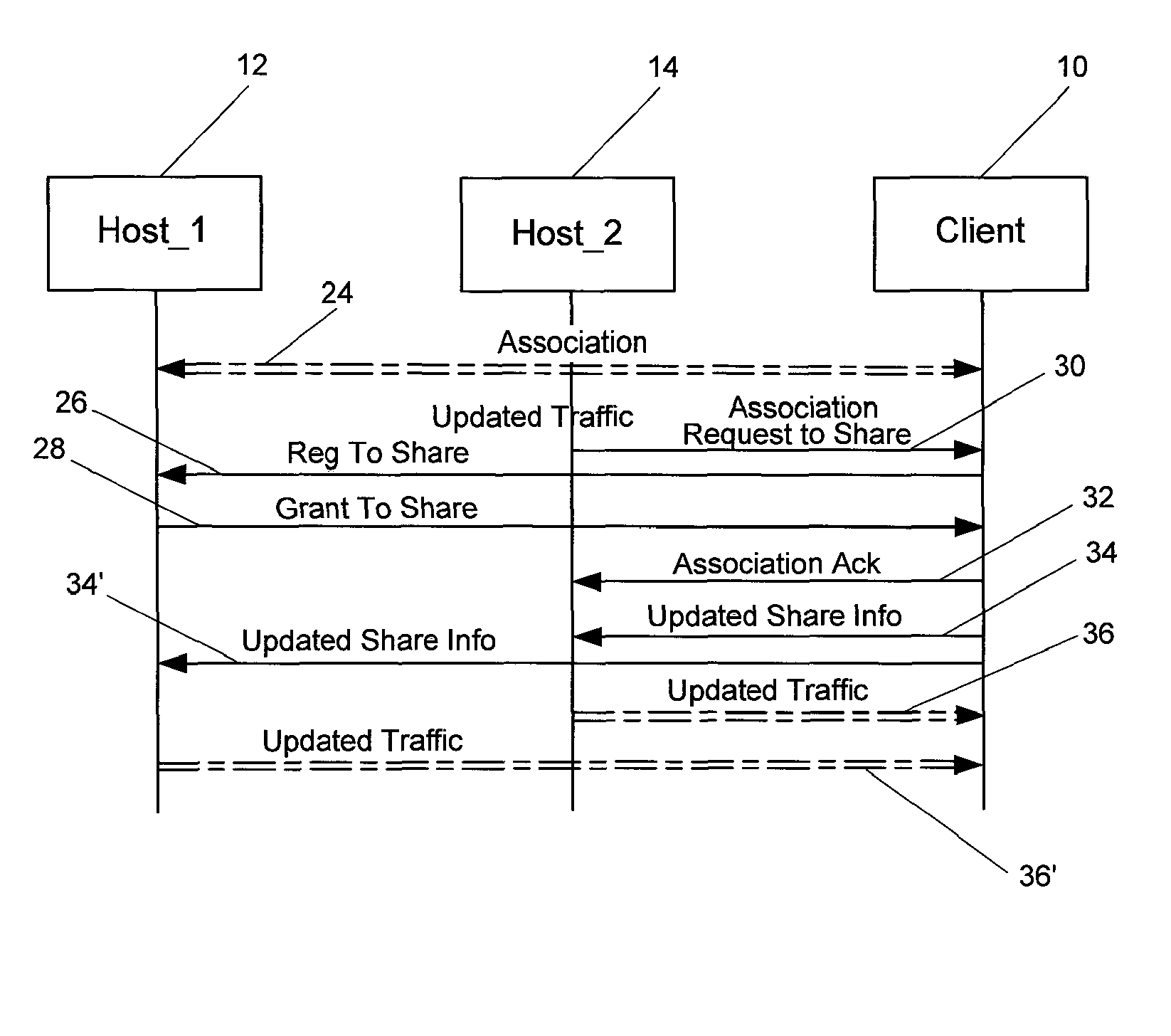
Operation—The operation of the claimed invention is described by the following examples. Although these examples only describe two hosts, it is anticipated that the system operates similarly with any number of hosts, and these exemplary aspects are meant for simple explanation of the system and not a limitation. The implementation of the claimed invention requires that a shared session be established and is depicted in <figref idref="DRAWINGS">FIG. 2</figref>. Initially, an association <b>24</b> exists between Host_<b>1</b><b>12</b> and a client <b>10</b>. An association request <b>30</b> can be made by another host, such as Host_<b>2</b><b>14</b>. Host_<b>2</b><b>14</b> specifies one of the share-modes in a request to share, as specified above. Client <b>10</b> may accept (or reject) the request depending upon the type of the specified share-mode and whether there are any other hosts using the client <b>10</b> resource. When Host_<b>2</b><b>14</b>, requests to share the client resource while sending the association request to share <b>30</b>, client seeks the permission <b>26</b> from the current owner (or all tenants), in this case Host_<b>1</b><b>12</b>, to allow the entry. If current owner (or all tenants) grant(s) the permission, client <b>10</b> accepts the association request with grant to share-mode <b>28</b> and provides an acknowledgment of the association <b>32</b>. Client updates and sends the sharing information <b>34</b> and <b>34</b>′ (e.g., size, location of the shared area, instruction to scale down/up resource usage) to Host_<b>1</b><b>12</b> including the new one, Host_<b>2</b><b>14</b>. Upon acceptance, new Host_<b>2</b><b>14</b> and existing Host_<b>1</b><b>12</b> make the necessary changes (e.g., scales down the resource consumption) and start/continue using the client services using updated traffic mode <b>36</b> and <b>36</b>′.
The negotiation of the allocation of the client <b>10</b> resources is shown in <figref idref="DRAWINGS">FIG. 3</figref>. When one of the hosts, in this case Host_<b>2</b><b>14</b>, is already engaged in association with client <b>10</b> and wants to change the sharing of the client resource (e.g., display), Host_<b>2</b><b>14</b> sends a “ReqToUpdateShare” <b>40</b> to client <b>10</b>. Client <b>10</b> seeks permission to update share <b>42</b> from the other host(s) (e.g., owner or all tenants), in this case Host_<b>1</b><b>12</b>, for the change in share. If the other host(s), Host_<b>1</b><b>12</b>, grants the permission <b>44</b>, client <b>10</b> acknowledges the “ReqToUpdateShare” by sending Ack <b>46</b> to Host_<b>2</b><b>14</b>. Client <b>10</b> also sends the updated sharing information to all the hosts having active association with the client using “UpdateSharedInfo” <b>48</b> and <b>48</b>′. Client includes the necessary change request (e.g., scale down/up) in this message. When host(s), Host_<b>1</b><b>12</b> and Host_<b>2</b><b>14</b>, receive the “UpdateSharedInfo” <b>48</b> and <b>48</b>′ message, they take necessary action and respond with “UpdateSharedInfoAck” <b>50</b> and <b>50</b>′ to client <b>10</b>. Then, they start sending the updated traffic <b>52</b> and <b>52</b>′. The “UpdateSharedInfo” <b>48</b> and <b>48</b>′ can also be activated at certain predetermined time intervals to insure the system is balanced.
<figref idref="DRAWINGS">FIG. 4</figref> shows the system for rebalancing the allocated shares of client <b>10</b> resources. When client <b>10</b> receives the “UpdateSharedInfoAck” <b>50</b> and <b>50</b>′ of <figref idref="DRAWINGS">FIG. 3</figref>, it updates the allocation vector <b>54</b> and continues processing updated traffic <b>52</b> and <b>52</b>′ (e.g., displays images using new share). When Host_<b>2</b><b>14</b> leaves the association <b>56</b>, client <b>10</b> rebalances the resource allocation <b>58</b> amongst remaining hosts, in this case Host_<b>1</b><b>12</b>. It sends the “UpdateShareInfo” <b>48</b> signal to all the remaining hosts, in this case Host_<b>1</b><b>12</b>, as described in the description of <figref idref="DRAWINGS">FIG. 3</figref>. When Host_<b>1</b><b>12</b> receives the “UpdateShareInfo” <b>48</b>, it and client <b>10</b> make necessary changes as described in the negotiate allocation section of <figref idref="DRAWINGS">FIG. 3</figref>.
In an established ad-hoc network, if a host wants to modify its share mode, such as upgrading or downgrading to higher privilege mode (e.g. secondary tenant to primary tenant), or a lower privilege mode it sends the request to the client to modify its (host's) own share mode. The client grants the requests if there is no other active host with the requested privilege mode. If a host with the same share mode present in the ad-hoc network, the client will seek the permission from the host. The host may grant it while specifying new share mode for itself or reject it. If the host grants the permission, the client allows the requesting host to upgrade its share mode. Alternately, if a host with higher privilege (e.g. primary) mode intends to depart the ad-hoc network, it may send a request to the client to nominate another active host for the privileges it had. The client may select a host to assign these privileges based on predetermined criteria or by polling the all the active hosts within the ad-hoc network
Those of skill in the art would understand that information and signals may be represented using any of a variety of different technologies and techniques. For example, data, instructions, commands, information, signals, bits, symbols, and chips that may be referenced throughout the above description may be represented by voltages, currents, electromagnetic waves, magnetic fields or particles, optical fields or particles, or any combination thereof.
Those of skill in the art would further appreciate that the various illustrative logical blocks, modules, circuits, and algorithm steps described in connection with the aspects disclosed herein may be implemented as electronic hardware, computer software, or combinations of both. To clearly illustrate this interchangeability of hardware and software, various illustrative components, blocks, modules, circuits, and steps have been described above, generally in terms of their functionality. Whether such functionality is implemented as hardware or software depends upon the particular application and design constraints imposed on the overall system. Skilled artisans may implement the described functionality in varying ways for each particular application, but such implementation decisions should not be interpreted as causing a departure from the scope of the presently claimed invention.
The various illustrative logical blocks, modules, and circuits described in connection with the aspects disclosed herein may be implemented or performed with a general purpose processor, a Digital Signal Processor (DSP), an Application Specific Integrated Circuit (ASIC), a Field Programmable Gate Array (FPGA) or other programmable logic device, discrete gate or transistor logic, discrete hardware components, or any combination thereof designed to perform the functions described herein. A general purpose processor may be a microprocessor, but in the alternative, the processor may be any conventional processor, controller, microcontroller, or state machine. A processor may also be implemented as a combination of computing devices, e.g., a combination of a DSP and a microprocessor, a plurality of microprocessors, one or more microprocessors in conjunction with a DSP core, or any other such configuration.
The steps of a method or algorithm described in connection with the aspects disclosed herein may be embodied directly in hardware, in a software module executed by a processor, or in a combination of the two. A software module may reside in Random Access Memory (RAM), flash memory, Read Only Memory (ROM), Electrically Programmable ROM (EPROM), Electrically Erasable Programmable ROM (EEPROM), registers, hard disk, a removable disk, a CD-ROM, or any other form of storage medium known in the art. An exemplary storage medium is coupled to the processor such that the processor can read information from, and write information to the storage medium. In the alternative, the storage medium may be integral to the processor. The processor and the storage medium may reside in an ASIC. The ASIC may reside in a user terminal. In the alternative, the processor and the storage medium may reside as discrete components in a user terminal.
The previous description of the disclosed aspects is provided to enable any person skilled in the art to make or use the presently claimed invention. Various modifications to these aspects will be readily apparent to those skilled in the art, and the generic principles defined herein may be applied to other aspects without departing from the spirit or scope of the claimed invention. Thus, the presently claimed invention is not intended to be limited to the aspects shown herein, but is to be accorded the widest scope consistent with the principles and novel features disclosed herein.
Contents5
5 sheets
Sheet 1 Sheet 2 Sheet 3 Sheet 4 Sheet 5
Every citation, both waysCites: the store holds 488 of 489
| Document | Relation | Office | Cited during |
|---|---|---|---|
| US2023289430A1 | Cited by | United States of America | Search report |
| US11693946B2 | Cited by | United States of America | Search report |
| US2024394358A1 | Cited by | United States of America | Search report |
| US2021081522A1 | Cited by | United States of America | Search report |
| US12067105B2 | Cited by | United States of America | Search report |
| US2002007494A1 | Cites | United States of America | Applicant |
| US2002035621A1 | Cites | United States of America | Applicant |
| US2002097718A1 | Cites | United States of America | Applicant |
| US2003031152A1 | Cites | United States of America | Applicant |
| US2003064752A1 | Cites | United States of America | Applicant |
| US2003110297A1 | Cites | United States of America | Applicant |
| US2003142631A1 | Cites | United States of America | Applicant |
| US2003152098A1 | Cites | United States of America | Applicant |
| US2003167171A1 | Cites | United States of America | Applicant |
| US2003225737A1 | Cites | United States of America | Applicant |
| US2004039934A1 | Cites | United States of America | Applicant |
| US2004071169A1 | Cites | United States of America | Applicant |
| US2004083284A1 | Cites | United States of America | Applicant |
| US2004103282A1 | Cites | United States of America | Applicant |
| US2004147264A1 | Cites | United States of America | Applicant |
| US2004160967A1 | Cites | United States of America | Applicant |
| US2004202249A1 | Cites | United States of America | Applicant |
| US2004214571A1 | Cites | United States of America | Applicant |
| US2005021810A1 | Cites | United States of America | Applicant |
| US2005044142A1 | Cites | United States of America | Applicant |
| US2005058090A1 | Cites | United States of America | Applicant |
| US2005060750A1 | Cites | United States of America | Applicant |
| US2005085239A1 | Cites | United States of America | Applicant |
| US2005096086A1 | Cites | United States of America | Applicant |
| US2005102699A1 | Cites | United States of America | Applicant |
| US2005111361A1 | Cites | United States of America | Applicant |
| US2005130611A1 | Cites | United States of America | Applicant |
| US2005136990A1 | Cites | United States of America | Applicant |
| US2005138193A1 | Cites | United States of America | Applicant |
| US2005144225A1 | Cites | United States of America | Applicant |
| US2005149976A1 | Cites | United States of America | Applicant |
| US2005152330A1 | Cites | United States of America | Applicant |
| US2005166241A1 | Cites | United States of America | Applicant |
| US2005175321A1 | Cites | United States of America | Applicant |
| US2005176429A1 | Cites | United States of America | Applicant |
| US2005184993A1 | Cites | United States of America | Applicant |
| US2005198663A1 | Cites | United States of America | Applicant |
| US2005219266A1 | Cites | United States of America | Applicant |
| US2005266798A1 | Cites | United States of America | Applicant |
| US2005267946A1 | Cites | United States of America | Applicant |
| US2006002320A1 | Cites | United States of America | Applicant |
| US2006288008A1 | Cites | United States of America | Search report |
| US4791554A | Cites | United States of America | Search report |
| US5828370A | Cites | United States of America | Applicant |
| US5835723A | Cites | United States of America | Applicant |
| US5925137A | Cites | United States of America | Applicant |
| US6014706A | Cites | United States of America | Applicant |
| US6049549A | Cites | United States of America | Applicant |
| US6195680B1 | Cites | United States of America | Applicant |
| US6252889B1 | Cites | United States of America | Applicant |
| US6266690B1 | Cites | United States of America | Applicant |
| US6400720B1 | Cites | United States of America | Applicant |
| US6424626B1 | Cites | United States of America | Applicant |
| US6515992B1 | Cites | United States of America | Applicant |
| US6594699B1 | Cites | United States of America | Applicant |
| US6608841B1 | Cites | United States of America | Applicant |
| US6748195B1 | Cites | United States of America | Applicant |
| US6760772B2 | Cites | United States of America | Applicant |
| US6801530B1 | Cites | United States of America | Applicant |
| US6876857B1 | Cites | United States of America | Applicant |
| US6917976B1 | Cites | United States of America | Applicant |
| US6963921B1 | Cites | United States of America | Applicant |
| US7035281B1 | Cites | United States of America | Applicant |
| US7072984B1 | Cites | United States of America | Applicant |
| US7080151B1 | Cites | United States of America | Applicant |
| US7085420B2 | Cites | United States of America | Applicant |
| US7324462B1 | Cites | United States of America | Applicant |
| US7328021B1 | Cites | United States of America | Applicant |
| US7333464B2 | Cites | United States of America | Applicant |
| US7366204B2 | Cites | United States of America | Applicant |
| US7373415B1 | Cites | United States of America | Applicant |
| US7376155B2 | Cites | United States of America | Applicant |
| US7477659B1 | Cites | United States of America | Applicant |
| US7519470B2 | Cites | United States of America | Applicant |
| US7529823B2 | Cites | United States of America | Applicant |
| US7565357B2 | Cites | United States of America | Applicant |
| US7688859B2 | Cites | United States of America | Applicant |
| US7696980B1 | Cites | United States of America | Applicant |
| US7712670B2 | Cites | United States of America | Applicant |
| US7716385B2 | Cites | United States of America | Applicant |
| US7719972B2 | Cites | United States of America | Applicant |
| US7720096B2 | Cites | United States of America | Applicant |
| US7768536B2 | Cites | United States of America | Applicant |
| US7835406B2 | Cites | United States of America | Applicant |
| US7881315B2 | Cites | United States of America | Applicant |
| US7929475B2 | Cites | United States of America | Applicant |
| US8001384B2 | Cites | United States of America | Applicant |
| US8102849B2 | Cites | United States of America | Applicant |
| US8157168B2 | Cites | United States of America | Applicant |
| US8364201B1 | Cites | United States of America | Applicant |
| US8406961B2 | Cites | United States of America | Applicant |
| US8428048B2 | Cites | United States of America | Applicant |
| US8437347B2 | Cites | United States of America | Applicant |
| US8466870B2 | Cites | United States of America | Applicant |
| US8517251B2 | Cites | United States of America | Applicant |
10 members in 6 offices
Priority claims2
| Document | Office | Kind | Date |
|---|---|---|---|
| 33314508 | United States of America | A | |
| US20080333145 | – | – | – |
Members10
| Document | Office | Kind | |
|---|---|---|---|
| US2010153553A1 | United States of America | A1 | |
| WO2010068842A1 | World Intellectual Property Organization (WIPO) | A1 | |
| KR20110098807A | Republic of Korea | A | |
| EP2374327A1 | European Patent Office (EPO) | A1 | |
| CN102246589A | China | A | |
| JP2012511288A | Japan | A | |
| KR101314404B1 | Republic of Korea | B1 | |
| JP5635528B2 | Japan | B2 | |
| CN102246589B | China | B | |
| US9398089B2This record | United States of America | B2 |
200 transactions on the USPTO file
Allowed after 1 non-final rejection and 9 RCEs.
- Non-final rejections
- 1
- Final rejections
- 0
- RCEs
- 9
- Appeals
- 0
Over time
Point at a mark for the transactionTransactions
| Event | Code | |
|---|---|---|
| Expire PatentEXP. | EXP. | |
| Maintenance Fee Reminder MailedREM. | REM. | |
| Payment of Maintenance Fee, 4th Year, Large EntityM1551 | M1551 | |
| Recordation of Patent Grant MailedPGM/ | PGM/ | |
| Patent Issue Date Used in PTA CalculationAllowedPTAC | PTAC | |
| Email NotificationEML_NTR | EML_NTR | |
| Issue Notification MailedAllowedWPIR | WPIR | |
| Dispatch to FDCD1935 | D1935 | |
| Application Is Considered Ready for IssuePILS | PILS | |
| Mail-Record Petition Decision of Granted to Accept Delayed Payment of Issue FeeMP005 | MP005 | |
| Issue Fee Payment VerifiedN084 | N084 | |
| Issue Fee Payment ReceivedIFEE | IFEE | |
| Record Petition Decision of Granted to Accept Delayed Payment of Issue FeeP005 | P005 | |
| Petition EnteredPET. | PET. | |
| Email NotificationEML_NTR | EML_NTR | |
| Mail Abandonment for Failure to Pay Issue FeeAbandonedMABN6 | MABN6 | |
| Abandonment for Failure to Pay Issue FeeAbandonedABN6 | ABN6 | |
| Electronic ReviewELC_RVW | ELC_RVW | |
| Email NotificationEML_NTF | EML_NTF | |
| Mail Notice of AllowanceAllowedMN/=. | MN/=. | |
| Notice of Allowance Data Verification CompletedAllowedN/=. | N/=. | |
| Reasons for AllowanceEX.R | EX.R | |
| Information Disclosure Statement consideredIDSC | IDSC | |
| Disposal for a RCE / CPA / R129AbandonedABN9 | ABN9 | |
| Information Disclosure Statement consideredIDSC | IDSC | |
| Information Disclosure Statement (IDS) FiledM844 | M844 | |
| Request for Continued Examination (RCE)RCEX | RCEX | |
| Information Disclosure Statement (IDS) FiledWIDS | WIDS | |
| Information Disclosure Statement (IDS) FiledWIDS | WIDS | |
| Workflow - Request for RCE - BeginBRCE | BRCE | |
| Electronic ReviewELC_RVW | ELC_RVW | |
| Email NotificationEML_NTF | EML_NTF | |
| Mail Notice of AllowanceAllowedMN/=. | MN/=. | |
| Notice of Allowance Data Verification CompletedAllowedN/=. | N/=. | |
| Reasons for AllowanceEX.R | EX.R | |
| Information Disclosure Statement consideredIDSC | IDSC | |
| Disposal for a RCE / CPA / R129AbandonedABN9 | ABN9 | |
| Information Disclosure Statement consideredIDSC | IDSC | |
| Electronic Information Disclosure StatementEIDS. | EIDS. | |
| Request for Continued Examination (RCE)RCEX | RCEX | |
| Information Disclosure Statement (IDS) FiledWIDS | WIDS | |
| Information Disclosure Statement (IDS) FiledWIDS | WIDS | |
| Workflow - Request for RCE - BeginBRCE | BRCE | |
| Electronic ReviewELC_RVW | ELC_RVW | |
| Email NotificationEML_NTF | EML_NTF | |
| Mail Notice of AllowanceAllowedMN/=. | MN/=. | |
| Notice of Allowance Data Verification CompletedAllowedN/=. | N/=. | |
| Reasons for AllowanceEX.R | EX.R | |
| Information Disclosure Statement consideredIDSC | IDSC | |
| Disposal for a RCE / CPA / R129AbandonedABN9 | ABN9 | |
| Electronic Information Disclosure StatementEIDS. | EIDS. | |
| Request for Continued Examination (RCE)RCEX | RCEX | |
| Information Disclosure Statement (IDS) FiledWIDS | WIDS | |
| Workflow - Request for RCE - BeginBRCE | BRCE | |
| Email NotificationEML_NTR | EML_NTR | |
| Printer Rush- No mailingTCPB | TCPB | |
| Mail Miscellaneous Communication to ApplicantMM327 | MM327 | |
| Miscellaneous Communication to Applicant - No Action CountM327 | M327 | |
| Information Disclosure Statement consideredIDSC | IDSC | |
| Pubs Case Remand to TCPUBTC | PUBTC | |
| Electronic ReviewELC_RVW | ELC_RVW | |
| Email NotificationEML_NTF | EML_NTF | |
| Mail Notice of AllowanceAllowedMN/=. | MN/=. | |
| Notice of Allowance Data Verification CompletedAllowedN/=. | N/=. | |
| Information Disclosure Statement (IDS) FiledWIDS | WIDS | |
| Reasons for AllowanceEX.R | EX.R | |
| Information Disclosure Statement consideredIDSC | IDSC | |
| Information Disclosure Statement consideredIDSC | IDSC | |
| Information Disclosure Statement consideredIDSC | IDSC | |
| Electronic Information Disclosure StatementEIDS. | EIDS. | |
| Information Disclosure Statement (IDS) FiledWIDS | WIDS | |
| Disposal for a RCE / CPA / R129AbandonedABN9 | ABN9 | |
| Reference capture on IDSRCAP | RCAP | |
| Information Disclosure Statement (IDS) FiledM844 | M844 | |
| Information Disclosure Statement (IDS) FiledM844 | M844 | |
| Request for Continued Examination (RCE)RCEX | RCEX | |
| Information Disclosure Statement (IDS) FiledWIDS | WIDS | |
| Information Disclosure Statement (IDS) FiledWIDS | WIDS | |
| Workflow - Request for RCE - BeginBRCE | BRCE | |
| Email NotificationEML_NTR | EML_NTR | |
| Printer Rush- No mailingTCPB | TCPB | |
| Mail Miscellaneous Communication to ApplicantMM327 | MM327 | |
| Miscellaneous Communication to Applicant - No Action CountM327 | M327 | |
| Information Disclosure Statement consideredIDSC | IDSC | |
| Pubs Case Remand to TCPUBTC | PUBTC | |
| Electronic ReviewELC_RVW | ELC_RVW | |
| Email NotificationEML_NTF | EML_NTF | |
| Mail Notice of AllowanceAllowedMN/=. | MN/=. | |
| Notice of Allowance Data Verification CompletedAllowedN/=. | N/=. | |
| Electronic Information Disclosure StatementEIDS. | EIDS. | |
| Information Disclosure Statement (IDS) FiledWIDS | WIDS | |
| Reasons for AllowanceEX.R | EX.R | |
| Information Disclosure Statement consideredIDSC | IDSC | |
| Disposal for a RCE / CPA / R129AbandonedABN9 | ABN9 | |
| Reference capture on IDSRCAP | RCAP | |
| Information Disclosure Statement (IDS) FiledM844 | M844 | |
| Request for Continued Examination (RCE)RCEX | RCEX | |
| Information Disclosure Statement (IDS) FiledWIDS | WIDS | |
| Workflow - Request for RCE - BeginBRCE | BRCE | |
| Electronic ReviewELC_RVW | ELC_RVW |
8 legal events, as the office reported them to INPADOC
Over the term
Point at a mark for the eventEvents
| Event | Code | |
|---|---|---|
| Lapsed due to failure to pay maintenance feeLapsedFP | FP | |
| Lapse for failure to pay maintenance feesLapsedPATENT EXPIRED FOR FAILURE TO PAY MAINTENANCE FEES (ORIGINAL EVENT CODE: EXP.); ENTITY STATUS OF PATENT OWNER: LARGE ENTITYLAPS | LAPS | |
| Information on status: patent discontinuationPATENT EXPIRED DUE TO NONPAYMENT OF MAINTENANCE FEES UNDER 37 CFR 1.362STCH | STCH | |
| Fee payment procedureMAINTENANCE FEE REMINDER MAILED (ORIGINAL EVENT CODE: REM.); ENTITY STATUS OF PATENT OWNER: LARGE ENTITYFEPP | FEPP | |
| Maintenance fee paymentMAFP | MAFP | |
| Information on status: patent grantGrantedPATENTED CASESTCF | STCF | |
| AssignmentAS | AS | |
| AssignmentAS | AS |
Numbers
- Publication
- 09398089
- Publication, DOCDB
- 9398089
- Publication, EPODOC
- US9398089
- Application
- 12333145
- Application, DOCDB
- 33314508
- Application, EPODOC
- US20080333145
Titles
- English
- Dynamic resource sharing among multiple wireless devices
Patent term adjustment
- A delay
- +547 daysthe office missed an examination deadline
- B delay
- +905 dayspendency past three years
- Applicant delay
- −1,629 days
- Net adjustment
- 0 days
Classification
- CPC, 8
- H04L67/1095
- H04L65/00
- G06F21/6209
- G06F2221/2141
- H04N21/4312
- H04N21/4316
- H04N21/440263
- H04N21/4126
- IPC, 3
- G06F15 173
- G06F15 16
- H04L29 08
- USPC, 1
- 001001000