Method and apparatus for determining locations of communication devices in a simulcast network
Summary by NHIP
Simulcast Network Location Method
The method identifies communication device locations to assign talk groups and maximize network resource reuse. A comparator sends requests containing timeslot assignments and network access codes, then receives responses in specific slots to determine geographic separation for resource allocation.
Claim Score by NHIP
Abstract
Methods and apparatuses are disclosed for identifying locations of communication devices in a simulcast network. A comparator sends a location request to communication devices in a simulcast network. The location request includes timeslot assignments for each talk group in the simulcast network. The comparator receives responses from the communication devices. Each response is received in a timeslot assigned to a talk group. The comparator assigns network resources to talk groups in the simulcast network based at least in part on the received responses.
Term
4.8 yearsleft in the term
Expires 13 July 2031, including 224 days of term adjustment.
- Priority and filed
- Granted
- Today
- Expires
20 claims: 2 independent, 18 dependent
- 1Broadest claimClaim Score 52, average(NHIP)A method for identifying locations of communication devices and correspondingly assigning talk groups to maximize network resource reuse in a simulcast network, comprising:sending, by a comparator, a location request to a plurality of communication devices in a simulcast network, wherein the location request includes timeslot assignments for each talk group of a plurality of talkgroups in the simulcast network;receiving, by the comparator, responses from each of the plurality of communication devices indicating a location of the communication device, each response being received in a timeslot assigned to a respective one of the plurality of talk groups with which the communication device is associated;and assigning, by the comparator, a common network resources to two or more of the plurality of talk groups determined to be geographically separated in the simulcast network based at least in part on the received responses.
- 14A comparator configured to identify locations of communication devices and correspondingly assign talk groups to maximize network resource reuse in a simulcast network, comprising:a transmitting component configured to transmit a location request to a plurality of communication devices in a simulcast network, wherein the location request includes timeslot assignments for each talk group of a plurality of talk groups in the simulcast network;a receiving component configured to receive responses from each of the plurality of communication devices indicating a location of the communication device, each response being received in a timeslot assigned to a respective one of the plurality of talk groups with which the communication device is associated;and a processing component configured to assign a common network resources to two or more of the plurality of talk groups determined to be geographically separated in the simulcast network based at least in part on the received responses.
Independent claims2
35 paragraphs in 4 sections, as filed
This application claims priority to PCT Application Serial Number PCT/PL2010/000119 filed Dec. 1, 2010, the contents of which are expressly incorporated herein by reference in their entirety.
FIELD OF THE DISCLOSURE
The present disclosure relates generally to assigning base radios to talk groups in a simulcast network and more particularly to continuously monitoring locations of communication devices to efficiently assign network resources to each talk group.
BACKGROUND
Institutional organizations, such as public safety organizations, typically use simulcast networks for voice communications. A simulcast radio network is a radio network in which all network components are active on the same radio frequency channel at the same time. In simulcast radio networks, mobile devices, for example portable two-way radios, mobile radios, or other similar radios, communicate with each other and with a centralized dispatch center through base radios/stations. Signals transmitted from each radio are received by multiple base radios and simulcast radio network <b>100</b> is configured to select a desired base radio signal for processing. In order to efficiently use network resources, each radio in the network may be associated with one or more talk groups.
To split common network resources between two or more talk groups that operate on the same access channel, each talk group is located in a unique geographical area in the network coverage area. Each talk group is also assigned a unique network access code, wherein radios in each talk group are programmed to suppress audio input/output that does not include the unique network access code. For example, radios for firefighters may be associated with a firefighter talk group which is located in, for example, the northern coverage area in simulcast radio network <b>100</b>. The radios in the firefighter talk group may therefore be configured to communicate through base radios in the northern coverage area of simulcast radio network <b>100</b>. Radios for police officers in the same simulcast radio network may be associated with a police talk group which is located in another geographical coverage area, for example, the southern coverage area in simulcast radio network <b>100</b>. As such, the radios in the police talk group may be configured to communicate through base radios in the southern coverage area of simulcast radio network <b>100</b>. Because the talk groups are in different geographical locations, there should be no interference between the talk groups. In order to efficiently configure and modify talk groups and to assign adequate network resources to each talk group, it is useful to identify the locations of radios associated with each talk group.
Accordingly, there is a need for a method and apparatus for continuously monitoring locations of radios in talk groups.
BRIEF DESCRIPTION OF THE FIGURES
The accompanying figures, where like reference numerals refer to identical or functionally similar elements throughout the separate views, together with the detailed description below, are incorporated in and form part of the specification, and serve to further illustrate embodiments of concepts that include the claimed invention, and explain various principles and advantages of those embodiments.
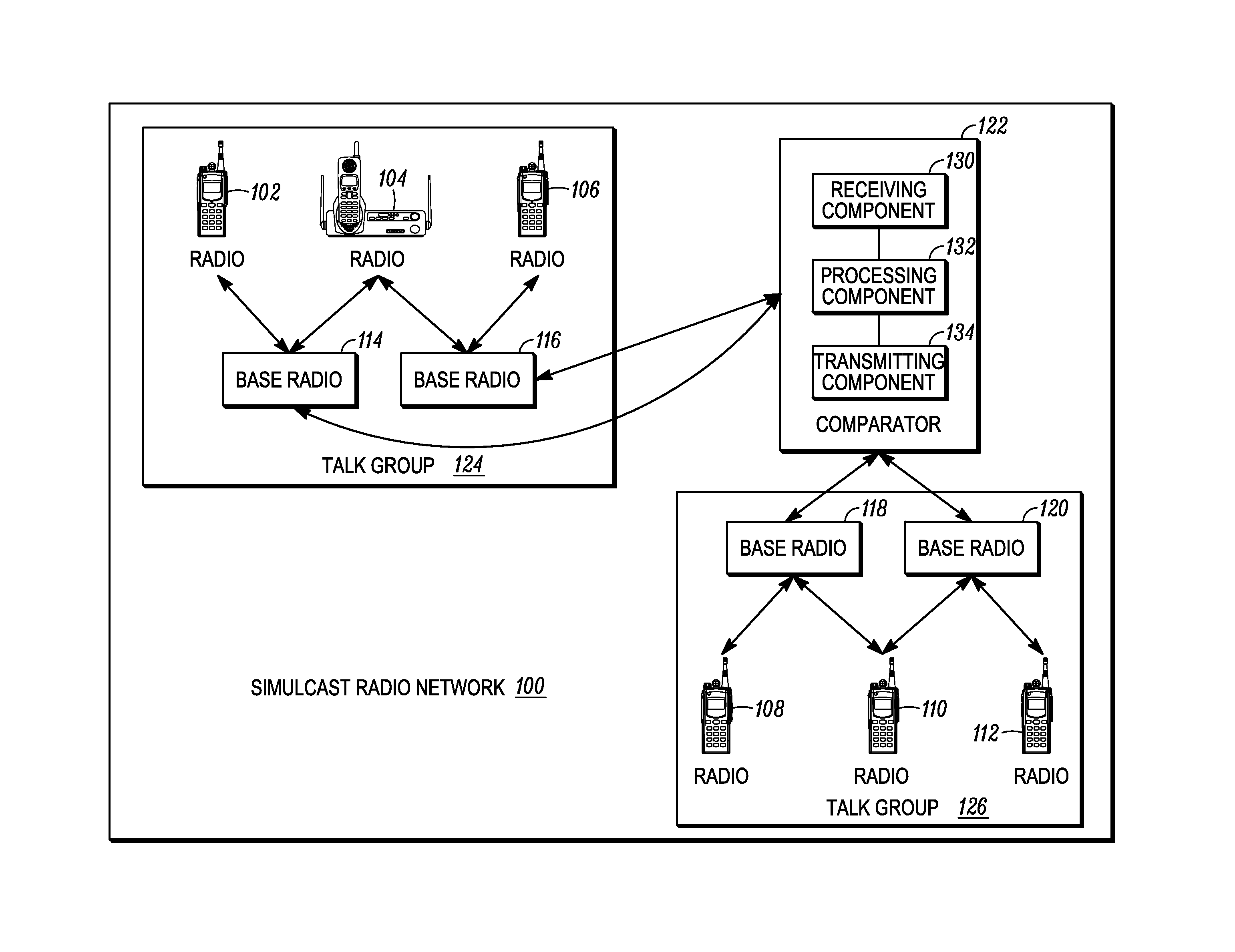
<figref idref="DRAWINGS">FIG. 1</figref> is a block diagram of a simulcast radio network used in accordance with some embodiments.
<figref idref="DRAWINGS">FIG. 2</figref> is a block diagram illustrating a system in which a comparator obtains location information from radios in accordance with some embodiments.
<figref idref="DRAWINGS">FIG. 3</figref> is another block diagram illustrating a system in which a comparator obtains location information from radios in accordance with some embodiments.
<figref idref="DRAWINGS">FIG. 4</figref> is a block diagram illustrating a system in which sub-sites are used in accordance with some embodiments.
<figref idref="DRAWINGS">FIG. 5</figref> is a flowchart of a method for continuously monitoring locations of radios in talk groups in accordance with some embodiments.
Skilled artisans will appreciate that elements in the figures are illustrated for simplicity and clarity and have not necessarily been drawn to scale. For example, the dimensions of some of the elements in the figures may be exaggerated relative to other elements to help to improve understanding of embodiments of the present invention.
The apparatus and method components have been represented where appropriate by conventional symbols in the drawings, showing only those specific details that are pertinent to understanding the embodiments of the present invention so as not to obscure the disclosure with details that will be readily apparent to those of ordinary skill in the art having the benefit of the description herein.
DETAILED DESCRIPTION
Embodiments are directed to methods and apparatuses for identifying locations of communication devices in a simulcast network. A comparator sends a location request to communication devices in a simulcast network. The location request includes timeslot assignments for each talk group in the simulcast network. The comparator receives responses from the communication devices. Each response is received in a timeslot assigned to a talk group. The comparator assigns network resources to talk groups in the simulcast network based at least in part on the received responses.
<figref idref="DRAWINGS">FIG. 1</figref> is a block diagram of a simulcast radio network used in accordance with some embodiments. Simulcast radio network <b>100</b> includes communication devices, such as radios <b>102</b>-<b>112</b>, which may be, for example portable two-way radios, mobile radios, or other similar radios. Simulcast radio network <b>100</b> also includes base stations or base radios <b>114</b>-<b>120</b>, each of which is configured to receive signals transmitted from one or more radios <b>102</b>-<b>112</b>. Radios <b>102</b>-<b>112</b> and base radios <b>114</b>-<b>120</b> are configured to operate on the same radio frequency channel and they may operate according to, for example, the Association of Public Safety Communications Officials International (APCO) Project 25 (P25) standard, the Terrestrial Trunked Radio (TETRA) protocol, or similar radio protocol. Further details regarding the P25 standards can be obtained from the Telecommunications Industry Association, 2500 Wilson Boulevard, Suite 300 Arlington, Va. 22201 and regarding the TETRA standards may be obtained by contacting ETSI at ETSI Secretariat, 650, Route des Lucioles, 06921 Sophia-Antipolis Cedex, FRANCE. Each radio <b>102</b>-<b>112</b> is assigned to a specific talk group and one or more base radios <b>114</b>-<b>120</b> are assigned to each talk group. For example, radios <b>102</b>-<b>106</b> are assigned to a first talk group <b>124</b> and radios <b>102</b>-<b>106</b> are configured to communicate through base radios <b>114</b>-<b>116</b>. Radios <b>108</b>-<b>112</b> are assigned into a second talk group <b>126</b> and radios <b>108</b>-<b>112</b> are configured to communicate through base radios <b>118</b>-<b>120</b>. Signals transmitted from each radio <b>102</b>-<b>112</b> are detected by the appropriate base radios <b>114</b>-<b>120</b> and a comparator <b>122</b> ensures that the best possible voice signal is broadcast by combining the best parts of a single signal that has been received by two or more base radios <b>114</b>-<b>120</b>. Comparator <b>122</b> therefore enhances received audio quality in weak signal areas by selecting and mixing inputs from multiple base radios <b>114</b>-<b>120</b>. It should be noted that although comparator <b>122</b> is illustrated as a stand-alone device, the functions performed by comparator <b>122</b> can be performed alternatively by one or more base radios <b>114</b>-<b>120</b>. In addition, one or more other infrastructure elements in simulcast radio network <b>100</b> can perform the functions performed by comparator <b>122</b>.
In some embodiments, a talk group <b>124</b> or <b>126</b> may be a voice talk group, a data talk group, or a combination talk group (a voice and data talk group). The voice talk group may process voice calls and the data talk group may process data, for example text messages, or control channel activities. The control channel activities may be used to, for example improve performance and channel load for selected talk groups. The combination talk group may process conventional voice/data calls in some geographical areas of the talk group coverage area and process voice/data/control activities in other geographical areas of the talk group coverage area.
In order to split common resources between two or more talk groups, for example the first talk group <b>124</b> and the second talk group <b>126</b> that use the same radio frequency channel, each talk group is geographically separated to avoid signal interference between the talk groups. Accordingly, comparator <b>122</b> is configured to identify the locations of radios <b>102</b>-<b>112</b> in order to determine how to assign radios <b>102</b>-<b>112</b> to appropriate talk groups on the same radio frequency channel. Upon locating radios in simulcast radio network <b>100</b>, comparator <b>122</b> may also disable one or more base radios <b>114</b>-<b>120</b> or remove the base radio from the talk group if comparator <b>122</b> determines that the base radios are not being used by assigned talk groups. On the other hand, upon locating radios in simulcast radio network <b>100</b>, comparator <b>122</b> may also enable one or more base radios <b>114</b>-<b>120</b> if comparator <b>122</b> determines that more base radios need to be assigned to a talk group.
In some embodiments, comparator <b>122</b> includes a transmitting component <b>134</b>, a processing component <b>132</b> and a receiving component <b>130</b>. Although illustrated for simplicity purposes as individual components, it will be appreciated by those of ordinary skill in the art that other configurations performing the same functionality may be implemented. Transmitting component <b>134</b> periodically sends a location request to radios <b>102</b>-<b>112</b> through base radios <b>114</b>-<b>120</b>. For example, comparator <b>122</b> may send the location request after a period of time, after every call, or when comparator <b>122</b> determines that an immediate location update is required. The location request may be a Trunked Signaling Block (TSBK) message, that is, a single block control channel message. The TSBK message may be, for example, a location identification message which requests location information from all radios <b>102</b>-<b>112</b> or a predefined group of radios in simulcast radio network <b>100</b>. To ensure that the request is reliably received, transmitting component <b>134</b> may send location identification messages two or more times within a predefined time period. Upon receiving the location identification messages, each base radio <b>114</b>-<b>120</b> transmits the received location identification messages to associated radios. For example, base radios <b>118</b> and <b>120</b> transmit the location identification messages to radios <b>108</b>-<b>112</b> and base radios <b>114</b>-<b>116</b> transmit the location identification messages to radios <b>102</b>-<b>106</b>.
The location identification messages sent from comparator <b>122</b> includes a list of network access codes, where each network access code is unique and is assigned to one talk group. The radios in each talk group are programmed to suppress audio input/output that does not include the unique network access code for their talk group. The location identification messages also include a timeslot assignment for each talk group, such that each radio is configured to transmit its response to the location identification messages in the timeslot assigned to its talk group. At a predetermined time after the radios received the location identification messages, each radio <b>102</b>-<b>112</b> responds to the location identification messages. In some embodiments, the response is a short symbol stream that may be a pseudorandom Compatible 4-Level FM version of Quadrature phase-shift keying (QPSK) c-modulation (C4FM) symbol stream, in order to mitigate radio frequency wave elimination. Because the radios are configured to transmit the C4FM symbol stream during a predetermined period after receiving the location identification messages, radios <b>102</b>-<b>112</b> may transmit C4FM symbol streams at the same time or at close to the same time.
When base radios <b>114</b>-<b>120</b> receive responses from radios <b>102</b>-<b>112</b>, base radios <b>114</b>-<b>120</b> are configured to send the responses to receiving component <b>130</b> in comparator <b>122</b>. Base radios <b>114</b>-<b>120</b> send the response from each radio if a received signal strength indicator (RSSI) or another parameter for indicating signal quality for the radio is above a predefined threshold. For example, base radios <b>114</b>-<b>116</b> are configured to send responses for talk group <b>124</b> if the RSSI for radios <b>102</b>-<b>106</b> is above one hundred and ten decibels (110 dBm). The responses from each radio are sent in the timeslot assigned to the radio talk group.
In other embodiments, comparator <b>122</b> may also send a present request, to selected talk group(s), in the location identification messages. For example, comparator <b>122</b> may send a present request to only talk group <b>124</b>. In response to the present request, each radio in talk group <b>124</b> transmits a signal in the timeslot assigned to talk group <b>124</b>. This signal can be thought of a “present” signal which indicates that radios in talk group <b>124</b> are active in simulcast radio network <b>100</b>. When base radios <b>114</b>-<b>116</b> receive the present signals from radios in talk group <b>124</b>, base radios <b>114</b>-<b>120</b> send messages to comparator <b>122</b> to indicate that responses were received in the timeslot assigned to talk group <b>124</b>. Base radios <b>114</b>-<b>120</b> send the responses to comparator <b>122</b> if the signal quality indicator for radios in talk group <b>124</b> is above the predefined threshold.
Upon receiving responses to the location identification messages, processing component <b>132</b> in comparator <b>122</b> can determine whether a talk group may be further divided into more talk groups. If a split is possible, comparator <b>122</b> can begin preparation for the split for selected talk group pairs. For example, comparator <b>122</b> can begin to perform Ethernet port allocation for selected talk group pairs. Processing component <b>132</b> can also determine whether one or more base radios are being used and, if a base radio is not being used, the base radio can be removed from the talk group. Processing component <b>132</b> can determine that a base radio is not being used if, for example, it does not receive a response to the location identification messages from the base radio.
<figref idref="DRAWINGS">FIG. 2</figref> is a block diagram illustrating a system in which a comparator obtains location information from radios in accordance with some embodiments. Comparator <b>202</b> is configured to send a location identification message to base radios <b>204</b>-<b>210</b>. Comparator <b>202</b>, for example, may be comparator <b>122</b> of <figref idref="DRAWINGS">FIG. 1</figref>. Each location identification message identifies a talk group and/or a network access code associated with a talk group. Each location identification message also identifies a timeslot <b>214</b>-<b>218</b> assigned to each talk group. To ensure that the location identification message is reliably received, comparator <b>202</b> may send the location identification message two or more times within a predefined time period.
Each base radio <b>204</b>-<b>210</b> transmits the location identification messages to associated radios <b>220</b>-<b>240</b>. Each radio <b>220</b>-<b>240</b> responds to the location identification messages by transmitting a short pseudorandom C4FM symbol stream <b>212</b> in its assigned timeslot <b>214</b>-<b>218</b>. When base radios <b>204</b>-<b>210</b> receive the responses from radios <b>220</b>-<b>240</b>, base radios <b>204</b>-<b>210</b> send responses for each talk group to comparator <b>202</b> if a signal quality parameter, such as the RSSI for radios in the talk group is above a predefined threshold <b>212</b>. The shaded area in each time slot denotes the responses sent from base radios <b>204</b>-<b>210</b>. Comparator <b>202</b> can use the responses from base radios <b>204</b>-<b>210</b> to identify the number of talk group members in each talk group and to configure or modify talk groups.
<figref idref="DRAWINGS">FIG. 3</figref> is another block diagram illustrating a system in which a comparator obtains location information from radios in accordance with some embodiments. Comparator <b>302</b> is configured to send a location identification message to base radios <b>304</b>-<b>310</b>. Each location identification message <b>313</b>, <b>315</b> and <b>317</b> is directed to specific talk group(s) and identifies the talk group and/or a network access code associated with the talk group. Each location identification message <b>313</b>, <b>315</b> and <b>317</b> also identifies the timeslot <b>314</b>, <b>316</b> and <b>318</b> associated with the talk group. Upon receiving the location identification message, each base radio <b>304</b>-<b>310</b> is configured to send out the location identification message in the timeslot assigned to the talk group.
Radios in the talk group(s) specified in the location identification messages respond to the location identification messages by transmitting a present signal in the assigned timeslot <b>314</b>, <b>316</b> and <b>318</b>. The shaded areas in timeslots <b>316</b> and <b>318</b> denote responses from radios in the specified talk group. In <figref idref="DRAWINGS">FIG. 3</figref>, base radios <b>304</b>-<b>310</b> did not receive any responses to the location identification messages transmitted to talk group A. Accordingly, base radios <b>304</b>-<b>310</b> did not transmit any present signals (as denoted by the lack of shaded areas) in timeslot <b>314</b> to comparator <b>302</b>. Base radios <b>304</b>-<b>310</b> did receive responses to the location identification messages transmitted to talk group B and talk group C. Accordingly, base radios <b>304</b>-<b>310</b> transmitted present signals (as denoted by the shaded areas) in timeslots <b>316</b> and <b>318</b>. When base radios <b>304</b>-<b>310</b> receive the responses from radios <b>330</b>-<b>340</b>, base radios <b>304</b>-<b>310</b> send responses for the specified talk group <b>330</b>-<b>340</b> to comparator <b>302</b>, if a signal quality parameter, such as the RSSI for radios in the specified talk group is above a predefined threshold <b>312</b>. Comparator <b>302</b> can use the answers from base radios <b>304</b>-<b>310</b> to identify the number of subscribers in the specified talk group(s) and to modify the specified talk group(s). Using the example in <figref idref="DRAWINGS">FIG. 3</figref>, comparator <b>302</b> may disable base radios assigned to talk group A because no radios are active in that talk group.
The composition of talk groups may change as radios are added to or removed from talk groups. There are circumstances where the comparator may need to be notified of changes in a talk group without using the location identification messages. For example, if during continuous base radio transmissions a radio moves from one geographical location to another, the comparator will be unable to transmit location identification messages and will therefore be unaware of the location of the radio. In order for the comparator to remain continuously informed about each talk group's composition, in some embodiments, the simulcast network is divided into sub-sites. Each talk group is assigned to a group of adjacent sub-sites. Bordering sub-sites, which are adjacent to the group of sub-sites assigned to a talk group but which are not part of the group of sub-sites assigned to the talk group, may be used to alert comparator about radios leaving a talk group coverage area.
<figref idref="DRAWINGS">FIG. 4</figref> is a block diagram illustrating a system in which sub-sites are used in accordance with some embodiments. Based on responses to location identification messages, each talk group may be assigned to specific sub-sites. For example, a first talk group may be assigned to sub-sites labeled <b>402</b> and a second talk group may be assigned to sub-sites labeled <b>404</b>. Adjacent sub-sites to each set of sub-sites are identified as border sub-sites. For example, sub-sites labeled as <b>406</b> are border sub-sites for sub-sites <b>402</b>. Similarly, sub-sites labeled as <b>408</b> are border sub-sites for sub-sites <b>404</b>. Those sub-sites which are not labeled are not assigned to any talk groups. Base radios in border sub-sites <b>406</b> and <b>408</b> may be configured to receive and/or transmit different status symbols when there are no radios transmitting from sub-sites <b>406</b>-<b>408</b>. The status symbols may be an error protected code that is spread across few status symbol bits. It should be noted that in some embodiments, sub-sites <b>406</b> and <b>408</b> may be configured to receive and/or transmit information other than status symbols. The status symbol may be transmitted from the comparator to determine if there is any radio activity in border sub-sites <b>406</b> and <b>408</b>. The comparator may use responses to the status symbols from border sub-sites <b>406</b> and <b>408</b> when modifying talk group assignments. Base radios in border sub-sites <b>406</b> and <b>408</b> may also transmit the status symbol to inform the radios in sub-site <b>402</b> or <b>404</b> that are approaching sub-site <b>406</b> or <b>408</b> that sub-site <b>406</b> or <b>408</b> is a border sub-site.
<figref idref="DRAWINGS">FIG. 5</figref> is a flowchart of a method for continuously monitoring locations of radios in talk groups in accordance with some embodiments. In <b>510</b>, a comparator sends a location request to communication devices in a simulcast network. The location request includes timeslot assignments for each talk group in the simulcast network. In <b>520</b>, the comparator receives responses from the communication devices. Each response is received in a timeslot assigned to a talk group. In <b>530</b>, the comparator assigns network resources to talk groups in the simulcast network based at least in part on the received responses.
In the foregoing specification, specific embodiments have been described. However, one of ordinary skill in the art appreciates that various modifications and changes can be made without departing from the scope of the invention as set forth in the claims below. Accordingly, the specification and figures are to be regarded in an illustrative rather than a restrictive sense, and all such modifications are intended to be included within the scope of present teachings.
The benefits, advantages, solutions to problems, and any element(s) that may cause any benefit, advantage, or solution to occur or become more pronounced are not to be construed as a critical, required, or essential features or elements of any or all the claims. The invention is defined solely by the appended claims including any amendments made during the pendency of this application and all equivalents of those claims as issued.
Moreover in this document, relational terms such as first and second, top and bottom, and the like may be used solely to distinguish one entity or action from another entity or action without necessarily requiring or implying any actual such relationship or order between such entities or actions. The terms “comprises,” “comprising,” “has”, “having,” “includes”, “including,” “contains”, “containing” or any other variation thereof, are intended to cover a non-exclusive inclusion, such that a process, method, article, or apparatus that comprises, has, includes, contains a list of elements does not include only those elements but may include other elements not expressly listed or inherent to such process, method, article, or apparatus. An element proceeded by “comprises . . . a”, “has . . . a”, “includes . . . a”, “contains . . . a” does not, without more constraints, preclude the existence of additional identical elements in the process, method, article, or apparatus that comprises, has, includes, contains the element. The terms “a” and “an” are defined as one or more unless explicitly stated otherwise herein. The terms “substantially”, “essentially”, “approximately”, “about” or any other version thereof, are defined as being close to as understood by one of ordinary skill in the art, and in one non-limiting embodiment the term is defined to be within 10%, in another embodiment within 5%, in another embodiment within 1% and in another embodiment within 0.5%. The term “coupled” as used herein is defined as connected, although not necessarily directly and not necessarily mechanically. A device or structure that is “configured” in a certain way is configured in at least that way, but may also be configured in ways that are not listed.
It will be appreciated that some embodiments may be comprised of one or more generic or specialized processors (or “processing devices”) such as microprocessors, digital signal processors, customized processors and field programmable gate arrays (FPGAs) and unique stored program instructions (including both software and firmware) that control the one or more processors to implement, in conjunction with certain non-processor circuits, some, most, or all of the functions of the method and/or apparatus described herein. Alternatively, some or all functions could be implemented by a state machine that has no stored program instructions, or in one or more application specific integrated circuits (ASICs), in which each function or some combinations of certain of the functions are implemented as custom logic. Of course, a combination of the two approaches could be used.
Moreover, an embodiment can be implemented as a computer-readable storage medium having computer readable code stored thereon for programming a computer (e.g., comprising a processor) to perform a method as described and claimed herein. Examples of such computer-readable storage mediums include, but are not limited to, a hard disk, a CD-ROM, an optical storage device, a magnetic storage device, a ROM (Read Only Memory), a PROM (Programmable Read Only Memory), an EPROM (Erasable Programmable Read Only Memory), an EEPROM (Electrically Erasable Programmable Read Only Memory) and a Flash memory. Further, it is expected that one of ordinary skill, notwithstanding possibly significant effort and many design choices motivated by, for example, available time, current technology, and economic considerations, when guided by the concepts and principles disclosed herein will be readily capable of generating such software instructions and programs and ICs with minimal experimentation.
The Abstract of the Disclosure is provided to allow the reader to quickly ascertain the nature of the technical disclosure. It is submitted with the understanding that it will not be used to interpret or limit the scope or meaning of the claims. In addition, in the foregoing Detailed Description, it can be seen that various features are grouped together in various embodiments for the purpose of streamlining the disclosure. This method of disclosure is not to be interpreted as reflecting an intention that the claimed embodiments require more features than are expressly recited in each claim. Rather, as the following claims reflect, inventive subject matter lies in less than all features of a single disclosed embodiment. Thus the following claims are hereby incorporated into the Detailed Description, with each claim standing on its own as a separately claimed subject matter.
Contents4
7 sheets
Sheet 1 Sheet 2 Sheet 3 Sheet 4 Sheet 5 Sheet 6 Sheet 7
Every citation, both waysCites: the store holds 49 of 50
| Document | Relation | Office | Cited during |
|---|---|---|---|
| EP1638249B1 | Cites | European Patent Office (EPO) | Applicant |
| US2003017836A1 | Cites | United States of America | Search report |
| US2003207690A1 | Cites | United States of America | Search report |
| US2004196793A1 | Cites | United States of America | Search report |
| US2004198376A1 | Cites | United States of America | Search report |
| US2004203793A1 | Cites | United States of America | Search report |
| US2005227722A1 | Cites | United States of America | Search report |
| US2006268882A1 | Cites | United States of America | Applicant |
| US2007036100A1 | Cites | United States of America | Search report |
| US2007184862A1 | Cites | United States of America | Search report |
| US2007232242A1 | Cites | United States of America | Search report |
| WO2008101208A1 | Cites | World Intellectual Property Organization (WIPO) | Applicant |
| US2008242312A1 | Cites | United States of America | Search report |
| US2008299940A1 | Cites | United States of America | Search report |
| US2010086092A1 | Cites | United States of America | Search report |
| US2010189048A1 | Cites | United States of America | Applicant |
| US2010261477A1 | Cites | United States of America | Applicant |
| US2013210476A1 | Cites | United States of America | Search report |
| US5146538A | Cites | United States of America | Search report |
| US5448758A | Cites | United States of America | Search report |
| US5485632A | Cites | United States of America | Search report |
| US5535431A | Cites | United States of America | Search report |
| US5542099A | Cites | United States of America | Search report |
| US5566181A | Cites | United States of America | Search report |
| US5973643A | Cites | United States of America | Search report |
| US6044069A | Cites | United States of America | Search report |
| US6253091B1 | Cites | United States of America | Search report |
| US6545995B1 | Cites | United States of America | Applicant |
| US6728226B1 | Cites | United States of America | Applicant |
| US6959199B2 | Cites | United States of America | Applicant |
| US7221660B1 | Cites | United States of America | Search report |
| US7400861B2 | Cites | United States of America | Applicant |
| US8213371B1 | Cites | United States of America | Search report |
| US20030017836A1 | Cites | United States of America | Search report |
| US20030207690A1 | Cites | United States of America | Search report |
| US20040196793A1 | Cites | United States of America | Search report |
| US20040198376A1 | Cites | United States of America | Search report |
| US20040203793A1 | Cites | United States of America | Search report |
| US20050227722A1 | Cites | United States of America | Search report |
| US20060268882A1 | Cites | United States of America | Applicant |
| US20070036100A1 | Cites | United States of America | Search report |
| US20070184862A1 | Cites | United States of America | Search report |
| US20070232242A1 | Cites | United States of America | Search report |
| US20080242312A1 | Cites | United States of America | Search report |
| US20080299940A1 | Cites | United States of America | Search report |
| US20100086092A1 | Cites | United States of America | Search report |
| US20100189048A1 | Cites | United States of America | Applicant |
| US20100261477A1 | Cites | United States of America | Applicant |
| US20130210476A1 | Cites | United States of America | Search report |
| International Search Report and Written Opinion for International Patent Application No. PCT/PL2010/000119 mailed Aug. 18, 2011. | Non-patent | – | Applicant |
| International Search Report and Written Opinion for International Patent Application No. PCT/PL2010/000119 mailed Aug. 18, 2011. | Non-patent | – | Applicant |
3 members in 2 offices
Priority claims4
| Document | Office | Kind | Date |
|---|---|---|---|
| 2010000119 | Poland | W | |
| 2010000119 | Poland | W | |
| PCTPL2010000119 | – | – | – |
| WO2010PL00119 | – | – | – |
Members3
| Document | Office | Kind | |
|---|---|---|---|
| WO2012074418A1 | World Intellectual Property Organization (WIPO) | A1 | |
| US2013244712A1 | United States of America | A1 | |
| US9191921B2This record | United States of America | B2 |
39 transactions on the USPTO file
Allowed after 1 non-final rejection.
- Non-final rejections
- 1
- Final rejections
- 0
- RCEs
- 0
- Appeals
- 0
Over time
Point at a mark for the transactionTransactions
| Event | Code | |
|---|---|---|
| Payment of Maintenance Fee, 8th Year, Large EntityM1552 | M1552 | |
| Payment of Maintenance Fee, 4th Year, Large EntityM1551 | M1551 | |
| Recordation of Patent Grant MailedPGM/ | PGM/ | |
| Patent Issue Date Used in PTA CalculationAllowedPTAC | PTAC | |
| Email NotificationEML_NTR | EML_NTR | |
| Issue Notification MailedAllowedWPIR | WPIR | |
| Dispatch to FDCD1935 | D1935 | |
| Application Is Considered Ready for IssuePILS | PILS | |
| Issue Fee Payment VerifiedN084 | N084 | |
| Issue Fee Payment ReceivedIFEE | IFEE | |
| Application ready for PDX access by participating foreign officesCCRDY | CCRDY | |
| Electronic ReviewELC_RVW | ELC_RVW | |
| Email NotificationEML_NTF | EML_NTF | |
| Mail Notice of AllowanceAllowedMN/=. | MN/=. | |
| Notice of Allowance Data Verification CompletedAllowedN/=. | N/=. | |
| Date Forwarded to ExaminerFWDX | FWDX | |
| Response after Non-Final ActionA... | A... | |
| Mail Post CardPST_CRD | PST_CRD | |
| Email NotificationEML_NTF | EML_NTF | |
| Mail Non-Final RejectionNon-final rejectionMCTNF | MCTNF | |
| Non-Final RejectionNon-final rejectionCTNF | CTNF | |
| Information Disclosure Statement consideredIDSC | IDSC | |
| Case Docketed to Examiner in GAUDOCK | DOCK | |
| Electronic Information Disclosure StatementEIDS. | EIDS. | |
| Information Disclosure Statement (IDS) FiledWIDS | WIDS | |
| Email NotificationEML_NTR | EML_NTR | |
| PG-Pub Issue NotificationPG-ISSUE | PG-ISSUE | |
| Case Docketed to Examiner in GAUDOCK | DOCK | |
| Application Dispatched from OIPEOIPE | OIPE | |
| Email NotificationEML_NTR | EML_NTR | |
| Email NotificationEML_NTR | EML_NTR | |
| Filing ReceiptFLRCPT.O | FLRCPT.O | |
| Notice of DO/EO Acceptance MailedM903 | M903 | |
| FITF set to NO - revise initial settingFTFI | FTFI | |
| Sent to Classification ContractorPGPC | PGPC | |
| 371 Completion Date371COMP | 371COMP | |
| Cleared by OIPE CSRL194 | L194 | |
| Entity status set to undiscounted (initial default setting or status change)BIG. | BIG. | |
| Initial Exam Team nnIEXX | IEXX |
4 legal events, as the office reported them to INPADOC
Over the term
Point at a mark for the eventEvents
| Event | Code | |
|---|---|---|
| Maintenance fee paymentMAFP | MAFP | |
| Maintenance fee paymentMAFP | MAFP | |
| Information on status: patent grantGrantedPATENTED CASESTCF | STCF | |
| AssignmentAS | AS |
Numbers
- Publication
- 09191921
- Publication, DOCDB
- 9191921
- Publication, EPODOC
- US9191921
- Application
- 13885898
- Application, DOCDB
- 201013885898
- Application, EPODOC
- US201013885898
Titles
- English
- Method and apparatus for determining locations of communication devices in a simulcast network
Patent term adjustment
- A delay
- +224 daysthe office missed an examination deadline
- Net adjustment
- 224 days
Classification
- CPC, 7
- H04W72/005
- H04W72/51
- H04W72/30
- H04W4/06
- H04W64/00
- H04W72/048
- H04W84/08
- IPC, 5
- H04W72 00
- H04W4 06
- H04W64 00
- H04W72 04
- H04W84 08
- USPC, 1
- 001001000