Method and apparatus for broadcast services in a communication system
Summary by NHIP
Base Station Parameter Coordination
The method receives identifications from two base stations and requests new broadcast parameters if they lack a common set. The apparatus uses a controller to compare identifications and a transmitter to solicit updated parameters from the second base station when necessary.
Claim Score by NHIP
Abstract
A method, apparatus and system provide for efficient use of communication resources for providing broadcast services in a communication system. A receiver receives a first broadcast controller identification from a first base station, and a second broadcast controller identification from a second base station. A controller coupled to the receiver determines whether the first and second broadcast controller identifications are associated with use of a common set of broadcast parameters. A transmitter transmits a request for transmission of a new set of broadcast parameters when the first and second broadcast controller identifications are not associated with use of the common set of broadcast parameters. After receiving the new set of broadcast parameters, the receiver uses the new set of broadcast parameters for receiving broadcast services.
Term
Term ended
Expired 24 April 2025, 1.4 years ago.
- Priority
- Filed
- Granted
- Expired
- Today
16 claims: 5 independent, 11 dependent
- 1Broadest claimClaim Score 68, broad(NHIP)A method for providing broadcast services, comprising:receiving a first identification from a first base station;receiving a second identification from a second base station;determining whether the first and second identifications are associated with use of a common set of broadcast parameters;and requesting transmission of a new set of broadcast parameters from the second base station if the first and second identifications are not associated with use of the common set of broadcast parameters.
- 5An apparatus for providing broadcast services, comprising:a receiver for receiving a first identification from a first base station, and for receiving a second identification from a second base station;a controller for determining whether the first and second identifications are associated with use of a common set of broadcast parameters;a transmitter for requesting transmission of a new set of broadcast parameters from the second base station if the first and second identifications are not associated with use of the common set of broadcast parameters.
- 8An apparatus for providing broadcast services, comprising:means for receiving a first identification from a first base station;means for receiving a second identification from a second base station;means for determining whether the first and second identifications are associated with use of a common set of broadcast parameters;and means for requesting transmission of a new set of broadcast parameters from the second base station if the first and second broadcast controller identifications are not associated with use of the common set of broadcast parameters.
- 12A processor-readable medium including processor-executable instructions encoded thereon for performing a method for providing broadcast services, the method comprising:receiving a first identification from a first base station;receiving a second identification from a second base station;determining whether the first and second identifications are associated with use of a common set of broadcast parameters;and requesting transmission of a new set of broadcast parameters from the second base station if the first and second broadcast controller identifications are not associated with use of the common set of broadcast parameters.
- 16A mobile station, comprising:a receiver for receiving a first identification from a first base station, and for receiving a second identification from a second base station;a controller for determining whether the first and second identifications are associated with use of a common set of broadcast parameters;a transmitter for requesting transmission of a new set of broadcast parameters from the second base station if the first and second identifications are not associated with use of the common set of broadcast parameters;and an antenna coupled to the receiver to receive the first and second identifications, the antenna further coupled to the transmitter to request the transmission of the new set of broadcast parameters.
Independent claims5
35 paragraphs in 5 sections, as filed
CLAIM OF PRIORITY UNDER 35 U.S.C. §120
The present application for patent is a continuation of patent application Ser. No. 10/335,626 entitled “Method and Apparatus for Broadcast Services in a Communication System” filed Jan. 2, 2003, pending, and assigned to the assignee hereof and hereby expressly incorporated by reference herein
FIELD
The present invention relates generally to the field of communications, and more particularly, to communications of broadcast services in a communication system.
BACKGROUND
In a wireless communication system, unnecessary and excessive transmissions by a user may cause interference for other users in addition to reducing the system capacity. The unnecessary and excessive transmission may be caused by requesting transmission of unnecessary data in the communication system. A system for broadcast application may require use of specific broadcast parameters. At a time before receiving the broadcast services, a mobile station may request transmission of such broadcast parameters from a serving base station. Such broadcast parameters may include the broadcast modulation format information, data rate information, encryption key information, coding information, broadcast channel frequency information and other similar type information. Several base stations may be controlled by a common broadcast controller. Therefore, as long as the mobile station is within the coverage areas of these base stations, the mobile station does not need to request retransmission of the broadcast parameters. However, the mobile station may not have a reliable way of determining whether a new base station uses the same or different broadcast controller when the mobile station moves to the coverage area of the new base station. As such, the mobile station may request transmission of broadcast parameters every time it moves to the coverage area of a new base station. Requesting and receiving the transmission of the broadcast parameters may interrupt the broadcast services played at the mobile station, and cause unnecessary and excessive transmissions in the communication system.
Therefore, there is a need for a method, apparatus and system for updating a mobile station broadcast parameters for broadcast services in a communication system.
SUMMARY
A method, apparatus and system provide for efficient use of communication resources for providing broadcast services in a communication system. A receiver receives a first broadcast controller identification from a first base station, and a second broadcast controller identification from a second base station. A controller coupled to the receiver determines whether the first and second broadcast controller identifications are associated with use of a common set of broadcast parameters. A transmitter transmits a request for transmission of a new set of broadcast parameters when the first and second broadcast controller identifications are not associated with use of the common set of broadcast parameters. After receiving the new set of broadcast parameters, the receiver uses the new set of broadcast parameters for receiving broadcast services.
BRIEF DESCRIPTION OF THE DRAWINGS
The features, objects, and advantages of the present invention will become more apparent from the detailed description set forth below when taken in conjunction with the drawings in which like reference characters identify correspondingly throughout and wherein:
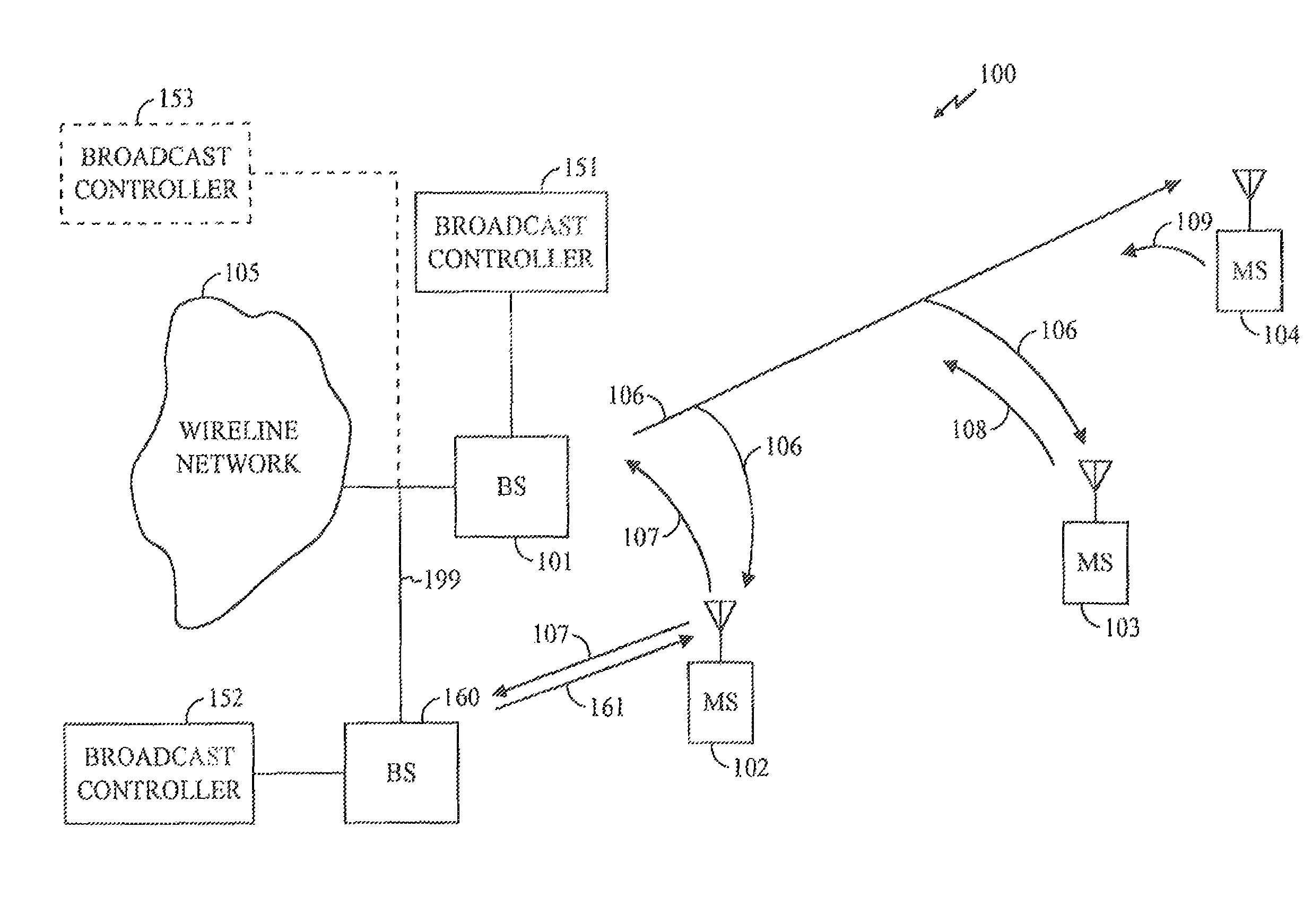
<figref idref="DRAWINGS">FIG. 1</figref> depicts a communication system capable of providing broadcast services in accordance with various aspects of the invention;
<figref idref="DRAWINGS">FIG. 2</figref> depicts a flow chart of various steps that may be used for obtaining and updating broadcast parameters of a mobile station for broadcast services in accordance with various aspects of the invention;
<figref idref="DRAWINGS">FIG. 3</figref> depicts a transmitter capable of operating in accordance with various aspects of the invention for broadcast services;
<figref idref="DRAWINGS">FIG. 4</figref> depicts a receiver capable of operating in accordance with various aspects of the invention for broadcast services;
<figref idref="DRAWINGS">FIG. 5</figref> depicts a transceiver system capable of operating in accordance with various aspects of the invention for broadcast services; and
<figref idref="DRAWINGS">FIG. 6</figref> depicts at least one configuration of a communication system subnets and broadcast controllers for broadcast services.
DETAILED DESCRIPTION OF THE PREFERRED EMBODIMENTS
Generally stated, a novel and improved system, method and apparatus provide for efficient use of communication resources for broadcast services in a communication system. A set of broadcast parameters is associated with one or more broadcast controllers in accordance with various aspects of the invention. While using a first broadcast controller through a first base station, obtaining a second broadcast controller identification from a second base station triggers a process for determining whether the first and second broadcast controller identifications are associated with a common set of broadcast parameters. Requesting transmission of a new set of broadcast parameters is triggered when the first and second broadcast controller identifications are not associated with a common set of broadcast parameters in accordance with various aspects of the invention. One or more exemplary embodiments described herein are set forth in the context of a digital wireless data communication system. While use within this context is advantageous, different embodiments of the invention may be incorporated in different environments or configurations. In general, the various systems described herein may be formed using software-controlled processors, integrated circuits, or discrete logic. The data, instructions, commands, information, signals, symbols, and chips that may be referenced throughout the application are advantageously represented by voltages, currents, electromagnetic waves, magnetic fields or particles, optical fields or particles, or a combination thereof. In addition, the blocks shown in each block diagram may represent hardware or method steps.
More specifically, various embodiments of the invention may be incorporated in a wireless communication system operating in accordance with the code division multiple access (CDMA) technique which has been disclosed and described in various standards published by the Telecommunication Industry Association (TIA) and other standards organizations. Such standards include the TIA/EIA-95 standard, TIA/EIA-IS-2000 standard, IMT-2000 standard, UMTS and WCDMA standard, all incorporated by reference herein. A system for communication of data is also detailed in the “TIA/EIA/IS-856 cdma2000 High Rate Packet Data Air Interface Specification,” incorporated by reference herein. A copy of the standards may be obtained by accessing the world wide web at the address: http://www.3gpp2.org, or by writing to TIA, Standards and Technology Department, 2500 Wilson Boulevard, Arlington, Va. 22201, United States of America. The standard generally identified as UMTS standard, incorporated by reference herein, may be obtained by contacting 3GPP Support Office, 650 Route des Lucioles-Sophia Antipolis, Valbonne-France.
<figref idref="DRAWINGS">FIG. 1</figref> illustrates a general block diagram of a communication system <b>100</b> capable of operating in accordance with any of the code division multiple access (CDMA) communication system standards while incorporating various embodiments of the invention. Communication system <b>100</b> may be for communications of voice, data or both. Generally, communication system <b>100</b> includes a base station <b>101</b> that provides communication links between a number of mobile stations, such as mobile stations <b>102</b>-<b>104</b>, and between the mobile stations <b>102</b>-<b>104</b> and a public switch telephone and data network <b>105</b>. The mobile stations in <figref idref="DRAWINGS">FIG. 1</figref> may be referred to as data access terminals (AT) and the base station as a data access network (AN) without departing from the main scope and various advantages of the invention. Base station <b>101</b> may include a number of components, such as a base station controller and a base transceiver system. For simplicity, such components are not shown. Base station <b>101</b> may be in communication with other base stations, for example base station <b>160</b>. A mobile switching center (not shown) may control various operating aspects of the communication system <b>100</b> and in relation to a back-haul <b>199</b> between network <b>105</b> and base stations <b>101</b> and <b>160</b>.
Base station <b>101</b> communicates with each mobile station that is in its coverage area via a forward link signal transmitted from base station <b>101</b>. The forward link signals targeted for mobile stations <b>102</b>-<b>104</b> may be summed to form a forward link signal <b>106</b>. The forward link may carry a number of different forward link channels. Each of the mobile stations <b>102</b>-<b>104</b> receiving forward link signal <b>106</b> decodes the forward link signal <b>106</b> to extract the information that is targeted for its user. Base station <b>160</b> may also communicate with the mobile stations that are in its coverage area via a forward link signal transmitted from base station <b>160</b>. Mobile stations <b>102</b>-<b>104</b> communicate with base stations <b>101</b> and <b>160</b> via corresponding reverse links. Each reverse link is maintained by a reverse link signal, such as reverse link signals <b>107</b>-<b>109</b> for respectively mobile stations <b>102</b>-<b>104</b>. The reverse link signals <b>107</b>-<b>109</b>, although may be targeted for one base station, may be received at other base stations.
Base stations <b>101</b> and <b>160</b> may be simultaneously communicating to a common mobile station. For example, mobile station <b>102</b> may be in close proximity of base stations <b>101</b> and <b>160</b>, which can maintain communications with both base stations <b>101</b> and <b>160</b>. On the forward link, base station <b>101</b> transmits on forward link signal <b>106</b>, and base station <b>160</b> on the forward link signal <b>161</b>. On the reverse link, mobile station <b>102</b> transmits on reverse link signal <b>107</b> to be received by both base stations <b>101</b> and <b>160</b>. For transmitting a packet of data to mobile station <b>102</b>, one of the base stations <b>101</b> and <b>160</b> may be selected to transmit the packet of data to mobile station <b>102</b>. On the reverse link, both base stations <b>101</b> and <b>160</b> may attempt to decode the traffic data transmission from the mobile station <b>102</b>. The data rate and power level of the reverse and forward links may be maintained in accordance with the channel condition between the base station and the mobile station.
The communication system <b>100</b> may also provide broadcast services to the mobile stations. Broadcast services may include receiving video or audio broadcast through base stations <b>101</b> and <b>160</b>. In another example, the weather or traffic information may be broadcasted for the mobile stations. In a broadcast system, the same signal may be sent simultaneously to a large number of mobile stations. The broadcast signal may be encrypted. Therefore, the mobile stations may need to sign up for such services. The mobile station may need to obtain encryption information from the base station, before receiving the services. In addition, the mobile station may need to receive other broadcast parameters in order to receive the broadcast services. The broadcast parameters may include the broadcast channel identifier, broadcast modulation format information, data rate information, encryption key information, coding information, broadcast channel frequency information, encryption and decryption keys information, header compression information, and other similar type information. The broadcast services may be controlled by a broadcast controller. The broadcast controller provides the broadcast programming, transmission and control of the broadcast services. The broadcast controller also provides the aforementioned broadcast parameters to the authorized mobile stations. The broadcast controller may verify that the mobile station has signed up for the requested broadcast service before providing the broadcast parameters.
The communication system <b>100</b> may have one or more broadcast controllers. For example, in one embodiment, the base stations <b>101</b> and <b>160</b> may use a common broadcast controller <b>153</b>. A common set of broadcast parameters is provided to base stations <b>101</b> and <b>160</b>, and to the mobile stations within the coverage area of base stations <b>101</b> and <b>160</b>. In accordance with various aspects of the invention, the base stations <b>101</b> and <b>160</b> transmit a broadcast controller identification. When a mobile station roams into the coverage area of a base station, the mobile station receives the broadcast controller identification. The broadcast controller identification may be transmitted by the base station periodically or transmitted based on a request by a mobile station. In another embodiment, the broadcast controller identification may be included with other information that a mobile station normally acquires from a base station when it roams into the coverage area of the new base station. Various interoperability standards, incorporated herein, provide one or more methods for exchange of information when a mobile station roams into a new coverage area.
In another embodiment, in communication system <b>100</b>, the base station <b>101</b> may use broadcast controller <b>151</b>, and the base station <b>160</b> may use a different broadcast controller <b>152</b>. The broadcast parameters used by the broadcast controllers <b>151</b> and <b>152</b> may be different. The broadcast controller identifications received from base stations <b>101</b> and <b>160</b>, therefore, are not associated with a common set of broadcast parameters. As such, when a mobile station roams into the coverage area of base station <b>160</b> from coverage area of base station <b>101</b>, the mobile station needs to receive a new set of broadcast parameters associated with the broadcast controller <b>1152</b>.
Referring to <figref idref="DRAWINGS">FIG. 2</figref>, a flow chart <b>270</b> outlines several steps that may be performed by a mobile station roaming from coverage area of a first base station to coverage area of a second base station to efficiently receive and change the broadcast parameters in order to receive broadcast services in communication system <b>100</b>, in accordance with various aspects of the invention. At step <b>271</b>, the mobile station, for example mobile station <b>102</b> roaming from coverage areas of base station <b>101</b> to base station <b>160</b>, has received a first broadcast controller identification from a first base station, for example base station <b>101</b>. At step <b>272</b>, the mobile station receives a second broadcast controller identification from a second base station, for example base station <b>160</b>. The first broadcast controller identification may be associated with the broadcast controller <b>151</b>, and the second broadcast controller identification may be associated with the broadcast controller <b>152</b>. At step <b>273</b>, the mobile station may determine whether the first and the second broadcast controller identifications are associated with a common broadcast parameters. In one embodiment, the broadcast controllers <b>151</b> and <b>152</b> may be using the same parameters. In another embodiment, the first and second broadcast controller identifications may be associated to a common broadcast controller <b>153</b> that may be used for both the base stations <b>101</b> and <b>160</b>. As such, at step <b>274</b>, the mobile station continues to use the same broadcast parameters for receiving the broadcast services. At step <b>275</b>, if the first and the second broadcast controller identifications are not associated with a common broadcast parameters, the mobile station requests transmission of a new set of broadcast parameters from the second broadcast controller, for example broadcast controller <b>152</b>. The transmission of the parameters may take place by the second base station, for example base station <b>160</b>. At step <b>276</b>, the mobile station receives the new set of broadcast parameters and continues to receive broadcast services using the new set of broadcast parameters.
<figref idref="DRAWINGS">FIG. 3</figref> illustrates a block diagram of a transmitter <b>300</b> for transmitting the reverse and forward link signals. The transmitter <b>300</b> may be used for transmission of fundamental channels, control channels, supplemental channels, and broadcast channels. The broadcast channel data for transmission are input to a modulator <b>301</b> for modulation. The modulation may be according to any of the commonly known modulation techniques such as QAM, PSK or BPSK. Before modulation, the broadcast channel data for transmission may pass through one or more layers of coding. The modulation data rate may be selected by a data rate and power level selector <b>303</b>. The data rate selection may be based on feedback information received from a destination or may be fixed for the broadcast channel. In case of a feedback, the data rate very often is based on the channel condition, among other considered factors. The data rate and power level selector <b>303</b> accordingly selects the data rate in modulator <b>301</b>. The output of modulator <b>301</b> passes through a signal spreading operation and amplified in a block <b>302</b> for transmission from an antenna <b>304</b>. The data rate and power level selector <b>303</b> also selects a power level for the amplification level of the transmitted signal. The combination of the selected data rate and the power level allows proper decoding of the transmitted data at the receiving destination. A pilot signal is also generated in a block <b>307</b>. The pilot signal is amplified to an appropriate level in block <b>307</b>. The pilot signal power level may be in accordance with the channel condition at the receiving destination. The pilot signal may be combined with the channel signal in a combiner <b>308</b>. The combined signal may be amplified in an amplifier <b>309</b> and transmitted from antenna <b>304</b>. The antenna <b>304</b> may be in any number of combinations including antenna arrays and multiple input multiple output configurations. The selected modulation, data rate and the coding technique for transmission of broadcast channel data may be in accordance with the broadcast parameters set forth by the broadcast controller. For example, if the base station <b>101</b>, incorporating transmitter <b>300</b>, is transmitting the broadcast channel and the broadcast controller <b>151</b> is controlling the broadcast information, the broadcast parameters of the broadcast controller <b>151</b> are used in transmitter <b>300</b> for transmission of broadcast channel. Therefore, the selected modulation, data rate and the coding technique may be three of the broadcast parameters that need to be communicated to the mobile station in the set of broadcast parameters.
<figref idref="DRAWINGS">FIG. 4</figref> illustrates a block diagram of a receiver <b>200</b> used for processing and demodulating the received CDMA signal while operating in accordance with various aspects of the invention. Receiver <b>200</b> may be used for decoding the information on the reverse and forward links signals. Receiver <b>200</b> may be used for decoding information on the fundamental channel, control channel, supplemental channels, and the broadcast channels. Received (Rx) samples may be stored in RAM <b>204</b>. Receive samples are generated by a radio frequency/intermediate frequency (RF/IF) system <b>290</b> and an antenna system <b>292</b>. The RF/IF system <b>290</b> and antenna system <b>292</b> may include one or more components for receiving multiple signals and RF/IF processing of the received signals for taking advantage of the receive diversity gain. Multiple received signals propagated through different propagation paths may be from a common source. Antenna system <b>292</b> receives the RF signals, and passes the RF signals to RF/IF system <b>290</b>. RF/IF system <b>290</b> may be any conventional RF/IF receiver. The received RF signals are filtered, down-converted and digitized to form RX samples at base band frequencies. The samples are supplied to a multiplexer (mux) <b>252</b>. The output of mux <b>252</b> is supplied to a searcher unit <b>206</b> and finger elements <b>208</b>. A control system <b>210</b> is coupled thereto. A combiner <b>212</b> couples a decoder <b>214</b> to finger elements <b>208</b>. Control system <b>210</b> may be a microprocessor controlled by software, and may be located on the same integrated circuit or on a separate integrated circuit. The decoding function in decoder <b>214</b> may be in accordance with a turbo decoder or any other suitable decoding algorithms. The signal transmitted from a source may be encoded with several layers of codes. As such, the decoder <b>214</b> decodes the received samples in accordance with such codes. The decoder <b>214</b> may perform decoding function in accordance with the coding information received in the broadcast parameters.
During operation, received samples are supplied to mux <b>252</b>. Mux <b>252</b> supplies the samples to searcher unit <b>206</b> and finger elements <b>208</b>. Control unit <b>210</b> configures finger elements <b>208</b> to perform demodulation and despreading of the received signal at different time offsets based on search results from searcher unit <b>206</b>. The results of the demodulation are combined and passed to decoder <b>214</b>. The demodulation function may be performed in accordance with the modulation information received in the broadcast parameters. Decoder <b>214</b> decodes the data and outputs the decoded data. Despreading of the channels is performed by multiplying the received samples with the complex conjugate of the PN sequence and assigned Walsh function at a single timing hypothesis and digitally filtering the resulting samples, often with an integrate and dump accumulator circuit (not shown). Such a technique is commonly known in the art. Receiver <b>200</b> may be used in a receiver portion of base stations <b>101</b> and <b>160</b> for processing the received reverse link signals from the mobile stations, and in a receiver portion of any of the mobile stations for processing the received forward link signals.
<figref idref="DRAWINGS">FIG. 5</figref> depicts a general diagram of a transceiver system <b>500</b> for incorporating receiver <b>200</b> and transmitter <b>300</b> for maintaining a communication link with a destination, including receiving broadcast channels. The transceiver <b>500</b> may be incorporated in a mobile station or a base station. A processor <b>401</b> may be coupled to receiver <b>200</b> and transmitter <b>300</b> to process the received and transmitted data. Various aspects of the receiver <b>200</b> and transmitter <b>300</b> may be common, even though receiver <b>200</b> and transmitter <b>300</b> are shown separately. In one aspect, receiver <b>200</b> and transmitter <b>300</b> may share a common local oscillator and a common antenna system for RF/IF receiving and transmitting. Transmitter <b>300</b> receives the data for transmission on input <b>405</b>. Transmit data processing block <b>403</b> prepares the data for transmission on a transmit channel. If the transmit channel is a broadcast channel, the processing of data is in accordance with the broadcast parameters used by the transceiver <b>500</b>. Received data, after being decoded in decoder <b>214</b>, are received at processor <b>401</b> at an input <b>404</b>. Received data are processed in received data processing block <b>402</b> in processor <b>401</b>. If the received channel is a broadcast channel, the processing of the received broadcast data is in accordance with the broadcast parameters used by the transmitter for transmitting the broadcast channel. Various operations of processor <b>401</b> may be integrated in a single or multiple processing units. The transceiver <b>500</b> may be connected to another device. The transceiver <b>500</b> may be an integral part of the device. The device may be a computer or operates similar to a computer. The device may be connected to a data network, such as Internet. In case of incorporating the transceiver <b>500</b> in a base station, the base station through several connections may be connected to a network, such as Internet.
The processing of the received data generally includes checking for error in the received packets of data. For example, if a received packet of data has error at an unacceptable level, the received data processing block <b>402</b> sends an instruction to transmit data processing block <b>403</b> for making a request for retransmission of the packet of data. The request is transmitted on a transmit channel. However, for the broadcast channel, the receiver operation may not include a request for retransmission. The broadcast service may include sending video from the base station and playing the same video at the mobile station. The broadcast channel data may be transmitted in a block of data at a time. As such, the receive data storage block <b>480</b> may accumulate data received in each frame of data to reconstruct the block of data for the playing the video of the broadcast services at the mobile station.
A broadcast controller, such as any of the broadcast controllers <b>151</b>, <b>152</b> and <b>153</b>, may control broadcast services of a large number of base stations in a communication system. A set of base stations may form a subnet of base stations. The base station may transmit a subnet identifier to the mobile stations. The subnet identifier identifies the subnet. All base stations in a subnet may be served by the same broadcast controller. The subnet identification sent from each base station in a subnet may indicate that they belong to a common subnet in accordance with various aspects of the invention. As such, when the mobile station is roaming among the base stations of a subnet, the mobile station uses the same broadcast parameters for broadcast services. In accordance with various aspects of the invention, the mobile station determines, while referring to <figref idref="DRAWINGS">FIG. 2</figref>, at step <b>273</b>, whether the first and second base stations belong to a common subnet having a common broadcast controller, and hence a common broadcast controller identification and common broadcast parameters. As such, when the first and second base stations belong to a common subnet, the mobile station uses the same broadcast parameters for broadcast services. When the first and second base stations belong to different subnets, at steps <b>275</b> and <b>296</b>, the mobile station may request and receive a new set of broadcast parameters.
Moreover, several subnets may be controlled by a common broadcast controller, in another exemplary embodiment. Referring to <figref idref="DRAWINGS">FIG. 6</figref>, an exemplary communication system subnets configuration <b>600</b> is shown. The broadcast controller <b>610</b> may control the broadcast services of all the base stations in the subnet <b>601</b> and subnet <b>602</b>. The broadcast controller <b>620</b> may control the broadcast services of all the base stations in the subnet <b>603</b>. As such, when the mobile station determines that the base station belongs to different subnets, the mobile station and/or base station determines whether the mobile station needs a new set of broadcast parameters. The communication for determining whether a new set of broadcast parameters are necessary may be via communications of several messages. For example, the base station may determine whether the subnet of the previous base station and the subnet of the current base station are served by the same broadcast controller. The base station may perform this function by maintaining a list of other subnets served by the broadcast controller that serves this base station. In another embodiment, either the base station or the broadcast controller sends to the mobile station a list of subnets controlled by a common broadcast controller. The list may also be the identifiers for identifying the base station members of each subnet. This list of subnets may be sent to the mobile station along with the broadcast parameters. When the mobile station enters the coverage area of a base station belonging to a different subnet, the mobile stations checks whether the new subnet is included in the list of subnets controlled by the current broadcast controller. If so, the mobile station continues to use the current broadcast parameters. Otherwise, the mobile station requests from the new broadcast controller for a new set of broadcast parameters. Since the list of subnets may be very large, the broadcast controller may provide the mobile station only a partial list of subnets controlled by the broadcast controller. This list may be updated as the mobile station moves to the edge of the subnets included in the current list. In another embodiment, the information may be encoded by indicating a series of consecutive subnet identification numbers. The message, therefore, may include the first and last subnet identification (or base station identification numbers) of the series of consecutive subnets (or base stations) identification numbers. In another embodiment, the base stations bordering the coverage areas may transmit a message indicating a need for requesting a new set of broadcast parameters because the mobile station may be entering the coverage area of a base station in a subnet controlled by a different broadcast controller. In such a case, when the mobile station roams from a base station of a first subnet controlled by a first broadcast controller to another base station of a second subnet controlled by a second broadcast controller, the mobile station sends a request to the second base station for transmission of the broadcast parameters associated with the second broadcast controller.
The broadcast channel may transmit encrypted data to prevent unauthorized users from using the broadcast services. A user identity module (UIM) <b>499</b> shown in <figref idref="DRAWINGS">FIG. 5</figref> may contain user specific information including an encryption key. Two patent applications filed with assigned Ser. Nos. 09/933,972 and 10/233,188, with the title: Method and Apparatus for Security in a Data Processing System, assigned to the assignee of the present application, details various embodiments for encrypted communications, incorporated by reference herein. The UIM <b>499</b> is associated with a particular user and is used primarily to verify that a mobile station incorporating transceiver <b>500</b> is entitled to the privileges afforded to the user, such as access to the mobile phone network. Therefore, a user is associated with the UIM <b>499</b> rather than a mobile station. The same user may be associated with multiple UIM <b>499</b>.
The broadcast service faces a problem in determining how to distribute keys to subscribed users. To decrypt the broadcast content at a particular time, the mobile station must know the current decryption key that is valid in the current subnet. To avoid theft-of-service, the decryption key should be changed frequently, for example, every minute. These decryption keys are called Short-term Keys (SK). The SK is used to decrypt the broadcast content for a short-amount of time. The SK is derived from a Broadcast Access Key that may be stored in the UIM. The list of subnets controlled by a broadcast controller may be stored in the UIM along with the Broadcast Access Key. The mobile station may need to obtain the Broadcast Access Key from the broadcast controller in the set of broadcast parameters. The UIM receives an identifier for the current subnet along with a request to compute the SK. The UIM may check if the Broadcast Access Key is valid in the current subnet. If the Broadcast Access Key is not valid in the current subnet, the UIM may send an indication to initiate a process to obtain a new key from the new broadcast controller to continue the reception of broadcast services.
Those of skill in the art would further appreciate that the various illustrative logical blocks, modules, circuits, and algorithm steps described in connection with the embodiments disclosed herein may be implemented as electronic hardware, computer software, or combinations of both. To clearly illustrate this interchangeability of hardware and software, various illustrative components, blocks, modules, circuits, and steps have been described above generally in terms of their functionality. Whether such functionality is implemented as hardware or software depends upon the particular application and design constraints imposed on the overall system. Skilled artisans may implement the described functionality in varying ways for each particular application, but such implementation decisions should not be interpreted as causing a departure from the scope of the present invention.
The various illustrative logical blocks, modules, and circuits described in connection with the embodiments disclosed herein may be implemented or performed with a general purpose processor, a digital signal processor (DSP), an application specific integrated circuit (ASIC), a field programmable gate array (FPGA) or other programmable logic device, discrete gate or transistor logic, discrete hardware components, or any combination thereof designed to perform the functions described herein. A general-purpose processor may be a microprocessor, but in the alternative, the processor may be any conventional processor, controller, microcontroller, or state machine. A processor may also be implemented as a combination of computing devices, e.g., a combination of a DSP and a microprocessor, a plurality of microprocessors, one or more microprocessors in conjunction with a DSP core, or any other such configuration.
The steps of a method or algorithm described in connection with the embodiments disclosed herein may be embodied directly in hardware, in a software module executed by a processor, or in a combination. A software module may reside in RAM memory, flash memory, ROM memory, EPROM memory, EEPROM memory, registers, hard disk, a removable disk, a CD-ROM, or any other form of storage medium known in the art. An exemplary storage medium is coupled to the processor such that the processor can read information from, and write information to, the storage medium. In the alternative, the storage medium may be integral to the processor. The processor and the storage medium may reside in an ASIC. The ASIC may reside in a user terminal. In the alternative, the processor and the storage medium may reside as discrete components in a user terminal.
The previous description of the preferred embodiments is provided to enable any person skilled in the art to make or use the present invention. The various modifications to these embodiments will be readily apparent to those skilled in the art, and the generic principles defined herein may be applied to other embodiments without the use of the inventive faculty. Thus, the present invention is not intended to be limited to the embodiments shown herein but is to be accorded the widest scope consistent with the principles and novel features disclosed herein.
Contents5
8 sheets
Sheet 1 Sheet 2 Sheet 3 Sheet 4 Sheet 5 Sheet 6 Sheet 7 Sheet 8
Every citation, both waysCites: the store holds 631 of 632
| Document | Relation | Office | Cited during |
|---|---|---|---|
| US2015195827A1 | Cited by | United States of America | Pre-grant |
| US9736847B2 | Cited by | United States of America | Search report |
| US4163255A | Cites | United States of America | Applicant |
| US4323921A | Cites | United States of America | Applicant |
| US4336612A | Cites | United States of America | Applicant |
| US4750167A | Cites | United States of America | Applicant |
| US4870408A | Cites | United States of America | Applicant |
| US4881263A | Cites | United States of America | Applicant |
| US4901307A | Cites | United States of America | Applicant |
| US4924513A | Cites | United States of America | Applicant |
| US5052000A | Cites | United States of America | Applicant |
| US5056109A | Cites | United States of America | Applicant |
| US5101501A | Cites | United States of America | Applicant |
| US5103459A | Cites | United States of America | Applicant |
| US5117457A | Cites | United States of America | Applicant |
| US5136586A | Cites | United States of America | Applicant |
| US5150412A | Cites | United States of America | Applicant |
| US5159447A | Cites | United States of America | Applicant |
| US5164988A | Cites | United States of America | Applicant |
| US5235631A | Cites | United States of America | Applicant |
| US5237612A | Cites | United States of America | Applicant |
| US5239584A | Cites | United States of America | Applicant |
| US5241598A | Cites | United States of America | Applicant |
| US5253294A | Cites | United States of America | Applicant |
| US5257396A | Cites | United States of America | Applicant |
| US5325357A | Cites | United States of America | Applicant |
| US5351087A | Cites | United States of America | Applicant |
| US5353332A | Cites | United States of America | Applicant |
| US5363379A | Cites | United States of America | Applicant |
| US5365572A | Cites | United States of America | Applicant |
| US5369784A | Cites | United States of America | Applicant |
| US5371794A | Cites | United States of America | Applicant |
| US5404563A | Cites | United States of America | Applicant |
| US5410602A | Cites | United States of America | Applicant |
| US5412655A | Cites | United States of America | Applicant |
| US5421006A | Cites | United States of America | Applicant |
| US5442626A | Cites | United States of America | Applicant |
| US5448568A | Cites | United States of America | Applicant |
| US5467398A | Cites | United States of America | Applicant |
| US5473609A | Cites | United States of America | Applicant |
| US5473642A | Cites | United States of America | Applicant |
| US5481613A | Cites | United States of America | Applicant |
| US5485577A | Cites | United States of America | Applicant |
| US5504773A | Cites | United States of America | Applicant |
| US5513245A | Cites | United States of America | Applicant |
| US5515441A | Cites | United States of America | Applicant |
| US5537474A | Cites | United States of America | Applicant |
| US5565909A | Cites | United States of America | Applicant |
| US5579393A | Cites | United States of America | Applicant |
| US5592470A | Cites | United States of America | Applicant |
| US5659556A | Cites | United States of America | Applicant |
| US5673259A | Cites | United States of America | Applicant |
| US5686963A | Cites | United States of America | Applicant |
| US5708961A | Cites | United States of America | Applicant |
| US5729540A | Cites | United States of America | Applicant |
| US5740246A | Cites | United States of America | Applicant |
| US5748736A | Cites | United States of America | Applicant |
| US5751707A | Cites | United States of America | Applicant |
| US5751725A | Cites | United States of America | Applicant |
| US5758068A | Cites | United States of America | Applicant |
| US5758291A | Cites | United States of America | Applicant |
| US5768276A | Cites | United States of America | Applicant |
| US5774496A | Cites | United States of America | Applicant |
| US5778059A | Cites | United States of America | Applicant |
| US5778069A | Cites | United States of America | Applicant |
| US5778187A | Cites | United States of America | Applicant |
| US5787172A | Cites | United States of America | Applicant |
| US5787347A | Cites | United States of America | Applicant |
| US5796829A | Cites | United States of America | Applicant |
| US5835730A | Cites | United States of America | Applicant |
| US5850444A | Cites | United States of America | Applicant |
| US5850445A | Cites | United States of America | Applicant |
| US5870474A | Cites | United States of America | Applicant |
| US5878141A | Cites | United States of America | Applicant |
| US5881368A | Cites | United States of America | Applicant |
| US5884196A | Cites | United States of America | Applicant |
| US5887252A | Cites | United States of America | Applicant |
| US5909491A | Cites | United States of America | Applicant |
| US5915024A | Cites | United States of America | Applicant |
| US5923649A | Cites | United States of America | Applicant |
| US5936965A | Cites | United States of America | Applicant |
| US5940507A | Cites | United States of America | Applicant |
| US5946316A | Cites | United States of America | Applicant |
| US5956404A | Cites | United States of America | Applicant |
| US5956681A | Cites | United States of America | Applicant |
| US5970072A | Cites | United States of America | Applicant |
| US5970417A | Cites | United States of America | Applicant |
| US5978386A | Cites | United States of America | Applicant |
| US5983099A | Cites | United States of America | Applicant |
| US5983388A | Cites | United States of America | Applicant |
| US5990928A | Cites | United States of America | Applicant |
| US5991400A | Cites | United States of America | Applicant |
| US5991407A | Cites | United States of America | Applicant |
| US6006073A | Cites | United States of America | Applicant |
| US6014765A | Cites | United States of America | Applicant |
| US6018360A | Cites | United States of America | Applicant |
| US6021124A | Cites | United States of America | Applicant |
| US6026165A | Cites | United States of America | Applicant |
| US6032197A | Cites | United States of America | Applicant |
| US6044154A | Cites | United States of America | Applicant |
28 members in 14 offices
Priority claims6
| Document | Office | Kind | Date |
|---|---|---|---|
| 33562603 | United States of America | A | |
| 33562603 | United States of America | A | |
| 55012909 | United States of America | A | |
| 10335626 | – | – | – |
| US20030335626 | – | – | – |
| US20090550129 | – | – | – |
Members28
| Document | Office | Kind | |
|---|---|---|---|
| US2004132402A1 | United States of America | A1 | |
| CA2511508A1 | Canada | A1 | |
| WO2004062304A2 | World Intellectual Property Organization (WIPO) | A2 | |
| AU2003299940A1 | Australia | A1 | |
| TW200421755A | Taiwan Province of China | A | |
| WO2004062304A3 | World Intellectual Property Organization (WIPO) | A3 | |
| EP1584205A2 | European Patent Office (EPO) | A2 | |
| MXPA05007264A | Mexico | A | |
| MXPA05007264A | Mexico | A | |
| BR0317921A | Brazil | A | |
| BR0317921A | Brazil | A | |
| JP2006521709A | Japan | A | |
| CN1902958A | China | A | |
| RU2005124509A | Russian Federation | A | |
| HK1097155A1 | Hong Kong, China | A1 | |
| IL169470A0 | Israel | A0 | |
| RU2355119C2 | Russian Federation | C2 | |
| AU2003299940B2 | Australia | B2 | |
| US7599655B2 | United States of America | B2 | |
| CN100574471C | China | C | |
| UA89161C2 | Ukraine | C2 | |
| US2010048206A1 | United States of America | A1 | |
| CN101692719A | China | A | |
| JP4494219B2 | Japan | B2 | |
| JP2010148136A | Japan | A | |
| JP5080595B2 | Japan | B2 | |
| CN101692719B | China | B | |
| US8971790B2This record | United States of America | B2 |
112 transactions on the USPTO file
Allowed after 1 non-final rejection, 1 final rejection and 2 RCEs.
- Non-final rejections
- 1
- Final rejections
- 1
- RCEs
- 2
- Appeals
- 0
Over time
Point at a mark for the transactionTransactions
| Event | Code | |
|---|---|---|
| Payment of Maintenance Fee, 8th Year, Large EntityM1552 | M1552 | |
| Payment of Maintenance Fee, 4th Year, Large EntityM1551 | M1551 | |
| Recordation of Patent Grant MailedPGM/ | PGM/ | |
| Patent Issue Date Used in PTA CalculationAllowedPTAC | PTAC | |
| Email NotificationEML_NTR | EML_NTR | |
| Issue Notification MailedAllowedWPIR | WPIR | |
| Dispatch to FDCD1935 | D1935 | |
| Application Is Considered Ready for IssuePILS | PILS | |
| Issue Fee Payment VerifiedN084 | N084 | |
| Issue Fee Payment ReceivedIFEE | IFEE | |
| Electronic ReviewELC_RVW | ELC_RVW | |
| Email NotificationEML_NTF | EML_NTF | |
| Mail Notice of AllowanceAllowedMN/=. | MN/=. | |
| Notice of Allowance Data Verification CompletedAllowedN/=. | N/=. | |
| Reasons for AllowanceEX.R | EX.R | |
| Information Disclosure Statement consideredIDSC | IDSC | |
| Information Disclosure Statement consideredIDSC | IDSC | |
| Information Disclosure Statement consideredIDSC | IDSC | |
| Information Disclosure Statement consideredIDSC | IDSC | |
| Information Disclosure Statement consideredIDSC | IDSC | |
| Information Disclosure Statement consideredIDSC | IDSC | |
| Reference capture on IDSRCAP | RCAP | |
| Information Disclosure Statement (IDS) FiledM844 | M844 | |
| Information Disclosure Statement (IDS) FiledWIDS | WIDS | |
| Electronic Information Disclosure StatementEIDS. | EIDS. | |
| Information Disclosure Statement (IDS) FiledWIDS | WIDS | |
| Reference capture on IDSRCAP | RCAP | |
| Information Disclosure Statement (IDS) FiledM844 | M844 | |
| Information Disclosure Statement (IDS) FiledWIDS | WIDS | |
| Information Disclosure Statement (IDS) FiledM844 | M844 | |
| Reference capture on IDSRCAP | RCAP | |
| Information Disclosure Statement (IDS) FiledWIDS | WIDS | |
| Reference capture on IDSRCAP | RCAP | |
| Information Disclosure Statement (IDS) FiledM844 | M844 | |
| Information Disclosure Statement (IDS) FiledWIDS | WIDS | |
| Disposal for a RCE / CPA / R129AbandonedABN9 | ABN9 | |
| Reference capture on IDSRCAP | RCAP | |
| Request for Continued Examination (RCE)RCEX | RCEX | |
| Information Disclosure Statement (IDS) FiledM844 | M844 | |
| Information Disclosure Statement (IDS) FiledWIDS | WIDS | |
| Workflow - Request for RCE - BeginBRCE | BRCE | |
| Electronic ReviewELC_RVW | ELC_RVW | |
| Email NotificationEML_NTF | EML_NTF | |
| Mail Notice of AllowanceAllowedMN/=. | MN/=. | |
| Notice of Allowance Data Verification CompletedAllowedN/=. | N/=. | |
| Reasons for AllowanceEX.R | EX.R | |
| Disposal for a RCE / CPA / R129AbandonedABN9 | ABN9 | |
| Information Disclosure Statement consideredIDSC | IDSC | |
| Reference capture on IDSRCAP | RCAP | |
| Information Disclosure Statement (IDS) FiledM844 | M844 | |
| Request for Continued Examination (RCE)RCEX | RCEX | |
| Information Disclosure Statement (IDS) FiledWIDS | WIDS | |
| Workflow - Request for RCE - BeginBRCE | BRCE | |
| Electronic ReviewELC_RVW | ELC_RVW | |
| Email NotificationEML_NTF | EML_NTF | |
| Mail Notice of AllowanceAllowedMN/=. | MN/=. | |
| Notice of Allowance Data Verification CompletedAllowedN/=. | N/=. | |
| Reasons for AllowanceEX.R | EX.R | |
| Examiner's Amendment CommunicationEX.A | EX.A | |
| Date Forwarded to ExaminerFWDX | FWDX | |
| Response after Final ActionA.NE | A.NE | |
| Electronic ReviewELC_RVW | ELC_RVW | |
| Email NotificationEML_NTF | EML_NTF | |
| Mail Final Rejection (PTOL - 326)Final rejectionMCTFR | MCTFR | |
| Final RejectionFinal rejectionCTFR | CTFR | |
| Date Forwarded to ExaminerFWDX | FWDX | |
| Terminal Disclaimer FiledDIST | DIST | |
| Paralegal or electronic terminal disclaimer approvedP574 | P574 | |
| Information Disclosure Statement consideredIDSC | IDSC | |
| Response after Non-Final ActionA... | A... | |
| Reference capture on IDSRCAP | RCAP | |
| Information Disclosure Statement (IDS) FiledM844 | M844 | |
| Terminal Disclaimer FiledDIST | DIST | |
| Information Disclosure Statement (IDS) FiledWIDS | WIDS | |
| Electronic ReviewELC_RVW | ELC_RVW | |
| Email NotificationEML_NTF | EML_NTF | |
| Mail Non-Final RejectionNon-final rejectionMCTNF | MCTNF | |
| Non-Final RejectionNon-final rejectionCTNF | CTNF | |
| Case Docketed to Examiner in GAUDOCK | DOCK | |
| Information Disclosure Statement consideredIDSC | IDSC | |
| Information Disclosure Statement consideredIDSC | IDSC | |
| Reference capture on IDSRCAP | RCAP | |
| Information Disclosure Statement (IDS) FiledM844 | M844 | |
| Information Disclosure Statement (IDS) FiledWIDS | WIDS | |
| Information Disclosure Statement (IDS) FiledWIDS | WIDS | |
| Information Disclosure Statement consideredIDSC | IDSC | |
| Reference capture on IDSRCAP | RCAP | |
| Electronic Information Disclosure StatementEIDS. | EIDS. | |
| Information Disclosure Statement (IDS) FiledWIDS | WIDS | |
| Email NotificationEML_NTR | EML_NTR | |
| PG-Pub Issue NotificationPG-ISSUE | PG-ISSUE | |
| Preliminary AmendmentA.PE | A.PE | |
| Electronic Information Disclosure StatementEIDS. | EIDS. | |
| Email NotificationEML_NTR | EML_NTR | |
| Email NotificationEML_NTR | EML_NTR | |
| Change in Power of Attorney (May Include Associate POA)PA.. | PA.. | |
| Filing Receipt - UpdatedFLRCPT.U | FLRCPT.U | |
| Application Dispatched from OIPEOIPE | OIPE | |
| Additional Application Filing FeesADDFLFEE | ADDFLFEE | |
| A statement by one or more inventors satisfying the requirement under 35 USC 115, Oath of the ApplicOATHDECL | OATHDECL |
5 legal events, as the office reported them to INPADOC
Over the term
Point at a mark for the eventEvents
| Event | Code | |
|---|---|---|
| Maintenance fee paymentMAFP | MAFP | |
| Maintenance fee paymentMAFP | MAFP | |
| Information on status: patent grantGrantedPATENTED CASESTCF | STCF | |
| AssignmentAS | AS | |
| AssignmentAS | AS |
Numbers
- Publication
- 08971790
- Publication, DOCDB
- 8971790
- Publication, EPODOC
- US8971790
- Application
- 12550129
- Application, DOCDB
- 55012909
- Application, EPODOC
- US20090550129
Titles
- English
- Method and apparatus for broadcast services in a communication system
Patent term adjustment
- A delay
- +894 daysthe office missed an examination deadline
- B delay
- +418 dayspendency past three years
- Overlap
- −32 daysdelays counted once
- Applicant delay
- −437 days
- Net adjustment
- 843 days
Classification
- CPC, 6
- H04W4/06
- H04H20/26
- H04W36/12
- H04W36/0007
- H04W72/005
- H04W72/30
- IPC, 6
- H04H20 71
- H04H20 26
- H04L12 56
- H04W4 06
- H04W36 12
- H04W72 00
- USPC, 6
- 455003010
- 348734000
- 370337000
- 370352000
- 455003020
- 455179100