Method and apparatus for ensuring critical resource allocation for group calls made in a push-to-talk communication environment
Summary by NHIP
PTT Critical Resource Allocation
A controlling system identifies required resources and requests their allocation from a secondary system via an expanded network-to-network interface. The controlling system authorizes the group call only after the secondary system successfully allocates those specific critical resources for use.
Claim Score by NHIP
Abstract
Critical resource data (192) required for a group call can be identified. Controlling (115) and secondary (155) PTT communications systems can communicate using an expanded network-to-network interface (NNI) (140). Allocation of identified critical resources (150) can be requested (145) for the group call from the secondary PTT communications system (155). In response to a successful allocation of the requested critical resources by the secondary PTT communications system, the group call can be authorized by the controlling PTT communications system (115). The allocated critical resources of the secondary PTT communications system (155) can be used to establish the group call.
Term
6.2 yearsleft in the term
Expires 6 December 2032, including 398 days of term adjustment.
- Priority and filed
- Granted
- Today
- Expires
21 claims: 3 independent, 18 dependent
- 1Broadest claimClaim Score 37, narrow(NHIP)A method for ensuring critical resource availability in a push-to-talk (PTT) communications environment comprising:identifying critical resources required for a group call that belong to a secondary PTT communications system by a controlling PTT communications system that is a home system for a subscriber group to which an originating PTT subscriber unit of the group call belongs, wherein the controlling and secondary PTT communications systems are members of a PTT communications environment, wherein the controlling and secondary PTT communications systems communicate using an expanded network-to-network interface (NNI), wherein said expanded NNI represents a NNI that has been modified to encompass messaging and procedural elements supporting management of critical resource availability;requesting allocation of the identified critical resources for the group call from the secondary PTT communications system using the expanded NNI;and in response to a successful allocation of the requested critical resources by the secondary PTT communications system, authorizing of the group call by the controlling PTT communications system, wherein the allocated critical resources of the secondary PTT communications system are used in establishing the group call.
- 9A system for ensuring critical resource availability in a push-to-talk (PTT) communications environment comprising:a plurality of PTT subscriber units are configured to participate in a group call;a plurality of expanded network-to-network interfaces (NNIs) each representing a NNI that has been modified to encompass messaging and procedural elements supporting management of critical resource availability, wherein the NNI defines basic messaging and interoperability procedures that support communications between distinct communications systems;a PTT communications environment comprised of a plurality of PTT communications systems interlinked using the plurality of expanded NNIs, said PTT communications environment further comprising: a controlling PTT communications system configured to establish the group call between a subset of the plurality of subscriber units, wherein said establishment of the group call requires use of resources of the PTT communications environment identified as critical to said establishment of the group call, wherein the controlling PTT communications system is a home system for a subscriber group to which a PTT subscriber unit originating the group call belongs;at least one secondary PTT communications system configured to allocate critical resources supporting the group call for PTT subscriber units of the subset that the at least one secondary PTT communications system is servicing.
- 17A computer program product comprising a non-transitory computer readable storage medium having computer usable program code embodied therewith, the computer usable program code comprising:computer usable program code configured to identify critical resources required for a group call that belong to a secondary PTT communications system, wherein said identified critical resources represent components of the secondary PTT communications system necessary for transmitting and receiving communications with a PTT subscriber unit of a participant of the group call that is being serviced by the secondary PTT communications system, wherein the secondary PTT communications system communicates with a controlling PTT communications system for the group call using an expanded network-to-network interface (NNI), wherein said expanded NNI represents a NNI that has been modified to encompass messaging and procedural elements supporting management of critical resource availability;computer usable program code configured to request allocation of the identified critical resources for the group call from the secondary PTT communications system;and computer usable program code configured to, in response to a successful allocation of the identified critical resources by the secondary PTT communications system, authorize the group call by the controlling PTT communications system, wherein the allocated critical resources of the secondary PTT communications system are used in the group call, and, wherein the successful allocation of the identified critical resources is determined based upon a call type of the group call.
Independent claims3
84 paragraphs in 4 sections, as filed
FIELD OF THE DISCLOSURE
p-0002The present disclosure relates generally to push-to-talk (PTT) communications systems, and more particularly to ensuring critical resource allocation for group calls made in a heterogeneous PTT communications environment.
BACKGROUND
p-0003Wireless communications, specifically push-to-talk (PTT) communications, have been and continue to be a critical tool used by public safety officers to coordinate and communicate. As wireless communications technology has advanced (e.g., digital radio systems, broadband communications, voice over Internet Protocol (VoIP), etc.), the overall public safety communications system environment has become diversified, prompting the development and adoption of standardized network-to-network interfaces (NNIs).
p-0004A NNI defines the basic messaging and procedures for establishing and handling communications between disparate or separate communications systems. This allows a public safety officer to continue communicating with other members of the team while roaming or to attach their PTT communications device, called a subscriber unit, to a foreign communications system when on assignment.
p-0005As it stands, current NNIs address the basic infrastructure necessary to establish a call between subscriber units—mobility management, call control, and transmission control. While this is sufficient for calls made by the general public, the communications of public safety officers are typically deemed to be of priority and, therefore, the availability of the resources critical to conduct their communications should be ensured. The ability to ensure the allocation of critical resources by a second communications system is lacking in current NNIs.
BRIEF DESCRIPTION OF THE FIGURES
p-0006The accompanying figures, where like reference numerals refer to identical or functionally similar elements throughout the separate views, together with the detailed description below, are incorporated in and form part of the specification, and serve to further illustrate embodiments of concepts that include the claimed invention, and explain various principles and advantages of those embodiments.
p-0007<figref idrefs="DRAWINGS">FIG. 1</figref> is a block diagram of a system for ensuring the allocation of the critical resources within a push-to-talk (PTT) communications environment for a group call in accordance with embodiments of the inventive arrangements disclosed herein.
p-0008<figref idrefs="DRAWINGS">FIG. 2</figref> is a flowchart of a method detailing actions performed by the controlling PTT communications system to ensure the allocation of critical resources of a secondary PTT communications system for a group call in accordance with embodiments of the inventive arrangements disclosed herein.
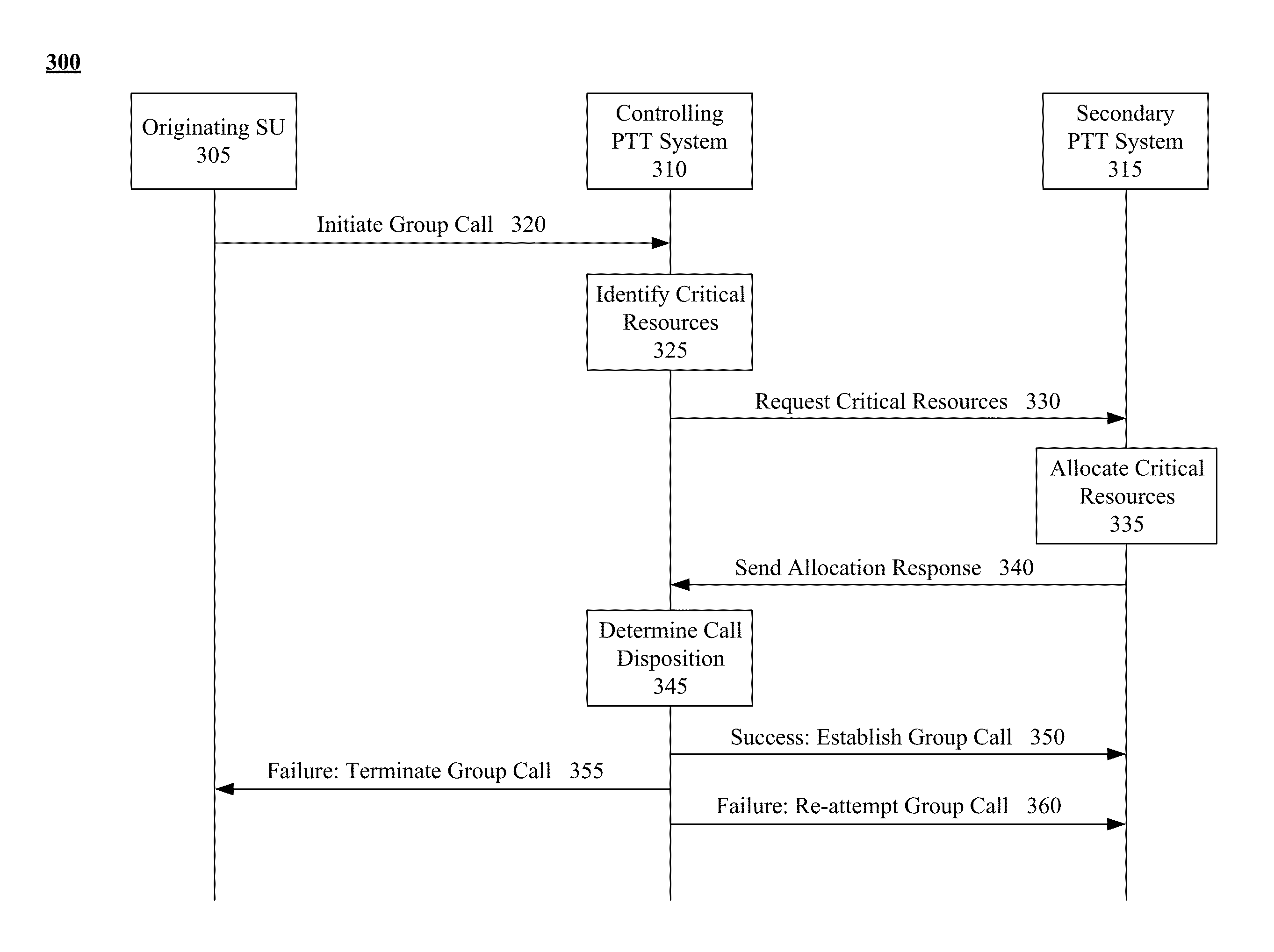
p-0009<figref idrefs="DRAWINGS">FIG. 3A</figref> depicts an interaction diagram that visually illustrates the actions performed to ensure critical resource allocation for a group call in accordance with embodiments of the inventive arrangements disclosed herein.
p-0010<figref idrefs="DRAWINGS">FIG. 3B</figref> depicts an interaction diagram that visually illustrates the actions performed to ensure critical resource allocation for a group call in accordance with embodiments where a secondary PPT initiates a group call.
p-0011<figref idrefs="DRAWINGS">FIG. 4</figref> is an example messaging diagram coordinating the allocation of critical resources for a subscriber unit participating in a group call using expanded ISSI Session Initiation Protocol (SIP) NNI messages in accordance with embodiments of the inventive arrangements disclosed herein.
p-0012Skilled artisans will appreciate that elements in the figures are illustrated for simplicity and clarity and have not necessarily been drawn to scale. For example, the dimensions of some of the elements in the figures may be exaggerated relative to other elements to help to improve understanding of embodiments of the present invention.
p-0013The apparatus and method components have been represented where appropriate by conventional symbols in the drawings, showing only those specific details that are pertinent to understanding the embodiments of the present invention so as not to obscure the disclosure with details that will be readily apparent to those of ordinary skill in the art having the benefit of the description herein.
DETAILED DESCRIPTION
p-0014Embodiments of the invention address ensuring critical resource availability in a push-to-talk (PTT) communications environment. An expanded network-to-network interface (NNI) is used to exchange critical resource data between PTT communications systems in order to coordinate the allocation of the critical resources required for a group call.
p-0015<figref idrefs="DRAWINGS">FIG. 1</figref> illustrates a schematic diagram of a system <b>100</b> for ensuring the allocation of the critical resources <b>180</b> within a push-to-talk (PTT) communications environment <b>110</b> for a group call in accordance with embodiments of the inventive arrangements disclosed herein. In system <b>100</b>, an originating subscriber unit (SU) <b>105</b> can establish a group call with participating SUs <b>185</b> using the PTT communications environment <b>110</b>.
p-0016The originating SU <b>105</b> and participating SUs <b>185</b> can represent a variety of electronic devices, such as a two-way radio or cell phone, that are capable of communicating via the PTT communications environment <b>110</b> using a PTT mechanism.
p-0017The PTT communications environment <b>110</b> can represent a communications environment comprised of multiple PTT communications systems <b>115</b> and <b>155</b> that are interlinked to each other through the use of one or more expanded network-to-network interfaces (NNIs) <b>140</b> to provide greater service coverage. Although only two PTT communications systems <b>115</b> and <b>155</b> are shown in system <b>100</b>, it should be noted that the PTT communications environment <b>110</b> can be comprised of a multitude of PTT communications systems <b>115</b> and <b>155</b> arranged in a variety of configurations.
p-0018The operation and functionality of a PTT communications environment <b>110</b> is well known in the art, and, therefore, only those points relevant to the present invention shall be discussed herein.
p-0019In system <b>100</b>, the PTT communications environment <b>110</b> can include a controlling PTT communications system <b>115</b> and a secondary PTT communications system <b>155</b>. While these are both PTT communications systems <b>115</b> and <b>155</b>, a distinction can be made in terms of the role that the controlling PTT communications system <b>115</b> plays and the secondary PTT communications system <b>155</b> plays in the context of resource allocation.
p-0020The controlling PTT communications system <b>115</b> can represent the PTT communications system that is the home system of the subscriber group to which the originating SU <b>105</b> belongs. Therefore, the controlling PTT communications system <b>115</b> can be in charge of or control functions related to the group call (e.g., establish, terminate, QoS, etc.).
p-0021As shown in system <b>100</b>, the originating SU <b>105</b> can connect to the PTT communications environment <b>110</b> directly through the controlling PTT communications system <b>115</b>. Alternately, the originating SU <b>105</b> can connect using an intermediary PTT communications system (not shown) that relays message traffic between the originating SU <b>105</b> and the controlling PTT communications system <b>115</b> without affecting the functionality of the present invention.
p-0022The secondary PTT communications system <b>155</b> can represent a PTT communications system whose service is required to establish the group call with one or more participating SUs <b>185</b>. The secondary PTT communications system <b>155</b> can include critical resources <b>180</b> that represent hardware and/or software components of the secondary PTT communications system <b>155</b> that are necessary to establish a communications pathway to one or more participating SUs <b>185</b>. Examples of critical resources <b>180</b> can include, but are not limited to, users, devices, sites, cells, sectors, servers, applications, roles (e.g. detectives), group identifiers, a designation of an area, specifically identified resources, unicast resources, broadcast resources, multi-cast resources, bearers, Quality of Service, all users/devices within an area, all user/device within a radius of the originator, and the like. Critical resources may be expressed as a list of one or more resources of the same type (e.g. a list of devices) or as a mixed list of several of the previously identified examples (e.g. “all detectives within ¼ mile of the originator.”).
p-0023The secondary PTT communications system <b>155</b> can utilize the same or different communications technology as the controlling PTT communications system <b>115</b>. For example, the controlling PTT communications system <b>115</b> can be a typical land-mobile radio (LMR) system and the secondary PTT communications system <b>155</b> can be an Open Mobile Alliance (OMA) Push-to-Talk over Cellular (PoC) system, or vice versa. Examples of PTT technologies used by the controlling and/or secondary PTT communications systems <b>115</b> and <b>155</b> can include, but are not limited to, OMA PoC, APCO P25, LMR conventional, Dimetra, commercial cellular technology (e.g., iDEN), and the like.
p-0024Conventionally, the controlling and secondary PTT communications systems <b>115</b> and <b>155</b> can establish the necessary communication pathways using a NNI, such as the Open Mobile Alliance (OMA) push-to-talk over cellular (PoC) NNI, the Telecommunications Industry Association (TIA) inter-RF subsystem interface (ISSI) NNI, Radio over IP (RoIP), the session initiation protocol (SIP) NNI, proprietary NNIs (e.g., iDEN technology), and the like. As it is known in the art, these NNIs can provide the basis for interoperability and data exchanges between the PTT communications systems <b>115</b> and <b>155</b>.
p-0025The expanded NNI <b>140</b> of system <b>100</b> can be a version of a basic NNI that has been modified to include messaging and procedural components for handling the allocation of critical resources <b>180</b> from the secondary PTT communications system <b>155</b>. That is, by using the expanded NNI <b>140</b>, the controlling PTT communications system <b>115</b> can ensure that the critical resources <b>180</b> are available and allocated by the secondary PTT communications system <b>155</b> to establish a group call.
p-0026This technique can be of great importance in the mission critical setting of public safety, where the unavailability of critical resources <b>180</b> can be a matter of life or death. This approach can elevate the handling of mission critical communications like those of public safety when the participating SUs <b>185</b> are being serviced by a high-volume secondary PTT communications system <b>155</b> that may not be dedicated for public safety use, such as a broadband communication system <b>155</b>, without requiring large-scale changes to either the controlling or secondary PTT communications systems <b>115</b> and <b>155</b>.
p-0027The following are examples of messaging elements that can be included in the expanded NNI <b>140</b>. It should be noted that the messages <b>145</b> discussed in these examples already exist and can be exchanged between the controlling and secondary PTT communications systems <b>115</b> and <b>155</b> in accordance with conventional NNIs.
p-0028The group call initiation message <b>190</b> can be sent by the originating SU <b>105</b> to the controlling PTT communications system <b>115</b> to start a group call. Using the expanded NNI <b>140</b>, a user of the originating SU <b>105</b> can configure the group call initiation message <b>190</b> to include critical resource data <b>150</b> and/or a call type <b>195</b>.
p-0029The critical resource data <b>192</b> can be a list of people and/or devices from a user's perspective that are to be included in the group call. For example, the critical resource data <b>192</b> can specify participating SUs <b>185</b> by name (e.g., John Smith, Engine <b>22</b>), role (e.g., all detectives), and/or location (e.g., within four blocks of my location). It is important to note that the critical resource data <b>192</b> of the group call initiation message <b>190</b> can differ from the critical resource data <b>150</b> of the group call message <b>145</b>.
p-0030The call type <b>195</b> can be a user-configurable parameter to express the criticality of the inclusion of the critical resource data <b>192</b> and/or participating SUs <b>185</b> of the secondary PTT communications system <b>155</b>. For example, a user may select a “Fast Start” call type <b>195</b> to indicate that the group call should begin as soon as any of the participating SUs <b>185</b> are available and other participating SUs <b>185</b> can be added as they become available. In another example, a user can select an “All Start” call type <b>195</b> to indicate that the group call should not commence unless all identified critical resource data <b>192</b> (i.e., all designated users) are available.
p-0031The group call messages <b>145</b> exchanged between the controlling and secondary PTT communications systems <b>115</b> and <b>155</b> to establish the group call can be modified to include critical resource data <b>150</b>. The critical resource data <b>150</b> can include elements that allow the controlling PTT communications system <b>115</b> to specify critical resources <b>180</b> that are to be allocated for the group call and the secondary PTT communications system <b>155</b> to provide a disposition to the controlling PTT communications system <b>115</b> regarding the availability of the requested critical resources <b>180</b>. Specific examples of critical resource data <b>150</b> can include, but are not limited to, users, user equipment, sites, cells, sectors, servers, multi-cast resources, broadcast resources, uni-cast resources, quality of service (QoS) level of bearers, and the like.
p-0032Implementation of the expanded NNI <b>140</b> can be embodied by a critical resource handler <b>125</b> and <b>165</b> of the PTT server <b>120</b> and <b>160</b> of the controlling and secondary PTT communications systems <b>115</b> and <b>155</b>, respectively. The PTT server <b>120</b> and <b>160</b> can represent the primary PTT server for each PTT communications system <b>115</b> and <b>155</b>. The PTT server <b>120</b> and <b>160</b> can be configured with the functionality to identify critical resources <b>180</b>, as is available in conventional PTT communications systems <b>115</b> and/or <b>155</b>.
p-0033The critical resource handler <b>125</b> and <b>165</b> can be the component of the PTT server <b>120</b> and <b>160</b> that implements the additional functionality of the expanded NNI <b>140</b>. The specific functionality performed by the critical resource handler <b>125</b> and <b>165</b> can be dependent on whether its PTT communications system <b>115</b> or <b>155</b> is in the controlling or secondary role.
p-0034The critical resource handler <b>125</b> of the controlling PTT communications system <b>115</b> can perform those operations pertinent to requesting and assessing the availability of critical resources <b>180</b> in the secondary PTT communications system <b>155</b>. For example, the critical resource handler <b>125</b> can modify the group call message <b>145</b> to contain critical resource data <b>150</b> that identifies the critical resources <b>180</b> for the group call and assess the availability status of the critical resources <b>180</b> contained in the responsive group call message <b>145</b>.
p-0035Identification of the critical resources <b>180</b> can be expressed in a by-value and/or by-reference format. The by-value format can explicitly identify each critical resource <b>180</b>, whereas the by-reference format can utilize general identifiers that can be independently interpreted and correlated to the specific critical resources <b>180</b> of the secondary PTT communications system <b>155</b>.
p-0036Additionally, multiple elements of critical resource data <b>150</b> can be used in concert to specify a critical resource <b>180</b>. For example, the critical resource data <b>150</b> can include an identifier for the participating SU <b>185</b> and a QoS level for the bearer between the participating SU <b>185</b> and the secondary PTT communications system <b>155</b>.
p-0037In another contemplated embodiment, the critical resource handler <b>125</b> of the controlling PTT communications system <b>115</b> can be configured to also handle identification and/or allocation of the critical resources (not shown) local to the controlling PTT communications system <b>115</b>.
p-0038It should be noted that the request for roaming participating SUs <b>185</b>, when supported, can be unaffected by these methods for identifying the critical resources <b>180</b>. That is, a roaming participating SU <b>185</b> can be explicitly identified by its appropriate address.
p-0039It is important to emphasize that the concept of exchanging critical resource data <b>150</b> between the controlling and secondary PTT communications systems <b>115</b> and <b>155</b> can represent an approach that is distinct from that taught in RFC 4412. RFC 4412 can teach the use of an identifier in the header of a session-initiated protocol (SIP) message to explicitly express a priority for using SIP resources. Using RFC 4412, a specific resource of the communications system supporting the SIP message traffic cannot be specified to be allocated for the communication session, as is taught in the present invention. Additionally, RCF 4412 teaches passing priority (e.g., a reference to a priority value) to everyone in a session, and is not able to pass priority to a subset of people in a session, which is contemplated by embodiments of the disclosure. In embodiments of the disclosure, the concepts of the present invention and RFC 4412 can be considered complementary (i.e., used in concert within the same SIP message).
p-0040The assessment of the availability status of the requested critical resources <b>180</b> by the critical resource handler <b>125</b> can be performed in accordance with a critical resource policy <b>135</b> contained in data store <b>130</b>. The critical resource policy <b>135</b> can define the handling of a group call under various availability conditions of the requested critical resources <b>180</b>.
p-0041For example, the critical resource policy <b>135</b> can indicate that, when one or more of the critical resources <b>180</b> are unavailable, the critical resource handler <b>125</b> should wait ten seconds and perform a second attempt to establish the group call.
p-0042The critical resource handler <b>165</b> of the secondary PTT communications system <b>155</b> can perform operations related to the availability of the requested critical resources <b>180</b>. For example, the critical resource handler <b>165</b> can modify the group call message <b>145</b> that acknowledges the group call to include critical resource data <b>150</b> that expresses the availability of the requested critical resources <b>180</b>.
p-0043Additionally, when the critical resources <b>180</b> are requested using the by-reference format, the critical resource handler <b>165</b> can be configured to correlate the identifiers to the specific critical resources <b>180</b> using a critical resource identifier definition <b>175</b> contained in an accessible data store <b>170</b>. The critical resource identifier definition <b>175</b> can associate the critical resources <b>180</b> of the secondary PTT communications system <b>155</b> with specific identifier values.
p-0044The critical resource identifier definition <b>175</b> can represent a single instance of an overall critical resource identification schema (not shown) utilized throughout the PTT communications environment <b>110</b> in accordance with best practices. Alternately, each PTT communications systems <b>115</b> and <b>155</b> can have a critical resource identifier definition <b>175</b> created using different schemas that share common elements with respect to critical resource <b>180</b> definition. In such an example, the critical resource handler <b>165</b> can be further configured to utilize additional data contained in the critical resource identifier definition <b>175</b> to correlate like elements of the different schemas.
p-0045For example, the critical resource identifier definition <b>175</b> of the controlling PTT communications system <b>115</b> can be created using Schema A and the critical resource identifier definition <b>175</b> of the secondary PTT communications system <b>155</b> can be created using Schema B. When the secondary PTT communications system <b>155</b> receives a group call message <b>145</b>, the critical resource handler <b>165</b>, using the additional data of the critical resource identifier definition <b>175</b>, can correlate the “Critical Resource” element <b>150</b> of Schema A with the “Key Node” element of Schema B.
p-0046As used herein, presented data stores <b>130</b> and <b>170</b> can be a physical or virtual storage space configured to store digital information. Data stores <b>130</b> and <b>170</b> can be physically implemented within any type of hardware including, but not limited to, a magnetic disk, an optical disk, a semiconductor memory, a digitally encoded plastic memory, a holographic memory, or any other recording medium. Data stores <b>130</b> and <b>170</b> can be a stand-alone storage unit as well as a storage unit formed from a plurality of physical devices. Additionally, information can be stored within data stores <b>130</b> and <b>170</b> in a variety of manners. For example, information can be stored within a database structure or can be stored within one or more files of a file storage system, where each file may or may not be indexed for information searching purposes. Further, data stores <b>130</b> and/or <b>170</b> can utilize one or more encryption mechanisms to protect stored information from unauthorized access.
p-0047<figref idrefs="DRAWINGS">FIG. 2</figref> is a flow chart of a method <b>200</b> detailing actions performed by the controlling PTT communications system to ensure the allocation of critical resources of a secondary PTT communications system for a group call in accordance with embodiments of the inventive arrangements disclosed herein. Method <b>200</b> can be performed within the context of system <b>100</b>.
p-0048Method <b>200</b> can begin in step <b>205</b> where the controlling PTT communications system can receive a request to initiate a group call from an originating subscriber unit (SU). The PTT server can identify the critical resources required for the group call in step <b>210</b>.
p-0049In step <b>215</b> it can be determined if the critical resources encompass a secondary PTT communications system. When the critical resources do not encompass a secondary PTT communications system, meaning that all the critical resources can be provided by the controlling PTT communications system, the controlling PTT communications system can allocate the local critical resources in step <b>220</b>. Then, in step <b>225</b>, the group call can be authorized using the allocated critical resources.
p-0050When the critical resources do encompass a secondary PTT communications system, step <b>230</b> can execute where allocation of the critical resources can be requested of the secondary PTT communications system. Step <b>230</b> can be achieved through the use of the expanded NNI to augment the NNI messages typically exchanged between the controlling and secondary PTT communications systems with additional critical resource data.
p-0051In another contemplated embodiment, the request of step <b>230</b> can be separate message, in addition to the standard message to establish communications, defined by the expanded NNI specifically for critical resource allocation.
p-0052An allocation response can be received from the secondary PTT communications system in step <b>235</b>. As with step <b>230</b>, the allocation response of step <b>235</b> can correspond to an expanded NNI message that contains information regarding the allocation of the requested critical resources (e.g., successfully allocated, unsuccessfully allocated, queued, etc.).
p-0053In an alternate embodiment, the allocation response of step <b>235</b> can be a separate message exchanged between the controlling and secondary PTT communications systems specifically for critical resource allocation.
p-0054Based upon the received allocation response, the disposition of the group call can be determined in step <b>240</b>. The disposition of the group call can be determined in accordance with the critical resource policy and/or the call type of the group call.
p-0055When the disposition indicates NOT SUCCESS, step <b>245</b> can execute where the controlling PTT communications system can handle the group call in accordance with its critical resource policy. A NOT SUCCESS disposition can indicate situations where one or more parameters required by the critical resource policy and/or the call type of the group call have not been satisfied.
p-0056For example, an “All Start” message can result in a NOT SUCCESS disposition when any of the identified critical resources are unable to be allocated.
p-0057When the disposition indicates SUCCESS, flow of method <b>200</b> can proceed to step <b>220</b> where the controlling PTT communications system can allocate its local critical resources, if necessary. Step <b>225</b> can then be performed to authorize the group call using the allocated critical resources, from both the controlling and secondary PTT communications systems.
p-0058Method <b>200</b>, as shown in <figref idrefs="DRAWINGS">FIG. 2</figref>, can address operations when creating a new group call. With minor modification, the steps of method <b>200</b> can be applied to a group call in progress. That is, as the group call occurs, the critical resource handler can identify a new critical resource that is required for the group call.
p-0059For example, an officer can be driving while participating in the group call. As the officer drives, the critical resources of the secondary PTT communications system being used can change (i.e., the servicing cell tower changes). This change can trigger performance of step <b>210</b>.
p-0060<figref idrefs="DRAWINGS">FIG. 3A</figref> depicts an interaction diagram <b>300</b> that visually illustrates the actions performed to ensure critical resource allocation for a group call in accordance with embodiments of the inventive arrangements disclosed herein. Interaction diagram <b>300</b> can be performed within the context of system <b>100</b> and/or in conjunction with method <b>200</b>.
p-0061The components of interaction diagram <b>300</b> can include the originating SU <b>305</b>, the controlling PTT communications system <b>310</b>, and the secondary PTT communications system <b>315</b>. Interaction between these components <b>305</b>, <b>310</b>, and <b>315</b> can begin when the originating SU <b>305</b> signals the controlling PTT communications system <b>310</b> to initiate <b>320</b> a group call by activating the PTT functionality (i.e., depresses the PTT button).
p-0062In one embodiment, the controlling PTT communications system <b>310</b> can then identify <b>325</b> the critical resources for the group call. In another embodiment (not shown), the originating SU <b>305</b> can identify the critical resources for the call. In such an embodiment, these resources can be conveyed as data within the message that initiates <b>320</b> the group call. Embodiments are contemplated where some critical resources are identified by the SU <b>305</b> and others are identified by the controlling PPT system <b>310</b>. The controlling PTT communications system <b>310</b> can request <b>330</b> allocation of the identified critical resources that belong to the secondary PTT communications system <b>315</b>.
p-0063The secondary PTT communications system <b>315</b> can attempt to allocate <b>330</b> the identified critical resources <b>335</b> for the group call. An allocation response for the request can be sent <b>340</b> to the controlling PTT communications system <b>310</b>. The allocation response can contain information indicating whether or not each critical resource has been allocated to the group call like an allocation status.
p-0064As previously discussed, the allocation request and response can be included within existing messages or can represent an additional message exchange between the controlling and secondary PTT communications systems <b>310</b> and <b>315</b>.
p-0065The disposition of the group call can then be determined <b>345</b> by the controlling PTT communications system <b>310</b>. A successful disposition can establish <b>350</b> the group call between the controlling and secondary PTT communications systems <b>310</b> and <b>315</b>. An unsuccessful disposition can result in the controlling PTT communications system <b>310</b> informing the originating SU <b>305</b> that the group call has been terminated <b>355</b> or re-attempting <b>360</b> to establish the group call with the secondary PTT communications system <b>315</b>.
p-0066<figref idrefs="DRAWINGS">FIG. 3B</figref> depicts an interaction diagram <b>370</b> that visually illustrates the actions performed to ensure critical resource allocation for a group call in accordance with embodiments where a secondary PPT initiates a group call. Interaction diagram <b>370</b> can be performed within the context of system <b>100</b> and/or in conjunction with method <b>200</b>.
p-0067In diagram <b>370</b>, the originating SU <b>305</b> signals the secondary PTT communications system <b>315</b> to initiate <b>372</b> a group call by activating the PTT functionality (i.e., depresses the PTT button). Secondary PTT <b>315</b> then sends a message <b>374</b> to the controlling PTT system <b>310</b> for initiating the group call.
p-0068In one embodiment, the controlling PTT communications system <b>310</b> can then identify <b>376</b> the critical resources for the group call. Alternatively, critical resources can be identified by the originating SU <b>305</b> and/or the secondary PTT <b>315</b>. The controlling PTT communications system <b>310</b> can request <b>378</b> allocation of the identified critical resources that belong to the secondary PTT communications system <b>315</b>.
p-0069The secondary PTT communications system <b>315</b> can attempt to allocate <b>380</b> the identified critical resources for the group call. An allocation response for the request can be sent <b>382</b> to the controlling PTT communications system <b>310</b>.
p-0070The allocation request and response can be included within existing messages or can represent an additional message exchange between the controlling and secondary PTT communications systems <b>310</b> and <b>315</b>.
p-0071The disposition of the group call can be determined <b>384</b> by the controlling PTT communications system <b>310</b>. A successful disposition can establish <b>386</b> the group call between the controlling and secondary PTT communications systems <b>310</b> and <b>315</b>. Establishment of the group call involves sending <b>388</b> a success message to the originating SU <b>305</b>.
p-0072<figref idrefs="DRAWINGS">FIG. 4</figref> is an example messaging diagram <b>400</b> coordinating the allocation of critical resources for a subscriber unit participating in a group call using expanded ISSI Session Initiation Protocol (SIP) NNI messages <b>420</b> and <b>435</b> in accordance with embodiments of the inventive arrangements disclosed herein. Example messaging diagram <b>400</b> can be performed within the context of system <b>100</b> and/or in conjunction with method <b>200</b>.
p-0073The example messaging diagram <b>400</b> can illustrate an embodiment of the present invention that utilizes the additional syntax provided by an expanded SIP NNI in the messages exchanged between a controlling LMR PTT server <b>405</b> and a secondary broadband (BB) PTT server <b>410</b>.
p-0074As is typical of establishing a SIP communication session, the controlling LMR PTT server <b>405</b> can issue <b>415</b> a SIP INVITE message <b>420</b> to the secondary BB PTT server <b>410</b>. The example SIP INVITE message <b>420</b> can contain the fields typically included in the header of a SIP INVITE (e.g., To, From, Call-ID, CSeq, etc.) with the addition of critical-resource fields <b>425</b>. In this example, two subscriber units (SUs), SUID2 and SUID3, can be explicitly requested in a by-value format as being critical resources of the group call.
p-0075The secondary BB PTT server <b>410</b> can respond <b>430</b> to the SIP INVITE message <b>420</b> with an OK message <b>435</b>, after attempting to allocate the identified critical resources. The OK message <b>435</b> can repeat the critical resource fields <b>425</b> of the SIP INVITE message <b>420</b> appended with an allocation parameter <b>440</b>.
p-0076The allocation parameter <b>440</b> can indicate the status (e.g., success, failure, queued, etc.) for each critical resource when the secondary BB PTT server <b>410</b> attempted allocation. In this example, the OK message <b>435</b> can indicate that the secondary BB PTT server <b>410</b> was able to successfully allocate SUID2, but not SUID3.
p-0077From this point, the controlling LMR PTT server <b>405</b> would assess the OK message <b>435</b> and the allocation parameters <b>440</b> with the call type and/or critical resource policy to determine how to proceed with the group call.
p-0078It should be noted that the concepts illustrated in the example messaging diagram <b>400</b> can be applied to other types of SIP messages and/or transactions like PUBLISH, NOTIFY, and OPTIONS and need not be limited to the SIP INVITE message <b>420</b>.
p-0079It should also be emphasized that this type of messaging can be particularly beneficial when the controlling LMR PTT server <b>405</b> and secondary BB PTT server <b>410</b> are components of a PTT communications environment that handles public safety message traffic. Expanded NNI messages <b>415</b> and <b>430</b> can facilitate communication between the PTT servers <b>405</b> and <b>410</b> to confirm allocation of the critical resources for a public safety group call, which, in turn, can ensure that public safety officers are able to communicate with each other, even when the secondary BB PTT server <b>410</b> is part of a commercial provider that handles a high volume of message traffic.
p-0080In the foregoing specification, specific embodiments have been described. However, one of ordinary skill in the art appreciates that various modifications and changes can be made without departing from the scope of the invention as set forth in the claims below. Accordingly, the specification and figures are to be regarded in an illustrative rather than a restrictive sense, and all such modifications are intended to be included within the scope of present teachings.
p-0081The benefits, advantages, solutions to problems, and any element(s) that may cause any benefit, advantage, or solution to occur or become more pronounced are not to be construed as a critical, required, or essential features or elements of any or all the claims. The invention is defined solely by the appended claims including any amendments made during the pendency of this application and all equivalents of those claims as issued.
p-0082Moreover in this document, relational terms such as first and second, top and bottom, and the like may be used solely to distinguish one entity or action from another entity or action without necessarily requiring or implying any actual such relationship or order between such entities or actions. The terms “comprises,” “comprising,” “has”, “having,” “includes”, “including,” “contains”, “containing” or any other variation thereof, are intended to cover a non-exclusive inclusion, such that a process, method, article, or apparatus that comprises, has, includes, contains a list of elements does not include only those elements but may include other elements not expressly listed or inherent to such process, method, article, or apparatus. An element proceeded by “comprises . . . a”, “has . . . a”, “includes . . . a”, “contains . . . a” does not, without more constraints, preclude the existence of additional identical elements in the process, method, article, or apparatus that comprises, has, includes, contains the element. The terms “a” and “an” are defined as one or more unless explicitly stated otherwise herein. The terms “substantially”, “essentially”, “approximately”, “about” or any other version thereof, are defined as being close to as understood by one of ordinary skill in the art, and in one non-limiting embodiment the term is defined to be within 10%, in another embodiment within 5%, in another embodiment within 1% and in another embodiment within 0.5%. The term “coupled” as used herein is defined as connected, although not necessarily directly and not necessarily mechanically. A device or structure that is “configured” in a certain way is configured in at least that way, but may also be configured in ways that are not listed.
p-0083It will be appreciated that some embodiments may be comprised of one or more generic or specialized processors (or “processing devices”) such as microprocessors, digital signal processors, customized processors and field programmable gate arrays (FPGAs) and unique stored program instructions (including both software and firmware) that control the one or more processors to implement, in conjunction with certain non-processor circuits, some, most, or all of the functions of the method and/or apparatus described herein. Alternatively, some or all functions could be implemented by a state machine that has no stored program instructions, or in one or more application specific integrated circuits (ASICs), in which each function or some combinations of certain of the functions are implemented as custom logic. Of course, a combination of the two approaches could be used.
p-0084Moreover, an embodiment can be implemented as a computer-readable storage medium having computer readable code stored thereon for programming a computer (e.g., comprising a processor) to perform a method as described and claimed herein. Examples of such computer-readable storage mediums include, but are not limited to, a hard disk, a CD-ROM, an optical storage device, a magnetic storage device, a ROM (Read Only Memory), a PROM (Programmable Read Only Memory), an EPROM (Erasable Programmable Read Only Memory), an EEPROM (Electrically Erasable Programmable Read Only Memory) and a Flash memory. Further, it is expected that one of ordinary skill, notwithstanding possibly significant effort and many design choices motivated by, for example, available time, current technology, and economic considerations, when guided by the concepts and principles disclosed herein will be readily capable of generating such software instructions and programs and ICs with minimal experimentation.
p-0085The Abstract of the Disclosure is provided to allow the reader to quickly ascertain the nature of the technical disclosure. It is submitted with the understanding that it will not be used to interpret or limit the scope or meaning of the claims. In addition, in the foregoing Detailed Description, it can be seen that various features are grouped together in various embodiments for the purpose of streamlining the disclosure. This method of disclosure is not to be interpreted as reflecting an intention that the claimed embodiments require more features than are expressly recited in each claim. Rather, as the following claims reflect, inventive subject matter lies in less than all features of a single disclosed embodiment. Thus the following claims are hereby incorporated into the Detailed Description, with each claim standing on its own as a separately claimed subject matter.
Contents4
6 sheets
Sheet 1 Sheet 2 Sheet 3 Sheet 4 Sheet 5 Sheet 6
Every citation, both ways
| Document | Relation | Office | Cited during |
|---|---|---|---|
| US10582009B2 | Cited by | United States of America | Search report |
| US2018278718A1 | Cited by | United States of America | Search report |
| US2009005100A1 | Cites | United States of America | Applicant |
| WO2009121406A1 | Cites | World Intellectual Property Organization (WIPO) | Search report |
| WO2009121406A1 | Cites | World Intellectual Property Organization (WIPO) | Applicant |
| EP2009936A1 | Cites | European Patent Office (EPO) | Applicant |
| US2010330973A1 | Cites | United States of America | Search report |
| US2013315110A1 | Cites | United States of America | Search report |
| EP2066090A1 | Cites | European Patent Office (EPO) | Applicant |
| US7751841B2 | Cites | United States of America | Applicant |
| US7929472B2 | Cites | United States of America | Applicant |
| US7929475B2 | Cites | United States of America | Applicant |
| US7974650B2 | Cites | United States of America | Applicant |
| Allen, A. et al , "The P-Answer-State Header Extension to the Session Initiation Protocol for the Open Mobile Alliance Push to Talk over Cellular".-Network Working Group-RFC 4964-Sep. 2007. | Non-patent | – | Applicant |
| Garcia-Martin, M., A Session Initiative Protocol (SIP) Event Package and Data Format for Various Settings in Support for the Push-to-Talk over Cellular (PoC) Service.-Network Working Group-RFC 4354-Nokia. Jan. 2006. | Non-patent | – | Applicant |
| W. Marshall, "Private Session Initiation Protocol (SIP) Extensions for Media Authorization"-Network Working Group-RFC 3313-Jan. 2003. | Non-patent | – | Applicant |
| J. Polk et al, Quality of Service (QoS) Mechanism Selection in the Session Description Protocol (SDP)Network Working Group-RFC 5432-Mar. 2009. | Non-patent | – | Applicant |
| Schulzrinne, H., "Communications Resource Priority for the Session Initiation Protocol (SIP)," Network Working Group, RFC 4412, Feb. 2006. | Non-patent | – | Applicant |
| International Search Report with Written Opinion, mailing date Jan. 2, 2013, to corresponding PCT/US2012/060820 Application-14 pages. | Non-patent | – | Applicant |
5 members in 3 offices
Members5
| Document | Office | Kind | |
|---|---|---|---|
| US2013115995A1 | United States of America | A1 | |
| WO2013066628A1 | World Intellectual Property Organization (WIPO) | A1 | |
| EP2774395A1 | European Patent Office (EPO) | A1 | |
| US8886244B2This record | United States of America | B2 | |
| EP2774395B1 | European Patent Office (EPO) | B1 |
47 transactions on the USPTO file
Allowed after 1 non-final rejection.
- Non-final rejections
- 1
- Final rejections
- 0
- RCEs
- 0
- Appeals
- 0
Over time
Point at a mark for the transactionTransactions
| Event | Code | |
|---|---|---|
| Payment of Maintenance Fee, 12th Year, Large EntityM1553 | M1553 | |
| Payment of Maintenance Fee, 8th Year, Large EntityM1552 | M1552 | |
| Payment of Maintenance Fee, 4th Year, Large EntityM1551 | M1551 | |
| Post Issue Communication - Certificate of CorrectionN423 | N423 | |
| Recordation of Patent Grant MailedPGM/ | PGM/ | |
| Patent Issue Date Used in PTA CalculationAllowedPTAC | PTAC | |
| Email NotificationEML_NTR | EML_NTR | |
| Issue Notification MailedAllowedWPIR | WPIR | |
| Dispatch to FDCD1935 | D1935 | |
| Application Is Considered Ready for IssuePILS | PILS | |
| Issue Fee Payment VerifiedN084 | N084 | |
| Issue Fee Payment ReceivedIFEE | IFEE | |
| Electronic ReviewELC_RVW | ELC_RVW | |
| Email NotificationEML_NTF | EML_NTF | |
| Mail Notice of AllowanceAllowedMN/=. | MN/=. | |
| Notice of Allowance Data Verification CompletedAllowedN/=. | N/=. | |
| Reasons for AllowanceEX.R | EX.R | |
| Date Forwarded to ExaminerFWDX | FWDX | |
| Response after Non-Final ActionA... | A... | |
| Mail Post CardPST_CRD | PST_CRD | |
| Email NotificationEML_NTF | EML_NTF | |
| Mail Non-Final RejectionNon-final rejectionMCTNF | MCTNF | |
| Case Docketed to Examiner in GAUDOCK | DOCK | |
| Case Docketed to Examiner in GAUDOCK | DOCK | |
| Non-Final RejectionNon-final rejectionCTNF | CTNF | |
| Case Docketed to Examiner in GAUDOCK | DOCK | |
| Email NotificationEML_NTR | EML_NTR | |
| PG-Pub Issue NotificationPG-ISSUE | PG-ISSUE | |
| Information Disclosure Statement consideredIDSC | IDSC | |
| Electronic Information Disclosure StatementEIDS. | EIDS. | |
| Preliminary AmendmentA.PE | A.PE | |
| Information Disclosure Statement (IDS) FiledWIDS | WIDS | |
| Information Disclosure Statement consideredIDSC | IDSC | |
| Information Disclosure Statement (IDS) FiledM844 | M844 | |
| Information Disclosure Statement (IDS) FiledWIDS | WIDS | |
| Case Docketed to Examiner in GAUDOCK | DOCK | |
| Application Dispatched from OIPEOIPE | OIPE | |
| Application Is Now CompleteCOMP | COMP | |
| Email NotificationEML_NTR | EML_NTR | |
| Filing ReceiptFLRCPT.O | FLRCPT.O | |
| Sent to Classification ContractorPGPC | PGPC | |
| Cleared by OIPE CSRL194 | L194 | |
| Information Disclosure Statement consideredIDSC | IDSC | |
| Electronic Information Disclosure StatementEIDS. | EIDS. | |
| Information Disclosure Statement (IDS) FiledWIDS | WIDS | |
| IFW Scan & PACR Auto Security ReviewSCAN | SCAN | |
| Initial Exam Team nnIEXX | IEXX |
6 legal events, as the office reported them to INPADOC
Over the term
Point at a mark for the eventEvents
| Event | Code | |
|---|---|---|
| Maintenance fee paymentMAFP | MAFP | |
| Maintenance fee paymentMAFP | MAFP | |
| Maintenance fee paymentMAFP | MAFP | |
| Certificate of correctionCC | CC | |
| Information on status: patent grantGrantedPATENTED CASESTCF | STCF | |
| AssignmentAS | AS |
Numbers
- Publication
- 08886244
- Application
- 13289074
Titles
- English
- Method and apparatus for ensuring critical resource allocation for group calls made in a push-to-talk communication environment
Patent term adjustment
- A delay
- +391 daysthe office missed an examination deadline
- B delay
- +7 dayspendency past three years
- Net adjustment
- 398 days
Classification
- CPC, 2
- H04W4/10
- H04W76/45
- IPC, 3
- H04B7 00
- H04W4 10
- H04W76 00
- USPC, 3
- 455518000
- 370277000
- 455418000