Apparatus and method for a secure broadcast system
Summary by NHIP
Secure broadcast key provisioning
The method generates an access key from random network challenges and a stored secret key. It discards unused authentication responses and may use SHA-1 hashing or concatenate 64-bit keys to form a 128-bit key.
Claim Score by NHIP
Abstract
Apparatus and method for provisioning an access key used for a controlled access broadcast service is disclosed. In one aspect, a method for secure processing in a device that securely stores a secret key comprises receiving a plurality of challenges from a network, generating a plurality of ciphering keys based on the secret key and the plurality of challenges, and generating an access key based on the plurality of ciphering keys.
Term
Projected expiry 21 November 2027.
- Priority
- Filed
- Granted
- Today
- Projected expiry
34 claims: 4 independent, 30 dependent
- 1A method operational on a user terminal for secure processing in a device that securely stores a secret key, the user terminal in communication with a network that broadcasts to a plurality of user terminals, the method operational on the user terminal comprising:receiving a plurality of random challenges from the network;generating a plurality of ciphering keys based on the secret key and the plurality of random challenges;generating an access key based on the plurality of ciphering keys;generating a plurality of authentication responses using the plurality of random challenges and the secret key;sending at least one authentication response, from the plurality of authentication responses, to the network;and discarding any authentication responses, from the plurality of authentication responses, not sent to the network.
- 13Apparatus for use in a mobile phone, the apparatus in communication with a network that broadcasts to a plurality of user terminals, the apparatus comprising:an integrated circuit card (ICC) configured to securely store a secret key and to generate a plurality of ciphering key based on the secret key and a plurality of random challenges received from the network;a processor coupled to the ICC and configured to generate an access key based on the plurality of ciphering keys;and a transmitter coupled to the ICC, wherein the ICC uses the plurality of challenges and the secret key to generate a plurality of authentication responses, the transmitter is configured to send at least one authentication response, from the plurality of authentication responses, to the network, and the transmitter is configured to discard any authentication responses, from the plurality of authentication responses, not sent to the network.
- 20Broadest claimClaim Score 64, broad(NHIP)Apparatus for use in a mobile phone, the apparatus in communication with a network that broadcasts to a plurality of user terminals, the apparatus comprising:means for receiving a plurality of random challenges from the network;means for generating a plurality of ciphering keys based on the plurality of random challenges and the secret key;means for generating an access key based on the plurality of ciphering keys;means for generating a plurality of authentication responses using the plurality of challenges and the secret key;means for sending at least one authentication response, from the plurality of authentication responses, to the network;and means for discarding any authentication responses, from the plurality of authentication responses, not sent to the network.
- 28A non-transitory machine readable medium for use in a device that securely stores a secret key, the device in communication with a network that broadcasts to a plurality of user terminals, the machine readable medium comprising:codes for receiving a plurality of random challenges from the network;codes for generating a plurality of ciphering keys based on the plurality of random challenges and the secret key;codes for generating an access key based on the plurality of ciphering keys;codes for generating a plurality of authentication responses using the plurality of challenges and the secret key;codes for sending at least one authentication response, from the plurality of authentication responses, to the network;and codes for discarding any authentication responses, from the plurality of authentication responses, not sent to the network.
Independent claims4
58 paragraphs in 5 sections, as filed
CROSS-REFERENCE TO RELATED APPLICATIONS
The present Application for Patent claims priority to Provisional Application No. 60/485,791 entitled “Apparatus and Method for a Secure Broadcast System” filed Jul. 8, 2003, and assigned to the assignee hereof and hereby expressly incorporated by reference herein.
The present invention is related to the following applications, all of which are assigned to the assignee hereof.
Co-pending U.S. application Ser. No. 10/233,188 filed Aug. 28, 2002 and entitled “Method and Apparatus for Security in a Data Processing System,” which is a continuation in part of U.S. application Ser. No. 09/933,972 filed Aug. 20, 2001 and entitled “Method and Apparatus for Security in a Data Processing System.”
Co-pending U.S. Application Ser. No. 09/973,301 filed Oct. 9, 2001 and entitled “Method and Apparatus for Security in a Data Processing System.”
BACKGROUND
I. Field of Invention
The invention generally relates to secure communication systems and more particularly, to access key management for multimedia broadcasting service in a mobile environment.
II. Description of the Related Art
Wireless communication systems are widely deployed to provide various types of communication such as voice, data, and so on. These systems may be based on code division multiple access (CDMA), time division multiple access (TDMA), or other modulation techniques.
A system may be designed to support one or more standards such as the “TIA/EIA-95-B Mobile Station-Base Station Compatibility Standard for Dual-Mode Wideband Spread Spectrum Cellular System” (the IS-95 standard); the “Global System for Mobile” (GSM) communication standard based on TDMA; the “Universal Mobile Telecommunications Service” (UMTS) standard which is a third generation wireless service based on GSM communication standard; the General Packet Radio System (GPRS) communication standard which is an evolutionary step from GSM toward UMTS; the standard offered by a consortium named “3rd Generation Partnership Project” (3GPP) which is embodied in a set of documents including Document Nos. 3G TS 25.211, 3G TS 25.212, 3G TS 25.213, and 3G TS 25.214, 3G TS 25.302 (the W-CDMA standard); the standard offered by a consortium named “3rd Generation Partnership Project 2” (3GPP2) which is embodied in “TR-45.5 Physical Layer Standard for cdma2000 Spread Spectrum Systems” (the IS-2000 standard). Each standard defines the processing of data for wireless communication between an infrastructure element, such as a base station, and a user end device, such as a mobile device.
Increasing demand for wireless data transmission and the expansion of services available via wireless communication technology have led to the development of specific data services. In one embodiment, a system may be configured to support multimedia broadcasting services (hereinafter “broadcast service”). Similar to television and/or radio broadcasting, broadcast service may be used for wireless transmission of multimedia content stream from a content provider to user end devices. Here, a content stream can be considered as equivalent to a television channel or radio station. Examples of multimedia content streams include audio and/or video data such as movies, sports events, news and various other programs and/or files. Typically, a service provider indicates the availability of such broadcast service to users. Users desiring broadcast service may receive broadcast service related parameters in overhead messages transmitted by infrastructure elements. When a user desires to receive certain content stream, the user end device reads the overhead messages and learns the appropriate configurations. The user end device then tunes to the channel or frequency containing the content stream, and receives broadcast service.
There are several possible subscription/revenue models for broadcast service, including free access, controlled access, and partially controlled access. For free access, no subscription is needed by the users to receive the service. Content is broadcasted without encryption such that user end devices of interested users can receive and view the content. The revenue for the service provider can be generated through advertisements that may also be transmitted in the broadcast channel. For example, upcoming movie-clips can be transmitted for which the studios will pay the service provider.
In controlled access, users are required to subscribe and become authorized to receive the broadcast service by paying a fee. This controlled access can be achieved by encrypting the broadcast service transmission or content with cryptographic access keys such that only subscribed users can decrypt and view the content. Here, the encryption of the broadcast content may be based on symmetric or asymmetric cryptosystems. In symmetric cryptosystems, the same keys are used for encryption/decryption and in asymmetric cryptosystems, different keys are used for encryption/decryption.
Cryptography is well known to those skilled in art and will not be further described in detail. A hybrid access scheme or partial controlled access provides broadcast service as a subscription-based service that is encrypted with intermittent unencrypted advertisement transmissions. These advertisements may be intended to encourage subscriptions to the encrypted broadcast service.
For controlled or partially controlled broadcast service, a problem exists in the secure provision of the access key from a content provider to one or more recipients. Therefore, there is a need for a secure way to provision an access key to end user devices. More particularly, the provisioning of the access key needs to conform with existing standards and corresponding infrastructures as well as evolving standards and corresponding infrastructures.
SUMMARY
Embodiments disclosed herein address the above stated needs by enabling a secure provision of access key to end user devices.
In one embodiment, a method for secure processing in a device that securely stores a secret key comprises receiving a plurality of challenges from a network; generate a plurality of ciphering keys based on the secret key and the plurality of challenges; and generating an access key based on the plurality of ciphering keys. The method may further comprise using the plurality of challenges and the secret key to generate a plurality of authentication responses; and sending at least one authentication response to the network. Generation of the access key may comprise generating a broadcast access key; and wherein the method further comprises: receiving encrypted broadcast content; and decrypting the broadcast content based on the broadcast access key. Decryption of the content may comprises: generating a temporary decryption key based on each challenge and the broadcast access key; and decrypting the broadcast content using the temporary decryption key.
In another embodiment, apparatus for secure processing in a device having means for securely storing a secret key comprises means for generating a plurality of ciphering keys based on a plurality of challenges received from a network and the secret key; and means for generating an access key based on the plurality of ciphering keys.
In still another embodiment, a machine readable medium for use in a device that securely stores a secret key and receives a plurality of challenges from a network is disclosed. The machine readable medium comprises codes for generating a plurality of ciphering keys based on the plurality of challenges and the secret key; and codes for generating an access key based on the plurality of ciphering keys.
In the above embodiments, a 128 bit subscriber authentication key may be stored as the secret key in a subscriber identity module of a mobile phone using Global System for Mobile communication standard. A 128 bit subscriber authentication key may also be stored as the secret key in a universal subscriber identity module of a mobile phone using Universal Mobile Telecommunications System standard. Moreover, 64 bit ciphering keys may be generated and a 128 bit broadcast access key may be generated using two ciphering keys.
In a further embodiment, an apparatus for use in a mobile phone comprising: an integrated circuit card (ICC) configured to securely store a secret key and to generate a plurality of ciphering key based on the secret key and a plurality of challenges received from a network; and a processor coupled to the ICC and configured to generate an access key based on the plurality of ciphering keys. The ICC may be a subscriber identity module (SIM) of a mobile phone using Global System for Mobile communication standard. SIM may store a 128 bit subscriber authentication key as the secret key and generate 64-bit ciphering keys. The ICC may also be a universal subscriber identity module (USIM) of a mobile phone using Universal Mobile Telecommunications System standard. USIM may store a 128 bit subscriber authentication key as the secret key and generate 64-bit ciphering keys in a mode that is backward compatible with the SIM. The processor may generate a 128 bit broadcast access key using two ciphering keys.
BRIEF DESCRIPTION OF THE DRAWINGS
Various embodiments will be described in detail with reference to the following drawings in which like reference numerals refer to like elements, wherein:
<figref idrefs="DRAWINGS">FIG. 1</figref> is an example wireless communication capable of supporting broadcast service;
<figref idrefs="DRAWINGS">FIG. 2</figref> shows a simplified network for implementing MBMS;
<figref idrefs="DRAWINGS">FIG. 3</figref> shows a terminal capable of subscribing to MBMS to receive multimedia content;
<figref idrefs="DRAWINGS">FIG. 4</figref> a simplified example of a GSM system;
<figref idrefs="DRAWINGS">FIG. 5</figref> is an example system with a network that performs authentication and a terminal for broadcast service; and
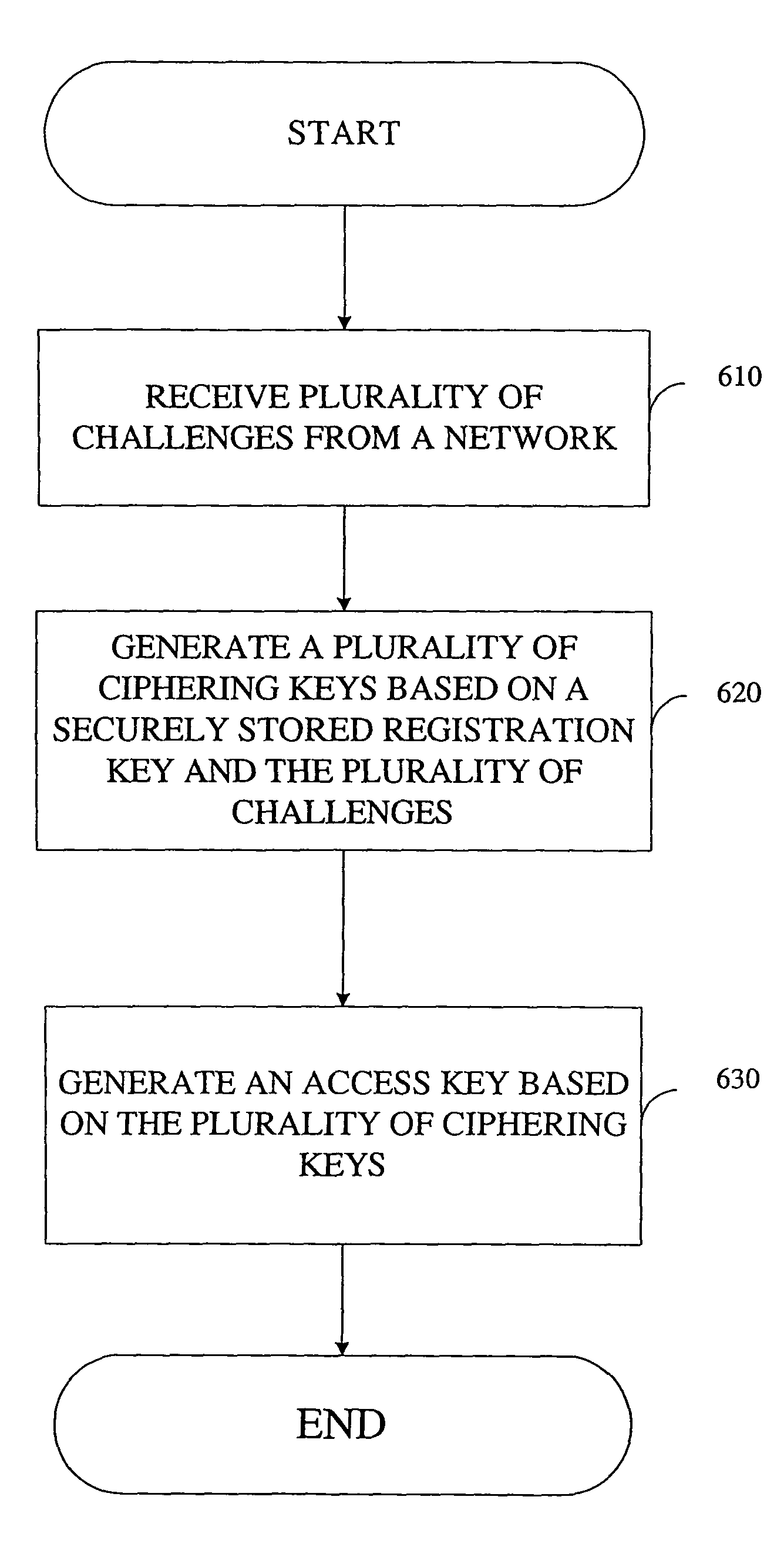
<figref idrefs="DRAWINGS">FIG. 6</figref> shows a method for secure processing in a device that securely stores a secret key.
DETAILED DESCRIPTION
In the following description, specific details are given to provide a thorough understanding of the embodiments. However, it will be understood by one of ordinary skill in the art that the embodiments may be practiced without these specific detail. For example, circuits may be shown in block diagrams in order not to obscure the embodiments in unnecessary detail. In other instances, well-known circuits, structures and techniques may be shown in detail in order not to obscure the embodiments.
Also, it is noted that the embodiments may be described as a process which is depicted as a flowchart, a flow diagram, a structure diagram, or a block diagram. Although a flowchart may describe the operations as a sequential process, many of the operations can be performed in parallel or concurrently. In addition, the order of the operations may be re-arranged. A process is terminated when its operations are completed. A process may correspond to a method, a function, a procedure, a subroutine, a subprogram, etc. When a process corresponds to a function, its termination corresponds to a return of the function to the calling function or the main function.
Moreover, as disclosed herein, a storage medium may represent one or more devices for storing data, including read only memory (ROM), random access memory (RAM), magnetic disk storage mediums, optical storage mediums, flash memory devices and/or other machine readable mediums for storing information. The term “machine readable medium” includes, but is not limited to portable or fixed storage devices, optical storage devices, wireless channels and various other mediums capable of storing, containing or carrying instruction(s) and/or data.
<figref idrefs="DRAWINGS">FIG. 1</figref> shows an example of a wireless communications network <b>100</b> capable of supporting broadcast service. Network <b>100</b> may comprise one or more communication systems supporting different standards. More particularly, network <b>100</b> comprises a plurality of service areas <b>102</b>A-<b>102</b>G, each of which is serviced by a corresponding infrastructure element <b>104</b>A-<b>104</b>G, respectively. Infrastructure elements <b>104</b>A-<b>104</b>G communicate with user end devices (hereinafter “terminal”) <b>106</b>A-<b>106</b>J that are within service areas <b>102</b>A-<b>102</b>G of infrastructure elements <b>104</b>A-<b>104</b>G, respectively. Depending on the type of communication system, infrastructure elements <b>104</b>A-<b>104</b>G may include base stations, base transceiver station, gateways or other devices that communicates with terminals <b>106</b>A-<b>106</b>J. Terminals <b>106</b>A-<b>106</b>J may be, but is not limited to, a mobile (including cellular and personal communications service) phone, wired phone, a wireless handset, a personal data assistant (PDA), various computer devices (including laptop and desktop) or other data transceiver. As shown in <figref idrefs="DRAWINGS">FIG. 1</figref>, terminals <b>106</b>A-<b>106</b>J can be hand-held, mobile, portable as in vehicle mounted (including cars, trucks, boats, trains, and planes) or fixed (stationary).
In one embodiment, network <b>100</b> supports a broadcast service referred to as Multimedia Broadcast/Multicast Service (MBMS), or sometimes referred to as Broadcast/Multimedia Service (BCMCS). Generally, MBMS is a packet data service based on the Internet Protocol (IP). A service provider may indicate the availability of such MBMS to users. The users desiring MBMS may receive the service and discover the broadcast service schedule through broadcasts such as advertisements, Short Message System (SMS), and Wireless Application Protocol (WAP). Infrastructure elements transmit MBMS related parameters in overhead messages. When a user desires to receive a broadcast session, a terminal <b>106</b> reads the overhead messages and learns the appropriate configurations. Terminal <b>106</b> then tunes to the frequency containing the MBMS channel, and receives the broadcast service content.
<figref idrefs="DRAWINGS">FIG. 2</figref> shows a simplified network <b>200</b> for implementing MBMS. In network <b>200</b>, video and/or audio information is provided to Packetized Data Service Network (PDSN) <b>230</b> by a Content Source (CS) <b>210</b>. The video and audio information may be from televised programs or radio transmissions. The information is provided as packetized data, such as in IP packets. PDSN <b>230</b> processes the IP packets for distribution within an Access Network (AN). As illustrated, AN is defined as the portions of network <b>200</b> including an infrastructure element <b>240</b> in communication with a plurality of terminals <b>250</b>.
For MBMS, CS <b>210</b> provides unencrypted content. Infrastructure element <b>240</b> receives the stream of information from PDSN <b>230</b> and provides the information on a designated channel to subscriber terminals within network <b>200</b>. To control access, the content from CS <b>210</b> is encrypted by a content encryptor (not shown) using an encryption key before being provided to PDSN <b>220</b>. While content encryptor may be implemented together or separately from CS <b>210</b>, content encryptor and CS <b>210</b> will hereinafter be referred to as a content provider. The subscribed users are provided with the decryption key so that the IP packets can be decrypted.
More particularly, <figref idrefs="DRAWINGS">FIG. 3</figref> shows a terminal <b>300</b> capable of subscribing to MBMS to receive multimedia content. Terminal <b>300</b> comprises an antenna <b>310</b> coupled to a receive circuitry <b>320</b>. Terminal <b>300</b> receives transmissions from a content provider (not shown) through an infrastructure element (not shown). Terminal <b>300</b> includes a Mobile Equipment <b>340</b> and a Universal Integrated Circuit Card (UICC) <b>330</b> coupled to receive circuitry <b>320</b>. It is to be noted that in some terminals, UICC <b>330</b> and ME <b>340</b> may be implemented together in one secure processing unit. Also, although the embodiment will be described using UICC, other integrated circuits and/r secure processing units, such as User Identification Module (UIM), Subscriber Identity Module (SIM) or universal SIM, may be implemented in a terminal.
Generally, UICC <b>330</b> applies verification procedures for security of the MBMS transmission and provides various keys to ME <b>340</b>. ME <b>340</b> performs substantial processing, including, but not limited to, decryption of MBMS content streams using the keys provided by UICC <b>330</b>. UICC <b>330</b> is trusted to securely store and process secret information (such as encryption keys) that should remain secret for a long time. As UICC <b>330</b> is a secure unit, the secrets stored therein do not necessarily require the system to change the secret information often. UICC <b>330</b> may include a processing unit referred to as a Secure UICC Processing Unit (SUPU) <b>324</b> and a secure memory storage unit referred to as a Secure UICC Memory Unit (SUMU) <b>322</b>. Within UICC <b>330</b>, SUMU <b>322</b> stores secret information in a way that discourages unauthorized access to the information. If the secret information is obtained from UICC <b>330</b>, the access will require significantly large amount of resources. Also within UICC <b>330</b>, SUPU <b>324</b> performs computations on values that may be external to and/or internal to UICC <b>330</b>. The results of the computation may be stored in SUMU <b>322</b> or passed to ME <b>340</b>.
In one embodiment, UICC <b>330</b> is a stationary unit or integrated within terminal <b>300</b>. Note that UICC <b>330</b> may also include non-secure memory and processing (not shown) for storing information including telephone numbers, e-mail address information, web page or URL address information, and/or scheduling functions, etc. Alternative embodiments may provide a removable and/or reprogrammable UICC. Typically, SUPU <b>332</b> does not have significant processing power for functions beyond security and key procedures, such as to allow encryption of the broadcast content of MBMS. However, alternative embodiments may implement a UICC having stronger processing power.
While UICC <b>330</b> is a secure unit, data in ME <b>340</b> may be accessed by a non-subscriber and is said to be insecure. Any information passed to ME <b>340</b> or processed by the ME <b>340</b> remains securely secret for only a short amount of time. It is therefore desired that any secret information, such as key(s), shared with ME <b>340</b> be changed often.
More particularly, MBMS content is encrypted using a unique and frequently changing temporary encryption keys referred to as short-term key (SK). In order to decrypt the broadcast content at a particular time, ME <b>340</b> must know the current SK. The SK is used to decrypt the broadcast content for a short-amount of time such that SK can be assumed to have some amount of intrinsic monetary value for a user. For example, this intrinsic monetary value may be a portion of the registration costs. Here, different content types may have different intrinsic monetary value. Assuming that the cost of a non-subscriber obtaining SK from ME <b>340</b> of a subscriber exceeds the intrinsic monetary value of SK, the cost of obtaining SK illegitimately exceeds the reward and there is no benefit. Consequently, there is no need to protect SK in ME <b>340</b>. However, if a broadcast has an intrinsic value greater than the cost of illegitimately obtaining this secret key, there is a benefit to the non-subscriber in obtaining such a key from ME <b>340</b>. Hence, ME <b>340</b> ideally will not store secrets with a lifetime longer than that of an SK.
In addition, the channels used by a content provider (not shown) for transmission of data are considered insecure. Therefore, SK is not transmitted over the air. It is derived either by UICC <b>330</b> or ME <b>340</b> from an access key called a broadcast access key (BAK) and SK information (SKI) broadcasted along with the encrypted content. BAK may be used for a certain amount of time, for example one day, one week or a month, and is updated. Within each period for updating the BAK, a shorter interval is provided during which SK is changed. The content provider may use a cryptographic function to determine two values SK and SKI such that SK can be determined from BAK and SKI. In one embodiment, SKI may contain SK that is encrypted using BAK as the key. Alternatively, SK may be a result of applying a cryptographic hash function to the concatenation of SKI and BAK. Here, SKI may be some random value.
To obtain access to MBMS, a user registers and subscribes to the service. In one embodiment of the registration process, a content provider and UICC <b>330</b> agree on a Registration Key or root key (RK) that serves as a security association between the user and the content provider. The registration may occur when a user subscribes to a broadcast channel offered by the content provider or may occur prior to subscription. A single content provider may offer multiple broadcast channels. The content provider may choose to associate users with the same RK for all channels or require users to register for each channel and associate the same user with different RKs on different channels. Multiple content providers may choose to use the same registration keys or require the user to register and obtain a different RK.
If possible, RK is then kept as a secret in UICC <b>330</b>. RK is unique to a given UICC, i.e., each user is assigned a different RK. However, if a user has multiple UICCs, then these UICCs may be configured to share the same RK depending on the policies of the content provider. The content provider may then send UICC <b>330</b> further secret information such as BAK encrypted with RK. UICC <b>330</b> is able to recover the value of the original BAK from the encrypted BAK using the RK. Since ME <b>340</b> is not a secret unit, UICC <b>330</b> does not provide BAK to ME <b>340</b>.
The content provider also broadcasts SKI that is combined with the BAK in UICC <b>330</b> to derive SK. UICC <b>330</b> then passes SK to ME <b>340</b> and ME <b>340</b> uses the SK to decrypt encrypted broadcast transmissions received from a content provider. In this way, the content provider can efficiently distribute new values of SK to subscribed users.
As described, controlled access may be achieved by provisioning an agreed upon RK in SUMU <b>334</b> of UICC <b>330</b>. However, in the existing infrastructure of some systems, an appropriate value of RK cannot be kept in a secure unit such as UICC <b>330</b>, because of the cost and/or inconvenience of replacing existing UICCs, SIMs, UIMs or other Integrated Circuit Cards.
For example, in GSM systems, a Subscriber Identity Module (SIM) is the secure unit and contains subscriber identifying data about a user that can be used to gain access to a network. For purposes of explanation, <figref idrefs="DRAWINGS">FIG. 4</figref> shows a simplified example of a GSM system <b>400</b> for authenticating a subscriber to allow access to a network. System <b>400</b> comprises a Home Location Register (HLR) <b>410</b>, a Visitor Location Register (VLR) <b>420</b> and a terminal such as a mobile device <b>430</b>. Note that system <b>400</b> comprise of additional elements, but GSM systems are well known to those skilled in the art and will not be described in detail.
HLR <b>410</b> is a subscriber database for a mobile system. HLR <b>410</b> is maintained by a terminal's home carrier and contains important user information for billing and for authentication to a network. VLR <b>420</b> is also a database and contains temporary user information, such as the current location of a terminal, to manage requests from subscribers who are out of the area covered by their home system. When a user initiates a call and the terminal of the user is our of the home area, VLR <b>420</b> communicates with HLR <b>410</b> to obtain information required to process a call, including information required to authenticate the subscriber.
Terminal <b>430</b> comprises a SIM module <b>432</b> that securely contains a subscriber authentication key (K) used to authenticate a subscriber. Here, a challenge-handshake authentication protocol known as Authenticated Key Agreement (AKA) is typically used for GSM authentication. In AKA, a network sends a challenge message to a subscriber terminal, which responds with a value obtained using a one-way hash function. Here, the challenge message may be a random value. The network checks the response by comparing it with its own expected hash value. If the values match, the authentication is acknowledged. While generating this response, a key that can be used to secure subsequent communications is also generated.
More particularly, in GSM system, VLR <b>420</b> requests authentication parameters from HLR <b>410</b>. HLR <b>410</b> sends to VLR a 128 bit random number RAND, a signed response (RES) and a ciphering key (Kc). The RES and Kc are both generated from the subscriber authentication key K and RAND, by using different algorithms. Using this Authentication Triplet (RAND, RES, Kc), a challenge message is issued by sending the random number RAND to Terminal <b>430</b>. The received RAND is passed to SIM <b>432</b> which generates RES and Kc using RAND and K. The generated RES is returned to VLR <b>420</b> which checks that the two values of RES match. If they match, the subscriber is authenticated and both terminal and network begin to encrypt/decrypt using Kc.
While GSM SIM securely contains a subscriber authentication key (K) used to authenticate a subscriber, it does not allow provisioning of an additional key such as RK. Namely, existing GSM SIMs cannot be changed. Therefore, one way to deliver BAK for broadcast service may be to use Kc rather than RK to encrypt BAK. A content provider would send a message containing RAND and BAK encrypted with Kc. A terminal receives the message and forwards the RAND to the SIM as if it was a normal GSM authentication. Accordingly, RES and Kc is generated by SIM using RAND and K. Here, the RES generated by SIM may be discarded. This protects against an attacker that might send the same RAND and record the returned RES for unauthorized access. The Kc may be used to decrypt the encrypted BAK.
However, Kc is typically a 64 bit key while some broadcast service such as MBMS is designed to give 128 bit security. Therefore, it is necessary to use a key as longer than 64 bits to encrypt BAK. As a result, a plurality of triplets is used for encryption of BAK.
<figref idrefs="DRAWINGS">FIG. 5</figref> shows an example system <b>500</b> with a network <b>510</b> that performs authentication and terminal <b>520</b> for broadcast service. Network <b>510</b> comprises one or more content providers and other infrastructure elements necessary for broadcast service. Terminal <b>520</b> comprises ICC <b>522</b> coupled to a processor <b>524</b>. In GSM system, network <b>510</b> may comprise a VLR and HLR, and ICC <b>522</b> would be a SIM module as described in <figref idrefs="DRAWINGS">FIG. 4</figref>. Generally, network <b>510</b> sends challenge messages for performing authentication. The challenge messages are used by terminal <b>520</b> to generate BAK for controlled access. Namely, ICC <b>522</b> of terminal <b>510</b> securely stores a secret key used in the generation of BAK. The operation of system <b>500</b> will be explained with reference to <figref idrefs="DRAWINGS">FIG. 6</figref> below.
<figref idrefs="DRAWINGS">FIG. 6</figref> shows a method <b>600</b> for secure processing in a device such as terminal <b>620</b>, that securely stores a secret key such as a subscriber authentication key in a secure unit such as ICC <b>622</b>. In method <b>600</b>, the device receives a plurality of challenges from a network (<b>610</b>). The plurality of challenges may be in one message or a plurality of messages. A plurality of ciphering keys are generated based on the secret key and the plurality of challenges (<b>620</b>). The access key is then generated based on the plurality of ciphering keys (<b>630</b>). In system <b>500</b>, for example, ICC <b>522</b> is configured to generate the ciphering keys as the secret key should be kept within ICC <b>522</b>. Processor <b>524</b> is configured to generate the access key based on the ciphering keys.
The access key is generated using a plurality of ciphering keys because the access key is typically longer than a ciphering key. For example, in GSM for MBMS, the ciphering key is 64 bits while the access key is 128 bits. In such case, the access key can be generated using two ciphering keys. Any known technique may be used to generate an access key from the plurality of ciphering keys. In one embodiment, the access key is generated by concatenating the plurality of ciphering keys. In an alternative embodiment, the access key is generated using a hash function on the plurality of ciphering keys. The hash function may comprise SHA-1 to mix the plurality of ciphering keys.
For authentication, method <b>600</b> may further comprise using the plurality of challenge messages and the secret key to generate a plurality of authentication responses as described with reference to <figref idrefs="DRAWINGS">FIG. 4</figref>. Thereafter, at least one of the authentication response is returned to the network using a transmitter (not shown) implemented in terminal <b>520</b> and any authentication responses not sent to the network may be discarded.
Therefore, after generating the access key, method <b>600</b> may further comprise receiving encrypted broadcast content and decrypting the broadcast content based on the access key. For example in MBMS, the access key would be the BAK and SKI would be used to generate SK. In such case, method <b>600</b> may further comprise generating a temporary encryption/decryption key such as SK based on each challenge message and current BAK. The current SK can then be used to decrypt and view/process encrypted content.
Accordingly, embodiments described allow a secure provisioning of an access key for broadcast service. It is to be noted here that although the embodiments have been described with reference to MBMS, the scope of the invention applies to broadcast services other than MBMS and to various systems requiring controlled access. Similarly, the access key may be shorter or longer than 128 bits. Moreover, the embodiments may apply to systems other than GSM system. For example, UMTS systems have a USIM which is analogous to GSM SIM and has a backward compatibility mode allowing it to act as a GSM SIM.
Furthermore, embodiments may be implemented by hardware, software, firmware, middleware, microcode, or any combination thereof. When implemented in software, firmware, middleware or microcode, the program code or code segments to perform the necessary tasks may be stored in a machine readable medium (not shown). A processor may perform the necessary tasks. A code segment may represent a procedure, a function, a subprogram, a program, a routine, a subroutine, a module, a software package, a class, or any combination of instructions, data structures, or program statements. A code segment may be coupled to another code segment or a hardware circuit by passing and/or receiving information, data, arguments, parameters, or memory contents. Information, arguments, parameters, data, etc. may be passed, forwarded, or transmitted via any suitable means including memory sharing, message passing, token passing, network transmission, etc. Also, the machine readable medium may be implemented in an article of manufacture for use in a computer system and may have machine readable code means embodied therein
Finally, it should be noted that the foregoing embodiments are merely examples and are not to be construed as limiting the invention. The description of the embodiments is intended to be illustrative, and not to limit the scope of the claims. As such, the present teachings can be readily applied to other types of apparatuses and many alternatives, modifications, and variations will be apparent to those skilled in the art.
Contents5
7 sheets
Sheet 1 Sheet 2 Sheet 3 Sheet 4 Sheet 5 Sheet 6 Sheet 7
Every citation, both waysCites: the store holds 114 of 115
| Document | Relation | Office | Cited during |
|---|---|---|---|
| US2012294246A1 | Cited by | United States of America | Pre-grant |
| US11443048B2 | Cited by | United States of America | Search report |
| US9071965B2 | Cited by | United States of America | Search report |
| US2002091931A1 | Cites | United States of America | Search report |
| US2002141591A1 | Cites | United States of America | Search report |
| US2002152384A1 | Cites | United States of America | Search report |
| US2003039361A1 | Cites | United States of America | Search report |
| US2003070092A1 | Cites | United States of America | Search report |
| US2004120527A1 | Cites | United States of America | Search report |
| US2004202329A1 | Cites | United States of America | Search report |
| US2006171540A1 | Cites | United States of America | Search report |
| US4163255A | Cites | United States of America | Applicant |
| US4323921A | Cites | United States of America | Applicant |
| US4336612A | Cites | United States of America | Applicant |
| US4750167A | Cites | United States of America | Applicant |
| US4870408A | Cites | United States of America | Applicant |
| US4881263A | Cites | United States of America | Applicant |
| US4901307A | Cites | United States of America | Applicant |
| US4924513A | Cites | United States of America | Applicant |
| US5052000A | Cites | United States of America | Applicant |
| US5056109A | Cites | United States of America | Applicant |
| US5101501A | Cites | United States of America | Applicant |
| US5103459A | Cites | United States of America | Applicant |
| US5117457A | Cites | United States of America | Applicant |
| US5136586A | Cites | United States of America | Applicant |
| US5150412A | Cites | United States of America | Applicant |
| US5159447A | Cites | United States of America | Applicant |
| US5164988A | Cites | United States of America | Applicant |
| US5235631A | Cites | United States of America | Applicant |
| US5237612A | Cites | United States of America | Applicant |
| US5241598A | Cites | United States of America | Applicant |
| US5253294A | Cites | United States of America | Applicant |
| US5257396A | Cites | United States of America | Applicant |
| US5325357A | Cites | United States of America | Applicant |
| US5351087A | Cites | United States of America | Applicant |
| US5353332A | Cites | United States of America | Applicant |
| US5363379A | Cites | United States of America | Applicant |
| US5365572A | Cites | United States of America | Applicant |
| US5369784A | Cites | United States of America | Applicant |
| US5371794A | Cites | United States of America | Applicant |
| US5404563A | Cites | United States of America | Applicant |
| US5410602A | Cites | United States of America | Applicant |
| US5412655A | Cites | United States of America | Applicant |
| US5421006A | Cites | United States of America | Applicant |
| US5442626A | Cites | United States of America | Applicant |
| US5448568A | Cites | United States of America | Applicant |
| US5467398A | Cites | United States of America | Applicant |
| US5473609A | Cites | United States of America | Applicant |
| US5473642A | Cites | United States of America | Applicant |
| US5481613A | Cites | United States of America | Applicant |
| US5485577A | Cites | United States of America | Applicant |
| US5504773A | Cites | United States of America | Applicant |
| US5513245A | Cites | United States of America | Applicant |
| US5515441A | Cites | United States of America | Applicant |
| US5537474A | Cites | United States of America | Applicant |
| US5565909A | Cites | United States of America | Applicant |
| US5592470A | Cites | United States of America | Applicant |
| US5659556A | Cites | United States of America | Applicant |
| US5673259A | Cites | United States of America | Applicant |
| US5686963A | Cites | United States of America | Applicant |
| US5708961A | Cites | United States of America | Applicant |
| US5729540A | Cites | United States of America | Applicant |
| US5740246A | Cites | United States of America | Applicant |
| US5748736A | Cites | United States of America | Applicant |
| US5751707A | Cites | United States of America | Applicant |
| US5751725A | Cites | United States of America | Applicant |
| US5758068A | Cites | United States of America | Applicant |
| US5758291A | Cites | United States of America | Applicant |
| US5768276A | Cites | United States of America | Applicant |
| US5774496A | Cites | United States of America | Applicant |
| US5778059A | Cites | United States of America | Applicant |
| US5778069A | Cites | United States of America | Applicant |
| US5778187A | Cites | United States of America | Applicant |
| US5787347A | Cites | United States of America | Applicant |
| US5796829A | Cites | United States of America | Applicant |
| US5835730A | Cites | United States of America | Applicant |
| US5850444A | Cites | United States of America | Applicant |
| US5850445A | Cites | United States of America | Applicant |
| US5870474A | Cites | United States of America | Applicant |
| US5878141A | Cites | United States of America | Applicant |
| US5881368A | Cites | United States of America | Applicant |
| US5884196A | Cites | United States of America | Applicant |
| US5887252A | Cites | United States of America | Applicant |
| US5909491A | Cites | United States of America | Applicant |
| US5923649A | Cites | United States of America | Applicant |
| US5936965A | Cites | United States of America | Applicant |
| US5940507A | Cites | United States of America | Applicant |
| US5946316A | Cites | United States of America | Applicant |
| US5956404A | Cites | United States of America | Applicant |
| US5956681A | Cites | United States of America | Applicant |
| US5970072A | Cites | United States of America | Applicant |
| US5970417A | Cites | United States of America | Applicant |
| US5978386A | Cites | United States of America | Applicant |
| US5983099A | Cites | United States of America | Applicant |
| US5983388A | Cites | United States of America | Applicant |
| US5990928A | Cites | United States of America | Applicant |
| US5991400A | Cites | United States of America | Applicant |
| US5991407A | Cites | United States of America | Search report |
| US6006073A | Cites | United States of America | Applicant |
| US6014765A | Cites | United States of America | Applicant |
21 members in 13 offices
Priority claims6
| Document | Office | Kind | Date |
|---|---|---|---|
| 48579103 | United States of America | P | |
| 48579103 | United States of America | P | |
| 87030304 | United States of America | A | |
| 60485791 | – | – | – |
| US20030485791P | – | – | – |
| US20040870303 | – | – | – |
Members21
| Document | Office | Kind | |
|---|---|---|---|
| US2005010774A1 | United States of America | A1 | |
| AU2004258561A1 | Australia | A1 | |
| CA2531590A1 | Canada | A1 | |
| WO2005008398A2 | World Intellectual Property Organization (WIPO) | A2 | |
| WO2005008398A3 | World Intellectual Property Organization (WIPO) | A3 | |
| TW200518543A | Taiwan Province of China | A | |
| MXPA06000274A | Mexico | A | |
| KR20060031852A | Republic of Korea | A | |
| EP1649630A2 | European Patent Office (EPO) | A2 | |
| IL173021A0 | Israel | A0 | |
| BRPI0412397A | Brazil | A | |
| CN1846395A | China | A | |
| RU2006103624A | Russian Federation | A | |
| JP2007529147A | Japan | A | |
| AU2004258561B2 | Australia | B2 | |
| AU2004258561C1 | Australia | C1 | |
| EP1649630A4 | European Patent Office (EPO) | A4 | |
| RU2419223C2 | Russian Federation | C2 | |
| TWI386004B | Taiwan Province of China | B | |
| CA2531590C | Canada | C | |
| US8718279B2This record | United States of America | B2 |
193 transactions on the USPTO file
Allowed after 6 non-final rejections, 3 final rejections, 7 RCEs and 1 appeal.
- Non-final rejections
- 6
- Final rejections
- 3
- RCEs
- 7
- Appeals
- 1
Over time
Point at a mark for the transactionTransactions
| Event | Code | |
|---|---|---|
| Payment of Maintenance Fee, 12th Year, Large EntityM1553 | M1553 | |
| Payment of Maintenance Fee, 8th Year, Large EntityM1552 | M1552 | |
| Payment of Maintenance Fee, 4th Year, Large EntityM1551 | M1551 | |
| Recordation of Patent Grant MailedPGM/ | PGM/ | |
| Patent Issue Date Used in PTA CalculationAllowedPTAC | PTAC | |
| Email NotificationEML_NTR | EML_NTR | |
| Issue Notification MailedAllowedWPIR | WPIR | |
| Dispatch to FDCD1935 | D1935 | |
| Application Is Considered Ready for IssuePILS | PILS | |
| Issue Fee Payment VerifiedN084 | N084 | |
| Issue Fee Payment ReceivedIFEE | IFEE | |
| Electronic ReviewELC_RVW | ELC_RVW | |
| Email NotificationEML_NTF | EML_NTF | |
| Mail Notice of AllowanceAllowedMN/=. | MN/=. | |
| Notice of Allowance Data Verification CompletedAllowedN/=. | N/=. | |
| Disposal for a RCE / CPA / R129AbandonedABN9 | ABN9 | |
| Information Disclosure Statement consideredIDSC | IDSC | |
| Reference capture on IDSRCAP | RCAP | |
| Information Disclosure Statement (IDS) FiledM844 | M844 | |
| Request for Continued Examination (RCE)RCEX | RCEX | |
| Information Disclosure Statement (IDS) FiledWIDS | WIDS | |
| Workflow - Request for RCE - BeginBRCE | BRCE | |
| Electronic ReviewELC_RVW | ELC_RVW | |
| Email NotificationEML_NTF | EML_NTF | |
| Mail Notice of AllowanceAllowedMN/=. | MN/=. | |
| Notice of Allowance Data Verification CompletedAllowedN/=. | N/=. | |
| Reasons for AllowanceEX.R | EX.R | |
| Date Forwarded to ExaminerFWDX | FWDX | |
| Information Disclosure Statement consideredIDSC | IDSC | |
| Reference capture on IDSRCAP | RCAP | |
| Information Disclosure Statement (IDS) FiledM844 | M844 | |
| Response after Non-Final ActionA... | A... | |
| Information Disclosure Statement (IDS) FiledWIDS | WIDS | |
| Electronic ReviewELC_RVW | ELC_RVW | |
| Email NotificationEML_NTF | EML_NTF | |
| Mail Non-Final RejectionNon-final rejectionMCTNF | MCTNF | |
| Non-Final RejectionNon-final rejectionCTNF | CTNF | |
| Date Forwarded to ExaminerFWDX | FWDX | |
| Disposal for a RCE / CPA / R129AbandonedABN9 | ABN9 | |
| Information Disclosure Statement consideredIDSC | IDSC | |
| Electronic Information Disclosure StatementEIDS. | EIDS. | |
| Request for Continued Examination (RCE)RCEX | RCEX | |
| Information Disclosure Statement (IDS) FiledWIDS | WIDS | |
| Workflow - Request for RCE - BeginBRCE | BRCE | |
| Electronic ReviewELC_RVW | ELC_RVW | |
| Email NotificationEML_NTF | EML_NTF | |
| Mail Notice of AllowanceAllowedMN/=. | MN/=. | |
| Notice of Allowance Data Verification CompletedAllowedN/=. | N/=. | |
| Reasons for AllowanceEX.R | EX.R | |
| Disposal for a RCE / CPA / R129AbandonedABN9 | ABN9 | |
| Information Disclosure Statement consideredIDSC | IDSC | |
| Information Disclosure Statement (IDS) FiledWIDS | WIDS | |
| Reference capture on IDSRCAP | RCAP | |
| Information Disclosure Statement (IDS) FiledM844 | M844 | |
| Request for Continued Examination (RCE)RCEX | RCEX | |
| Workflow - Request for RCE - BeginBRCE | BRCE | |
| Electronic ReviewELC_RVW | ELC_RVW | |
| Email NotificationEML_NTF | EML_NTF | |
| Mail Notice of AllowanceAllowedMN/=. | MN/=. | |
| Notice of Allowance Data Verification CompletedAllowedN/=. | N/=. | |
| Reasons for AllowanceEX.R | EX.R | |
| Disposal for a RCE / CPA / R129AbandonedABN9 | ABN9 | |
| Information Disclosure Statement consideredIDSC | IDSC | |
| Reference capture on IDSRCAP | RCAP | |
| Information Disclosure Statement (IDS) FiledM844 | M844 | |
| Request for Continued Examination (RCE)RCEX | RCEX | |
| Information Disclosure Statement (IDS) FiledWIDS | WIDS | |
| Workflow - Request for RCE - BeginBRCE | BRCE | |
| Electronic ReviewELC_RVW | ELC_RVW | |
| Email NotificationEML_NTF | EML_NTF | |
| Mail Notice of AllowanceAllowedMN/=. | MN/=. | |
| Notice of Allowance Data Verification CompletedAllowedN/=. | N/=. | |
| Disposal for a RCE / CPA / R129AbandonedABN9 | ABN9 | |
| Information Disclosure Statement consideredIDSC | IDSC | |
| Reference capture on IDSRCAP | RCAP | |
| Information Disclosure Statement (IDS) FiledM844 | M844 | |
| Request for Continued Examination (RCE)RCEX | RCEX | |
| Information Disclosure Statement (IDS) FiledWIDS | WIDS | |
| Workflow - Request for RCE - BeginBRCE | BRCE | |
| Email NotificationEML_NTR | EML_NTR | |
| Mail PUB Notice of non-compliant IDSMM327-B | MM327-B | |
| PUB Notice of non-compliant IDSM327-B | M327-B | |
| Information Disclosure Statement consideredIDSC | IDSC | |
| Information Disclosure Statement (IDS) FiledWIDS | WIDS | |
| Electronic ReviewELC_RVW | ELC_RVW | |
| Email NotificationEML_NTF | EML_NTF | |
| Mail Notice of AllowanceAllowedMN/=. | MN/=. | |
| Notice of Allowance Data Verification CompletedAllowedN/=. | N/=. | |
| Date Forwarded to ExaminerFWDX | FWDX | |
| Information Disclosure Statement consideredIDSC | IDSC | |
| Information Disclosure Statement (IDS) FiledWIDS | WIDS | |
| Reference capture on IDSRCAP | RCAP | |
| Information Disclosure Statement (IDS) FiledM844 | M844 | |
| Response after Non-Final ActionA... | A... | |
| Electronic ReviewELC_RVW | ELC_RVW | |
| Email NotificationEML_NTF | EML_NTF | |
| Mail Non-Final RejectionNon-final rejectionMCTNF | MCTNF | |
| Non-Final RejectionNon-final rejectionCTNF | CTNF | |
| Date Forwarded to ExaminerFWDX | FWDX | |
| Mail Appeals conf. Rej. withdrawnMAPCA | MAPCA |
6 legal events, as the office reported them to INPADOC
Over the term
Point at a mark for the eventEvents
| Event | Code | |
|---|---|---|
| Maintenance fee paymentMAFP | MAFP | |
| Maintenance fee paymentMAFP | MAFP | |
| Maintenance fee paymentMAFP | MAFP | |
| Information on status: patent grantGrantedPATENTED CASESTCF | STCF | |
| AssignmentAS | AS | |
| AssignmentAS | AS |
Numbers
- Publication
- 08718279
- Publication, DOCDB
- 8718279
- Publication, EPODOC
- US8718279
- Application
- 10870303
- Application, DOCDB
- 87030304
- Application, EPODOC
- US20040870303
Titles
- English
- Apparatus and method for a secure broadcast system
Patent term adjustment
- A delay
- +856 daysthe office missed an examination deadline
- B delay
- +754 dayspendency past three years
- Overlap
- −187 daysdelays counted once
- Applicant delay
- −170 days
- Net adjustment
- 1,253 days
Classification
- CPC, 13
- H04W12/08
- H04L9/0844
- H04L63/0428
- H04L63/06
- H04L2463/101
- H04W84/12
- H04L9/14
- H04L2209/601
- H04L2209/80
- H04W12/0431
- H04L9/0643
- H04L9/0877
- H04L9/0894
- IPC, 4
- H04L9 00
- H04L9 08
- H04L12 28
- H04L29 06
- USPC, 1
- 380044000