Methods, systems and computer program products for storing communication session information at a network interface module
Summary by NHIP
RTCP Packet Storage Method
The method stores communication session data at a network interface module by extracting RTCP information from incoming packets. A network processor uses extracted IP addresses and UDP port numbers as search keys to identify specific memory areas for storage before forwarding media packets.
Claim Score by NHIP
Abstract
The subject matter described herein includes methods, systems, and computer program products for storing communication session information at a network interface module. One method described herein includes receiving a plurality of RTCP packets associated with a communication session at a network interface module. RTCP information is extracted from at least one of the packets. The extracted RTCP information is stored in memory local to the network interface module.
Term
1 yearleft in the term
Expires 30 September 2027, including 353 days of term adjustment.
- Priority and filed
- Granted
- Today
- Expires
26 claims: 7 independent, 19 dependent
- 1Broadest claimClaim Score 30, narrow(NHIP)A method for storing communication session information at a network interface module, the method comprising:(a) receiving, at a network interface module of a network node, a plurality of real time transport control protocol (RTCP) packets associated with a communication session;(b) extracting, using a network processor located on the network interface module, RTCP information from at least one of the RTCP packets, wherein extracting the RTCP information includes using the network processor located on the network interface module to extract the RTCP information from fields of an RTCP portion of the at least one RTCP packet;(c) storing, using the network processor located on the network interface module, the extracted RTCP information in memory located on the network interface module, wherein storing the extracted RTCP information includes: extracting an Internet protocol (IP) address and a user datagram protocol (UDP) port number from the at least one of the RTCP packets;using the extracted IP address and UDP port number as a search key to identify an area in the memory allocated for the communication session;and storing the extracted RTCP information in the identified area in the memory allocated for the communication session;and (d) using the network processor to forward incoming packets to an appropriate voice server module of a plurality of voice server modules and to forward outbound media packets over a communications network.
- 10A method for storing communication session information at a network interface module, the method comprising:(a) receiving, at the network interface module of a network node, a plurality of real time transport control protocol (RTCP) packets associated with a communication session, wherein receiving the plurality of RTCP packets associated with the communication session includes receiving the plurality of RTCP packets associated with the communication session at a session border controller (SBC);(b) extracting, using a network processor located on the network interface module, RTCP information from at least one of the RTCP packets;(c) storing, using the network processor located on the network interface module, the extracted RTCP information in memory located on the network interface module, wherein storing the extracted RTCP information includes: extracting an Internet protocol (IP) address and a user datagram protocol (UDP) port number from the at least one of the RTCP packets;using the extracted IP address and UDP port number as a search key to identify an area in the memory allocated for the communication session;and storing the extracted RTCP information in the identified area in the memory allocated for the communication session;and (d) using the network processor to forward incoming packets to an appropriate voice server module of a plurality of voice server modules and to forward outbound media packets over a communications network.
- 11A method for storing communication session information at a network interface module, the method comprising:(a) receiving, at the network interface module of a network node, a plurality of real time transport control protocol (RTCP) packets associated with a communication session;(b) extracting, using a network processor located on the network interface module, RTCP information from at least one of the RTCP packets;(c) storing, using the network processor located on the network interface module, the extracted RTCP information in memory located on the network interface module, wherein storing the extracted RTCP information includes: extracting an Internet protocol (IP) address and a user datagram protocol (UDP) port number from the at least one of the RTCP packets;using the extracted IP address and UDP port number as a search key to identify an area in the memory allocated for the communication session;and storing the extracted RTCP information in the identified area in the memory allocated for the communication session, and wherein storing the extracted RTCP information includes allocating storage space in one of random access memory (RAM) of the network interface module and content addressable memory (CAM) of the network interface module;and (d) using the network processor to forward incoming packets to an appropriate voice server module of a plurality of voice server modules and to forward outbound media packets over a communications network.
- 12A system for storing communication session information, the system comprising:a network node including: (a) a plurality of voice server modules configured to process voice packets associated with a communication session and send real time transport control protocol (RTCP) packets to and receive RTCP packets from a network;(b) a plurality of network interface modules for sending the voice and RTCP packets to and receiving the voice and RTCP packets from the network, wherein at least one of the network interface modules includes: an RTCP caching module for extracting, using a network processor located on the at least one network interface module, RTCP information from at least one of the RTCP packets, wherein extracting the RTCP information includes using the network processor located on the at least one network interface module to extract the RTCP information from fields of an RTCP portion of the at least one RTCP packet;and an RTCP cache including memory located on the at least one network interface module for storing the extracted RTCP information from the received RTCP packets, wherein storing the extracted RTCP information includes: extracting an Internet protocol (IP) address and a user datagram protocol (UDP) port number from the at least one of the RTCP packets;using the extracted IP address and UDP port number as a search key to identify an area in the memory allocated for the communication session;and storing the extracted RTCP information in the identified area in the memory allocated for the communication session;and wherein the network processor is configured to forward incoming packets to an appropriate voice server module of the plurality of voice server modules and to forward outbound media packets over a communications network.
- 24A system for storing communication session information, the system comprising:a network node including: (a) a plurality of voice server modules configured to process voice packets associated with a communication session and send real time transport control protocol (RTCP) packets to and receive RTCP packets from a network;(b) a plurality of network interface modules for sending the voice and RTCP packets to and receiving the voice and RTCP packets from the network, wherein at least one of the network interface modules includes an RTCP caching module implemented by a network processor located on the at least one network interface module for extracting and storing, on the at least one network interface module, RTCP information extracted from the RTCP packets, and an RTCP cache for caching the RTCP information, wherein storing the extracted RTCP information includes: extracting an Internet protocol (IP) address and a user datagram protocol (UDP) port number from at least one of the RTCP packets associated with the communication session;using the extracted IP address and UDP port number as a search key to identify an area in the RTCP cache allocated for the communication session;and storing the extracted RTCP information in the identified area in the RTCP cache allocated for the communication session, and wherein the network node comprises a session border controller (SBC);and wherein the network processor is configured to forward incoming packets to an appropriate voice server module of the plurality of voice server modules and to forward outbound media packets over a communications network.
- 25A system for storing communication session information, the system comprising:a network node including: (a) a plurality of voice server modules configured to process voice packets associated with a communication session and send real time transport control protocol (RTCP) packets to and receive RTCP packets from a network;(b) a plurality of network interface modules for sending the voice and RTCP packets to and receiving the voice and RTCP packets from the network, wherein at least one of the network interface modules includes an RTCP caching module implemented by a network processor located on the network interface module for extracting RTCP information from received RTCP packets and storing, on the at least one network interface module, RTCP information extracted from the RTCP packets, and an RTCP cache for caching the RTCP information at the network interface module, wherein storing the extracted RTCP information includes: extracting an Internet protocol (IP) address and a user datagram protocol (UDP) port number from at least one of the RTCP packets associated with the communication session;using the extracted IP address and UDP port number as a search key to identify an area in the RTCP cache allocated for the communication session;and storing the extracted RTCP information in the identified area in the RTCP cache allocated for the communication session, and wherein the RTCP cache comprises one of a random access memory (RAM) and a content addressable memory (CAM);and wherein the network processor is configured to forward incoming packets to an appropriate voice server module of the plurality of voice server modules and to forward outbound media packets over a communications network.
- 26A computer program product comprising computer executable instructions embodied in a non-transitory computer readable medium for performing steps comprising:(a) receiving, at a network interface module of a network node, a plurality of real time transport control protocol (RTCP) packets associated with a communication session;(b) extracting, using a network processor at the network interface module, RTCP information from at least one of the RTCP packets, wherein extracting the RTCP information includes using the network processor located on the network interface module to extract the RTCP information from fields of an RTCP portion of the at least one RTCP packet;(c) storing, using the network processor located on the network interface module, the extracted RTCP information in memory located on the network interface module, wherein storing the extracted RTCP information includes: extracting an Internet protocol (IP) address and a user datagram protocol (UDP) port number from the at least one of the RTCP packets;using the extracted IP address and UDP port number as a search key to identify an area in the memory allocated for the communication session;and storing the extracted RTCP information in the identified area in the memory allocated for the communication session;and (d) using the network processor to forward incoming packets to an appropriate voice server module of a plurality of voice server modules and to forward outbound media packets over a communications network.
Independent claims7
43 paragraphs in 5 sections, as filed
TECHNICAL FIELD
The subject matter described herein relates to collecting information associated with a communication session in a network. More particularly, the subject matter described herein relates to methods, systems and computer program products for storing communication session information at a network interface module.
BACKGROUND
In communications networks, when a plurality of packets is sent from an origin to a destination for a shared purpose, the packets are collectively called a session. Network carriers may be interested in statistical data related to sessions traversing their networks. This data, hereinafter referred to as session information, can be collected by network elements that route and/or process packets belonging to network sessions. Examples of network elements that may perform such routing or processing include media gateways (MGs) and session border controllers (SBCs). Session information may be contained in portions of packets belonging to each session and therefore can be collected by extracting these portions from network packets associated with a communication session. For example, in communications sessions, such as voice over Internet protocol (VoIP)-to-VoIP sessions, which utilize real time transport control protocol (RTCP) packets to control the session, at least five types of session information are contained in each packet.
First, the session information data field, referred to as the sender's packet count, stores the total number of real time transport protocol (RTP) packets transmitted by the sender since the session was initiated. This count is reset at the beginning of each session.
Second, the sender's octet count data field stores the total number of RTP payload octets transmitted by the sender since the beginning of the session. The sender's octet count includes 32-bits and may be used to estimate the average payload data rate.
Third, the fraction lost data field stores the number of packets lost divided by the number of RTP packets expected. This number is expressed as a fixed point number with the binary point at the left edge of the field.
Fourth, the cumulative number of packets lost data field stores the total number of RTP packets belonging to a single source that were lost since the session began. The number of lost packets is equal to the expected number of packets minus the number of packets received, where the received packets include duplicate and late packets.
Fifth, the interarrival jitter data field stores a mathematical estimate of the variance in the arrival times of RTP packets. This jitter is measured as the difference between the spacing of a sender's RTP packets and the spacing of the packets when the destination receives them. This can also be viewed as the difference between the transit times of individual packets in an RTP packet stream.
Typically, session information generated by a communication session is sent to a centralized central processing unit (CPU) or one or more digital signal processors (DSPs) of a network node, such as a media gateway, for processing. In addition to processing session information, these CPUs and DSPs perform tasks such as call set-up and tear-down and codec conversion. The primary functions just described are resource intensive, and thus limit the processing resources these CPUs and DSPs can dedicate to also processing session data.
One type of network element that may receive RTCP information is a media gateway. A media gateway (MG) is a mediation device that translates communications traffic between different networks, such as public switched telephone network (PSTN) and Internet protocol (IP) networks. Media gateways receive incoming packets and process and/or route the packets. For example, media gateways can receive packets belonging to a VoIP session from an IP network, convert the voice information in the packets to a different codec, and forward the voice information to a PSTN network. Media gateways can also receive network packets from an IP network and route the packets to another IP network if codec conversion is needed. In addition to these core functions, one or more resources in a MG, such as the DSPs, can collect and analyze session information relating to the network traffic it processes.
Another type of network elements that may receive RTCP information is a session border controller (SBC). An SBC is a device that manages VoIP calls at the border of IP networks by managing the control and media signaling associated with setting up, conducting, and tearing down VoIP calls. Additionally, SBCs may enforce firewall permissions or quality of service (QoS) protocols. SBCs may also collect and analyze session information for the network traffic it processes. Both MGs and SBCs currently collect and analyze communications session information remotely using a central CPU or one or more DSPs.
Current methods and systems for collecting and analyzing communication session information that forward packets to a remote processor have several disadvantages. First, the time required to forward packets via a switching fabric or a communication bus to remote processors limits the number of packets per second a MG or SBC can process, and thus limits their scalability. Second, in the event of a link failure between the network interface module, where packets are received, and the remote processor where the packets' session information is collected and analyzed, no session information can be collected until the link returns to availability. Third, because remote processors in current systems also perform tasks vital to the operation of the network element, such as call set-up and tear-down and codec conversion, the increased load dedicated to processing session information can degrade the performance of these core operations. Accordingly, a need exists for improved methods, systems, and computer program products for managing, processing, and storing communication session information.
SUMMARY
The subject matter described herein includes methods, systems, and computer program products for storing communication session information at a network interface module. One method described herein includes receiving a plurality of RTCP packets associated with a communication session at a network interface module. RTCP information is extracted from at least one of the packets. The extracted RTCP information is stored in memory local to the network interface module.
According to another aspect, the subject matter described herein includes a system for storing communication session information at a network interface module. The system includes a plurality of voice processing resources for processing voice packets associated with communication sessions and for sending RTCP packets to and receiving RTCP packets from a network. A plurality of network interfaces sends and receives the voice and RTCP packets to and receives the RTCP packets from the network. At least one of the network interfaces includes an RTCP caching module and an RTCP cache for caching RTCP information from received packets.
The subject matter described herein may be implemented using a computer program product comprising computer executable instructions embodied in a computer readable medium. Exemplary computer readable media suitable for implementing the subject matter described herein include chip memory devices, disc memory devices, application specific integrated circuits, and programmable logic devices. In addition, a computer program product that implements a subject matter described herein may reside on a single device or computing platform or maybe distributed across multiple devices or computing platforms.
BRIEF DESCRIPTION OF THE DRAWINGS
The subject matter described herein will now be explained with reference to the accompanying drawings of which:
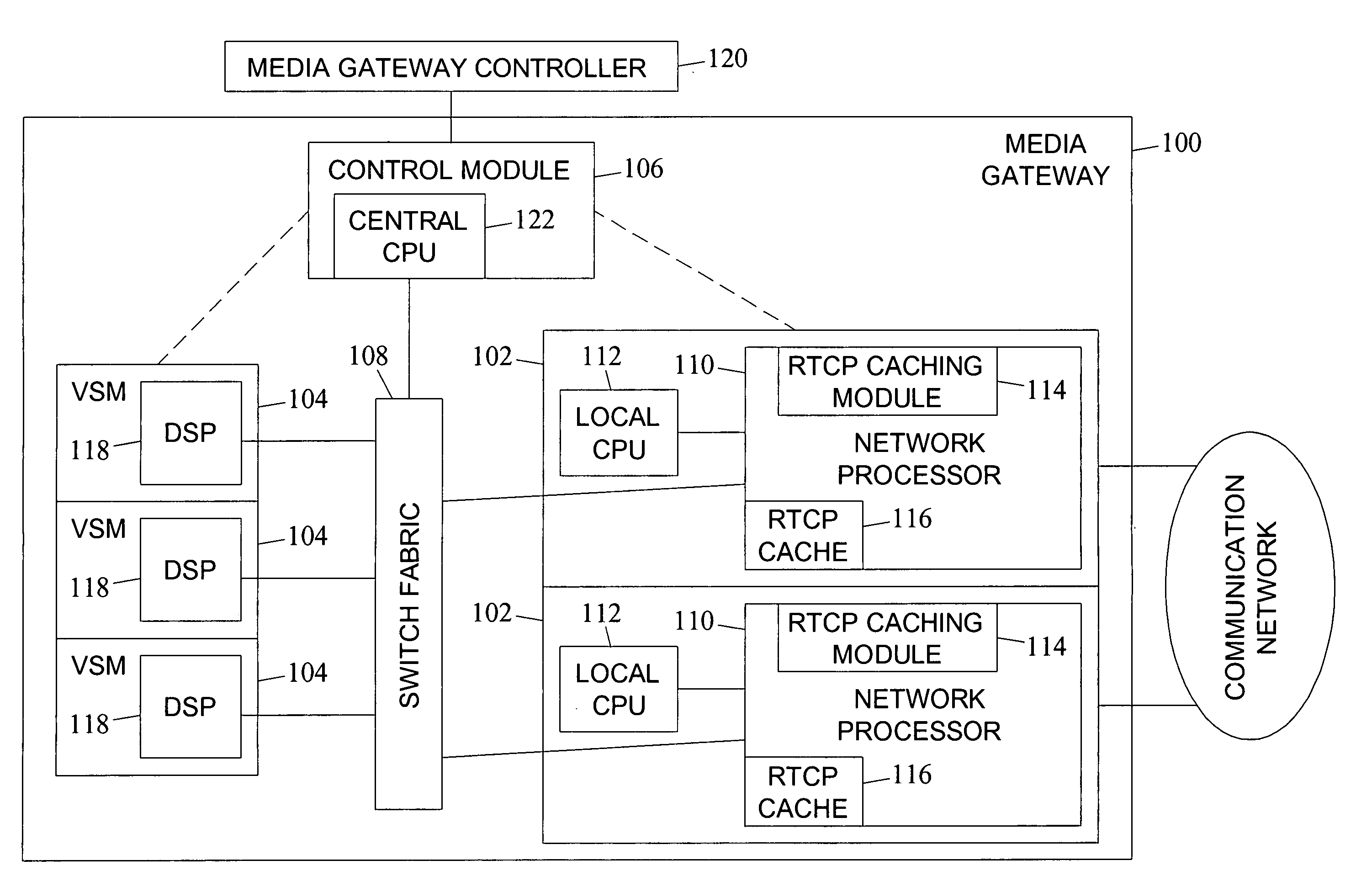
<figref idrefs="DRAWINGS">FIG. 1</figref> is a block diagram of a media gateway including a network interface module configured to locally cache RTCP session information according to an embodiment of the subject matter described herein;
<figref idrefs="DRAWINGS">FIG. 2</figref> is a flow chart illustrating a method for caching RTCP session information at the network interface module of an MG or an SBC according to an embodiment of the subject matter described herein;
<figref idrefs="DRAWINGS">FIG. 3</figref> is a flow chart illustrating a method for routing packets associated with a VoIP-to-VoIP communication session and caching session information at a network interface module according to an embodiment of the subject matter described herein; and
<figref idrefs="DRAWINGS">FIG. 4</figref> is a flow chart illustrating a method for caching RTCP session information at a network interface module according to an embodiment of the subject matter described herein.
DETAILED DESCRIPTION OF THE INVENTION
Systems, methods and computer program products for locally storing and updating communication session information at a network interface module are described herein which offload the collection and storage of session information from remote processors and locally cache the information at the network interface module. The subject matter described herein is illustrated with reference to the following figures, which include network elements, which are exemplary operating environments for locally caching communication session information as described herein.
<figref idrefs="DRAWINGS">FIG. 1</figref> is a schematic diagram illustrating an exemplary network element for collecting and storing session information. In particular, <figref idrefs="DRAWINGS">FIG. 1</figref> illustrates a media gateway <b>100</b> according to an embodiment of the subject matter described herein. Referring to <figref idrefs="DRAWINGS">FIG. 1</figref>, media gateway <b>100</b> includes a plurality of network interface modules (NIMs) <b>102</b>, a plurality of voice server modules (VSMs) <b>104</b>, and a control module <b>106</b>, which may be a connected via switch fabric <b>108</b>. Each VSM <b>104</b> may process VoIP and TDM voice sessions that include a leg in an IP or PSTN network. For example, each voice server module <b>104</b> may include a DSP <b>108</b>, a VoIP chip, a voice over ATM chip, a time slot interconnect chip, and a CPU. Each VSM may receive and process RTCP packets for controlling RTP sessions that are terminated by each VSM <b>104</b>.
Each network interface module <b>102</b> may be configured to locally cache RTCP session information according to an embodiment of the subject matter described herein. In one implementation, each network interface <b>102</b> includes a network processor <b>110</b> and a local CPU <b>112</b>. Network processor <b>110</b> performs packet forwarding functions, such as forwarding incoming packets to the appropriate VSM <b>104</b>. Network processor <b>110</b> also forwards outbound media packets over the communications network. Local CPU <b>112</b> controls the overall operation of each network interface module <b>102</b>.
In the illustrated example, network processor <b>110</b> includes or implements an RTCP caching module <b>114</b> and an RTCP cache <b>116</b>. RTCP caching module <b>114</b> may cache RTCP information from received packets in storage available in RTCP cache <b>116</b>. The RTCP information may include any information from the RTCP portion of a packet, including the five types of RTCP information described above. RTCP caching module <b>114</b> may identify a session with which an RTCP packet is associated and store the RTCP information associated with the packet in cache <b>116</b> in an area allocated for that session. The Network Processor module <b>110</b> may include an embedded CPU to offload RTCP caching burden from the central or local CPU. The local CPU on the network interface module may be optional if an embedded CPU exists in the Network Processor module. Exemplary operations that may be performed by RTCP caching module <b>114</b> and RTCP cache <b>116</b> will be described in more detail below.
Although in the illustrated embodiment, RTCP caching module <b>114</b> and RTCP cache <b>116</b> are implemented using network processor <b>110</b>, the subject matter described herein is not limited to such an embodiment. RTCP caching module <b>114</b> may be implemented using any processing resource local to a network interface <b>102</b>, and RTCP cache <b>116</b> may be implemented using any storage resource local to a network interface <b>102</b>. For example, RTCP caching module <b>112</b> may be implemented using a local CPU <b>112</b>, and RTCP cache <b>116</b> may be implemented using memory accessible by local CPU <b>112</b>.
Each VSM <b>104</b> may perform codec conversion and other voice processing for sessions, such as VoIP-to-VoIP and VoIP-to-TDM sessions. Each VSM <b>104</b> may include a digital signal processor (DSP) <b>118</b> that is optimized for such processing. Each VSM <b>104</b> may be reachable through packet switch fabric <b>108</b>, and thus is referred to as a remote processor relative to each NIM <b>102</b>. Multiple sessions may be assigned to the same VSM <b>104</b>, where each session is associated with a different IP address and user datagram protocol (UDP) port number combination. In one exemplary implementation, VoIP sessions for incoming packets may be identified by the destination IP address and UDP port, which correspond to an IP address and UDP port used by one of VSMs <b>104</b>. Remote IP address and UDP port information in received packets may also be used to identify the session with which a received packet belongs.
Control module <b>106</b> manages the data flow in media gateway <b>100</b> and communicates with media gateway controller <b>120</b> to set up and tear down calls. Control module <b>106</b> may include a central CPU <b>122</b> which may be used for processing session information. Central CPU <b>122</b> is reachable through packet switch fabric <b>108</b> and is thus referred to as a remote processor relative to network interfaces <b>102</b>. Performing RTCP caching at the network interfaces reduces the processing required to be performed by CPU <b>122</b> over implementations where CPU <b>122</b> is required to perform RTCP caching.
In performing its traditional role, network processor <b>110</b> receives packets associated with a communication session and routes the packets to a voice server module <b>104</b> assigned to the session or to another network interface <b>102</b>, depending on whether transcoding is required. According to one exemplary implementation of the subject matter described herein, each network processor <b>110</b> offloads the collection and storage of session information from central CPU <b>122</b> and DSPs <b>118</b> and stores the session information in local cache memory <b>116</b>.
For a VoIP-to-VoIP session, each network processor <b>110</b> may route packets associated with that session to another network processor, such as another network processor <b>112</b>, for delivery to a destination, if transcoding is not required. However, for VoIP-to-TDM sessions that require transcoding, each network processor <b>110</b> may send packets to an assigned voice server module <b>104</b>. For both types of sessions, packets received by a network processor <b>110</b> may be examined by RTCP caching module <b>114</b>, which may store RTCP information contained in each packet and may update the stored information with information from a last received packet associated with the communication session. For example, for each received RTCP packet, RTCP caching module <b>114</b> may identify the session with which the packet belongs and may update the session information extracted from a previous packet associated with the session.
<figref idrefs="DRAWINGS">FIG. 2</figref> is a flow chart illustrating a method for caching session information at the network interface module of a network node, such as MG or an SBC, according to an embodiment of the subject matter described herein. In step <b>200</b>, a network element, such as MG <b>100</b>, receives a plurality of RTCP packets associated with a VoIP session. In step <b>202</b>, RTCP information is extracted from at least one of the packets. In step <b>204</b>, the extracted RTCP information is stored in memory local to the network interface module. Subsequent RTCP packets will overwrite previously stored RTCP information from previous packets of the same session.
<figref idrefs="DRAWINGS">FIG. 3</figref> is a flow chart illustrating a method for routing packets for a VoIP-to-VoIP communication session and caching session information at a network interface module according to an embodiment of the subject matter described herein. VoIP-to-VoIP sessions may not require codec conversion, which is a function performed by DSPs <b>118</b>. Therefore, if transcoding is not required and RTCP information is cached on the network interfaces, packets belonging to a VoIP-to-VoIP session can be routed from an incoming network processor to an outbound network processor without forwarding to DSPs <b>118</b>.
Referring to <figref idrefs="DRAWINGS">FIG. 3</figref>, in step <b>300</b>, a network element, such as MG <b>100</b>, receives a plurality of RTCP packets associated with a VoIP-to-VoIP session. The RTCP information contained in a first packet of the plurality of packets is stored locally at the network interface module, as illustrated in step <b>302</b>. This RTCP information is updated based on subsequently received packets associated with the session in step <b>304</b>. The packets are routed to a second network processor for delivery without passing through the voice server card for unneeded processing, as illustrated in step <b>306</b>.
<figref idrefs="DRAWINGS">FIG. 4</figref> is a flow chart illustrating a method for caching session information at a network interface of an MG or an SBC according to an embodiment of the subject matter described herein. Referring to <figref idrefs="DRAWINGS">FIG. 4</figref>, in step <b>400</b>, once a packet is received by a network interface, session identification information is extracted from a received packet, which can include an Internet protocol (IP) address and a user datagram protocol (UDP) port number. The extracted session information becomes a search key that may be used to search cache <b>116</b> for stored RTCP information for the session in step <b>402</b>. If it is determined, in step <b>404</b>, that a record corresponding to the search key does not exist, then, in step <b>406</b>, RTCP information will not be cached as this session is not provisioned to cache the RTCP information.
Returning to step <b>404</b>, if, a record corresponding to the search key is found stored in memory, the RTCP information is updated with RTCP information from the received packet in step <b>412</b>. This process is repeated for subsequent packets belonging to the same communications session because a record corresponding to search key will be found in memory until the session is terminated and the session information relating to that session is deleted from memory.
Local CPU <b>112</b> can determine whether a received packet is the final packet of a session. If the packet is the final packet, indicating that the session has ended, post-session processing, such as generating billing information can be performed.
Returning to <figref idrefs="DRAWINGS">FIG. 1</figref>, each RTCP cache <b>116</b> may be implemented using any suitable memory technology. Examples of suitably memory technologies that may be used include content addressable memory (CAM) and random access memory (RAM). CAM, also called associative memory or an associative array, is a more expensive form of memory than RAM but provides reduced search time. Because CAM enjoys a large speed advantage over RAM for data searches, it is commonly used in hardware network elements such as MGs and SBCs.
In CAM, rather than providing a memory location to retrieve desired data, a user provides a data word which is used to search the entire memory for instances of the data word, and a list is returned containing the locations of the data word. Each memory cell in CAM has an embedded “match circuit” allowing parallel searching of all cells simultaneously. Thus, CAM is searchable in a single operation, which allows data stored at any memory location to be accessed without prior knowledge of the data's address in memory. In order to perform this function, additional circuitry is required, creating trade-offs associated with the use of CAM, including increased expense and physical space requirements.
Alternatively, RAM is a slower but cheaper form of memory than CAM. RAM includes simple storage cells that store data organized by a memory address. In order to retrieve data stored in RAM, a user provides the memory location of the desired data, and the data stored at that location is returned. While all memory locations in RAM can be accessed with equal speed and in any sequence, RAM is not capable of searching its entire contents in a single operation. Moreover, because RAM lacks the “match circuitry” that exists in CAM, it cannot return data without prior knowledge of the data's address in memory.
For communication sessions, collecting and processing session information may be offloaded from remote processors and performed locally at the network interface module. For some communications sessions, such as those not requiring codec conversion, further offloading from remote processors can be achieved, as described herein.
Sessions not requiring any codec conversion, such as VoIP-to-VoIP calls where transcoding is not required, allow direct routing of packets without forwarding packets to a VSM <b>104</b>. By eliminating VSM <b>104</b> from the network path for call sessions and by caching RTCP information locally at the network interface, network node resources, such as media gateway or SBC resources, are conserved.
For sessions requiring codec conversion, such as VoIP-to-TDM calls, packet payloads must still be sent to a VSM for conversion, yet session information can still be offloaded and locally cached by a network interface <b>102</b>.
An advantage of the subject matter described herein includes reduced remote processor resources dedicated to collecting and storing session information for each communication session by offloading this task to a local CPU and cache memory located on the network interface module with the network processor. Reduced processing requirements on the central CPU and DSPs allows these processors to better perform their primary functions, their primary functions being call set-up and tear-down and codec conversion respectively.
In the example illustrated in <figref idrefs="DRAWINGS">FIG. 1</figref>, the subject matter described herein is implemented in a media gateway. In an alternate implementation, the subject matter described herein can be implemented in a session border controller (SBC). An exemplary SBC includes the T9000 by Tekelec, of Calabasas Calif.
It will be understood that various details of the invention may be changed without departing from the scope of the invention. Furthermore, the foregoing description is for the purpose of illustration only, and not for the purpose of limitation.
Contents5
5 sheets
Sheet 1 Sheet 2 Sheet 3 Sheet 4 Sheet 5
Every citation, both waysCites: the store holds 18 of 19
| Document | Relation | Office | Cited during |
|---|---|---|---|
| US2014215002A1 | Cited by | United States of America | Pre-grant |
| US9350828B2 | Cited by | United States of America | Search report |
| US10135928B2 | Cited by | United States of America | Search report |
| US9071633B2 | Cited by | United States of America | Search report |
| US2014040506A1 | Cited by | United States of America | Pre-grant |
| US2002136162A1 | Cites | United States of America | Search report |
| US2003145077A1 | Cites | United States of America | Search report |
| US2003212809A1 | Cites | United States of America | Applicant |
| US2004047290A1 | Cites | United States of America | Applicant |
| US2004066753A1 | Cites | United States of America | Search report |
| US2004125751A1 | Cites | United States of America | Search report |
| US2004170163A1 | Cites | United States of America | Search report |
| US2005074017A1 | Cites | United States of America | Search report |
| US2005083844A1 | Cites | United States of America | Applicant |
| WO2006026726A2 | Cites | World Intellectual Property Organization (WIPO) | Applicant |
| US2006062208A1 | Cites | United States of America | Applicant |
| US6639915B1 | Cites | United States of America | Applicant |
| US6678250B1 | Cites | United States of America | Search report |
| US6757752B2 | Cites | United States of America | Search report |
| US7221660B1 | Cites | United States of America | Applicant |
| US7272153B2 | Cites | United States of America | Search report |
| US7380011B2 | Cites | United States of America | Applicant |
| US7453893B2 | Cites | United States of America | Applicant |
| Notification of Transmittal of the International Search Report and the Written Opinion of the International Searching Authority, or the Declaration for International Application No. PCT/US07/21832 (May 1, 2008). | Non-patent | – | Applicant |
| Response to Rule 312 Communication for U.S. Appl. No. 11/109,337 (Oct. 17, 2008). | Non-patent | – | Applicant |
| Notice of Allowance and Fee(s) Due for U.S. Appl. No. 11/109,337 (Jul. 15, 2008). | Non-patent | – | Applicant |
| Non-Final Official Action for U.S. Appl. No. 11/109,337 (Mar. 5, 2008). | Non-patent | – | Applicant |
| Communication of European Publication Number and Information on the Application of Article 67(3) EPC for European Patent No. 2082547 (Jul. 1, 2009). | Non-patent | – | Applicant |
| Schulzrinne et al., "RTP: A Transport Protocol for Real-Time Applications," RFC 3550, pp. 1-98 (Jul. 2003). | Non-patent | – | Applicant |
| Malkin et al., "F.Y.I. on F.Y.I.," RFC 1150, pp. 1-4 (Mar. 1990). | Non-patent | – | Applicant |
| First Office Action for Chinese Patent Application No. 200780045490.5 (Aug. 24, 2011). | Non-patent | – | Applicant |
| Second Office Action for Chinese Patent Application No. 200780045490.5 (Jun. 19, 2012). | Non-patent | – | Applicant |
| Extended European Search Report for European Application No. 07852713.2 (Apr. 19, 2013). | Non-patent | – | Applicant |
9 members in 4 offices
Priority claims2
| Document | Office | Kind | Date |
|---|---|---|---|
| 58022406 | United States of America | A | |
| US20060580224 | – | – | – |
Members9
| Document | Office | Kind | |
|---|---|---|---|
| US2008089327A1 | United States of America | A1 | |
| WO2008045540A2 | World Intellectual Property Organization (WIPO) | A2 | |
| WO2008045540A3 | World Intellectual Property Organization (WIPO) | A3 | |
| EP2082547A2 | European Patent Office (EPO) | A2 | |
| CN101622838A | China | A | |
| EP2082547A4 | European Patent Office (EPO) | A4 | |
| US8681776B2This record | United States of America | B2 | |
| US2014215002A1 | United States of America | A1 | |
| US9071633B2 | United States of America | B2 |
110 transactions on the USPTO file
Allowed after 5 non-final rejections, 3 final rejections, 2 RCEs and 1 appeal.
- Non-final rejections
- 5
- Final rejections
- 3
- RCEs
- 2
- Appeals
- 1
Over time
Point at a mark for the transactionTransactions
| Event | Code | |
|---|---|---|
| Payment of Maintenance Fee, 12th Year, Large EntityM1553 | M1553 | |
| Payment of Maintenance Fee, 8th Year, Large EntityM1552 | M1552 | |
| Payment of Maintenance Fee, 4th Year, Large EntityM1551 | M1551 | |
| Recordation of Patent Grant MailedPGM/ | PGM/ | |
| Patent Issue Date Used in PTA CalculationAllowedPTAC | PTAC | |
| Information Disclosure Statement (IDS) FiledM844 | M844 | |
| Information Disclosure Statement (IDS) FiledWIDS | WIDS | |
| Email NotificationEML_NTR | EML_NTR | |
| Issue Notification MailedAllowedWPIR | WPIR | |
| Dispatch to FDCD1935 | D1935 | |
| Application Is Considered Ready for IssuePILS | PILS | |
| Issue Fee Payment VerifiedN084 | N084 | |
| Issue Fee Payment ReceivedIFEE | IFEE | |
| Electronic ReviewELC_RVW | ELC_RVW | |
| Email NotificationEML_NTF | EML_NTF | |
| Mail Notice of AllowanceAllowedMN/=. | MN/=. | |
| Notice of Allowance Data Verification CompletedAllowedN/=. | N/=. | |
| Information Disclosure Statement consideredIDSC | IDSC | |
| Reference capture on IDSRCAP | RCAP | |
| Information Disclosure Statement (IDS) FiledM844 | M844 | |
| Information Disclosure Statement (IDS) FiledWIDS | WIDS | |
| Date Forwarded to ExaminerFWDX | FWDX | |
| Appeal Brief Review CompleteAPBR | APBR | |
| Appeal Brief FiledAP.B | AP.B | |
| track 1 OFFT1OFF | T1OFF | |
| Notice of Appeal FiledN/AP | N/AP | |
| Electronic ReviewELC_RVW | ELC_RVW | |
| Email NotificationEML_NTF | EML_NTF | |
| Mail Final Rejection (PTOL - 326)Final rejectionMCTFR | MCTFR | |
| Final RejectionFinal rejectionCTFR | CTFR | |
| Date Forwarded to ExaminerFWDX | FWDX | |
| Information Disclosure Statement consideredIDSC | IDSC | |
| Information Disclosure Statement (IDS) FiledM844 | M844 | |
| Information Disclosure Statement (IDS) FiledWIDS | WIDS | |
| Response after Non-Final ActionA... | A... | |
| Request for Extension of Time - GrantedXT/G | XT/G | |
| Mail Non-Final RejectionNon-final rejectionMCTNF | MCTNF | |
| Non-Final RejectionNon-final rejectionCTNF | CTNF | |
| Date Forwarded to ExaminerFWDX | FWDX | |
| Disposal for a RCE / CPA / R129AbandonedABN9 | ABN9 | |
| Request for Continued Examination (RCE)RCEX | RCEX | |
| Request for Extension of Time - GrantedXT/G | XT/G | |
| Workflow - Request for RCE - BeginBRCE | BRCE | |
| Mail Final Rejection (PTOL - 326)Final rejectionMCTFR | MCTFR | |
| Final RejectionFinal rejectionCTFR | CTFR | |
| Date Forwarded to ExaminerFWDX | FWDX | |
| Information Disclosure Statement consideredIDSC | IDSC | |
| Information Disclosure Statement (IDS) FiledM844 | M844 | |
| Response after Non-Final ActionA... | A... | |
| Request for Extension of Time - GrantedXT/G | XT/G | |
| Information Disclosure Statement (IDS) FiledWIDS | WIDS | |
| Mail Non-Final RejectionNon-final rejectionMCTNF | MCTNF | |
| Non-Final RejectionNon-final rejectionCTNF | CTNF | |
| Date Forwarded to ExaminerFWDX | FWDX | |
| Response after Non-Final ActionA... | A... | |
| Request for Extension of Time - GrantedXT/G | XT/G | |
| Mail Non-Final RejectionNon-final rejectionMCTNF | MCTNF | |
| Non-Final RejectionNon-final rejectionCTNF | CTNF | |
| Date Forwarded to ExaminerFWDX | FWDX | |
| Disposal for a RCE / CPA / R129AbandonedABN9 | ABN9 | |
| Request for Continued Examination (RCE)RCEX | RCEX | |
| Request for Extension of Time - GrantedXT/G | XT/G | |
| Workflow - Request for RCE - BeginBRCE | BRCE | |
| Mail Final Rejection (PTOL - 326)Final rejectionMCTFR | MCTFR | |
| Final RejectionFinal rejectionCTFR | CTFR | |
| Date Forwarded to ExaminerFWDX | FWDX | |
| Information Disclosure Statement consideredIDSC | IDSC | |
| Miscellaneous Incoming LetterLET. | LET. | |
| Reference capture on IDSRCAP | RCAP | |
| Information Disclosure Statement (IDS) FiledM844 | M844 | |
| Information Disclosure Statement (IDS) FiledWIDS | WIDS | |
| Mail Examiner Interview Summary (PTOL - 413)MEXIN | MEXIN | |
| Examiner Interview Summary Record (PTOL - 413)EXIN | EXIN | |
| Response after Non-Final ActionA... | A... | |
| Request for Extension of Time - GrantedXT/G | XT/G | |
| Case Docketed to Examiner in GAUDOCK | DOCK | |
| Mail Non-Final RejectionNon-final rejectionMCTNF | MCTNF | |
| Non-Final RejectionNon-final rejectionCTNF | CTNF | |
| Mail Examiner Interview Summary (PTOL - 413)MEXIN | MEXIN | |
| Miscellaneous Incoming LetterLET. | LET. | |
| Examiner Interview Summary Record (PTOL - 413)EXIN | EXIN | |
| Reference capture on IDSRCAP | RCAP | |
| Information Disclosure Statement (IDS) FiledM844 | M844 | |
| Information Disclosure Statement consideredIDSC | IDSC | |
| Information Disclosure Statement (IDS) FiledWIDS | WIDS | |
| Date Forwarded to ExaminerFWDX | FWDX | |
| Response after Non-Final ActionA... | A... | |
| Request for Extension of Time - GrantedXT/G | XT/G | |
| Mail Non-Final RejectionNon-final rejectionMCTNF | MCTNF | |
| Non-Final RejectionNon-final rejectionCTNF | CTNF | |
| Case Docketed to Examiner in GAUDOCK | DOCK | |
| Case Docketed to Examiner in GAUDOCK | DOCK | |
| Information Disclosure Statement consideredIDSC | IDSC | |
| Miscellaneous Incoming LetterLET. | LET. | |
| Information Disclosure Statement (IDS) FiledM844 | M844 | |
| Information Disclosure Statement (IDS) FiledWIDS | WIDS | |
| PG-Pub Issue NotificationPG-ISSUE | PG-ISSUE | |
| Withdraw Flagged for 5/25W525 | W525 | |
| Flagged for 5/25F525 | F525 | |
| Case Docketed to Examiner in GAUDOCK | DOCK |
27 legal events, as the office reported them to INPADOC
Over the term
Point at a mark for the eventEvents
| Event | Code | |
|---|---|---|
| Maintenance fee paymentMAFP | MAFP | |
| AssignmentAS | AS | |
| AssignmentAS | AS | |
| AssignmentAS | AS | |
| Maintenance fee paymentMAFP | MAFP | |
| AssignmentAS | AS | |
| AssignmentAS | AS | |
| AssignmentAS | AS | |
| AssignmentAS | AS | |
| Maintenance fee paymentMAFP | MAFP | |
| AssignmentAS | AS | |
| AssignmentAS | AS | |
| AssignmentAS | AS | |
| AssignmentAS | AS | |
| AssignmentAS | AS | |
| AssignmentAS | AS | |
| Information on status: patent grantGrantedPATENTED CASESTCF | STCF | |
| AssignmentAS | AS | |
| AssignmentAS | AS | |
| AssignmentAS | AS | |
| AssignmentAS | AS | |
| AssignmentAS | AS | |
| AssignmentAS | AS | |
| AssignmentAS | AS | |
| AssignmentAS | AS | |
| AssignmentAS | AS | |
| AssignmentAS | AS |
Numbers
- Publication
- 08681776
- Publication, DOCDB
- 8681776
- Publication, EPODOC
- US8681776
- Application
- 11580224
- Application, DOCDB
- 58022406
- Application, EPODOC
- US20060580224
Titles
- English
- Methods, systems and computer program products for storing communication session information at a network interface module
Patent term adjustment
- A delay
- +412 daysthe office missed an examination deadline
- B delay
- +377 dayspendency past three years
- Applicant delay
- −436 days
- Net adjustment
- 353 days
Classification
- CPC, 6
- H04L45/7453
- H04L67/1097
- H04L65/103
- H04L65/765
- H04L65/65
- H04L67/06
- IPC, 1
- H04L12 66
- USPC, 3
- 370352000
- 370401000
- 709227000