Method for dynamically monitoring a group of mobile entities
Summary by NHIP
Wireless Entity Cohesion Monitoring
The method assigns unique identifiers to mobile entities and saves a reference list within a designated entity. It repeatedly detects nearby units, relays identifiers to the reference entity, and compares received lists against the saved list to determine group cohesion and issue alerts for non-cohesive groups.
Claim Score by NHIP
Abstract
A method for dynamically monitoring a group of wirelessly communicating mobile entities, characterized in that it comprises: assigning each entity a unique identifier; saving within a referring entity the list of the identifiers of all of the entities in the group; determining, for each entity, a vicinity with a predetermined radius; repeatedly, for each entity in the group: detecting the other entities located in its vicinity; transmitting a message to the detecting entities, said message containing at least the identifier of the entity, to be relayed to the referring entity; collecting, within the referring entity, the messages relayed to it; creating a list of identifiers contained within the messages; comparing this list to the saved list; if the lists are identical, determining the cohesive group; otherwise, determining the non-cohesive group.
Term
Projected expiry 5 July 2030.
- Priority
- Filed
- Granted
- Today
- Projected expiry
20 claims: 9 independent, 11 dependent
- 1Broadest claimClaim Score 70, broad(NHIP)A method for dynamically monitoring a group of wirelessly communicating mobile entities, characterized in that it comprises:assigning each entity a unique identifier;saving within a referring entity the list of the identifiers of all of the entities in the group;determining, for each entity, a vicinity with a predetermined radius;repeatedly, for each entity in the group: detecting the other entities located in its vicinity;transmitting a message to the detecting entities, said message containing at least the identifier of the entity, to be relayed to the referring entity;collecting, within the referring entity, the messages relayed to it;creating a list of identifiers contained within the messages;comparing this list to the saved list;if the lists are identical, determining the cohesive group;otherwise, determining the non-cohesive group;and if the group is deemed to be non-cohesive, the issuing of an alert.
- 5A method according to 4 , wherein, for each entity, the transmitted message contains the number of entities detected within its vicinity.
- 6A method according to 5 , which comprises an operation consisting, if for at least one of the entities of the group the number of entities detected within its vicinity is less than the minimum quota, of an operation of issuing an alert.
- 9A method for dynamically monitoring a group of wirelessly communicating mobile entities, characterized in that it comprises:assigning each entity a unique identifier;saving within a referring entity the list of the identifiers of all of the entities in the group;determining, for each entity, a vicinity with a predetermined radius;repeatedly, for each entity in the group: detecting the other entities located in its vicinity;transmitting a message to the detecting entities, said message containing at least the identifier of the entity, to be relayed to the referring entity;collecting, within the referring entity, the messages relayed to it;creating a list of identifiers contained within the messages;comparing this list to the saved list;if the lists are identical, determining the cohesive group;otherwise, determining the non-cohesive group;wherein the message transmitted by each entity to the entities in its vicinity comprises the identifiers of those entities.
- 12The method according to 11 , wherein, for each entity, the transmitted message contains the number of entities detected within its vicinity.
- 13The method according to 12 , which comprises an operation consisting, if for at least one of the entities of the group the number of entities detected within its vicinity is less than the minimum quota, of an operation of issuing an alert.
- 16A method for dynamically monitoring a group of wirelessly communicating mobile entities, characterized in that it comprises:assigning each entity a unique identifier;saving within a referring entity the list of the identifiers of all of the entities in the group;determining, for each entity, a vicinity with a predetermined radius;repeatedly, for each entity in the group: detecting the other entities located in its vicinity;transmitting a message to the detecting entities, said message containing at least the identifier of the entity, to be relayed to the referring entity;collecting, within the referring entity, the messages relayed to it;creating a list of identifiers contained within the messages;comparing this list to the saved list;if the lists are identical, determining the cohesive group;otherwise, determining the non-cohesive group;wherein, if the group is deemed to be non-cohesive, an operation of identifying any missing entity, for which no identifier was relayed to the referring entity.
- 18The method according to 17 , wherein, for each entity, the transmitted message contains he number of entities detected within its vicinity.
- 19The method according to 18 , which comprises an operation consisting, if for at least one of the entities of the group the number of entities detected within its vicinity is less than the minimum quota, of an operation of issuing an alert.
Independent claims9
41 paragraphs, as filed
The invention deals with the monitoring of groups of mobile entities communicating wirelessly.
It is common for a group of mobile entities communicating wirelessly to spontaneously constitute itself into a wireless private area network (WPAN), also known as a mobile ad hoc network (MANet), which has the particular quality of not relying upon a pre-existing infrastructure. Among them are groups of people each equipped with a short-range (and therefore less power-consuming) radio sender/receiver operating, for example, based on the protocols defined in the IEEE 802.15 standard, such as the 802.15.1 (BlueTooth) or 802.15.4 (ZigBee) protocols.
Given the potentially fleeting nature of this sort of network, it seems necessary to ensure that it is subjected to dynamic surveillance, particularly to maintain its consistency, without which the network may become divided into multiple subgroups which can no longer communicate with one another.
A solution has been disclosed to mitigate this major drawback of mobile ad hoc networks. In this solution, described in the international patent application PCT No. WO 2005/009067 (Ericsson), a mobile terminal, within a group of mobile terminals, is defined as a reference point, and a maximum distance from this point, which all terminals of the group must fall within, is also defined. The actual distance between each terminal of the group and a reference point is measured, and an alert signal is sent when this distance exceeds the maximum distance.
This solution is only satisfactory for certain compact topologies of mobile entity groups. This is because it assumes that the reference point is located at the center of the group, which imposes a topological restriction on the group, which, for some applications, is not necessarily suitable.
A group may wish to maintain its consistency without necessarily being centered around a reference point. This is true for a column of soldiers marching in single file, where it is desired that their cohesiveness be maintained so as to avoid losing one or more laggards. By selecting the highest-ranking soldier, who is generally located at the front of the column, as a logical reference point, it is materially impossible to apply the solution proposed by the Ericsson document when using low-range terminals (such as Bluetooth or Zigbee).
The intention intends to mitigate the aforementioned drawbacks, by proposing a method for dynamically monitoring groups of wirelessly communicating entities that makes it possible to monitor the consistency of the group in a simple and reliable matter.
To that end, the invention discloses a method for the dynamic surveillance of a group of wirelessly communicating mobile entities, which comprises the following operations: <ul><li id="ul0004-0001" num="0000"><ul><li id="ul0005-0001" num="0009">assigning each entity a unique identifier;</li><li id="ul0005-0002" num="0010">saving within a referring entity the list of the identifiers of all of the entities in the group;</li><li id="ul0005-0003" num="0011">determining, for each entity, a vicinity with a predetermined radius;</li><li id="ul0005-0004" num="0012">repeatedly, for each entity in the group: <ul><li id="ul0006-0001" num="0013">detecting the other entities located in its vicinity;</li><li id="ul0006-0002" num="0014">transmitting a message to the detecting entities, said message containing at least the identifier of the entity, to be relayed to the referring entity;</li></ul></li><li id="ul0005-0005" num="0015">collecting, within the referring entity, the messages relayed to it;</li><li id="ul0005-0006" num="0016">creating a list of identifiers contained within the messages;</li><li id="ul0005-0007" num="0017">comparing this list to the saved list;</li><li id="ul0005-0008" num="0018">if the lists are identical, determining the cohesive group;</li><li id="ul0005-0009" num="0019">otherwise, declaring the group non-cohesive.</li></ul></li></ul>
Other objects and advantages of the invention will become apparent upon examining the description given below with reference to the attached drawings, in which:
<figref idrefs="DRAWINGS">FIG. 1</figref> is a schematic view illustrating a cohesive group of wirelessly communicating entities;
<figref idrefs="DRAWINGS">FIG. 2</figref> is a schematic view illustrating the group of <figref idrefs="DRAWINGS">FIG. 1</figref>, made non-cohesive by the loss of an entity;
<figref idrefs="DRAWINGS">FIG. 3</figref> is a schematic view illustrating the group of <figref idrefs="DRAWINGS">FIG. 1</figref>, made non-cohesive by the loss of a subgroup of entities;
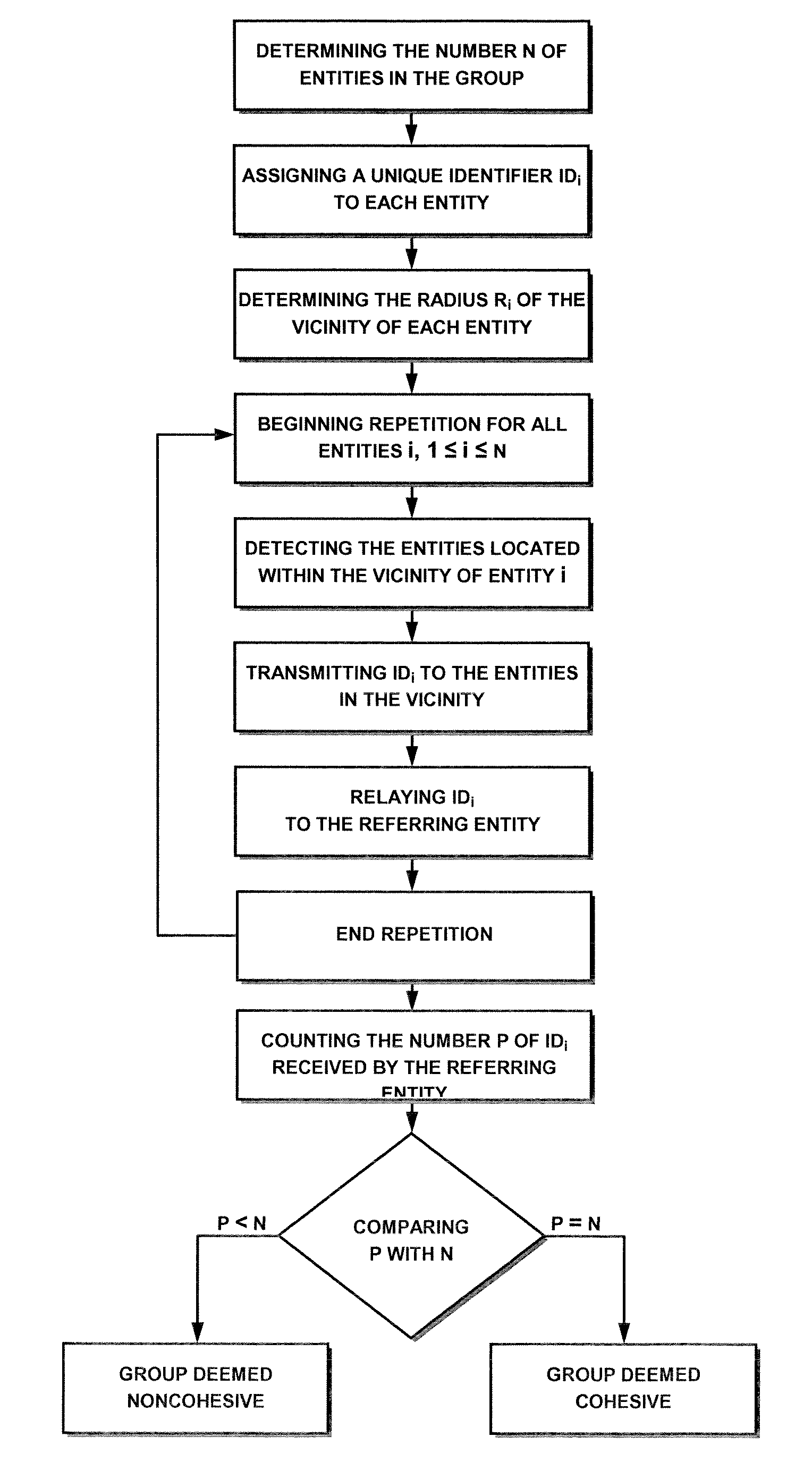
<figref idrefs="DRAWINGS">FIG. 4</figref> is a diagram illustrating various steps of a method according to the invention.
<figref idrefs="DRAWINGS">FIG. 5</figref> is a diagram illustrating a method of monitoring a group of mobile entities according to the invention.
<figref idrefs="DRAWINGS">FIGS. 1 to 3</figref> depict a group of N wirelessly communicating entities, such as Bluetooth or Zigbee radio sender/receivers, each entity equipping, for example, a member of a group of people for a dynamic monitoring of cohesiveness is required. Each entity is represented by a point in the figures.
Each mobile entity i (where 1≦i≦N) is associated with a unique identifier ID<sub>i</sub>. It is assumed that each entity possesses a certain emission range, depending on the power of its radio emitter. For the purposes of monitoring the group, within this range, a virtual vicinity is defined; this is a circle with a predetermined radius R centered upon the entity i (as depicted by the circles in <figref idrefs="DRAWINGS">FIGS. 1 to 3</figref>) and included within its range.
The entities may all have a vicinity of the same radius (in such a case, R is identical for all entities), or each entity may have a vicinity whose radius R<sub>i </sub>is specific to it.
In a first embodiment of the invention, illustrated in <figref idrefs="DRAWINGS">FIG. 4</figref>, the group of mobile entities is monitored in the following manner.
In the beginning, referring entity is defined, said entity being in charge of monitoring the group. This entity may, within a group of people, be the leader of the group (for example, an adult monitoring a group of children).
Next, the number N of entities in the group is determined. This number is saved within the referring entity. Each entity is then assigned a unique identifier ID<sub>i</sub>, the list of entities (i.e. the list of identifiers) is drawn up, this list being saved within the referring entity, and the radius of the vicinity of each entity is determined.
In a recurring manner (for example, every second), for each entity i in the group, the following operations are carried out: <ul><li id="ul0007-0001" num="0000"><ul><li id="ul0008-0001" num="0033">entity i detects the other entities located within its vicinity;</li><li id="ul0008-0002" num="0034">entity i transmits a message containing the identifier ID<sub>i </sub>to the detected entities, to be related to the referring entity.</li></ul></li></ul>
The messages are collected by the referring entity, which creates the list of identifiers contained within all the messages and then regularly (for example, every 1.5 seconds) evaluates the cohesiveness of the group by comparing this list with the saved list.
If the lists are identical, the group is deemed cohesive. This means that all of the entities were able to transmit their identifiers to the referring entity, and consequently, all of the entities are within one another's vicinity. This situation of cohesiveness is illustrated in <figref idrefs="DRAWINGS">FIG. 1</figref>.
If the lists are different, which means at least one entity is missing from the list of collected identifiers when compared to the saved list, the group is deemed non-cohesive. This means that at least one entity has no entities within its vicinity, or is not located within the vicinity of any other entity. Two non-cohesive configurations are illustrated in the drawings: a first one in <figref idrefs="DRAWINGS">FIG. 2</figref>, where an entity (whose vicinity is depicted as a dotted line) is detached from the group, and a second one in <figref idrefs="DRAWINGS">FIG. 3</figref>, with the group is split into two non-connected subgroups (the vicinities of the entities of one of these two groups being depicted as a dotted line), i.e. the vicinities of each of these subgroups include no entity of the other subgroup.
The checking of the group's cohesiveness may more simply be based on comparing the number of identifiers collected and the number of entities in the group, as initially saved within the referring entity. <ul><li id="ul0009-0001" num="0000"><ul><li id="ul0010-0001" num="0039">If the number P of different identifiers ID<sub>i </sub>collected by the referring entity is equal to the number N of entities in the group, the group is then deemed to be cohesive.</li><li id="ul0010-0002" num="0040">If the number P of different identifiers collected by the referring entity is less than the number N of entities in the group, the group is deemed to be non-cohesive.</li></ul></li></ul>
In a second embodiment of the invention, illustrated in <figref idrefs="DRAWINGS">FIG. 5</figref>, the group of mobile entities is monitored in the following manner.
The referring entity is defined, as indicated above. As before, the entity is then assigned a unique identifier ID<sub>i</sub>, the list of entities (i.e. the list of identifiers) is drawn up, this list being saved within the referring entity, and the radius of the vicinity of each entity is determined.
In a recurring manner (for example, every second), for each entity i in the group, the following operations are carried out: <ul><li id="ul0011-0001" num="0000"><ul><li id="ul0012-0001" num="0044">entity i detects the other entities located within its vicinity;</li><li id="ul0012-0002" num="0045">the distances separating the entity and the entities detected within its vicinity are evaluated;</li><li id="ul0012-0003" num="0046">entity i transmits a message to the detected entities to be relayed to the referring entity and comprising the identifier ID<sub>i </sub>as well as a table containing the identifiers of the detected entities and the distance from the entity to them.</li></ul></li></ul>
The messages are collected by the referring entity, which then regularly (for example, every 1.5 seconds) evaluates the cohesiveness of the group in the following manner:
The referring entity extracts the different identifiers from the collected tables, and creates a list of them. The list of the saved identifiers is compared as indicated above, with the conclusions regarding the cohesiveness of the group being drawn in the same manner.
In other words, if no identifiers are missing, all of the entities are either detected or were able to send a message to the referring entity. The group is then deemed cohesive.
On the other hand, if identifiers are missing from the collected tables, this means that an entity has become separated from the group, and either contains no other entities within its vicinity, or is not within the vicinity of any other entity. The group is then deemed non-cohesive.
Is possible to configure the issuing of an alert in the event that the group is deemed non-cohesive, in order to enable the referent (i.e., in practice, the carrier of the referring entity) to take the measures needed to make the group cohesive, such as by seeking out the missing elements of the group and incorporating them back into it. Such an alert, issued by the referring entity, may be an audio and/or visual alert.
If the group is deemed a non-cohesive, it is preferable to plan an identification of the missing entities. This identification may be carried out simply by identifying the non-received identifiers within the list of identifiers of all entities in the group, as saved within the referring entity.
It may then be provided, in order to restore cohesiveness to the group, to send to the carrier of any missing entity a message, over a channel separate from the communication performed within the ad hoc network formed by the entities of the group (for example, via a text message), in order to order it to rejoin the group. The referring entity may also identify the entities previously located within the vicinity of any missing entity, or whose vicinity previously comprised any missing entity. These entities may, for example, be alerted by the referring entity and their carriers, who are asked to seek out the missing entity (or entities) in order to incorporate it (or them) back into the group.
Additional operations may be provided for enabling more accurate monitoring of the group.
Thus, it is possible to define beforehand, for each entity of the group, a minimum quota of entities located within its vicinity. In such a case, each entity i, at the same time that it is detecting the other entities in its vicinity, repeatedly counts these entities. Next, the entity includes the number of the entities detected in this matter within its signal transmitted to the entities in its vicinity, to be relayed to the referring entity.
In this manner, the referring entity has, in addition to the number of entities actually located within the group, an additional piece of information—the number of entities and found within the vicinity at each entity—a characteristic of the group's density. In the event that density is one of the characteristics of the group which is to be monitored, and may be useful to alert the referent when this density drops below a minimum threshold, which indicates the dispersal of the group. Such an alert, issued by the referring entity, may be an audio and/or visual alert. Various degrees of alerts may be provided, depending on the density observed.
For example, a red alert may be issued if at least one entity of the group has a single entity with its vicinity; an orange alert being issued if at least one entity of the group has two other entities within its vicinity, and no alert being issued if any entity has at least three other entities within its vicinity.
Using the method described above, it is possible to dynamically monitor a group in a simple manner, without needing to centralize the sending of the presence notification within a central entity.
This method therefore enables greater flexibility for the group to be monitored, which may adopt various different topologies (for example, single-file), while maintaining its cohesiveness.
4 sheets
Sheet 1 Sheet 2 Sheet 3 Sheet 4
Every citation, both waysCites: the store holds 7 of 8
| Document | Relation | Office | Cited during |
|---|---|---|---|
| WO2005009067A1 | Cites | World Intellectual Property Organization (WIPO) | Applicant |
| WO2005091573A1 | Cites | World Intellectual Property Organization (WIPO) | Applicant |
| US2007008150A1 | Cites | United States of America | Applicant |
| US2007263647A1 | Cites | United States of America | Applicant |
| US7069016B2 | Cites | United States of America | Search report |
| US7353034B2 | Cites | United States of America | Search report |
| US7636339B2 | Cites | United States of America | Search report |
| French Search Report. | Non-patent | – | Applicant |
| Francoise Sailhan et al., "Wireless Mesh Network Monitoring: Design, Implementation and Experiments," Globecom Workshops, 2007, IEEE, PI, XP031207096 pp. 1-6. Nov. 1, 2007. | Non-patent | – | Applicant |
15 members in 9 offices
Priority claims4
| Document | Office | Kind | Date |
|---|---|---|---|
| 0708789 | France | A | |
| 0708789 | France | A | |
| 0708789 | – | – | – |
| FR20070008789 | – | – | – |
Members15
| Document | Office | Kind | |
|---|---|---|---|
| US2009156244A1 | United States of America | A1 | |
| FR2925248A1 | France | A1 | |
| CN101466143A | China | A | |
| EP2073438A1 | European Patent Office (EPO) | A1 | |
| WO2009077685A1 | World Intellectual Property Organization (WIPO) | A1 | |
| KR20100103612A | Republic of Korea | A | |
| EP2073438B1 | European Patent Office (EPO) | B1 | |
| JP2011507439A | Japan | A | |
| AT498961T | Austria | T | |
| ATE498961T1 | Austria | T1 | |
| DE602008004979D1 | Germany | D1 | |
| US8121608B2This record | United States of America | B2 | |
| KR101148652B1 | Republic of Korea | B1 | |
| JP5038506B2 | Japan | B2 | |
| CN101466143B | China | B |
43 transactions on the USPTO file
Allowed after 1 non-final rejection.
- Non-final rejections
- 1
- Final rejections
- 0
- RCEs
- 0
- Appeals
- 0
Over time
Point at a mark for the transactionTransactions
| Event | Code | |
|---|---|---|
| Expire PatentEXP. | EXP. | |
| Maintenance Fee Reminder MailedREM. | REM. | |
| Payment of Maintenance Fee, 8th Year, Large EntityM1552 | M1552 | |
| Recordation of Patent Grant MailedPGM/ | PGM/ | |
| Patent Issue Date Used in PTA CalculationAllowedPTAC | PTAC | |
| Issue Notification MailedAllowedWPIR | WPIR | |
| Dispatch to FDCD1935 | D1935 | |
| Application Is Considered Ready for IssuePILS | PILS | |
| Issue Fee Payment VerifiedN084 | N084 | |
| Issue Fee Payment ReceivedIFEE | IFEE | |
| Mail Response to 312 Amendment (PTO-271)MN271 | MN271 | |
| Response to Amendment under Rule 312N271 | N271 | |
| Amendment after Notice of Allowance (Rule 312)AllowedA.NA | A.NA | |
| Mail PUB other miscellaneous communication to applicantMM327-D | MM327-D | |
| PUB Other miscellaneous communication to applicantM327-D | M327-D | |
| Mail Notice of AllowanceAllowedMN/=. | MN/=. | |
| Notice of Allowance Data Verification CompletedAllowedN/=. | N/=. | |
| Case Docketed to Examiner in GAUDOCK | DOCK | |
| Date Forwarded to ExaminerFWDX | FWDX | |
| Response after Non-Final ActionA... | A... | |
| Mail Non-Final RejectionNon-final rejectionMCTNF | MCTNF | |
| Non-Final RejectionNon-final rejectionCTNF | CTNF | |
| Case Docketed to Examiner in GAUDOCK | DOCK | |
| Case Docketed to Examiner in GAUDOCK | DOCK | |
| Case Docketed to Examiner in GAUDOCK | DOCK | |
| Case Docketed to Examiner in GAUDOCK | DOCK | |
| Case Docketed to Examiner in GAUDOCK | DOCK | |
| IFW TSS Processing by Tech Center CompleteTSSCOMP | TSSCOMP | |
| PG-Pub Issue NotificationPG-ISSUE | PG-ISSUE | |
| Filing Receipt - CorrectedFLRCPT.C | FLRCPT.C | |
| Request for Foreign Priority (Priority Papers May Be Included)RQPR | RQPR | |
| Request for Foreign Priority (Priority Papers May Be Included)RQPR | RQPR | |
| Application Dispatched from OIPEOIPE | OIPE | |
| Sent to Classification ContractorPGPC | PGPC | |
| Application Is Now CompleteCOMP | COMP | |
| Filing ReceiptFLRCPT.O | FLRCPT.O | |
| Cleared by OIPE CSRL194 | L194 | |
| IFW Scan & PACR Auto Security ReviewSCAN | SCAN | |
| Information Disclosure Statement consideredIDSC | IDSC | |
| Reference capture on IDSRCAP | RCAP | |
| Information Disclosure Statement (IDS) FiledM844 | M844 | |
| Information Disclosure Statement (IDS) FiledWIDS | WIDS | |
| Initial Exam Team nnIEXX | IEXX |
27 legal events, as the office reported them to INPADOC
Over the term
Point at a mark for the eventEvents
| Event | Code | |
|---|---|---|
| Lapsed due to failure to pay maintenance feeLapsedFP | FP | |
| Lapse for failure to pay maintenance feesLapsedPATENT EXPIRED FOR FAILURE TO PAY MAINTENANCE FEES (ORIGINAL EVENT CODE: EXP.); ENTITY STATUS OF PATENT OWNER: LARGE ENTITYLAPS | LAPS | |
| Information on status: patent discontinuationPATENT EXPIRED DUE TO NONPAYMENT OF MAINTENANCE FEES UNDER 37 CFR 1.362STCH | STCH | |
| Fee payment procedureMAINTENANCE FEE REMINDER MAILED (ORIGINAL EVENT CODE: REM.); ENTITY STATUS OF PATENT OWNER: LARGE ENTITYFEPP | FEPP | |
| AssignmentAS | AS | |
| AssignmentAS | AS | |
| AssignmentAS | AS | |
| AssignmentAS | AS | |
| AssignmentAS | AS | |
| AssignmentAS | AS | |
| AssignmentAS | AS | |
| AssignmentAS | AS | |
| AssignmentAS | AS | |
| AssignmentAS | AS | |
| AssignmentAS | AS | |
| Maintenance fee paymentMAFP | MAFP | |
| AssignmentAS | AS | |
| AssignmentAS | AS | |
| AssignmentAS | AS | |
| AssignmentAS | AS | |
| Fee paymentFPAY | FPAY | |
| Information on status: patent grantGrantedPATENTED CASESTCF | STCF | |
| Fee payment procedurePAYOR NUMBER ASSIGNED (ORIGINAL EVENT CODE: ASPN); ENTITY STATUS OF PATENT OWNER: LARGE ENTITYFEPP | FEPP | |
| Notice of allowance mailedORIGINAL CODE: MN/=.ZAAB | ZAAB | |
| Notice of allowance and fees dueORIGINAL CODE: NOAZAAA | ZAAA | |
| AssignmentAS | AS | |
| AssignmentAS | AS |
Numbers
- Publication
- 08121608
- Publication, DOCDB
- 8121608
- Publication, EPODOC
- US8121608
- Application
- 12335955
- Application, DOCDB
- 33595508
- Application, EPODOC
- US20080335955
Titles
- English
- Method for dynamically monitoring a group of mobile entities
Patent term adjustment
- A delay
- +504 daysthe office missed an examination deadline
- B delay
- +67 dayspendency past three years
- Applicant delay
- −5 days
- Net adjustment
- 566 days
Classification
- CPC, 5
- H04W8/26
- H04W4/08
- H04W4/12
- H04W24/00
- H04W88/04
- IPC, 1
- H04W72 00
- USPC, 2
- 455453000
- 455517000