Passing information from a forwarding plane to a control plane
Summary by NHIP
Kernel Buffer Event Passing
The method conveys multicast events from a user-level data-plane process to a user-level control-plane process via an operating system kernel. An event code representing the event is placed in an unused field of a kernel buffer, bypassing shared memory and avoiding control-plane modifications.
Claim Score by NHIP
Abstract
Safe and efficient passing of information from a forwarding-plane to a control-plane is provided. The information can be passed from a forwarding-plane process to a control-plane process without having to modify the control-plane process and without requiring the processes to pass information via shared memory. The information is encoded in the forwarding-plane process. The encoded information is passed to the operating system, wherein the operating system interprets the encoded information and reports the information to the control plane process. The present invention can be advantageously utilized in passing multicast events from a forwarding-plane process to a control-plane process. Multicast events can be passed from a forwarding-plane process to a control-plane process without having to modify the control-plane process and without requiring the processes to pass messages via shared memory.
Term
Projected expiry 18 November 2027.
- Priority and filed
- Granted
- Today
- Projected expiry
16 claims: 3 independent, 13 dependent
- 1Broadest claimClaim Score 42, average(NHIP)A method for conveying information from a forwarding-plane process to a control-plane process, comprising:encoding the information in the forwarding-plane process;passing the encoded information from the forwarding-plane process to an operating system;interpreting the encoded information in the operating system;and reporting the encoded information to the control-plane process, the information being passed from the forwarding-plane process to the control-plane process via an unused field in a kernel buffer of the operating system so that messages need not be passed from the forwarding-plane process to the control-plane process through shared memory;wherein encoding the information in the forwarding-plane process includes: detecting an occurrence of a multicast event;creating an event code, based on the multicast event, at a data-plane process operating at a user level, wherein the event code comprises an encoded version of the multicast event, the data-plane process using a first memory mechanism, the event code representing the multicast event;and passing the event code to a kernel of the operating system;wherein interpreting the encoded information in the operating system includes: via a system-level process, interpreting the event code;and formatting the event code according to a format handled by the control-plane process, the control-plane process operating at the user-level;wherein reporting the encoded information to the control-plane process includes: reporting a formatted event code from the operating system to the control-plane process, the control-plane process using a second memory mechanism, wherein the second memory mechanism is separate from the first memory mechanism.
- 6A non-transitory computer-readable medium containing an executable program for performing a method for conveying information from a forwarding-plane process to a control-plane process, the method comprising:encoding the information in the forwarding-plane process;passing the encoded information from the forwarding-plane process to an operating system;interpreting the encoded information in the operating system;and reporting the encoded information to the control-plane process, the information being passed from the forwarding-plane process to the control-plane process via an unused field in a kernel buffer of the operating system so that messages need not be passed from the forwarding-plane process to the control-plane process through shared memory;wherein encoding the information in the forwarding-plane process includes: detecting an occurrence of a multicast event;creating an event code, based on the multicast event, at a data-plane process operating at a user level, wherein the event code comprises an encoded version of the multicast event, the data-plane process using a first memory mechanism, the event code representing the multicast event;and passing the event code to a kernel of the operating system;wherein interpreting the encoded information in the operating system includes: via a system-level process, interpreting the event code;and formatting the event code according to a format handled by the control-plane process, the control-plane process operating at the user-level;wherein reporting the encoded information to the control-plane process includes: reporting a formatted event code from the operating system to the control-plane process, the control-plane process using a second memory mechanism, wherein the second memory mechanism is separate from the first memory mechanism.
- 11A networking system adapted to convey information from a forwarding-plane process to a control-plane process by:encoding the information in the forwarding-plane process;passing the encoded information from the forwarding-plane process to an operating system executed via at least one processor;interpreting the encoded information in the operating system;and reporting the encoded information to the control-plane process;passing the information from the forwarding-plane process to the control-plane process via an unused field in a kernel buffer of the operating system so that messages need not be passed from the forwarding-plane process to the control-plane process through shared memory;wherein encoding the information in the forwarding-plane process includes: detecting an occurrence of a multicast event;creating an event code, based on the multicast event, at a data-plane process operating at a user level, wherein the event code comprises an encoded version of the multicast event, the data-plane process using a first memory mechanism, the event code representing the multicast event;and passing the event code to a kernel of the operating system;wherein interpreting the encoded information in the operating system includes: via a system-level process, interpreting the event code;and formatting the event code according to a format handled by the control-plane process, the control-plane process operating at the user-level;wherein reporting the encoded information to the control-plane process includes: reporting a formatted event code from the operating system to the control-plane process, the control-plane process using a second memory mechanism, wherein the second memory mechanism is separate from the first memory mechanism.
Independent claims3
25 paragraphs in 5 sections, as filed
FIELD OF THE INVENTION
p-0002The present invention relates generally to network systems. More particularly, the present invention relates to passing information from a forwarding plane in the network system to a control plane in the network system.
BACKGROUND OF THE INVENTION
p-0003The continued growth of the Internet in combination with demands for new services is rapidly increasing the requirements imposed on network systems, such as IP routers. The basic functions of an IP router can be divided into two main components: the forwarding plane (also referred to as the data plane) and the control plane. These components, while inter-related, perform functions that are largely independent of each other. The forwarding plane is generally responsible for a router's capacity to process and forward packets, which may include functions such as packet forwarding (also referred to as packet switching), which is the act of receiving packets on the router's interfaces and usually sending them out on other interfaces; classification; traffic shaping; and metering. The control plane is generally responsible for controlling the router. The control plane implements functions such as routing protocols, signaling protocols, control protocols (e.g., RIP, OSPF, and RSVP), and network management and dictates the forwarding behavior by manipulating forwarding tables, per-flow QoS tables, and access control lists. For example, the control plane gathers and maintains network topology information and passes this information to the forwarding plane so that the forwarding plane knows where to forward received packets. Typically, the architecture of these two components combines all of the required functionality into a single functional whole with respect to external entities. The increasing requirements put on network systems, such as IP routers, require new protocols in the routers, leading to an increased complexity in the control plane and frequently involve and affect the communication between the forwarding plane and the control plane.
SUMMARY OF THE INVENTION
p-0004The present invention addresses the communication needs between the forwarding plane and the control plane by providing for safe and efficient passing of information from a forwarding-plane process operating at a user level to a control-plane process operating at a user level. The present invention provides a more modular approach than is provided by operating systems that perform the forwarding-plane functionality while at the same time requiring less communication overhead than required by shared-memory approaches to communicating information between a forwarding-plane process at the user level and a control-plane process at the user level. In accordance with the present invention, information can be passed from a forwarding-plane process to a control-plane process without having to modify the control-plane process and without requiring the processes to pass information via shared memory. The information to be passed is encoded in the forwarding-plane process. The encoded information is first passed to the operating system, wherein the operating system interprets the encoded information and reports the information to the control plane process. The present invention can be advantageously utilized in passing multicast events from a forwarding-plane process to a control-plane process. In accordance with the present invention, multicast events can be passed from a forwarding-plane process to a control-plane process without having to modify the control-plane process and without requiring the processes to pass the multicast events via shared memory.
BRIEF DESCRIPTION OF THE DRAWING
p-0005The above and further advantages of this invention may be better understood by referring to the following description in conjunction with the accompanying drawing. The drawing is not meant to limit the scope of the invention. For clarity, not every element may be labeled in the drawing.
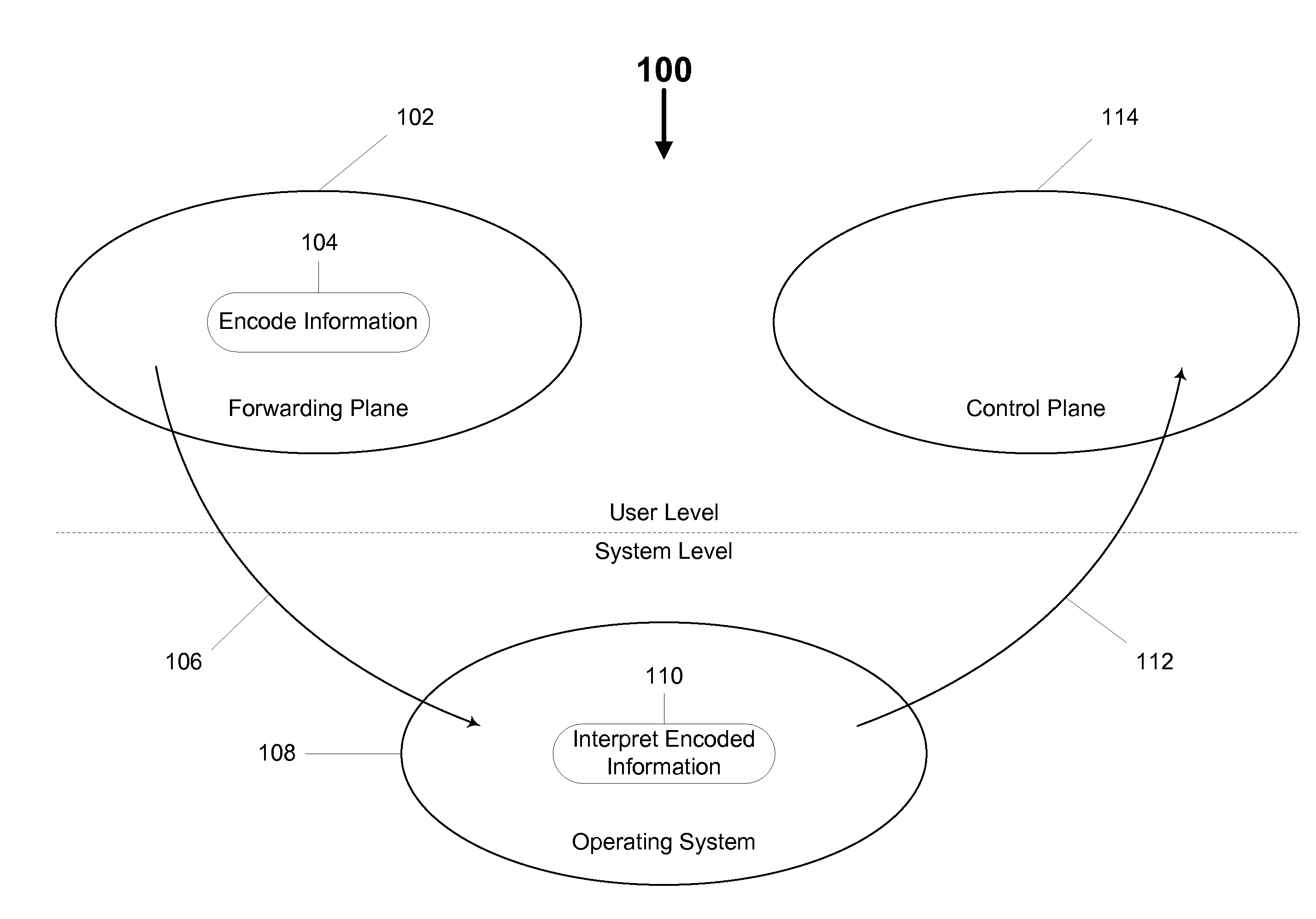
p-0006<figref idrefs="DRAWINGS">FIG. 1</figref> illustrates a process of passing information from a forwarding plane to an operating system and then to a control plane in accordance with the present invention.
DETAILED DESCRIPTION OF THE INVENTION
p-0007The continued growth of the Internet in combination with demands for new services is rapidly increasing the requirements imposed on network systems, such as IP routers. Network systems are also referred to in the networking industry as network nodes or network elements. The basic functions of an IP router can be divided into two main components: the forwarding plane (also referred to as the data plane) and the control plane. These components, while inter-related, perform functions that are largely independent of each other. The forwarding plane is generally responsible for a router's capacity to process and forward packets, which may include functions such as packet forwarding (also referred to as packet switching), which is the act of receiving packets on the router's interfaces and usually sending them out on other interfaces; classification; traffic shaping; and metering. The processes that execute the functionality of the forwarding plane are referred to herein as forwarding-plane processes. The control plane is generally responsible for controlling the router. The control plane implements functions such as routing protocols, signaling protocols, control protocols (e.g., RIP, OSPF, and RSVP), and network management and dictates the forwarding behavior by manipulating forwarding tables, per-flow QoS tables, and access control lists. For example, the control plane gathers and maintains network topology information and passes this information to the forwarding plane so that the forwarding plane knows where to forward received packets. Processes that execute the functionality of the control plane are referred to herein as control-plane processes. Typically, the architecture of these two components combines all of the required functionality into a single functional whole with respect to external entities.
p-0008As is known in the art, network systems generally include an operating system (e.g., Linux, UNIX, Microsoft Windows, etc.) and one or more processes that run at a user level. Generally, user-level process are written as applications separate and distinct from the processes that are considered to be part of the operating system. With respect to a user-level process, control functionality resides entirely within the application. User-level processes may also be referred to as application-level processes. Kernel-level or system-level processes, on the other hand, are implemented as a service at the operating system level. Individuals with ordinary skill in the art of computer programming understand what a user-level process is and how it differs from an operating system kernel, a kernel-level process, and a system-level process. Sometimes user-level processes are described as running on a particular operating system.
p-0009During the operation of a network system, such as a router, information may need to be passed from the forwarding plane to the control plane. The information passed may be referred to herein as a message. A first approach to passing information from the forwarding plane to the control plane involves the forwarding plane being integrated into the operating system. In this approach, the operating system kernel generates a message during its performance of the forwarding-plane functionality and then conveys the message to the control-plane process. Unless herein stated otherwise, a control-plane process is a user-level process. This first approach can be undesirable as it requires an implementer of a network system either to be dependent on the operating system's forwarding-plane process and functionality or to make significant modifications to the operating system to install a desired forwarding-plane process and functionality.
p-0010A second approach to passing information from the forwarding plane to the control plane involves having a forwarding-plane process that is a user-level process and, therefore, not integrated into the operating system. This second approach is a more modular approach and allows the forwarding-plane process to be implemented and modified separately from the implementation of the operating system. However, this second approach is based on passing messages through memory shared by the two user-level processes (i.e., the forwarding-plane process and the control-plane process). This shared-memory approach requires locks or synchronization mechanisms to handle the shared memory. Locks and synchronization mechanisms can be complex and instill communication overhead, making the inefficient to operate.
p-0011The increasing requirements put on network systems, such as IP routers, require new protocols in the routers, leading to an increased complexity in the control plane and frequently involve and affect the communication between the forwarding plane and the control plane. The present invention provides for safe and efficient passing of messages from a forwarding-plane process operating at a user level to a control-plane process operating at a user level. The present invention provides a more modular approach than is provided by operating systems that provide the forwarding-plane functionality while at the same time requiring less communication overhead than required by shared-memory approaches to communicating messages between a forwarding-plane process at the user level and a control-plane process at the user level.
p-0012In accordance with the present invention, information can be passed from a forwarding-plane process to a control-plane process without having to modify the control-plane process and without requiring the processes to pass messages via shared memory. Messages to be passed to the control-plane process are first encoded in the forwarding-plane process. The encoding may be a very simple process such as representing the information as a single integer value. The encoded message is then passed to the operating system. That is, the message can be encoded in a user buffer utilized by the forwarding-plane process and then sent to the operating system. The operating system interprets the encoded message and reports the message to the control plane process. In preferred embodiments, the message can be reported to the control-plane process in the same manner that messages get reported to control-plane processes of the prior art.
p-0013<figref idrefs="DRAWINGS">FIG. 1</figref> illustrates a process <b>100</b> of passing information from a forwarding plane to an operating system and then to a control plane in accordance with the present invention. According to the process <b>100</b>, a forwarding-plane process <b>102</b> executing at a user level encodes <b>104</b> information and then passes <b>106</b> the information to an operating system. A system-level process <b>108</b> interprets <b>110</b> the encoded information and passes <b>112</b> the information to a control-plane process <b>114</b> executing at a user level.
p-0014The present invention can be advantageously utilized in passing multicast events from a forwarding-plane process to a control-plane process. Multicasting is a way of efficiently transmitting text, audio, and video on the Internet or an internal network to a select group of people, much like a conference call includes a select group of people. Instead of sending information in individual packets to each recipient, a single message is sent to a multicast group, which includes all the people that want to participate in the multicast session. Thus, multicasting is a one-to-many transmission. In contrast, the traditional method of sending messages on the Internet, called unicasting, is a one-to-one transmission.
p-0015Multicasting provides a way for one host to send packets to a selective group of hosts. Users choose to be part of a specific multicast. Multicast packets then travel to the user from the multicast source. An important point is that multicast packets only travel across routes where there is an end user that has requested to be part of the multicast. Users indicate to their local router that they want to be part of a particular multicast group. That router then indicates to the next router closest to the source of the multicast that it wants to receive the multicast. This process continues until a path is established between the multicast source and the person who wants to join the multicast. The result is that only routers that need multicast packets for end systems actually receive those packets. Nonparticipating routers do not receive the packets, making the process more efficient. This keeps multicast packets from crossing parts of the network that do not have multicast participants. Still, on the Internet, a multicast group is potentially huge, with members located around the world.
p-0016Internet Protocol (“IP”) multicast, an important IP-based network-infrastructure component, lets a network deliver one data stream from a source to a group of destinations. This process saves network bandwidth and provides Quality of Service (“QoS”) for time-sensitive applications such as multimedia products. Manufacturers of operating systems (e.g., the Microsoft Corporation) are providing more support for IP multicast in newer versions of their operating systems. However, existing operating systems provide only host-level support for the Internet Group Management Protocol (“IGMP”), a fundamental protocol of IP multicast. Some existing operating systems support IGMP at the host-level and the router-level. In addition, some existing operating systems support IP multicast forwarding, administrative scoping, and the multicast DHCP service, and include a built-in multicast application.
p-0017In accordance with the present invention, multicast events can be passed from a forwarding-plane process to a control-plane process without having to modify the control-plane process and without requiring the processes to pass messages via shared memory. While the present invention will be addressed in some detail as it relates to multicasting, it should be understood that the present invention can be advantageously utilized in passing messages, other than multicast messages, from a forwarding plane to a control plane.
p-0018In the present invention, the functionality of a forwarding plane is implemented in a forwarding-plane process that operates at the user level. That is, forwarding-plane processes of the present invention are user-level processes. The forwarding-plane process detects the occurrence of a multicast event. Multicast events are known in the art. Examples of multicast events include register messages, asserts, and cache misses. When a detected multicast-event needs to be sent to a control-plane process it is first encoded and sent to the operating system. The encoded multicast-event is referred to herein as an Event Code and in preferred embodiments is a 32-bit integer. When the Event Code is a 32-bit integer, a large number of different events can be sent in this manner. One of ordinary skill in the art will readily understand that many different kinds of events (i.e., not just multicast events) can be encoded and sent to the operating system with a single 32-bit integer.
p-0019In one embodiment, a TUN/TAP device driver is utilized to pass encoded information (e.g., an Event Code) to a Linux kernel. TUN/TAP is known in the art and provides packet reception and transmission for user space programs. It can be viewed as a simple Point-to-Point or Ethernet device, which instead of receiving packets from a physical media, receives them from user-level programs and instead of sending packets via physical media writes them to user-level programs.
p-0020A socket buffer, or “SKB” is one of the most fundamental data structures in the Linux networking code. Every packet sent or received is handled using this data structure. The most fundamental parts of the SKB structure are as follows:
p-0021<tables id="TABLE-US-00001" num="00001"><table frame="none" colsep="0" rowsep="0"><tgroup align="left" colsep="0" rowsep="0" cols="2"><colspec colname="offset" colwidth="42pt" align="left" /><colspec colname="1" colwidth="175pt" align="left" /><thead><row><entry /><entry namest="offset" nameend="1" align="center" rowsep="1" /></row></thead><tbody valign="top"><row><entry /><entry>struct sk_buff {</entry></row></tbody></tgroup><tgroup align="left" colsep="0" rowsep="0" cols="2"><colspec colname="offset" colwidth="56pt" align="left" /><colspec colname="1" colwidth="161pt" align="left" /><tbody valign="top"><row><entry /><entry>/* These two members must be first. */</entry></row></tbody></tgroup><tgroup align="left" colsep="0" rowsep="0" cols="3"><colspec colname="offset" colwidth="56pt" align="left" /><colspec colname="1" colwidth="70pt" align="left" /><colspec colname="2" colwidth="91pt" align="left" /><tbody valign="top"><row><entry /><entry>struct sk_buff</entry><entry>*next;</entry></row><row><entry /><entry>struct sk_buff</entry><entry>*prev;</entry></row><row><entry /><entry>struct sk_buff_head</entry><entry>*list;</entry></row></tbody></tgroup><tgroup align="left" colsep="0" rowsep="0" cols="2"><colspec colname="offset" colwidth="42pt" align="left" /><colspec colname="1" colwidth="175pt" align="left" /><tbody valign="top"><row><entry /><entry>. . .</entry></row><row><entry /><entry namest="offset" nameend="1" align="center" rowsep="1" /></row></tbody></tgroup></table></tables><br /> In accordance with the present invention, an Event Code can be transferred to an unused field of the kernel buffer (e.g. skbuff in the case of Linux). For example, in Linux this transfer can be perform with the single line of code listed below. <ul><li id="ul0001-0001" num="0000"><ul><li id="ul0002-0001" num="0021">skbuff->unused=<Event Code></li></ul></li></ul>
p-0022Minor modifications can be made to existing operating systems in order to interpret encoded information that the operating system receives from a forwarding-plane process. For example, the part of a Linux kernel that performs forwarding-plane functionality for handling multicast events may have code that performs similar to the following psuedo-code description:
p-0023<tables id="TABLE-US-00002" num="00002"><table frame="none" colsep="0" rowsep="0"><tgroup align="left" colsep="0" rowsep="0" cols="2"><colspec colname="offset" colwidth="14pt" align="left" /><colspec colname="1" colwidth="203pt" align="left" /><thead><row><entry /><entry namest="offset" nameend="1" align="center" rowsep="1" /></row></thead><tbody valign="top"><row><entry /><entry>ip_mr_input(..)</entry></row><row><entry /><entry>{</entry></row></tbody></tgroup><tgroup align="left" colsep="0" rowsep="0" cols="2"><colspec colname="offset" colwidth="28pt" align="left" /><colspec colname="1" colwidth="189pt" align="left" /><tbody valign="top"><row><entry /><entry>{</entry></row><row><entry /><entry>- native Linux multicast table look up</entry></row><row><entry /><entry>- native event generating mechanism</entry></row><row><entry /><entry>- use cache_report to report the event to the control plane</entry></row><row><entry /><entry>}</entry></row></tbody></tgroup><tgroup align="left" colsep="0" rowsep="0" cols="2"><colspec colname="offset" colwidth="14pt" align="left" /><colspec colname="1" colwidth="203pt" align="left" /><tbody valign="top"><row><entry /><entry>}</entry></row><row><entry /><entry namest="offset" nameend="1" align="center" rowsep="1" /></row></tbody></tgroup></table></tables><br /> According to the above-described section of code in the prior art, the Linux kernel performs a multicast table look up and then generates a multicast event. Once the multicast event is generated, the cache_report function is used to report the multicast event to the control plane. The control-plane process can then perform whatever functionality is needed to handle the multicast event appropriately. The above code might be found in an operating system that performs the functionality of the forwarding plane.
p-0024In accordance with the present invention, the above Linux-kernel code can be modified so as to perform in accordance with the following psuedo-code description:
p-0025<tables id="TABLE-US-00003" num="00003"><table frame="none" colsep="0" rowsep="0"><tgroup align="left" colsep="0" rowsep="0" cols="2"><colspec colname="offset" colwidth="14pt" align="left" /><colspec colname="1" colwidth="203pt" align="left" /><thead><row><entry /><entry namest="offset" nameend="1" align="center" rowsep="1" /></row></thead><tbody valign="top"><row><entry /><entry>ip_mr_input(..)</entry></row><row><entry /><entry>{</entry></row></tbody></tgroup><tgroup align="left" colsep="0" rowsep="0" cols="2"><colspec colname="offset" colwidth="28pt" align="left" /><colspec colname="1" colwidth="189pt" align="left" /><tbody valign="top"><row><entry /><entry>{</entry></row><row><entry /><entry>- interpret the Event Code</entry></row><row><entry /><entry>- use the native Linux call cache_report to report the event</entry></row><row><entry /><entry> to the control plane</entry></row><row><entry /><entry>}</entry></row></tbody></tgroup><tgroup align="left" colsep="0" rowsep="0" cols="2"><colspec colname="offset" colwidth="14pt" align="left" /><colspec colname="1" colwidth="203pt" align="left" /><tbody valign="top"><row><entry /><entry>}</entry></row><row><entry /><entry namest="offset" nameend="1" align="center" rowsep="1" /></row></tbody></tgroup></table></tables><br /> Thus, instead of performing a multicast table look up and generating a multicast event, the Linux kernel can be modified to interpret the Event Code that was passed to the operating system and copied to a kernel buffer (e.g., skbuff). When the Event Code is interpreted, it is put in a format that is appropriate for reporting the multicast event to the control plane. The format may be identical to that which is used in the prior art. At this point, the Linux kernel can report the multicast event in exactly the same manner as is done in the prior art. For example, in the two sections of Linux-kernel code described above the exact same call to the cache_report function can be used to report a multicast event to the control plane. Control-plane processes do not need to be modified to operate in accordance with the present invention. That is, once the Event Code has been interpreted in the operating system, a method of reporting the multicast event known in the art can be used and the control-plane process that handles the reported multicast event can be a control-plane process known in the art.
p-0026In accordance with the present invention, it has been shown that information can be passed from a forwarding-plane process to a control-plane process without having to modify the control-plane process and without requiring the forwarding-plane process and control-plane process to use shared-memory mechanisms to pass the information. While the present invention has been shown and described herein with reference to specific embodiments thereof (e.g., passing multicast events), it should be understood by those skilled in the art that variations, alterations, changes in form and detail, and equivalents may be made or conceived of without departing from the spirit and scope of the invention. Accordingly, the scope of the present invention should be assessed as that of the appended claims and by equivalents thereto.
Contents5
2 sheets
Sheet 1 Sheet 2
Every citation, both ways
| Document | Relation | Office | Cited during |
|---|---|---|---|
| US9319337B2 | Cited by | United States of America | Applicant |
| US11509564B2 | Cited by | United States of America | Applicant |
| US10326660B2 | Cited by | United States of America | Applicant |
| US12028215B2 | Cited by | United States of America | Applicant |
| US10033579B2 | Cited by | United States of America | Applicant |
| US11425055B2 | Cited by | United States of America | Applicant |
| US10103939B2 | Cited by | United States of America | Applicant |
| US11539591B2 | Cited by | United States of America | Applicant |
| US2013058348A1 | Cited by | United States of America | Pre-grant |
| US10505856B2 | Cited by | United States of America | Applicant |
| US9154433B2 | Cited by | United States of America | Applicant |
| US9288104B2 | Cited by | United States of America | Applicant |
| US9246833B2 | Cited by | United States of America | Applicant |
| US9306864B2 | Cited by | United States of America | Applicant |
| US11223531B2 | Cited by | United States of America | Applicant |
| US9923760B2 | Cited by | United States of America | Applicant |
| US9407566B2 | Cited by | United States of America | Applicant |
| US11601521B2 | Cited by | United States of America | Applicant |
| US9300593B2 | Cited by | United States of America | Applicant |
| US12111787B2 | Cited by | United States of America | Applicant |
| US10320585B2 | Cited by | United States of America | Applicant |
| US11876679B2 | Cited by | United States of America | Applicant |
| US9590919B2 | Cited by | United States of America | Applicant |
| US9203701B2 | Cited by | United States of America | Applicant |
| US11288249B2 | Cited by | United States of America | Applicant |
| US12463871B2 | Cited by | United States of America | Applicant |
| US9253109B2 | Cited by | United States of America | Applicant |
| US10135676B2 | Cited by | United States of America | Applicant |
| US10204122B2 | Cited by | United States of America | Applicant |
| US9319336B2 | Cited by | United States of America | Applicant |
| US9319338B2 | Cited by | United States of America | Applicant |
| US11677588B2 | Cited by | United States of America | Applicant |
| US9954793B2 | Cited by | United States of America | Applicant |
| US11669488B2 | Cited by | United States of America | Applicant |
| US9106587B2 | Cited by | United States of America | Search report |
| US9137107B2 | Cited by | United States of America | Applicant |
| US9602421B2 | Cited by | United States of America | Applicant |
| US9391928B2 | Cited by | United States of America | Applicant |
| US11019167B2 | Cited by | United States of America | Applicant |
| US9967134B2 | Cited by | United States of America | Applicant |
| US8930604B2 | Cited by | United States of America | Applicant |
| US9525647B2 | Cited by | United States of America | Applicant |
| US11979280B2 | Cited by | United States of America | Applicant |
| US9231882B2 | Cited by | United States of America | Applicant |
| US10931600B2 | Cited by | United States of America | Applicant |
| US2002167910A1 | Cites | United States of America | Search report |
| US2005013274A1 | Cites | United States of America | Search report |
| US2005147095A1 | Cites | United States of America | Search report |
| US2006018253A1 | Cites | United States of America | Search report |
| US2006056427A1 | Cites | United States of America | Applicant |
| US2006072480A1 | Cites | United States of America | Search report |
| US2007104204A1 | Cites | United States of America | Search report |
| US6091712A | Cites | United States of America | Search report |
| US7200865B1 | Cites | United States of America | Search report |
| US7221660B1 | Cites | United States of America | Search report |
| http://research.microsoft.com/en-us/um/people/dmaltz/papers/tesseract-nsdi07.pdf "Tesseract: A 4D Network Control Plane"-Hong Yan Carnegie Mellon University, Microsoft Research, & Rice University. | Non-patent | – | Search report |
| http://www.cisco.com/en/US/docs/routers/crs/crs1/16-slot-lc/system-description/reference/guide/sysdsc8.pdf "Control Plane"-Cisco CRS Carrier Rouing System. | Non-patent | – | Search report |
| http://www.juniper.net/us/en/local/pdf/whitepapers/2000261-en.pdf "Control Plane Scaling and Router Virtualization"-Juniper Networks. | Non-patent | – | Search report |
| Hidell, M. et al.; "Control and Forwarding Plane Interaction in Distributed Routers"; KTH-Royal Institute of Technology; Mar. 2005; 13 pages. | Non-patent | – | Applicant |
| Stardust Technologies, Inc.; "How IP Multicast Works"; IP Multicast Initiative; 12 pages. | Non-patent | – | Applicant |
| Estrin, D. et al.; "Protocol Independent Multicast-Sparse Mode (PIM-SM): Protocol Specification"; The Internet Society (1998); Jun. 1998; RFC 2362; 66 pages. | Non-patent | – | Applicant |
| Deering, S.; "Host Extensions for IP Multicasting"; Aug. 1989; RFC 1112; 17 pages. | Non-patent | – | Applicant |
2 members in 1 office; this record represents the family
Members2
| Document | Office | Kind | |
|---|---|---|---|
| US2007280231A1 | United States of America | A1 | |
| US8010696B2This record | United States of America | B2 |
77 transactions on the USPTO file
Allowed after 3 non-final rejections, 1 final rejection and 1 RCE.
- Non-final rejections
- 3
- Final rejections
- 1
- RCEs
- 1
- Appeals
- 0
Over time
Point at a mark for the transactionTransactions
| Event | Code | |
|---|---|---|
| Expire PatentEXP. | EXP. | |
| Maintenance Fee Reminder MailedREM. | REM. | |
| Payment of Maintenance Fee, 8th Year, Large EntityM1552 | M1552 | |
| Recordation of Patent Grant MailedPGM/ | PGM/ | |
| Patent Issue Date Used in PTA CalculationAllowedPTAC | PTAC | |
| Email NotificationEML_NTR | EML_NTR | |
| Issue Notification MailedAllowedWPIR | WPIR | |
| Dispatch to FDCD1935 | D1935 | |
| Dispatch to FDCD1935 | D1935 | |
| Application Is Considered Ready for IssuePILS | PILS | |
| Issue Fee Payment VerifiedN084 | N084 | |
| Issue Fee Payment ReceivedIFEE | IFEE | |
| Electronic ReviewELC_RVW | ELC_RVW | |
| Email NotificationEML_NTF | EML_NTF | |
| Mail Notice of AllowanceAllowedMN/=. | MN/=. | |
| Notice of Allowance Data Verification CompletedAllowedN/=. | N/=. | |
| Date Forwarded to ExaminerFWDX | FWDX | |
| Email NotificationEML_NTR | EML_NTR | |
| Change in Power of Attorney (May Include Associate POA)PA.. | PA.. | |
| Correspondence Address ChangeC.AD | C.AD | |
| Response after Non-Final ActionA... | A... | |
| Mail Non-Final RejectionNon-final rejectionMCTNF | MCTNF | |
| Non-Final RejectionNon-final rejectionCTNF | CTNF | |
| Date Forwarded to ExaminerFWDX | FWDX | |
| Response after Non-Final ActionA... | A... | |
| Mail Non-Final RejectionNon-final rejectionMCTNF | MCTNF | |
| Non-Final RejectionNon-final rejectionCTNF | CTNF | |
| Date Forwarded to ExaminerFWDX | FWDX | |
| Response after Non-Final ActionA... | A... | |
| Mail Notice of Informal or Non-Responsive RCE AmendmentMCPA-AMD | MCPA-AMD | |
| RCE Amendment Informal or Non-ResponsiveCPA-AMD | CPA-AMD | |
| Date Forwarded to ExaminerFWDX | FWDX | |
| Date Forwarded to ExaminerFWDX | FWDX | |
| Disposal for a RCE / CPA / R129AbandonedABN9 | ABN9 | |
| Request for Continued Examination (RCE)RCEX | RCEX | |
| Request for Extension of Time - GrantedXT/G | XT/G | |
| Workflow - Request for RCE - BeginBRCE | BRCE | |
| Mail Advisory Action (PTOL - 303)MCTAV | MCTAV | |
| Advisory Action (PTOL-303)CTAV | CTAV | |
| Date Forwarded to ExaminerFWDX | FWDX | |
| Response after Final ActionA.NE | A.NE | |
| Mail Final Rejection (PTOL - 326)Final rejectionMCTFR | MCTFR | |
| Final RejectionFinal rejectionCTFR | CTFR | |
| Date Forwarded to ExaminerFWDX | FWDX | |
| Response after Non-Final ActionA... | A... | |
| Request for Extension of Time - GrantedXT/G | XT/G | |
| Mail Non-Final RejectionNon-final rejectionMCTNF | MCTNF | |
| Non-Final RejectionNon-final rejectionCTNF | CTNF | |
| Case Docketed to Examiner in GAUDOCK | DOCK | |
| Case Docketed to Examiner in GAUDOCK | DOCK | |
| Case Docketed to Examiner in GAUDOCK | DOCK | |
| Transfer Inquiry to GAUTI1050 | TI1050 | |
| Transfer Inquiry to GAUTI1050 | TI1050 | |
| Transfer Inquiry to GAUTI1050 | TI1050 | |
| Case Docketed to Examiner in GAUDOCK | DOCK | |
| Transfer Inquiry to GAUTI1050 | TI1050 | |
| Transfer Inquiry to GAUTI1050 | TI1050 | |
| Transfer Inquiry to GAUTI1050 | TI1050 | |
| PG-Pub Issue NotificationPG-ISSUE | PG-ISSUE | |
| Transfer Inquiry to GAUTI1050 | TI1050 | |
| Transfer Inquiry to GAUTI1050 | TI1050 | |
| Transfer Inquiry to GAUTI1050 | TI1050 | |
| Transfer Inquiry to GAUTI1050 | TI1050 | |
| Transfer Inquiry to GAUTI1050 | TI1050 | |
| IFW TSS Processing by Tech Center CompleteTSSCOMP | TSSCOMP | |
| Application Dispatched from OIPEOIPE | OIPE | |
| Application Is Now CompleteCOMP | COMP | |
| Payment of additional filing fee/PreexamFLFEE | FLFEE | |
| A statement by one or more inventors satisfying the requirement under 35 USC 115, Oath of the ApplicOATHDECL | OATHDECL | |
| Notice Mailed--Application Incomplete--Filing Date AssignedINCD | INCD | |
| Cleared by OIPE CSRL194 | L194 | |
| Information Disclosure Statement consideredIDSC | IDSC | |
| Reference capture on IDSRCAP | RCAP | |
| Information Disclosure Statement (IDS) FiledM844 | M844 | |
| Information Disclosure Statement (IDS) FiledWIDS | WIDS | |
| IFW Scan & PACR Auto Security ReviewSCAN | SCAN | |
| Initial Exam Team nnIEXX | IEXX |
51 legal events, as the office reported them to INPADOC
Over the term
Point at a mark for the eventEvents
| Event | Code | |
|---|---|---|
| Lapsed due to failure to pay maintenance feeLapsedFP | FP | |
| Lapse for failure to pay maintenance feesLapsedPATENT EXPIRED FOR FAILURE TO PAY MAINTENANCE FEES (ORIGINAL EVENT CODE: EXP.); ENTITY STATUS OF PATENT OWNER: LARGE ENTITYLAPS | LAPS | |
| Information on status: patent discontinuationPATENT EXPIRED DUE TO NONPAYMENT OF MAINTENANCE FEES UNDER 37 CFR 1.362STCH | STCH | |
| AssignmentAS | AS | |
| AssignmentAS | AS | |
| AssignmentAS | AS | |
| AssignmentAS | AS | |
| AssignmentAS | AS | |
| AssignmentAS | AS | |
| AssignmentAS | AS | |
| AssignmentAS | AS | |
| AssignmentAS | AS | |
| AssignmentAS | AS | |
| AssignmentAS | AS | |
| AssignmentAS | AS | |
| AssignmentAS | AS | |
| AssignmentAS | AS | |
| AssignmentAS | AS | |
| AssignmentAS | AS | |
| AssignmentAS | AS | |
| AssignmentAS | AS | |
| AssignmentAS | AS | |
| AssignmentAS | AS | |
| AssignmentAS | AS | |
| AssignmentAS | AS | |
| AssignmentAS | AS | |
| AssignmentAS | AS | |
| AssignmentAS | AS | |
| Fee payment procedureMAINTENANCE FEE REMINDER MAILED (ORIGINAL EVENT CODE: REM.); ENTITY STATUS OF PATENT OWNER: LARGE ENTITYFEPP | FEPP | |
| AssignmentAS | AS | |
| AssignmentAS | AS | |
| Maintenance fee paymentMAFP | MAFP | |
| AssignmentAS | AS | |
| AssignmentAS | AS | |
| AssignmentAS | AS | |
| AssignmentAS | AS | |
| AssignmentAS | AS | |
| AssignmentAS | AS | |
| AssignmentAS | AS | |
| AssignmentAS | AS | |
| AssignmentAS | AS | |
| AssignmentAS | AS | |
| AssignmentAS | AS | |
| Fee paymentFPAY | FPAY | |
| AssignmentAS | AS | |
| AssignmentAS | AS | |
| Information on status: patent grantGrantedPATENTED CASESTCF | STCF | |
| Notice of allowance mailedORIGINAL CODE: MN/=.ZAAB | ZAAB | |
| Notice of allowance and fees dueORIGINAL CODE: NOAZAAA | ZAAA | |
| AssignmentAS | AS | |
| AssignmentAS | AS |
Numbers
- Publication
- 08010696
- Application
- 42244006
Titles
- English
- Passing information from a forwarding plane to a control plane
Patent term adjustment
- A delay
- +499 daysthe office missed an examination deadline
- B delay
- +144 dayspendency past three years
- Applicant delay
- −113 days
- Net adjustment
- 530 days
Classification
- CPC, 2
- H04L45/56
- H04L45/60
- IPC, 1
- H04L45 00