Group key exchanges with failures
Summary by NHIP
Secure session key generation
The method generates a session key on demand in a network with up to t faulty devices where t is less than n/2. Each device chooses a local contribution value from a multiplicative group of size q, encrypts it under received public keys, and derives the final key by applying one decrypted contribution value to an agreed blinded session key.
Claim Score by NHIP
Abstract
A method for generating a session key on demand in a network among participating network devices, including choosing a private and public key according to a public key encryption scheme, and broadcasting the public key to each other participating network device; choosing a local contribution value from a multiplicative group of size q; encrypting the local contribution value under the received public key to an encrypted contribution value and sending the encrypted contribution value; receiving encrypted contribution values and deriving decrypted contribution values by applying the private key; deriving a blinded session key from the decrypted contribution values and the local contribution value; agreeing on one of the blinded session keys by using an agreement protocol; and deriving the session key from the agreed-on blinded session key by applying one of the decrypted contribution values and the contribution value A corresponding computer program element, computer program product, and computer device.
Term
Term ended
Expired 3 August 2025, 1.1 years ago.
- Priority
- Filed
- Granted
- Expired
- Today
24 claims: 4 independent, 20 dependent
- 1Broadest claimClaim Score 25, narrow(NHIP)A method for generating a session key (sk) on demand in a network among n participating network devices (A, B, C, D) with up to t faulty devices, wherein t n/2, the method comprising each participating network device (D):choosing a private and public key (d i , e i ) according to a public key encryption scheme, and broadcasting the public key (e i ) to each other participating network device (A, B, C);choosing a local contribution value (y i ) from a multiplicative group (G q ) of size q;in each case of receiving a public key (e j ) from one of the other participating network devices (A, B, C), encrypting the local contribution value (y i ) under the received public key (e j ) to an encrypted contribution value (y ij ) and sending in reply to the one of the other participating network devices (A, B, C) the encrypted contribution value (y ij );receiving at least n−t−1 encrypted contribution values (y ji ) and deriving decrypted contribution values (y j ) by applying the private key (d i );deriving a blinded session key (bsk i ) from the decrypted contribution values (y j ) and the local contribution value (y i );agreeing on one of the blinded session keys (bsk j ) by using an agreement protocol;and deriving the session key (sk) from the agreed-on blinded session key (bsk j ) by applying one of the decrypted contribution values (y j ) and the contribution value (y i ).
- 7A computer program element comprising program code means for performing a method for generating a session key (sk) on demand in a network among n participating network devices (A, B, C, D) with up to t faulty devices when the computer program element is run on a computer, wherein t n/2, the method comprising each participating network device (D):choosing a private and public key (d i , e i ) according to a public key encryption scheme, and broadcasting the public key (e i ) to each other participating network device (A, B, C);choosing a local contribution value (y i ) from a multiplicative group (G q ) of size q;in each case of receiving a public key (e j ) from one of the other participating network devices (A, B, C), encrypting the local contribution value (y i ) under the received public key (e j ) to an encrypted contribution value (y ij ) and sending in reply to the one of the other participating network devices (A, B, C) the encrypted contribution value (y ij );receiving at least n−t−1 encrypted contribution values (y ji ) and deriving decrypted contribution values (y j ) by applying the private key (d i );deriving a blinded session key (bsk i ) from the decrypted contribution values (y j ) and the local contribution value (y i );agreeing on one of the blinded session keys (bsk j ) by using an agreement protocol;and deriving the session key (sk) from the agreed-on blinded session key (bsk j ) by applying one of the decrypted contribution values (y j ) and the contribution value (y i ).
- 13A computer program product stored on a computer usable medium, comprising computer readable program means for causing a computer to perform a method for generating a session key (sk) on demand in a network among n participating network devices (A, B, C, D) with up to t faulty devices, wherein t n/2, the method comprising each participating network device (D):choosing a private and public key (d i , e i ) according to a public key encryption scheme, and broadcasting the public key (e i ) to each other participating network device (A, B, C);choosing a local contribution value (y i ) from a multiplicative group (G q ) of size q;in each case of receiving a public key (e j ) from one of the other participating network devices (A, B, C), encrypting the local contribution value (y i ) under the received public key (e j ) to an encrypted contribution value (y ij ) and sending in reply to the one of the other participating network devices (A, B, C) the encrypted contribution value (y ij );receiving at least n−t−1 encrypted contribution values (y ji ) and deriving decrypted contribution values (y j ) by applying the private key (d i );deriving a blinded session key (bsk i ) from the decrypted contribution values (y j ) and the local contribution value (y i );agreeing on one of the blinded session keys (bsk j ) by using an agreement protocol;and deriving the session key (sk) from the agreed-on blinded session key (bsk j ) by applying one of the decrypted contribution values (y j ) and the contribution value (y i ).
- 19A computer device, comprising:a computer program product stored on a computer usable medium, comprising computer readable program means for causing a computer to perform a method for generating a session key (sk) on demand in a network among n participating network devices (A, B, C, D) with up to t faulty devices, wherein t n/2, the method comprising each participating network device (D): choosing a private and public key (d i , e i ) according to a public key encryption scheme, and broadcasting the public key (e i ) to each other participating network device (A, B, C);choosing a local contribution value (y i ) from a multiplicative group (G q ) of size q;in each case of receiving a public key (e j ) from one of the other participating network devices (A, B, C), encrypting the local contribution value (y i ) under the received public key (e j ) to an encrypted contribution value (y ij ) and sending in reply to the one of the other participating network devices (A, B, C) the encrypted contribution value (y ij );receiving at least n−t−1 encrypted contribution values (y ji ) and deriving decrypted contribution values (y j ) by applying the private key (d i );deriving a blinded session key (bsk i ) from the decrypted contribution values (y j ) and the local contribution value (y i );agreeing on one of the blinded session keys (bsk j ) by using an agreement protocol;and deriving the session key (sk) from the agreed-on blinded session key (bsk j ) by applying one of the decrypted contribution values (y j ) and the contribution value (y i );wherein the network device (A, B, C, D) comprises a processor for executing the computer program product when the computer program product is run on the computer device.
Independent claims4
29 paragraphs in 6 sections, as filed
CROSS REFERENCE TO RELATED APPLICATIONS
This application is a continuation application of U.S. Ser. No. 10/964,446 filed Oct. 13, 2004, which claims priority to European Patent Application No. 03405739.8, filed Oct. 15, 2003, and all the benefits accruing therefrom under 35U.S.C. §119, the contents of each which in its entirety are herein incorporated by reference.
TECHNICAL FIELD
The present invention is related to a method for generating a session key on demand in a network among n participating network devices with up to a number t of faulty devices. Moreover, the invention is also related to a computer program element, a computer program product stored on a computer usable medium, and a computer device for executing the computer program product.
BACKGROUND
Group key exchange (GKE) protocols allow a group of parties or participating network devices communicating over an asynchronous network of point-to-point links to establish a common session key such that anyone outside the group that can only observe the network traffic cannot learn this key. That means an adversary which fully controls the network links cannot learn the key. The session key can later be used to achieve cryptographic goals like for example multicast message confidentiality, or multicast data integrity. Hence, group key exchange protocols are relevant to applications such as secure video- or teleconferencing, or other collaborative applications.
The primary goals of a group key exchange protocol is to ensure secrecy of the session key, and to ensure that every member of the group eventually terminates the protocol and computes the session key. So far, group key exchange protocols have been designed to meet these goals only as long as all members of the group follow the protocol specification, as for example described in the publication by M. Burmester and Y. Desmedt, “A secure and efficient conference key distribution system”, in Eurocrypt '94, 1994. However, the known protocols have the drawback that if only a single party crashes, i.e., stops to participate in the protocol, then no party of the group will terminate the protocol anymore. On one side, this makes such protocols specifically vulnerable to denial of service attacks, as the execution time of the protocol is determined by the slowest member of the group. On the other side, this drawback also imposes undesired restrictions on an application built on top of the group key exchange protocol. For example, a secure video conference involving a large number of participants could not start until the last member has joined the system.
From the above it follows that there is still a need in the art for an improved protocol that tolerates any minority of parties to crash. Henceforth, a party that crashes is called faulty. The solution should use a constant number of rounds, in order to makes it suitable for use in practice.
BRIEF SUMMARY
Group key exchanges with failures is provided. An exemplary method embodiment includes each participating device choosing a private and public key according to a public key encryption scheme, and broadcasting the public key to each other participating network device; choosing a local contribution value from a multiplicative group of size q; encrypting the local contribution value under the received public key to an encrypted contribution value and sending the encrypted contribution value; receiving encrypted contribution values and deriving decrypted contribution values by applying the private key; deriving a blinded session key from the decrypted contribution values and the local contribution value; agreeing on one of the blinded session keys by using an agreement protocol; and deriving the session key from the agreed-on blinded session key by applying one of the decrypted contribution values and the contribution value. Corresponding exemplary computer program element, computer program product, and computer device embodiments are also included.
Additional features and advantages are realized through the techniques of the present invention. Other embodiments and aspects of the invention are described in detail herein and are considered a part of the claimed invention. For a better understanding of the invention with advantages and features, refer to the description and to the drawings.
BRIEF DESCRIPTION OF THE SEVERAL VIEWS OF THE DRAWINGS
<figref idref="DRAWINGS">FIG. 1</figref> shows a typical asynchronous network with multiple participating network devices.
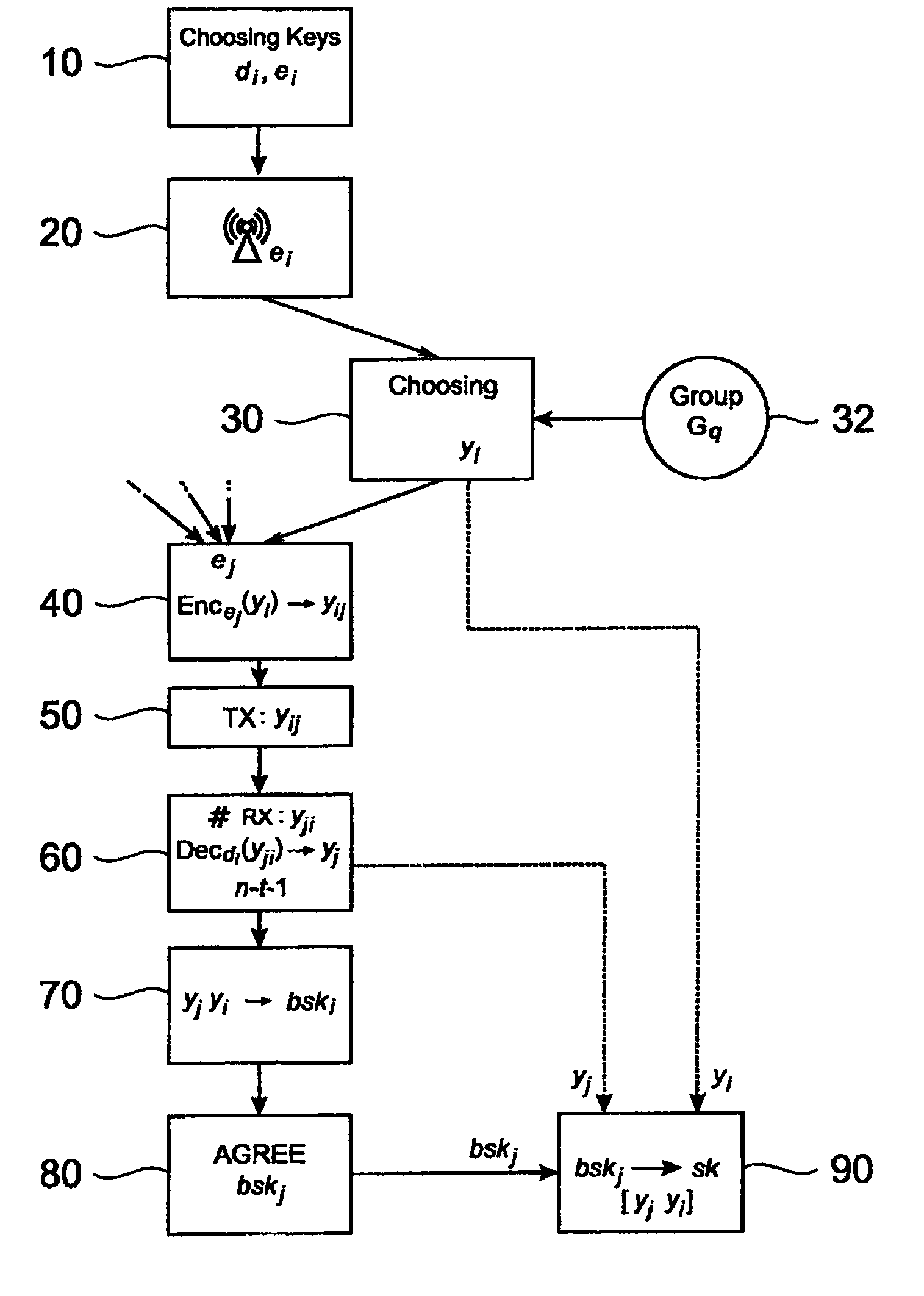
<figref idref="DRAWINGS">FIG. 2</figref> shows a schematic diagram of the group key exchange protocol according to the present invention.
<figref idref="DRAWINGS">FIGS. 3 to 8</figref> show more details to the group key exchange protocol of <figref idref="DRAWINGS">FIG. 2</figref>.
The drawings are provided for illustrative purposes only.
DETAILED DESCRIPTION
<figref idref="DRAWINGS">FIG. 1</figref> shows an example of a common computer system <b>2</b> consisting here of four participating network devices A, B, C, D, which are connected via communication lines <b>5</b> to a network, e.g. the Internet. The system, in which a group key exchange protocol is performed, may have t faulty devices. Such faulty device is here the participating network device B also designated by “X”. Each participating network device A, B, C, D may be any type of computer device known in the art from a computer on a chip, a wearable or laptop computer, a mobile phone to a large computer system. The communication lines can be any communication means commonly known to transmit data or messages from one participating network device A, B, C, D to another. For instance, the communication lines may be either single, bi-directional communication lines between each pair of participating network devices A, B, C, D or one unidirectional line in each direction between each pair of participating network devices A, B, C, D. The computer system <b>2</b> and communication lines are well known in the art. It is possible that each of the participating network devices A, B, C, D sends information to itself; in this case an equivalent result could be achieved by merely moving data within the participating network device and not sending it over a communication line to itself. The common computer system <b>2</b> is shown to facilitate the description of a described group key exchange protocol for generating a session key sk on demand in an asynchronous network.
The following steps indicate the described group key exchange protocol among a fixed set of participating network devices that tolerates any minority of parties or devices to crash. A series of messages is sent and received by each participating network device A, B, C, D.
<figref idref="DRAWINGS">FIG. 2</figref> shows a schematic diagram of the described group key exchange protocol in which the session key sk is generated on demand in the network among n participating network devices A, B, C, D with up to a number t of faulty devices, with t<n/2. In general, each participating network device sends and receives a series of messages and performs the following described steps. In view of simplicity, the following steps are regarded for the participating network device D, also herein regarded as the device with the index i in an enumeration of the participating network devices. At first, as indicated with step <b>10</b>, a private and public key d<sub>i</sub>, e<sub>i </sub>are chosen according to a public-key encryption scheme, e.g. El Gamal or RSA, and then, as indicated with step <b>20</b>, the public key e<sub>i </sub>is broadcast to each participating network device A, B, C. As indicated with step <b>30</b>, a local contribution value y<sub>i </sub>is chosen from a multiplicative group G<sub>q </sub>of size q, indicated in circle <b>32</b>.
As indicated with step <b>40</b>, when the public key e<sub>j </sub>from another participating network device A, B, C is received, the local contribution value y<sub>i </sub>is encrypted under the received public key e<sub>j </sub>to an encrypted contribution value y<sub>ij </sub>and sent to the respective participating network device A, B, C from which the public key e<sub>j </sub>was received, as indicated with step <b>50</b>. Herein the index j denotes one of the another participating network device A, B, C. When at least n−t−1 encrypted contribution values y<sub>ji </sub>are received then decrypted contribution values y<sub>j </sub>can be decrypted by applying the private key d<sub>i</sub>, as indicated with step <b>60</b>. As indicated with step <b>70</b>, a blinded session key bsk<sub>i </sub>is derived from the decrypted contribution values y<sub>j </sub>and the local contribution value y<sub>i</sub>.
As indicated with step <b>80</b>, the participating network devices A, B, C, D then perform an agreement protocol to agree on the blinded session key bsk<sub>j </sub>as computed by one of the participating network devices. The agreement protocol may be performed with or without a dealer. Such an agreement protocol is disclosed in US20010039630A1, entitled “Method of achieving multiple processor agreement in asynchronous networks”, presently assigned to the assignee of the instant application and the disclosure of which is incorporated herein by reference.
Finally, as indicated with step <b>90</b>, the session key sk is derived from the agreed-on blinded session key bsk<sub>j </sub>by applying one of the decrypted contribution values y<sub>j </sub>and the local contribution value y<sub>i</sub>. As indicated by dotted arrow lines in the figure, the contribution value y<sub>i </sub>arises from step <b>30</b> whilst the decrypted contribution values y<sub>j </sub>was obtained in step <b>60</b>.
<figref idref="DRAWINGS">FIGS. 3 to 8</figref> show further details to the group key exchange protocol of <figref idref="DRAWINGS">FIG. 2</figref>. As indicated in <figref idref="DRAWINGS">FIG. 3</figref> with step <b>11</b>, the private key d<sub>i </sub>in step <b>10</b> can be chosen as a random element from a set Z<sub>q </sub>of positive integers modulo q, where q is preferably a large prime, and the public key e<sub>j </sub>is derived by raising a generator g of the multiplicative group G<sub>q </sub>to the power of a first monotone function ƒ<sub>1</sub>of the private key d<sub>i</sub>. This mathematically reads as: <br />e<sub>i</sub>=g<sup>ƒ</sup><sup><sub2>1</sub2></sup><sup>(d</sup><sup><sub2>i</sub2></sup><sup>)</sup>.
As indicated in <figref idref="DRAWINGS">FIG. 4</figref> with step <b>31</b>, the local contribution value y<sub>i </sub>in step <b>30</b> can be chosen by first choosing a random value x<sub>i </sub>from the set Z<sub>q </sub>and then deriving the contribution value y<sub>i </sub>by raising the generator g to the power of a second monotone function ƒ<sub>2 </sub>of the random value x<sub>i</sub>, which reads as: <br />y<sub>i</sub>=g<sup>ƒ</sup><sup><sub2>2</sub2></sup><sup>(x</sup><sup><sub2>i</sub2></sup><sup>)</sup>.
As indicated in <figref idref="DRAWINGS">FIG. 5</figref> with step <b>41</b>, the encryption in step <b>40</b> of the contribution value y<sub>i </sub>under the received public key e<sub>j </sub>to the encrypted contribution value y<sub>ij </sub>can be performed by raising the received public key e<sub>j </sub>to the power of the second monotone function ƒ<sub>2 </sub>of the random value x<sub>i</sub>, which can be expressed by the formula: <br />y<sub>ij</sub>=e<sub>j</sub><sup>ƒ</sup><sup><sub2>2</sub2></sup><sup>(x</sup><sup><sub2>i</sub2></sup><sup>)</sup>.
As indicated in <figref idref="DRAWINGS">FIG. 6</figref> with step <b>61</b>, the decrypted contribution values y<sub>j </sub>in step <b>60</b> are derivable by raising the encrypted contribution value y<sub>ji </sub>to the power of the multiplicative inverse of the first monotone function ƒ<sub>1 </sub>of the private key d<sub>i</sub>. This can also be described by:
<maths id="MATH-US-00001" num="00001"><math overflow="scroll"><mrow><msub><mi>y</mi><mi>j</mi></msub><mo>=</mo><mrow><msubsup><mi>y</mi><mi>ji</mi><mfrac><mn>1</mn><mrow><msub><mi>f</mi><mn>1</mn></msub><mo></mo><mrow><mo>(</mo><msub><mi>d</mi><mi>i</mi></msub><mo>)</mo></mrow></mrow></mfrac></msubsup><mo>.</mo></mrow></mrow></math></maths><img file="US7853015B2_D0001.tif" />
It is noticed that the decrypted contribution value y<sub>j </sub>derived from the encrypted contribution value received from some other participating network device is the same as the local contribution value of this other device.
As indicated in <figref idref="DRAWINGS">FIG. 7</figref>, the step <b>70</b> of deriving the blinded session key bsk<sub>i </sub>can comprise the following steps <b>71</b> to <b>74</b>. As indicated in step <b>71</b>, a first sequence seq<sub>1 </sub>of at least n−t participating network devices E<sub>1</sub>, E<sub>2</sub>, E<sub>3 </sub>is derived. The first sequence seq<sub>1 </sub>comprises here the local participating network device D and the participating network devices A, B from which the at least n−t−1 encrypted contribution values y<sub>ji </sub>have been received. For example, the sequence could be allocated as [E<sub>1</sub>=A, E<sub>2</sub>=B, E<sub>3</sub>=D], as shown in the figure. In step <b>72</b>, a second sequence seq<sub>2 </sub>of at least n−t contribution values y<sub>i</sub><sub><sub2>1</sub2></sub>, y<sub>i</sub><sub><sub2>2</sub2></sub>, y<sub>i</sub><sub><sub2>3 </sub2></sub>is derived, where the m'th contribution value y<sub>i</sub><sub><sub2>m </sub2></sub>is the local contribution value y<sub>i </sub>of the m'th participating network device E<sub>m</sub>. Further, as indicated in step <b>73</b>, a third sequence seq<sub>3 </sub>of at least n−t quotients q<sub>1</sub>, q<sub>2</sub>, q<sub>3 </sub>is computed, where the m'th quotient q<sub>m </sub>is defined as the m'th contribution value y<sub>i</sub><sub><sub2>m </sub2></sub>divided by the m+1 modulo n−t'th contribution value y<sub>i</sub><sub><sub2>m+1 mod q</sub2></sub>, which here is
<maths id="MATH-US-00002" num="00002"><math overflow="scroll"><mrow><mrow><msub><mi>q</mi><mn>1</mn></msub><mo>=</mo><mfrac><msub><mi>y</mi><msub><mi>i</mi><mn>1</mn></msub></msub><msub><mi>y</mi><msub><mi>i</mi><mn>2</mn></msub></msub></mfrac></mrow><mo>,</mo><mrow><msub><mi>q</mi><mn>2</mn></msub><mo>=</mo><mfrac><msub><mi>y</mi><msub><mi>i</mi><mn>2</mn></msub></msub><msub><mi>y</mi><msub><mi>i</mi><mn>3</mn></msub></msub></mfrac></mrow><mo>,</mo><mrow><msub><mi>q</mi><mn>3</mn></msub><mo>=</mo><mrow><mfrac><msub><mi>y</mi><mrow><mi>i</mi><mo></mo><mstyle><mspace width="0.3em" height="0.3ex" /></mstyle><mo></mo><mn>3</mn></mrow></msub><msub><mi>y</mi><msub><mi>i</mi><mn>1</mn></msub></msub></mfrac><mo>.</mo></mrow></mrow></mrow></math></maths><img file="US7853015B2_D0002.tif" /><br /> Finally, as indicated by the arrows and step <b>74</b>, the blinded session key bsk<sub>i </sub>is defined as the first sequence seq<sub>1 </sub>and the third sequence seq<sub>3</sub>, that is bsk<sub>i</sub>=(seq<sub>1</sub>, seq<sub>3</sub>).
As indicated in <figref idref="DRAWINGS">FIG. 8</figref>, the step <b>90</b> of deriving the session key sk can comprise the following steps <b>91</b> to <b>93</b>. As indicated in step <b>91</b>, an un-blinding value u can be derived as the local contribution value y<sub>j </sub>of the k'th participating network device E<sub>k </sub>defined by the agreed-on blinded session key bsk<sub>j</sub>, where k is arbitrary. Moreover, as indicated in step <b>92</b>, a fourth sequence seq<sub>4 </sub>of at least n−t modified quotients q′<sub>1</sub>, q′<sub>2</sub>, q′<sub>3 </sub>is derived, in which the m'th modified quotient q′<sub>m </sub>is defined as the m'th power of the k+m modulo n−t'th quotient q<sub>k+mmodn−t </sub>defined by the agreed-on blinded session key bsk<sub>j</sub>. Finally, as indicated by the arrows and step <b>93</b>, the session key sk is derived as the product of the modified quotients q′<sub>1</sub>, q′<sub>2</sub>, q′<sub>3 </sub>multiplied with the n−t'th power of the un-blinding value u, which also reads as: <br /><i>sk=q′</i><sub>1</sub><i>*q′</i><sub>2</sub><i>*q′</i><sub>3</sub><i>*u</i><sup>n−t</sup>.
Any disclosed embodiment may be combined with one or several of the other embodiments shown and/or described. This is also possible for one or more features of the embodiments.
The present invention can be realized in hardware, software, or a combination of hardware and software. Any kind of computer system—or other apparatus adapted for carrying out the method described herein—is suited. A typical combination of hardware and software could be a general purpose computer system with a computer program that, when being loaded and executed, controls the computer system such that it carries out the methods described herein. The present invention can also be embedded in a computer program product, which comprises all the features enabling the implementation of the methods described herein, and which—when loaded in a computer system—is able to carry out these methods.
Computer program means or computer program in the present context mean any expression, in any language, code or notation, of a set of instructions intended to cause a system having an information processing capability to perform a particular function either directly or after either or both of the following a) conversion to another language, code or notation; b) reproduction in a different material form.
Contents6
10 sheets
Sheet 1 Sheet 2 Sheet 3 Sheet 4 Sheet 5 Sheet 6 Sheet 7 Sheet 8 Sheet 9 Sheet 10
Every citation, both waysCites: the store holds 7 of 8
| Document | Relation | Office | Cited during |
|---|---|---|---|
| US2004139146A1 | Cites | United States of America | Applicant |
| US4569015A | Cites | United States of America | Applicant |
| US6671821B1 | Cites | United States of America | Applicant |
| US6941457B1 | Cites | United States of America | Applicant |
| US7260716B1 | Cites | United States of America | Applicant |
| US7340603B2 | Cites | United States of America | Applicant |
| US20040139146A1 | Cites | United States of America | Third party observation |
| Wei-Chi Ku, et al., An Improved Key Management Scheme for Large Dynamic Groups Using One-Way Function Trees, 2003, IEEE Department of Computer Sciences and Information Engineering. | Non-patent | – | Applicant |
| ELK, A New Protocol for Efficient Large-Group Key Distribution, 2001, IEEE-University of California Berkeley. | Non-patent | – | Applicant |
| Sanjeev Setia, et al., A Scalable Group Re-Keying Approach for Secure Multicast, 2000, IEEE Center for Secure Information Systems. | Non-patent | – | Applicant |
| Wei-Chi Ku, et al., An Improved Key Management Scheme for Large Dynamic Groups Using One-Way Function Trees, 2003, IEEE Department of Computer Sciences and Information Engineering. | Non-patent | – | Third party observation |
| ELK, A New Protocol for Efficient Large-Group Key Distribution, 2001, IEEE—University of California Berkeley. | Non-patent | – | Third party observation |
| Sanjeev Setia, et al., A Scalable Group Re-Keying Approach for Secure Multicast, 2000, IEEE Center for Secure Information Systems. | Non-patent | – | Third party observation |
4 members in 1 office
Priority claims11
| Document | Office | Kind | Date |
|---|---|---|---|
| 03405739 | European Patent Office (EPO) | A | |
| 03405739 | European Patent Office (EPO) | A | |
| 03405739 | European Patent Office (EPO) | – | |
| 96444604 | United States of America | A | |
| 96444604 | United States of America | A | |
| 19164708 | United States of America | A | |
| 03405739 | – | – | – |
| 10964446 | – | – | – |
| EP20030405739 | – | – | – |
| US20040964446 | – | – | – |
| US20080191647 | – | – | – |
Members4
| Document | Office | Kind | |
|---|---|---|---|
| US2005086470A1 | United States of America | A1 | |
| US7444514B2 | United States of America | B2 | |
| US2008304662A1 | United States of America | A1 | |
| US7853015B2This record | United States of America | B2 |
33 transactions on the USPTO file
Allowed without a rejection on record.
- Non-final rejections
- 0
- Final rejections
- 0
- RCEs
- 0
- Appeals
- 0
Over time
Point at a mark for the transactionTransactions
| Event | Code | |
|---|---|---|
| Expire PatentEXP. | EXP. | |
| Recordation of Patent Grant MailedPGM/ | PGM/ | |
| Patent Issue Date Used in PTA CalculationAllowedPTAC | PTAC | |
| Email NotificationEML_NTR | EML_NTR | |
| Issue Notification MailedAllowedWPIR | WPIR | |
| Dispatch to FDCD1935 | D1935 | |
| Application Is Considered Ready for IssuePILS | PILS | |
| Issue Fee Payment VerifiedN084 | N084 | |
| Issue Fee Payment ReceivedIFEE | IFEE | |
| Mail Post CardPST_CRD | PST_CRD | |
| Email NotificationEML_NTF | EML_NTF | |
| Mail Notice of AllowanceAllowedMN/=. | MN/=. | |
| Notice of Allowance Data Verification CompletedAllowedN/=. | N/=. | |
| Case Docketed to Examiner in GAUDOCK | DOCK | |
| Email NotificationEML_NTR | EML_NTR | |
| PG-Pub Issue NotificationPG-ISSUE | PG-ISSUE | |
| Case Docketed to Examiner in GAUDOCK | DOCK | |
| IFW TSS Processing by Tech Center CompleteTSSCOMP | TSSCOMP | |
| Electronic ReviewELC_RVW | ELC_RVW | |
| Email NotificationEML_NTF | EML_NTF | |
| Mail Pre-Exam NoticeMPEN | MPEN | |
| Application Dispatched from OIPEOIPE | OIPE | |
| Sent to Classification ContractorPGPC | PGPC | |
| Filing ReceiptFLRCPT.O | FLRCPT.O | |
| Application Is Now CompleteCOMP | COMP | |
| Request for Foreign Priority (Priority Papers May Be Included)RQPR | RQPR | |
| Cleared by OIPE CSRL194 | L194 | |
| IFW Scan & PACR Auto Security ReviewSCAN | SCAN | |
| Information Disclosure Statement consideredIDSC | IDSC | |
| Information Disclosure Statement (IDS) FiledM844 | M844 | |
| Request from applicant for the USPTO to retrieve the Priority DocumentPDREQUST | PDREQUST | |
| Information Disclosure Statement (IDS) FiledWIDS | WIDS | |
| Initial Exam Team nnIEXX | IEXX |
5 legal events, as the office reported them to INPADOC
Over the term
Point at a mark for the eventEvents
| Event | Code | |
|---|---|---|
| Lapsed due to failure to pay maintenance feeLapsedFP | FP | |
| Information on status: patent discontinuationPATENT EXPIRED DUE TO NONPAYMENT OF MAINTENANCE FEES UNDER 37 CFR 1.362STCH | STCH | |
| Information on status: patent discontinuationPATENT EXPIRED DUE TO NONPAYMENT OF MAINTENANCE FEES UNDER 37 CFR 1.362STCH | STCH | |
| Lapse for failure to pay maintenance feesLapsedLAPS | LAPS | |
| Maintenance fee reminder mailedREMI | REMI |
Numbers
- Publication
- 07853015
- Publication, DOCDB
- 7853015
- Publication, EPODOC
- US7853015
- Application
- 12191647
- Application, DOCDB
- 19164708
- Application, EPODOC
- US20080191647
Titles
- English
- Group key exchanges with failures
Patent term adjustment
- A delay
- +294 daysthe office missed an examination deadline
- Net adjustment
- 294 days
Classification
- CPC, 2
- H04L9/0841
- H04L2209/16
- IPC, 4
- H04L9 06
- H04L9 08
- H04L9 30
- H04L29 06
- USPC, 1
- 380044000