Group admission control apparatus and methods
Summary by NHIP
Group admission control method
The method admits parties to a group by exchanging unique keys and verifying membership through a challenge-response protocol. Verification requires modifying data using a one-way function with an updated group key as input, where this key updates at least once per predetermined time interval.
Claim Score by NHIP
Abstract
The present invention uses a group key management scheme for admission control while enabling various conventional approaches toward establishing peer-to-peer security. Various embodiments of the invention can provide peer-to-peer confidentiality and authenticity, such that other parties, such as group members, can not understand communications not intended for them. A group key may be used in combination with known unicast security protocols to establish, implicitly or explicitly, proof of group membership together with bi-lateral secure communication.
Term
Term ended
Expired 1 November 2025, 0.9 years ago.
- Priority and filed
- Granted
- Expired
- Today
14 claims: 4 independent, 10 dependent
- 1A method for admission control for a group, said group comprising a plurality of members and having a group key used for encryption of messages, said method comprising the steps of:a first party to be admitted to the group: receiving, from a group administrator, a first key, wherein said first key is an updated group key, said updated group key being sent from the administrator, to the plurality of members;receiving, from the group administrator, a second key unique to said first party;and verifying group membership by receiving a challenge and replying to said challenge, wherein said replying to said challenge is performed by modifying data by the use of a one-way function having said first key as an input.
- 4A method for admission control for a group, said group comprising a plurality of members and having a group key used for encryption of messages, said method comprising the steps of:enabling a first party to verify group membership to at least one of the plurality of members by: sending a first key to the first party, wherein said first key is an updated group key;sending a second key to said first party;and sending said first key to the plurality of members of said group;wherein said second key is unique to said first party, wherein, said first party verifies group membership by receiving a challenge and replying to said challenge, said replying to said challenge is performed by modifying data by the use of a one-way function having said first key as an input.
- 6An electronic device, comprising:an admission control facility for controlling access to a group, said group comprising a plurality of members and having a group key used for encryption of messages, said admission control facility comprising: a receiver adapted to receive a request from a first party for admission to said group;and a sender adapted to enable said first party to verify group membership to at least one of the plurality of members by sending a first key and a second key to said first party, wherein said first key is an updated group key and is sent to said plurality of members;said second key is unique to first said party and is sent exclusively to said first party;and said first party verifies group membership by receiving a challenge and replying to said challenge, said replying to said challenge is performed by modifying data by use of a one-way function having said first key as an input.
- 14Broadest claimClaim Score 64, broad(NHIP)An electronic device holding computer-executable instructions for performing a method of admission control for a group, comprising the steps of:enabling a first party to verify group membership to at least one of the plurality of members by: sending a first key to the first party, wherein said first key is an updated group key;sending a second key to said first party;and sending said first key to the plurality of members of said group;wherein said second key is unique to said first party, wherein, said first party verifies group membership by receiving a challenge and replying to said challenge, said replying to said challenge is performed by modifying data by the use of a one-way function having said first key as an input.
Independent claims4
55 paragraphs in 5 sections, as filed
REFERENCE TO RELATED APPLICATIONS
The present invention relates to U.S. Pat. Nos. 6,049,878 and 6,195,751, both to Caronni et al. These patents are hereby incorporated by reference.
BACKGROUND
Communication among electronic devices has become commonplace and often serves as the mechanism for communication between parties. Electronic devices can be used for communicating among parties that are members of a group or are a subset of members of a group. Difficulties can arise in that communications and identities of parties often can not be trusted. Lack of trust can be caused by concerns such as communications being overheard by unauthorized parties or diverted to unintended recipients, contents changed without the knowledge of the communicating parties or communications originating from a source other than the apparent source.
Various forms of overcoming such concerns have been cumbersome to implement, not offered true identification of parties and/or required extensive communication among group members. Existing approaches to communications include the use of a group key distributed to members of the group. Group key management has been used to provide the combined functionality of confidentiality and authenticity on a group-wide basis. Typically, the group key is used to encrypt and decrypt various messages, and the ability of members to correctly encrypt or decrypt has been used as proof of membership of the group. Previous methods of implementing peer-to-peer confidentiality and authenticity of communications among the group members have also included certificate revocation lists, tickets issued by a central authority as in Kerberos and other approaches that require substantial communication among group members or substantial communication with a centralized authority.
Substantial communication requirements in conventional solutions may require a more robust communications capability in order to accommodate the periods of high overhead, such as at periods of group membership changes or other events, such as updating certificate revocation lists.
SUMMARY
The present invention uses a group key management scheme for admission control while optionally enabling various conventional approaches toward establishing peer-to-peer security. The invention may be used to separate admission control issues from providing confidentiality and authenticity by using a group key scheme to convey admission control information. Conventional approaches may be used to provide peer-to-peer confidentiality and authenticity. By not using the same group key for admission control, confidentiality and authenticity, the drawback of exposing all communications to all group members can be avoided.
Various embodiments of the invention can provide peer-to-peer confidentiality and authenticity, such that other parties, including other group members, cannot understand communications that are not intended for them. Furthermore, various embodiments of the invention can inhibit a group member from impersonating another party.
The invention may also provide a method of admission control by the use of a group key. According to this embodiment, proof of possession of a current group key is used to verify that they are members of the group.
According to an embodiment of the invention, a method is provided for admission control for a group. The method may include the steps of possessing a key and providing proof of possession of the key to verify membership of the group.
According to an embodiment of the invention, a method for admission control for a group having a group key is provided, having the step of sending a first key and a second key to a first party. The first key is also sent to a plurality of members of the group. According to this embodiment, the first key is an update of the group key and the second key is unique to the first party.
According to another embodiment of the invention, a method for admission control for a group having a group key is provided, having the step of sending a first key and a second key to a first party. In this case, the first key is a hashed key of the group key and the second key is unique to the first party.
A further embodiment involves an electronic device having an admission control facility for controlling access to a group using a group key. In this embodiment, the admission control facility is provided with means for receiving a request from a first party for admission to the group and means for sending a first key and a second key, wherein the first key is an update of the group key and is sent to a plurality of members of the group and wherein the second key is unique to the first party and is sent exclusively to the first party.
Another embodiment of the invention also involves an electronic device. In this embodiment, the admission control facility has means for receiving a request from a first party for admission to the group and means for sending a first key and a second key, wherein the first key is a hashed key of the group key and is sent to the first party and wherein the second key is unique to the first party and is sent exclusively to the first party.
An electronic device is provided in another embodiment of the invention, having an admission control facility for controlling access to a group using a group key. The admission control facility has a receiver adapted to receive a request from a first party for admission to the group. The admission control facility also has a sender adapted to send a first key and a second key, wherein the first key is an update of the group key and is sent to a plurality of members of the group and wherein the second key is unique to the first party and is sent exclusively to the first party.
A further embodiment of the invention involves an electronic device having an admission control facility for controlling access to a group using a group key. The admission control facility is provided with a receiver adapted to receive a request from a first party for admission to the group and a sender adapted to send a first key and a second key, wherein the first key is a hashed key of the group key and is sent to the first party and wherein the second key is unique to the first party and is sent exclusively to the first party.
Further embodiments of the invention involve an electronic device or a storage medium holding computer-executable instructions for performing a method including the steps of sending a first key and a second key to a first party and sending the first key to a plurality of members of the group. According to this embodiment, the first key is an update of the group key and the second key is unique to the first party.
Further embodiments of the invention involve an electronic device or a storage medium holding computer-executable instructions for performing a method, comprising the step of sending a first key and a second key to a first party. According to this embodiment, the first key is a hashed key of the group key and the second key is unique to the first party.
BRIEF DESCRIPTION OF THE DRAWINGS
The invention will be apparent from the description herein and the accompanying drawings, in which like reference characters refer to the same parts throughout the different views.
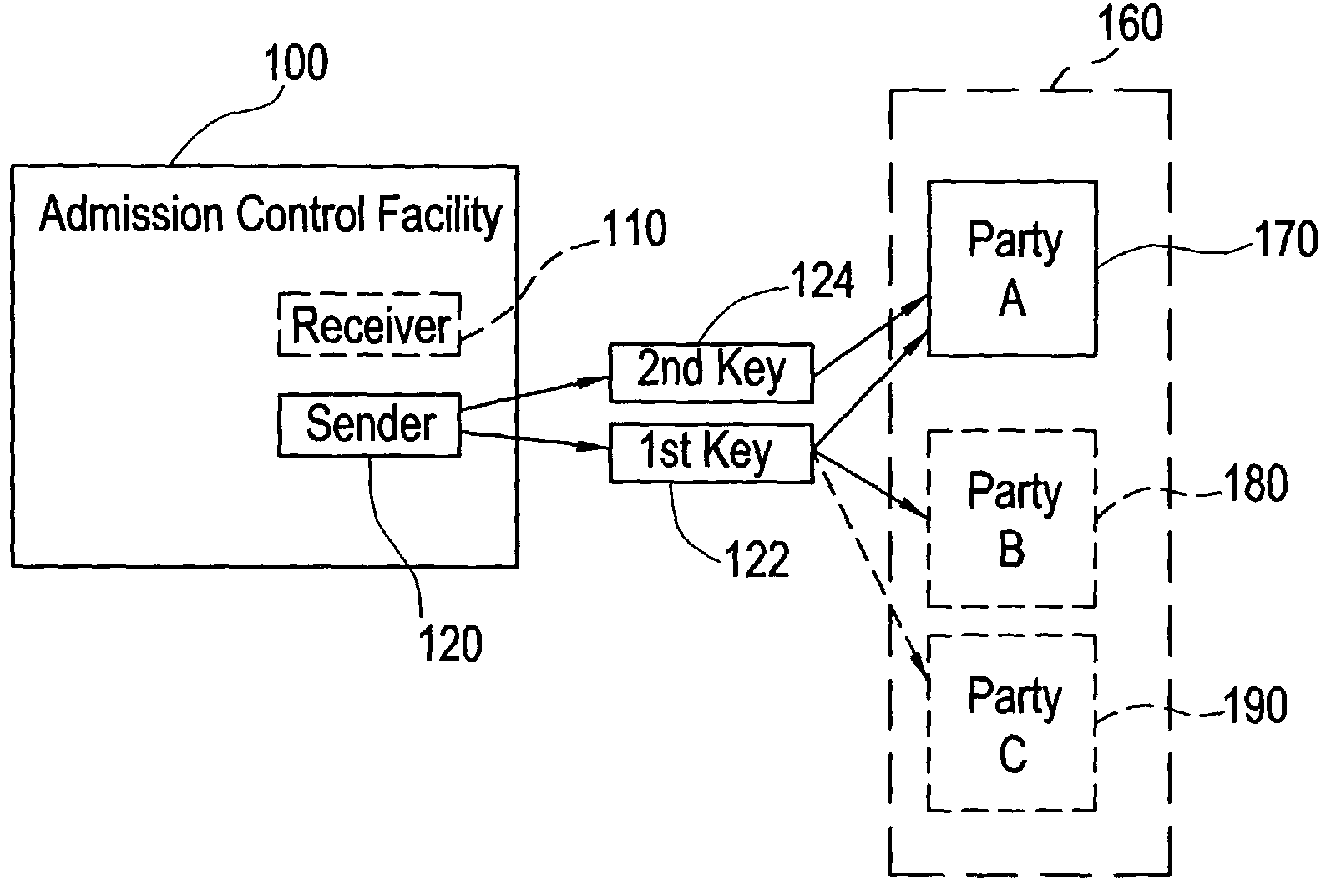
<figref idrefs="DRAWINGS">FIG. 1</figref> is a block diagram of an admission control facility according to an embodiment of the invention;
<figref idrefs="DRAWINGS">FIG. 2</figref> illustrates a communication protocol between an admission control facility and a group according to an embodiment of the invention;
<figref idrefs="DRAWINGS">FIG. 3</figref> illustrates a method of operation of the embodiment of <figref idrefs="DRAWINGS">FIG. 2</figref>;
<figref idrefs="DRAWINGS">FIG. 4</figref> illustrates communication between an admission control facility and a group according to a further embodiment of the invention;
<figref idrefs="DRAWINGS">FIG. 5</figref> illustrates a method of operation of the embodiment of <figref idrefs="DRAWINGS">FIG. 4</figref>;
<figref idrefs="DRAWINGS">FIG. 6</figref> illustrates an implementation of an embodiment of the invention;
<figref idrefs="DRAWINGS">FIG. 7</figref> illustrates a method according to an embodiment of the invention;
<figref idrefs="DRAWINGS">FIGS. 8-10</figref> illustrate various implementations of admission control facilities according to various embodiments of the invention;
<figref idrefs="DRAWINGS">FIG. 11</figref> illustrates an electronic device according to a further embodiment of the invention; and
<figref idrefs="DRAWINGS">FIG. 12</figref> illustrates a storage medium holding computer-executable instructions for performing a method according to various embodiments of the invention.
DETAILED DESCRIPTION
According to one embodiment of the invention, an admission control facility <b>100</b> is provided as illustrated by way of example in <figref idrefs="DRAWINGS">FIG. 1</figref>. The admission control facility <b>100</b> is optionally provided with a receiver <b>110</b> and with a sender <b>120</b>. The receiver <b>110</b> and sender <b>120</b> may be adapted to communicate on a variety of communication systems. Examples of such communication systems include a computer network and a telecommunications network. The network may be partially or completely a wireless, wired or an optical network or a combination thereof. Examples of the network may include a Bluetooth network, a cellular network, a GSM based network, a local area network (LAN), a wide area network (WAN), the Internet, an intranet, or a metropolitan network or some other type of network, although the invention is not so limited and may be used with any type of communications system allowing electronic devices to communicate.
The admission control facility <b>100</b> may be a computer system or other type of electronic device. As used herein, an electronic device may be wide variety of devices capable of processing signals or information, such as a processor, a computer, a personal digital assistant, a communications device, such as a cell phone, an intelligent appliance, a network appliance, a web server, a network, any device capable of manipulating information, a receiver, a transmitter, an interface or any combination of these devices. Examples of computers may include a personal computer, a network computer, or workstation.
The admission control facility <b>100</b> optionally possesses storage capacity that may be implemented using a number of different types of storage technology, including read-only memory (ROM), random access memory (RAM), secondary storage media, such as optical disks, magnetic disks or other types of storage technologies. According to an alternative embodiment, the admission control facility <b>100</b> may be configured to interface with an external storage capacity.
As illustrated in <figref idrefs="DRAWINGS">FIG. 2</figref>, a further embodiment of the invention is shown having at least one admission control facility <b>100</b> in communication with one or more members of a group <b>160</b>. The invention may optionally include multiple admission control facilities <b>100</b>. The admission control facility <b>100</b> is provided with a sender <b>120</b>. The sender <b>120</b> is adapted to send a first key <b>122</b> and a second key <b>124</b> to at least one member of the group <b>160</b>, such as party A <b>170</b>. It is understood that party A <b>170</b>, party B <b>180</b> and party C <b>190</b> are representative of electronic devices associated with one or more parties.
The group <b>160</b> may consist of one or more members. For purposes of illustration, the group <b>160</b> is shown including party A <b>170</b> and optionally including party B <b>180</b> and party C <b>190</b>. However the invention is not so limited, and the group <b>160</b> may consist of tens, hundreds, thousands or millions of members.
In operation, the embodiment of the invention, illustrated by way of example in <figref idrefs="DRAWINGS">FIG. 2</figref>, may operate according to the sample method <b>400</b> of <figref idrefs="DRAWINGS">FIG. 3</figref>. The admission control facility <b>100</b> sends a first key to party A, step <b>410</b>. A second key is also sent to party A, step <b>420</b>. The admission control facility <b>100</b> also sends the first key <b>122</b> to at least one other member of the group <b>160</b>, step <b>430</b>. While these steps of the invention have been recited in a particular order, for purposes of illustration, the invention is not so limited. The first key <b>122</b> and second key <b>124</b> may be sent simultaneously or in any order. According to this embodiment of the invention, the first key <b>122</b> is an update of a group key used by the group <b>160</b> and the second key <b>124</b> is sent only to party A <b>170</b>. The keys may be sent according to any method known in the art. See U.S. Pat. Nos. 6,049,878 and 6,195,751 or A. Fiat et al., <i>Broadcast Encryption</i>, Advances in Cryptology—CRYPTO '93 Proceedings, Lecture Notes in Computer Science, Vol. 773, 1994, pp. 480-91 for examples.
To update the group key, a message may be sent by the admission control facility <b>100</b> to members of the group <b>160</b> that are to remain in the group <b>160</b>. See U.S. Pat. No. 6,049,878, the contents of which are incorporated herein by reference. Optionally, messages transmitted by the admission control facility <b>100</b> may be encrypted and/or include a revision number of the current group key, allowing members of the group <b>160</b> to compare the revision number of the group key currently being transmitted with the most recent group key received by that member.
The group key may optionally be put through a one-way function after a pre-determined amount of time to prevent access to earlier messages by newcomers. An example one-way function is the MD5 algorithm, the secure hash algorithm (SHA) or an equivalent. In one embodiment, the group key is put through a one-way function every ten minutes.
In order to add a new party to the group <b>160</b>, the new party would contact an admission control facility <b>100</b>. The new party would receive information back from the admission control facility <b>100</b>. A second key <b>124</b> would be specific to the new party while the first key <b>122</b> would be a group key. The admission control facility <b>100</b> would then send a message to the other members of the group <b>160</b> to update the group key.
The invention may be used to separate admission control issues from providing authenticity and confidentiality by using a group key scheme to convey admission control information. Conventional approaches may be used to provide peer-to-peer confidentiality and authenticity. By not using a group key for confidentiality and authenticity, the drawback of exposing all communications to all group members can be avoided.
Security of communications may be established by the use of conventional methods. Examples include SKIP (Simple Keymanagement for Internet Protocols), a Sun key management protocol, or IPSEC/IKE (Internet Key Exchange) or SSL (Secure Socket Layer).
Optionally, the key used between members of the group <b>160</b> may be mixed with the current group key, thereby proving its possession to other group members, and thus the right to participate in the group. By way of example, in versakey the group authentication token is known as a traffic encryption key (TEK). Therefore for SKIP, the actual encryption key is a hash of (E_kp∥ TEK) and the authentication key is a hash of (A_kp∥ TEK). In order to remove a member from the group <b>160</b>, the admission control facility <b>100</b> issues a new group key to those members of the group that are to remain in the group <b>160</b>. Therefore, those members removed from the group will be unable to decrypt future group messages and will be unable to provide appropriate responses to challenges by other members for an appropriately encrypted reply. According to an optional embodiment of the invention, the revision number of the group key may be included with each message. In such a case, those members removed from the group could then determine that they no longer have the current group key.
In operation, members of the group <b>160</b> may challenge others to transmit an encrypted reply reflective of the current group key. Such encryption may also be used in conjunction with other encryption techniques.
A further embodiment is illustrated in <figref idrefs="DRAWINGS">FIG. 4</figref> and may operate according to the sample method <b>500</b> of <figref idrefs="DRAWINGS">FIG. 5</figref>. According to the embodiment of <figref idrefs="DRAWINGS">FIG. 4</figref>, the admission control facility <b>100</b> sends a first key <b>122</b> to party A <b>170</b> of group <b>160</b>, step <b>510</b>. The admission control facility <b>100</b> also sends a second key <b>124</b> to party A <b>170</b>, step <b>520</b>. The admission control facility <b>100</b> may send the first key <b>122</b> and second <b>124</b> in any order to party A <b>170</b>. According to this embodiment of the invention, the first key <b>122</b> is a hashed key of the group key used by the group <b>160</b>. The second key <b>124</b> is sent only to party A <b>170</b> of the group <b>160</b>. Because the first and second keys <b>122</b>, <b>124</b> are sent to party A <b>170</b> and need not be sent to other members of the group <b>160</b>, this embodiment of the invention can avoid the need for multiple members of the group <b>160</b> to communicate with a centralized authority whenever a member is added to the group <b>160</b>. In this case, other members of the group <b>160</b> are aware of the hash function used to hash the first key <b>122</b> and therefore are able to recognize the hashed key of the group key.
According to the embodiment of <figref idrefs="DRAWINGS">FIGS. 4 and 5</figref>, the group key need not be updated upon the addition of a new member to the group <b>160</b>. Instead, the party newly joining the group is provided with a hashed key. The hashed key may prevent the new member to the party from accessing messages or activities among group members prior to admission of the new member to the group.
<figref idrefs="DRAWINGS">FIG. 6</figref> illustrates another embodiment of the invention. <figref idrefs="DRAWINGS">FIG. 6</figref> shows Party A <b>170</b> and Party B <b>180</b> as members of a group <b>160</b>. Party A <b>170</b> possesses a key <b>121</b>, such as a group key. In operation, as shown in <figref idrefs="DRAWINGS">FIG. 7</figref>, a method <b>10</b> may include the step <b>20</b> of possessing the key <b>121</b>. The key <b>121</b> may be distributed to group members according to any method known in the art. See U.S. Pat. Nos. 6,049,878 and 6,195,751 and A. Fiat et al., <i>Broadcast Encryption</i>, Advances in Cryptology—CRYPTO '93 Proceedings, Lecture Notes in Computer Science, Vol. 773, 1994, pp. 480-91 for examples.
The method further involves the step <b>30</b> of providing proof of possession of the key <b>121</b> to verify membership of the group <b>160</b>. The providing proof of possession of the key <b>121</b> may be done explicitly by showing the key <b>121</b> to another member of the group <b>160</b> and/or to an admission control facility <b>100</b>. An alternative for providing proof of possession of the key <b>121</b> involves receiving a challenge and replying to the challenge. An example of this alternative is appending the key to a received message and returning the message. A further example is processing and returning a message through a one-way function using the key <b>121</b>. Providing proof of possession of the key <b>121</b> may also be done implicitly by peers, such as Party A <b>170</b> and Party B <b>180</b> negotiating a common key for communications then hashing the common key together with the key <b>121</b>. The hashing may be done at any time, including the beginning of negotiations and the end of negotiations.
In summary, the key <b>121</b>, such as a group key, may be used according to the invention in combination with known unicast security protocols to establish, implicitly or explicitly, proof of group membership together with bi-lateral secure communication.
By the use of the invention, Party A <b>170</b> need not disclose its identity in order to provide proof of membership in the group <b>160</b>. Similarly, Party B <b>180</b> also need not disclose its identity in determining the group membership status of Party A <b>170</b>.
Optionally, the key <b>121</b> may be updated upon the departure of a member from the group <b>160</b>, step <b>40</b>. As noted above, the key <b>121</b> may be distributed to group members according to any method known in the art.
According to further embodiments of the invention, the admission control facility <b>100</b> may be coupled between a client <b>50</b> and server <b>150</b>, as illustrated in <figref idrefs="DRAWINGS">FIG. 8</figref>.
A further embodiment of the invention is illustrated in <figref idrefs="DRAWINGS">FIG. 8</figref>. The admission control facility <b>100</b> may be positioned between a client <b>50</b> and a server <b>150</b>. The admission control facility <b>100</b> may be used to enable or prohibit communication between the client <b>50</b> and the server <b>150</b>. In this embodiment, the admission control facility <b>100</b> functions as an intermediary that mediates and/or processes communications between the client <b>50</b> and the server <b>150</b>.
Further embodiments of the invention are illustrated in <figref idrefs="DRAWINGS">FIGS. 9-12</figref>. <figref idrefs="DRAWINGS">FIG. 9</figref> illustrates an admission control facility <b>100</b> within a server <b>200</b>. <figref idrefs="DRAWINGS">FIG. 10</figref> illustrates an admission control facility <b>100</b> within a web server <b>300</b>. In each of these embodiments, the admission control facility <b>100</b> may communicate with other electronic devices in communication with the server <b>200</b> or web server <b>300</b>. The admission control facility <b>100</b> operate concurrently with other functionality hosted by the server <b>200</b> or web server <b>300</b>.
As noted above an electronic device may be a wide variety of devices capable of processing signals or information. The electronic device <b>600</b> of <figref idrefs="DRAWINGS">FIG. 11</figref> is further provided with a storage capability for holding the computer-executable instructions <b>610</b>. The electronic device <b>600</b> is adapted to communicate with other electronic devices in order to perform methods according to various embodiments of the invention.
Further embodiments of the invention include an electronic device <b>600</b> holding computer-executable instructions <b>610</b> for performing a method according to various embodiments of the invention as shown in <figref idrefs="DRAWINGS">FIG. 11</figref>.
As illustrated in <figref idrefs="DRAWINGS">FIG. 12</figref>, a further embodiment of the invention involves a storage medium <b>700</b> having computer-executable instructions <b>710</b> for executing various methods according to the invention. The storage medium <b>700</b> may be formed of a wide variety of technologies. Examples of these technologies include ROM, RAM, secondary storage media, such as optical disks, magnetic disks or other types of storage technologies adapted to store computer-executable instructions <b>710</b>.
These examples are meant to be illustrative and not limiting. As described herein, the terms positioning mechanism and adjustment mechanism are considered to be interchangeable.
The present invention has been described by way of example, and modifications and variations of the exemplary embodiments will suggest themselves to skilled artisans in this field without departing from the spirit of the invention. Features and characteristics of the above-described embodiments may be used in combination. The preferred embodiments are merely illustrative and should not be considered restrictive in any way. The scope of the invention is to be measured by the appended claims, rather than the preceding description, and all variations and equivalents that fall within the range of the claims are intended to be embraced therein.
Contents5
7 sheets
Sheet 1 Sheet 2 Sheet 3 Sheet 4 Sheet 5 Sheet 6 Sheet 7
Every citation, both waysCites: the store holds 13 of 14
| Document | Relation | Office | Cited during |
|---|---|---|---|
| US2008201770A1 | Cited by | United States of America | Pre-grant |
| US2009249060A1 | Cited by | United States of America | Pre-grant |
| US2007025360A1 | Cited by | United States of America | Pre-grant |
| US8256007B2 | Cited by | United States of America | Search report |
| US2002112154A1 | Cites | United States of America | Search report |
| US2003026273A1 | Cites | United States of America | Search report |
| US2003035370A1 | Cites | United States of America | Search report |
| US2003097571A1 | Cites | United States of America | Search report |
| US4531020A | Cites | United States of America | Search report |
| US4613901A | Cites | United States of America | Search report |
| US4792973A | Cites | United States of America | Search report |
| US6049878A | Cites | United States of America | Search report |
| US6195751B1 | Cites | United States of America | Search report |
| US6393128B1 | Cites | United States of America | Search report |
| US6782475B1 | Cites | United States of America | Search report |
| US6941457B1 | Cites | United States of America | Search report |
| US7207062B2 | Cites | United States of America | Search report |
| Co-pending U.S. Appl. No. 09/458,021. | Non-patent | – | Search report |
| Fiat et al. "Broadcast encryption." 1994, Lecture Notes in Computer Science, pp. 1-12 http://citeseer.nj.nec.com/cache/papers/cs/20701/http:zSzzSzwww.wisdom.weizmann.ac.ilzSz~naorzSzPAPERSzSzbroad.pdf/fiat94broadcast.pdf. | Non-patent | – | Applicant |
| U.S. Appl. No. 09/458,021, filed Dec. 1999, Caronni et al. | Non-patent | – | Applicant |
2 members in 1 office
Priority claims2
| Document | Office | Kind | Date |
|---|---|---|---|
| 29945402 | United States of America | A | |
| US20020299454 | – | – | – |
Members2
| Document | Office | Kind | |
|---|---|---|---|
| US2004096063A1 | United States of America | A1 | |
| US7751569B2This record | United States of America | B2 |
73 transactions on the USPTO file
Allowed after 4 non-final rejections, 3 final rejections and 3 RCEs.
- Non-final rejections
- 4
- Final rejections
- 3
- RCEs
- 3
- Appeals
- 0
Over time
Point at a mark for the transactionTransactions
| Event | Code | |
|---|---|---|
| Payment of Maintenance Fee, 12th Year, Large EntityM1553 | M1553 | |
| Payment of Maintenance Fee, 8th Year, Large EntityM1552 | M1552 | |
| Recordation of Patent Grant MailedPGM/ | PGM/ | |
| Patent Issue Date Used in PTA CalculationAllowedPTAC | PTAC | |
| Issue Notification MailedAllowedWPIR | WPIR | |
| Dispatch to FDCD1935 | D1935 | |
| Application Is Considered Ready for IssuePILS | PILS | |
| Issue Fee Payment VerifiedN084 | N084 | |
| Issue Fee Payment ReceivedIFEE | IFEE | |
| Mail Notice of AllowanceAllowedMN/=. | MN/=. | |
| Notice of Allowance Data Verification CompletedAllowedN/=. | N/=. | |
| Date Forwarded to ExaminerFWDX | FWDX | |
| Response after Non-Final ActionA... | A... | |
| Mail Non-Final RejectionNon-final rejectionMCTNF | MCTNF | |
| Non-Final RejectionNon-final rejectionCTNF | CTNF | |
| Date Forwarded to Examiner | – | |
| Date Forwarded to Examiner | – | |
| Disposal for a RCE / CPA / R129AbandonedABN9 | ABN9 | |
| Request for Continued Examination (RCE)RCEX | RCEX | |
| Workflow - Request for RCE - BeginBRCE | BRCE | |
| Mail Final Rejection (PTOL - 326)Final rejectionMCTFR | MCTFR | |
| Final RejectionFinal rejectionCTFR | CTFR | |
| Date Forwarded to ExaminerFWDX | FWDX | |
| Response after Non-Final ActionA... | A... | |
| Mail Non-Final RejectionNon-final rejectionMCTNF | MCTNF | |
| Non-Final RejectionNon-final rejectionCTNF | CTNF | |
| Date Forwarded to Examiner | – | |
| Date Forwarded to Examiner | – | |
| Disposal for a RCE / CPA / R129AbandonedABN9 | ABN9 | |
| Request for Continued Examination (RCE)RCEX | RCEX | |
| Workflow - Request for RCE - BeginBRCE | BRCE | |
| Case Docketed to Examiner in GAUDOCK | DOCK | |
| Mail Final Rejection (PTOL - 326)Final rejectionMCTFR | MCTFR | |
| Final RejectionFinal rejectionCTFR | CTFR | |
| Date Forwarded to ExaminerFWDX | FWDX | |
| Response after Non-Final ActionA... | A... | |
| Request for Extension of Time - GrantedXT/G | XT/G | |
| Mail Non-Final RejectionNon-final rejectionMCTNF | MCTNF | |
| Non-Final RejectionNon-final rejectionCTNF | CTNF | |
| Date Forwarded to Examiner | – | |
| Date Forwarded to Examiner | – | |
| Disposal for a RCE / CPA / R129AbandonedABN9 | ABN9 | |
| Request for Continued Examination (RCE)RCEX | RCEX | |
| Request for Extension of Time - GrantedXT/G | XT/G | |
| Workflow - Request for RCE - BeginBRCE | BRCE | |
| Request for Extension of Time - GrantedXT/G | XT/G | |
| Correspondence Address ChangeC.AD | C.AD | |
| Change in Power of Attorney (May Include Associate POA)PA.. | PA.. | |
| Mail Final Rejection (PTOL - 326)Final rejectionMCTFR | MCTFR | |
| Final RejectionFinal rejectionCTFR | CTFR | |
| Date Forwarded to ExaminerFWDX | FWDX | |
| Response after Non-Final ActionA... | A... | |
| Request for Extension of Time - GrantedXT/G | XT/G | |
| Mail Non-Final RejectionNon-final rejectionMCTNF | MCTNF | |
| Non-Final RejectionNon-final rejectionCTNF | CTNF | |
| Case Docketed to Examiner in GAUDOCK | DOCK | |
| Case Docketed to Examiner in GAUDOCK | DOCK | |
| Correspondence Address ChangeC.ADB | C.ADB | |
| IFW TSS Processing by Tech Center CompleteTSSCOMP | TSSCOMP | |
| Case Docketed to Examiner in GAUDOCK | DOCK | |
| Correspondence Address ChangeC.ADB | C.ADB | |
| Case Docketed to Examiner in GAUDOCK | DOCK | |
| Information Disclosure Statement consideredIDSC | IDSC | |
| Reference capture on IDSRCAP | RCAP | |
| Information Disclosure Statement (IDS) Filed | – | |
| Information Disclosure Statement (IDS) Filed | – | |
| Case Docketed to Examiner in GAUDOCK | DOCK | |
| Application Dispatched from OIPEOIPE | OIPE | |
| Application Is Now CompleteCOMP | COMP | |
| Cleared by L&R (LARS) | – | |
| IFW Scan & PACR Auto Security Review | – | |
| IFW Scan & PACR Auto Security Review | – | |
| Initial Exam Team nnIEXX | IEXX |
9 legal events, as the office reported them to INPADOC
Over the term
Point at a mark for the eventEvents
| Event | Code | |
|---|---|---|
| Maintenance fee paymentMAFP | MAFP | |
| Maintenance fee paymentMAFP | MAFP | |
| AssignmentAS | AS | |
| Fee paymentFPAY | FPAY | |
| Information on status: patent grantGrantedPATENTED CASESTCF | STCF | |
| Fee payment procedurePAYOR NUMBER ASSIGNED (ORIGINAL EVENT CODE: ASPN); ENTITY STATUS OF PATENT OWNER: LARGE ENTITYFEPP | FEPP | |
| Fee payment procedurePAYER NUMBER DE-ASSIGNED (ORIGINAL EVENT CODE: RMPN); ENTITY STATUS OF PATENT OWNER: LARGE ENTITYFEPP | FEPP | |
| AssignmentAS | AS | |
| AssignmentAS | AS |
Numbers
- Publication
- 07751569
- Publication, DOCDB
- 7751569
- Publication, EPODOC
- US7751569
- Application
- 10299454
- Application, DOCDB
- 29945402
- Application, EPODOC
- US20020299454
Titles
- English
- Group admission control apparatus and methods
Patent term adjustment
- A delay
- +844 daysthe office missed an examination deadline
- B delay
- +627 dayspendency past three years
- Overlap
- −167 daysdelays counted once
- Applicant delay
- −226 days
- Net adjustment
- 1,078 days
Classification
- CPC, 4
- H04L9/0833
- H04L9/0891
- H04L2209/42
- H04L2209/60
- IPC, 2
- H04L9 00
- H04L9 08
- USPC, 9
- 380277000
- 380044000
- 380045000
- 380279000
- 380281000
- 380284000
- 713155000
- 713163000
- 713171000