Server, computer memory, and method to support security policy maintenance and distribution
Summary by NHIP
Mobile security policy enforcement
The method generates a mobile security policy from an LDAP directory and transmits it to a gatekeeper device. The gatekeeper checks for an installed shield software module, automatically initiating installation if missing, then authenticates the user and enforces the policy rules on the mobile device.
Claim Score by NHIP
Abstract
In a particular embodiment, a server module deployed on a server is disclosed. The server module is connected to a wireless network access node. The server module includes a database containing user information for multiple wireless devices. Each element in the database is attributable to at least one authorized wireless device and contains at least one type of data file from the following group: (i) wireless connectivity permissions, (ii) authorized wireless device identification, and (iii) authorized network access node information.
Term
Term ended
Expired 11 March 2025, 1.5 years ago.
- Priority and filed
- Granted
- Expired
- Today
8 claims: 1 independent, 7 dependent
- 1Broadest claimClaim Score 59, broad(NHIP)A method of selectively providing a mobile computing device with access to a software application on a server, the method comprising:generating at the server a mobile security policy for a user from data received from a LDAP directory communicably coupled to the server;transmitting the mobile security policy and key materials from the server to a gatekeeper device;receiving at the gatekeeper device a request to access the software application from the mobile computing device;determining at the gatekeeper device whether to grant access to the software application by checking whether the mobile computing device has an installed security program;automatically initiating by the gatekeeper device installation of the security program onto the mobile computer device if the mobile computer device does not have the installed security program;authenticating at the gatekeeper device the user;transmitting the mobile security policy from the gatekeeper device to the mobile device;and enforcing on the mobile device a rule encoded in the mobile security policy.
82 paragraphs in 4 sections, as filed
BACKGROUND
00011. Field of the Invention
0002The present application relates to systems and methods of distributing and enforcing security policies.
00032. Description of the Related Art
0004The use of mobile devices, such as personal digital assistants (PDAs), in corporate environments is projected to grow significantly over the next 3-5 years. These smart devices are increasing in diversity and capability as well as number. These devices offer a unique blend of lightweight mobility, convenience and functionality providing an instant-on access to information such as email, calendar, address book and other documents. Many enterprises are developing or have deployed special applications for mobile devices that transform the platform into a mission critical tool and repository for sensitive corporate data.
0005As a result, mobile devices have become indispensable tools for business communications. The use of these devices is expected to grow rapidly according to industry experts.
0006The prevalence and power of mobile computing devices and the increasing availability of wireless connectivity represents a paradigm shift in how people will use computers and access data. The current use and diversity of these devices are impacting the integrity of corporate IT infrastructures in many ways. These devices connect to the corporate network in multiple, unsecured and difficult to monitor transient ways. Cradles are used to ‘synch’ the devices to laptops or desktops using serial or USB lines. Modems and wired or wireless networks are used. Cell phones are converging with PDAs to provide a new generation of devices that may access corporate data in an expanding network of advanced cellular access points. Finally, since these devices have significant storage, computing power and operate in a connected and disconnected mode, security management and control of these devices remains an important challenge.
0007Mobile devices provide an “open door” into the enterprise, especially if lost or stolen. A variety of sensitive information may reside on these devices including passwords and access codes for most corporate databases, network files and applications. These pocket-size devices have become the “password sticky note” of the 21<sup>st </sup>century. In a wireless “always-on” world, these devices can enter and exit numerous unknown and ad hoc networks in a single day. At industry tradeshows, cyber-cafes or industry networking environments, corporate data is especially exposed to unauthorized access.
0008These devices have become large walking repositories for business confidential information. Mobile professionals frequently synch or copy proprietary corporate information from laptops, such as financial results, launch plans, personnel information, client records or application specific information. The large memory capacity of mobile devices and the plummeting price of after market memory cards make it more likely that users will store additional information on their devices.
0009The emerging corporate use and capabilities of these devices make unique challenges for an enterprise scale mobile security solution. Because mobile devices often operate in a disconnected mode, on-device policy enforcement is required.
0010The number of mobile devices entering the enterprise and the complexity of the security requirements is placing an increased demand on the enterprises ability to manage and enforce corporate security on mobile devices. Many information technology (IT) departments do not know how many non-company issued devices are currently being used by employees. They have no tools to restrict these devices from accessing corporate data. Simply put, current IT departments are not equipped to respond to the emerging computing standard of the mobile device.
0011Accordingly, there is a need for an improved system and method of handing security policies with respect to mobile devices.
SUMMARY
0012In a particular embodiment, a server module deployed on a server that is connected to a wireless network access node is disclosed. The server module includes a database containing user information for multiple wireless devices. Each element in the database is attributable to at least one authorized wireless device and contains at least one type of data file from the following group: (i) wireless connectivity permissions, (ii) authorized wireless device identification, and (iii) authorized network access node information.
0013In another embodiment, a computer memory is disclosed. The computer memory includes a plurality of operating keys for use in connection with security features of a mobile computing device and a root key. The root key is to encrypt the plurality of operating keys.
0014In another embodiment, a method of enforcing security policies at a mobile computing device is provided. The method includes receiving a policy at the mobile computing device and enforcing the policy at the mobile computing device by disallowing a user of the mobile computing device from engaging in the use precluded by the use limitation. The policy includes at least one device use limitation.
0015In another embodiment, a security method is provided. The security method includes receiving a password from a user of a mobile computing device; deriving a security code from the password by applying a non-linear function; and encrypting the security code using the password as an encryption key.
0016In another embodiment, a method of selectively providing a mobile computing device with access to a software application on a server is provided. The method includes receiving a request to access the software application from the mobile computing device and determining whether to grant access to the software application by checking whether the mobile computing device has an installed security program.
0017In a further embodiment, a method of updating policies and key materials is provided. The method includes providing a shared encryption key that is shared by a server and a client module; encrypting data on the client using the shared encryption key; authenticating a user of a mobile computing device by receiving a password, where the client is resident at the mobile computing device; decrypting the shared key using the password; using the shared key to decrypt updated policies and key materials; and replacing policies and key materials at the mobile computing device with the updated and decrypted policies and key materials.
BRIEF DESCRIPTION OF THE DRAWINGS
0018<figref idref="DRAWINGS">FIG. 1</figref> is a block diagram of an embodiment of a system for use in providing security policy distribution and mobile device management.
0019<figref idref="DRAWINGS">FIG. 2</figref> is a block diagram of an embodiment of a server within the system of <figref idref="DRAWINGS">FIG. 1</figref>.
0020<figref idref="DRAWINGS">FIG. 3</figref> is a general diagram that illustrates software layers within the server of <figref idref="DRAWINGS">FIG. 2</figref>.
0021<figref idref="DRAWINGS">FIG. 4</figref> is an illustrative screen shot of an administrative user interface for use with the server of <figref idref="DRAWINGS">FIG. 2</figref>.
0022<figref idref="DRAWINGS">FIG. 5</figref> is a block diagram that illustrates functional elements within the gatekeeper of <figref idref="DRAWINGS">FIG. 1</figref>.
0023<figref idref="DRAWINGS">FIG. 6</figref> is block diagram that illustrates elements within the shield application of the system of <figref idref="DRAWINGS">FIG. 1</figref>.
0024<figref idref="DRAWINGS">FIG. 7</figref> is a flow chart that illustrates installation of the shield security application onto mobile devices.
0025<figref idref="DRAWINGS">FIG. 8</figref> is a flow chart that illustrates a method of updating policy information and distributing the updated policy information to a mobile device.
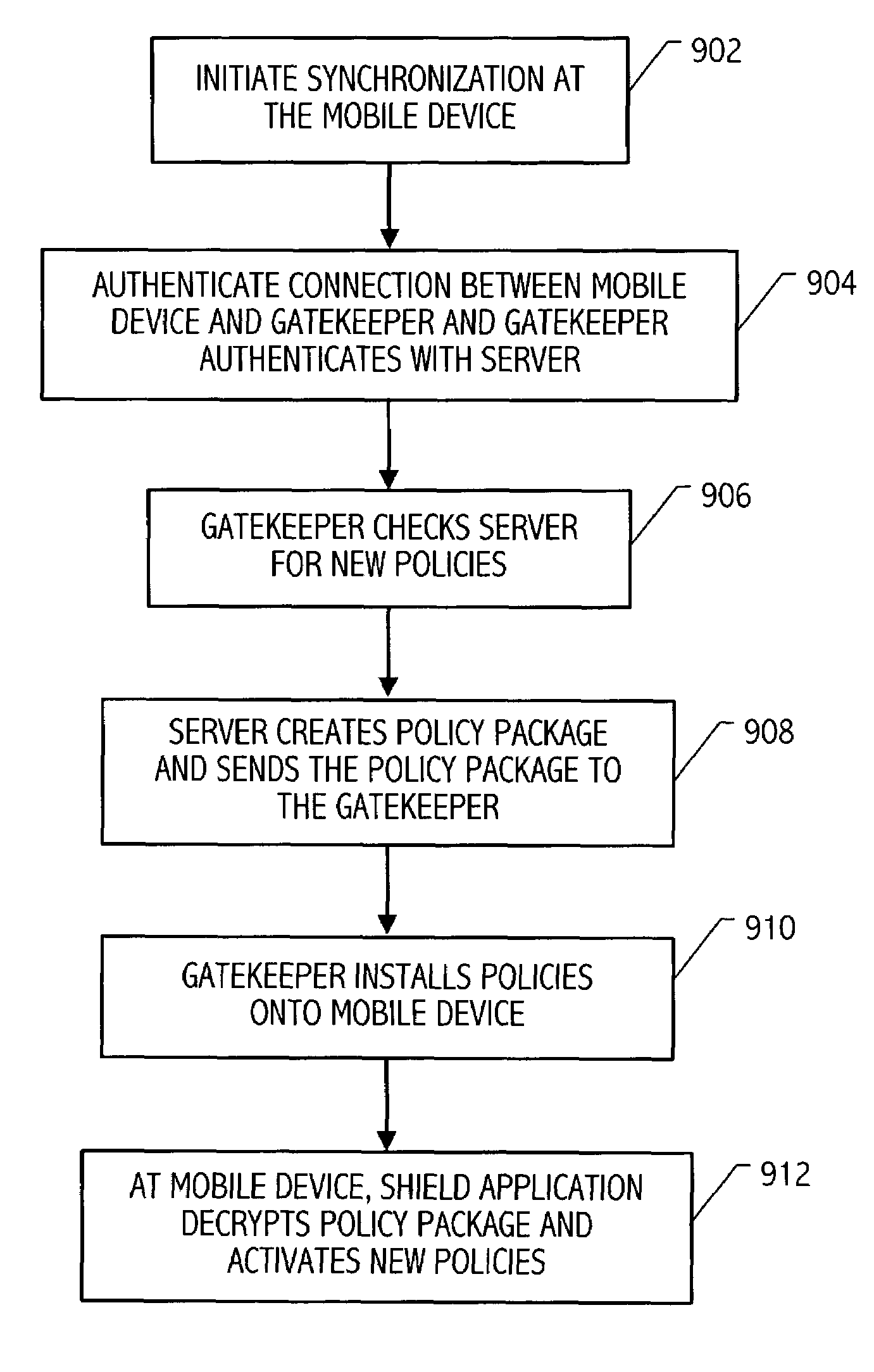
0026<figref idref="DRAWINGS">FIG. 9</figref> is a flow chart that illustrates another method of updating policy information and distributing the updated policy information to a mobile device.
0027<figref idref="DRAWINGS">FIG. 10</figref> is a diagram that illustrates key materials and specific key field formats for use with encryption of policy information.
0028The use of the same reference symbols in different drawings indicates similar or identical items.
DETAILED DESCRIPTION OF THE DRAWINGS
0029Referring to <figref idref="DRAWINGS">FIG. 1</figref>, a system <b>100</b> for use in enterprise security management is disclosed. The system <b>100</b> includes a server <b>102</b>, a gatekeeper <b>104</b>, and a client device module <b>106</b>. The client device module <b>106</b> that is used to provide security functionality is also referred to as a shield. The system <b>100</b> is a comprehensive enterprise security management software platform for diverse mobile operating systems, applications and devices. The system <b>100</b> enables an organization to secure and manage mobile devices easily and cost effectively. The server <b>102</b> integrates with existing security policy management systems and allows administrators to centrally create new mobile security policies by extending existing security policies and to distribute them to a diverse population of mobile devices. The server <b>102</b> and gatekeeper <b>104</b> work together to automatically and securely push these security policies to a specified mobile device. The shield <b>106</b> is a trusted computing environment on the mobile device that enacts and enforces the distributed security policies, controls access to the mobile device, and provides data security.
0030The server <b>102</b> may be implemented as a web-based application server that provides central creation and management of mobile security policies. The server <b>102</b> is preferably implemented with portability, scalability and maintainability in mind using industry standards such as Java, XML and other advanced web technologies. To provide easy control and accessibility, an administrative interface to the server <b>102</b> is provided through a secure browser interface allowing the simple delegation of responsibilities and access by any workstation or PC on a local network connected to the server <b>102</b>.
0031A consolidated LDAP directory (CLD) technique may be used to integrate the server <b>102</b> with existing enterprise security infrastructure, such as an existing identity database <b>108</b>. Existing policy and identity management systems are integrated through a real-time interface to directory resources. A layer in the server <b>102</b> provides a consolidated view of the external LDAP services and extends these services through policy inheritance and over-riding. As a result, existing identity directories, such as directory <b>108</b>, can be used without copying data and without changing the data schemas of the existing enterprise security systems.
0032The data passed to the gatekeeper <b>104</b> and subsequent mobile devices <b>106</b> is derived from security role and is protected through a combination of secure socket layer (SSL) and data encryption. Mobile security policies are formed using the administration interface <b>110</b>, which is coupled to the server <b>102</b> via interface <b>112</b>, to set and extend policies in a consolidated directory (e.g., LDAP). Once policies are set, a policy package is generated for each user within a role, encrypted with the specific users' encryption key, and forwarded to the gatekeeper <b>104</b> for installation on the target mobile device <b>106</b>. Policy package encryption forms a main pillar of system security. Additionally, SSL communication is used for added privacy and authentication between the server <b>102</b> and the gatekeeper <b>104</b> over the secure interface <b>114</b>. The system <b>100</b> is designed for robust security management to provide many advanced security features including: centralized management of disconnected devices, automatic versioning and distribution of policies, role-based policy creation and management, seamless integration with existing role repositories and security infrastructure, delegated security management, separation of administrative duties, automatic retrieval of device audit logs, consolidation, alerting and reporting, and mobile device management.
0033The gatekeeper <b>104</b> may be implemented as a security management software agent that forms a virtual security layer on existing, third party synchronization systems, such as HotSync, ActiveSycn, and ScoutSync. A function of the gatekeeper <b>104</b> is to receive policy packages from the server <b>102</b> and install the packages on target mobile devices <b>106</b>. The gatekeeper <b>104</b> operates in two modes to support local and network synchronization. In local mode, the gatekeeper <b>104</b> executable operates on desktop and laptop computers forming a security layer on top of personal synchronization tools. In network mode, the gatekeeper <b>104</b> executable operates on an enterprise server and forms a security layer on top of a network synchronization application. When the gatekeeper <b>104</b> is deployed, mobile devices <b>106</b>, such as personal digital assistants (PDAs), are required to authenticate and to request permission to synchronize before the third party data synchronization tool is allowed to launch. Additionally, the gatekeeper <b>104</b> provides for automatic installation of the mobile shield on specified PDAs, application configuration, update and patch management, mobile device configuration management, monitoring, management, and control access to synchronization application, and distribution of device policies, permissions and configurations.
0034The mobile device application, i.e., shield, <b>106</b>, may be implemented as a trusted computing environment operating as a software layer on top of the mobile device operating system. Security policies are received from the gatekeeper <b>104</b> using a two-way authentication process. The policies are used by agent software at the mobile device to encrypt data, and to monitor and control device access, device peripherals, and device software and hardware operations. The mobile device trusted environment approach provides many security features, including: on-device policy enforcement whether connected or disconnected, mandatory access control, data encryption with secure recovery, mandatory synchronization authentication, controlled application access and use, control over hardware ports—infrared (IR), compact flash (CF), universal serial bus (USB), secure digital (SD), multiple profiles—personal and business, and secure audit logs. Sample devices that may accept shield software include personal devices made by Palm, Handspring, Sony, Compaq iPaq, and the HP Jornada 500 series.
0035To summarize, all three major components of the system <b>100</b> interoperate substantially seamlessly and transparently to the user to enable a secure mobile environment without materially deterring from the user's experience. The server <b>102</b> virtually consolidates external LDAP identity and policy data to integrate to existing security infrastructure. The administrative tools on the server <b>102</b> allow policy packages to be automatically formed and distributed to each mobile device <b>106</b>. The gatekeeper <b>104</b> monitors synchronization and installs the shield software and policy packages on targeted devices. Finally, the shield forms a trusted computing environment by forming a security layer on the mobile operating system to enforce the policies originating from the server <b>102</b>. The complete system <b>100</b> forms a comprehensive, enterprise scale mobile security management system.
0036The system <b>100</b> includes components that integrate to external systems. To support a large customer base, multiple platforms are supported for each component. The following sample list identifies illustrative devices and software platforms for integration. At the server <b>102</b>, the windows2000 operating system, an LDAP of MS Active Directory System (ADS), Critical Path, or iPlanet flat files, and the Explorer version 5.0+ browser. At the gatekeeper <b>104</b>, compatible operating systems include Win98, WinNT 4.0, Win2000, WinXP, compatible data synchronization software includes HotSync, ActiveSync version 3.1+, server operating system of Win2000, and the network synchronization of ScoutSync version 3.5+. For the shield, the supported operating systems include PocketPC 2000, PocketPC 2002, and device OS version 3.5+.
0037The server <b>102</b> is constructed using enterprise scale server technology, such as federated webservices to provide scalability servers and portability of functions, model-view-controller (MVC) web interface techniques to provide maintainability and speed, and consolidated LDAP Directory (CLD) technology to provide compatibility and reduce installation and administrative costs in existing security infrastructures.
0038The server <b>102</b> architecture is integrated through a web service paradigm, as illustrated in <figref idref="DRAWINGS">FIG. 2</figref>. This paradigm is an industry recognized best practice for developing and integrating enterprise web applications. The web service paradigm is a loosely coupled architecture of processes that is flexible, allows additional functions, and allows replacement of servers as well as increased scale through load balancing and additional servers.
0039The core of the web services approach is in the ability to expose or advertise services through a consolidating interface. Referring to <figref idref="DRAWINGS">FIG. 2</figref> many of the key functions of the server <b>102</b> such as access control, audit log and security policy management are implemented as individual Java “applications” and advertised or exposed to the internal local area network (LAN) as services. These “applications” operate as web services. Each service can be run as a process or thread on a shared server, on separate servers or in combinations on fewer servers. Scalability and load balancing is achieved by running multiple threads of a service on a single server or on a cluster of servers. Maintenance is simplified by supporting the ability to move services between servers and to replace servers dynamically.
0040The federating web service in <figref idref="DRAWINGS">FIG. 2</figref> is a proxy type of service that consolidates the internally advertised services and provides the corresponding service to an external user through a hyper-text transfer protocol (HTTP) interface. The federated web service consolidates internal services by proxying the functionality to external users. The location of the services is specified in a service table or configuration file formatted with eXtensible markup language (XML). Service management is an advantage to the federated services approach. Only a single URL needs to be maintained to provide service to a scalable cluster of servers and services. The federating service has the ability to route application calls dynamically to perform load balancing. Scalability of the federating service is achieved using multiple federating service servers and standard load balancing routers such as Cisco's LocalDirector router.
0041The federating services and external users may be integrated through industry standard scripting protocols XML (eXtensible Markup Language) and SOAP (Simple Object Access Protocol). XML is a markup language similar to HTML for web pages, while SOAP is composed with structures or sentences written in XML. With web services, XML is the alphabet that represents data while SOAP is the grammar that defines the service call similar to a remote function call. Specifically, XML provides a tagged markup language that allows portable data representation between services. SOAP is an industry standard structure of XML tags that define calling sequences, parameter structures and result variables. These protocols are supported over the ubiquitous HTTP communication channels of the web.
0042As a result, XML/SOAP allows an external application, such as the gatekeeper <b>104</b>, to request a service as a single federated web service URL, to proxy the result to the actual web service and to provide the result back to the gatekeeper <b>104</b>. Privacy and authentication of the gatekeeper <b>104</b> can be achieved using SSL services by using the standard HTTPS protocol in place of HTTP.
0043The administrator interface <b>112</b> is provided through use of a lightweight HTTP or web interface. Benefits of this configuration includes wide availability of access from anywhere in the LAN, secure usage through SSL protocol, as well as simple delegation of responsibilities and separation of duties through authentication and access control.
0044The server <b>102</b> uses the industry recognized best practice of MVC programming model to implement the graphical user interfaces (GUI) of the administrator console. Model View Controller (MVC) is similar to web service in that it is a method of providing remote function calls. MVC leverages the federating web service to manage resources. However, MVC provides an additional capability to graphically represent the results of the service to provide a web page representation and a GUI.
0045MVC is the modern evolution of CGI for calling functions from web pages. The CGI approach used a myriad of println( ) calls to return HTTP data back to the browser for display. Servlets are a server side Java application that perform a specific task and that do not have GUI capabilities. The servlets were used to manage flow while JSP managed the HTML formatting. The MVC model separates servlets into logic (or model) servlets and control servlets resulting in the acronym MVC.
0046The server <b>102</b> uses MVC to implement the GUI. A view component is used to format and represent GUI to the browser. JSP and HTML are used to implement the view component. A controller component is used to consolidate, delegate and manage control flow and may be implemented with a Java servlet controller using HTTPS with the federated web service. Finally, the controller delegates work to an appropriate model within the server <b>102</b>. The model may be implemented as a servlet in Java. The models are used to control setting of policies, accessing roles stored in the LDAP and forming policy packages for distribution. The entire GUI including operation and logic is controlled and managed by the MVC framework. The framework is quickly implemented, and is easily modified, expanded and maintained.
0047Simplifying and lowering the total cost of ownership of the mobile security management system is a goal in the design of system <b>100</b>. A challenge and cost of installation is integration with existing identity data management systems. LDAP is data directory structure that is commonly used to store identity information and security policies to support authentication and authorization systems. It is understandable that customers want to reuse existing LDAP repositories after investing the time and effort to create an LDAP role-based policy system and populate the system with every user in the company. Furthermore, customers may desire future security systems to use the existing LDAP repositories without compromising the integrity of the system by modifying any database schemas.
0048The server <b>102</b> uses a consolidated LDAP directory (CLD) technology to address this integration challenge. The server <b>102</b> uses a layering approach and places a virtual layer above external and internal LDAP systems to provide a federated view of LDAP repositories. <figref idref="DRAWINGS">FIG. 3</figref> illustrates this approach.
0049The federation works with three layers. The bottom layer <b>302</b> is an adapter layer that is specific to a data store format and converts the store representation to a portable format. The middle layer <b>304</b> is a core directory engine that performs on-the-fly mapping to transform top-level client requests into the context of each repository and results into federated representations. The top level <b>306</b> is a front-end listener that converts the directory engine results into proper LDAP format. The result is a powerful method for integrating disparate customer identity data stores into a unified view for simplified server installations.
0050An access control service provides authentication for administrator logins and for gatekeeper <b>104</b> communications. This service interfaces to the LDAP repository of identities and permissions to provide control for system and data access. Administrators are authenticated through a login screen presented by a browser with JSP. The JSP requests authentication with the user name and password through the servlet interface of the federated service. The request is proxied to the access control service for completion. The authentication may be performed with LDAP version 3 operations through the CLD and may alternatively be performed using private key encryption type authentication systems.
0051The gatekeeper <b>104</b> is authenticated using SSL server certificates and realm authentication. An SSL connection is created to provide communications between the server <b>102</b> and gatekeeper <b>104</b>. Initially, the server <b>102</b> is authenticated to the gatekeeper <b>104</b> through SSL certificate authentication. Next, an SSL channel is constructed for privacy. Finally, a name/password pair (per realm authentication) is passed to through the federated service to the access control service for authentication. Successful match of name and password provides authentication of the gatekeeper <b>104</b> to the server <b>102</b>.
0052A policy service provides management of the role-based policies as well as creation of the policy files. The policy management service is provided to the administration console and allows definition of the policy values for both roles (or groups) and individual users. Once the policies have been defined for a population of users, the administrator can select to publish the policies. The publication process is the act of forming the secure policy files and automatically pushing the policy files out to the individual shield application <b>106</b>. An example screen shot of the policy management service is shown in <figref idref="DRAWINGS">FIG. 4</figref>.
0053The system <b>100</b> provides a key management service that generates and archives password keys for encryption operations in the shield <b>106</b>. Symmetric encryption keys are generated using techniques such as industry standard X9.17. Symmetric keys are used to protect data on the mobile device. These data encryption keys are generated uniquely for each mobile device and are stored on both the server <b>102</b> and the shield <b>106</b> to enable data protection while allowing secure data recovery with administrator intervention. Asymmetric or public/private key pairs are created with the elliptical curve cryptography (ECC) key algorithm and are used to encrypt policy files and audit log files. Separate key pairs are generated for each device and individually for the policy files and the audit logs. The key pairs are stored on the server <b>102</b> for secure data recovery through administrator intervention. The private audit log key is stored on the shield <b>106</b> to encrypt audit log information to support transference off of the device. The public policy file key is stored on the shield <b>106</b> to allow the software to authenticate and extract the policy items from the encrypted policy files. The opposite keys are used on the server <b>102</b> to decrypt audit log files and to encrypt policy files in support of the device.
0054A policy file is a collection of policy items combined into a single data package and formatted with XML. The policy file is transferred from the server <b>102</b> to the mobile device for security configuration and enforcement. The policy file is actually a number of files; one main index file and another for each category of policies defined. Each category file contains a series of policies that define the permissions and behavior of the shield <b>106</b>. Three items define each policy: category, key and value name. A key may have zero or more name/value pairs associated with it.
0055The server <b>102</b> encodes the policy file with ECC asymmetric encryption and transfers the file to the mobile device. The key pair corresponding to the policy management of an individual mobile device is created and managed by the server <b>102</b>. The private key is stored on the server <b>102</b> and used to encrypt the policy file. The public key is stored on the mobile device by the shield application <b>106</b>. The policy file is transferred to the mobile device during synchronization, after authentication is performed. The public key stored in the shield is used to open the policy file. The public key is passed to the shield application in a secure manner. This method of policy file management provides private transfer to specific shield deployments, provides policy authentication and management, and is tamper resistant to enable consistent policy enforcement.
0056Policy data falls into the following categories: I/O, storage, applications, and authentication.
0057The following tables specify sample types of policy data:
0058<tables id="TABLE-US-00001" num="00001"><table frame="none" colsep="0" rowsep="0" pgwide="1"><tgroup align="left" colsep="0" rowsep="0" cols="1"><colspec colname="1" colwidth="308pt" align="center" /><tbody valign="top"><row><entry namest="1" nameend="1" align="center" rowsep="1" /></row><row><entry>Permission Policies</entry></row></tbody></tgroup><tgroup align="left" colsep="0" rowsep="0" cols="6"><colspec colname="1" colwidth="91pt" align="left" /><colspec colname="2" colwidth="49pt" align="left" /><colspec colname="3" colwidth="35pt" align="center" /><colspec colname="4" colwidth="28pt" align="center" /><colspec colname="5" colwidth="35pt" align="center" /><colspec colname="6" colwidth="70pt" align="left" /><tbody valign="top"><row><entry>Name</entry><entry>ID (Category)</entry><entry>Value</entry><entry>Type</entry><entry>ReadOnly</entry><entry>Affects</entry></row><row><entry namest="1" nameend="6" align="center" rowsep="1" /></row><row><entry>IR_Enable</entry><entry>I/O</entry><entry>True/False</entry><entry>Boolean</entry><entry>True</entry><entry>Palm: Exchange</entry></row><row><entry /><entry /><entry /><entry /><entry /><entry>Manager, IR Library</entry></row><row><entry /><entry /><entry /><entry /><entry /><entry>CE:</entry></row><row><entry>TCPIP_Enable</entry><entry>I/O</entry><entry>True/False</entry><entry>Boolean</entry><entry>True</entry><entry>Palm: Network,</entry></row><row><entry /><entry /><entry /><entry /><entry /><entry>INet Library</entry></row><row><entry /><entry /><entry /><entry /><entry /><entry>CE:</entry></row><row><entry>NetBios_Enable</entry><entry>I/O</entry><entry>True/False</entry><entry>Boolean</entry><entry>True</entry><entry>Palm: N/A</entry></row><row><entry /><entry /><entry /><entry /><entry /><entry>CE:</entry></row><row><entry>SyncAuthenticated_Required</entry><entry>I/O</entry><entry>True/False</entry><entry>Boolean</entry><entry>True</entry><entry>Palm:</entry></row><row><entry /><entry /><entry /><entry /><entry /><entry>CE:</entry></row><row><entry>VolumeMount_Enable</entry><entry>Storage</entry><entry>True/False</entry><entry>Boolean</entry><entry>True</entry><entry>Palm: DB, VFS</entry></row><row><entry /><entry /><entry /><entry /><entry /><entry>Manager (File</entry></row><row><entry /><entry /><entry /><entry /><entry /><entry>system mounting)</entry></row><row><entry /><entry /><entry /><entry /><entry /><entry>CE:</entry></row><row><entry>DateBook_Enable</entry><entry>Applications</entry><entry>True/False</entry><entry>Boolean</entry><entry>True</entry><entry>Palm: DateBook</entry></row><row><entry /><entry /><entry /><entry /><entry /><entry>CE: Calendar</entry></row><row><entry>AddressBook_Enable</entry><entry>Applications</entry><entry>True/False</entry><entry>Boolean</entry><entry>True</entry><entry>Palm: AddressBook</entry></row><row><entry /><entry /><entry /><entry /><entry /><entry>CE: Contacts</entry></row><row><entry>Todo_Enable</entry><entry>Applications</entry><entry>True/False</entry><entry>Boolean</entry><entry>True</entry><entry>Palm: Todo</entry></row><row><entry /><entry /><entry /><entry /><entry /><entry>CE: Tasks</entry></row><row><entry>Memo_Enable</entry><entry>Applications</entry><entry>True/False</entry><entry>Boolean</entry><entry>True</entry><entry>Palm: Memo</entry></row><row><entry /><entry /><entry /><entry /><entry /><entry>CE: Notes</entry></row><row><entry>Expense_Enable</entry><entry>Applications</entry><entry>True/False</entry><entry>Boolean</entry><entry>True</entry><entry>Palm: Expense</entry></row><row><entry /><entry /><entry /><entry /><entry /><entry>CE: Money</entry></row><row><entry>Mail_Enable</entry><entry>Applications</entry><entry>True/False</entry><entry>Boolean</entry><entry>True</entry><entry>Palm: Mail</entry></row><row><entry /><entry /><entry /><entry /><entry /><entry>CE: Inbox</entry></row><row><entry>Prefs_Enable</entry><entry>Applications</entry><entry>True/False</entry><entry>Boolean</entry><entry>True</entry><entry>Palm: Prefs</entry></row><row><entry /><entry /><entry /><entry /><entry /><entry>CE: Settings</entry></row><row><entry>Security_Enable</entry><entry>Applications</entry><entry>True/False</entry><entry>Boolean</entry><entry>True</entry><entry>Palm: Security</entry></row><row><entry /><entry /><entry /><entry /><entry /><entry>CE: N/A</entry></row><row><entry>FileExplorer_Enable</entry><entry>Applications</entry><entry>True/False</entry><entry>Boolean</entry><entry>True</entry><entry>Palm: N/A</entry></row><row><entry /><entry /><entry /><entry /><entry /><entry>CE: File Explorer</entry></row><row><entry>InternetExplorer_Enable</entry><entry>Applications</entry><entry>True/False</entry><entry>Boolean</entry><entry>True</entry><entry>Palm: N/A</entry></row><row><entry /><entry /><entry /><entry /><entry /><entry>CE: Internet Explorer</entry></row><row><entry>PocketWord_Enable</entry><entry>Applications</entry><entry>True/False</entry><entry>Boolean</entry><entry>True</entry><entry>Palm: N/A</entry></row><row><entry /><entry /><entry /><entry /><entry /><entry>CE: Pocket Word</entry></row><row><entry>PocketExcel_Enable</entry><entry>Applications</entry><entry>True/False</entry><entry>Boolean</entry><entry>True</entry><entry>Palm: N/A</entry></row><row><entry /><entry /><entry /><entry /><entry /><entry>CE: Pocket Excel</entry></row><row><entry>WindowsMedia_Enable</entry><entry>Applications</entry><entry>True/False</entry><entry>Boolean</entry><entry>True</entry><entry>Palm: N/A</entry></row><row><entry /><entry /><entry /><entry /><entry /><entry>CE: Windows Media</entry></row><row><entry>Reader_Enable</entry><entry>Applications</entry><entry>True/False</entry><entry>Boolean</entry><entry>True</entry><entry>Palm: N/A</entry></row><row><entry /><entry /><entry /><entry /><entry /><entry>CE: MS Reader</entry></row><row><entry namest="1" nameend="6" align="center" rowsep="1" /></row></tbody></tgroup></table></tables>
0059<tables id="TABLE-US-00002" num="00002"><table frame="none" colsep="0" rowsep="0" pgwide="1"><tgroup align="left" colsep="0" rowsep="0" cols="1"><colspec colname="1" colwidth="322pt" align="center" /><tbody valign="top"><row><entry namest="1" nameend="1" align="center" rowsep="1" /></row><row><entry>Rule Policies</entry></row></tbody></tgroup><tgroup align="left" colsep="0" rowsep="0" cols="6"><colspec colname="1" colwidth="91pt" align="left" /><colspec colname="2" colwidth="49pt" align="center" /><colspec colname="3" colwidth="56pt" align="left" /><colspec colname="4" colwidth="28pt" align="left" /><colspec colname="5" colwidth="35pt" align="center" /><colspec colname="6" colwidth="63pt" align="left" /><tbody valign="top"><row><entry>Name</entry><entry>ID (Category)</entry><entry>Value</entry><entry>Type</entry><entry>ReadOnly</entry><entry>Description</entry></row><row><entry namest="1" nameend="6" align="center" rowsep="1" /></row><row><entry>PINEnable</entry><entry>Authentication</entry><entry>True/False</entry><entry>Boolean</entry><entry>True</entry><entry>Whether to</entry></row><row><entry /><entry /><entry /><entry /><entry /><entry>include PIN</entry></row><row><entry /><entry /><entry /><entry /><entry /><entry>authentication</entry></row><row><entry /><entry /><entry /><entry /><entry /><entry>in the password</entry></row><row><entry /><entry /><entry /><entry /><entry /><entry>hierarchy</entry></row><row><entry>PasswordEnable</entry><entry>Authentication</entry><entry>True/False</entry><entry>Boolean</entry><entry>True</entry><entry>Whether to</entry></row><row><entry /><entry /><entry /><entry /><entry /><entry>include Password</entry></row><row><entry /><entry /><entry /><entry /><entry /><entry>authentication</entry></row><row><entry /><entry /><entry /><entry /><entry /><entry>in the password</entry></row><row><entry /><entry /><entry /><entry /><entry /><entry>hierarchy</entry></row><row><entry>PassPhraseEnable</entry><entry>Authentication</entry><entry>True/False</entry><entry>Boolean</entry><entry>True</entry><entry>Whether to</entry></row><row><entry /><entry /><entry /><entry /><entry /><entry>include Pass Phase</entry></row><row><entry /><entry /><entry /><entry /><entry /><entry>authentication</entry></row><row><entry /><entry /><entry /><entry /><entry /><entry>in the password</entry></row><row><entry /><entry /><entry /><entry /><entry /><entry>hierarchy</entry></row><row><entry>ManAuthEnable</entry><entry>Authentication</entry><entry>True/False</entry><entry>Boolean</entry><entry>True</entry><entry>Whether to</entry></row><row><entry /><entry /><entry /><entry /><entry /><entry>include PIN</entry></row><row><entry /><entry /><entry /><entry /><entry /><entry>authentication</entry></row><row><entry /><entry /><entry /><entry /><entry /><entry>in the password</entry></row><row><entry /><entry /><entry /><entry /><entry /><entry>hierarchy</entry></row><row><entry>PasswordNumChars</entry><entry>Authentication</entry><entry>8-16 characters</entry><entry>Number</entry><entry>True</entry></row><row><entry>PasswordAlphasRequired</entry><entry>Authentication</entry><entry>True/False</entry><entry>Boolean</entry><entry>True</entry></row><row><entry>PasswordNumericRequired</entry><entry>Authentication</entry><entry>True/False</entry><entry>Boolean</entry><entry>True</entry></row><row><entry>PasswordSpecialRequired</entry><entry>Authentication</entry><entry>True/False</entry><entry>Boolean</entry><entry>True</entry></row><row><entry>PasswordUpperCaseRequired</entry><entry>Authentication</entry><entry>True/False</entry><entry>Boolean</entry><entry>True</entry></row><row><entry>PassPhraseNumChars</entry><entry>Authentication</entry><entry>16-32 characters</entry><entry>Number</entry><entry>True</entry></row><row><entry>NumPINAttempts</entry><entry>Authentication</entry><entry>1-4</entry><entry>Number</entry><entry>True</entry></row><row><entry>NumPasswordAttempts</entry><entry>Authentication</entry><entry>1-4</entry><entry>Number</entry><entry>True</entry></row><row><entry>NumPassPhraseAttempts</entry><entry>Authentication</entry><entry>1-4</entry><entry>Number</entry><entry>True</entry></row><row><entry>NumManAuthAttempts</entry><entry>Authentication</entry><entry>1-4</entry><entry>Number</entry><entry>True</entry></row><row><entry>UserSessionTimeout</entry><entry>Authentication</entry><entry>1-120 minutes</entry><entry>Number</entry><entry>True</entry><entry>Inactive time</entry></row><row><entry /><entry /><entry /><entry /><entry /><entry>till user must</entry></row><row><entry /><entry /><entry /><entry /><entry /><entry>re-authenticate</entry></row><row><entry>PowerOffTimeoutEnable</entry><entry>Authentication</entry><entry>True/False</entry><entry>Boolean</entry><entry>True</entry><entry>Requires user</entry></row><row><entry /><entry /><entry /><entry /><entry /><entry>to re-authenticate</entry></row><row><entry /><entry /><entry /><entry /><entry /><entry>after device has</entry></row><row><entry /><entry /><entry /><entry /><entry /><entry>been turned off</entry></row><row><entry>AuthDataExpires</entry><entry>Authentication</entry><entry>1-365 days</entry><entry>Number</entry><entry>True</entry><entry>Time till user</entry></row><row><entry /><entry /><entry /><entry /><entry /><entry>must reset</entry></row><row><entry /><entry /><entry /><entry /><entry /><entry>authentication</entry></row><row><entry /><entry /><entry /><entry /><entry /><entry>information</entry></row><row><entry namest="1" nameend="6" align="center" rowsep="1" /></row></tbody></tgroup></table></tables>
0060The system <b>100</b> also provides a logging service. Each event defined in the logging service has a corresponding registered policy. This will enable the administrator to control which events are written to the audit logs.
0061A log file is a record of events that is generated by the shield software <b>106</b>. The shield <b>106</b> initially stores the file locally. During synchronization, the log file is automatically transferred through the gatekeeper <b>104</b> to the server <b>102</b>. After synchronization, the shield <b>106</b> initializes a new file. The server <b>102</b> automatically appends the new log to the previous synchronized logs to form a consolidated log. Server access to the log is provided through an open database connectivity (ODBC) interface to allow custom or third party reporting tools to be used.
0062The log files are locally protected against tampering with elliptical curve algorithm asymmetric encryption. The key pair corresponding to the on-device audit logs of an individual mobile device is created and managed by the server <b>102</b>. The public key is stored on the server and used to open the audit log after synchronization. The private key is stored on the mobile device by the shield application <b>106</b> and is used to add new event records to the event log. An initial value or seed is transferred from the server <b>102</b> to the mobile device in a secure mode during synchronization. This seed is updated through the encryption process as records are added to the audit log. This forms an encryption thread through the event recording process. Additionally, a time stamp from the server is used to initialize the file. The initial time stamp combined with periodic time events in the file allows monitoring of the mobile device clock to prevent time tampering. This method of on-device audit logging provides a secure and private audit log that is easily maintained by the server, detects gaps in time and in logging sequence, and is tamper resistant to provide a robust, on-device monitoring system.
0063Referring to <figref idref="DRAWINGS">FIG. 5</figref>, an illustrative functional diagram for the gatekeeper <b>104</b> is disclosed. The gatekeeper <b>104</b> includes a persistence network <b>502</b>, a server interface <b>504</b>, a client interface <b>506</b>, an encryption module <b>508</b>, an audit module <b>510</b>, a synchronization plug-in module <b>512</b>, and an authentication module <b>514</b>. The gatekeeper <b>104</b> communicates with the server <b>102</b> using HTTPS and XML over the interface <b>114</b> and communicates with the mobile device <b>106</b> via the synchronization interface <b>116</b>, such as with SKID3 and XML.
0064Referring to <figref idref="DRAWINGS">FIG. 6</figref>, an illustrative block diagram for the shield application <b>106</b> on a representative mobile device is shown. The shield application <b>106</b> includes a communication module <b>602</b>, a storage area <b>604</b>, a user interface <b>606</b>, encryption module <b>608</b>, audit and log module <b>610</b>, policy rule engine <b>612</b>, and system interface <b>614</b>.
0065The communication module <b>602</b> communicates with external systems such as the gatekeeper. The communication module receives application data, personal information data (PIM), new key materials and policy data from the gatekeeper <b>104</b>. The application data and PIM data are stored in the general device storage <b>604</b>. This general storage may be encrypted by the encryption module <b>608</b>. The new key materials are decrypted by the encryption module <b>608</b> and stored in the key data store in <b>608</b>. The policy data is decrypted by the encryption module <b>608</b> and stored in the rules engine store <b>612</b>.
0066The user interface module <b>606</b> communicates with the device user to authenticate the user and unlock the device. The user interface may retrieve any of a plurality of data such as PIN (personal identification number), password, answer to a question or response to a challenge. Authentication is tested by decrypting data in the encryption module <b>608</b> with the retrieved data. Upon successful decryption, authentication is approved. A similar authentication test can be hashing the retrieved information and comparing the information with data stored in the encryption module <b>608</b>. The user interface <b>606</b> also displays alerts such as sync in progress or device is locked.
0067The audit log module <b>610</b> stores system event data, such as successful or unsuccessful authentication attempts, in the encrypted log store of <b>610</b>. The events are encrypted by the encryption module <b>608</b> and transferred to the gatekeeper <b>104</b> by the communications module <b>602</b>.
0068The rules engine <b>612</b> provides authorization based on the policy data in its store. The policies are retrieved from the communications module <b>602</b> during connectivity to the gatekeeper <b>104</b> and enforces the policies at all times whether connected or disconnected. The policy data is retrieved from the gatekeeper <b>104</b> by the communications module <b>602</b> in an encrypted form. The encryption module <b>608</b> decrypts the data prior to storage on the policy data store in <b>612</b>. The rules engine receives authorization requests from a plurality of modules and responds with authorization based on the policies stored within. The policy engine can signal the user interface <b>606</b> to lock the device if a user action is denied or an unauthorized event occurs.
0069The rules engine <b>612</b> can enforce which devices to which the communications module <b>602</b> can communicate. The policy database may contain a list of devices that can be communicated with, a list of devices that cannot be communicated with or a list of keys stored in the encryption module <b>608</b> with which can be used to authenticate devices. If an external device is included in the list of approved devices to communicate with, the rules engine <b>612</b> grants authorization to the communication module <b>602</b> to communicate with the external device. If an external device is included in the list of disapproved devices to communicate with, the rules engine denies authorization to the communications module <b>602</b> to communicate with the external device. If a plurality of keys is listed in the policy database, then the rules engine can request the encryption module <b>608</b> to perform a challenge response with an external device to determine authentication. If the authentication is successful, the rules engine <b>612</b> may grant authorization to the communications module <b>602</b> to communicate with the external device. Otherwise, the rules engine may deny authorization to the communications module <b>602</b> to communicate with an external device.
0070The rules engine <b>612</b> and user interface <b>606</b> can enforce a personal or business mode. The user interface <b>606</b> can authenticate a user in either personal mode or business mode. The mode is determined from the data retrieved from the user interface indicating which mode the user requests. The rules engine authorizes what actions can be performed in each mode. Additionally, the rules engine can authorize which data items in the general data store <b>604</b> can be displayed by the user interface <b>606</b>, can be accessed by a plurality of modules, or can be transferred by the communications module <b>602</b>.
0071The system interface <b>614</b> communicates using intercepted events with an external event handler, such as OS event handler <b>630</b> and communicates, by intercepting system calls, with external operating systems, such as OS <b>632</b>. The system interface <b>614</b> authorizes system calls and events by intercepting the system calls and events, requesting authorization from the policy engine <b>612</b>, and granting or denying the system calls or events.
0072Referring to <figref idref="DRAWINGS">FIG. 7</figref>, a method of distributing security software from the server <b>102</b> to a mobile computing device is illustrated. First, gatekeeper software <b>104</b>, including network scripts, policies, and key materials, is installed from the server <b>102</b> to a desktop computer, or other suitable gatekeeper platform, at <b>702</b>. When the mobile computing device connects to the gatekeeper <b>104</b> during a data synchronization event, the shield software application <b>106</b>, i.e., security software for the mobile computing device, is installed from the gatekeeper <b>104</b> to the mobile computing device, at <b>704</b>. The gatekeeper <b>104</b> requests a one-time use password from the server <b>102</b>, at <b>706</b>. The server <b>102</b> emails the one-time use password to the user of the mobile computing device, at <b>708</b>. The mobile computing device user can then use the one-time password to complete installation of the security shield application.
0073At this point, the root key for the key pack is decrypted using the one-time password, allowing access for the user to enter a new password, a personal identification number (PIN), and a password phrase, and optionally other user identification information, such as the user's mothers maiden name or pet name, at <b>710</b>. The root key is then encrypted using each of the above user information entries, including the new password, the PIN, the phrase, and the user's answers to key questions, at <b>712</b>. The above process of having a mobile computing device user initiate security operations may be accomplished using user interface software, such as by providing prompting screens to facilitate entry of the user information.
0074Referring to <figref idref="DRAWINGS">FIG. 8</figref>, a method for distributing a new or modified security policy information to a mobile device is illustrated. At <b>802</b>, a policy change or a new policy is added by an administrator connected to the server <b>102</b> and the server <b>102</b>, in response to the administrator request, creates a new policy package. The policy package contains the new or modified policy. To distribute the new policy package to the mobile computing device, the server <b>102</b> authenticates a connection with the gatekeeper <b>104</b> and upon successful authentication, sends the policy package to the gatekeeper <b>104</b>, at <b>804</b>.
0075The authentication between the device and gatekeeper may be implemented using a mutual challenge-response algorithm that uses a shared key as a shared secret for determining authentication. The process is a two step challenge-response that may begin with ether the device or the gatekeeper. Consider an example where the device initiates the challenge. A random number is calculated by the device and sent to the gatekeeper as a challenge. The gatekeeper and the device compute the expected answer in parallel and in private. The answer can be calculated by any one way function of the shared key and challenge value. For example, the key can be appended to the challenge and input to a hashing algorithm such as MD5 for calculation of a message digest. The gatekeeper responds to the device by returning the computed response. If the response matches the expected answer, the first step or phase of the mutual challenge response is completed successfully and the gatekeeper calculates a random number for the return challenge. The next step repeats the first step but in reverse roles. The gatekeeper challenges the device with the random number. Each computes the expected response privately. The device returns the calculated value as the response. If the values match, then the second phase is passed. If either phase fails, then the entire process is failed. Both steps must pass in order to be successful.
0076The gatekeeper <b>104</b> receives the policy package and waits for the next data synchronization communication with the mobile computing device, at <b>806</b>. When the mobile computing device initiates data synchronization, at <b>808</b>, the gatekeeper <b>104</b> authenticates the mobile computing device. The gatekeeper <b>104</b>, upon successful authentication of the mobile computing device, pushes the policy package to the mobile computing device, at <b>810</b>. The mobile computing device then decrypts the policies and activates the new or modified security policies, at <b>812</b>. If authentication of either the gatekeeper <b>104</b>, from the server <b>102</b>, or the mobile computing device from the gatekeeper <b>104</b> fails, then the updated policy package is not distributed and the administrator may be notified.
0077Referring to <figref idref="DRAWINGS">FIG. 9</figref>, a method where a mobile computing device requests policy updates is shown. In this method, the mobile computing device initiates synchronization with the gatekeeper <b>104</b>, at <b>902</b>. The connections between the mobile computing device and the gatekeeper <b>104</b> and between the gatekeeper <b>104</b> and the server <b>102</b> is authenticated, at <b>904</b>. After successful authentication, the gatekeeper <b>104</b> checks the server <b>102</b> for new policies, at <b>906</b>. The server <b>102</b> creates a policy package based on new and modified policies and sends the policy package to the gatekeeper <b>104</b>, at <b>908</b>. The gatekeeper <b>104</b> installs the new and/or modified policies onto the mobile computing device, at <b>910</b>. At the mobile computing device, the security application (i.e., the shield application <b>106</b>) decrypts the policy package and activates the new or modified policies on the mobile computing device, at <b>912</b>.
0078Referring to <figref idref="DRAWINGS">FIG. 10</figref>, the key materials and the use of the key materials to provide for security applications is illustrated. A sample key <b>1002</b> with a plurality of fields, including the software field <b>1004</b>, the date field <b>1006</b>, the owner field <b>1008</b>, the length field <b>1010</b>, the key ID <b>1012</b>, and a cyclic redundancy check field <b>1014</b> is shown. Also shown is a root key <b>1016</b>. The root key <b>1016</b> is encrypted using a user's PIN <b>1018</b>, password <b>1020</b>, phrase <b>1022</b>, and challenge <b>1024</b> (i.e., answer to key questions). The root key <b>1016</b> is then used to encrypt a set of operating keys <b>1036</b> referred to as a key ring. The operating keys <b>1036</b> include a data key <b>1038</b>, a policy key <b>1040</b>, a log key <b>1042</b>, a gatekeeper authentication element <b>1044</b>, an updating key <b>1046</b>, and a heartbeat log key <b>1048</b>. The data key <b>1038</b> is linked to unlock data storage <b>1054</b> within the mobile computing device. The policy key <b>1040</b> is used to access policies <b>1050</b> and the log key <b>1042</b> is used to access log files <b>1052</b> that track historical mobile device user activities.
0079The log key is the public key used with a public key encryption algorithm to encrypt data into the event log that tracks historical mobile device user activities.
0080The gatekeeper authentication key is used by the device in a challenge-response algorithm to prove its identity with the gatekeeper. The key is used as a shared secret to compute the response to a challenge. The update key is used to decrypt new keys sent by the server to the device as replacements to any of the plurality of keys. The heartbeat key is used similar to the gatekeeper authentication key for authenticating between the device and the server. The challenge and response between the device and server is used as a heartbeat to monitor the device.
0081Also illustrated, is the policy package that includes the policy pack <b>1056</b>, encrypted using the policy key, and a key material pack <b>1058</b> that has been encrypted using the root key <b>1016</b>. The policy package may be pushed from the server <b>102</b>, via the gatekeeper <b>104</b>, to the mobile computing device <b>106</b> or may be pulled from the mobile computing device from the server <b>102</b>, via the gatekeeper <b>104</b>. Methods for distributing the policy package were described above with respect to <figref idref="DRAWINGS">FIGS. 8 and 9</figref>.
0082The above disclosed subject matter is to be considered illustrative and the appended claims are intended to cover all such modifications and other embodiments which fall within the true spirit and scope of the present invention. Thus, to the maximum extent allowed by law, the scope of the present invention is to be determined by the broadest permissible interpretation of the following claims and their equivalents, and shall not be restricted or limited by the foregoing detailed description.
Contents4
12 sheets
Sheet 1 Sheet 2 Sheet 3 Sheet 4 Sheet 5 Sheet 6 Sheet 7 Sheet 8 Sheet 9 Sheet 10 Sheet 11 Sheet 12
Every citation, both ways
| Document | Relation | Office | Cited during |
|---|---|---|---|
| US9585016B2 | Cited by | United States of America | Applicant |
| US9270777B2 | Cited by | United States of America | Applicant |
| US10515334B2 | Cited by | United States of America | Applicant |
| US8850530B2 | Cited by | United States of America | Applicant |
| US9058495B2 | Cited by | United States of America | Applicant |
| US8756426B2 | Cited by | United States of America | Applicant |
| US8683545B2 | Cited by | United States of America | Search report |
| US9378350B2 | Cited by | United States of America | Applicant |
| US9819682B2 | Cited by | United States of America | Applicant |
| US10785228B2 | Cited by | United States of America | Applicant |
| US8832785B2 | Cited by | United States of America | Applicant |
| US9246918B2 | Cited by | United States of America | Applicant |
| US9535857B2 | Cited by | United States of America | Applicant |
| US10986095B2 | Cited by | United States of America | Applicant |
| US9917862B2 | Cited by | United States of America | Applicant |
| US9552463B2 | Cited by | United States of America | Applicant |
| US8924608B2 | Cited by | United States of America | Applicant |
| US2007143824A1 | Cited by | United States of America | Pre-grant |
| US2011162049A1 | Cited by | United States of America | Pre-grant |
| US9112749B2 | Cited by | United States of America | Applicant |
| US9686287B2 | Cited by | United States of America | Applicant |
| US9148416B2 | Cited by | United States of America | Applicant |
| US9847986B2 | Cited by | United States of America | Applicant |
| US11204993B2 | Cited by | United States of America | Applicant |
| US11824644B2 | Cited by | United States of America | Applicant |
| US8750108B2 | Cited by | United States of America | Applicant |
| US8635661B2 | Cited by | United States of America | Applicant |
| US11902281B2 | Cited by | United States of America | Applicant |
| US9426129B2 | Cited by | United States of America | Applicant |
| US10402789B2 | Cited by | United States of America | Applicant |
| US8495700B2 | Cited by | United States of America | Search report |
| US2009265754A1 | Cited by | United States of America | Pre-grant |
| US2010115284A1 | Cited by | United States of America | Pre-grant |
| US11880477B2 | Cited by | United States of America | Applicant |
| US11651325B2 | Cited by | United States of America | Applicant |
| US9800454B2 | Cited by | United States of America | Applicant |
| US9516066B2 | Cited by | United States of America | Applicant |
| US9825996B2 | Cited by | United States of America | Applicant |
| US10341298B1 | Cited by | United States of America | Search report |
| US8806217B2 | Cited by | United States of America | Applicant |
| US12081452B2 | Cited by | United States of America | Applicant |
| US11962510B2 | Cited by | United States of America | Applicant |
| US2010115581A1 | Cited by | United States of America | Pre-grant |
| US10129242B2 | Cited by | United States of America | Applicant |
| US10412081B2 | Cited by | United States of America | Applicant |
| US9705813B2 | Cited by | United States of America | Applicant |
| US9813390B2 | Cited by | United States of America | Applicant |
| US8565726B2 | Cited by | United States of America | Applicant |
| US10257194B2 | Cited by | United States of America | Applicant |
| US9202025B2 | Cited by | United States of America | Applicant |
| US9699193B2 | Cited by | United States of America | Applicant |
| US10951541B2 | Cited by | United States of America | Applicant |
| US8978110B2 | Cited by | United States of America | Applicant |
| US8259568B2 | Cited by | United States of America | Applicant |
| US10194266B2 | Cited by | United States of America | Applicant |
| US8572676B2 | Cited by | United States of America | Applicant |
| US10754966B2 | Cited by | United States of America | Applicant |
| US9514078B2 | Cited by | United States of America | Applicant |
| US8826432B2 | Cited by | United States of America | Applicant |
| US10243932B2 | Cited by | United States of America | Applicant |
| US2009320012A1 | Cited by | United States of America | Pre-grant |
| US9401915B2 | Cited by | United States of America | Applicant |
| US10108808B2 | Cited by | United States of America | Applicant |
| US9450921B2 | Cited by | United States of America | Applicant |
| US9203820B2 | Cited by | United States of America | Applicant |
| US12120077B2 | Cited by | United States of America | Applicant |
| US9274812B2 | Cited by | United States of America | Applicant |
| US11096054B2 | Cited by | United States of America | Applicant |
| US2006224742A1 | Cited by | United States of America | Pre-grant |
| US9473417B2 | Cited by | United States of America | Applicant |
| US9544306B2 | Cited by | United States of America | Applicant |
| US9258301B2 | Cited by | United States of America | Applicant |
| US8935741B2 | Cited by | United States of America | Search report |
| US10965658B2 | Cited by | United States of America | Applicant |
| US10681017B2 | Cited by | United States of America | Applicant |
| US8862868B2 | Cited by | United States of America | Applicant |
| USRE49585E | Cited by | United States of America | Applicant |
| US11069168B2 | Cited by | United States of America | Applicant |
| US9665723B2 | Cited by | United States of America | Applicant |
| US9882850B2 | Cited by | United States of America | Applicant |
| US9325713B2 | Cited by | United States of America | Applicant |
| US8341693B2 | Cited by | United States of America | Applicant |
| US12355741B2 | Cited by | United States of America | Applicant |
| US9391960B2 | Cited by | United States of America | Applicant |
| US8775815B2 | Cited by | United States of America | Applicant |
| US9516005B2 | Cited by | United States of America | Applicant |
| US8555271B2 | Cited by | United States of America | Search report |
| US8935384B2 | Cited by | United States of America | Applicant |
| US11070543B2 | Cited by | United States of America | Applicant |
| US9021037B2 | Cited by | United States of America | Applicant |
| US9584964B2 | Cited by | United States of America | Applicant |
| US10127751B2 | Cited by | United States of America | Applicant |
| US9787655B2 | Cited by | United States of America | Applicant |
| US9703949B2 | Cited by | United States of America | Applicant |
| US9916446B2 | Cited by | United States of America | Applicant |
| US9413754B2 | Cited by | United States of America | Applicant |
| US9226155B2 | Cited by | United States of America | Applicant |
| US10652242B2 | Cited by | United States of America | Applicant |
| US11283803B2 | Cited by | United States of America | Applicant |
| US9584437B2 | Cited by | United States of America | Applicant |
12 members in 5 offices; this record represents the family
Members12
| Document | Office | Kind | |
|---|---|---|---|
| WO2004028070A1 | World Intellectual Property Organization (WIPO) | A1 | |
| AU2003276898A1 | Australia | A1 | |
| EP1547303A1 | European Patent Office (EPO) | A1 | |
| JP2006500657A | Japan | A | |
| US2006147043A1 | United States of America | A1 | |
| US2006190984A1 | United States of America | A1 | |
| US2006236363A1 | United States of America | A1 | |
| US2006242685A1 | United States of America | A1 | |
| US7437752B2 | United States of America | B2 | |
| EP1547303A4 | European Patent Office (EPO) | A4 | |
| US7665118B2This record | United States of America | B2 | |
| US7665125B2 | United States of America | B2 |
117 transactions on the USPTO file
Allowed after 3 non-final rejections, 3 final rejections, 1 RCE and 1 appeal.
- Non-final rejections
- 3
- Final rejections
- 3
- RCEs
- 1
- Appeals
- 1
Over time
Point at a mark for the transactionTransactions
| Event | Code | |
|---|---|---|
| Payment of Maintenance Fee, 12th Year, Large EntityM1553 | M1553 | |
| Entity Status Set To Undiscounted (Initial Default Setting or Status Change)BIG. | BIG. | |
| Email NotificationEML_NTR | EML_NTR | |
| Change in Power of Attorney (May Include Associate POA)PA.. | PA.. | |
| Correspondence Address ChangeC.AD | C.AD | |
| Recordation of Patent Grant MailedPGM/ | PGM/ | |
| Patent Issue Date Used in PTA CalculationAllowedPTAC | PTAC | |
| Issue Notification MailedAllowedWPIR | WPIR | |
| Dispatch to FDCD1935 | D1935 | |
| Application Is Considered Ready for IssuePILS | PILS | |
| Issue Fee Payment VerifiedN084 | N084 | |
| Issue Fee Payment ReceivedIFEE | IFEE | |
| Mail Notice of AllowanceAllowedMN/=. | MN/=. | |
| Notice of Allowance Data Verification CompletedAllowedN/=. | N/=. | |
| Paralegal or electronic terminal disclaimer approved | – | |
| Paralegal or electronic terminal disclaimer approved | – | |
| Paralegal or electronic terminal disclaimer approved | – | |
| Mail Appeals conf. Reopen Prosec.MAPCR | MAPCR | |
| Date Forwarded to ExaminerFWDX | FWDX | |
| Pre-Appeal Conference Decision - Reopen ProsecutionAPCR | APCR | |
| Request for Pre-Appeal Conference FiledAP.C | AP.C | |
| Notice of Appeal FiledN/AP | N/AP | |
| Correspondence Address ChangeC.ADB | C.ADB | |
| Mail Final Rejection (PTOL - 326)Final rejectionMCTFR | MCTFR | |
| Final RejectionFinal rejectionCTFR | CTFR | |
| Date Forwarded to ExaminerFWDX | FWDX | |
| Response after Non-Final ActionA... | A... | |
| Case Docketed to Examiner in GAUDOCK | DOCK | |
| Information Disclosure Statement consideredIDSC | IDSC | |
| Electronic Information Disclosure StatementEIDS. | EIDS. | |
| Information Disclosure Statement (IDS) FiledWIDS | WIDS | |
| Mail Non-Final RejectionNon-final rejectionMCTNF | MCTNF | |
| Non-Final RejectionNon-final rejectionCTNF | CTNF | |
| Electronic Information Disclosure StatementEIDS. | EIDS. | |
| Information Disclosure Statement consideredIDSC | IDSC | |
| Information Disclosure Statement (IDS) FiledWIDS | WIDS | |
| Date Forwarded to Examiner | – | |
| Date Forwarded to Examiner | – | |
| Disposal for a RCE / CPA / R129AbandonedABN9 | ABN9 | |
| Terminal Disclaimer Filed | – | |
| Information Disclosure Statement consideredIDSC | IDSC | |
| Terminal Disclaimer Filed | – | |
| Electronic Information Disclosure StatementEIDS. | EIDS. | |
| Request for Continued Examination (RCE)RCEX | RCEX | |
| Information Disclosure Statement (IDS) FiledWIDS | WIDS | |
| Workflow - Request for RCE - BeginBRCE | BRCE | |
| Mail Advisory Action (PTOL - 303)MCTAV | MCTAV | |
| Advisory Action (PTOL-303)CTAV | CTAV | |
| Date Forwarded to ExaminerFWDX | FWDX | |
| Response after Final ActionA.NE | A.NE | |
| Information Disclosure Statement consideredIDSC | IDSC | |
| Information Disclosure Statement (IDS) FiledWIDS | WIDS | |
| Mail Final Rejection (PTOL - 326)Final rejectionMCTFR | MCTFR | |
| Final RejectionFinal rejectionCTFR | CTFR | |
| Date Forwarded to ExaminerFWDX | FWDX | |
| Response after Non-Final ActionA... | A... | |
| Request for Extension of Time - GrantedXT/G | XT/G | |
| Information Disclosure Statement consideredIDSC | IDSC | |
| Electronic Information Disclosure StatementEIDS. | EIDS. | |
| Information Disclosure Statement (IDS) FiledWIDS | WIDS | |
| Information Disclosure Statement consideredIDSC | IDSC | |
| Electronic Information Disclosure StatementEIDS. | EIDS. | |
| Information Disclosure Statement (IDS) FiledWIDS | WIDS | |
| Mail Non-Final RejectionNon-final rejectionMCTNF | MCTNF | |
| Non-Final RejectionNon-final rejectionCTNF | CTNF | |
| Date Forwarded to ExaminerFWDX | FWDX | |
| Response after Final ActionA.NE | A.NE | |
| Date Forwarded to ExaminerFWDX | FWDX | |
| Response after Final ActionA.NE | A.NE | |
| Mail Advisory Action (PTOL - 303)MCTAV | MCTAV | |
| Advisory Action (PTOL-303)CTAV | CTAV | |
| Date Forwarded to ExaminerFWDX | FWDX | |
| Response after Final ActionA.NE | A.NE | |
| Correspondence Address ChangeC.AD | C.AD | |
| Change in Power of Attorney (May Include Associate POA)PA.. | PA.. | |
| Mail Final Rejection (PTOL - 326)Final rejectionMCTFR | MCTFR | |
| Final RejectionFinal rejectionCTFR | CTFR | |
| Date Forwarded to ExaminerFWDX | FWDX | |
| Response to Election / Restriction FiledELC. | ELC. | |
| Request for Extension of Time - GrantedXT/G | XT/G | |
| Mail Restriction RequirementMCTRS | MCTRS | |
| Restriction/Election RequirementCTRS | CTRS | |
| Date Forwarded to ExaminerFWDX | FWDX | |
| Terminal Disclaimer Filed | – | |
| Terminal Disclaimer Filed | – | |
| Response after Non-Final ActionA... | A... | |
| Mail Non-Final RejectionNon-final rejectionMCTNF | MCTNF | |
| Non-Final RejectionNon-final rejectionCTNF | CTNF | |
| Case Docketed to Examiner in GAUDOCK | DOCK | |
| Information Disclosure Statement consideredIDSC | IDSC | |
| Reference capture on IDSRCAP | RCAP | |
| Information Disclosure Statement (IDS) Filed | – | |
| Information Disclosure Statement (IDS) Filed | – | |
| Mail-Petition Decision - GrantedMPTGR | MPTGR | |
| Correspondence Address ChangeC.AD | C.AD | |
| Change in Power of Attorney (May Include Associate POA)PA.. | PA.. | |
| Rescind Nonpublication Request for Pre Grant PublicationRESC | RESC | |
| Petition EnteredPET. | PET. | |
| Case Docketed to Examiner in GAUDOCK | DOCK | |
| Information Disclosure Statement consideredIDSC | IDSC |
121 legal events, as the office reported them to INPADOC
Over the term
Point at a mark for the eventEvents
| Event | Code | |
|---|---|---|
| AssignmentAS | AS | |
| AssignmentAS | AS | |
| AssignmentAS | AS | |
| AssignmentAS | AS | |
| AssignmentAS | AS | |
| AssignmentAS | AS | |
| AssignmentAS | AS | |
| AssignmentAS | AS | |
| AssignmentAS | AS | |
| AssignmentAS | AS | |
| AssignmentAS | AS | |
| AssignmentAS | AS | |
| AssignmentAS | AS | |
| AssignmentAS | AS | |
| AssignmentAS | AS | |
| AssignmentAS | AS | |
| AssignmentAS | AS | |
| AssignmentAS | AS | |
| AssignmentAS | AS | |
| AssignmentAS | AS | |
| AssignmentAS | AS | |
| AssignmentAS | AS | |
| AssignmentAS | AS | |
| AssignmentAS | AS | |
| AssignmentAS | AS | |
| AssignmentAS | AS | |
| AssignmentAS | AS | |
| AssignmentAS | AS | |
| AssignmentAS | AS | |
| AssignmentAS | AS | |
| AssignmentAS | AS | |
| AssignmentAS | AS | |
| AssignmentAS | AS | |
| AssignmentAS | AS | |
| AssignmentAS | AS | |
| AssignmentAS | AS | |
| AssignmentAS | AS | |
| AssignmentAS | AS | |
| AssignmentAS | AS | |
| AssignmentAS | AS | |
| AssignmentAS | AS | |
| AssignmentAS | AS | |
| AssignmentAS | AS | |
| AssignmentAS | AS | |
| AssignmentAS | AS | |
| AssignmentAS | AS | |
| AssignmentAS | AS | |
| AssignmentAS | AS | |
| AssignmentAS | AS | |
| AssignmentAS | AS | |
| AssignmentAS | AS | |
| AssignmentAS | AS | |
| AssignmentAS | AS | |
| AssignmentAS | AS | |
| AssignmentAS | AS | |
| AssignmentAS | AS | |
| AssignmentAS | AS | |
| Maintenance fee paymentMAFP | MAFP | |
| AssignmentAS | AS | |
| AssignmentAS | AS | |
| AssignmentAS | AS | |
| AssignmentAS | AS | |
| AssignmentAS | AS | |
| Fee paymentFPAY | FPAY | |
| AssignmentAS | AS | |
| AssignmentAS | AS | |
| AssignmentAS | AS | |
| AssignmentAS | AS | |
| AssignmentAS | AS | |
| AssignmentAS | AS | |
| AssignmentAS | AS | |
| AssignmentAS | AS | |
| AssignmentAS | AS | |
| AssignmentAS | AS | |
| AssignmentAS | AS | |
| AssignmentAS | AS | |
| AssignmentAS | AS | |
| AssignmentAS | AS | |
| AssignmentAS | AS | |
| AssignmentAS | AS | |
| AssignmentAS | AS | |
| AssignmentAS | AS | |
| AssignmentAS | AS | |
| AssignmentAS | AS | |
| AssignmentAS | AS | |
| AssignmentAS | AS | |
| AssignmentAS | AS | |
| AssignmentAS | AS | |
| AssignmentAS | AS | |
| AssignmentAS | AS | |
| AssignmentAS | AS | |
| AssignmentAS | AS | |
| AssignmentAS | AS | |
| AssignmentAS | AS | |
| AssignmentAS | AS | |
| AssignmentAS | AS | |
| AssignmentAS | AS | |
| AssignmentAS | AS | |
| AssignmentAS | AS | |
| AssignmentAS | AS |
Numbers
- Publication
- 7665118
- Application
- 10252212
Titles
- English
- Server, computer memory, and method to support security policy maintenance and distribution
Patent term adjustment
- A delay
- +962 daysthe office missed an examination deadline
- B delay
- +21 dayspendency past three years
- Applicant delay
- −83 days
- Net adjustment
- 900 days
Classification
- CPC, 21
- H04L9/0822
- H04L63/062
- H04L63/08
- H04L63/1425
- H04L63/20
- H04L2463/062
- H04W8/18
- H04L9/0891
- H04L63/102
- H04L9/088
- H04L9/12
- H04L9/3226
- H04L9/0863
- H04L2209/80
- H04L9/3066
- H04W12/041
- H04W12/0433
- H04W12/069
- H04W12/086
- H04L41/0894
- H04L41/0893
- IPC, 6
- H04L29 06
- H04K1 00
- G06F15 177
- G06F11 30
- G06F21 00
- H04L41 0894