Method of access to a channelized network from a packet data network
Summary by NHIP
Gateway network access method
The method enables a mobile device to access a channelized network via a gateway by exchanging encapsulated registration and affiliation messages. The channelized network adheres to the APCO Project 25 standard dated April 1995 or the TETRA standard dated March 1996, while the IP packets follow IPv4 or IPv6 standards.
Claim Score by NHIP
Abstract
A method for providing a mobile device in a packet data network access to a channelized network is disclosed. At a gateway between the two networks, a first channelized network message that is encapsulated in a first IP data packet from the packet data network is received. The first channelized network message is retrieved and reformatted for sending over the channelized network. The gateway then receives a second channelized network message from the channelized network. An identifier of a mobile device associated with the second channelized network message is retrieved and an IP address for the identified mobile device is determined. Then, the gateway encapsulates the second channelized network message into a second IP data packet and sends the encapsulated second channelized network message to the identified mobile device in the packet data network.
Term
0 yearsleft in the term
Expires 6 October 2026, including 526 days of term adjustment.
- Priority and filed
- Granted
- Today
- Expires
20 claims: 2 independent, 18 dependent
- 1Broadest claimClaim Score 59, broad(NHIP)A method for providing a mobile device in a packet data network of an RF communications system access to a channelized network comprising the steps of:at a mobile device in the packet data network: retrieving IP configuration information wherein the IP configuration information comprises an IP address of a gateway that interfaces between the packet data network and the channelized network;sending a registration message encapsulated in an IP data packet to the IP address of the gateway, wherein the registration message adheres to a protocol utilized with the channelized network;and sending an affiliation message encapsulated in an IP data packet to the IP address of the gateway, wherein the affiliation message adheres to a protocol utilized with the channelized network.
- 8A method for providing a mobile device in a packet data network of an RF communications system access to a channelized network comprising the steps of:at a gateway, wherein the gateway interfaces between the packet data network and the channelized network of the RF communication system: receiving a first channelized network message encapsulated in a first IP data packet from the packet data network, wherein the channelized network message adheres to a protocol utilized with the channelized network;retrieving the first channelized network message from the first IP data packet;reformatting the first channelized network message for sending over the channelized network;sending the reformatted first channelized network message to the channelized network;receiving a second channelized network message from the channelized network;retrieving an identifier of a mobile device associated with the second channelized network message from the second channelized network message;determining an IP address for the identified mobile device;encapsulating the second channelized network message into a second IP data packet for the packet data network;and sending the encapsulated second channelized network message to the identified mobile device in the packet data network.
Independent claims2
47 paragraphs in 4 sections, as filed
FIELD OF THE INVENTION
p-0002The present invention relates generally to wireless communication systems and in particular to the field of cross-network communication.
BACKGROUND
p-0003Providing a mobile device which is capable of communicating over a packet data network access to a channelized network, such as a radio network, via the packet data network is important. Access to the channelized network is particularly important when the channelized network is an Association of Public Safety Communication Officers Project 25 (APCO 25) network. Currently, a mobile device in a packet data network does not have access to an APCO 25 network via the packet data network. Accordingly, there is a need for access to a channelized network from a packet data network.
BRIEF DESCRIPTION OF THE FIGURES
p-0004The present invention is illustrated by way of example and not limitation in the accompanying figures, in which like references indicate similar elements, and in which:
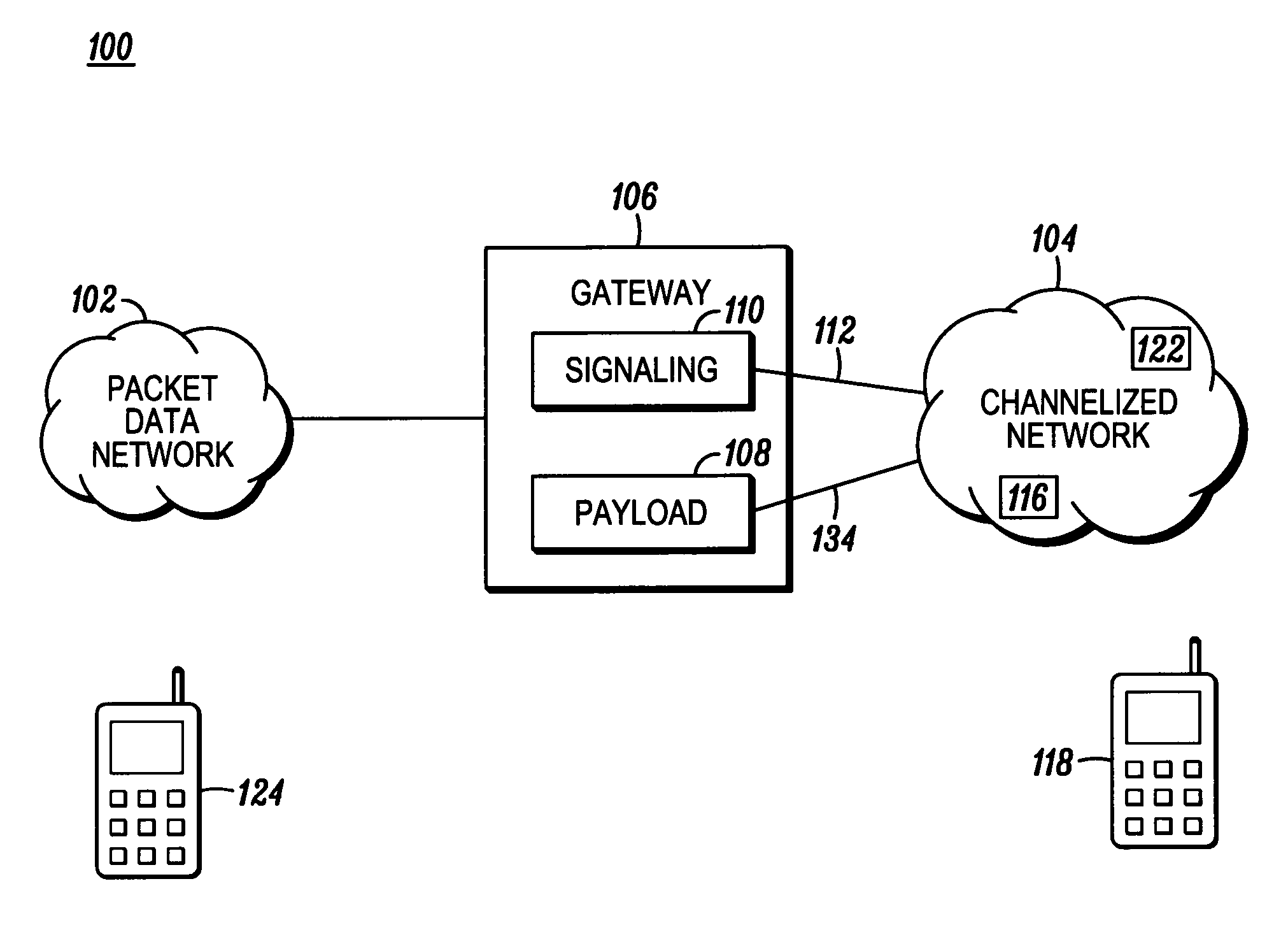
p-0005<figref idrefs="DRAWINGS">FIG. 1</figref> is an example of a simple block diagram illustrating an RF communication system in accordance with some embodiments of the invention.
p-0006<figref idrefs="DRAWINGS">FIG. 2</figref> is an example APCO 25 message encapsulated in an IP data packet in accordance with some embodiments of the invention.
p-0007<figref idrefs="DRAWINGS">FIG. 3</figref> is an example APCO 25 group call grant message encapsulated in an IP data packet in accordance with some embodiments of the invention.
p-0008Skilled artisans will appreciate that elements in the figures are illustrated for simplicity and clarity and have not necessarily been drawn to scale. For example, the dimensions of some of the elements in the figures may be exaggerated relative to other elements to help to improve understanding of embodiments of the present invention.
DETAILED DESCRIPTION
p-0009Before describing in detail an embodiment of the present invention, it should be observed that the present invention resides primarily in combinations of method steps and apparatus components. Accordingly, the apparatus components and method steps have been represented where appropriate by conventional symbols in the drawings, showing only those specific details that are pertinent to understanding the present invention so as not to obscure the disclosure with details that will be readily apparent to those of ordinary skill in the art having the benefit of the description herein.
p-0010In this document, relational terms such as first and second, top and bottom, and the like may be used solely to distinguish one entity or action from another entity or action without necessarily requiring or implying any actual such relationship or order between such entities or actions. The terms “comprises,” “comprising,” or any other variation thereof, are intended to cover a non-exclusive inclusion, such that a process, method, article, or apparatus that comprises a list of elements does not include only those elements but may include other elements not expressly listed or inherent to such process, method, article, or apparatus. An element proceeded by “comprises . . . a” does not, without more constraints, preclude the existence of additional identical elements in the process, method, article, or apparatus that comprises the element.
p-0011A method and apparatus for providing access to a channelized network from a packet data network is disclosed. Referring to <figref idrefs="DRAWINGS">FIG. 1</figref>, a radio frequency (RF) communication system <b>100</b> according to an embodiment of the present invention illustratively comprises a mobile device <b>124</b>, a gateway <b>106</b> which interfaces between a packet data network <b>102</b> and a channelized network <b>104</b>. Both networks <b>102</b>, <b>104</b> comprise sites for providing RF coverage over a specific geographic area.
p-0012For example, referring to <figref idrefs="DRAWINGS">FIG. 1</figref>, sites <b>116</b>, <b>122</b> of the channelized network <b>104</b> are generally fixed in location and comprise a control and voice channel that adheres to an APCO 25 (also known as TIA 102) standard. Further, the channelized network <b>104</b> is preferably an APCO 25 system such as an Astro 25™ system manufactured by Motorola, Inc. where the channelized network further comprises one or more zones with Zone Controllers where each Zone Controller is also referred to as a call server. Even though an embodiment of the present invention is described with reference to the channelized network <b>104</b> being an APCO 25 network, embodiments of the present invention are intended to work with a Trans European Trunked Radio (TETRA) network. Thus, the mention of APCO 25 is not meant to be limiting.
p-0013Referring to the packet data network <b>102</b>, the sites (not shown) of the packet data network <b>102</b> may be fixed or mobile and adhere to an Internet Protocol (IP) based protocol. The packet data network <b>102</b> may be an 802.11 wireless local area network (WLAN), wherein the mobile device <b>124</b> and sites (not shown) of the packet data network <b>102</b> are configured to operate in accordance with the ANSI/IEEE (American National Standards Institute/Institute of Electrical and Electronics Engineers) 802.11 wireless LAN standards. Alternatively, packet data network <b>102</b> may adhere to another ANSI/IEEE 802 wireless standard, such as 802.15.1, 802.15.3, 802.15.4, 802.16, 802.20, 802.22, and the like. The mention of ANSI/IEEE 802.11 is not to be construed as a limitation. In such an example, the sites (not shown) of the packet data network <b>102</b> may be termed access points (APs) and/or transmitters. Further, the packet data network <b>102</b> may be a carrier data network as that term is known to one of ordinary skill in the art. An example of such a carrier data network is a CDMA 1xEV-DO commercial network.
p-0014In <figref idrefs="DRAWINGS">FIG. 1</figref>, the channelized network <b>104</b> is illustrated with only two sites <b>116</b>, <b>122</b> for the purpose of ease of illustration. However, it should be understood by those of ordinary skill in the art that both networks <b>102</b>, <b>104</b> may be designed with any number of sites. Further, in <figref idrefs="DRAWINGS">FIG. 1</figref>, only two networks <b>102</b>, <b>104</b> are shown for ease of illustration. However, it should be understood by those of ordinary skill in the art that more than two networks may co-exist where the gateway <b>106</b> interfaces between the more than two networks.
p-0015In an exemplary embodiment, the gateway <b>106</b> functions as an interface between the packet data network <b>102</b> and the channelized network <b>104</b>. The gateway <b>106</b> comprises a signaling function <b>110</b> and a payload function <b>108</b>. The gateway <b>106</b> shown in <figref idrefs="DRAWINGS">FIG. 1</figref> accepts APCO 25 Common Air Interface messages encapsulated in an IP data packet and reformats the messages as necessary to interface to the channelized network <b>104</b>. Even though a single gateway <b>106</b> with combined functionality for signaling <b>110</b> and payload <b>108</b> is shown in <figref idrefs="DRAWINGS">FIG. 1</figref>, the functions of signaling <b>110</b> and payload <b>108</b> could be decomposed into multiple devices.
p-0016The endpoints of communication in the. RF communication system <b>100</b> are mobile devices, e.g. mobile devices <b>118</b>, <b>124</b>. The mobile devices <b>118</b>, <b>124</b> are generally communication devices that may be either sources or recipients of payload and/or signaling messages routed through the RF communication system <b>100</b>. As such, the mobile devices <b>118</b>, <b>124</b> may be any suitable type of wireless communications device capable of communicating within the RF communication system <b>100</b>, for instance, a laptop computer, a personal digital assistant, a voice handset, or any other suitable device as will be appreciated by those of skill in the art. In an exemplary embodiment, the mobile devices are APCO 25 radios equipped with a WLAN modem. The mobile devices <b>118</b>, <b>124</b> may also be connected to a fixed communications infrastructure, if desired.
p-0017As is known in the art, for a communication to take place in the channelized network <b>104</b>, a circuit is set up between two endpoints, e.g. mobile devices, before a communication takes place. In contrast, the packet data network <b>102</b> supports IP addressing of packets. As is known in the art and as used herein, packets are units of payload and are not sequentially processed by the packet data network <b>102</b>.
p-0018Practitioners skilled in the art will appreciate that the RF communication system <b>100</b> may include various other communication devices not specifically shown in <figref idrefs="DRAWINGS">FIG. 1</figref>. For example, the channelized network <b>104</b> may comprise a link, such as, for example a T1 line or E1 digital carrier system that connects the site <b>116</b> to a public switched telephone network (PSTN) via a telephone gateway, a paging network or short message system via a paging gateway, and a facsimile machine or similar device via fax gateway or modem.
p-0019In addition, the packet data network <b>102</b> may be connected via an access point (AP) to an underlying network that may be implemented, for instance, as a wired network or as a mesh network having fixed or mobile access points. Further, the packet data network <b>102</b> may provide access to a number of content sources, such as the Internet or various Intranets. In support thereof, the packet data network <b>102</b> may include any number or type of wire line communication device(s), site controller(s), comparator(s), telephone interconnect device(s), internet protocol telephony device(s), call logger(s), scanner(s) and gateway(s, collectively referred to herein as a fixed device(s).
p-0020In operation, the gateway <b>106</b> functions to translate APCO 25 packets between the packet data network <b>102</b> and the APCO 25 network <b>104</b>. As shown in <figref idrefs="DRAWINGS">FIG. 1</figref>, a signaling interface <b>112</b> is defined to connect the signaling <b>110</b> function to the APCO 25 network <b>104</b>. In an exemplary embodiment, the signaling interface <b>112</b> is an ALSLIP interface that connects a site controller of a site, e.g. site <b>116</b>, to the site's Zone Controller. In an alternative embodiment, signaling interface <b>112</b>, e.g. an ALSLIP interface, connects a Zone Controller of the channelized network <b>104</b> to the gateway <b>106</b>. In any case, the signaling interface <b>112</b>, e.g. an ALSLIP interface, connects the gateway <b>106</b> to the channelized network <b>104</b> in general terms. Further shown in <figref idrefs="DRAWINGS">FIG. 1</figref>, a payload interface <b>114</b> is defined to connect the payload <b>108</b> function to the APCO 25 network <b>104</b>. In an exemplary embodiment, the payload interface <b>114</b> is an XIS interface that carries payload between the site and the Zone Controller on a traffic channel of the APCO 25 network <b>104</b>.
p-0021Referring to <figref idrefs="DRAWINGS">FIG. 2</figref>, shown is an example APCO 25 message encapsulated in an IP data packet <b>202</b>. Shown is an IP data packet <b>202</b> adhering to a UDP/IPv4 protocol, however, the IP data packet <b>202</b> may also be formatted to UDP/IPv6 standards. Notice that each block of the APCO message <b>204</b> is of a fixed size and that the APCO 25 message <b>202</b> comprises a last block field <b>206</b>. Because each block (also known as a trunking control block) is of a fixed size and the APCO 25 message <b>202</b> has a last block <b>204</b>, more than one APCO 25 message may be encapsulated into one IP data packet <b>202</b>. In an exemplary embodiment, APCO 25 multi-block messages are combined into a single IP data packet <b>202</b>. That is, in an exemplary embodiment, a single APCO 25 control block is not split across multiple IP data packets.
p-0022In operation, the gateway <b>106</b> receives and transmits APCO 25 messages that are encapsulated in an IP data packet. The gateway <b>106</b> receives APCO 25 messages that are encapsulated in an IP data packet from the packet data network <b>102</b> and decapsulates the APCO 25 message from the IP data packet to forward to a site, e.g. site <b>116</b>, in the APCO 25 network <b>104</b>. Once in the APCO 25 network <b>104</b>, the APCO 25 message is processed according to the APCO 25 standard as outlined in TIA 102.
p-0023In operation, the mobile device, e.g. mobile device <b>124</b>, powers-on and initializes its IP network interface. Initializing the IP network interface means to get the mobile device's IP address from a domain name server (DNS) using dynamic host control protocol (DHCP) or other well-known means. Additional events that trigger the mobile device to initialize its IP network interface include a change in the mobile device's IP address (from network failure or otherwise), a change in a point of attachment to the packet data network, and a change to a different network interface.
p-0024Following initialization of the IP network interface, the mobile device retrieves the IP address of the mobile device's home channelized network. There may be a number of ways to distribute mobile devices among various channelized networks. One way is to assign a mobile device to a channelized network that is geographically closest to the mobile device. Another is to perform load sharing using well-known techniques to distribute the number of mobile devices associated with each gateway. In any case, each mobile device is assigned a home channelized network. In one embodiment, retrieving the IP address of the mobile device's home channelized network may be carried out by performing a DNS lookup of the name. In one embodiment, the home channelized network name is constructed by taking a unique system ID of the mobile device's home channelized network expressed as a text string and combining it with another text string to form a valid domain name for the home channelized network's gateway. The IP address returned from the DNS lookup is the IP address of the gateway for mobile device.
p-0025Upon retrieving the IP address of the home channelized network, namely the IP address of the gateway <b>106</b>, the mobile device confirms itself with the gateway <b>106</b>. Because, the packet data network <b>102</b> does not broadcast signaling as in the channelized network <b>104</b>, the gateway <b>106</b> sends specific IP data packets with APCO 25 messages that contain status or network specific messages (also referred to as RSS messages) as unicast messages as necessary.
p-0026In one embodiment, the mobile device <b>124</b> confirms itself with the gateway <b>106</b> by sending a manufacturer-specific NET_STS_QUERY message encapsulated in UDP/IP. The gateway <b>106</b> responds to the message with an NET_STS_BCST message that contains the information normally broadcast on a control channel of the channelized network <b>104</b>. In this case, the RFSS_STS_BCST is unicast to the mobile device <b>124</b>. The mobile device <b>124</b> compares the value of a WACN ID field received in the NET_STS_BCST with known valid codes. If the WACN ID is a valid code, the mobile device <b>124</b> shall consider itself confirmed on the gateway. If the WACN ID is not a valid code, then the mobile device <b>124</b> will continue searching for a gateway <b>106</b>.
p-0027In one embodiment, performing the DNS lookup returns more than one IP address. For example, the home channelized network may be associated with more than one IP address or there may be other channelized networks that may function as the home channelized network for the mobile device <b>124</b>. Thus, if additional IP addresses were returned by the DNS lookup, then the mobile device contacts those additional gateways. If additional IP network interfaces are available, the mobile device switches to another packet data network (e.g., switching to a different wireless interface), performs another DNS lookup, and contacts the resulting gateway. When all combinations have been tried and the mobile device does not receive confirmation from a gateway, then the mobile device <b>124</b> waits for a period of time before retrying the initialization process.
p-0028Continuing, once the mobile device has found a gateway, the mobile device performs registration with the channelized network <b>104</b>. In one embodiment, the registration is performed as outlined in TIA 102-AABD <figref idrefs="DRAWINGS">FIG. 5-1</figref> and as shown in TIA 102-AABD <figref idrefs="DRAWINGS">FIG. 6-1</figref>. In general, the mobile device <b>124</b> creates an APCO 25 Unit Registration message (e.g. U_REG_REQ) which is encapsulated in an IP data packet addressed to the gateway <b>106</b>. As mentioned, the APCO 25 Unit Registration message is defined in the TIA 102 standard.
p-0029Once the gateway <b>106</b> receives the IP data packet containing the registration message from the mobile device <b>124</b>, the gateway <b>106</b> removes the registration message from the IP data packet and processes the registration message. In one embodiment, a signaling <b>110</b> function of the gateway <b>106</b> retrieves the mobile device's identification (e.g. SUID) from the U_REG_REQ message and reformats the registration message for sending to the channelized network <b>104</b>. Further, the gateway <b>106</b> maintains knowledge of the mobile device's identification and the mapping to the mobile device's IP address so that future messages can be properly sent to and from the mobile device <b>124</b>.
p-0030In one embodiment, a Zone Controller of the channelized network <b>104</b> will respond with an APCO 25 registration response message (e.g. U_REG_RSP). When the gateway <b>106</b> receives the registration response message, it retrieves an SUID from the registration response to lookup the mobile device's IP address. The gateway <b>106</b> maintains the mapping between the SUID, IP address, and a WUID assigned by the Zone Controller in an IP/mobile device table. Then, the gateway <b>106</b> repackages the registration response message in an IP data packet and forwards the IP data packet to the mobile device <b>124</b>.
p-0031Following registration, the mobile device creates an APCO 25 affiliation message, encapsulates it in an IP data packet and sends the IP data packet to the gateway <b>106</b>. In one embodiment, the signaling <b>110</b> function of the gateway <b>106</b> extracts a talk group ID from the IP data packet and looks up the talk group ID in a talk group/mobile device table where the talk group/mobile device table maps talk group IDs with IP addresses of mobile devices. If the talk group ID is found in the talk group/mobile device table, the IP address of the mobile device is stored; otherwise a new entry is created for the talk group ID and the IP address of the mobile device is stored. The mapping of talk group IDs and IP addresses of mobile devices is used to duplicate and send audio packets to the mobile device during a group call.
p-0032In one embodiment, the signaling <b>110</b> function converts the affiliation message into ALSLIP and sends the affiliation message to a Zone Controller of the channelized network <b>104</b>. The Zone Controller will respond with an acknowledgement that the signaling <b>110</b> function forwards to the mobile device <b>124</b>. Having registered and affiliated with the channelized network <b>104</b>, the mobile device <b>124</b> is able to communicate with the channelized network <b>104</b> from the packet data network <b>102</b>.
p-0033If, for any reason, the Zone Controller rejects the affiliation, the signaling <b>110</b> function removes the mobile device's IP address from the list of devices associated with the talk group ID from the talk group/mobile device table in the gateway <b>106</b>. Further, the mobile device's entry may also be removed from the talk group/mobile device table when the mobile device deregisters and/or after a period of inactivity.
p-0034In one embodiment, following successful registration and affiliation of the mobile device <b>124</b>, the signaling <b>110</b> function of the gateway may perform a series of network tests to estimate transmission characteristics. Such tests may include sending a PING packet that is immediately acknowledged by the mobile device <b>124</b> to measure round-trip times. Such tests may be conducted using manufacturer-specific APCO 25 messages encapsulated in an EP data packet. Further, the gateway <b>106</b> may use the measured round-trip time in calculating when the mobile device <b>124</b> is ready to receive payload.
p-0035Further following registration and affiliation of the mobile device <b>124</b>, the signaling <b>110</b> function of the gateway <b>106</b> may send one or more manufacturer-specific APCO 25 messages that contain configuration information necessary for the mobile device to communicate with the channelized network <b>104</b>. As described above, such messages are encapsulated in an IP data packet before being sent by the gateway <b>106</b> to the mobile device <b>124</b>. As used herein, configuration information may include IP addresses, UDP port numbers, and other parameters, such as a count of the number of audio frames to be bundled into each IP data packet.
p-0036As mentioned above, now that the mobile device is registered and affiliated with the channelized network <b>104</b>, the mobile device <b>124</b> is able to communicate with the channelized network <b>104</b> from the packet data network <b>102</b>. As such, a user of the mobile device <b>124</b> may begin a push-to-talk (PTT) call by pressing the PTT button on the mobile device <b>124</b>. Pressing the PTT button on the mobile device <b>124</b> creates an APCO 25 service request where the service request is encapsulated in an IP data packet and sent to the gateway <b>106</b>. The mobile device may retransmit the APCO 25 request as specified in the TIA 102 standard. In any event, once the APCO 25 service request encapsulated in an IP data packet is received by the signaling function of the gateway <b>106</b>, the gateway removes the APCO 25 service request from the IP data packet, converts the APCO 25 service request to ALSLIP format, and forwards the APCO 25 service request to the channelized network <b>104</b>.
p-0037In one embodiment, a Zone Controller of the channelized network <b>104</b> processes the APCO 25 service request. Before starting the PTT call, the Zone Controller sends an ALSLIP get ready message to the gateway <b>106</b> where the get ready message identifies traffic destination or a talk group.
p-0038The gateway <b>106</b> handles the ALSLIP get ready message differently depending on whether or not the packet data network <b>102</b> uses power-saving techniques that delay the availability of mobile devices in the packet data network <b>102</b>. If the mobile device <b>124</b> is immediately available, the gateway <b>106</b> returns an ALSLIP ready response message immediately to the Zone Controller in the APCO 25 network <b>104</b>. If power-saving techniques are in use, the gateway <b>106</b> will wait to return the ALSLIP ready response message until the mobile device is expected to be ready. If the PTT call is a talk group call, then the gateway <b>106</b> looks up the list of mobile devices affiliated with the talk group. If this is the only mobile device using the gateway <b>106</b> in the talk group, the gateway <b>106</b> immediately returns an ALSLIP ready response message if the mobile device is known to be ready. If there are other affiliated mobile devices that are not active, the gateway <b>106</b> sends a message to each mobile device causing the mobile device to become active and sends an ALSLIP ready response message to the Zone Controller in the channelized network.
p-0039In an alternative embodiment, the gateway <b>106</b> may maintain knowledge of the activity state on the mobile devices in the packet data network <b>102</b>, query the packet data network <b>102</b>, and use a measured round-trip time to return the ALSLIP ready response message sooner than if the gateway <b>106</b> waits for a response from each mobile device. Further, as is known to one of ordinary skill in the art, techniques other than sending a message may be used to activate the mobile devices. Further, the gateway <b>106</b> may reduce call setup latency by requesting the packet data network to directly page the mobile device.
p-0040If the PTT call is a request is for a talk group call, the channelized network <b>104</b> will send an APCO 25 call grant message to the gateway <b>106</b>. As specified in TIA 102, an APCO 25 call grant message typically has information about an RF channel. Since such information is not applicable to the packet data network, the signaling function of the gateway <b>106</b> replaces the channel value with a dummy value, e.g. 0, in the APCO 25 call grant message and encapsulates the APCO 25 call-grant message in an IP data packet. In an alternate embodiment, the signaling <b>110</b> function of the gateway <b>106</b> creates a manufacturer-specific APCO 25 call grant message that includes IP address information <b>302</b> as shown in <figref idrefs="DRAWINGS">FIG. 3</figref>. Such an exemplary APCO 25 call grant message allows for multiple gateways to load share the payload of the RF communication system <b>100</b>.
p-0041As mentioned above, the signaling <b>110</b> function of the gateway <b>106</b> looks up in the talk group/mobile device table the list of mobile devices affiliated with the talk group and associated IP addresses. The signaling function of the gateway <b>106</b> then sends an APCO 25 call grant message to each mobile device affiliated with the talk group. As is known, the APCO 25 call grant message may be transmitted multiple times to ensure delivery to the mobile devices in the packet data network <b>102</b>. As mentioned above, an example APCO 25 call grant message encapsulated in an IP data packet is shown in <figref idrefs="DRAWINGS">FIG. 3</figref>.
p-0042If the mobile device <b>124</b> has been granted permission, namely the mobile device <b>124</b> has received an APCO 25 call grant message encapsulated in an IP data packet, the mobile device <b>124</b> sends communications to the gateway <b>106</b>. The gateway <b>106</b> then forwards the communications to the channelized network <b>104</b> for further processing. In one embodiment, the gateway <b>106</b> may process the communications locally and discard received communications from all but the current traffic source and forward the communications to other mobile devices using the gateway <b>106</b> to forward to the channelized network <b>104</b>.
p-0043A user of the mobile device <b>124</b> may end a push-to-talk (PTT) call by releasing the PTT button on the mobile device <b>124</b>. Releasing the PTT button on the mobile device <b>124</b> causes the mobile device to pad audio in the communication to the next logical data unit (LDU) boundary as specified in the APCO 25 standard. Further, the mobile device sends an APCO 25 dekey link control message encapsulated in an IP data packet to the gateway and the gateway communicates the APCO 25 dekey link control message to the APCO 25 network <b>104</b>. In response, the channelized network <b>104</b> sends an APCO 25 call over message to all mobile devices in the PTT call.
p-0044A user of a mobile device <b>118</b> in the channelized network may request a call. When the user does so, a Zone Controller in the channelized network <b>104</b> sends an ALSLIP get ready control message to the gateway <b>106</b>. As described before, if this is a request for a talk group call, the gateway <b>106</b> looks up the list of mobile devices affiliated with the talk group, and determines if each affiliated mobile device is active in the packet data network <b>102</b>. If the affiliated mobile devices are not active, the gateway <b>106</b> sends a message to each inactive mobile device causing the inactive mobile device to become active. When the mobile devices of the request talk group are ready, the gateway <b>106</b> returns an ALSLIP ready response message to the channelized network <b>104</b>.
p-0045When the Zone Controller affiliated with the mobile device <b>118</b> in the channelized network <b>104</b> decides to start the call, the signaling <b>110</b> function of the gateway <b>106</b> receives an APCO 25 call grant message from the channelized network <b>104</b>. In an exemplary embodiment, the APCO 25 call grant message has information about the RF channel that is not applicable to the packet data network, so the signaling <b>110</b> function replaces the channel value and encapsulates the APCO 25 call grant message in an IP data packet. The signaling <b>110</b> function of the gateway then looks up in the talk group/mobile device table, the list of mobile devices affiliated with the talk group. Finally, the signaling function of the gateway <b>106</b> sends the APCO 25 call grant message to each mobile device affiliated with the talk group. The payload <b>108</b> function of the gateway then forwards payload packets to each mobile device in the talk group. Finally, when the user of the mobile device <b>118</b> in the channelized network <b>104</b> releases the PTT button, the gateway <b>106</b> receives indication of the released PTT button and sends an APCO 25 termination of audio message to the mobile devices in the talk group call.
p-0046In further embodiments, data communications whether in the packet data network <b>102</b> or in the channelized network <b>104</b> are tunneled through the gateway without manipulation by the gateway. In an exemplary embodiment, a layer <b>3</b> tunnel is utilized to provide data communications between the two networks <b>102</b>. <b>104</b>. Further yet, regardless of the type of APCO 25 message that is utilized in the channelized network <b>104</b>, the APCO 25 message is encapsulated in an IP data packet for communication in the packet data network <b>102</b>.
p-0047It will be appreciated that embodiments of the present invention described herein may be comprised of one or more conventional processors and unique stored program instructions that control the one or more processors to implement, in conjunction with certain non-processor circuits, some, most, or all of the functions described herein. The non-processor circuits may include, but are not limited to, a radio receiver, a radio transmitter, signal drivers, clock circuits, power source circuits, and user input devices. As such, these functions may be interpreted as steps of a method. Alternatively, some or all functions could be implemented by a state machine that has no stored program instructions, or in one or more application specific integrated circuits (ASICs), in which each function or some combinations of certain of the functions are implemented as custom logic. Of course, a combination of the two approaches could be used. Thus, methods and means for these functions have been described herein. Further, it is expected that one of ordinary skill, notwithstanding possibly significant effort and many design choices motivated by, for example, available time, current technology, and economic considerations, when guided by the concepts and principles disclosed herein will be readily capable of generating such software instructions and programs and ICs with minimal experimentation.
p-0048In the foregoing specification, the invention and its benefits and advantages have been described with reference to specific embodiments. However, one of ordinary skill in the art appreciates that various modifications and changes can be made without departing from the scope of the present invention as set forth in the claims below. Accordingly, the specification and figures are to be regarded in an illustrative rather than a restrictive sense, and all such modifications are intended to be included within the scope of present invention. The benefits, advantages, solutions to problems, and any element(s) that may cause any benefit, advantage, or solution to occur or become more pronounced are not to be construed as a critical, required, or essential features or elements of any or all the claims. The invention is defined solely by the appended claims including any amendments made during the pendency of this application and all equivalents of those claims as issued.
Contents4
3 sheets
Sheet 1 Sheet 2 Sheet 3
Every citation, both ways
| Document | Relation | Office | Cited during |
|---|---|---|---|
| US8145262B2 | Cited by | United States of America | Applicant |
| US2008031207A1 | Cited by | United States of America | Pre-grant |
| US8279868B2 | Cited by | United States of America | Applicant |
| US8359066B2 | Cited by | United States of America | Applicant |
| US8406168B2 | Cited by | United States of America | Applicant |
| US2010232355A1 | Cited by | United States of America | Pre-grant |
| US2006262800A1 | Cited by | United States of America | Pre-grant |
| US8194682B2 | Cited by | United States of America | Applicant |
| US2003174670A1 | Cites | United States of America | Search report |
| US2004114634A1 | Cites | United States of America | Search report |
| US2004190468A1 | Cites | United States of America | Search report |
| US2006262808A1 | Cites | United States of America | Search report |
| US5847771A | Cites | United States of America | Search report |
| US5987331A | Cites | United States of America | Applicant |
| US7221660B1 | Cites | United States of America | Search report |
2 priority claims, no other members on record
Priority claims2
| Document | Office | Kind | Date |
|---|---|---|---|
| 11719105 | United States of America | A | |
| US20050117191 | – | – | – |
48 transactions on the USPTO file
Allowed after 1 non-final rejection.
- Non-final rejections
- 1
- Final rejections
- 0
- RCEs
- 0
- Appeals
- 0
Over time
Point at a mark for the transactionTransactions
| Event | Code | |
|---|---|---|
| Recordation of Patent Grant MailedPGM/ | PGM/ | |
| Patent Issue Date Used in PTA CalculationAllowedPTAC | PTAC | |
| Email NotificationEML_NTR | EML_NTR | |
| Issue Notification MailedAllowedWPIR | WPIR | |
| Dispatch to FDCD1935 | D1935 | |
| Application Is Considered Ready for IssuePILS | PILS | |
| Issue Fee Payment VerifiedN084 | N084 | |
| Issue Fee Payment ReceivedIFEE | IFEE | |
| Electronic ReviewELC_RVW | ELC_RVW | |
| Email NotificationEML_NTR | EML_NTR | |
| Email NotificationEML_NTF | EML_NTF | |
| Email NotificationEML_NTR | EML_NTR | |
| Mail Examiner's AmendmentMEX.A | MEX.A | |
| Mail Examiner Interview Summary (PTOL - 413)MEXIN | MEXIN | |
| Mail Notice of AllowanceAllowedMN/=. | MN/=. | |
| Examiner's Amendment CommunicationEX.A | EX.A | |
| Notice of Allowance Data Verification CompletedAllowedN/=. | N/=. | |
| Case Docketed to Examiner in GAUDOCK | DOCK | |
| Examiner Interview Summary Record (PTOL - 413)EXIN | EXIN | |
| Date Forwarded to ExaminerFWDX | FWDX | |
| Response after Non-Final ActionA... | A... | |
| Request for Extension of Time - GrantedXT/G | XT/G | |
| Electronic ReviewELC_RVW | ELC_RVW | |
| Email NotificationEML_NTF | EML_NTF | |
| Mail Non-Final RejectionNon-final rejectionMCTNF | MCTNF | |
| Non-Final RejectionNon-final rejectionCTNF | CTNF | |
| Information Disclosure Statement consideredIDSC | IDSC | |
| Reference capture on IDSRCAP | RCAP | |
| Electronic Information Disclosure StatementEIDS. | EIDS. | |
| Information Disclosure Statement (IDS) FiledWIDS | WIDS | |
| Case Docketed to Examiner in GAUDOCK | DOCK | |
| Case Docketed to Examiner in GAUDOCK | DOCK | |
| Case Docketed to Examiner in GAUDOCK | DOCK | |
| Case Docketed to Examiner in GAUDOCK | DOCK | |
| IFW TSS Processing by Tech Center CompleteTSSCOMP | TSSCOMP | |
| Case Docketed to Examiner in GAUDOCK | DOCK | |
| Application Dispatched from OIPEOIPE | OIPE | |
| Application Is Now CompleteCOMP | COMP | |
| Additional Application Filing FeesADDFLFEE | ADDFLFEE | |
| Applicant has submitted new drawings to correct Corrected Papers problemsCORRDRW | CORRDRW | |
| Corrected PaperCPAP | CPAP | |
| Cleared by OIPE CSRL194 | L194 | |
| IFW Scan & PACR Auto Security ReviewSCAN | SCAN | |
| Information Disclosure Statement consideredIDSC | IDSC | |
| Reference capture on IDSRCAP | RCAP | |
| Information Disclosure Statement (IDS) FiledM844 | M844 | |
| Information Disclosure Statement (IDS) FiledWIDS | WIDS | |
| Initial Exam Team nnIEXX | IEXX |
6 legal events, as the office reported them to INPADOC
Over the term
Point at a mark for the eventEvents
| Event | Code | |
|---|---|---|
| Maintenance fee paymentMAFP | MAFP | |
| Fee paymentFPAY | FPAY | |
| Fee paymentFPAY | FPAY | |
| AssignmentAS | AS | |
| Information on status: patent grantGrantedPATENTED CASESTCF | STCF | |
| AssignmentAS | AS |
Numbers
- Publication, DOCDB
- 7492734
- Publication, EPODOC
- US7492734
- Application
- 11117191
- Application, DOCDB
- 11719105
- Application, EPODOC
- US20050117191
Titles
- English
- Method of access to a channelized network from a packet data network
Patent term adjustment
- A delay
- +577 daysthe office missed an examination deadline
- Applicant delay
- −51 days
- Net adjustment
- 526 days
Classification
- CPC, 3
- H04W92/02
- H04W88/16
- H04W76/10
- USPC, 6
- 370328000
- 370352000
- 370390000
- 370401000
- 370432000
- 370466000