RTP payload format
Summary by NHIP
Encrypted ASF RTP Packetization
The apparatus encrypts data streams with an arbitrary block size and transforms Advanced Systems Format audio and video into separate RTP packets. It preserves block boundaries within distinct payloads to ensure encrypted units can be reassembled and decrypted without mixing media types.
Claim Score by NHIP
Abstract
A data stream is encrypted to form encryption units that are packetized into RTP packets. Each RTP packet includes an RTP packet header, one or more payloads of a common data stream, and a RTP payload format header for each payload and including, for the corresponding encryption units, a boundary for the payload. The payload can be one or more of the encryption units or a fragment of one of the encryption units. The encryption units are reassembled the using the payloads in the RTP packets and the respective boundary in the respective RTP payload format header. The reassembled of encryption units are decrypted for rendering. Each RTP payload format header can have attributes for the corresponding payload that can be used to render the payload. The RTP packets can be sent server-to-client or peer-to-peer.
Term
Term ended
Expired 27 July 2025, 1.2 years ago.
- Priority and filed
- Granted
- Expired
- Today
11 claims: 2 independent, 9 dependent
- 1An apparatus comprising:means for encrypting a data stream with an arbitrary block size to form a plurality of encryption units;means for transforming packets of Advanced Systems Format (ASF) audio and video data into RTP packets, wherein the audio and video data are packetized separated;means for preserving block boundaries for each payload, wherein the block boundaries for each payload are determined by a corresponding separate audio and video payloads of ASF formats;means for putting a payload of different data streams into separate RTP packets;means for packetizing the plurality of encryption units into a plurality RTP packets each including: an RTP packet header;one or more payloads of a common data stream and selected from the group consisting of: one or more encryption units;fragment of one encryption unit;and one RTP payload format header for each payload and including, for the corresponding encryption units, a boundary for the arbitrary block size;wherein there is a separation of audio data and video data into the RTP packets, without containing mixed media payloads;wherein the RTP packet header of each packet contains information relating to the separation of the audio data and video data;wherein the block boundaries for each payload are preserved for the original audio and video data that were encrypted and packetized can be reconstructed by decryption.
- 6Broadest claimClaim Score 28, narrow(NHIP)A method comprising:encrypting a data stream with an arbitrary block size to form a plurality of encryption units;and transforming packets of Advanced Systems Format (ASF) audio and video data into RTP packets, wherein the audio and video data are packetized separated;preserving block boundaries for each payload, wherein the block boundaries for each payload are determined by corresponding separate audio and video payloads of ASF;means for putting a payload of different data streams into separate RTP packets;packetizing the plurality of encryption units into a plurality RTP packets each including: an RTP packet header;one or more payloads of a common data stream and selected from the group consisting of: one or more encryption units;and a fragment of one encryption unit;one RTP payload format header for each said payload and including, for the corresponding encryption units, a boundary for the arbitrary block size;wherein there is a separation of audio data and video data into the RTP packets, without containing mixed media payloads;wherein the RTP packet header of each packet contains information relating to the separation of the audio data and video data;wherein the block boundaries for each payload are preserved for the original audio and video data that were encrypted and packetized can be reconstructed by decryption.
Independent claims2
71 paragraphs in 6 sections, as filed
TECHNICAL FIELD
0001The present invention relates to Real-Time Transport Protocol (RTP) and more particularly to an RTP wire format for streaming media (e.g. audio-video) over a network, such as the Internet.
BACKGROUND OF THE INVENTION
0002The following discussion assumes that the reader is familiar with the IETF RFC 1889 standard—RTP: A Transport Protocol for Real-Time Applications and with the IETF RFC 1890 standard—RTP Profile for Audio and Video Conferences with Minimal Control.
0003Real-time transport protocol (RTP), as defined in the RFC 1889 standard, provides end-to-end network transport functions suitable for applications transmitting real-time data, such as audio, video or simulation data, over multicast or unicast network services. These transport functions provide end-to-end delivery services for data with real-time characteristics, such as interactive audio and video. Such services include payload type identification, sequence numbering, time stamping and delivery monitoring. RTP supports data transfer to multiple destinations using multicast distribution if provided by the underlying network.
0004The RFC 1889 standard does not provide any mechanism to ensure timely delivery or provide other quality-of-service guarantees, but relies on lower-layer services to do so. It does not guarantee delivery or prevent out-of-order delivery, nor does it assume that the underlying network is reliable and delivers packets in sequence. The sequence numbers included in RTP allow the receiver to reconstruct the sender's packet sequence, but sequence numbers might also be used to determine the proper location of a packet, for example in video decoding, without necessarily decoding packets in sequence.
0005A typical application of RTP involves streaming data, where packets of Advanced Systems Format (ASF) audio-visual (AV) data is sent in RTP packets over a network from a server to a client or peer-to-peer. The ASF audio and video data can be stored together in one ASF packet. As such, an RTP packet can contain both audio and video data.
0006RTP, as defined the RFC 1889 standard, lacks flexibility to group multiple payloads together into a single RTP packet, and to split a payload across multiple RTP packets. Neither does the RFC 1889 standard define a format in which metadata can be delivered with each payload in an RTP packet. Another deficiency of the RFC 1889 standard is the lack of a mechanism for streaming encrypted blocks of data across a network while maintaining a block boundary of each encrypted block such that the recipient thereof can decrypt the encrypted blocks of data. In would be an advance in the art to provide such flexibility as an enhancement to RTP streaming. Consequently, there is a need for improved methods, computer-readable medium, data structures, apparatus, and computing devices that can provide such flexibility.
SUMMARY
0007In one implementation, packets of Advanced Systems Format (ASF) audio-visual (AV) data are repacketized into Real-Time Transport Protocol (RTP) packets and sent over a network from a server to client or by peer-to-peer network communications in response to a request to stream the AV data. The AV data is encrypted to form encryption units. The repacketizing process includes packetizing the encryption units into the RTP packets each of which includes an RTP packet header, one or more payloads of a common data stream, and a RTP payload format (PF) header for each payload. The RTP PF header includes, for the corresponding encryption units, a boundary for the payload. The payload in the RTP packet can be one or more encryption units or a fragment of an encryption unit. After the RTP packets are sent over a network, the encryption units contained in the received RTP packets are reassembled. The reassembly process uses the payloads in the RTP packets and the respective boundary in the respective RTP PF header. The reassembled encryption units can be decrypted for rendering. Each RTP PF header can have attributes for its corresponding payload that can be used to render the payload.
0008In a variation on the foregoing implementation, data in a format other than ASF is used to form the RTP packets. In a still further variation on the foregoing implementation, the RTP packets are formed so as to contain payloads that are not encrypted.
0009In yet another implementation, a wire format is provided for streaming encrypted blocks of data protected with Windows® Media Digital Rights Management (WM DRM) across a network in RTP packets (e.g., streaming WM DRM protected content). Each RTP packet contains header data to maintain encryption block boundaries so that each encryption unit can be decrypted by the recipient thereof. Upon decryption using the WM DRM protocol, the streaming data can be rendered by the recipient.
BRIEF DESCRIPTION OF THE DRAWINGS
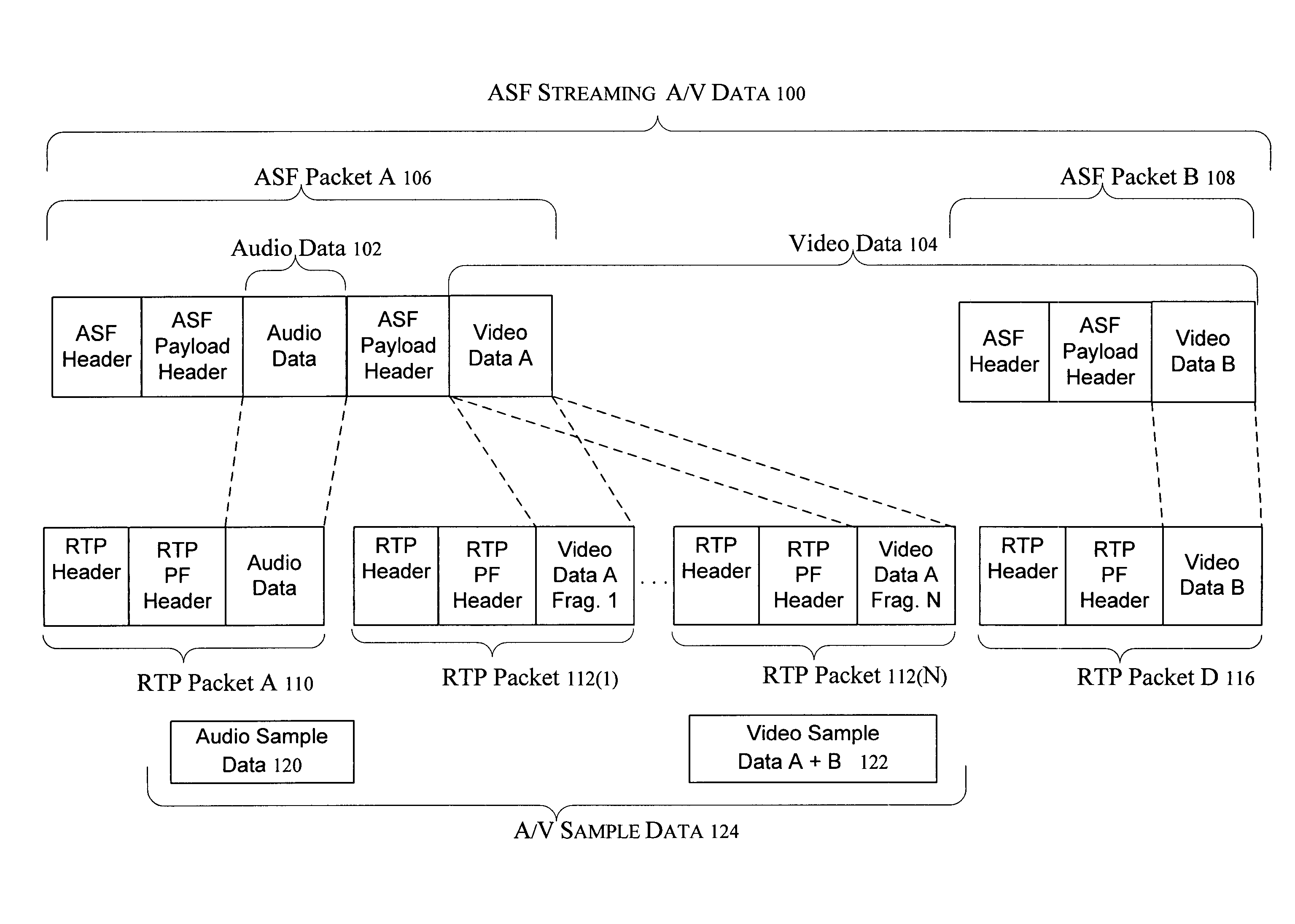
<figref idref="DRAWINGS">FIG. 1</figref> is an illustration of an exemplary process, in accordance with an embodiment of the invention, for the transformation of two (2) packets of Advanced Systems Format (ASF) audio-visual (AV) data into four (4) RTP packets, where the audio data and the video data are packetized separately in the resultant RTP packets, and where block boundaries for each payload are preserved such that original AV samples that were encrypted and packetized in the two ASF packets can be reconstructed by a decryption mechanism.
<figref idref="DRAWINGS">FIG. 2</figref> is an illustration of alternative exemplary processes, in accordance with different embodiments of the invention, for the transformation of two (2) packets of ASF video data into one (1) RTP packet, where one alternative process moves the payloads of the ASF packets into separate payloads in the RTP packet, where the other alternative process combines the payloads of the ASF packets into a combined payload in the RTP packet, and where block boundaries for each payload are preserved such that an original video sample that was encrypted and packetized in the two ASF packets can be reconstructed by a decryption mechanism.
<figref idref="DRAWINGS">FIGS. 3</figref><i>a</i>-<b>3</b><i>b </i>are respective data structure layouts, in accordance with an embodiment of the present invention, for an RTP header and a corresponding payload header.
<figref idref="DRAWINGS">FIG. 4</figref> is a block diagram, in accordance with an embodiment of the present invention, of a networked client/server system in which streaming can be performed by server to client or peer to peer.
<figref idref="DRAWINGS">FIG. 5</figref> is a block diagram, in accordance with an embodiment of the present invention, illustrating communications between a server (or client) and a client, where the server (or client) serves to the client a requested audio-visual data stream that the client can render.
<figref idref="DRAWINGS">FIG. 6</figref> is a block diagram, in accordance with an embodiment of the present invention, of a networked computer that can be used to implement either a server or a client.
DETAILED DESCRIPTION
0016Implementations disclosed herein define wire formats for delivery of single and mixed data streams, such as Windows® media data via Real-Time Transport Protocol (RTP). The delivery can be between server and client, as well as in a peer to peer context (e.g., a Windows® Messenger™ audio-visual conference software environment).
0017A wire format, in various implementations, enhances the IETF RFC 1889 standard to provide greater flexibility for RTP delivery. Implementations provide a mechanism for streaming of audio data in RTP packets that are separate from video data in RTP packets. Implementations also provide a wire format in which metadata can be delivered with each payload in an RTP packet, where the metadata provides rich information that is descriptive of the payload. Still other implementations provide a mechanism for streaming encrypted blocks of data across a network while maintaining a block boundary of each encrypted block such that the recipient thereof can decrypt the encrypted blocks of data. In another implementation, a wire format provides for delivery of data that is protected with Windows® Media Digital Rights Management (WM DRM) such that the delivery thereof can be unencrypted for rendering.
0018Various implementations disclosed herein repackage data in a series of media packets that are included in a system layer bit stream. These data are packetized into RTP packets consistent with, yet enhancing, the RFC 1889 standard such that the system layer bit stream is mapped to RTP. In this mapping, each media packet contains one or more payloads. In some system layer bit streams, there may be mixed media packets having data such as audio data, video data, program data, JPEG Data, HTML data, MIDI data, etc. A mixed media packet is a media packet where two or more of its payloads belong to different media streams.
0019Various implementations apply to system layer bit streams where each media packet is a single media packet. In a single media packet, all of the payloads in the media packet belong to the same media stream. Other implementations apply to system layer bit streams where each media packet always contains only one (1) payload. In still further implementations, the size of the “payload header” in the media packet is zero—which is likely if each media packet only contains a single payload, but could also happen when there are multiple payloads where the media packet header contains information about the size of each payload.
0020<figref idref="DRAWINGS">FIGS. 1-2</figref> depict exemplary implementations in which the system layer bit streams include a series of Advanced Systems Format (ASF) packets each having data therein. These data are packetized into RTP packets consistent with, yet enhancing, the RFC 1889 standard. As such, the system layer bit streams includes a series of media packets that are ASF packets, and the payload in each ASF packet is an ASF payload. While ASF packets are being used for illustration, the creation of RTP packets, in other implementations disclosed herein, is not limited to the use of ASF format data but may rather use other formats in which data to be streamed is stored. These other formats, as well as the ASF format, are generally described herein as system layer bit streams that include a plurality of media packets each having data therein, where these data are mapped to RTP in various implementations.
0021ASF Steaming Audio-Visual (AV) data <b>100</b> is depicted in <figref idref="DRAWINGS">FIG. 1</figref>. The ASF Streaming AV data <b>100</b>, which includes audio data <b>102</b> and video data <b>104</b>, has been packetized into an ASF packet A <b>106</b> and an ASF packet B <b>108</b>. ASF packet A <b>106</b> includes a first ASF header, an ASF payload header, audio data <b>102</b>, a second ASF header, and a video data A fragment of video data <b>104</b>. ASF packet B <b>108</b> includes an ASF header, an ASF payload header, and a video data B fragment of video data <b>104</b>.
0022The ASF Streaming AV data <b>100</b> as expressed in ASF packet A <b>106</b> and ASF packet B <b>108</b>, in one implementation, can be packetized into a plurality of RTP packets. As seen in <figref idref="DRAWINGS">FIG. 1</figref>, these include RTP packet A <b>110</b>, RTP packet <b>112</b>(1) through RTP packet <b>112</b>(N), and RTP packet D <b>116</b>. Each RTP packet, in accordance with the RFC 1889 standard, has an RTP packet header, a payload, and an RTP payload format (PF) header. As used herein the RTP PF header is a payload header in the RTP packet. Only one (1) type of media is in the RTP packet. Stated otherwise, the RTP packet does not contain mixed media payloads. In the implementation depicted in <figref idref="DRAWINGS">FIG. 1</figref>, video data A of ASF packet A <b>106</b> is too large to fit into a single RTP packet. As such, video data A of ASF packet A <b>106</b> is divided among RTP packet <b>112</b>(1) through RTP packet <b>112</b>(N). The RTP packet size can be a function of a physical characteristic of an underlying network over which the RTP packets are to be transmitted, or an administrative policy with respect to packet size such as can be made by the administrator of the underlying network, or an assessment of the transmission bandwidth of the underlying network.
0023Following the RTP packetization depicted in <figref idref="DRAWINGS">FIG. 1</figref>, audio data <b>102</b> is included in RTP packet A <b>110</b> and video data B of ASF packet B <b>108</b> is included in RTP packet D <b>116</b>. Each RTP PF header of each RTP packet can contain information relating to the separation of the audio and video data into respectively separate RTP packets. Thus, A/V streaming sample data <b>124</b> can be reconstructed from the audio data in RTP packet A <b>110</b>, video data A fragment <b>1</b> through video data A fragment N in respective RTP packets <b>112</b>(1) through <b>112</b> (N), and video data B in RTP packet D <b>116</b>. Once the reconstruction of A/V streaming sample data <b>124</b> is complete, the audio sample data <b>120</b> and the video sample data A+B <b>122</b> therein can be rendered in a streaming context. Given the foregoing, <figref idref="DRAWINGS">FIG. 1</figref> illustrates a wire format in which smaller RTP packets are created from larger ASF packets, where the packetization puts a payload of different data streams into separate packets each with its own RTP PF header. <figref idref="DRAWINGS">FIG. 1</figref> also illustrates an implementation of a wire format in which block boundaries for each payload are preserved such that original audio and video samples that were encrypted and packetized in ASF packets can be reconstructed by a decryption mechanism that is performed upon the RTP packets.
0024ASF Steaming AV data <b>200</b> is depicted in <figref idref="DRAWINGS">FIG. 2</figref>. The ASF Streaming AV data <b>200</b>, which includes video data <b>202</b>, has been packetized into an ASF packet A <b>208</b> and an ASF packet B <b>210</b>. ASF packet A <b>208</b> includes an ASF header, an ASF payload header, and video data A <b>204</b>. ASF packet B <b>210</b> includes an ASF header, an ASF payload header, and a video data B <b>206</b>. <figref idref="DRAWINGS">FIG. 2</figref> shows two (2) alternatives for packetizing ASF Streaming AV data <b>200</b> into RTP packets consistent with, yet enhancing, the RFC 1889 standard.
0025In the first alternative, following arrow <b>250</b>, video data A <b>204</b> and video data B <b>206</b> are packetized into a single RTP packet alternative A <b>212</b> having an RTP header. Each of video data A <b>204</b> and video data B <b>206</b> is preceded by an RTP PF header. RTP packet alternative A <b>212</b>, in accordance with the RFC 1889 standard, has an RTP header, multiple payloads, and respective RTP PF headers.
0026In the second alternative, also following arrow <b>250</b>, video data A <b>204</b> and video data B <b>206</b>, from respective ASF packets, are packetized into an RTP packet alternative B <b>214</b> having an RTP header. Video data A <b>204</b> and video data B <b>206</b> are assembled contiguously as the payload in RTP packet alternative B <b>214</b>. The payload is preceded by an RTP PF header. RTP packet alternative B <b>214</b>, in accordance with the RFC 1889 standard, has an RTP header, a payload, and one RTP PF header.
0027Following the RTP packetization depicted in <figref idref="DRAWINGS">FIG. 2</figref>, video data A and B (<b>204</b>, <b>206</b>) are included in either RTP packet alternative A <b>212</b> or in RTP packet alternative B <b>214</b>. Each RTP PF header can contains information relating to the corresponding payload. Each of the alternative RTP packets <b>212</b>, <b>214</b> contain sufficient data to reconstruct ASF packet A <b>208</b> and ASF packet B <b>210</b> so as to obtain therein video data A and B (<b>204</b>, <b>206</b>). Once the reconstruction of is complete, the video sample data <b>222</b> can be rendered in a streaming context. Given the foregoing, <figref idref="DRAWINGS">FIG. 2</figref> illustrates an RTP wire format in which larger RTP packets are created from small ASF packets, and where block boundaries for each payload are preserved such that original video samples that were encrypted and packetized in the two ASF packets can be reconstructed by a decryption mechanism that is performed upon the RTP packets.
0028<figref idref="DRAWINGS">FIG. 3</figref><i>a </i>depicts a data structure layout for fields in an RTP header. The RTP header is more fully described in the RFC 1889 standard. The timestamp field in the RTP header should be set to the presentation time of the sample contained in the RTP packet. In one implementation, the clock frequency is 1 kHz unless specified to be different through means independent of RTP.
0029The 8th bit from the start of the RTP header is interpreted as a marker (M) bit field. The M bit is set to zero, but will be set to one (“1”) whenever the corresponding RTP packet has payload that is not a fragment of a sample, contains the final fragment of a sample, or is one of a plurality of complete samples in the RTP packet. The M bit can be used by a receiver to detect the receipt of a complete sample for decoding and presenting. Thus, the M bit in the RTP header can be used to mark significant events in a packet stream (e.g., video sample frame boundaries).
0030<figref idref="DRAWINGS">FIG. 3</figref><i>b </i>depicts one implementation of an RTP payload format (PF) Header or payload header. The RTP PF header has a sixteen (16) bit fixed length portion followed by a variable length portion. The fields of the RTP PF header depicted in <figref idref="DRAWINGS">FIG. 3</figref><i>b </i>include a 8-bit string indicated by the character fields “SGLRTDXZ”, a length/offset field, a relative timestamp field, a decompression time field, a duration field, and a Payload Extension (P.E.) length field and a corresponding P.E. data field, each of which is explained below.
0031The S field is one (1) bit in length and is set to one (“1”) if the corresponding payload (e.g., sample, fragment of a sample, or combination of samples) is a key sample, i.e. intracoded sample or I-Frame. Otherwise it is set to zero. The S-bit in all RTP PF headers preceding fragments of the same sample must be set to the same value.
0032The G field is one (1) bit in length and is used to group sub-samples in a corresponding payload that make up a single sample. Windows® Media Digital Rights Management (WM DRM) encrypts content based on the “ASF Payload” boundaries. In order to allow this content to be correctly decrypted, the boundaries of the sub-samples in the payload can be communicated to the client that is to receive the payload. For instance, an encryption unit can be packetized such that it is broken into a plurality of transmission units (e.g., placed within separate packets) that are to be transmitted. Before the broken plurality of transmission units can be decrypted at a receiving client they have to be reassembled into the original encrypted form. As in other decryption methodologies and mechanisms, the client can use the boundaries to properly reconstruct the encrypted encryption units in preparation for decryption of the encrypted content. As such, each “ASF Payload” should be preceded by this RTP PF header.
0033The G field bit should be set to zero (“0”) to indicate that an encrypted “unit” has been fragmented. If ASF is being used, the encryption unit will be an ASF payload and the bit is set to zero (“0”) on all fragmented ASF payloads, except the last ASF payload. In this case, whether or not a sample has been fragmented doesn't matter. If ASF is not being used the encryption unit is a media sample, in which case the G bit is set to zero (“0”) on all fragmented media samples except the last sample. As to this latter case, the concern about whether or not an ASF payload has been fragmented is not applicable, since ASF is not used.
0034The L field is one (1) bit in length and is set to one (“1”) if the Length/Offset field contains a length. Otherwise it is set to zero (“0”) and the Length/Offset field contains an offset. The L-bit must be set to one (“1”) in all RTP PF headers preceding a complete (unfragmented) sample in the corresponding payload and must be set to zero in all RTP PF headers that precede a payload containing a fragmented sample.
0035The R field is one (1) bit in length and is set to one (“1”) if the RTP PF header contains a relative timestamp. Otherwise it is set to zero. The R-bit in all headers preceding fragments of the same sample must be set to the same value.
0036The T field is one (1) bit in length and is set to one (“1”) if the RTP PF header contains a decompression time. Otherwise it is set to zero. The T-bit in all RTP PF headers that precede a payload that contains a fragment of the same sample must be set to the same value.
0037The D field is one (1) bit in length and is set to one (“1”) if the RTP PF header contains a sample duration. Otherwise it is set to zero. The D-bit in all RTP PF headers that precede a payload containing fragments of the same sample must be set to the same value.
0038The X field is one (1) bit in length and is for optional or unspecified use. A transmitter of an RTP packet should set this bit to zero and a receiver thereof can ignore this bit.
0039The Z field is one (1) bit in length and is set to one (“1”) if the RTP PF header contains Payload Extension (P.E.) data, which can be metadata regarding the corresponding payload. Otherwise the Z field is set to zero. The Z field bit could be zero for all RTP PF headers whose M-bit is zero, but it should be set for all RTP PF headers whose M-bit is set to one (“1”) if the corresponding payload has P.E. data associated with it.
0040The Length/Offset field is twenty four (24) bits in length and quantifies the length or offset of a single sample that has been fragmented over multiple RTP packets. The L-bit is set to zero and the Length/Offset field contains the byte offset of the first byte of this fragment from the beginning of the corresponding payload (e.g., sample or fragment thereof). If one or more complete samples are contained in the RTP packet, the L-bit is set to one (“1”) in each RTP PF header, and the Sample Length/Offset field contains the length of the sample (including the RTP PF header).
0041The Relative Timestamp field is thirty-two (32) bits in length and is present only if the R-bit is set to one (“1”). It contains the relative timestamp for the corresponding sample with respect to the timestamp in the corresponding RTP header. The timescale used is the same as that used for the timestamp in the RTP header. The Relative Timestamp field is specified as a signed 32-bit number to allow for negative offsets from the timestamp of the RTP header. When the Relative Timestamp field is absent, a default relative timestamp of zero can be used.
0042The Decompression Time is thirty-two (32) bits in length and is present only if the T-bit is set to one (“1”). It contains the decompression time relative to the timestamp in the RTP header. The timescale used is the same as that used for the timestamp in the RTP header. This field is specified as a signed 32-bit number to allow for negative offsets from the timestamp in the RTP header.
0043The Duration field is thirty-two (32) bits in length and is present only if the D-bit is set to one (“1”). It contains the duration of the corresponding sample. The timescale used is the same as that used for the timestamp in the RTP header. The Duration field, in all RTP PF headers preceding fragments of the same sample, should be set to the same value. When this field is absent, the default duration is implicitly or explicitly obtained from the sample data. If this is not practical, the default is the difference between this sample's timestamp and the next sample's timestamp.
0044The Payload Extension (P.E.) Data Length field is sixteen (16) bits in length and is present only if the Z-bit is set to one (“1”). It contains the number of bytes of P.E. data contained after the fixed part of the RTP PF header. The P.E. data is variable in length and contain one of more attributes descriptive of the corresponding payload that it precedes. The P.E. data length field immediately follows the fixed part of the payload header and will be a number of bytes that contain the actual P.E. data. The structure of the P.E. data is communicated between the client and server (or peer to peer), such as via an SDP description. In one implementation for WM DRM protected content, there can be at least 4 bytes of DUE data representing the WM DRM payload ID associated with every sample.
0045While <figref idref="DRAWINGS">FIGS. 3</figref><i>a</i>-<b>3</b><i>b </i>show various fields in various orders for an RTP header and RTP PF header, not all fields are required and the order thereof can be rearranged. In some implementations, the required fields and order therefore may be consistent with, yet extend, the flexibility of the RFC 1889 standard. While ASF packets are being used for illustration of <figref idref="DRAWINGS">FIG. 3</figref><i>a</i>-<b>3</b><i>b</i>, the creation of RTP packets, RTP PF headers and payloads therefore, in other implementations disclosed herein, is not limited to the use of ASF format data but may rather use other formats in which data to be streamed is stored.
0000General Network Structure
0046<figref idref="DRAWINGS">FIG. 4</figref> shows a client/server network system <b>400</b> and environment in accordance with the invention. Generally, the system <b>400</b> includes one or more (m) network multimedia servers <b>402</b> and one or more (k) network clients <b>404</b>. The computers communicate with each other over a data communications network, which in <figref idref="DRAWINGS">FIG. 4</figref> includes a wired/wireless network <b>406</b>. The data communications network <b>406</b> might also include the Internet or local-area networks and private wide-area networks. Servers <b>402</b> and clients <b>404</b> communicate with one another via any of a wide variety of known protocols, such as the Transmission Control Protocol (TCP) or User Datagram Protocol (UDP).
0047Multimedia servers/clients <b>402</b>/<b>404</b> have access to streaming media content in the form of different media streams. These media streams can be individual media streams (e.g., audio, video, graphical, simulation, etc.), or alternatively composite media streams including multiple such individual streams. Some media streams might be stored as files <b>408</b> in a database (e.g., ASF files) or other file storage system, while other media streams <b>410</b> might be supplied to the multimedia server <b>402</b> or client <b>404</b> on a “live” basis from other data source components through dedicated communications channels or through the Internet itself.
0048The media streams received from servers <b>402</b> or from clients <b>404</b> are rendered at the client <b>404</b> as a multimedia presentation, which can include media streams from one or more of the servers/clients <b>402</b>/<b>404</b>. These different media streams can include one or more of the same or different types of media streams. For example, a multimedia presentation may include two video streams, one audio stream, and one stream of graphical images. A user interface (UI) at the client <b>404</b> can allows users various controls, such as allowing a user to either increase or decrease the speed at which the media presentation is rendered.
0000Exemplary Computer Environment
0049In the discussion below, the invention will be described in the general context of computer-executable instructions, such as program modules, being executed by one or more conventional personal computers. Generally, program modules include routines, programs, objects, components, data structures, etc. perform particular tasks or implement particular abstract data types. Moreover, those skilled in the art will appreciate that the invention may be practiced with other computer system configurations, including hand-held devices, multiprocessor systems, microprocessor-based or programmable consumer electronics, network PCs, minicomputers, mainframe computers, and the like. In a distributed computer environment, program modules may be located in both local and remote memory storage devices. Alternatively, the invention could be implemented in hardware or a combination of hardware, software, and/or firmware. For example, one or more application specific integrated circuits (ASICs) could be programmed to carry out the invention.
0050As shown in <figref idref="DRAWINGS">FIG. 4</figref>, a network system in accordance with the invention includes network server(s) and client <b>402</b>, <b>404</b> from which a plurality of media streams are available. In some cases, the media streams are actually stored by server(s) and/or client <b>402</b>, <b>404</b>. In other cases, server(s) and/or client(s) <b>402</b>, <b>404</b> can obtain the media streams from other network sources or devices. Generally, the network clients <b>404</b> are responsive to user input to request media streams corresponding to selected multimedia content. In response to a request for a media stream corresponding to multimedia content, server(s) and/or clients <b>402</b>, <b>404</b> stream the requested media streams to the requesting network client <b>404</b> in accordance with an RTP wire format. The client <b>404</b> decrypts the payloads in the respective RTP packets and renders the resultant unencrypted data streams to produce the requested multimedia content.
0051<figref idref="DRAWINGS">FIG. 5</figref> illustrates the input and storage of A/V streaming data on a server <b>402</b> or a client <b>404</b> (e.g., a peer). <figref idref="DRAWINGS">FIG. 5</figref> also illustrates communications between server and client (<b>402</b>-<b>404</b>) or peer-to-peer (<b>404</b>-<b>404</b>) in accordance with various implementations. By way of overview, the server or client <b>402</b>, <b>404</b> receives input of A/V streaming data from an input device <b>530</b>. The server or client <b>402</b>, <b>404</b> encodes the input using an encoder of a codec. The encoding can, but need not, be performed on ASF format data. If ASF format data is used, the encoding is performed upon ASF packets that each include an ASF header, and ASF payload header, and an AV (audio and/or video) payload. The encoding can include encryption, such as where WM DRM is used. The ASF packets are stored by the server/client <b>402</b>, <b>404</b> for serving future requests for same.
0052Subsequently, the client requests the corresponding AV data stream from the server/client. The server/client retrieves and transmits to the client the corresponding AV stream that the server/client had previously stored. Upon receipt, the client decodes the AV data stream, and reconstructs and decrypts encrypted broken up AV data stream samples using boundaries communicated in the corresponding RTP PF headers. The client can then perform rendering of the streamed AV data.
0053The flow of data in seen in <figref idref="DRAWINGS">FIG. 5</figref> between and among blocks <b>504</b>-<b>530</b>. At block <b>504</b>, an input device <b>502</b> furnishes to server/client <b>402</b>/<b>404</b> input that includes A/V streaming data. By way of example, the A/V streaming data might be supplied to server/client <b>402</b>/<b>404</b> on a “live” basis by input device <b>502</b> through dedicated communications channels or through the Internet. The A/V streaming data is supplied to an encoder at block <b>504</b> for placing the data into ASF packets. At block <b>506</b>, optional WM DRM encryption is employed and the ASF packets are stored at the server/client <b>402</b>/<b>404</b>. A result of the WM DRM encryption and packetization can be that an encryption unit is broken into a plurality of separate packets. Before the broken plurality of transmission units can be decrypted at a receiving client they have to be reassembled at the client into the original encryption units. As such, the boundaries of the broken transmission units are stored in the ASF payload headers at block <b>506</b>.
0054At block <b>508</b>, client <b>404</b> makes a request for the A/V data stream that is transmitted to server/client <b>402</b>/<b>404</b> as seen at arrow <b>510</b> in <figref idref="DRAWINGS">FIG. 5</figref>. At block <b>512</b>, server/client <b>402</b>/<b>404</b> receives the request. The corresponding ASF packets that contain the requested A/V data stream are retrieved. At block <b>514</b>, audio and video payloads in the ASF packets are logically separated so that they can be separately packetized into RTP packets. Boundaries for each logically separate audio and video payload are identified.
0055A bandwidth of the network over which RTP packets are to be transmitted is determined. This determination is used to derive a predetermined RTP packet size. Where the ASF packet size is smaller than the predetermined RTP packet size, like-kind payloads can be combined into a single RTP packet. Where the ASF packet size is bigger than the predetermined RTP packet size, ASF payloads can be fragmented for placement as a payload into a single RTP packet. Boundaries for each RTP payload are determined using the corresponding logically separate audio and video payloads of the ASF packets.
0056At step <b>516</b>, the RTP header, RTP PF header, and respective payload are assembled for each RTP packet. As such, a plurality of RTP packets have been formed that represent a plurality of ASF packets, where the ASF packets contain the A/V data stream that was requested by client <b>404</b>. The RTP packets are streamed for rendering at client <b>404</b> from server/client <b>402</b>/<b>404</b> via a transmission function at block <b>518</b>.
0057An arrow <b>520</b> in <figref idref="DRAWINGS">FIG. 5</figref> shows transmission of the RTP packets from server/client <b>402</b>/<b>404</b> to client <b>404</b>. At block <b>522</b>, client <b>404</b> receives the RTP packets. At block <b>524</b>, an RTP decoder at client <b>404</b> decodes each received RTP packet, including the RTP header, and RTP PF header. At block <b>526</b>, a process performs defragmentation and reconstruction of the ASF packets containing the requested A/V datastream. The defragmentation and reconstruction uses boundaries set forth in the RTP PF header for each corresponding payload containing, for instance, a sample or fragment thereof.
0058At block <b>528</b>, the reconstructed ASF packets are decrypted for rendering at block <b>530</b>. The RTP PF header in an RTP packet may contain Payload Extension (P.E.) data that is descriptive of the corresponding payload. The P.E. data can thus provide metadata that can be used during a rendering of the payload in the corresponding RTP packet at block <b>530</b>. The blocks <b>522</b>-<b>530</b> are repeated for each RTP packet that is received at client <b>404</b>, thereby accomplishing the streaming of the A/V data from server/client <b>402</b>/<b>404</b> for rendering.
0059<figref idref="DRAWINGS">FIG. 6</figref> shows a general example of a computer <b>642</b> that can be used in accordance with the invention. Computer <b>642</b> is shown as an example of a computer that can perform the functions of any of clients <b>402</b> or servers <b>404</b> of <figref idref="DRAWINGS">FIGS. 4-5</figref>. Computer <b>642</b> includes one or more processors or processing units <b>644</b>, a system memory <b>646</b>, and a system bus <b>648</b> that couples various system components including the system memory <b>646</b> to processors <b>644</b>.
0060The bus <b>648</b> represents one or more of any of several types of bus structures, including a memory bus or memory controller, a peripheral bus, an accelerated graphics port, and a processor or local bus using any of a variety of bus architectures. The system memory includes read only memory (ROM) <b>650</b> and random access memory (RAM) <b>652</b>. A cache <b>675</b> have levels L<b>1</b>, L<b>2</b>, and L<b>3</b> may be included in RAM <b>652</b>. A basic input/output system (BIOS) <b>654</b>, containing the basic routines that help to transfer information between elements within computer <b>642</b>, such as during start-up, is stored in ROM <b>650</b>. Computer <b>642</b> further includes a hard disk drive <b>656</b> for reading from and writing to a hard disk (not shown) a magnetic disk drive <b>658</b> for reading from and writing to a removable magnetic disk <b>660</b>, and an optical disk drive <b>662</b> for reading from or writing to a removable optical disk <b>664</b> such as a CD ROM or other optical media.
0061Any of the hard disk (not shown), magnetic disk drive <b>658</b>, optical disk drive <b>662</b>, or removable optical disk <b>664</b> can be an information medium having recorded information thereon. The information medium has a data area for recording stream data using stream packets each of which includes a packet area containing one or more data packets. By way of example, each data packet is encoded and decoded by a Codec of application programs <b>672</b> executing in processing unit <b>644</b>. As such, the encoder distributes the stream data to the data packet areas in the stream packets so that the distributed stream data are recorded in the data packet areas using an encoding algorithm. Alternatively, encoding and decoding of data packets can be performed as a function of operating system <b>670</b> executing on processing unit <b>644</b>.
0062The hard disk drive <b>656</b>, magnetic disk drive <b>658</b>, and optical disk drive <b>662</b> are connected to the system bus <b>648</b> by an SCSI interface <b>666</b> or some other appropriate interface. The drives and their associated computer-readable media provide nonvolatile storage of computer readable instructions, data structures, program modules and other data for computer <b>642</b>. Although the exemplary environment described herein employs a hard disk, a removable magnetic disk <b>660</b> and a removable optical disk <b>664</b>, it should be appreciated by those skilled in the art that other types of computer readable media which can store data that is accessible by a computer, such as magnetic cassettes, flash memory cards, digital video disks, random access memories (RAMs) read only memories (ROM), and the like, may also be used in the exemplary operating environment.
0063A number of program modules may be stored on the hard disk, magnetic disk <b>660</b>, optical disk <b>664</b>, ROM <b>650</b>, or RAM <b>652</b>, including an operating system <b>670</b>, one or more application programs <b>672</b> (which may include the Codec), other program modules <b>674</b>, and program data <b>676</b>. A user may enter commands and information into computer <b>642</b> through input devices such as keyboard <b>678</b> and pointing device <b>680</b>. Other input devices (not shown) may include a microphone, joystick, game pad, satellite dish, scanner, or the like. These and other input devices are connected to the processing unit <b>644</b> through an interface <b>682</b> that is coupled to the system bus. A monitor <b>684</b> or other type of display device is also connected to the system bus <b>648</b> via an interface, such as a video adapter <b>686</b>. In addition to the monitor, personal computers typically include other peripheral output devices (not shown) such as speakers and printers.
0064Computer <b>642</b> operates in a networked environment using logical connections to one or more remote computers, such as a remote computer <b>688</b>. The remote computer <b>688</b> may be another personal computer, a server, a router, a network PC, a peer device or other common network node, and typically includes many or all of the elements described above relative to computer <b>642</b>, although only a memory storage device <b>690</b> has been illustrated in <figref idref="DRAWINGS">FIG. 6</figref>. The logical connections depicted in <figref idref="DRAWINGS">FIG. 6</figref> include a local area network (LAN) <b>692</b> and a wide area network (WAN) <b>694</b>. Such networking environments are commonplace in offices, enterprise-wide computer networks, intranets, and the Internet. In the described embodiment of the invention, remote computer <b>688</b> executes an Internet Web browser program such as the Internet Explorer® Web browser manufactured and distributed by Microsoft Corporation of Redmond, Wash.
0065When used in a LAN networking environment, computer <b>642</b> is connected to the local network <b>692</b> through a network interface or adapter <b>696</b>. When used in a WAN networking environment, computer <b>642</b> typically includes a modem <b>698</b> or other means for establishing communications over the wide area network <b>694</b>, such as the Internet. The modem <b>698</b>, which may be internal or external, is connected to the system bus <b>648</b> via a serial port interface <b>668</b>. In a networked environment, program modules depicted relative to the personal computer <b>642</b>, or portions thereof, may be stored in the remote memory storage device. It will be appreciated that the network connections shown are exemplary and other means of establishing a communications link between the computers may be used.
0066Generally, the data processors of computer <b>642</b> are programmed by means of instructions stored at different times in the various computer-readable storage media of the computer. Programs and operating systems are typically distributed, for example, on floppy disks or CD-ROMs. From there, they are installed or loaded into the secondary memory of a computer. At execution, they are loaded at least partially into the computer's primary electronic memory. The invention described herein includes these and other various types of computer-readable storage media when such media contain instructions or programs for implementing the steps described below in conjunction with a microprocessor or other data processor. The invention also includes the computer itself when programmed according to the methods and techniques described below. Furthermore, certain sub-components of the computer may be programmed to perform the functions and steps described below. The invention includes such sub-components when they are programmed as described. In addition, the invention described herein includes data structures, described below, as embodied on various types of memory media.
0067For purposes of illustration, programs and other executable program components such as the operating system are illustrated herein as discrete blocks, although it is recognized that such programs and components reside at various times in different storage components of the computer, and are executed by the data processor(s) of the computer.
CONCLUSION
0068Implementations disclosed herein define a wire format that can be used in delivery of multimedia data between server and client and peer to peer via RTP. The wire format allows for greater flexibility than the currently adopted IETF RFC 1889 standards for RTP delivery. Implementations of the wire format provide for streaming of encrypted data, provide a mechanism for delivering per sample metadata via RTP, and provide for streaming of data that is protected with WM DRM.
0069Although the invention has been described in language specific to structural features and/or methodological acts, it is to be understood that the invention defined in the appended claims is not necessarily limited to the specific features or acts described. Rather, the specific features and acts are disclosed as exemplary forms of implementing the claimed invention.
Contents6
7 sheets
Sheet 1 Sheet 2 Sheet 3 Sheet 4 Sheet 5 Sheet 6 Sheet 7
Every citation, both waysCites: the store holds 29 of 30
| Document | Relation | Office | Cited during |
|---|---|---|---|
| US2009300203A1 | Cited by | United States of America | Pre-grant |
| US2008317438A1 | Cited by | United States of America | Pre-grant |
| US2007242670A1 | Cited by | United States of America | Pre-grant |
| US2009055417A1 | Cited by | United States of America | Pre-grant |
| US2009282162A1 | Cited by | United States of America | Pre-grant |
| US2009201948A1 | Cited by | United States of America | Pre-grant |
| US7965846B2 | Cited by | United States of America | Search report |
| US8355336B2 | Cited by | United States of America | Search report |
| US2010080290A1 | Cited by | United States of America | Pre-grant |
| US2009297123A1 | Cited by | United States of America | Pre-grant |
| US2007201435A1 | Cited by | United States of America | Pre-grant |
| US10620904B2 | Cited by | United States of America | Applicant |
| US9852219B2 | Cited by | United States of America | Applicant |
| US2010138647A1 | Cited by | United States of America | Pre-grant |
| US2008025516A1 | Cited by | United States of America | Pre-grant |
| US7929475B2 | Cited by | United States of America | Search report |
| US8306406B2 | Cited by | United States of America | Search report |
| WO0011849A1 | Cites | World Intellectual Property Organization (WIPO) | Applicant |
| EP1041823A2 | Cites | European Patent Office (EPO) | Applicant |
| EP1494425A1 | Cites | European Patent Office (EPO) | Applicant |
| US2002002674A1 | Cites | United States of America | Applicant |
| US2003041257A1 | Cites | United States of America | Applicant |
| US2003056118A1 | Cites | United States of America | Applicant |
| US2003081592A1 | Cites | United States of America | Applicant |
| US2003161473A1 | Cites | United States of America | Applicant |
| WO2004023717A2 | Cites | World Intellectual Property Organization (WIPO) | Applicant |
| WO2004030364A1 | Cites | World Intellectual Property Organization (WIPO) | Applicant |
| US2004042451A1 | Cites | United States of America | Applicant |
| US2004125757A1 | Cites | United States of America | Applicant |
| US2004143736A1 | Cites | United States of America | Applicant |
| US2005163052A1 | Cites | United States of America | Applicant |
| US2005216413A1 | Cites | United States of America | Applicant |
| US2005265555A1 | Cites | United States of America | Applicant |
| US2006161635A1 | Cites | United States of America | Applicant |
| US2006167985A1 | Cites | United States of America | Applicant |
| US2007003064A1 | Cites | United States of America | Applicant |
| US2007171903A1 | Cites | United States of America | Applicant |
| US6654389B1 | Cites | United States of America | Applicant |
| US6856997B2 | Cites | United States of America | Applicant |
| US6918034B1 | Cites | United States of America | Search report |
| US6983049B2 | Cites | United States of America | Search report |
| US6993137B2 | Cites | United States of America | Applicant |
| US7010032B1 | Cites | United States of America | Search report |
| US7136945B2 | Cites | United States of America | Applicant |
| US7145919B2 | Cites | United States of America | Applicant |
| US7174452B2 | Cites | United States of America | Search report |
| Schulzrinne et al., “RFC 1889, RTP: A Transport Protocol for Real-Time Applications”, Jan. 1996, IETF.ORG, pp. 1-92. | Non-patent | – | Search report |
| Nafaa et al., “RTP4MUX: A novel MPEG-4 RTP Payload for Multicast Video Communications over Wireless IP,” IEEE-PV 2003, Apr. 28, 2003, 13<sup>th </sup>International Packet Video Workshop, available at <<http://www.prism.uvsq.fr/{anaf/nafaa<sub>—</sub>iscc03.pdf>>, 10 pages. | Non-patent | – | Third party observation |
| “RTP Payload Format for MPEG-4 Streams,” Internet Engineering Task Force, Internet Draft, XP-001033580, Jul. 2001, 41 pages. | Non-patent | – | Third party observation |
| D. Curet et al., “RTP Payload Format for MPEG-4 FlexMultiplexed Streams,” Internet Engineering Task Force, Internet Draft, XP-001075015, Nov. 8, 2001, 12 pages. | Non-patent | – | Third party observation |
| European Search Report for European Patent Application EP 04 102 589.1, dated Nov. 8, 2004, 4 pages. | Non-patent | – | Third party observation |
| “RTP Profile for Audio and Video Conferences with Minimal Control”, RFC 1890, accessible at <http://faqs.org/rfcs/rfc1890.html>, print out date Jan. 7, 2004, 14 pages. | Non-patent | – | Third party observation |
| “RTP: A Transport Protocol for Real-Time Applications”, RFC 1889, accessible at <http://faqs.org/rfcs/rfc1889.html>, print out date Jan. 7, 2004, 57 pages. | Non-patent | – | Third party observation |
| Handley, et al., “SDP: Session Description Protocol,” Network Working Group, Request for Comments: 2327, available at <<http://www.ietf.org/rfc/rfc2327.txt>>, Apr. 1998, pp. 1-40. | Non-patent | – | Third party observation |
| Klemets, “RTP Payload Format for Video Codec 1 (VC-1),” Network Working Group, Request for Comments: 4425, available at <<http://rfc4425.x42.com/>>, Feb. 2006, pp. 1-34. | Non-patent | – | Third party observation |
| “Proposed SMPTE Standard for Television: VC-1 Compressed Video Bitstream Format and Decoding Process,” Specification for VC-1, The Society of Motion Picture and Television Engineers, Aug. 23, 2005, pp. 1-480. | Non-patent | – | Third party observation |
| “SMPTE Standard for Television, Audio and Film—Time and Control Code,” The Society of Motion Picture and Television Engineers, ANSI/SMPTE 12M-1995, Sep. 12, 1995, 19 pages. | Non-patent | – | Third party observation |
| Won-Ho Kim, “Design and Implementation of MPEG-2/DVB Scrambler Unit,” 1997 International Conference on Consumer Electronics, vol. 43, No. 3., Jun. 1997, pp. 320-321. | Non-patent | – | Third party observation |
| U.S. Appl. No. 11/275,426, filed Dec. 30, 2005, entitled “RTP Payload Format for VC-1,” Anders E. Klemets. | Non-patent | – | Third party observation |
| Official Notice Of Rejection For Malaysian Patent Application No. PI 20042167 Mailed On Dec. 26, 2007, pp. 5. | Non-patent | – | Third party observation |
| “RTP Profile for Audio and Video Conferences with Minimal Control”, RFC 1890, available at <<http://faqs.org/rfcs/rfc1890.html>>, accessed Jan. 7, 2004, 14 pages. Published, Jan. 1996. | Non-patent | – | Third party observation |
| Schulzrinne, et al., “RTP: A Transport Protocol for Real-Time Applications,” The Internet Society, 2003, pp. 1-104. Published, Jan. 1996. | Non-patent | – | Third party observation |
| Schulzrinne et al., "RFC 1889, RTP: A Transport Protocol for Real-Time Applications", Jan. 1996, IETF.ORG, pp. 1-92. | Non-patent | – | Search report |
| Nafaa et al., "RTP4MUX: A novel MPEG-4 RTP Payload for Multicast Video Communications over Wireless IP," IEEE-PV 2003, Apr. 28, 2003, 13th International Packet Video Workshop, available at <<http://www.prism.uvsq.fr/{anaf/nafaa-iscc03.pdf>>, 10 pages. | Non-patent | – | Applicant |
| "RTP Payload Format for MPEG-4 Streams," Internet Engineering Task Force, Internet Draft, XP-001033580, Jul. 2001, 41 pages. | Non-patent | – | Applicant |
| D. Curet et al., "RTP Payload Format for MPEG-4 FlexMultiplexed Streams," Internet Engineering Task Force, Internet Draft, XP-001075015, Nov. 8, 2001, 12 pages. | Non-patent | – | Applicant |
| European Search Report for European Patent Application EP 04 102 589.1, dated Nov. 8, 2004, 4 pages. | Non-patent | – | Applicant |
| "RTP Profile for Audio and Video Conferences with Minimal Control", RFC 1890, accessible at <http://faqs.org/rfcs/rfc1890.html>, print out date Jan. 7, 2004, 14 pages. | Non-patent | – | Applicant |
| "RTP: A Transport Protocol for Real-Time Applications", RFC 1889, accessible at <http://faqs.org/rfcs/rfc1889.html>, print out date Jan. 7, 2004, 57 pages. | Non-patent | – | Applicant |
| Handley, et al., "SDP: Session Description Protocol," Network Working Group, Request for Comments: 2327, available at <<http://www.ietf.org/rfc/rfc2327.txt>>, Apr. 1998, pp. 1-40. | Non-patent | – | Applicant |
| Klemets, "RTP Payload Format for Video Codec 1 (VC-1)," Network Working Group, Request for Comments: 4425, available at <<http://rfc4425.x42.com/>>, Feb. 2006, pp. 1-34. | Non-patent | – | Applicant |
| "Proposed SMPTE Standard for Television: VC-1 Compressed Video Bitstream Format and Decoding Process," Specification for VC-1, The Society of Motion Picture and Television Engineers, Aug. 23, 2005, pp. 1-480. | Non-patent | – | Applicant |
| "SMPTE Standard for Television, Audio and Film-Time and Control Code," The Society of Motion Picture and Television Engineers, ANSI/SMPTE 12M-1995, Sep. 12, 1995, 19 pages. | Non-patent | – | Applicant |
| Won-Ho Kim, "Design and Implementation of MPEG-2/DVB Scrambler Unit," 1997 International Conference on Consumer Electronics, vol. 43, No. 3., Jun. 1997, pp. 320-321. | Non-patent | – | Applicant |
| U.S. Appl. No. 11/275,426, filed Dec. 30, 2005, entitled "RTP Payload Format for VC-1," Anders E. Klemets. | Non-patent | – | Applicant |
| Official Notice Of Rejection For Malaysian Patent Application No. PI 20042167 Mailed On Dec. 26, 2007, pp. 5. | Non-patent | – | Applicant |
| "RTP Profile for Audio and Video Conferences with Minimal Control", RFC 1890, available at <<http://faqs.org/rfcs/rfc1890.html>>, accessed Jan. 7, 2004, 14 pages. Published, Jan. 1996. | Non-patent | – | Applicant |
| Schulzrinne, et al., "RTP: A Transport Protocol for Real-Time Applications," The Internet Society, 2003, pp. 1-104. Published, Jan. 1996. | Non-patent | – | Applicant |
40 members in 18 offices
Priority claims2
| Document | Office | Kind | Date |
|---|---|---|---|
| 61285103 | United States of America | A | |
| US20030612851 | – | – | – |
Members40
| Document | Office | Kind | |
|---|---|---|---|
| CA2469830A1 | Canada | A1 | |
| CA2786809A1 | Canada | A1 | |
| NO20042821L | Norway | L | |
| EP1494425A1 | European Patent Office (EPO) | A1 | |
| US2005002525A1 | United States of America | A1 | |
| KR20050004128A | Republic of Korea | A | |
| TW200503485A | Taiwan Province of China | A | |
| AU2004202538A1 | Australia | A1 | |
| JP2005027325A | Japan | A | |
| CN1578311A | China | A | |
| MXPA04006449A | Mexico | A | |
| ZA200404701B | South Africa | B | |
| BRPI0402436A | Brazil | A | |
| IL162304A0 | Israel | A0 | |
| NZ533297A | New Zealand | A | |
| RU2004120267A | Russian Federation | A | |
| CO5600215A1 | Colombia | A1 | |
| SG129298A1 | Singapore | A1 | |
| NZ543135A | New Zealand | A | |
| US7483532B2This record | United States of America | B2 | |
| US2009135849A1 | United States of America | A1 | |
| RU2372646C2 | Russian Federation | C2 | |
| AU2004202538B2 | Australia | B2 | |
| IL199658A0 | Israel | A0 | |
| JP4504749B2 | Japan | B2 | |
| US7876896B2 | United States of America | B2 | |
| KR20110013561A | Republic of Korea | A | |
| IL162304A | Israel | A | |
| KR101022894B1 | Republic of Korea | B1 | |
| KR101026565B1 | Republic of Korea | B1 | |
| CN1578311B | China | B | |
| TWI347106B | Taiwan Province of China | B | |
| MY144841A | Malaysia | A | |
| IL199658A | Israel | A | |
| MY146788A | Malaysia | A | |
| CA2469830C | Canada | C | |
| MY152016A | Malaysia | A | |
| CA2786809C | Canada | C | |
| EP1494425B1 | European Patent Office (EPO) | B1 | |
| NO339940B1 | Norway | B1 |
101 transactions on the USPTO file
Allowed after 1 non-final rejection, 1 final rejection and 1 RCE.
- Non-final rejections
- 1
- Final rejections
- 1
- RCEs
- 1
- Appeals
- 0
Over time
Point at a mark for the transactionTransactions
| Event | Code | |
|---|---|---|
| Expire PatentEXP. | EXP. | |
| Maintenance Fee Reminder MailedREM. | REM. | |
| Correspondence Address ChangeC.ADB | C.ADB | |
| Email NotificationEML_NTR | EML_NTR | |
| Change in Power of Attorney (May Include Associate POA)PA.. | PA.. | |
| Correspondence Address ChangeC.AD | C.AD | |
| Recordation of Patent Grant MailedPGM/ | PGM/ | |
| Patent Issue Date Used in PTA CalculationAllowedPTAC | PTAC | |
| Issue Notification MailedAllowedWPIR | WPIR | |
| Dispatch to FDCD1935 | D1935 | |
| Application Is Considered Ready for IssuePILS | PILS | |
| Issue Fee Payment VerifiedN084 | N084 | |
| Issue Fee Payment ReceivedIFEE | IFEE | |
| Mail Examiner's AmendmentMEX.A | MEX.A | |
| Mail Notice of AllowanceAllowedMN/=. | MN/=. | |
| Notice of Allowance Data Verification CompletedAllowedN/=. | N/=. | |
| Examiner's Amendment CommunicationEX.A | EX.A | |
| Examiner Interview Summary Record (PTOL - 413)EXIN | EXIN | |
| Mail Examiner Interview Summary (PTOL - 413)MEXIN | MEXIN | |
| Date Forwarded to ExaminerFWDX | FWDX | |
| Date Forwarded to ExaminerFWDX | FWDX | |
| Disposal for a RCE / CPA / R129AbandonedABN9 | ABN9 | |
| Request for Continued Examination (RCE)RCEX | RCEX | |
| Workflow - Request for RCE - BeginBRCE | BRCE | |
| Examiner Interview Summary Record (PTOL - 413)EXIN | EXIN | |
| Mail Advisory Action (PTOL - 303)MCTAV | MCTAV | |
| Advisory Action (PTOL-303)CTAV | CTAV | |
| Date Forwarded to ExaminerFWDX | FWDX | |
| Mail Examiner Interview Summary (PTOL - 413)MEXIN | MEXIN | |
| Information Disclosure Statement consideredIDSC | IDSC | |
| Electronic Information Disclosure StatementEIDS. | EIDS. | |
| Miscellaneous Incoming LetterLET. | LET. | |
| Response after Final ActionA.NE | A.NE | |
| Request for Extension of Time - GrantedXT/G | XT/G | |
| Information Disclosure Statement (IDS) FiledWIDS | WIDS | |
| Examiner Interview Summary Record (PTOL - 413)EXIN | EXIN | |
| Mail Final Rejection (PTOL - 326)Final rejectionMCTFR | MCTFR | |
| Final RejectionFinal rejectionCTFR | CTFR | |
| Date Forwarded to ExaminerFWDX | FWDX | |
| Information Disclosure Statement consideredIDSC | IDSC | |
| Electronic Information Disclosure StatementEIDS. | EIDS. | |
| Response after Non-Final ActionA... | A... | |
| Request for Extension of Time - GrantedXT/G | XT/G | |
| Information Disclosure Statement (IDS) FiledWIDS | WIDS | |
| Mail Examiner Interview Summary (PTOL - 413)MEXIN | MEXIN | |
| Information Disclosure Statement consideredIDSC | IDSC | |
| Reference capture on IDSRCAP | RCAP | |
| Electronic Information Disclosure StatementEIDS. | EIDS. | |
| Information Disclosure Statement (IDS) FiledWIDS | WIDS | |
| Mail Non-Final RejectionNon-final rejectionMCTNF | MCTNF | |
| Non-Final RejectionNon-final rejectionCTNF | CTNF | |
| Date Forwarded to ExaminerFWDX | FWDX | |
| Information Disclosure Statement consideredIDSC | IDSC | |
| Response to Election / Restriction FiledELC. | ELC. | |
| Miscellaneous Incoming LetterLET. | LET. | |
| Reference capture on IDSRCAP | RCAP | |
| Information Disclosure Statement (IDS) FiledM844 | M844 | |
| Information Disclosure Statement (IDS) FiledWIDS | WIDS | |
| Electronic ReviewELC_RVW | ELC_RVW | |
| Email NotificationEML_NTF | EML_NTF | |
| Mail Notice of Informal or Non-Responsive AmendmentNINA | NINA | |
| Case Docketed to Examiner in GAUDOCK | DOCK | |
| Date Forwarded to ExaminerFWDX | FWDX | |
| Reference capture on IDSRCAP | RCAP | |
| Information Disclosure Statement (IDS) FiledM844 | M844 | |
| Information Disclosure Statement (IDS) FiledWIDS | WIDS | |
| Informal or Non-Responsive Amendment after Examiner ActionA.I. | A.I. | |
| Response to Election / Restriction FiledELC. | ELC. | |
| Electronic ReviewELC_RVW | ELC_RVW | |
| Email NotificationEML_NTF | EML_NTF | |
| Mail Restriction RequirementMCTRS | MCTRS | |
| Restriction/Election RequirementCTRS | CTRS | |
| Case Docketed to Examiner in GAUDOCK | DOCK | |
| Examiner Interview Summary Record (PTOL - 413)EXIN | EXIN | |
| Case Docketed to Examiner in GAUDOCK | DOCK | |
| Case Docketed to Examiner in GAUDOCK | DOCK | |
| Information Disclosure Statement consideredIDSC | IDSC | |
| Electronic Information Disclosure StatementEIDS. | EIDS. | |
| Information Disclosure Statement (IDS) FiledWIDS | WIDS | |
| Miscellaneous Incoming LetterLET. | LET. | |
| Information Disclosure Statement consideredIDSC | IDSC | |
| Reference capture on IDSRCAP | RCAP | |
| Information Disclosure Statement (IDS) FiledM844 | M844 | |
| Information Disclosure Statement (IDS) FiledWIDS | WIDS | |
| Information Disclosure Statement consideredIDSC | IDSC | |
| Information Disclosure Statement (IDS) FiledM844 | M844 | |
| Information Disclosure Statement (IDS) FiledWIDS | WIDS | |
| Information Disclosure Statement consideredIDSC | IDSC | |
| Information Disclosure Statement (IDS) FiledM844 | M844 | |
| Information Disclosure Statement (IDS) FiledWIDS | WIDS | |
| IFW TSS Processing by Tech Center CompleteTSSCOMP | TSSCOMP | |
| Case Docketed to Examiner in GAUDOCK | DOCK | |
| Application Return from OIPEWROIPE | WROIPE | |
| Application Return TO OIPEROIPE | ROIPE | |
| Application Dispatched from OIPEOIPE | OIPE | |
| Application Is Now CompleteCOMP | COMP | |
| Cleared by L&R (LARS)L128 | L128 | |
| Cleared by L&R (LARS)L128 | L128 | |
| Referred to Level 2 (LARS) by OIPE CSRL198 | L198 | |
| IFW Scan & PACR Auto Security ReviewSCAN | SCAN |
10 legal events, as the office reported them to INPADOC
Over the term
Point at a mark for the eventEvents
| Event | Code | |
|---|---|---|
| Lapsed due to failure to pay maintenance feeLapsedFP | FP | |
| Lapse for failure to pay maintenance feesLapsedPATENT EXPIRED FOR FAILURE TO PAY MAINTENANCE FEES (ORIGINAL EVENT CODE: EXP.); ENTITY STATUS OF PATENT OWNER: LARGE ENTITYLAPS | LAPS | |
| Information on status: patent discontinuationPATENT EXPIRED DUE TO NONPAYMENT OF MAINTENANCE FEES UNDER 37 CFR 1.362STCH | STCH | |
| Fee payment procedureMAINTENANCE FEE REMINDER MAILED (ORIGINAL EVENT CODE: REM.); ENTITY STATUS OF PATENT OWNER: LARGE ENTITYFEPP | FEPP | |
| Fee paymentFPAY | FPAY | |
| AssignmentAS | AS | |
| Fee paymentFPAY | FPAY | |
| Information on status: patent grantGrantedPATENTED CASESTCF | STCF | |
| Fee payment procedurePAYOR NUMBER ASSIGNED (ORIGINAL EVENT CODE: ASPN); ENTITY STATUS OF PATENT OWNER: LARGE ENTITYFEPP | FEPP | |
| AssignmentAS | AS |
Numbers
- Publication
- 07483532
- Publication, DOCDB
- 7483532
- Publication, EPODOC
- US7483532
- Application
- 10612851
- Application, DOCDB
- 61285103
- Application, EPODOC
- US20030612851
Titles
- English
- RTP payload format
Patent term adjustment
- A delay
- +943 daysthe office missed an examination deadline
- Applicant delay
- −188 days
- Net adjustment
- 755 days
Classification
- CPC, 18
- H04L63/0457
- H04R1/32
- H04N21/2347
- H04N21/2381
- H04N21/4143
- H04N21/42623
- H04N21/472
- H04N21/4788
- H04N21/6437
- H04L69/03
- H04L65/65
- H04L65/70
- H04R1/02
- H04R2201/02
- H04L65/60
- H04N21/00
- H04L9/40
- H04L65/1101
- IPC, 6
- H04L9 00
- H04N7 08
- H04L47 43
- H04N7 081
- H04N7 167
- H04N21 6437
- USPC, 1
- 380037000