Rating method, program product and apparatus
Summary by NHIP
Multi-game contest rating method
The method assesses participant performance by generating scores from actions in two distinct game types and calculating a rating by manipulating those scores. Distinctive elements include calculating scores based on play frequency, skill level, success against configured goals, counts of different games played, duration of play, and consecutive wins within specific rule sets.
Claim Score by NHIP
Abstract
The invention relates to a method of assessing the performance of a contest participant. Scores reflecting actions taken by the participant with regard to multiple games are manipulated to compute a rating.
Term
Term ended
Expired 4 December 2022, 3.8 years ago.
- Priority and filed
- Granted
- Expired
- Today
83 claims: 5 independent, 78 dependent
- 1A method for assessing the performance of a contest participant, the method comprising:generating first scores reflective of action taken by each of a first plurality of participants in relation to a first type of game having a first set of rules;generating second scores reflective of action taken by each of a second plurality of participants in relation to a second type of game having a second set of rules;and calculating a rating by manipulating at least the first and second scores for a participant in both the first and second pluralities of participants.
- 23Broadest claimClaim Score 61, broad(NHIP)A computer-implemented method for assessing the performance of a computer contest participant, the method comprising:storing first scores reflective of action taken by each of a first plurality of participants in relation to a first type of game having a first set of rules;storing second scores reflective of action taken by each of a second plurality of participants in relation to a second type of game having a second set of rules;and calculating a rating by processing at least the first and the second scores for a participant in both the first and second pluralities of participants.
- 47An apparatus, comprising:a memory;a database resident in the memory, the database storing first scores reflective of action taken by each of a first plurality of participants in relation to a first type of game having a first set of rules, wherein the database further stores second scores reflective of action taken by each of a second plurality of participants in relation to a second type of game having a second set of rules, and a program configured to compute a rating by processing at least the first and the second score for a participant in both the first and second pluralities of participants.
- 71A computer program product on a computer readable medium, comprising:a program configured to perform a method of assessing the performance of a contest participant, the method comprising determining a rating based upon at least a first score and a second score, wherein the first score reflects a first action taken by the participant in relation to a first game having a first set of rules, wherein the second score reflects a second action taken by the participant in relation to a second game having a second set of rules, and wherein a first plurality of participants that includes the participant plays the first game and a second plurality of participants that also includes the participant plays the second game, and calculating a rating by manipulating at least the first and second, score for a participant in both the first and second pluralities of participants.
- 72A method for assessing the performance of a contest participant, the method comprising:generating first scores reflective of action taken by each of a plurality of participants with respect to a first type of game having a first set of rules, wherein the first scores reflect at least one action selected from among the group, comprising: a frequency with which a participant of the first plurality plays the game, a level of skill with which the participant plays the game, a measurement of the success achieved by the participant with respect to a configured goal of the game, how long the participant plays the game, a count of consecutive actions identified according to the first set of rules as a win posted by the participant with respect to the game, and a count of consecutive wins posted by the participant with respect to a ratings contest;generating second scores reflective of action taken by each of a second plurality of participants in relation to a second type of game having a second set of rules, and calculating a rating by manipulating at least the first and the second scores for the participant in both the first and second pluralities of participants.
Independent claims5
81 paragraphs in 5 sections, as filed
FIELD OF THE INVENTION
0001The present invention relates to a manner of assessing the performance of a participant within a contest environment.
BACKGROUND OF THE INVENTION
0002Industry has long recognized the economic potential associated with games and other contests. Sponsors and promoters routinely organize and produce contests in hopes of attracting ticket and product purchases, and in so doing, acquiring a profit in exchange for providing the entertainment or sport. The popularity and technological potential of electronic media such as the Internet now translate into even greater game diversity, sponsorship and accessibility.
0003The scope of proffered games is virtually limitless, ranging from simple chance, trivia, athletic, and role playing games to sophisticated computer-based games that feature lifelike sound and animation. Forums for such games vary accordingly, from fold-up card tables to convention halls, broadcast and Internet media.
0004Contests commonly reward participants based upon the level of skill demonstrated during a given contest. For instance, games typically challenge and recognize the speed, knowledge, accuracy or strategy of a contestant. Such recognition or rating of players provides a mechanism for motivating and rewarding skilled contestants, creating an incentive for participation.
0005Among such games, there exists a seemingly endless appetite for new contests, as well as for ways to make existing games more enticing. Further, the gaming industry strives in parallel to conceive concepts that will appeal to a broader spectrum of participants, drawing more players to sponsored gaming events.
SUMMARY OF THE INVENTION
0006The present invention provides method, apparatus and program product for assessing the performance of a contest participant. One embodiment rates performance based on generated scores that may reflect, among other actions taken by the participant, the diversity, endurance and skill level demonstrated in relation to a first and/or second game.
0007A ratings program resident on a Web server may evaluate participant performance based on scores. An associated network may support an environment comprising a plurality of games within which scores are generated, updated and displayed. A ratings program may process the scores to compute a rating. The network may ultimately compare ratings of participants to assess performance within the confines of the contest.
0008The above and other objects and advantages of the present invention shall be made apparent from the accompanying drawings and the description thereof.
BRIEF DESCRIPTION OF THE DRAWING
0009The accompanying drawings, which are incorporated in and constitute a part of this specification, illustrate embodiments of the invention and, together with a general description of the invention given above, and the detailed description of the embodiments given below, serve to explain the principles of the invention.
0010<figref idref="DRAWINGS">FIG. 1</figref> is a block diagram of a networked computer system consistent with the invention.
0011<figref idref="DRAWINGS">FIG. 2</figref> is a block diagram of an exemplary hardware and software environment for a computer from the networked computer system of <figref idref="DRAWINGS">FIG. 1</figref>.
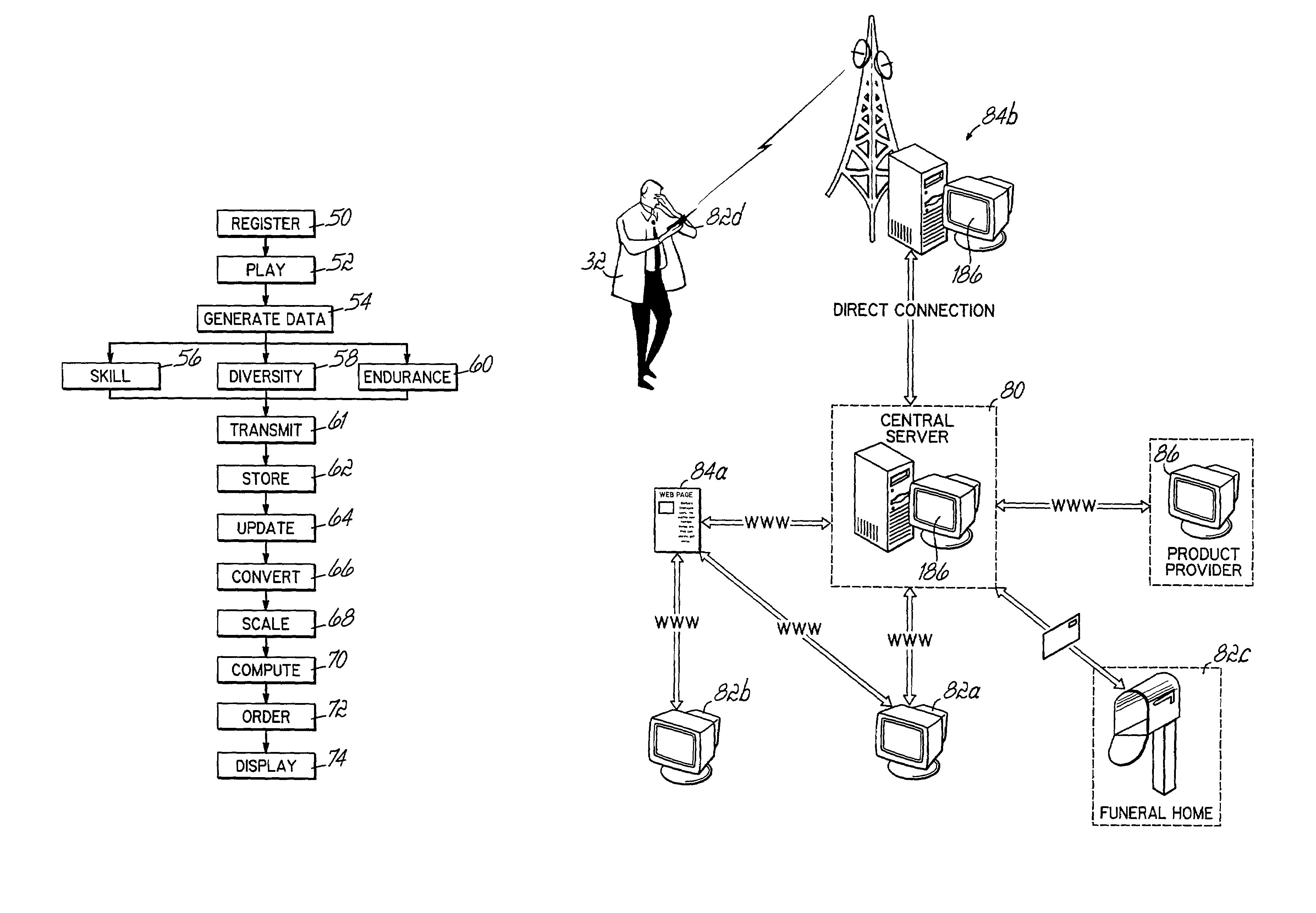
0012<figref idref="DRAWINGS">FIG. 3</figref> is a flow chart illustrating one embodiment of a method of assessing the performance of a contest participant that is in accordance with the principles of the present invention;
0013<figref idref="DRAWINGS">FIG. 4</figref> is a schematic diagram that illustrates a communications network consistent with the principles of the present invention.
DETAILED DESCRIPTION OF SPECIFIC EMBODIMENTS
0014One embodiment of the present invention relates a method of assessing the performance of a game participant. The embodiment rates performance based on generated scores that may reflect the diversity, endurance and skill level of the participant.
0015The scores may be generated, accumulated, updated and displayed within an environment comprising a plurality of games. The scores relate to particular aspects or categorizations of participant play with respect to the plurality of games. For instance, the scores may be indicative of the frequency or skill with which the participant executes a respective game within the plurality of games. Another action embodied in a score might reflect how many different games the participant attempts.
0016One embodiment manipulates and combines scores to arrive at a rating. The scores may be disproportionally scaled prior to the rating computation, according to contest specifications. One embodiment ultimately compares the rating of the participant to that of other players. Thus, the rating achieved by the participant determines their placement or assessment within the confines of the contest.
0017While the principles of this invention do not limit its forum or application, one desirable embodiment capitalizes on structure available through the computer networked systems exemplified in <figref idref="DRAWINGS">FIGS. 1 and 2</figref>.
0000Exemplary Hardware and Software Environment
0018Turning to the Drawings, wherein like numbers denote like parts throughout the several views, <figref idref="DRAWINGS">FIG. 1</figref> illustrates a computer system <b>10</b> suitable for assessing the performance of a contest participant in a manner consistent with the invention. Computer system <b>10</b> is illustrated as a networked computer system including one or more client computers <b>12</b>, <b>14</b> and <b>20</b> (e.g., desktop or PC-based computers, workstations, etc.) coupled to server <b>16</b> (e.g., a PC-based server, a minicomputer, a midrange computer, a mainframe computer, etc.) through a network <b>18</b>.
0019Network <b>18</b> represents a networked interconnection, including, but not limited to local-area, wide-area, wireless, and public networks (e.g., the Internet). Moreover, any number of computers and other devices may be networked through network <b>18</b>, e.g., multiple servers.
0020User computer <b>20</b>, which may be similar to computers <b>12</b>, <b>14</b>, may include: a central processing unit (CPU) <b>21</b>, a number of peripheral components such as a computer display <b>22</b>, a storage device <b>23</b>, a printer <b>24</b>, and various input devices (e.g., a mouse <b>26</b> and keyboard <b>27</b>), among others. Server computer <b>16</b> may be similarly configured, albeit typically with greater processing performance and storage capacity, as is well known in the art.
0021<figref idref="DRAWINGS">FIG. 2</figref> illustrates a hardware and software environment for an apparatus <b>30</b> suitable for hosting an online contest assessment website consistent with the principles of the invention. For the purposes of the invention, apparatus <b>30</b> may represent a computer, computer system or other programmable electronic device, including: a client computer (e.g., similar to computers <b>12</b>, <b>14</b> and <b>20</b> of FIG. <b>1</b>), a server computer (e.g., similar to server <b>16</b> of <figref idref="DRAWINGS">FIG. 1</figref>), a portable computer, an embedded controller, etc. Apparatus <b>30</b> will hereinafter also be referred to as a “computer,” although it should be appreciated the term “apparatus” may also include other suitable programmable electronic devices consistent with the invention.
0022Computer <b>30</b> typically includes at least one processor <b>31</b> coupled to a memory <b>32</b>. Processor <b>31</b> may represent one or more processors (e.g., microprocessors), and memory <b>32</b> may represent the random access memory (RAM) devices comprising the main storage of computer <b>30</b>, as well as any supplemental levels of memory, e.g., cache memories, non-volatile or backup memories (e.g., programmable or flash memories), read-only memories, etc.
0023In addition, memory <b>32</b> may be considered to include memory storage physically located elsewhere in computer <b>30</b>, e.g., any cache memory in a processor <b>31</b>, as well as any storage capacity used as a virtual memory, e.g., as stored within a database <b>36</b> or on another computer coupled to computer <b>30</b> via network <b>38</b>.
0024Computer <b>30</b> also may receive a number of inputs and outputs for communicating information externally. For interface with a user, computer <b>30</b> typically includes one or more input devices <b>33</b> (e.g., a keyboard, a mouse, a trackball, a joystick, a touchpad, and/or a microphone, among others) and a display <b>34</b> (e.g., a CRT monitor, an LCD display panel, and/or a speaker, among others). It should be appreciated, however, that with some implementations of computer <b>30</b>, e.g., some server implementations, direct user input and output may not be supported by the computer, and interface with the computer may be implemented through client computer or workstation networked with computer <b>30</b>.
0025For additional storage, computer <b>30</b> may also include one or more mass storage devices <b>36</b> configured to store a database <b>37</b> containing ratings, as well as game and participant statistics. Exemplary devices <b>36</b> can include: a floppy or other removable disk drive, a hard disk drive, a direct access storage device (DASD), an optical drive (e.g., a CD drive, a DVD drive, etc.), and/or a tape drive, among others.
0026Furthermore, computer <b>30</b> may include an interface with one or more networks <b>38</b> (e.g., a LAN, a WAN, a wireless network, and/or the Internet, among others) to permit the communication of information with other computers coupled to the network. It should be appreciated that computer <b>30</b> typically includes suitable analog and/or digital interfaces between processor <b>31</b> and each of components <b>32</b>, <b>33</b>, <b>34</b>, <b>36</b> and <b>38</b>.
0027Computer <b>30</b> operates under the control of an operating system <b>40</b>, and executes various computer software applications, components, programs, objects, modules, etc. (e.g., ratings program <b>44</b>, web server <b>42</b>, scaling algorithm <b>43</b>, among others). Moreover, various applications, components, programs, objects, modules, etc. may also execute on one or more processors in another computer coupled to computer <b>30</b> via a network <b>38</b>, e.g., in a distributed or client-server computing environment, whereby the processing required to implement the functions of a computer program may be allocated to multiple computers over a network.
0028In general, the routines executed to implement the embodiments of the invention, whether implemented as part of an operating system or a specific application, component, program, object, module or sequence of instructions will be referred to herein as “computer programs,” or simply “programs.” The computer programs typically comprise one or more instructions that are resident at various times in various computer memory and storage devices. When a program is read and executed by a processor, the program causes the computer to execute steps or elements embodying the various aspects of the invention.
0029Moreover, while the invention has and hereinafter will be described in the context of fully functioning computers and computer systems, those skilled in the art will appreciate that the various embodiments of the invention are capable of being distributed as a program product in a variety of forms. Further, the invention applies equally regardless of the particular type of signal bearing media used to actually carry out the distribution. Examples of signal bearing media include but are not limited to recordable type media such as volatile and non-volatile memory devices, floppy and other removable disks, hard disk drives, optical disks (e.g., CD-ROM's, DVD's, etc.), among others, and transmission type media such as digital and analog communication links.
0030In addition, various programs described hereinafter may be identified based upon the application for which they are implemented in a specific embodiment of the invention. However, it should be appreciated that any particular program nomenclature that follows is used merely for convenience, and thus the invention should not be limited to use solely in any specific application identified and/or implied by such nomenclature.
0031Those skilled in the art will recognize that the exemplary environments illustrated in <figref idref="DRAWINGS">FIGS. 1 and 2</figref> are not intended to limit the present invention. Indeed, those skilled in the art will recognize that other alternative hardware and/or software environments may be used without departing from the scope of the invention.
0000Ratings Program
0032The ratings program <b>44</b> of <figref idref="DRAWINGS">FIG. 2</figref> manipulates recorded scores to assess the performance of a contest participant. The flowchart of <figref idref="DRAWINGS">FIG. 3</figref> illustrates process steps associated with one embodiment of the program that are consistent with the invention.
0033An exemplary ratings program may prompt the participant to register at a central Web server at block <b>50</b>. Registration may be universally free, or may have fees associated with it. Registration may require a participant to enter information, or may be accomplished automatically through a computer token, or “cookie,” sent to the central server. Other known browser identification means are equally applicable.
0034A ratings program may assign an identification number to registered participants. The program may further allocate memory space at an associated database configured to store generated scores. The identification number can be used by the program to time-stamp game sessions, as well as to categorize scores prior to storage in the central database. The ratings program may additionally allocate storage space for the recording of personal participant information. Such information is not limited to hobbies, game preferences and general contact information.
0035The identification number may enable a participant access to different games and may be password protected. The identification number may further allow the participant to periodically track their own progress on a status website hosted by the central server, which displays updated scores, ratings and other statistics. Sponsors purchasing permissions to monitor or advertise during game sessions may use the identification number to match goods and services with participants meeting a product profile criterion.
0036Following registration at block <b>50</b>, the player may proceed to participate in one or more of a plurality of games at block <b>52</b>. The embodiment accommodates nearly any manner of game or contest hosted or designated by the central server. To function within the structure of one embodiment, a game must merely possess a certain, generic attribute from which a predetermined type of score can be generated.
0037Suitable games may merely feature some singular characteristic upon which some minimal, evaluative standard can be applied. For instance, games might qualify for inclusion in a contest based solely upon an attribute that lends itself to comparisons between participants, such as game points, duration, difficulty levels, timeliness, etc.
0038As may be appreciated, such generic mandates can apply to most any type of game, whether based in classic card, arcade, or board game principles. Suitable games also include athletic endeavors, trivia challenges and role-playing contests. Also, while a preferred embodiment realizes effects and other advantages affiliated with Internet and computer-related technologies, appropriate forums for games consistent with the invention are equally unbounded.
0039The games may be maintained by a common host or sponsor. As such, a central server may store and administer programs corresponding to the games. In such a scenario, the rating system can act as an incentive to encourage participants to play longer and to try other games posted by a sponsor.
0040Alternatively, the central server may host a link to an Internet site of the sponsor. Still another embodiment may assemble games based upon membership dues paid to the host, participant preference, or according to some common or complementary scheme. The program may also allow a participant to include games not specifically associated with the host website, but that nevertheless generate scores appropriate to a given contest.
0041As alluded to above, scores generated at block <b>54</b> can embody many different participant actions taken with respect to a game. A measurement of one such action, represented by block <b>56</b>, reflects the success or skill demonstrated by a participant during a game session. As discussed below, the criteria used for evaluating skill levels may vary with respect to the character of each game.
0042A common measurement, such as the placement of a participant's final game score among those of other participants, may serve as a watermark for a skill measurement. However, another applicable action may pertain to the accumulation of incremental point totals or game scores. Game protocol may assign such points at specified instances within a game in response to participant accomplishments.
0043Measuring actions may further be knowledge-based, i.e., may reflect a participant's ability to answer a question pertaining to an aspect of a game. Other scores may be based on previously compiled statistics formatted to function as a baseline for comparison and measurement.
0044Of note, while some sophisticated computer games may present ample opportunity for the evaluation of skill and strategy, the skill score of other qualifying games may be satisfied by the mere entry of a participant. Such might be the case in a lottery-based game. As such, a participant may achieve a maximum score by merely submitting an entry, or through the action of presenting an answer to a trivia question.
0045Another score that may help establish a rating for a player concerns how many different games the participant attempts. At block <b>58</b>, the ratings program may assign a score to a participant for demonstrated diversity, that is, for each contest played within the plurality of games.
0046As discussed below in greater detail, the program of the embodiment stores diversity scores within associated fields of the database at block <b>62</b>. As such, the program may retrieve a score stored within the database diversity field in order for it to be manipulated and combined with other scores ultimately used to establish the rating.
0047Similarly, block <b>60</b> represents a step configured to glean another, exemplary score that can be used to establish a rating. Endurance comprises a measurement of how many games a participant played throughout the duration of a contest. For instance, the ratings program may tally the raw number of games played in a day, irrespective of repeated games.
0048One embodiment may stipulate that a participant complete a game in order to maximize an endurance score. Another contest may award endurance credit for completing an incremental portion of a game sequence. For instance, an exemplary computer game may credit a player with participation in the game after the player arrives at some intermediate point accumulation or program instance.
0049Scores relating to any of the above participant actions may be communicated to the central server at block <b>61</b>. The transmission of the generated scores may be immediate, or may coincide with the conclusion of a contest, or some other predetermined occurrence, depending upon program and contest protocol. In a preferred embodiment, the central server receives scores on at least a daily basis.
0050To this end, a subroutine of the ratings program may retrieve scores from fields housed within the structure of a given game program. Conversely, the game program may be configured to generate and transmit a report that embodies pertinent scores. Scores reflecting participant actions may be automatically searched by the subroutine or forwarded to the appropriate database fields of the central server. In either instance, the ratings program is presented with the scores ultimately needed to compute the rating at block <b>70</b>.
0051Should the games be resident on the central server, then the ratings program may easily retrieve or download the scores to the central database. Games maintained at a remote website, or games that are not conducive to a computer environment, may transmit the scores to the central server via voice, facsimile, electronic/conventional mail or any other known communication means.
0052The central server may store the scores in a database at block <b>62</b>. The ratings program may periodically update the recorded scores at block <b>64</b> to reflect the most current game activity of a participant. The program may continue to update, store, and even post scores for participant review throughout the duration of a contest.
0053The server may compile and organize the scores in memory according to the identification number of the participant. The server may additionally record the scores according to the participant action it embodies. For instance, skill scores may be stored in a database field reserved exclusively for such data. Likewise, data tracking the diversity of a participant may be stored in a separate database field. Such exclusive structure may facilitate storage of newly generated scores, while further accommodating conversion <b>66</b>, scaling <b>68</b> and computation <b>70</b> operations discussed below.
0054At block <b>66</b>, the ratings program converts and formats the raw scores for further processing. For instance, in the case of a skill-related scores, the ratings program may assign points to a participant according to how many times they achieve one of the top ten game scores for a day. The chart below exemplifies a point allocation system consistent with such a embodiment:
0055<tables id="TABLE-US-00001" num="00001"><table frame="none" colsep="0" rowsep="0"><tgroup align="left" colsep="0" rowsep="0" cols="11"><colspec colname="1" colwidth="35pt" align="left" /><colspec colname="2" colwidth="14pt" align="char" /><colspec colname="3" colwidth="21pt" align="char" /><colspec colname="4" colwidth="14pt" align="char" /><colspec colname="5" colwidth="21pt" align="char" /><colspec colname="6" colwidth="14pt" align="char" /><colspec colname="7" colwidth="21pt" align="char" /><colspec colname="8" colwidth="14pt" align="char" /><colspec colname="9" colwidth="21pt" align="char" /><colspec colname="10" colwidth="14pt" align="char" /><colspec colname="11" colwidth="28pt" align="char" /><thead><row><entry namest="1" nameend="11" align="center" rowsep="1" /></row></thead><tbody valign="top"><row><entry>Place</entry><entry>1</entry><entry>2</entry><entry>3</entry><entry>4</entry><entry>5</entry><entry>6</entry><entry>7</entry><entry>8</entry><entry>9</entry><entry>10</entry></row><row><entry>Points</entry><entry>10</entry><entry>9</entry><entry>8</entry><entry>7</entry><entry>6</entry><entry>5</entry><entry>4</entry><entry>3</entry><entry>2</entry><entry>1</entry></row><row><entry namest="1" nameend="11" align="center" rowsep="1" /></row></tbody></tgroup></table></tables>
0056By way of further example, the number of repeat game wins posted by a participant may constitute a measuring action in another given contest. As such, scores could testify as to the number of consecutive victories achieved by a participant in a rating contest. The rating program may assign a sliding-scale integer value to the identification number of the participant. The assigned integer embodies a score representative of the participant's repeat victories. Thus, the resultant, converted scores reflects a score indicative of a proscribed, participant act.
0057At block <b>68</b>, the ratings program may scale the converted scores according to contest protocol. While skill, diversity and endurance data may all ultimately contribute to the rating of a participant, it may be desirable to disproportionately weight the emphasis placed on each score.
0058For example, one embodiment may call for ratings to reflect a statistical (two-to-one) preference for skill-based achievements. As such, the ratings program may mathematically manipulate the skill scores at block <b>68</b> so that the resultant number potentially accounts for half of the final rating. Scaling factors and other algorithms may likewise be applied to the diversity and endurance scores to scale them into values that each potentially comprise one quarter of the final rating.
0059Using the above scoring relationship, a skill rating of “6” (multiplied by fifty percent) will account for 3 rating points, while a diversity score of “4,” and an endurance score of “6” (multiplied by twenty-five percent) will comprise 1.0 and 1.5 points, respectively. More involved computations may account for normal and standard deviations where appropriate. In this manner, steps associated with block <b>68</b> scale the data in accordance with contest scoring specifications.
0060The ratings program may sum the scaled scores at block <b>70</b>. The resultant computation may comprise the rating for the participant. While one embodiment calls for a simple addition step at block <b>70</b>, another may employ more sophisticated algorithms to achieve more subtle scoring effects.
0061At block <b>72</b>, the ratings program may record the calculated rating and rank it in relation to the ratings of other participants. In another embodiment, the rating may be compared to a predetermined table of scores for purpose of assessing the relative performance of the participant.
0062One embodiment may initiate the display of information that relates to a rating at block <b>74</b>. For instance, the rating of a participant may be posted as a percentile, or as a raw point total on a public or password-protected website. Other displays may include graphs or charts that reveal current leaders from among all participants based upon ratings.
0063Displays may be further customized to show only the rating of the participant and that of another, designated participant. Such postings can provide further incentive to participants eager to bolster their scores, as well as to those seeking encouragement regarding their current standing.
0064The exemplary communications network of <figref idref="DRAWINGS">FIG. 4</figref> further demonstrates the broad application of principles presented in the flowchart of <figref idref="DRAWINGS">FIG. 3</figref>. Namely, a central Web server <b>80</b>, associated database and a ratings program are electronically and logically connected to game participants <b>82</b><i>a–d, </i>sponsors <b>84</b><i>a,b </i>and a product vendor <b>86</b>. In sum, the exemplary network provides an infrastructure for assessing the performance of a contest participant.
0065A ratings program resident on the central server <b>80</b> evaluates performance based on generated game scores. Such scores reflect participant actions that potentially reflect, among other characterizations, player diversity, endurance and skill level. The exemplary network supports an environment comprising multiple games within which the participant interacts and generates the scores.
0066Participants <b>82</b> and game sponsors <b>84</b> submit game scores and other information to the central database of the server <b>80</b> via Internet, telephone, computer and mail delivery mechanisms. The ratings program convert, proportion and otherwise process the scores to compute a rating. The network may ultimately compare ratings of participants to assess performance within the confines of the contest.
0067Referring more specifically to <figref idref="DRAWINGS">FIG. 4</figref>, a participant <b>82</b><i>a </i>accesses a central server <b>108</b> directly over the Internet, or via a website of a participating game host <b>84</b><i>a. </i>In the latter instance, a seamless link to the server <b>80</b> may allow scores to be transmitted, tallied and displayed without leaving the host website <b>84</b><i>a. </i>Alternatively, a game sponsor <b>84</b><i>b </i>may access the ratings website of the server <b>80</b> on behalf of the participant. As such, the sponsor <b>84</b><i>b </i>or other representative submits participant <b>82</b><i>d </i>scores according to contest parameters.
0068The interactive program of the central server <b>80</b> may allow participants <b>82</b> to choose from among several games appealing to varying levels of interest and skill. The server <b>80</b> may maintain and execute the game programs, itself, or it may provide links to remotely hosted/sponsored contests.
0069One embodiment may require the participant to register with the central server <b>80</b> before accessing the games. Exemplary registration submissions may include player contact, preference, password and/or payment information. Registration may be universally free, or have fees associated with different types of memberships.
0070After, or while playing a selected game, a ratings program executed on the central server <b>80</b> extracts scores relating to a designated game parameter. Alternatively, the game program may generate and communicate a data report or other transmission to the central server <b>80</b>. Scores may be updated constantly at the central server <b>80</b>. At the server <b>80</b>, the ratings program may sum, replace, order or otherwise categorize newly submitted scores according to contest specifications.
0071A score typically reflects some action taken by the participant <b>82</b> with regard to a game or collection of games. For instance, one score might reflect how long a participant <b>82</b><i>a </i>remained logged-in to the game website. Another score might relate to achievements specific to two-player games, or to consecutive wins by the same participant. Still other score may embody the frequency with which a participant achieves a particular rating.
0072The character of other applicable scores may be dictated by the contest forum. For instance, a radio listener <b>82</b><i>d </i>may call in to a station <b>84</b><i>b </i>sponsoring a contest. The mere act of communication made by the participant <b>82</b><i>d </i>may satisfy a relevant requisite action, constituting a score. As illustrated in the exemplary network, the sponsor <b>84</b><i>b </i>may automatically or periodically transmit such scores to the central server <b>80</b> over a direct network connection.
0073Another game sponsor <b>84</b><i>a </i>within the embodiment may host games over their own server. Reporting dynamics between the sponsor <b>84</b><i>a </i>and central server <b>80</b> may operate as above, except now an Internet connection may provide the data link. The link may provide a seamless transition between the two servers, allowing the participant <b>82</b><i>b </i>access to ratings displays and other games offered via the central server <b>80</b>. Of note, another sponsor or participant <b>82</b><i>c </i>may communicate scores and other results directly to the central server <b>80</b> using voice, facsimile or postal lines.
0074In any case, once the scores have been delivered, the ratings program incident on the central server <b>80</b> processes the scores according to the parameter specifications of the contest. For instance, the program may scale and combine a skill parameter score with a weighted endurance value. That resultant score may be further manipulated prior to being combined with a third score, such as one reflecting diversity.
0075Ultimately, the program of the embodiment arrives at a rating particular to the performance of the participant in the context of the predefined scores. The ratings program may rank the rating of the participant with respect to the ratings of other players processed at the central server <b>80</b>.
0076Depending upon the access privileges granted to the participant <b>82</b><i>a, </i>the ratings program may initiate the display of the ratings on the central server <b>80</b>, such that the ratings may be accessed from the terminal of the participant <b>82</b><i>a. </i>As alluded to above, the display format of the rating may vary according to player preference, marketing strategy and contest structure.
0077While the present invention has been illustrated by a description of various embodiments, and while these embodiments have been described in considerable detail, it is not the intention of the applicants to restrict or in any way limit the scope of the appended claims to such detail.
0078For instance, while diversity, skill and endurance scores, among others, have been addressed herein, another embodiment of the invention may employ virtually any measuring scheme conceivably suited to distinguish between participant performance, not limited to player age, zip code or game difficulty level.
0079Furthermore, while a computer-specific embodiment of the invention has been described above in detail, the embodiments of the invention have equal application in non-computer or computer-hybrid environments. Additional advantages and modifications will readily appear to those skilled in the art. The invention in its broader aspects is therefore not limited to the specific details, representative apparatus and method, and illustrative example shown and described. Accordingly, departures may be made from such details without departing from the spirit or scope of applicant's general inventive concept.
Contents5
4 sheets
Sheet 1 Sheet 2 Sheet 3 Sheet 4
Every citation, both ways
| Document | Relation | Office | Cited during |
|---|---|---|---|
| US2009156302A1 | Cited by | United States of America | Pre-grant |
| US2008098417A1 | Cited by | United States of America | Pre-grant |
| US8380554B2 | Cited by | United States of America | Applicant |
| US10248729B2 | Cited by | United States of America | Applicant |
| US2009093287A1 | Cited by | United States of America | Pre-grant |
| US2011118035A1 | Cited by | United States of America | Pre-grant |
| US2006122716A1 | Cited by | United States of America | Pre-grant |
| US2009093313A1 | Cited by | United States of America | Pre-grant |
| US8538910B2 | Cited by | United States of America | Applicant |
| US8425331B2 | Cited by | United States of America | Applicant |
| US10803694B2 | Cited by | United States of America | Applicant |
| US2016132771A1 | Cited by | United States of America | Pre-grant |
| US2010293026A1 | Cited by | United States of America | Pre-grant |
| US8657664B2 | Cited by | United States of America | Search report |
| US8734221B2 | Cited by | United States of America | Applicant |
| US10452247B2 | Cited by | United States of America | Applicant |
| US8727857B2 | Cited by | United States of America | Applicant |
| US8323112B2 | Cited by | United States of America | Applicant |
| US2007117630A1 | Cited by | United States of America | Pre-grant |
| US8583266B2 | Cited by | United States of America | Applicant |
| US8496529B2 | Cited by | United States of America | Applicant |
| US7887419B2 | Cited by | United States of America | Search report |
| US11132642B2 | Cited by | United States of America | Search report |
| US2013252738A1 | Cited by | United States of America | Pre-grant |
| US2007232396A1 | Cited by | United States of America | Pre-grant |
| US8788074B1 | Cited by | United States of America | Search report |
| US8734257B2 | Cited by | United States of America | Applicant |
| US8454443B2 | Cited by | United States of America | Applicant |
| US2004002326A1 | Cited by | United States of America | Pre-grant |
| US9355097B2 | Cited by | United States of America | Applicant |
| US8727858B2 | Cited by | United States of America | Applicant |
| US2011136575A1 | Cited by | United States of America | Pre-grant |
| US2007021165A1 | Cited by | United States of America | Pre-grant |
| US2016132771A1 | Cited by | United States of America | Search report |
| US8277325B2 | Cited by | United States of America | Applicant |
| US7502610B2 | Cited by | United States of America | Search report |
| US8527553B2 | Cited by | United States of America | Applicant |
| US8734220B2 | Cited by | United States of America | Applicant |
| US2007259709A1 | Cited by | United States of America | Pre-grant |
| US11079920B2 | Cited by | United States of America | Applicant |
| US8103700B2 | Cited by | United States of America | Search report |
| US2009227313A1 | Cited by | United States of America | Pre-grant |
| US2011269550A1 | Cited by | United States of America | Pre-grant |
| US8876606B2 | Cited by | United States of America | Applicant |
| US10391405B2 | Cited by | United States of America | Applicant |
| US8079911B2 | Cited by | United States of America | Search report |
| US8195498B2 | Cited by | United States of America | Search report |
| US2006287100A1 | Cited by | United States of America | Pre-grant |
| US9144741B2 | Cited by | United States of America | Applicant |
| US8548610B1 | Cited by | United States of America | Search report |
| US2005192852A1 | Cited by | United States of America | Pre-grant |
| US9367543B2 | Cited by | United States of America | Search report |
| US2002151359A1 | Cites | United States of America | Search report |
| US2002187834A1 | Cites | United States of America | Search report |
| US5917725A | Cites | United States of America | Search report |
| US5957776A | Cites | United States of America | Search report |
| US5970143A | Cites | United States of America | Search report |
| US5971397A | Cites | United States of America | Search report |
| US6074312A | Cites | United States of America | Search report |
| US6076021A | Cites | United States of America | Search report |
| US6113495A | Cites | United States of America | Search report |
| US6149519A | Cites | United States of America | Search report |
| US6224486B1 | Cites | United States of America | Search report |
| US6302793B1 | Cites | United States of America | Search report |
| US6321128B1 | Cites | United States of America | Search report |
| US6343990B1 | Cites | United States of America | Search report |
| US6425828B2 | Cites | United States of America | Search report |
| US6511377B1 | Cites | United States of America | Search report |
2 members in 1 office
Priority claims2
| Document | Office | Kind | Date |
|---|---|---|---|
| 83452901 | United States of America | A | |
| US20010834529 | – | – | – |
Members2
| Document | Office | Kind | |
|---|---|---|---|
| US2002173349A1 | United States of America | A1 | |
| US6996444B2This record | United States of America | B2 |
29 transactions on the USPTO file
Allowed after 1 non-final rejection, 1 final rejection and 1 RCE.
- Non-final rejections
- 1
- Final rejections
- 1
- RCEs
- 1
- Appeals
- 0
Over time
Point at a mark for the transactionTransactions
| Event | |
|---|---|
| Expire Patent | |
| Recordation of Patent Grant Mailed | |
| Patent Issue Date Used in PTA CalculationAllowed | |
| Issue Notification MailedAllowed | |
| Dispatch to FDC | |
| Application Is Considered Ready for Issue | |
| Issue Fee Payment Verified | |
| Issue Fee Payment Received | |
| Mail Notice of AllowanceAllowed | |
| Notice of Allowance Data Verification CompletedAllowed | |
| Date Forwarded to Examiner | |
| Date Forwarded to Examiner | |
| Disposal for a RCE / CPA / R129 | |
| Request for Continued Examination (RCE) | |
| Workflow - Request for RCE - Begin | |
| Mail Final Rejection (PTOL - 326)Final rejection | |
| Final RejectionFinal rejection | |
| IFW TSS Processing by Tech Center Complete | |
| Date Forwarded to Examiner | |
| Response after Non-Final Action | |
| Request for Extension of Time - Granted | |
| Mail Non-Final RejectionNon-final rejection | |
| Non-Final RejectionNon-final rejection | |
| Miscellaneous Incoming Letter | |
| Case Docketed to Examiner in GAU | |
| Application Dispatched from OIPE | |
| Correspondence Address Change | |
| IFW Scan & PACR Auto Security Review | |
| Initial Exam Team nn |
6 legal events, as the office reported them to INPADOC
Over the term
Point at a mark for the eventEvents
| Event | Code | |
|---|---|---|
| Lapsed due to failure to pay maintenance feeLapsedFP | FP | |
| Information on status: patent discontinuationPATENT EXPIRED DUE TO NONPAYMENT OF MAINTENANCE FEES UNDER 37 CFR 1.362STCH | STCH | |
| Lapse for failure to pay maintenance feesLapsedLAPS | LAPS | |
| Maintenance fee reminder mailedREMI | REMI | |
| AssignmentAS | AS | |
| AssignmentAS | AS |
Numbers
- Publication
- 06996444
- Publication, DOCDB
- 6996444
- Publication, EPODOC
- US6996444
- Application
- 9834529
- Application, DOCDB
- 83452901
- Application, EPODOC
- US20010834529
Titles
- English
- Rating method, program product and apparatus
Patent term adjustment
- A delay
- +692 daysthe office missed an examination deadline
- Applicant delay
- −92 days
- Net adjustment
- 600 days
Classification
- CPC, 9
- A63F13/12
- A63F13/798
- A63F2300/407
- A63F2300/50
- G07F17/3239
- G07F17/3295
- A63F13/30
- A63F13/46
- A63F13/35
- IPC, 2
- A63F13 00
- A63F13 12
- USPC, 3
- 700091000
- 463025000
- 463029000