Remote media ordering hub
Summary by NHIP
Contextual Media Ordering Hub
The system receives a playback request for content contextually discovered at a website based on current user activity. It authenticates login credentials to access a selected multichannel video programming distributor from a provided plurality, enabling delivery of the media content.
Claim Score by NHIP
Abstract
A media ordering hub receives a request for media content. Further, the media ordering hub provides a plurality of multichannel video programming distributors that offer the media content. In addition, the media ordering hub determines a selected multichannel video programming distributor from the plurality of multichannel video programming distributors. The media ordering hub also authenticates login credentials to access the selected multichannel video programming distributor so that the selected multichannel video programming distributor delivers the media content.
Term
6.7 yearsleft in the term
Expires 10 June 2033, including 351 days of term adjustment.
- Priority and filed
- Granted
- Today
- Expires
20 claims: 3 independent, 17 dependent
- 1A computer program product comprising a non-transitory computer readable storage device having a computer readable program stored thereon, wherein the computer readable program when executed on a computer causes the computer to:receive, at a media ordering hub, a request for playback of first media content that is contextually discovered at a website based upon a current user activity performed through a network on a user device, wherein the website displays content about second media content without playback of the second media content, wherein the first media content is categorized according to a same category as the second media content, wherein the first media content is distinct from the second media content, wherein the contextual discovery comprises a contextual display of information on the user device that is associated with the second media content in conjunction with the current user activity, wherein the contextual discovery is performed by the user device without a user search during the current user activity, the request for the media content being received from a set of embeddable code that streams a preview of the first media content that is contextually discovered to the user device during the current user activity at the website for display at the website, the preview including one or more portions of the first media content that is viewed by the user, the one or more viewed portions being available for selection by the user device for viewing subsequent to the current user activity;provide, from the media ordering hub, a plurality of indicia corresponding to a plurality of multichannel video programming distributors to the user device based upon the set of embeddable code directing the user device to the media ordering hub from the website after streaming of the preview has been initiated, the plurality of multichannel video programming distributors offering the first media content;receive, at the media ordering hub, an indication of a multichannel video programming distributor that is selected by a user associated with the user device from the plurality of multichannel video programming distributors;andauthenticate, at the media ordering hub, login credentials received from the user device to access the selected multichannel video programming distributor so that the selected multichannel video programming distributor delivers the first media content to the user device without the user device directly accessing a website associated with the selected multichannel video programming distributor, the media ordering hub being an intermediary website that acts as an intermediary between the user device and the website associated with the selected multichannel video programming distributor.
- 14Broadest claimClaim Score 23, narrow(NHIP)A method comprising:receiving, at a media ordering hub, a request for playback of first media content that is contextually discovered at a website based upon a current user activity performed through a network on a user device, wherein the website displays content about second media content without playback of the second media content, wherein the first media content is categorized according to a same category as the second media content, wherein the first media content is distinct from the second media content, wherein the contextual discovery comprises a contextual display of information on the user device that is associated with the second media content in conjunction with the current user activity, wherein the contextual discovery is performed by the user device without a user search during the current user activity, the request for the media content being received from a set of embeddable code that streams a preview of the first media content that is contextually discovered to the user device during the current user activity at the website for display at the website, the preview including one or more portions of the first media content that is viewed by the user, the one or more viewed portions being available for selection by the user device for viewing subsequent to the current user activity;providing, from the media ordering hub, a plurality of indicia corresponding to a plurality of multichannel video programming distributors to the user device based upon the set of embeddable code directing the user device to the media ordering hub from the website after streaming of the preview has been initiated, the plurality of multichannel video programming distributors offering the media content;receiving, at the media ordering hub, an indication of a multichannel video programming distributor that is selected by a user associated with the user device from the plurality of multichannel video programming distributors;andauthenticating, at the media ordering hub, login credentials received from the user device to access the selected multichannel video programming distributor so that the selected multichannel video programming distributor delivers the first media content to the user device without the user device directly accessing a website associated with the selected multichannel video programming distributor, the media ordering hub being an intermediary website that acts as an intermediary between the user device and the website associated with the selected multichannel video programming distributor.
- 20A system comprising:a processor that is configured to receive, at a media ordering hub, a request for playback of first media content that is contextually discovered at a website based upon a current user activity performed through a network on a user device, provide, from the media ordering hub, a plurality of indicia corresponding to a plurality of multichannel video programming distributors to the user device based upon a set of embeddable code directing the user device to the media ordering hub from the website after streaming of a preview has been initiated, receive, at the media ordering hub, indication of a multichannel video programming distributor that is selected by a user associated with the user device from the plurality of multichannel video programming distributors, and authenticate, at the media ordering hub, login credentials received from the user device to access the selected multichannel video programming distributor so that the selected multichannel video programming distributor delivers the first media content to the user device without the user device directly accessing a website associated with the selected multichannel video programming distributor, wherein the website displays content about second media content without playback of the second media content, wherein the first media content is categorized according to a same category as the second media content, wherein the first media content is distinct from the second media content, wherein the preview includes one or more portions of the first media content that is viewed by the user, wherein the one or more viewed portions are available for selection by the user device for viewing subsequent to the current user activity, wherein the contextual discovery comprises a contextual display of information that is associated with the second media content in conjunction with the current user activity, wherein the contextual discovery is performed by the user device without a user search during the current user activity, wherein the plurality of multichannel video programming distributors offer the first media content, the request for the first media content being received from the set of embeddable code that streams the preview of the first media content that is contextually discovered to the user device during the current user activity at the website for display at the website, the media ordering hub being an intermediary website that acts as an intermediary between the user device and the website associated with the selected multichannel video programming distributor.
Independent claims3
36 paragraphs in 4 sections, as filed
BACKGROUND
1. Field
This disclosure generally relates to the field of data content. More particularly, the disclosure relates to the ordering of data content.
2. General Background
Current multichannel video programming distributors (“MVPDs”), e.g. cable and satellite service providers, offer pay per view (“PPV”) and video on demand (“VOD”) services. These services may typically be ordered by the consumer via the MVPD's program guide on the television. Program guides and other television interfaces that utilize a remote control make the searching and ordering process cumbersome. Moreover, consumers frequently experience “sticker shock” when their bill arrives with an amount larger than what was expected as a result of incremental charges incurred from ordering movies.
SUMMARY
In one aspect of the disclosure, a computer program product is provided. The computer program product includes a computer readable medium having a computer readable program stored thereon. The computer readable program when executed on a computer causes the computer to receive, at a media ordering hub, a request for media content. Further, the computer readable program when executed on the computer causes the computer to provide, from the media ordering hub, a plurality of multichannel video programming distributors that offer the media content. In addition, the computer readable program when executed on the computer causes the computer to determine, at the media ordering hub, a selected multichannel video programming distributor from the plurality of multichannel video programming distributors. The computer readable program when executed on the computer also causes the computer to authenticate, at the media ordering hub, login credentials to access the selected multichannel video programming distributor so that the selected multichannel video programming distributor delivers the media content.
In another aspect of the disclosure, a process is provided. The process receives, at a media ordering hub, a request for media content. Further, the process provides, from the media ordering hub, a plurality of multichannel video programming distributors that offer the media content. In addition, the process receives, at the media ordering hub, a selected multichannel video programming distributor from the plurality of multichannel video programming distributors. The process also authenticates, at the media ordering hub, login credentials to access the selected multichannel video programming distributor so that the selected multichannel video programming distributor delivers the media content.
In yet another aspect of the disclosure, a system is provided. The system includes a processor that is configured to receive, at a media ordering hub, a request for media content, provide, from the media ordering hub, a plurality of multichannel video programming distributors that offer the media content, determine, at the media ordering hub, a selected multichannel video programming distributor from the plurality of multichannel video programming distributors, and authenticate, at the media ordering hub, login credentials to access the selected multichannel video programming distributor so that the selected multichannel video programming distributor delivers the media content.
BRIEF DESCRIPTION OF THE DRAWINGS
The above-mentioned features of the present disclosure will become more apparent with reference to the following description taken in conjunction with the accompanying drawings wherein like reference numerals denote like elements and in which:
<figref idref="DRAWINGS">FIG. 1</figref> illustrates a system that may be utilized to perform ordering of media content.
<figref idref="DRAWINGS">FIG. 2</figref> illustrates a media ordering configuration.
<figref idref="DRAWINGS">FIG. 3</figref> illustrates a contextual discovery configuration
<figref idref="DRAWINGS">FIG. 4</figref> illustrates an example of the contextual discovery configuration in which the user places an order for media content.
<figref idref="DRAWINGS">FIG. 5</figref> illustrates a data delivery configuration that may be utilized to deliver the media content that is ordered through the media ordering hub as illustrated in <figref idref="DRAWINGS">FIG. 4</figref>.
<figref idref="DRAWINGS">FIG. 6</figref> illustrates a process that may be utilized to provide ordering of media content.
DETAILED DESCRIPTION
A media ordering hub may be utilized to provide an enhanced method of ordering media content. In one aspect, embeddable code may be included within a web page, online advertisement, an application, or the like. An example of an application is an application that is installed on a mobile device. Applications installed on other devices may also be utilized. Further, the embeddable code may be hosted on one or more remote servers. The embeddable code may be utilized to provide information about media content that is available for purchase to a computing device of a customer. For example, the embeddable code may be utilized to present a user with a ten minute preview of a movie. After conclusion of the preview, the user may be provided with the opportunity to rent or purchase the movie.
In one aspect, the embeddable code is contextually placed. For example, embeddable code for an action movie may be contextually placed on a website about a different action movie that has a similar type of storyline. Accordingly, the user may contextually discover media content rather than having to search through a cumbersome program guide for the media content. In other words, a user may contextually discover embeddable code for media content of possible interest rather than having to perform a cumbersome search of the website or the program guide of an MVPD.
In another aspect, the embeddable code allows the user to select the MVPD. For example, a user may be a subscriber of an MVPD. The user may then select that MVPD. The media ordering hub may receive that selection and coordinate authentication of the user with the particular MVPD. The media ordering hub may then provide the media content to the user after payment is authorized by the user. Accordingly, the media ordering hub is in operable communication with a plurality of MVPDs. As a result, a user does not have to be concerned with going to a website, portal, or program guide of the MVPD. The user may start with the content that is contextually discovered and then order through the embeddable code via the media ordering hub. In yet another aspect, the embeddable code allows a user that is not a subscriber of the MVPD or is a subscriber of a different MVPD to place an order for the media content with the particular MVPD.
In contrast with the current payment model that bills media content directly to the bill of a subscriber of the MVPD, the media ordering hub may allow a user to select from a variety of different payment options. For example, the media ordering hub may allow a user to pay for the media content by credit card, debit card, virtual currency, coupon, voucher, or the like. The media ordering hub may also allow the user to pay for the media content by having the MVPD bill the user directly for the media content.
The term media content is intended herein to include movies, applications, games, audio files, or the like. Although the media ordering hub facilitates the ordering of the media content, the MVPD may provide the media content directly to the user after purchase.
The user may watch the media content on any device supported by the MVPD. For example, the user may order the media content on a personal computer (“PC”) and watch the media content on a television. The user may also order and watch the media content on the same device. For example, a user may order the media content on a tablet device and then watch the media content immediately after purchase on the tablet device. A variety of computing devices may be utilized to order and/or watch the media content. The computing device may be a PC, laptop, smartphone, tablet device, set top box, or the like.
<figref idref="DRAWINGS">FIG. 1</figref> illustrates a system <b>100</b> that may be utilized to perform ordering of media content. In one aspect, the system <b>100</b> is implemented utilizing a general purpose computer or any other hardware equivalents. Thus, the system <b>100</b> comprises a processor <b>102</b>, a memory <b>106</b>, e.g., random access memory (“RAM”) and/or read only memory (ROM), a media ordering hub <b>108</b> that performs the ordering of the media content, and various input/output devices <b>104</b>, (e.g., audio/video outputs and audio/video inputs, storage devices, including but not limited to, a tape drive, a floppy drive, a hard disk drive or a compact disk drive, a receiver, a transmitter, a speaker, a display, an image capturing sensor, e.g., those used in a digital still camera or digital video camera, a clock, an output port, a user input device (such as a keyboard, a keypad, a mouse, and the like, or a microphone for capturing speech commands)). In one aspect, the media ordering hub <b>108</b> is implemented as a module. Various other configurations for the media ordering hub <b>108</b> may be utilized.
It should be understood that the media ordering hub <b>108</b> may be implemented as one or more physical devices that are coupled to the processor <b>102</b>. For example, the media ordering hub <b>108</b> may include a plurality of modules. Alternatively, the media ordering hub <b>108</b> may be represented by one or more software applications (or even a combination of software and hardware, e.g., using application specific integrated circuits (ASIC)), where the software is loaded from a storage medium, (e.g., a magnetic or optical drive, diskette, or non-volatile memory) and operated by the processor <b>102</b> in the memory <b>106</b> of the system <b>100</b>. As such, the media ordering hub <b>108</b> (including associated data structures) of the present disclosure may be stored on a computer readable medium, e.g., RAM memory, magnetic or optical drive or diskette and the like.
The system <b>100</b> may be utilized to implement any of the configurations herein. In another aspect, the processor <b>102</b> is the media ordering hub <b>108</b>. Accordingly, in such an aspect, a media ordering hub <b>108</b> that is separate from the processor <b>102</b> is unnecessary. <figref idref="DRAWINGS">FIG. 1</figref> provides an example of an implementation of a media ordering system. However, the media ordering system is not limited to any particular model and may be implemented with similar and/or different components from this example.
The media ordering hub <b>108</b> of the system <b>100</b> illustrated in <figref idref="DRAWINGS">FIG. 1</figref> may interact with various entities so that media content may be ordered by a user. <figref idref="DRAWINGS">FIG. 2</figref> illustrates a media ordering configuration <b>200</b>. In one aspect, the media ordering configuration <b>200</b> includes the media ordering hub <b>108</b> and a plurality of MVPDs. The media ordering hub <b>108</b> may interact with a plurality of different MVPDs. As an example, the media ordering hub <b>108</b> may interact with an MVPD A <b>202</b>, an MVPD B <b>204</b>, an MVPD C <b>206</b>, and an MVPD D <b>208</b>. The media ordering hub <b>108</b> has the flexibility to allow users that are subscribed to different MVPDs to order media content. Accordingly, the media ordering hub <b>108</b> may not know in advance which MVPD the user is subscribed to. Therefore, the media ordering hub <b>108</b> interacts with a plurality of different MVPDs and allows the user to select an MVPD from which to order media content.
In one aspect, the user does not have to select the MVPD as the media ordering hub <b>108</b> may be location aware. In other words, the media ordering hub <b>108</b> may have knowledge of the selected MVPD providing media content in a geographic location in which a user is situated.
Further, the media ordering hub <b>108</b> may act as an intermediary between the user and the selected MVPD. In other words, the user may provide login credentials to the media ordering hub <b>108</b>. The media ordering hub <b>108</b> may then interact with the selected MVPD to authenticate the login credentials. Further, the media ordering hub <b>108</b> may provide various information regarding the order to the MVPD. For example, the user may select the name of the content, the format of the content, e.g., Standard Definition or High Definition, or the like.
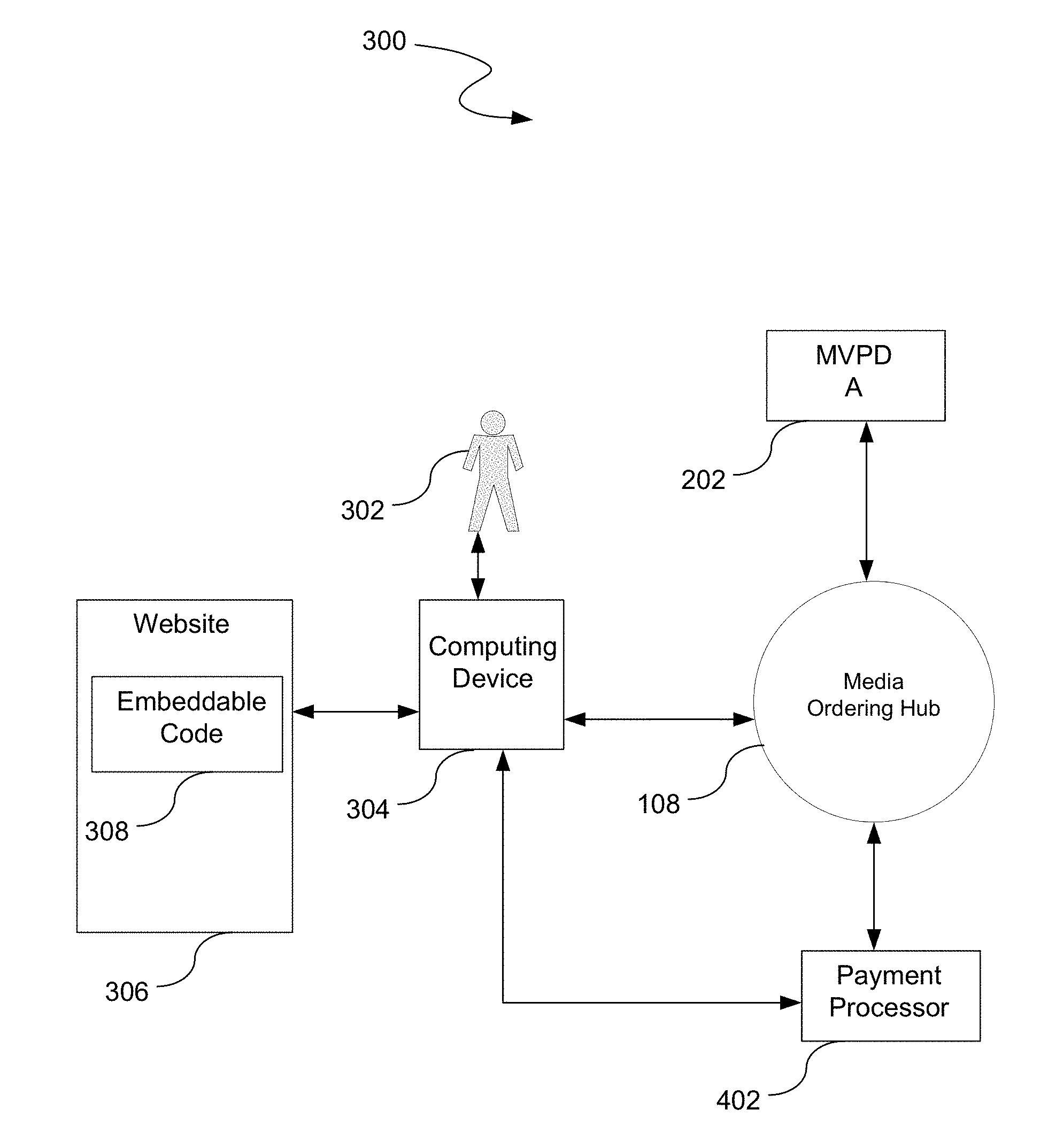
<figref idref="DRAWINGS">FIG. 3</figref> illustrates a contextual discovery configuration <b>300</b>. A user <b>302</b> may interact with a computing device <b>304</b>. The user <b>302</b> may utilize the computing device <b>304</b> to interact with a website <b>306</b>. For example, the website <b>306</b> may have a movie review of an action movie. In one aspect, the website <b>306</b> may have embeddable code <b>308</b>. The embeddable code <b>308</b> may include instructions to provide information on the website <b>306</b> about a similar type of movie that is available for rent or purchase by the user <b>302</b>. For example, the embeddable code <b>308</b> may include instructions for providing a ten minute movie preview of the similar type of movie. If the user is interested in purchasing the similar type of movie, the user may utilize the media ordering hub <b>108</b> to select the MVPD to which the user is a subscriber and purchase or rent the similar type of movie. The user may then be directed to the media ordering hub <b>108</b> to initiate a transaction. As an example, the media ordering hub <b>108</b> may be a website to which the user may be directed from the embeddable code <b>308</b> at the website <b>306</b>.
Accordingly, the contextual discovery configuration <b>300</b> involves media content finding the user. The embeddable code <b>308</b> may be provided in a context that has some degree of similarity.
In contrast with current MVPD branded web portals that involve a user having to go through the cumbersome process of entering a particular MVPD website and searching through content, the contextual discovery configuration <b>300</b> attempts to place the embeddable code <b>308</b> in contextual locations where media content that may be of interest to the user finds the user. The website <b>306</b> is illustrated only as an example. Various other types of locations may be utilized for the embeddable code <b>308</b>. For example, online advertisements, social networking platforms, co-branded websites, or the like may be utilized. Accordingly, the embeddable code <b>308</b> may be placed in browsing contexts that have large amounts of user traffic. Accordingly, a user does not have to go to a new web destination or search for media content.
<figref idref="DRAWINGS">FIG. 4</figref> illustrates an example of the contextual discovery configuration <b>300</b> in which the user <b>302</b> places an order for media content. As an example, the user <b>302</b> may provide an input to the media ordering hub <b>108</b> through the computing device <b>304</b> that the user <b>302</b> is a subscriber to the MVPD A <b>202</b> illustrated in <figref idref="DRAWINGS">FIG. 2</figref>. The media ordering hub <b>302</b> may then interact with the user <b>302</b> and the MVPD <b>202</b> to authenticate the login credentials of the user <b>302</b> and provide an order to the MVPD A <b>202</b> of the media content.
In one aspect, the media ordering hub <b>108</b> may then provide the user with a variety of payment options. For example, the media ordering hub <b>108</b> may provide a menu of payment options that may include a credit card payment, a debit card payment, a direct billing to the selected multichannel video programming distributor for subsequent payment, a virtual currency payment, a coupon payment, a voucher payment, or the like. The media ordering hub <b>108</b> may then coordinate with a payment processor <b>402</b> so that the user <b>302</b> may provide payment to the payment processor <b>402</b>. In one aspect, the payment processor <b>402</b> is a different entity than that of the media ordering hub <b>108</b>. In another aspect, the media ordering <b>108</b> hub performs the payment processing tasks of the payment processor <b>402</b> so that the payment processor <b>404</b> is unnecessary. In yet another aspect, the payment processor <b>402</b> is a selected MVPD such as the selected MVPD A <b>202</b>.
<figref idref="DRAWINGS">FIG. 5</figref> illustrates a data delivery configuration <b>500</b> that may be utilized to deliver the media content that is ordered through the media ordering hub <b>108</b> as illustrated in <figref idref="DRAWINGS">FIG. 4</figref>. As an example, the MVPD A <b>202</b> may support media content on a set top box <b>502</b>, a laptop <b>504</b>, and a tablet device <b>506</b>. Accordingly, the user <b>302</b> may be able to watch the delivered media content on any of these devices. In one aspect, the selected MVPD delivers the content to the user <b>302</b>. Although the media ordering hub <b>108</b> facilitates the ordering transaction between the user <b>302</b> and the selected MVPD, the selected MVPD may deliver the media content. In another aspect, the media ordering hub <b>108</b> may deliver the media content.
In addition, <figref idref="DRAWINGS">FIG. 6</figref> illustrates a process <b>600</b> that may be utilized to provide ordering of media content. At a process block <b>602</b>, the process <b>600</b> receives, at the media ordering hub <b>108</b>, a request for media content. Further, at a process block <b>604</b>, the process <b>600</b> provides, from the media ordering hub <b>108</b>, a plurality of MVPDs that offer the media content. In addition, at a process block <b>606</b>, the process <b>600</b> determines, at the media ordering hub <b>108</b>, a selected MVPD from the plurality of MVPDs. At a process block <b>608</b>, the process <b>600</b> also authenticates, at the media ordering hub <b>108</b>, login credentials to access the selected MVPD so that the selected MVPD delivers the media content.
The processes described herein may be implemented in a general, multi-purpose or single purpose processor. Such a processor will execute instructions, either at the assembly, compiled or machine-level, to perform the processes. Those instructions can be written by one of ordinary skill in the art following the description of the figures corresponding to the processes and stored or transmitted on a computer readable medium. The instructions may also be created using source code or any other known computer-aided design tool. A computer readable medium may be any medium capable of carrying those instructions and include a CD-ROM, DVD, magnetic or other optical disc, tape, silicon memory (e.g., removable, non-removable, volatile or non-volatile), packetized or non-packetized data through wireline or wireless transmissions locally or remotely through a network. A computer is herein intended to include any device that has a general, multi-purpose or single purpose processor as described above. For example, a computer may be a PC, laptop, smartphone, tablet device, set top box, or the like.
The concepts described herein may be used with or applied to a digital content service. So the term “MVPDs” may refer to or include VOD/Electronic Sell-Through (“EST”) Providers or Internet Protocol (“IP”)-based providers.
It is understood that the apparatuses, systems, computer program products, and processes described herein may also be applied in other types of apparatuses, systems, computer program products, and processes. Those skilled in the art will appreciate that the various adaptations and modifications of the aspects of the apparatuses, systems, computer program products, and processes described herein may be configured without departing from the scope and spirit of the present apparatuses, systems, computer program products, and processes. Therefore, it is to be understood that, within the scope of the appended claims, the present apparatuses, systems, computer program products, and processes may be practiced other than as specifically described herein.
Contents4
7 sheets
Sheet 1 Sheet 2 Sheet 3 Sheet 4 Sheet 5 Sheet 6 Sheet 7
Every citation, both ways
| Document | Relation | Office | Cited during |
|---|---|---|---|
| US11863837B2 | Cited by | United States of America | Applicant |
| US12008232B2 | Cited by | United States of America | Applicant |
| US11962836B2 | Cited by | United States of America | Applicant |
| US11934640B2 | Cited by | United States of America | Applicant |
| US11997347B2 | Cited by | United States of America | Search report |
| US11822858B2 | Cited by | United States of America | Applicant |
| US11720229B2 | Cited by | United States of America | Applicant |
| US2014259078A1 | Cited by | United States of America | Search report |
| US11966560B2 | Cited by | United States of America | Applicant |
| US12086186B2 | Cited by | United States of America | Applicant |
| US12105942B2 | Cited by | United States of America | Applicant |
| US11797606B2 | Cited by | United States of America | Applicant |
| US11899895B2 | Cited by | United States of America | Applicant |
| US2024143551A1 | Cited by | United States of America | Search report |
| US11843838B2 | Cited by | United States of America | Applicant |
| US2022329891A1 | Cited by | United States of America | Search report |
| US2008229354A1 | Cites | United States of America | Search report |
| US2008271078A1 | Cites | United States of America | Search report |
| US2009133059A1 | Cites | United States of America | Search report |
| US7124093B1 | Cites | United States of America | Search report |
| US8584165B1 | Cites | United States of America | Search report |
| US20080229354A1 | Cites | United States of America | Search report |
| US20080271078A1 | Cites | United States of America | Search report |
| US20090133059A1 | Cites | United States of America | Search report |
3 members in 2 offices
Priority claims2
| Document | Office | Kind | Date |
|---|---|---|---|
| 201213531574 | United States of America | A | |
| US201213531574 | – | – | – |
Members3
| Document | Office | Kind | |
|---|---|---|---|
| US2013347014A1 | United States of America | A1 | |
| WO2014004262A1 | World Intellectual Property Organization (WIPO) | A1 | |
| US10405015B2This record | United States of America | B2 |
175 transactions on the USPTO file
Allowed after 6 non-final rejections, 6 final rejections, 6 RCEs and 1 appeal.
- Non-final rejections
- 6
- Final rejections
- 6
- RCEs
- 6
- Appeals
- 1
Over time
Point at a mark for the transactionTransactions
| Event | Code | |
|---|---|---|
| Recordation of Patent Grant MailedPGM/ | PGM/ | |
| Patent Issue Date Used in PTA CalculationAllowedPTAC | PTAC | |
| Email NotificationEML_NTR | EML_NTR | |
| Issue Notification MailedAllowedWPIR | WPIR | |
| Dispatch to FDCD1935 | D1935 | |
| Dispatch to FDCD1935 | D1935 | |
| Application Is Considered Ready for IssuePILS | PILS | |
| Issue Fee Payment VerifiedN084 | N084 | |
| Issue Fee Payment ReceivedIFEE | IFEE | |
| Issue Fee Payment VerifiedN084 | N084 | |
| Electronic ReviewELC_RVW | ELC_RVW | |
| Email NotificationEML_NTF | EML_NTF | |
| Mail Notice of AllowanceAllowedMN/=. | MN/=. | |
| Notice of Allowance Data Verification CompletedAllowedN/=. | N/=. | |
| Reasons for AllowanceEX.R | EX.R | |
| Date Forwarded to ExaminerFWDX | FWDX | |
| Disposal for a RCE / CPA / R129AbandonedABN9 | ABN9 | |
| Request for Continued Examination (RCE)RCEX | RCEX | |
| Workflow - Request for RCE - BeginBRCE | BRCE | |
| Mail Post CardPST_CRD | PST_CRD | |
| Email NotificationEML_NTF | EML_NTF | |
| Mail Final Rejection (PTOL - 326)Final rejectionMCTFR | MCTFR | |
| Final RejectionFinal rejectionCTFR | CTFR | |
| Date Forwarded to ExaminerFWDX | FWDX | |
| Email NotificationEML_NTR | EML_NTR | |
| Mail Applicant Initiated Interview SummaryMEXIA | MEXIA | |
| Response after Non-Final ActionA... | A... | |
| Interview Summary - Applicant Initiated - TelephonicEXAT | EXAT | |
| Interview Summary- Applicant InitiatedEXIA | EXIA | |
| Electronic ReviewELC_RVW | ELC_RVW | |
| Email NotificationEML_NTF | EML_NTF | |
| Mail Non-Final RejectionNon-final rejectionMCTNF | MCTNF | |
| Non-Final RejectionNon-final rejectionCTNF | CTNF | |
| Date Forwarded to ExaminerFWDX | FWDX | |
| Disposal for a RCE / CPA / R129AbandonedABN9 | ABN9 | |
| Request for Continued Examination (RCE)RCEX | RCEX | |
| Workflow - Request for RCE - BeginBRCE | BRCE | |
| Electronic ReviewELC_RVW | ELC_RVW | |
| Email NotificationEML_NTF | EML_NTF | |
| Mail Final Rejection (PTOL - 326)Final rejectionMCTFR | MCTFR | |
| Final RejectionFinal rejectionCTFR | CTFR | |
| Date Forwarded to ExaminerFWDX | FWDX | |
| Email NotificationEML_NTR | EML_NTR | |
| Mail Applicant Initiated Interview SummaryMEXIA | MEXIA | |
| Response after Non-Final ActionA... | A... | |
| Interview Summary - Applicant Initiated - ConferenceEXAC | EXAC | |
| Interview Summary- Applicant InitiatedEXIA | EXIA | |
| Electronic ReviewELC_RVW | ELC_RVW | |
| Email NotificationEML_NTF | EML_NTF | |
| Mail Non-Final RejectionNon-final rejectionMCTNF | MCTNF | |
| Non-Final RejectionNon-final rejectionCTNF | CTNF | |
| Date Forwarded to ExaminerFWDX | FWDX | |
| Disposal for a RCE / CPA / R129AbandonedABN9 | ABN9 | |
| Request for Continued Examination (RCE)RCEX | RCEX | |
| Request for Extension of Time - GrantedXT/G | XT/G | |
| Workflow - Request for RCE - BeginBRCE | BRCE | |
| Email NotificationEML_NTR | EML_NTR | |
| Mail Advisory Action (PTOL - 303)MCTAV | MCTAV | |
| Advisory Action (PTOL-303)CTAV | CTAV | |
| Date Forwarded to ExaminerFWDX | FWDX | |
| Response after Final ActionA.NE | A.NE | |
| Mail Post CardPST_CRD | PST_CRD | |
| Email NotificationEML_NTF | EML_NTF | |
| Mail Final Rejection (PTOL - 326)Final rejectionMCTFR | MCTFR | |
| Final RejectionFinal rejectionCTFR | CTFR | |
| Date Forwarded to ExaminerFWDX | FWDX | |
| Response after Non-Final ActionA... | A... | |
| Mail Interview Summary - Applicant Initiated - TelephonicMEXAT | MEXAT | |
| Interview Summary - Applicant Initiated - TelephonicEXAT | EXAT | |
| Electronic ReviewELC_RVW | ELC_RVW | |
| Email NotificationEML_NTF | EML_NTF | |
| Mail Non-Final RejectionNon-final rejectionMCTNF | MCTNF | |
| Non-Final RejectionNon-final rejectionCTNF | CTNF | |
| Date Forwarded to ExaminerFWDX | FWDX | |
| Disposal for a RCE / CPA / R129AbandonedABN9 | ABN9 | |
| Request for Continued Examination (RCE)RCEX | RCEX | |
| Workflow - Request for RCE - BeginBRCE | BRCE | |
| Mail Post CardPST_CRD | PST_CRD | |
| Email NotificationEML_NTF | EML_NTF | |
| Mail PTAB Decision on Appeal - AffirmedMAPDA | MAPDA | |
| PTAB Decision - Examiner AffirmedAPDA | APDA | |
| Email NotificationEML_NTR | EML_NTR | |
| Docketing Notice Mailed to AppellantAP_DK_M | AP_DK_M | |
| Assignment of Appeal NumberAPAS | APAS | |
| Appeal Awaiting PTAB DocketingAPWD | APWD | |
| Appeal ready for PAC reviewARBP | ARBP | |
| Reply Brief FiledAPRB | APRB | |
| Electronic ReviewELC_RVW | ELC_RVW | |
| Email NotificationEML_NTF | EML_NTF | |
| Mail Examiner's AnswerMAPEA | MAPEA | |
| Exam. Ans. Review CompletePACC | PACC | |
| Examiner's Answer to Appeal BriefAPEA | APEA | |
| Appeal Brief Review CompleteAPBR | APBR | |
| Date Forwarded to ExaminerFWDX | FWDX | |
| track 1 OFFT1OFF | T1OFF | |
| Appeal Brief FiledAP.B | AP.B | |
| Notice of Appeal FiledN/AP | N/AP | |
| Electronic ReviewELC_RVW | ELC_RVW | |
| Email NotificationEML_NTF | EML_NTF | |
| Mail Final Rejection (PTOL - 326)Final rejectionMCTFR | MCTFR |
14 legal events, as the office reported them to INPADOC
Over the term
Point at a mark for the eventEvents
| Event | Code | |
|---|---|---|
| Maintenance fee paymentMAFP | MAFP | |
| Information on status: patent grantGrantedSTCF | STCF | |
| Information on status: patent application and granting procedure in generalSTPP | STPP | |
| Information on status: patent application and granting procedure in generalSTPP | STPP | |
| Information on status: patent application and granting procedure in generalSTPP | STPP | |
| Information on status: patent application and granting procedure in generalSTPP | STPP | |
| Information on status: patent application and granting procedure in generalSTPP | STPP | |
| Information on status: patent application and granting procedure in generalSTPP | STPP | |
| Information on status: patent application and granting procedure in generalSTPP | STPP | |
| Information on status: application discontinuationSTCB | STCB | |
| Information on status: patent application and granting procedure in generalSTPP | STPP | |
| Information on status: patent application and granting procedure in generalSTPP | STPP | |
| Information on status: patent application and granting procedure in generalSTPP | STPP | |
| AssignmentAS | AS |
Numbers
- Publication
- 10405015
- Publication, DOCDB
- 10405015
- Publication, EPODOC
- US10405015
- Application
- 13531574
- Application, DOCDB
- 201213531574
- Application, EPODOC
- US201213531574
Titles
- English
- Remote media ordering hub
Patent term adjustment
- A delay
- +364 daysthe office missed an examination deadline
- B delay
- +17 dayspendency past three years
- Applicant delay
- −30 days
- Net adjustment
- 351 days
Classification
- CPC, 5
- H04N21/2393
- H04N21/25875
- H04N21/2665
- H04N21/47202
- H04N21/2543
- IPC, 5
- H04N21 239
- H04N21 258
- H04N21 2665
- H04N21 472
- H04N21 2543
- USPC, 1
- 705014410