Intent identification for agent matching by assistant systems
Abstract
In one embodiment, a method includes receiving a user request associated with one or more domains from a client system associated with a first user, parsing the user request to identify one or more semantic-intents are associated with the one or more domains and one or more slots, identifying, based on a ranker model , one or more dialog-intents associated with the user request based on the one or more semantic-intents and slots and context information associated with the user request, wherein each dialog-intent is a sub-intent of one or more of the semantic-intents, determining one or more agents for executing one or more tasks associated with the one or more dialog-intents respectively, and sending instructions for presenting a communication content information returned from the one or more agents responsive to executing the one or more tasks responsive to the user input to the client system.
Term
Projected expiry 31 October 2038.
- Priority and filed
- Published
- Today
- Projected expiry
15 claims: 4 independent, 11 dependent
- 1A method, in particular for use in an assistant system for assisting a user to obtain information or services by enabling the user to interact with the assistant system with user input in conversations to get assistance, wherein the user input includes voice, text, image or video or any combination of them, the assistant system in particular being enabled by the combination of computing devices, application programming interfaces (APIs), and the proliferation of applications on user devices, the method comprising, by one or more computing systems:receiving, from a client system associated with a first user, a user request, wherein the user request is associated with one or more domains;parsing, by a natural-language understanding module, the user request to identify one or more semantic-intents and one or more slots, wherein the one or more semantic-intents are associated with the one or more domains;identifying, based on a ranker model, one or more dialog-intents associated with the user request based on (1) the one or more semantic-intents, (2) the one or more slots, and (3) context information associated with the user request, wherein each dialog-intent is a sub-intent of one or more of the semantic-intents;determining, by a dialog engine, one or more agents from a plurality of agents for executing one or more tasks associated with the one or more dialog-intents, respectively;and sending, to the client system associated with the first user, instructions for presenting a communication content responsive to the user request, wherein the communication content comprises information returned from the one or more agents responsive to executing the one or more tasks.
- 2The method of Claim 1, wherein the ranker model is a machine-learning model trained based on a plurality of training samples comprising one or more of:(1) a plurality of user requests, (2) a plurality of positive dialog-intents, or (3) a plurality of negative dialog-intents.
- 3The method of Claim 2, wherein the plurality of training samples are generated based on one or more dry runs, each dry run comprising:accessing a dry-run request, wherein the dry-run request is associated with the one or more domains;executing, via the plurality of agents, a plurality of tasks associated with the dry-run request;determining a plurality of dialog-intents based on information returned from each of the plurality of agents responsive to executing the plurality of tasks;selecting one or more dialog-intents from the determined plurality of dialog-intents;and annotating the selected one or more dialog-intents as positive dialog-intents and remaining non-selected dialog-intents as negative dialog-intents.
- 4The method of Claim 3, further comprising generating feature representations for the plurality of training samples based on one or more of:a plurality of capability values associated with the plurality of agents, each capability value indicating a confidence of a corresponding agent being able to execute a particular task;information returned from the plurality of agents responsive to executing the plurality of tasks;one or more dialog states associated with one or more dry-run requests corresponding to the one or more dry runs;a plurality of semantic-intents associated with the one or more dry-run requests corresponding to the one or more dry runs;one or more device contexts of one or more client systems associated with one or more users associated with the one or more dry runs;or user profile data associated with the one or more users.
- 5The method of Claim 4, wherein the ranker model is customized based on the user profile data;and/or wherein each dry-run request in each dry run is associated with a particular dialog session, and wherein each dialog state indicates one or more of a domain or a context associated with the particular dialog session at a time associated with the dialog session.
- 6The method of any of Claims 1 to 5, further comprising:sending the one or more dialog-intents and the one or more slots to the one or more agents for executing the one or more tasks;and receiving, from the one or more agents, information responsive to executing the one or more tasks;optionally, further comprising: generating feature representations for the information returned from the one or more agents responsive to executing the one or more tasks;and re-training the ranker model based on the generated feature representations.
- 7The method of any of Claims 1 to 6, wherein identifying the one or more dialog-intents associated with the user request comprises:determining a plurality of candidate dialog-intents based on the one or more domains associated with the one or more semantic-intents and the one or more slots;calculating, by the ranker model, a plurality of confidence scores for the plurality of candidate dialog-intents;and identifying one or more of the dialog-intents based on their respective confidence scores;and/or wherein each of the one or more dialog-intents is associated with one of the one or more domains.
- 8The method of any of Claims 1 to 7, wherein the communication content comprises one or more of:a character string;an audio clip;an image;or a video clip;and/or wherein the method further comprises determining one or more modalities for the communication content;optionally, wherein determining the one or more modalities for the communication content comprises: identifying contextual information associated with the first user;identifying contextual information associated with the client system;and determining the one or more modalities based on the contextual information associated with the first user and the contextual information associated with the client system.
- 9The method of any of Claims 1 to 8, wherein the one or more agents execute the one or more tasks in parallel;and/or wherein each of the one or more agents is implemented with an application programming interface (API), and wherein the API receives a command from the dialog engine for executing one of the one or more tasks;and/or wherein the one or more semantic-intents are associated with one or more confidence scores, respectively.
- 11An assistant system for assisting a user to obtain information or services by enabling the user to interact with the assistant system with user input in conversations to get assistance, wherein the user input includes voice, text, image or video or any combination of them, the assistant system in particular being enabled by the combination of computing devices, application programming interfaces (APIs), and the proliferation of applications on user devices, the system comprising:one or more processors;and a non-transitory memory coupled to the processors comprising instructions executable by the processors, the processors operable when executing the instructions to perform a method according to any of Claims 1 to 9.
- 12The assistant system of Claim 11 for assisting the user by executing at least one or more of the following features or steps:- create and store a user profile comprising both personal and contextual information associated with the user - analyze the user input using natural-language understanding, wherein the analysis may be based on the user profile for more personalized and context-aware understanding - resolve entities associated with the user input based on the analysis - interact with different agents to obtain information or services that are associated with the resolved entities - generate a response for the user regarding the information or services by using natural-language generation - through the interaction with the user, use dialog management techniques to manage and forward the conversation flow with the user - assist the user to effectively and efficiently digest the obtained information by summarizing the information - assist the user to be more engaging with an online social network by providing tools that help the user interact with the online social network (e.g., creating posts, comments, messages) - assist the user to manage different tasks such as keeping track of events - proactively execute pre-authorized tasks that are relevant to user interests and preferences based on the user profile, at a time relevant for the user, without a user input - check privacy settings whenever it is necessary to guarantee that accessing user profile and executing different tasks are subject to the user's privacy settings.
- 13The assistant system of Claim 11 or 12, comprising at least one or more of the following components:- a messaging platform to receive a user input based on a text modality from the client system associated with the user and/or to receive user input based on an image or video modality and to process it using optical character recognition techniques within the messaging platform to convert the user input into text, - an audio speech recognition (ASR) module to receive a user input based on an audio modality (e.g., the user may speak to or send a video including speech) from the client system associated with the user and to convert the user input based on the audio modality into text, - an assistant xbot to receive the output of the messaging platform or the ASR module.
- 14A system comprising at least one client system (130), in particular an electronic device at least one assistant system (140) according to any of Claims 11 to 13, connected to each other, in particular by a network (110), wherein the client system comprises an assistant application (136) for allowing a user at the client system (130) to interact with the assistant system (140), wherein the assistant application (136) communicates user input to the assistant system (140) and, based on the user input, the assistant system (140) generates responses and sends the generated responses to the assistant application (136) and the assistant application (136) presents the responses to the user at the client system (130), wherein in particular the user input is audio or verbal and the response may be in text or also audio or verbal.
- 15The system of Claim 14, further comprising a social-networking system (160), wherein the client system comprises in particular a social-networking application (134) for accessing the social networking system (160).
Independent claims15
146 paragraphs, as filed
<u>TECHNICAL FIELD</u>
0001This disclosure generally relates to databases and file management within network environments, and in particular relates to hardware and software for smart assistant systems.
<u>BACKGROUND</u>
0002An assistant system can provide information or services on behalf of a user based on a combination of user input, location awareness, and the ability to access information from a variety of online sources (such as weather conditions, traffic congestion, news, stock prices, user schedules, retail prices, etc.). The user input may include text (e.g., online chat), especially in an instant messaging application or other applications, voice, images, or a combination of them. The assistant system may perform concierge-type services (e.g., making dinner reservations, purchasing event tickets, making travel arrangements) or provide information based on the user input. The assistant system may also perform management or data-handling tasks based on online information and events without user initiation or interaction. Examples of those tasks that may be performed by an assistant system may include schedule management (e.g., sending an alert to a dinner date that a user is running late due to traffic conditions, update schedules for both parties, and change the restaurant reservation time). The assistant system may be enabled by the combination of computing devices, application programming interfaces (APIs), and the proliferation of applications on user devices.
0003A social-networking system, which may include a social-networking website, may enable its users (such as persons or organizations) to interact with it and with each other through it. The social-networking system may, with input from a user, create and store in the social-networking system a user profile associated with the user. The user profile may include demographic information, communication-channel information, and information on personal interests of the user. The social-networking system may also, with input from a user, create and store a record of relationships of the user with other users of the social-networking system, as well as provide services (e.g. profile/news feed posts, photo-sharing, event organization, messaging, games, or advertisements) to facilitate social interaction between or among users.
0004The social-networking system may send over one or more networks content or messages related to its services to a mobile or other computing device of a user. A user may also install software applications on a mobile or other computing device of the user for accessing a user profile of the user and other data within the social-networking system. The social-networking system may generate a personalized set of content objects to display to a user, such as a newsfeed of aggregated stories of other users connected to the user.
<u>SUMMARY OF PARTICULAR EMBODIMENTS</u>
0005In particular embodiments, the assistant system may assist a user to obtain information or services. The assistant system may enable the user to interact with it with multi-modal user input (such as voice, text, image, video) in stateful and multi-turn conversations to get assistance. The assistant system may create and store a user profile comprising both personal and contextual information associated with the user. In particular embodiments, the assistant system may analyze the user input using natural-language understanding. The analysis may be based on the user profile for more personalized and context-aware understanding. The assistant system may resolve entities associated with the user input based on the analysis. In particular embodiments, the assistant system may interact with different agents to obtain information or services that are associated with the resolved entities. The assistant system may generate a response for the user regarding the information or services by using natural-language generation. Through the interaction with the user, the assistant system may use dialog management techniques to manage and forward the conversation flow with the user. In particular embodiments, the assistant system may further assist the user to effectively and efficiently digest the obtained information by summarizing the information. The assistant system may also assist the user to be more engaging with an online social network by providing tools that help the user interact with the online social network (e.g., creating posts, comments, messages). The assistant system may additionally assist the user to manage different tasks such as keeping track of events. In particular embodiments, the assistant system may proactively execute tasks that are relevant to user interests and preferences based on the user profile without a user input. In particular embodiments, the assistant system may check privacy settings to ensure that accessing a user's profile or other user information and executing different tasks are permitted subject to the user's privacy settings.
0006In particular embodiments, the assistant system may determine the most suitable agent for handling a user request. The assistant system may receive a user request from a user, identify one or more semantic-intents and dialog-intents (which is a sub-intent of the semantic-intent) associated with the user request, determine the most suitable agent (first- or third-party) to execute tasks associated with the identified dialog-intents, and send the execution results to the user. The assistant system may first identify the semantic-intents and slots associated with the user request based on a natural-language understanding module. The assistant system may then process the semantic-intents and slots by calling multiple agents in parallel. During the processing, a dialog engine may apply a ranker model to the processing results returned from the agents. The output of the ranker model may include ranked dialog-intents with confidence scores and the corresponding agents, respectively. The assistant system may further identify the top dialog-intents, select the associated results returned by the corresponding agents, and send them to the user. As an example and not by way of limitation, a user may ask the assistant system "when is Obama's birthday?" The assistant system may identify a semantic-intent as [IN:find_birthday(person)] and a person slot as [SL:person("Obama")]. The assistant system may then call multiple agents and process the results returned by the agents using the ranker model. Depending on the relationship between the inquiring user and Obama, the output may be different. For example, if Obama is a friend of the user, a dialog-intent of [IN: find_birthday_social_connection(person)] together with a social agent may be top ranked. If the inquiring user has no personal relationship with Obama, a dialog-intent of [IN: find_birthday _celebrity(person)] together with a fact agent may be top ranked. The assistant system may then select the result returned by the top ranked agent and send it to the user. As a result, the assistant system may accurately identify dialog-intents which are more comprehensive than semantic-intents which only focus on the semantic information of a user request. In addition, the assistant system may be able to perform effective mapping between different dialog-intents and different agents. The assistant system may therefore interpret user requests more accurately and executes associated tasks more effectively. In alternative embodiments, the assistant system may first request the multiple agents to evaluate their capability for executing a task. The assistant system may rank the agents based on the evaluation results (e.g., confidence scores) and select the top ranked agent for executing the task. As an example and not by way of limitation, a task may comprise ordering a pizza. The assistant system may request different pizza ordering agents, e.g., pizza-hut_agent and dominos_agent, to evaluate if they can fulfill the task. The assistant system may select the agent that has higher confidence score for ordering the pizza. Although this disclosure describes identifying particular intents via a particular system in a particular manner, this disclosure contemplates identifying any suitable intents via any suitable system in any suitable manner.
0007In particular embodiments, the assistant system may receive, from a client system associated with a first user, a user request. The user request may be associated with one or more domains. In particular embodiments, the assistant system may parse, by a natural-language understanding module, the user request to identify one or more semantic-intents and one or more slots. The one or more semantic-intents may be associated with the one or more domains. In particular embodiments, the one or more semantic-intents may be associated with one or more confidence scores, respectively. A confidence score for a semantic-intent may indicate a probability that the semantic-intent should be the correct semantic-intent from the first user. In particular embodiments, the assistant system may identify, based on a ranker model, one or more dialog-intents associated with the user request based on (1) the one or more semantic-intents, (2) the one or more slots, and (3) context information associated with the user request. In particular embodiments, each dialog-intent may be a sub-intent of one or more of the semantic-intents. The assistant system may determine, by a dialog engine, one or more agents from a plurality of agents for executing one or more tasks associated with the one or more dialog-intents, respectively. In particular embodiments, the assistant system may send, to the client system associated with the first user, instructions for presenting a communication content responsive to the user input. The communication content may comprise information returned from the one or more agents responsive to executing the one or more tasks.
0008Certain technical challenges exist for achieving the goal of intent identification for agent matching by assistant systems. One technical challenge includes accurately identifying dialog-intents associated with user requests. The solution presented by the embodiments disclosed herein to address the above challenge is using a ranker model (e.g., a machine-learning model) to identify dialog-intents based on semantic-intents, slots, and context information associated with the user request, which results in more accurate dialog-intent identification since the machine-learning model leverages various information for identification. Another technical challenge includes training a robust ranker model. The solutions presented by the embodiments disclosed herein to address this challenge are training the ranker model using a plurality of training samples from both historical data and real-time data associated with various dialog-intents and generating their feature representations based on various information including information from different agents, dialog states, device contexts, and user profile data, which makes the ranker model robust as more data and information are utilized. Another technical challenge includes interacting with users about the execution results responsive to user requests without causing inconvenience to their ongoing activities. The solution presented by the embodiments disclosed herein to address this challenge is determining proper modalities based on which the execution results should be delivered to the users, which allows the assistant system to interact with users based on the determined modalities that may be more suitable to the users' current situation or context.
0009Certain embodiments disclosed herein may provide one or more technical advantages. A technical advantage of the embodiments may include efficiently executing tasks responsive to user requests as the assistant system can accurately determine the most suitable agents, thereby saving the time and cost of calling all possible agents for execution. Another technical advantage of the embodiments may include adaptively optimizing the processing of user requests by re-training ranker models during run-time. Certain embodiments disclosed herein may provide none, some, or all of the above technical advantages. One or more other technical advantages may be readily apparent to one skilled in the art in view of the figures, descriptions, and claims of the present disclosure.
0010The embodiments disclosed herein are only examples, and the scope of this disclosure is not limited to them. Particular embodiments may include all, some, or none of the components, elements, features, functions, operations, or steps of the embodiments disclosed herein. Embodiments according to the invention are in particular disclosed in the attached claims directed to a method, a storage medium, a system and a computer program product, wherein any feature mentioned in one claim category, e.g. method, can be claimed in another claim category, e.g. system, as well. The dependencies or references back in the attached claims are chosen for formal reasons only. However any subject matter resulting from a deliberate reference back to any previous claims (in particular multiple dependencies) can be claimed as well, so that any combination of claims and the features thereof are disclosed and can be claimed regardless of the dependencies chosen in the attached claims. The subject-matter which can be claimed comprises not only the combinations of features as set out in the attached claims but also any other combination of features in the claims, wherein each feature mentioned in the claims can be combined with any other feature or combination of other features in the claims. Furthermore, any of the embodiments and features described or depicted herein can be claimed in a separate claim and/or in any combination with any embodiment or feature described or depicted herein or with any of the features of the attached claims.
0011Embodiments according to the invention are in particular disclosed in the attached claims directed to a method, a storage medium, a system, and an assistant system, wherein any feature mentioned in one claim category, e.g. method, can be claimed in another claim category, e.g. storage medium, system, assistant system, computer program product, as well. The dependencies or references back in the attached claims are chosen for formal reasons only. However any subject matter resulting from a deliberate reference back to any previous claims (in particular multiple dependencies) can be claimed as well, so that any combination of claims and the features thereof is disclosed and can be claimed regardless of the dependencies chosen in the attached claims. The subject-matter which can be claimed comprises not only the combinations of features as set out in the attached claims but also any other combination of features in the claims, wherein each feature mentioned in the claims can be combined with any other feature or combination of other features in the claims. Furthermore, any of the embodiments and features described or depicted herein can be claimed in a separate claim and/or in any combination with any embodiment or feature described or depicted herein or with any of the features of the attached claims.
0012In an embodiment according to the invention, a method in particular for use in an assistant system for assisting a user to obtain information or services by enabling the user to interact with the assistant system with user input in conversations to get assistance, wherein the user input includes voice, text, image or video or any combination of them, the assistant system in particular being enabled by the combination of computing devices, application programming interfaces (APIs), and the proliferation of applications on user devices, the method may comprise, by one or more computing systems: <ul id="ul0001" list-style="none" compact="compact"><li>receiving, from a client system associated with a first user, a user request, wherein the user request is associated with one or more domains;</li><li>parsing, by a natural-language understanding module, the user request to identify one or more semantic-intents and one or more slots, wherein the one or more semantic-intents are associated with the one or more domains;</li><li>identifying, based on a ranker model, one or more dialog-intents associated with the user request based on (1) the one or more semantic-intents, (2) the one or more slots, and (3) context information associated with the user request, wherein each dialog-intent is a sub-intent of one or more of the semantic-intents;</li><li>determining, by a dialog engine, one or more agents from a plurality of agents for executing one or more tasks associated with the one or more dialog-intents, respectively; and</li><li>sending, to the client system associated with the first user, instructions for presenting a communication content responsive to the user request, wherein the communication content comprises information returned from the one or more agents responsive to executing the one or more tasks.</li></ul>
0013The ranker model may be a machine-learning model trained based on a plurality of training samples comprising one or more of: (1) a plurality of user requests, (2) a plurality of positive dialog-intents, or (3) a plurality of negative dialog-intents.
0014The plurality of training samples may be generated based on one or more dry runs, each dry run comprising: <ul id="ul0002" list-style="none" compact="compact"><li>accessing a dry-run request, wherein the dry-run request is associated with the one or more domains;</li><li>executing, via the plurality of agents, a plurality of tasks associated with the dry-run request;</li><li>determining a plurality of dialog-intents based on information returned from each of the plurality of agents responsive to executing the plurality of tasks;</li><li>selecting one or more dialog-intents from the determined plurality of dialog-intents; and</li><li>annotating the selected one or more dialog-intents as positive dialog-intents and remaining non-selected dialog-intents as negative dialog-intents.</li></ul>
0015In an embodiment according to the invention, a method may comprise generating feature representations for the plurality of training samples based on one or more of: <ul id="ul0003" list-style="none" compact="compact"><li>a plurality of capability values associated with the plurality of agents, each capability value indicating a confidence of a corresponding agent being able to execute a particular task;</li><li>information returned from the plurality of agents responsive to executing the plurality of tasks;</li><li>one or more dialog states associated with one or more dry-run requests corresponding to the one or more dry runs;</li><li>a plurality of semantic-intents associated with the one or more dry-run requests corresponding to the one or more dry runs;</li><li>one or more device contexts of one or more client systems associated with one or more users associated with the one or more dry runs; or</li><li>user profile data associated with the one or more users.</li></ul>
0016The ranker model may be customized based on the user profile data.
0017Each dry-run request in each dry run may be associated with a particular dialog session, and each dialog state may indicate one or more of a domain or a context associated with the particular dialog session at a time associated with the dialog session.
0018In an embodiment according to the invention, a method may comprise: <ul id="ul0004" list-style="none" compact="compact"><li>sending the one or more dialog-intents and the one or more slots to the one or more agents for executing the one or more tasks; and</li><li>receiving, from the one or more agents, information responsive to executing the one or more tasks.</li></ul>
0019In an embodiment according to the invention, a method may comprise: <ul id="ul0005" list-style="none" compact="compact"><li>generating feature representations for the information returned from the one or more agents responsive to executing the one or more tasks; and</li><li>re-training the ranker model based on the generated feature representations.</li></ul>
0020Identifying the one or more dialog-intents associated with the user request may comprise: <ul id="ul0006" list-style="none" compact="compact"><li>determining a plurality of candidate dialog-intents based on the one or more domains associated with the one or more semantic-intents and the one or more slots;</li><li>calculating, by the ranker model, a plurality of confidence scores for the plurality of candidate dialog-intents; and</li><li>identifying one or more of the dialog-intents based on their respective confidence scores.</li></ul>
0021Each of the one or more dialog-intents may be associated with one of the one or more domains.
0022The communication content may comprise one or more of: a character string; <ul id="ul0007" list-style="none" compact="compact"><li>an audio clip;</li><li>an image; or</li><li>a video clip.</li></ul>
0023In an embodiment according to the invention, a method may comprise determining one or more modalities for the communication content.
0024Determining the one or more modalities for the communication content may comprise: <ul id="ul0008" list-style="none" compact="compact"><li>identifying contextual information associated with the first user;</li><li>identifying contextual information associated with the client system; and</li><li>determining the one or more modalities based on the contextual information associated with the first user and the contextual information associated with the client system.</li></ul>
0025The one or more agents may execute the one or more tasks in parallel.
0026Each of the one or more agents may be implemented with an application programming interface (API), and the API may receive a command from the dialog engine for executing one of the one or more tasks.
0027The one or more semantic-intents may be associated with one or more confidence scores, respectively.
0028In an embodiment according to the invention, one or more computer-readable non-transitory storage media may embody software that is operable when executed to: <ul id="ul0009" list-style="none" compact="compact"><li>receive, from a client system associated with a first user, a user request, wherein the user request is associated with one or more domains;</li><li>parse, by a natural-language understanding module, the user request to identify one or more semantic-intents and one or more slots, wherein the one or more semantic-intents are associated with the one or more domains;</li><li>identify, based on a ranker model, one or more dialog-intents associated with the user request based on (1) the one or more semantic-intents, (2) the one or more slots, and (3) context information associated with the user request, wherein each dialog-intent is a sub-intent of one or more of the semantic-intents;</li><li>determine, by a dialog engine, one or more agents from a plurality of agents for executing one or more tasks associated with the one or more dialog-intents, respectively; and</li><li>send, to the client system associated with the first user, instructions for presenting a communication content responsive to the user input, wherein the communication content comprises information returned from the one or more agents responsive to executing the one or more tasks.</li></ul>
0029In an embodiment according to the invention, a system may comprise: one or more processors; and a non-transitory memory coupled to the processors comprising instructions executable by the processors, the processors operable when executing the instructions to: <ul id="ul0010" list-style="none" compact="compact"><li>receive, from a client system associated with a first user, a user request, wherein the user request is associated with one or more domains;</li><li>parse, by a natural-language understanding module, the user request to identify one or more semantic-intents and one or more slots, wherein the one or more semantic-intents are associated with the one or more domains;</li><li>identify, based on a ranker model, one or more dialog-intents associated with the user request based on (1) the one or more semantic-intents, (2) the one or more slots, and (3) context information associated with the user request, wherein each dialog-intent is a sub-intent of one or more of the semantic-intents;</li><li>determine, by a dialog engine, one or more agents from a plurality of agents for executing one or more tasks associated with the one or more dialog-intents, respectively; and</li><li>send, to the client system associated with the first user, instructions for presenting a communication content responsive to the user input, wherein the communication content comprises information returned from the one or more agents responsive to executing the one or more tasks.</li></ul>
0030In an embodiment according to the invention, a system may comprise: one or more processors; and at least one memory coupled to the processors and comprising instructions executable by the processors, the processors operable when executing the instructions to perform a method according to the invention or any of the above mentioned embodiments.
0031In an embodiment according to the invention, a computer program product, preferably comprising a computer-readable non-transitory storage media, may be operable when executed on a data processing system to perform a method according to the invention or any of the above mentioned embodiments.
0032In an embodiment according to the invention, one or more computer-readable non-transitory storage media may embody software that is operable when executed to perform a method according to the invention or any of the above mentioned embodiments.
0033In an embodiment according to the invention, an assistant system for assisting a user to obtain information or services by enabling the user to interact with the assistant system with user input in conversations to get assistance, wherein the user input includes voice, text, image or video or any combination of them, the assistant system in particular being enabled by the combination of computing devices, application programming interfaces (APIs), and the proliferation of applications on user devices, the system comprising: one or more processors; and a non-transitory memory coupled to the processors comprising instructions executable by the processors, the processors operable when executing the instructions to perform a method according to any of the above mentioned embodiments.
0034In an embodiment according to the invention, an assistant system may execute at least one or more of the following features or steps: <ul id="ul0011" list-style="dash" compact="compact"><li>create and store a user profile comprising both personal and contextual information associated with the user</li><li>analyze the user input using natural-language understanding, wherein the analysis may be based on the user profile for more personalized and context-aware understanding</li><li>resolve entities associated with the user input based on the analysis</li><li>interact with different agents to obtain information or services that are associated with the resolved entities</li><li>generate a response for the user regarding the information or services by using natural-language generation</li><li>through the interaction with the user, use dialog management techniques to manage and forward the conversation flow with the user</li><li>assist the user to effectively and efficiently digest the obtained information by summarizing the information</li><li>assist the user to be more engaging with an online social network by providing tools that help the user interact with the online social network (e.g., creating posts, comments, messages)</li><li>assist the user to manage different tasks such as keeping track of events</li><li>proactively execute pre-authorized tasks that are relevant to user interests and preferences based on the user profile, at a time relevant for the user, without a user input</li><li>check privacy settings whenever it is necessary to guarantee that accessing user profile and executing different tasks are subject to the user's privacy settings.</li></ul>
0035In an embodiment according to the invention, an assistant system may comprise at least one or more of the following components: <ul id="ul0012" list-style="dash" compact="compact"><li>a messaging platform to receive a user input based on a text modality from the client system associated with the user and/or to receive user input based on an image or video modality and to process it using optical character recognition techniques within the messaging platform to convert the user input into text,</li><li>an audio speech recognition (ASR) module to receive a user input based on an audio modality (e.g., the user may speak to or send a video including speech) from the client system associated with the user and to convert the user input based on the audio modality into text,</li><li>an assistant xbot to receive the output of the messaging platform or the ASR module.</li></ul>
0036In an embodiment according to the invention, a system may comprise at least one client system (130), in particular an electronic device at least one assistant system (140) according to any of Claims 32 to 34, connected to each other, in particular by a network (110), wherein the client system comprises an assistant application (136) for allowing a user at the client system (130) to interact with the assistant system (140), wherein the assistant application (136) communicates user input to the assistant system (140) and, based on the user input, the assistant system (140) generates responses and sends the generated responses to the assistant application (136) and the assistant application (136) presents the responses to the user at the client system (130), wherein in particular the user input is audio or verbal and the response may be in text or also audio or verbal.
0037In an embodiment according to the invention, a system may comprise a social-networking system (160), wherein the client system comprises in particular a social-networking application (134) for accessing the social networking system (160).
<u>BRIEF DESCRIPTION OF THE DRAWINGS</u>
0038<dl id="dl0001" compact="compact"><dt>FIG. 1</dt><dd>illustrates an example network environment associated with an assistant system.</dd><dt>FIG. 2</dt><dd>illustrates an example architecture of the assistant system.</dd><dt>FIG. 3</dt><dd>illustrates an example diagram flow of responding to a user request by the assistant system.</dd><dt>FIG. 4</dt><dd>illustrates an example diagram flow of identifying intents for agent matching based on the example architecture of the assistant system in <figref idref="f0002">FIG. 2</figref>.</dd><dt>FIG. 5</dt><dd>illustrates an example method for identifying intents for agent matching.</dd><dt>FIG. 6</dt><dd>illustrates an example social graph.</dd><dt>FIG. 7</dt><dd>illustrates an example view of an embedding space.</dd><dt>FIG. 8</dt><dd>illustrates an example artificial neural network.</dd><dt>FIG. 9</dt><dd>illustrates an example computer system.</dd></dl>
<u>DESCRIPTION OF EXAMPLE EMBODIMENTS</u>
System Overview
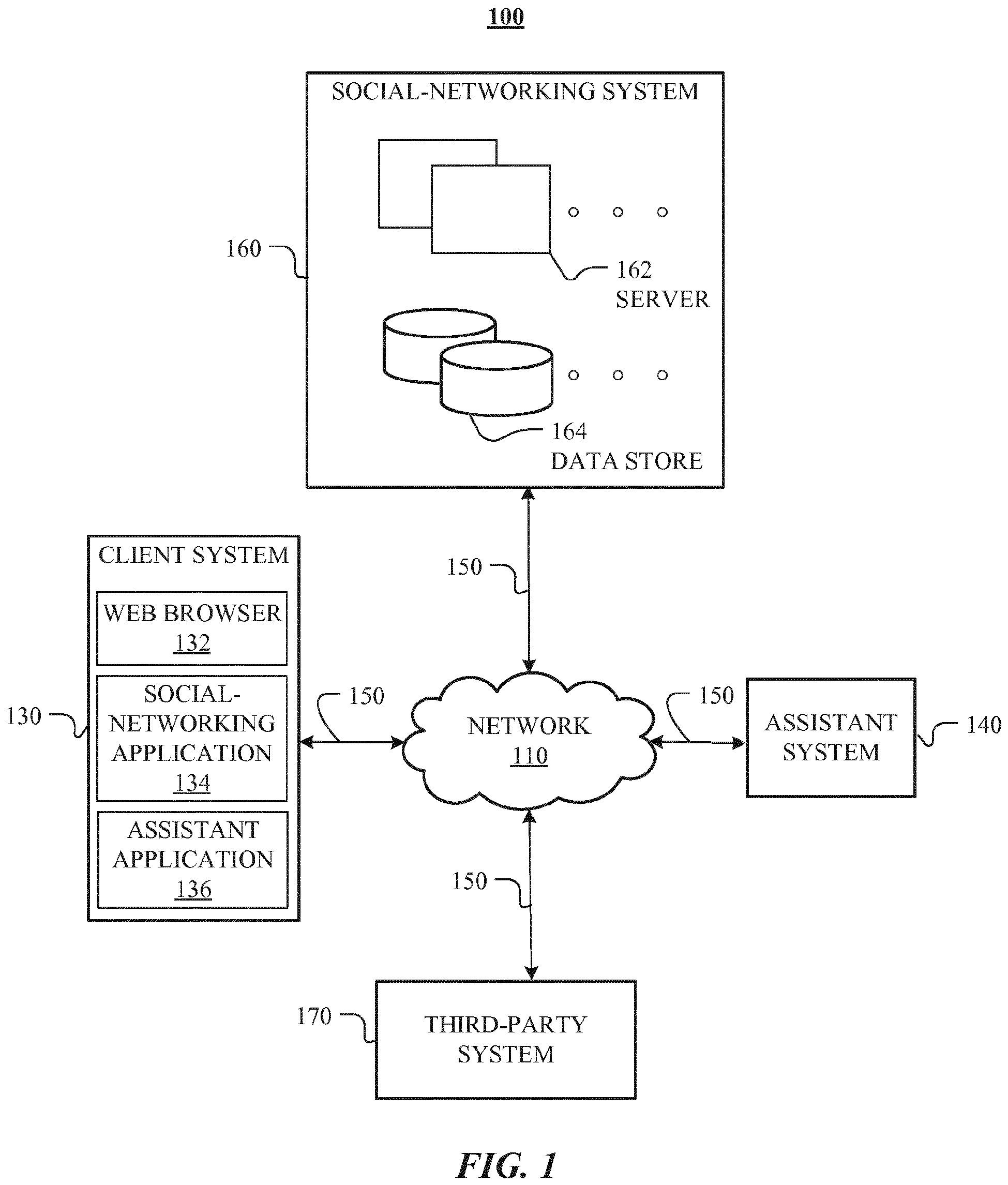
0039<figref idref="f0001"><b>FIG. 1</b></figref> illustrates an example network environment 100 associated with an assistant system. Network environment 100 includes a client system 130, an assistant system 140, a social-networking system 160, and a third-party system 170 connected to each other by a network 110. Although <figref idref="f0001">FIG. 1</figref> illustrates a particular arrangement of a client system 130, an assistant system 140, a social-networking system 160, a third-party system 170, and a network 110, this disclosure contemplates any suitable arrangement of a client system 130, an assistant system 140, a social-networking system 160, a third-party system 170, and a network 110. As an example and not by way of limitation, two or more of a client system 130, a social-networking system 160, an assistant system 140, and a third-party system 170 may be connected to each other directly, bypassing a network 110. As another example, two or more of a client system 130, an assistant system 140, a social-networking system 160, and a third-party system 170 may be physically or logically co-located with each other in whole or in part. Moreover, although <figref idref="f0001">FIG. 1</figref> illustrates a particular number of client systems 130, assistant systems 140, social-networking systems 160, third-party systems 170, and networks 110, this disclosure contemplates any suitable number of client systems 130, assistant systems 140, social-networking systems 160, third-party systems 170, and networks 110. As an example and not by way of limitation, network environment 100 may include multiple client systems 130, assistant systems 140, social-networking systems 160, third-party systems 170, and networks 110.
0040This disclosure contemplates any suitable network 110. As an example and not by way of limitation, one or more portions of a network 110 may include an ad hoc network, an intranet, an extranet, a virtual private network (VPN), a local area network (LAN), a wireless LAN (WLAN), a wide area network (WAN), a wireless WAN (WWAN), a metropolitan area network (MAN), a portion of the Internet, a portion of the Public Switched Telephone Network (PSTN), a cellular telephone network, or a combination of two or more of these. A network 110 may include one or more networks 110.
0041Links 150 may connect a client system 130, an assistant system 140, a social-networking system 160, and a third-party system 170 to a communication network 110 or to each other. This disclosure contemplates any suitable links 150. In particular embodiments, one or more links 150 include one or more wireline (such as for example Digital Subscriber Line (DSL) or Data Over Cable Service Interface Specification (DOCSIS)), wireless (such as for example Wi-Fi or Worldwide Interoperability for Microwave Access (WiMAX)), or optical (such as for example Synchronous Optical Network (SONET) or Synchronous Digital Hierarchy (SDH)) links. In particular embodiments, one or more links 150 each include an ad hoc network, an intranet, an extranet, a VPN, a LAN, a WLAN, a WAN, a WWAN, a MAN, a portion of the Internet, a portion of the PSTN, a cellular technology-based network, a satellite communications technology-based network, another link 150, or a combination of two or more such links 150. Links 150 need not necessarily be the same throughout a network environment 100. One or more first links 150 may differ in one or more respects from one or more second links 150.
0042In particular embodiments, a client system 130 may be an electronic device including hardware, software, or embedded logic components or a combination of two or more such components and capable of carrying out the appropriate functionalities implemented or supported by a client system 130. As an example and not by way of limitation, a client system 130 may include a computer system such as a desktop computer, notebook or laptop computer, netbook, a tablet computer, e-book reader, GPS device, camera, personal digital assistant (PDA), handheld electronic device, cellular telephone, smartphone, smart speaker, other suitable electronic device, or any suitable combination thereof. In particular embodiments, the client system 130 may be a smart assistant device. More information on smart assistant devices may be found in <patcit id="pcit0001" dnum="US94901118A"><text>U.S. Patent Application No. 15/949011, filed 09 April 2018</text></patcit>, <patcit id="pcit0002" dnum="US62655751A"><text>U.S. Patent Application No. 62/655751, filed 10 April 2018</text></patcit>, <patcit id="pcit0003" dnum="US63191018F"><text>U.S. Patent Application No. 29/631910, filed 03 January 2018</text></patcit>, <patcit id="pcit0004" dnum="US63174718F"><text>U.S. Patent Application No. 29/631747, filed 02 January 2018</text></patcit>, <patcit id="pcit0005" dnum="US63191318F"><text>U.S. Patent Application No. 29/631913, filed 03 January 2018</text></patcit>, and <patcit id="pcit0006" dnum="US63191418F"><text>U.S. Patent Application No. 29/631914, filed 03 January 2018</text></patcit>, which are incorporated by reference. This disclosure contemplates any suitable client systems 130. A client system 130 may enable a network user at a client system 130 to access a network 110. A client system 130 may enable its user to communicate with other users at other client systems 130.
0043In particular embodiments, a client system 130 may include a web browser 132, such as MICROSOFT INTERNET EXPLORER, GOOGLE CHROME or MOZILLA FIREFOX, and may have one or more add-ons, plug-ins, or other extensions, such as TOOLBAR or YAHOO TOOLBAR. A user at a client system 130 may enter a Uniform Resource Locator (URL) or other address directing a web browser 132 to a particular server (such as server 162, or a server associated with a third-party system 170), and the web browser 132 may generate a Hyper Text Transfer Protocol (HTTP) request and communicate the HTTP request to server. The server may accept the HTTP request and communicate to a client system 130 one or more Hyper Text Markup Language (HTML) files responsive to the HTTP request. The client system 130 may render a web interface (e.g. a webpage) based on the HTML files from the server for presentation to the user. This disclosure contemplates any suitable source files. As an example and not by way of limitation, a web interface may be rendered from HTML files, Extensible Hyper Text Markup Language (XHTML) files, or Extensible Markup Language (XML) files, according to particular needs. Such interfaces may also execute scripts such as, for example and without limitation, those written in JAVASCRIPT, JAVA, MICROSOFT SILVERLIGHT, combinations of markup language and scripts such as AJAX (Asynchronous JAVASCRIPT and XML), and the like. Herein, reference to a web interface encompasses one or more corresponding source files (which a browser may use to render the web interface) and vice versa, where appropriate.
0044In particular embodiments, a client system 130 may include a social-networking application 134 installed on the client system 130. A user at a client system 130 may use the social-networking application 134 to access on online social network. The user at the client system 130 may use the social-networking application 134 to communicate with the user's social connections (e.g., friends, followers, followed accounts, contacts, etc.). The user at the client system 130 may also use the social-networking application 134 to interact with a plurality of content objects (e.g., posts, news articles, ephemeral content, etc.) on the online social network. As an example and not by way of limitation, the user may browse trending topics and breaking news using the social-networking application 134.
0045In particular embodiments, a client system 130 may include an assistant application 136. A user at a client system 130 may use the assistant application 136 to interact with the assistant system 140. In particular embodiments, the assistant application 136 may comprise a stand-alone application. In particular embodiments, the assistant application 136 may be integrated into the social-networking application 134 or another suitable application (e.g., a messaging application). In particular embodiments, the assistant application 136 may be also integrated into the client system 130, an assistant hardware device, or any other suitable hardware devices. In particular embodiments, the assistant application 136 may be accessed via the web browser 132. In particular embodiments, the user may provide input via different modalities. As an example and not by way of limitation, the modalities may include audio, text, image, video, etc. The assistant application 136 may communicate the user input to the assistant system 140. Based on the user input, the assistant system 140 may generate responses. The assistant system 140 may send the generated responses to the assistant application 136. The assistant application 136 may then present the responses to the user at the client system 130. The presented responses may be based on different modalities such as audio, text, image, and video. As an example and not by way of limitation, the user may verbally ask the assistant application 136 about the traffic information (i.e., via an audio modality). The assistant application 136 may then communicate the request to the assistant system 140. The assistant system 140 may accordingly generate the result and send it back to the assistant application 136. The assistant application 136 may further present the result to the user in text.
0046In particular embodiments, an assistant system 140 may assist users to retrieve information from different sources. The assistant system 140 may also assist user to request services from different service providers. In particular embodiments, the assist system 140 may receive a user request for information or services via the assistant application 136 in the client system 130. The assist system 140 may use natural-language understanding to analyze the user request based on user's profile and other relevant information. The result of the analysis may comprise different entities associated with an online social network. The assistant system 140 may then retrieve information or request services associated with these entities. In particular embodiments, the assistant system 140 may interact with the social-networking system 160 and/or third-party system 170 when retrieving information or requesting services for the user. In particular embodiments, the assistant system 140 may generate a personalized communication content for the user using natural-language generating techniques. The personalized communication content may comprise, for example, the retrieved information or the status of the requested services. In particular embodiments, the assistant system 140 may enable the user to interact with it regarding the information or services in a stateful and multi-turn conversation by using dialog-management techniques. The functionality of the assistant system 140 is described in more detail in the discussion of <figref idref="f0002">FIG. 2</figref> below.
0047In particular embodiments, the social-networking system 160 may be a network-addressable computing system that can host an online social network. The social-networking system 160 may generate, store, receive, and send social-networking data, such as, for example, user-profile data, concept-profile data, social-graph information, or other suitable data related to the online social network. The social-networking system 160 may be accessed by the other components of network environment 100 either directly or via a network 110. As an example and not by way of limitation, a client system 130 may access the social-networking system 160 using a web browser 132, or a native application associated with the social-networking system 160 (e.g., a mobile social-networking application, a messaging application, another suitable application, or any combination thereof) either directly or via a network 110. In particular embodiments, the social-networking system 160 may include one or more servers 162. Each server 162 may be a unitary server or a distributed server spanning multiple computers or multiple datacenters. Servers 162 may be of various types, such as, for example and without limitation, web server, news server, mail server, message server, advertising server, file server, application server, exchange server, database server, proxy server, another server suitable for performing functions or processes described herein, or any combination thereof. In particular embodiments, each server 162 may include hardware, software, or embedded logic components or a combination of two or more such components for carrying out the appropriate functionalities implemented or supported by server 162. In particular embodiments, the social-networking system 160 may include one or more data stores 164. Data stores 164 may be used to store various types of information. In particular embodiments, the information stored in data stores 164 may be organized according to specific data structures. In particular embodiments, each data store 164 may be a relational, columnar, correlation, or other suitable database. Although this disclosure describes or illustrates particular types of databases, this disclosure contemplates any suitable types of databases. Particular embodiments may provide interfaces that enable a client system 130, a social-networking system 160, or a third-party system 170 to manage, retrieve, modify, add, or delete, the information stored in data store 164.
0048In particular embodiments, the social-networking system 160 may store one or more social graphs in one or more data stores 164. In particular embodiments, a social graph may include multiple nodes-which may include multiple user nodes (each corresponding to a particular user) or multiple concept nodes (each corresponding to a particular concept)-and multiple edges connecting the nodes. The social-networking system 160 may provide users of the online social network the ability to communicate and interact with other users. In particular embodiments, users may join the online social network via the social-networking system 160 and then add connections (e.g., relationships) to a number of other users of the social-networking system 160 whom they want to be connected to. Herein, the term "friend" may refer to any other user of the social-networking system 160 with whom a user has formed a connection, association, or relationship via the social-networking system 160.
0049In particular embodiments, the social-networking system 160 may provide users with the ability to take actions on various types of items or objects, supported by the social-networking system 160. As an example and not by way of limitation, the items and objects may include groups or social networks to which users of the social-networking system 160 may belong, events or calendar entries in which a user might be interested, computer-based applications that a user may use, transactions that allow users to buy or sell items via the service, interactions with advertisements that a user may perform, or other suitable items or objects. A user may interact with anything that is capable of being represented in the social-networking system 160 or by an external system of a third-party system 170, which is separate from the social-networking system 160 and coupled to the social-networking system 160 via a network 110.
0050In particular embodiments, the social-networking system 160 may be capable of linking a variety of entities. As an example and not by way of limitation, the social-networking system 160 may enable users to interact with each other as well as receive content from third-party systems 170 or other entities, or to allow users to interact with these entities through an application programming interfaces (API) or other communication channels.
0051In particular embodiments, a third-party system 170 may include one or more types of servers, one or more data stores, one or more interfaces, including but not limited to APIs, one or more web services, one or more content sources, one or more networks, or any other suitable components, e.g., that servers may communicate with. A third-party system 170 may be operated by a different entity from an entity operating the social-networking system 160. In particular embodiments, however, the social-networking system 160 and third-party systems 170 may operate in conjunction with each other to provide social-networking services to users of the social-networking system 160 or third-party systems 170. In this sense, the social-networking system 160 may provide a platform, or backbone, which other systems, such as third-party systems 170, may use to provide social-networking services and functionality to users across the Internet.
0052In particular embodiments, a third-party system 170 may include a third-party content object provider. A third-party content object provider may include one or more sources of content objects, which may be communicated to a client system 130. As an example and not by way of limitation, content objects may include information regarding things or activities of interest to the user, such as, for example, movie show times, movie reviews, restaurant reviews, restaurant menus, product information and reviews, or other suitable information. As another example and not by way of limitation, content objects may include incentive content objects, such as coupons, discount tickets, gift certificates, or other suitable incentive objects.
0053In particular embodiments, the social-networking system 160 also includes user-generated content objects, which may enhance a user's interactions with the social-networking system 160. User-generated content may include anything a user can add, upload, send, or "post" to the social-networking system 160. As an example and not by way of limitation, a user communicates posts to the social-networking system 160 from a client system 130. Posts may include data such as status updates or other textual data, location information, photos, videos, links, music or other similar data or media. Content may also be added to the social-networking system 160 by a third-party through a "communication channel," such as a newsfeed or stream.
0054In particular embodiments, the social-networking system 160 may include a variety of servers, sub-systems, programs, modules, logs, and data stores. In particular embodiments, the social-networking system 160 may include one or more of the following: a web server, action logger, API-request server, relevance-and-ranking engine, content-object classifier, notification controller, action log, third-party-content-object-exposure log, inference module, authorization/privacy server, search module, advertisement-targeting module, user-interface module, user-profile store, connection store, third-party content store, or location store. The social-networking system 160 may also include suitable components such as network interfaces, security mechanisms, load balancers, failover servers, management-and-network-operations consoles, other suitable components, or any suitable combination thereof. In particular embodiments, the social-networking system 160 may include one or more user-profile stores for storing user profiles. A user profile may include, for example, biographic information, demographic information, behavioral information, social information, or other types of descriptive information, such as work experience, educational history, hobbies or preferences, interests, affinities, or location. Interest information may include interests related to one or more categories. Categories may be general or specific. As an example and not by way of limitation, if a user "likes" an article about a brand of shoes the category may be the brand, or the general category of "shoes" or "clothing." A connection store may be used for storing connection information about users. The connection information may indicate users who have similar or common work experience, group memberships, hobbies, educational history, or are in any way related or share common attributes. The connection information may also include user-defined connections between different users and content (both internal and external). A web server may be used for linking the social-networking system 160 to one or more client systems 130 or one or more third-party systems 170 via a network 110. The web server may include a mail server or other messaging functionality for receiving and routing messages between the social-networking system 160 and one or more client systems 130. An API-request server may allow a third-party system 170 to access information from the social-networking system 160 by calling one or more APIs. An action logger may be used to receive communications from a web server about a user's actions on or off the social-networking system 160. In conjunction with the action log, a third-party-content-object log may be maintained of user exposures to third-party-content objects. A notification controller may provide information regarding content objects to a client system 130. Information may be pushed to a client system 130 as notifications, or information may be pulled from a client system 130 responsive to a request received from a client system 130. Authorization servers may be used to enforce one or more privacy settings of the users of the social-networking system 160. A privacy setting of a user determines how particular information associated with a user can be shared. The authorization server may allow users to opt in to or opt out of having their actions logged by the social-networking system 160 or shared with other systems (e.g., a third-party system 170), such as, for example, by setting appropriate privacy settings. Third-party-content-object stores may be used to store content objects received from third parties, such as a third-party system 170. Location stores may be used for storing location information received from client systems 130 associated with users. Advertisement-pricing modules may combine social information, the current time, location information, or other suitable information to provide relevant advertisements, in the form of notifications, to a user.
Assistant Systems
0055<figref idref="f0002"><b>FIG. 2</b></figref> illustrates an example architecture of the assistant system 140. In particular embodiments, the assistant system 140 may assist a user to obtain information or services. The assistant system 140 may enable the user to interact with it with multi-modal user input (such as voice, text, image, video) in stateful and multi-turn conversations to get assistance. The assistant system 140 may create and store a user profile comprising both personal and contextual information associated with the user. In particular embodiments, the assistant system 140 may analyze the user input using natural-language understanding. The analysis may be based on the user profile for more personalized and context-aware understanding. The assistant system 140 may resolve entities associated with the user input based on the analysis. In particular embodiments, the assistant system 140 may interact with different agents to obtain information or services that are associated with the resolved entities. The assistant system 140 may generate a response for the user regarding the information or services by using natural-language generation. Through the interaction with the user, the assistant system 140 may use dialog management techniques to manage and forward the conversation flow with the user. In particular embodiments, the assistant system 140 may further assist the user to effectively and efficiently digest the obtained information by summarizing the information. The assistant system 140 may also assist the user to be more engaging with an online social network by providing tools that help the user interact with the online social network (e.g., creating posts, comments, messages). The assistant system 140 may additionally assist the user to manage different tasks such as keeping track of events. In particular embodiments, the assistant system 140 may proactively execute pre-authorized tasks that are relevant to user interests and preferences based on the user profile, at a time relevant for the user, without a user input. In particular embodiments, the assistant system 140 may check privacy settings to ensure that accessing a user's profile or other user information and executing different tasks are permitted subject to the user's privacy settings. More information on assisting users subject to privacy settings may be found in <patcit id="pcit0007" dnum="US62675090A"><text>U.S. Patent Application No. 62/675090, filed 22 May 2018</text></patcit>, which is incorporated by reference.
0056In particular embodiments, the assistant system 140 may receive a user input from the assistant application 136 in the client system 130 associated with the user. In particular embodiments, the user input may be a user generated input that is sent to the assistant system 140 in a single turn. If the user input is based on a text modality, the assistant system 140 may receive it at a messaging platform 205. If the user input is based on an audio modality (e.g., the user may speak to the assistant application 136 or send a video including speech to the assistant application 136), the assistant system 140 may process it using an audio speech recognition (ASR) module 210 to convert the user input into text. If the user input is based on an image or video modality, the assistant system 140 may process it using optical character recognition techniques within the messaging platform 205 to convert the user input into text. The output of the messaging platform 205 or the ASR module 210 may be received at an assistant xbot 215. More information on handling user input based on different modalities may be found in <patcit id="pcit0008" dnum="US05360018A"><text>U.S. Patent Application No. 16/053600, filed 02 August 2018</text></patcit>, which is incorporated by reference.
0057In particular embodiments, the assistant xbot 215 may be a type of chat bot. The assistant xbot 215 may comprise a programmable service channel, which may be a software code, logic, or routine that functions as a personal assistant to the user. The assistant xbot 215 may work as the user's portal to the assistant system 140. The assistant xbot 215 may therefore be considered as a type of conversational agent. In particular embodiments, the assistant xbot 215 may send the textual user input to a natural-language understanding (NLU) module 220 to interpret the user input. In particular embodiments, the NLU module 220 may get information from a user context engine 225 and a semantic information aggregator 230 to accurately understand the user input. The user context engine 225 may store the user profile of the user. The user profile of the user may comprise user-profile data including demographic information, social information, and contextual information associated with the user. The user-profile data may also include user interests and preferences on a plurality of topics, aggregated through conversations on news feed, search logs, messaging platform 205, etc. The usage of a user profile may be protected behind a privacy check module 245 to ensure that a user's information can be used only for his/her benefit, and not shared with anyone else. More information on user profiles may be found in <patcit id="pcit0009" dnum="US96723918A"><text>U.S. Patent Application No. 15/967239, filed 30 April 2018</text></patcit>, which is incorporated by reference. The semantic information aggregator 230 may provide ontology data associated with a plurality of predefined domains, intents, and slots to the NLU module 220. In particular embodiments, a domain may denote a social context of interaction, e.g., education. An intent may be an element in a pre-defined taxonomy of semantic intentions, which may indicate a purpose of a user interacting with the assistant system 140. In particular embodiments, an intent may be an output of the NLU module 220 if the user input comprises a text/speech input. The NLU module 220 may classify the text/speech input into a member of the pre-defined taxonomy, e.g., for the input "Play Beethoven's 5th," the NLU module 220 may classify the input as having the intent [intent:play_music]. In particular embodiments, a domain may be conceptually a namespace for a set of intents, e.g., music. A slot may be a named sub-string with the user input, representing a basic semantic entity. For example, a slot for "pizza" may be [slot:dish]. In particular embodiments, a set of valid or expected named slots may be conditioned on the classified intent. As an example and not by way of limitation, for [intent:play_music], a slot may be [slot:song_name]. The semantic information aggregator 230 may additionally extract information from a social graph, a knowledge graph, and a concept graph, and retrieve a user's profile from the user context engine 225. The semantic information aggregator 230 may further process information from these different sources by determining what information to aggregate, annotating n-grams of the user input, ranking the n-grams with confidence scores based on the aggregated information, formulating the ranked n-grams into features that can be used by the NLU module 220 for understanding the user input. More information on aggregating semantic information may be found in <patcit id="pcit0010" dnum="US96734218A"><text>U.S. Patent Application No. 15/967342, filed 30 April 2018</text></patcit>, which is incorporated by reference. Based on the output of the user context engine 225 and the semantic information aggregator 230, the NLU module 220 may identify a domain, an intent, and one or more slots from the user input in a personalized and context-aware manner. As an example and not by way of limitation, a user input may comprise "show me how to get to the Starbucks". The NLU module 220 may identify the particular Starbucks that the user wants to go based on the user's personal information and the associated contextual information. In particular embodiments, the NLU module 220 may comprise a lexicon of language and a parser and grammar rules to partition sentences into an internal representation. The NLU module 220 may also comprise one or more programs that perform naive semantics or stochastic semantic analysis to the use of pragmatics to understand a user input. In particular embodiments, the parser may be based on a deep learning architecture comprising multiple long-short term memory (LSTM) networks. As an example and not by way of limitation, the parser may be based on a recurrent neural network grammar (RNNG) model, which is a type of recurrent and recursive LSTM algorithm. More information on natural-language understanding may be found in <patcit id="pcit0011" dnum="US01106218A"><text>U.S. Patent Application No. 16/011062, filed 18 June 2018</text></patcit>, <patcit id="pcit0012" dnum="US02531718A"><text>U.S. Patent Application No. 16/025317, filed 02 July 2018</text></patcit>, and <patcit id="pcit0013" dnum="US03812018A"><text>U.S. Patent Application No. 16/038120, filed 17 July 2018</text></patcit>, each of which is incorporated by reference.
0058In particular embodiments, the identified domain, intent, and one or more slots from the NLU module 220 may be sent to a dialog engine 235. In particular embodiments, the dialog engine 235 may manage the dialog state and flow of the conversation between the user and the assistant xbot 215. The dialog engine 235 may additionally store previous conversations between the user and the assistant xbot 215. In particular embodiments, the dialog engine 235 may communicate with an entity resolution module 240 to resolve entities associated with the one or more slots, which supports the dialog engine 235 to forward the flow of the conversation between the user and the assistant xbot 215. In particular embodiments, the entity resolution module 240 may access the social graph, the knowledge graph, and the concept graph when resolving the entities. Entities may include, for example, unique users or concepts, each of which may have a unique identifier (ID). As an example and not by way of limitation, the knowledge graph may comprise a plurality of entities. Each entity may comprise a single record associated with one or more attribute values. The particular record may be associated with a unique entity identifier. Each record may have diverse values for an attribute of the entity. Each attribute value may be associated with a confidence probability. A confidence probability for an attribute value represents a probability that the value is accurate for the given attribute. Each attribute value may be also associated with a semantic weight. A semantic weight for an attribute value may represent how the value semantically appropriate for the given attribute considering all the available information. For example, the knowledge graph may comprise an entity of a movie "<nplcit id="ncit0001" npl-type="s"><text>The Martian" (2015</text></nplcit>), which includes information that has been extracted from multiple content sources (e.g., Facebook, Wikipedia, movie review sources, media databases, and entertainment content sources), and then deduped, resolved, and fused to generate the single unique record for the knowledge graph. The entity may be associated with a space attribute value which indicates the genre of the movie "<nplcit id="ncit0002" npl-type="s"><text>The Martian" (2015</text></nplcit>). More information on the knowledge graph may be found in <patcit id="pcit0014" dnum="US04804918A"><text>U.S. Patent Application No. 16/048049, filed 27 July 2018</text></patcit>, and <patcit id="pcit0015" dnum="US04810118A"><text>U.S. Patent Application No. 16/048101, filed 27 July 2018</text></patcit>, each of which is incorporated by reference. The entity resolution module 240 may additionally request a user profile of the user associated with the user input from the user context engine 225. In particular embodiments, the entity resolution module 240 may communicate with a privacy check module 245 to guarantee that the resolving of the entities does not violate privacy policies. In particular embodiments, the privacy check module 245 may use an authorization/privacy server to enforce privacy policies. As an example and not by way of limitation, an entity to be resolved may be another user who specifies in his/her privacy settings that his/her identity should not be searchable on the online social network, and thus the entity resolution module 240 may not return that user's identifier in response to a request. Based on the information obtained from the social graph, knowledge graph, concept graph, and user profile, and subject to applicable privacy policies, the entity resolution module 240 may therefore accurately resolve the entities associated with the user input in a personalized and context-aware manner. In particular embodiments, each of the resolved entities may be associated with one or more identifiers hosted by the social-networking system 160. As an example and not by way of limitation, an identifier may comprise a unique user identifier (ID). In particular embodiments, each of the resolved entities may be also associated with a confidence score. More information on resolving entities may be found in <patcit id="pcit0016" dnum="US04804918A"><text>U.S. Patent Application No. 16/048049, filed 27 July 2018</text></patcit>, and <patcit id="pcit0017" dnum="US04807218A"><text>U.S. Patent Application No. 16/048072, filed 27 July 2018</text></patcit>, each of which is incorporated by reference.
0059In particular embodiments, the dialog engine 235 may communicate with different agents based on the identified intent and domain, and the resolved entities. In particular embodiments, an agent may be an implementation that serves as a broker across a plurality of content providers for one domain. A content provider may be an entity responsible for carrying out an action associated with an intent or completing a task associated with the intent. As an example and not by way of limitation, multiple device-specific implementations (e.g., real-time calls for a client system 130 or a messaging application on the client system 130) may be handled internally by a single agent. Alternatively, these device-specific implementations may be handled by multiple agents associated with multiple domains. In particular embodiments, the agents may comprise first-party agents 250 and third-party agents 255. In particular embodiments, first-party agents 250 may comprise internal agents that are accessible and controllable by the assistant system 140 (e.g. agents associated with services provided by the online social network (Messenger, Instagram)). In particular embodiments, third-party agents 255 may comprise external agents that the assistant system 140 has no control over (e.g., music streams agents (Spotify), ticket sales agents (Ticketmaster)). The first-party agents 250 may be associated with first-party providers 260 that provide content objects and/or services hosted by the social-networking system 160. The third-party agents 255 may be associated with third-party providers 265 that provide content objects and/or services hosted by the third-party system 170.
0060In particular embodiments, the communication from the dialog engine 235 to the first-party agents 250 may comprise requesting particular content objects and/or services provided by the first-party providers 260. As a result, the first-party agents 250 may retrieve the requested content objects from the first-party providers 260 and/or execute tasks that command the first-party providers 260 to perform the requested services. In particular embodiments, the communication from the dialog engine 235 to the third-party agents 255 may comprise requesting particular content objects and/or services provided by the third-party providers 265. As a result, the third-party agents 255 may retrieve the requested content objects from the third-party providers 265 and/or execute tasks that command the third-party providers 265 to perform the requested services. The third-party agents 255 may access the privacy check module 245 to guarantee no privacy violations before interacting with the third-party providers 265. As an example and not by way of limitation, the user associated with the user input may specify in his/her privacy settings that his/her profile information is invisible to any third-party content providers. Therefore, when retrieving content objects associated with the user input from the third-party providers 265, the third-party agents 255 may complete the retrieval without revealing to the third-party providers 265 which user is requesting the content objects.
0061In particular embodiments, each of the first-party agents 250 or third-party agents 255 may be designated for a particular domain. As an example and not by way of limitation, the domain may comprise weather, transportation, music, etc. In particular embodiments, the assistant system 140 may use a plurality of agents col-laboratively to respond to a user input. As an example and not by way of limitation, the user input may comprise "direct me to my next meeting." The assistant system 140 may use a calendar agent to retrieve the location of the next meeting. The assistant system 140 may then use a navigation agent to direct the user to the next meeting.
0062In particular embodiments, each of the first-party agents 250 or third-party agents 255 may retrieve a user profile from the user context engine 225 to execute tasks in a personalized and context-aware manner. As an example and not by way of limitation, a user input may comprise "book me a ride to the airport." A transportation agent may execute the task of booking the ride. The transportation agent may retrieve the user profile of the user from the user context engine 225 before booking the ride. For example, the user profile may indicate that the user prefers taxis, so the transportation agent may book a taxi for the user. As another example, the contextual information associated with the user profile may indicate that the user is in a hurry so the transportation agent may book a ride from a ride-sharing service (e.g., Uber, Lyft) for the user since it may be faster to get a car from a ride-sharing service than a taxi company. In particular embodiment, each of the first-party agents 250 or third-party agents 255 may take into account other factors when executing tasks. As an example and not by way of limitation, other factors may comprise price, rating, efficiency, partnerships with the online social network, etc.
0063In particular embodiments, the dialog engine 235 may communicate with a conversational understanding composer (CU composer) 270. The dialog engine 235 may send the requested content objects and/or the statuses of the requested services to the CU composer 270. In particular embodiments, the dialog engine 235 may send the requested content objects and/or the statuses of the requested services as a < <i>k, c, u, d</i> > tuple, in which <i>k</i> indicates a knowledge source, <i>c</i> indicates a communicative goal, <i>u</i> indicates a user model, and <i>d</i> indicates a discourse model. In particular embodiments, the CU composer 270 may comprise a natural-language generator (NLG) 271 and a user interface (UI) payload generator 272. The natural-language generator 271 may generate a communication content based on the output of the dialog engine 235. In particular embodiments, the NLG 271 may comprise a content determination component, a sentence planner, and a surface realization component. The content determination component may determine the communication content based on the knowledge source, communicative goal, and the user's expectations. As an example and not by way of limitation, the determining may be based on a description logic. The description logic may comprise, for example, three fundamental notions which are individuals (representing objects in the domain), concepts (describing sets of individuals), and roles (representing binary relations between individuals or concepts). The description logic may be characterized by a set of constructors that allow the natural-language generator 271 to build complex concepts/roles from atomic ones. In particular embodiments, the content determination component may perform the following tasks to determine the communication content. The first task may comprise a translation task, in which the input to the natural-language generator 271 may be translated to concepts. The second task may comprise a selection task, in which relevant concepts may be selected among those resulted from the translation task based on the user model. The third task may comprise a verification task, in which the coherence of the selected concepts may be verified. The fourth task may comprise an instantiation task, in which the verified concepts may be instantiated as an executable file that can be processed by the natural-language generator 271. The sentence planner may determine the organization of the communication content to make it human understandable. The surface realization component may determine specific words to use, the sequence of the sentences, and the style of the communication content. The UI payload generator 272 may determine a preferred modality of the communication content to be presented to the user. In particular embodiments, the CU composer 270 may communicate with the privacy check module 245 to make sure the generation of the communication content follows the privacy policies. In particular embodiments, the CU composer 270 may retrieve a user profile from the user context engine 225 when generating the communication content and determining the modality of the communication content. As a result, the communication content may be more natural, personalized, and context-aware for the user. As an example and not by way of limitation, the user profile may indicate that the user likes short sentences in conversations so the generated communication content may be based on short sentences. As another example and not by way of limitation, the contextual information associated with the user profile may indicated that the user is using a device that only outputs audio signals so the UI payload generator 272 may determine the modality of the communication content as audio. More information on natural-language generation may be found in <patcit id="pcit0018" dnum="US96727918A"><text>U.S. Patent Application No. 15/967279, filed 30 April 2018</text></patcit>, and <patcit id="pcit0019" dnum="US96645518A"><text>U.S. Patent Application No. 15/966455, filed 30 April 2018</text></patcit>, each of which is incorporated by reference.
0064In particular embodiments, the CU composer 270 may send the generated communication content to the assistant xbot 215. In particular embodiments, the assistant xbot 215 may send the communication content to the messaging platform 205. The messaging platform 205 may further send the communication content to the client system 130 via the assistant application 136. In alternative embodiments, the assistant xbot 215 may send the communication content to a text-to-speech (TTS) module 275. The TTS module 275 may convert the communication content to an audio clip. The TTS module 275 may further send the audio clip to the client system 130 via the assistant application 136.
0065In particular embodiments, the assistant xbot 215 may interact with a proactive inference layer 280 without receiving a user input. The proactive inference layer 280 may infer user interests and preferences based on the user profile that is retrieved from the user context engine 225. In particular embodiments, the proactive inference layer 280 may further communicate with proactive agents 285 regarding the inference. The proactive agents 285 may execute proactive tasks based on the inference. As an example and not by way of limitation, the proactive tasks may comprise sending content objects or providing services to the user. In particular embodiments, each proactive task may be associated with an agenda item. The agenda item may comprise a recurring item such as a daily digest. The agenda item may also comprise a one-time item. In particular embodiments, a proactive agent 285 may retrieve the user profile from the user context engine 225 when executing the proactive task. Therefore, the proactive agent 285 may execute the proactive task in a personalized and context-aware manner. As an example and not by way of limitation, the proactive inference layer may infer that the user likes the band Maroon 5 and the proactive agent 285 may generate a recommendation of Maroon 5's new song/album to the user.
0066In particular embodiments, the proactive agent 285 may generate candidate entities associated with the proactive task based on a user profile. The generation may be based on a straightforward backend query using deterministic filters to retrieve the candidate entities from a structured data store. The generation may be alternatively based on a machine-learning model that is trained based on the user profile, entity attributes, and relevance between users and entities. As an example and not by way of limitation, the machine-learning model may be based on support vector machines (SVM). As another example and not by way of limitation, the machine-learning model may be based on a regression model. As another example and not by way of limitation, the machine-learning model may be based on a deep convolutional neural network (DCNN). In particular embodiments, the proactive agent 285 may also rank the generated candidate entities based on the user profile and the content associated with the candidate entities. The ranking may be based on the similarities between a user's interests and the candidate entities. As an example and not by way of limitation, the assistant system 140 may generate a feature vector representing a user's interest and feature vectors representing the candidate entities. The assistant system 140 may then calculate similarity scores (e.g., based on cosine similarity) between the feature vector representing the user's interest and the feature vectors representing the candidate entities. The ranking may be alternatively based on a ranking model that is trained based on user feedback data.
0067In particular embodiments, the proactive task may comprise recommending the candidate entities to a user. The proactive agent 285 may schedule the recommendation, thereby associating a recommendation time with the recommended candidate entities. The recommended candidate entities may be also associated with a priority and an expiration time. In particular embodiments, the recommended candidate entities may be sent to a proactive scheduler. The proactive scheduler may determine an actual time to send the recommended candidate entities to the user based on the priority associated with the task and other relevant factors (e.g., clicks and impressions of the recommended candidate entities). In particular embodiments, the proactive scheduler may then send the recommended candidate entities with the determined actual time to an asynchronous tier. The asynchronous tier may temporarily store the recommended candidate entities as a job. In particular embodiments, the asynchronous tier may send the job to the dialog engine 235 at the determined actual time for execution. In alternative embodiments, the asynchronous tier may execute the job by sending it to other surfaces (e.g., other notification services associated with the social-networking system 160). In particular embodiments, the dialog engine 235 may identify the dialog intent, state, and history associated with the user. Based on the dialog intent, the dialog engine 235 may select some candidate entities among the recommended candidate entities to send to the client system 130. In particular embodiments, the dialog state and history may indicate if the user is engaged in an ongoing conversation with the assistant xbot 215. If the user is engaged in an ongoing conversation and the priority of the task of recommendation is low, the dialog engine 235 may communicate with the proactive scheduler to reschedule a time to send the selected candidate entities to the client system 130. If the user is engaged in an ongoing conversation and the priority of the task of recommendation is high, the dialog engine 235 may initiate a new dialog session with the user in which the selected candidate entities may be presented. As a result, the interruption of the ongoing conversation may be prevented. When it is determined that sending the selected candidate entities is not interruptive to the user, the dialog engine 235 may send the selected candidate entities to the CU composer 270 to generate a personalized and context-aware communication content comprising the selected candidate entities, subject to the user's privacy settings. In particular embodiments, the CU composer 270 may send the communication content to the assistant xbot 215 which may then send it to the client system 130 via the messaging platform 205 or the TTS module 275. More information on proactively assisting users may be found in <patcit id="pcit0020" dnum="US96719318A"><text>U.S. Patent Application No. 15/967193, filed 30 April 2018</text></patcit>, and <patcit id="pcit0021" dnum="US03682718A"><text>U.S. Patent Application No. 16/036827, filed 16 July 2018</text></patcit>, each of which is incorporated by reference.
0068In particular embodiments, the assistant xbot 215 may communicate with a proactive agent 285 in response to a user input. As an example and not by way of limitation, the user may ask the assistant xbot 215 to set up a reminder. The assistant xbot 215 may request a proactive agent 285 to set up such reminder and the proactive agent 285 may proactively execute the task of reminding the user at a later time.
0069In particular embodiments, the assistant system 140 may comprise a summarizer 290. The summarizer 290 may provide customized news feed summaries to a user. In particular embodiments, the summarizer 290 may comprise a plurality of meta agents. The plurality of meta agents may use the first-party agents 250, third-party agents 255, or proactive agents 285 to generated news feed summaries. In particular embodiments, the summarizer 290 may retrieve user interests and preferences from the proactive inference layer 280. The summarizer 290 may then retrieve entities associated with the user interests and preferences from the entity resolution module 240. The summarizer 290 may further retrieve a user profile from the user context engine 225. Based on the information from the proactive inference layer 280, the entity resolution module 240, and the user context engine 225, the summarizer 290 may generate personalized and context-aware summaries for the user. In particular embodiments, the summarizer 290 may send the summaries to the CU composer 270. The CU composer 270 may process the summaries and send the processing results to the assistant xbot 215. The assistant xbot 215 may then send the processed summaries to the client system 130 via the messaging platform 205 or the TTS module 275. More information on summarization may be found in <patcit id="pcit0022" dnum="US96729018A"><text>U.S. Patent Application No. 15/967290, filed 30 April 2018</text></patcit>, which is incorporated by reference.
0070<figref idref="f0003"><b>FIG. 3</b></figref> illustrates an example diagram flow of responding to a user request by the assistant system 140. In particular embodiments, the assistant xbot 215 may access a request manager 305 upon receiving the user request. The request manager 305 may comprise a context extractor 306 and a conversational understanding object generator (CU object generator) 307. The context extractor 306 may extract contextual information associated with the user request. The context extractor 306 may also update contextual information based on the assistant application 136 executing on the client system 130. As an example and not by way of limitation, the update of contextual information may comprise content items are displayed on the client system 130. As another example and not by way of limitation, the update of contextual information may comprise alarm is set on the client system 130. As another example and not by way of limitation, the update of contextual information may comprise a song is playing on the client system 130. The CU object generator 307 may generate particular content objects relevant to the user request. The content objects may comprise dialog-session data and features associated with the user request, which may be shared with all the modules of the assistant system 140. In particular embodiments, the request manager 305 may store the contextual information and the generated content objects in data store 310 which is a particular data store implemented in the assistant system 140.
0071In particular embodiments, the request manger 305 may send the generated content objects to the NLU module 220. The NLU module 220 may perform a plurality of steps to process the content objects. At step 221, the NLU module 220 may generate a whitelist for the content objects. In particular embodiments, the whitelist may comprise interpretation data matching the user request. At step 222, the NLU module 220 may perform a featurization based on the whitelist. At step 223, the NLU module 220 may perform domain classification/selection on user request based on the features resulted from the featurization to classify the user request into predefined domains. The domain classification/selection results may be further processed based on two related procedures. At step 224a, the NLU module 220 may process the domain classification/selection result using an intent classifier. The intent classifier may determine the user's intent associated with the user request. In particular embodiments, there may be one intent classifier for each domain to determine the most possible intents in a given domain. As an example and not by way of limitation, the intent classifier may be based on a machine-learning model that may take the domain classification/selection result as input and calculate a probability of the input being associated with a particular predefined intent. At step 224b, the NLU module may process the domain classification/selection result using a meta-intent classifier. The meta-intent classifier may determine categories that describe the user's intent. In particular embodiments, intents that are common to multiple domains may be processed by the meta-intent classifier. As an example and not by way of limitation, the meta-intent classifier may be based on a machine-learning model that may take the domain classification/selection result as input and calculate a probability of the input being associated with a particular predefined meta-intent. At step 225a, the NLU module 220 may use a slot tagger to annotate one or more slots associated with the user request. In particular embodiments, the slot tagger may annotate the one or more slots for the n-grams of the user request. At step 225b, the NLU module 220 may use a meta slot tagger to annotate one or more slots for the classification result from the meta-intent classifier. In particular embodiments, the meta slot tagger may tag generic slots such as references to items (e.g., the first), the type of slot, the value of the slot, etc. As an example and not by way of limitation, a user request may comprise "change 500 dollars in my account to Japanese yen." The intent classifier may take the user request as input and formulate it into a vector. The intent classifier may then calculate probabilities of the user request being associated with different predefined intents based on a vector comparison between the vector representing the user request and the vectors representing different predefined intents. In a similar manner, the slot tagger may take the user request as input and formulate each word into a vector. The intent classifier may then calculate probabilities of each word being associated with different predefined slots based on a vector comparison between the vector representing the word and the vectors representing different predefined slots. The intent of the user may be classified as "changing money". The slots of the user request may comprise "500", "dollars", "account", and "Japanese yen". The meta-intent of the user may be classified as "financial service". The meta slot may comprise "finance".
0072In particular embodiments, the NLU module 220 may improve the domain classification/selection of the content objects by extracting semantic information from the semantic information aggregator 230. In particular embodiments, the semantic information aggregator 230 may aggregate semantic information in the following way. The semantic information aggregator 230 may first retrieve information from the user context engine 225. In particular embodiments, the user context engine 225 may comprise offline aggregators 226 and an online inference service 227. The offline aggregators 226 may process a plurality of data associated with the user that are collected from a prior time window. As an example and not by way of limitation, the data may include news feed posts/comments, interactions with news feed posts/comments, Instagram posts/comments, search history, etc. that are collected from a prior 90-day window. The processing result may be stored in the user context engine 225 as part of the user profile. The online inference service 227 may analyze the conversational data associated with the user that are received by the assistant system 140 at a current time. The analysis result may be stored in the user context engine 225 also as part of the user profile. In particular embodiments, both the offline aggregators 226 and online inference service 227 may extract personalization features from the plurality of data. The extracted personalization features may be used by other modules of the assistant system 140 to better understand user input. In particular embodiments, the semantic information aggregator 230 may then process the retrieved information, i.e., a user profile, from the user context engine 225 in the following steps. At step 231, the semantic information aggregator 230 may process the retrieved information from the user context engine 225 based on natural-language processing (NLP). In particular embodiments, the semantic information aggregator 230 may tokenize text by text normalization, extract syntax features from text, and extract semantic features from text based on NLP. The semantic information aggregator 230 may additionally extract features from contextual information, which is accessed from dialog history between a user and the assistant system 140. The semantic information aggregator 230 may further conduct global word embedding, domain-specific embedding, and/or dynamic embedding based on the contextual information. At step 232, the processing result may be annotated with entities by an entity tagger. Based on the annotations, the semantic information aggregator 230 may generate dictionaries for the retrieved information at step 233. In particular embodiments, the dictionaries may comprise global dictionary features which can be updated dynamically offline. At step 234, the semantic information aggregator 230 may rank the entities tagged by the entity tagger. In particular embodiments, the semantic information aggregator 230 may communicate with different graphs 330 including social graph, knowledge graph, and concept graph to extract ontology data that is relevant to the retrieved information from the user context engine 225. In particular embodiments, the semantic information aggregator 230 may aggregate the user profile, the ranked entities, and the information from the graphs 330. The semantic information aggregator 230 may then send the aggregated information to the NLU module 220 to facilitate the domain classification/selection.
0073In particular embodiments, the output of the NLU module 220 may be sent to a co-reference module 315 to interpret references of the content objects associated with the user request. In particular embodiments, the co-reference module 315 may be used to identify an item the user request refers to. The co-reference module 315 may comprise reference creation 316 and reference resolution 317. In particular embodiments, the reference creation 316 may create references for entities determined by the NLU module 220. The reference resolution 317 may resolve these references accurately. As an example and not by way of limitation, a user request may comprise "find me the nearest Walmart and direct me there". The co-reference module 315 may interpret "there" as "the nearest Walmart". In particular embodiments, the co-reference module 315 may access the user context engine 225 and the dialog engine 235 when necessary to interpret references with improved accuracy.
0074In particular embodiments, the identified domains, intents, meta-intents, slots, and meta slots, along with the resolved references may be sent to the entity resolution module 240 to resolve relevant entities. The entity resolution module 240 may execute generic and domain-specific entity resolution. In particular embodiments, the entity resolution module 240 may comprise domain entity resolution 241 and generic entity resolution 242. The domain entity resolution 241 may resolve the entities by categorizing the slots and meta slots into different domains. In particular embodiments, entities may be resolved based on the ontology data extracted from the graphs 330. The ontology data may comprise the structural relationship between different slots/meta-slots and domains. The ontology may also comprise information of how the slots/meta-slots may be grouped, related within a hierarchy where the higher level comprises the domain, and subdivided according to similarities and differences. The generic entity resolution 242 may resolve the entities by categorizing the slots and meta slots into different generic topics. In particular embodiments, the resolving may be also based on the ontology data extracted from the graphs 330. The ontology data may comprise the structural relationship between different slots/meta-slots and generic topics. The ontology may also comprise information of how the slots/meta-slots may be grouped, related within a hierarchy where the higher level comprises the topic, and subdivided according to similarities and differences. As an example and not by way of limitation, in response to the input of an inquiry of the advantages of a Tesla car, the generic entity resolution 242 may resolve a Tesla car as vehicle and the domain entity resolution 241 may resolve the Tesla car as electric car.
0075In particular embodiments, the output of the entity resolution module 240 may be sent to the dialog engine 235 to forward the flow of the conversation with the user. The dialog engine 235 may comprise dialog intent resolution 236 and dialog state update/ranker 237. In particular embodiments, the dialog intent resolution 236 may resolve the user intent associated with the current dialog session based on dialog history between the user and the assistant system 140. The dialog intent resolution 236 may map intents determined by the NLU module 220 to different dialog intents. The dialog intent resolution 236 may further rank dialog intents based on signals from the NLU module 220, the entity resolution module 240, and dialog history between the user and the assistant system 140. In particular embodiments, the dialog state update/ranker 237 may update/rank the dialog state of the current dialog session. As an example and not by way of limitation, the dialog state update/ranker 237 may update the dialog state as "completed" if the dialog session is over. As another example and not by way of limitation, the dialog state update/ranker 237 may rank the dialog state based on a priority associated with it.
0076In particular embodiments, the dialog engine 235 may communicate with a task completion module 335 about the dialog intent and associated content objects. In particular embodiments, the task completion module 335 may rank different dialog hypotheses for different dialog intents. The task completion module 335 may comprise an action selection component 336. In particular embodiments, the dialog engine 235 may additionally check against dialog policies 320 regarding the dialog state. In particular embodiments, a dialog policy 320 may comprise a data structure that describes an execution plan of an action by an agent 340. An agent 340 may select among registered content providers to complete the action. The data structure may be constructed by the dialog engine 235 based on an intent and one or more slots associated with the intent. A dialog policy 320 may further comprise multiple goals related to each other through logical operators. In particular embodiments, a goal may be an outcome of a portion of the dialog policy and it may be constructed by the dialog engine 235. A goal may be represented by an identifier (e.g., string) with one or more named arguments, which parameterize the goal. As an example and not by way of limitation, a goal with its associated goal argument may be represented as {confirm_artist, args: {artist: "Madonna"}}. In particular embodiments, a dialog policy may be based on a tree-structured representation, in which goals are mapped to leaves of the tree. In particular embodiments, the dialog engine 235 may execute a dialog policy 320 to determine the next action to carry out. The dialog policies 320 may comprise generic policy 321 and domain specific policies 322, both of which may guide how to select the next system action based on the dialog state. In particular embodiments, the task completion module 335 may communicate with dialog policies 320 to obtain the guidance of the next system action. In particular embodiments, the action selection component 336 may therefore select an action based on the dialog intent, the associated content objects, and the guidance from dialog policies 320.
0077In particular embodiments, the output of the task completion module 335 may be sent to the CU composer 270. In alternative embodiments, the selected action may require one or more agents 340 to be involved. As a result, the task completion module 335 may inform the agents 340 about the selected action. Meanwhile, the dialog engine 235 may receive an instruction to update the dialog state. As an example and not by way of limitation, the update may comprise awaiting agents' response. In particular embodiments, the CU composer 270 may generate a communication content for the user using the NLG 271 based on the output of the task completion module 335. In particular embodiments, the NLG 271 may use different language models and/or language templates to generate natural language outputs. The generation of natural language outputs may be application specific. The generation of natural language outputs may be also personalized for each user. The CU composer 270 may also determine a modality of the generated communication content using the UI payload generator 272. Since the generated communication content may be considered as a response to the user request, the CU composer 270 may additionally rank the generated communication content using a response ranker 273. As an example and not by way of limitation, the ranking may indicate the priority of the response.
0078In particular embodiments, the output of the CU composer 270 may be sent to a response manager 325. The response manager 325 may perform different tasks including storing/updating the dialog state 326 retrieved from data store 310 and generating responses 327. In particular embodiments, the output of CU composer 270 may comprise one or more of natural-language strings, speech, or actions with parameters. As a result, the response manager 325 may determine what tasks to perform based on the output of CU composer 270. In particular embodiments, the generated response and the communication content may be sent to the assistant xbot 215. In alternative embodiments, the output of the CU composer 270 may be additionally sent to the TTS module 275 if the determined modality of the communication content is audio. The speech generated by the TTS module 275 and the response generated by the response manager 325 may be then sent to the assistant xbot 215.
Intent Identification for Agent Matching by Assistant Systems
0079In particular embodiments, the assistant system 140 may determine the most suitable agent for handling a user request. The assistant system 140 may receive a user request from a user, identify one or more semantic-intents and dialog-intents (which is a sub-intent of the semantic-intent) associated with the user request, determine the most suitable agent (first- or third-party) to execute tasks associated with the identified dialog-intents, and send the execution results to the user. The assistant system 140 may first identify the semantic-intents and slots associated with the user request based on a natural-language understanding module 220. The assistant system 140 may then process the semantic-intents and slots by calling multiple agents in parallel. During the processing, a dialog engine 235 may apply a ranker model to the processing results returned from the agents. The output of the ranker model may include ranked dialog-intents with confidence scores and the corresponding agents, respectively. The assistant system 140 may further identify the top dialog-intents, select the associated results returned by the corresponding agents, and send them to the user. As an example and not by way of limitation, a user may ask the assistant system 140 "when is Obama's birthday?" The assistant system 140 may identify a semantic-intent as [IN:find_birthday(person)] and a person slot as [SL:person("Obama")]. The assistant system 140 may then call multiple agents and process the results returned by the agents using the ranker model. Depending on the relationship between the inquiring user and Obama, the output may be different. For example, if Obama is a friend of the user, a dialog-intent of [IN: find_birthday_social_connection(person)] together with a social agent may be top ranked. If the inquiring user has no personal relationship with Obama, a dialog-intent of [IN: find_birthday _celebrity(person)] together with a fact agent may be top ranked. The assistant system 140 may then select the result returned by the top ranked agent and send it to the user. As a result, the assistant system 140 may accurately identify dialog-intents which are more comprehensive than semantic-intents which only focus on the semantic information of a user request. In addition, the assistant system 140 may be able to perform effective mapping between different dialog-intents and different agents. The assistant system 140 may therefore interpret user requests more accurately and executes associated tasks more effectively. In alternative embodiments, the assistant system 140 may first request the multiple agents to evaluate their capability for executing a task. The assistant system 140 may rank the agents based on the evaluation results (e.g., confidence scores) and select the top ranked agent for executing the task. As an example and not by way of limitation, a task may comprise ordering a pizza. The assistant system 140 may request different pizza ordering agents, e.g., pizza-hut_agent and dominos_agent, to evaluate if they can fulfill the task. The assistant system 140 may select the agent that has higher confidence score for ordering the pizza. Although this disclosure describes identifying particular intents via a particular system in a particular manner, this disclosure contemplates identifying any suitable intents via any suitable system in any suitable manner.
0080<figref idref="f0004"><b>FIG. 4</b></figref> illustrates an example diagram flow of identifying intents for agent matching based on the example architecture of the assistant system in <figref idref="f0002">FIG. 2</figref>. In particular embodiments, the assistant system 140 may receive, from a client system 130 associated with a first user, a user request 405. The user request 405 may be associated with one or more domains. In particular embodiments, the natural-language understanding module 220 may parse the user request 405 to identify one or more semantic-intents 410 and one or more slots 415. The one or more semantic-intents 410 may be associated with the one or more domains. In particular embodiments, the one or more semantic-intents 410 may be associated with one or more confidence scores, respectively. A confidence score for a semantic-intent 410 may indicate a probability that the semantic-intent 410 should be the correct semantic-intent 410 from the first user. In particular embodiments, the one or more semantic-intents 410 and one or more slots 415 may be sent to the dialog engine 235. The dialog engine 235 may then use a ranker model, which is a sub-process of the dialog engine 235, to identify one or more dialog-intents 420 associated with the user request 405 based on (1) the one or more semantic-intents 410, (2) the one or more slots 415, and (3) context information 425 associated with the user request 405. The dialog engine 235 may access the user context engine 225 to retrieve the context information 425. In particular embodiments, each dialog-intent 420 may be a sub-intent of one or more of the semantic-intents 410. The dialog engine 235 may further determine one or more agents from a plurality of agents for executing one or more tasks associated with the one or more dialog-intents 420, respectively. The dialog engine 235 may send the one or more dialog-intents 420 and one or more slots 415 to the one or more agents. In particular embodiments, the one or more agents may be first-party agents 250. In alternative embodiments, the one or more agents may be third-party agents 255. In particular embodiments, the one or more agents may return information 430 responsive to executing the one or more tasks based on the one or more dialog-intents 420 and one or more slots 415. The information 430 may be sent to the CU composer 270. In particular embodiments, the CU composer 270 may generate a communication content 435 comprising the information 430 returned by the one or more agents. The communication content 435 may be then sent to the client system 130 associated with the first user. Although this disclosure describes particular diagram flow of identifying particular intents in particular manners, this disclosure contemplates any suitable diagram flow of identifying any suitable intent in any suitable manner.
0081In particular embodiments, a dialog-intent 420 may be a sub-intent of one or more semantic-intents 410 as it is related to the semantic-intents 410 but comprises more detailed information. A semantic-intent 410 may be identified based on explicit semantic information of a user request 405 only. By contrast, a dialog-intent 420 may be identified based on both the explicit semantic information and context information 425 associated with the user request 405. A semantic-intent 410 may comprise broader scope than a dialog-intent 420. A semantic-intent 410 may be associated with multiple domains whereas a dialog-intent 420 may be associated with only one domain. As a result, a dialog-intent 420 may be more comprehensive than a semantic-intent 410. As an example and not by way of limitation, a user request 405 "stop" may be determined by the NLU module 220 as a semantic-intent 410 [IN:execute(next_step)]. The determined semantic-intent 410 may be not informative and ignore the context information 425 as the next step can be associated with all kinds of activities the user is currently engaged with. By contrast, a dialog-intent 420 may indicate a more specific sub-intent, such as [IN:execute(stop_music)], [IN:execute(stop_alarm)], [IN:execute(stop_timer)], etc., which is more specific and useful for interpreting the user request 405. Although this disclosure describes particular intents in a particular manner, this disclosure contemplates any suitable intents in any suitable manner.
0082In particular embodiments, the assistant system 140 may identify the one or more dialog-intents 420 associated with the user request 405 based on the following process. The assistant system 140 may first determine a plurality of candidate dialog-intents 420 based on the one or more domains associated with the one or more semantic-intents 410 and the one or more slots 415. The assistant system 140 may then calculate, by the ranker model, a plurality of confidence scores for the plurality of candidate dialog-intents 420 based on the ranker model. A confidence score for a candidate dialog-intent 420 may indicate a probability that the candidate dialog-intent 420 should be the correct dialog-intent 420 from the first user. The assistant system 140 may further identify one or more of the dialog-intents 420 based on their respective confidence scores. In particular embodiments, each of the one or more dialog-intents 420 may be associated with one of the one or more domains. Using a ranker model to identify dialog-intents 420 based on semantic-intents 410, slots 415, and context information 425 associated with the user request 405 results in more accurate dialog-intent 420 identification since the model leverages various information for identification, which makes it an effective solution for addressing the technical challenge of accurately identifying dialog-intents 420 associated with user request 405s. Although this disclosure describes identifying particular dialog-intents 420 in a particular manner, this disclosure contemplates identifying any suitable dialog-intents 420 in any suitable manner.
0083In particular embodiments, the ranker model may be a sub-process of the dialog engine 235. The ranker model may be a machine-learning model trained based on a plurality of training samples. The training samples may comprise one or more of: (1) a plurality of user requests 405, (2) a plurality of positive dialog-intents 420, or (3) a plurality of negative dialog-intents 420. In particular embodiments, the plurality of training samples may be generated based on one or more dry runs. A dry run may be a process performed on a computer, hardware, or electrical equipment to collect data for a task, test performance of a system/model, or evaluate stability of the system/model. Each dry run may comprise the following process. The assistant system 140 may first access a dry-run request. The dry-run request may be associated with the one or more domains. As an example and not by way of limitation, accessing a dry-run request may be a real-time processing where the assistant system 140 receives the dry-run request from a user via the user's client system 130. As another example and not by way of limitation, accessing a dry-run request may be accessing a set of historical dry-run requests submitted by users. In particular embodiments, the assistant system 140 may then execute, via the plurality of agents, a plurality of tasks associated with the dry-run request. In particular embodiments, the plurality of agents may be a subset of all possible agents which can handle the user request 405. The assistant system 140 may call the plurality of agents for executing the tasks via the dialog engine 235. In particular embodiments, the dialog engine 235 may target a few domains, each of which has multiple agents. As an example and not by way of limitation, the assistant system 140 may determine top five domains as related to the user request 405. In each domain, the dialog engine 235 may call top forty agents to execute the tasks related to the user request 405. In particular embodiments, the assistant system 140 may determine a plurality of dialog-intents 420 based on information returned from each of the plurality of agents responsive to executing the plurality of tasks. The assistant system 140 may then select one or more dialog-intents 420 from the determined plurality of dialog-intents 420. In particular embodiments, selecting the one or more dialog-intents 420 may be completed manually by human. As an example and not by way of limitation, the assistant system 140 may receive user selections of the one or more dialog-intents 420. In alternative embodiments, selecting the one or more dialog-intents 420 may be completed automatically by other machine-learning models when necessary. The assistant system 140 may further annotate the selected one or more dialog-intents 420 as positive dialog-intents 420 and remaining non-selected dialog-intents 420 as negative dialog-intents 420. As an example and not by way of limitation, a dry run based on a user request 405 "tell me about NYC" may be implemented as follows. The NLU module 220 may first analyze this user request 405 and determine the semantic-intents 410 as [IN: get_news(location)] and [IN:follow_up(location)]. The semantic-intents 410 may be further processed by the dialog engine 235. The dialog engine 235 may determine a dialog-intent 420 as [IN:call_news-agent(location)] for the semantic-intent 410 of [IN:get_news(location)]. The dialog engine 235 may also determine a dialog-intent 420 as [IN:call_weather-agent(location)] for the semantic-intent 410 of [IN:follow_up(location)]. The dialog engine 235 may then call a news agent and a weather agent to get results respectively. The assistant system 140 may then return the results to the user, for which the user may evaluate and select the result and the associated dialog-intent 420 that are correct to the user. For example, the user may select the dialog-intent 420 of [IN: call_weather-agent(location)] and the associated result as the correct ones. As a result, the assistant system 140 may annotate the selected dialog-intent 420 of [IN:call_weather-agent(location)] and the result, in combination with the associated agent as positive training samples for the originally submitted user request 405 "tell me about NYC". Other non-selected dialog-intents 420, e.g., [IN: follow_up(location)], and the associated result in combination with the associated agent are annotated as negative examples for the originally submitted user request 405. Although this disclosure describes training particular ranker models based on particular training samples in a particular manner, this disclosure contemplates training any suitable ranker model based on any suitable training samples in any suitable manner.
0084In particular embodiments, the assistant system 140 may further generate feature representations for the plurality of training samples based on one or more of: a plurality of capability values associated with the plurality agents, each capability value indicating a confidence of a corresponding agent being able to execute a particular task; information returned from the plurality of agents responsive to executing the plurality of tasks; one or more dialog states associated with one or more dry-run requests corresponding to the one or more dry runs; a plurality of semantic-intents 410 associated with the one or more dry-run requests corresponding to the one or more dry runs, each semantic-intent 410 being associated with a confidence score; one or more device contexts of one or more client systems 130 associated with one or more users associated with the one or more dry runs; user profile data associated with the one or more users; other suitable data; or any combination thereof. In particular embodiments, the information returned from the plurality of agents may include the execution results returned by the agents. In particular embodiments, each dry-run request in each dry run may be associated with a particular dialog session and each dialog state may indicate one or more of a domain or a context associated with the particular dialog session at a time associated with the dialog session. As an example and not by way of limitation, a user may have been browsing a wine directory, which directs the user to Italian wine and the user may subsequently submit a dry-run request of "tell me more about Italy". In this case, the dialog state may include the previous domain which is alcoholic beverage. In particular embodiments, device contexts of systems associated with users may include discriminating information that is useful for training a robust ranker model. As an example and not by way of limitation, a device context associated with music being played on the device is different from a device context associated with the alarm being activated on the device, or a device context associated with the timer running on the device. In particular embodiments, user profile data may include personal information that is useful for training a robust ranker model. As an example and not by way of limitation, user profile data of a user may include the user's contacts and affinity coefficients between the user and his/her social connections. After the feature representations are generated, the assistant system 140 may train the ranker model based on them. In particular embodiments, the ranker model may be a generalized model that can be applied to different users. Training the ranker model using a plurality of training samples from both historical data and real-time data associated with various dialog-intents 420 and generating their feature representations based on various information including information from different agents, dialog states, device contexts, and user profile data makes the ranker model robust as more data and information are utilized, which may be effective solutions for addressing the technical challenge of training a robust ranker model. Although this disclosure describes generating particular feature representations based on particular information in a particular manner, this disclosure contemplates generating any suitable feature representations based on any suitable information in any suitable manner.
0085In particular embodiments, the assistant system 140 may send the one or more dialog-intents 420 and the one or more slots 415 to the one or more agents for executing the one or more tasks. In particular embodiments, the one or more agents may execute the one or more tasks in parallel. Each of the one or more agents may be implemented with an application programming interface (API), which receives a command from the dialog engine 235 for executing one of the one or more tasks. In particular embodiments, the assistant system 140 may receive, from the one or more agents, information responsive to executing the one or more tasks 430. Continuing with the previous example ranker model trained based on "tell me about NYC", the assistant system 140 may receive a new user request 405 such as "tell me about London." The assistant system 140 may process it based on the ranker model. In particular embodiments, the ranker model may be customized based on the user profile data. The output of the ranker model may comprise several dialog-intents 420, each being associated with a confidence score and a corresponding agent. For example, the dialog-intent 420 of [IN:call_news-agent(location)] may have a confidence score of 0.75 whereas the dialog intent 420 of [IN:call_weather-agent(location)] may have a confidence score of 0.25. The dialog engine 235 may then rank the results from these agents based on the respective confidence scores. Based on the ranking, the assistant system 140 may select the result associated with the top ranked dialog-intent 420 together with the corresponding agent as a response to the user request 405. For example, the news of London may be presented to the user. As a result, the assistant system 140 may have a technical advantage of efficiently executing tasks responsive to user requests 405 as the assistant system 140 can accurately determine the most suitable agents, thereby saving the time and cost of calling all possible agents for execution. In particular embodiments, the assistant system 140 may additionally generate feature representations for the information returned from the one or more agents responsive to executing the one or more tasks 430. The assistant system 140 may further re-train the ranker model based on the generated feature representations. As a result, the assistant system 140 may have a technical advantage of adaptively optimizing the processing of user request 405 by re-training ranker models during the run-time, thereby further enhancing the ability of the assistant system 140 to determine the most suitable agent when receiving a future user request 405. In particular embodiments, the assistant system 140 may not need to wait the results from different agents for re-training purpose of the ranker model. As an example and not by way of limitation, a user request 405 may be "book a hotel room." The assistant system 140 may call all possible agents and the agents may directly communicate with hotel-booking parties to complete the task. As a result, no results may be returned for the assistant system 140 to re-train the ranker model. Although this disclosure describes executing particular tasks via particular agents in a particular manner, this disclosure contemplates executing any suitable task via any suitable agent in any suitable manner.
0086In particular embodiments, the assistant system 140 may send the one or more dialog-intents 420 and the one or more slots 415 to the one or more agents. The assistant system 140 may request the one or more agents to evaluate their capability for executing the one or more tasks associated with the one or more dialog-intents 420 and the one or more slots 415. In particular embodiments, the assistant system 140 may receive one or more evaluation results from the one or more agents. Each of the one or more evaluation results may indicate the capability of a respective agent to complete the one or more tasks. As an example and not by way of limitation, an evaluation result may comprise a confidence score characterized by a number between 0 and 1. In particular embodiments, the assistant system 140 may rank the one or more agents based on the evaluation results. The assistant system 140 may further select the top ranked agent from the one or more agents for executing the one or more task. As an example and not by way of limitation, a task may comprise ordering a pizza. The assistant system 140 may request different pizza ordering agents, e.g., pizza-hut_agent and dominos_agent, to evaluate if they can fulfill the task. The dominos_agent may return a higher confidence score whereas the pizza-hut_agent may return a lower confidence score (e.g., the nearest pizza hut is closed). As a result, the assistant system 140 may rank the pizza ordering agents and select dominos_agent to order pizza based on the evaluation results. Although this disclosure describes re-ranking particular agents in a particular manner, this disclosure contemplates re-ranking any suitable agents in any suitable manner.
0087In alternative embodiments, the assistant system 140 may process a user request 405 without applying the ranker model. The assistant system 140 may analyze the user request 405 based on the NLU module 220 to identify one or more semantic-intents 410 and one or more slots 415. In particular embodiments, the assistant system 140 may have a high confidence of which agent should be called to execute the one or more tasks related to the one or more semantic-intents 410 and one or more slots 415. As a result, the assistant system 140 may proceed with sending the one or more semantic-intents 410 and one or more slots 415 to the agent via the dialog engine 235 without applying the ranker model to determine dialog-intents 420. Although this disclosure describes processing particular user requests without a ranker model in a particular manner, this disclosure contemplates processing any suitable user request without a ranker model in any suitable manner.
0088In particular embodiments, the communication content 435 responsive to the user request 405 may comprise one or more of a character string, an audio clip, an image, a video clip, other suitable content, or any combination thereof. The assistant system 140 may determine one or more modalities for the communication content 435. In particular embodiments, the assistant system 140 may determine the one or more modalities for the communication content 435 based on the following process. The assistant system 140 may first identify contextual information associated with the first user. The assistant system 140 may then identify contextual information associated with the client system 130. The assistant system 140 may further determine the one or more modalities based on the contextual information associated with the first user and the contextual information associated with the client system 130. As an example and not by way of limitation, the contextual information associated with the first user may indicate that the user is at home, which means any modalities may be suitable for the communication content 435. On the other hand, the contextual information associated with the client system 130 may indicate that the client system 130 only supports text output. As a result, the determined modalities may only comprise text. As another example and not by way of limitation, the contextual information associated with the first user may indicate that the user is running and the contextual information associated with the client system 130 may indicate that the client system 130 supports all the modalities. As a result, the determined modalities may only comprise audio. Determining proper modalities based on which the execution results should be delivered to the users allows the assistant system 140 to interact with users based on the determined modalities that may be more suitable to the users' current situation, which may be an effective solution for addressing the technical challenge of interacting with users about the execution results responsive to user request 405s without causing inconvenience to their ongoing activities. Although this disclosure describes determining particular modalities for particular communication content in a particular manner, this disclosure contemplates determining any suitable modality for any suitable communication content in any suitable manner.
0089<figref idref="f0005"><b>FIG. 5</b></figref> illustrates an example method 500 for identifying intents for agent matching. The method may begin at step 510, where the assistant system 140 may receive, from a client system 130 associated with a first user, a user request 405, wherein the user request 405 is associated with one or more domains. At step 520, the assistant system 140 may parse, by a natural-language understanding module 220, the user request 405 to identify one or more semantic-intents 410 and one or more slots 415, wherein the one or more semantic-intents 410 are associated with the one or more domains. At step 530, the assistant system 140 may identify, based on a ranker model, one or more dialog-intents 420 associated with the user request 405 based on (1) the one or more semantic-intents 410, (2) the one or more slots 415, and (3) context information 425 associated with the user request 405, wherein each dialog-intent 420 is a sub-intent of one or more of the semantic-intents 410. At step 540, the assistant system 140 may determine, by a dialog engine 235, one or more agents from a plurality of agents for executing one or more tasks associated with the one or more dialog-intents 420, respectively. At step 550, the assistant system 140 may send, to the client system 130 associated with the first user, instructions for presenting a communication content 435 responsive to the user input, wherein the communication content 435 comprises information 430 returned from the one or more agents responsive to executing the one or more tasks. Particular embodiments may repeat one or more steps of the method of <figref idref="f0005">FIG. 5</figref>, where appropriate. Although this disclosure describes and illustrates particular steps of the method of <figref idref="f0005">FIG. 5</figref> as occurring in a particular order, this disclosure contemplates any suitable steps of the method of <figref idref="f0005">FIG. 5</figref> occurring in any suitable order. Moreover, although this disclosure describes and illustrates an example method for identifying intents for agent matching, including the particular steps of the method of <figref idref="f0005">FIG. 5</figref>, this disclosure contemplates any suitable method for identifying intents for agent matching, including any suitable steps, which may include all, some, or none of the steps of the method of <figref idref="f0005">FIG. 5</figref>, where appropriate. Furthermore, although this disclosure describes and illustrates particular components, devices, or systems carrying out particular steps of the method of <figref idref="f0005">FIG. 5</figref>, this disclosure contemplates any suitable combination of any suitable components, devices, or systems carrying out any suitable steps of the method of <figref idref="f0005">FIG. 5</figref>.
Social Graphs
0090<figref idref="f0006"><b>FIG. 6</b></figref> illustrates an example social graph 600. In particular embodiments, the social-networking system 160 may store one or more social graphs 600 in one or more data stores. In particular embodiments, the social graph 600 may include multiple nodes-which may include multiple user nodes 602 or multiple concept nodes 604-and multiple edges 606 connecting the nodes. Each node may be associated with a unique entity (i.e., user or concept), each of which may have a unique identifier (ID), such as a unique number or username. The example social graph 600 illustrated in <figref idref="f0006">FIG. 6</figref> is shown, for didactic purposes, in a two-dimensional visual map representation. In particular embodiments, a social-networking system 160, a client system 130, an assistant system 140, or a third-party system 170 may access the social graph 600 and related social-graph information for suitable applications. The nodes and edges of the social graph 600 may be stored as data objects, for example, in a data store (such as a social-graph database). Such a data store may include one or more searchable or queryable indexes of nodes or edges of the social graph 600.
0091In particular embodiments, a user node 602 may correspond to a user of the social-networking system 160 or the assistant system 140. As an example and not by way of limitation, a user may be an individual (human user), an entity (e.g., an enterprise, business, or third-party application), or a group (e.g., of individuals or entities) that interacts or communicates with or over the social-networking system 160 or the assistant system 140. In particular embodiments, when a user registers for an account with the social-networking system 160, the social-networking system 160 may create a user node 602 corresponding to the user, and store the user node 602 in one or more data stores. Users and user nodes 602 described herein may, where appropriate, refer to registered users and user nodes 602 associated with registered users. In addition or as an alternative, users and user nodes 602 described herein may, where appropriate, refer to users that have not registered with the social-networking system 160. In particular embodiments, a user node 602 may be associated with information provided by a user or information gathered by various systems, including the social-networking system 160. As an example and not by way of limitation, a user may provide his or her name, profile picture, contact information, birth date, sex, marital status, family status, employment, education background, preferences, interests, or other demographic information. In particular embodiments, a user node 602 may be associated with one or more data objects corresponding to information associated with a user. In particular embodiments, a user node 602 may correspond to one or more web interfaces.
0092In particular embodiments, a concept node 604 may correspond to a concept. As an example and not by way of limitation, a concept may correspond to a place (such as, for example, a movie theater, restaurant, landmark, or city); a website (such as, for example, a website associated with the social-networking system 160 or a third-party website associated with a web-application server); an entity (such as, for example, a person, business, group, sports team, or celebrity); a resource (such as, for example, an audio file, video file, digital photo, text file, structured document, or application) which may be located within the social-networking system 160 or on an external server, such as a web-application server; real or intellectual property (such as, for example, a sculpture, painting, movie, game, song, idea, photograph, or written work); a game; an activity; an idea or theory; another suitable concept; or two or more such concepts. A concept node 604 may be associated with information of a concept provided by a user or information gathered by various systems, including the social-networking system 160 and the assistant system 140. As an example and not by way of limitation, information of a concept may include a name or a title; one or more images (e.g., an image of the cover page of a book); a location (e.g., an address or a geographical location); a website (which may be associated with a URL); contact information (e.g., a phone number or an email address); other suitable concept information; or any suitable combination of such information. In particular embodiments, a concept node 604 may be associated with one or more data objects corresponding to information associated with concept node 604. In particular embodiments, a concept node 604 may correspond to one or more web interfaces.
0093In particular embodiments, a node in the social graph 600 may represent or be represented by a web interface (which may be referred to as a "profile interface"). Profile interfaces may be hosted by or accessible to the social-networking system 160 or the assistant system 160. Profile interfaces may also be hosted on third-party websites associated with a third-party system 170. As an example and not by way of limitation, a profile interface corresponding to a particular external web interface may be the particular external web interface and the profile interface may correspond to a particular concept node 604. Profile interfaces may be viewable by all or a selected subset of other users. As an example and not by way of limitation, a user node 602 may have a corresponding user-profile interface in which the corresponding user may add content, make declarations, or otherwise express himself or herself. As another example and not by way of limitation, a concept node 604 may have a corresponding concept-profile interface in which one or more users may add content, make declarations, or express themselves, particularly in relation to the concept corresponding to concept node 604.
0094In particular embodiments, a concept node 604 may represent a third-party web interface or resource hosted by a third-party system 170. The third-party web interface or resource may include, among other elements, content, a selectable or other icon, or other inter-actable object (which may be implemented, for example, in JavaScript, AJAX, or PHP codes) representing an action or activity. As an example and not by way of limitation, a third-party web interface may include a selectable icon such as "like," "check-in," "eat," "recommend," or another suitable action or activity. A user viewing the third-party web interface may perform an action by selecting one of the icons (e.g., "check-in"), causing a client system 130 to send to the social-networking system 160 a message indicating the user's action. In response to the message, the social-networking system 160 may create an edge (e.g., a check-in-type edge) between a user node 602 corresponding to the user and a concept node 604 corresponding to the third-party web interface or resource and store edge 606 in one or more data stores.
0095In particular embodiments, a pair of nodes in the social graph 600 may be connected to each other by one or more edges 606. An edge 606 connecting a pair of nodes may represent a relationship between the pair of nodes. In particular embodiments, an edge 606 may include or represent one or more data objects or attributes corresponding to the relationship between a pair of nodes. As an example and not by way of limitation, a first user may indicate that a second user is a "friend" of the first user. In response to this indication, the social-networking system 160 may send a "friend request" to the second user. If the second user confirms the "friend request," the social-networking system 160 may create an edge 606 connecting the first user's user node 602 to the second user's user node 602 in the social graph 600 and store edge 606 as social-graph information in one or more of data stores 166. In the example of <figref idref="f0006">FIG. 6</figref>, the social graph 600 includes an edge 606 indicating a friend relation between user nodes 602 of user "A" and user "B" and an edge indicating a friend relation between user nodes 602 of user "C" and user "B." Although this disclosure describes or illustrates particular edges 606 with particular attributes connecting particular user nodes 602, this disclosure contemplates any suitable edges 606 with any suitable attributes connecting user nodes 602. As an example and not by way of limitation, an edge 606 may represent a friendship, family relationship, business or employment relationship, fan relationship (including, e.g., liking, etc.), follower relationship, visitor relationship (including, e.g., accessing, viewing, checking-in, sharing, etc.), subscriber relationship, superior/subordinate relationship, reciprocal relationship, non-reciprocal relationship, another suitable type of relationship, or two or more such relationships. Moreover, although this disclosure generally describes nodes as being connected, this disclosure also describes users or concepts as being connected. Herein, references to users or concepts being connected may, where appropriate, refer to the nodes corresponding to those users or concepts being connected in the social graph 600 by one or more edges 606.
0096In particular embodiments, an edge 606 between a user node 602 and a concept node 604 may represent a particular action or activity performed by a user associated with user node 602 toward a concept associated with a concept node 604. As an example and not by way of limitation, as illustrated in <figref idref="f0006">FIG. 6</figref>, a user may "like," "attended," "played," "listened," "cooked," "worked at," or "watched" a concept, each of which may correspond to an edge type or subtype. A concept-profile interface corresponding to a concept node 604 may include, for example, a selectable "check in" icon (such as, for example, a clickable "check in" icon) or a selectable "add to favorites" icon. Similarly, after a user clicks these icons, the social-networking system 160 may create a "favorite" edge or a "check in" edge in response to a user's action corresponding to a respective action. As another example and not by way of limitation, a user (user "C") may listen to a particular song ("Imagine") using a particular application (SPOTIFY, which is an online music application). In this case, the social-networking system 160 may create a "listened" edge 606 and a "used" edge (as illustrated in <figref idref="f0006">FIG. 6</figref>) between user nodes 602 corresponding to the user and concept nodes 604 corresponding to the song and application to indicate that the user listened to the song and used the application. Moreover, the social-networking system 160 may create a "played" edge 606 (as illustrated in <figref idref="f0006">FIG. 6</figref>) between concept nodes 604 corresponding to the song and the application to indicate that the particular song was played by the particular application. In this case, "played" edge 606 corresponds to an action performed by an external application (SPOTIFY) on an external audio file (the song "Imagine"). Although this disclosure describes particular edges 606 with particular attributes connecting user nodes 602 and concept nodes 604, this disclosure contemplates any suitable edges 606 with any suitable attributes connecting user nodes 602 and concept nodes 604. Moreover, although this disclosure describes edges between a user node 602 and a concept node 604 representing a single relationship, this disclosure contemplates edges between a user node 602 and a concept node 604 representing one or more relationships. As an example and not by way of limitation, an edge 606 may represent both that a user likes and has used at a particular concept. Alternatively, another edge 606 may represent each type of relationship (or multiples of a single relationship) between a user node 602 and a concept node 604 (as illustrated in <figref idref="f0006">FIG. 6</figref> between user node 602 for user "E" and concept node 604 for "SPOTIFY").
0097In particular embodiments, the social-networking system 160 may create an edge 606 between a user node 602 and a concept node 604 in the social graph 600. As an example and not by way of limitation, a user viewing a concept-profile interface (such as, for example, by using a web browser or a special-purpose application hosted by the user's client system 130) may indicate that he or she likes the concept represented by the concept node 604 by clicking or selecting a "Like" icon, which may cause the user's client system 130 to send to the social-networking system 160 a message indicating the user's liking of the concept associated with the concept-profile interface. In response to the message, the social-networking system 160 may create an edge 606 between user node 602 associated with the user and concept node 604, as illustrated by "like" edge 606 between the user and concept node 604. In particular embodiments, the social-networking system 160 may store an edge 606 in one or more data stores. In particular embodiments, an edge 606 may be automatically formed by the social-networking system 160 in response to a particular user action. As an example and not by way of limitation, if a first user uploads a picture, watches a movie, or listens to a song, an edge 606 may be formed between user node 602 corresponding to the first user and concept nodes 604 corresponding to those concepts. Although this disclosure describes forming particular edges 606 in particular manners, this disclosure contemplates forming any suitable edges 606 in any suitable manner.
Vector Spaces and Embeddings
0098<figref idref="f0007"><b>FIG. 7</b></figref> illustrates an example view of a vector space 700. In particular embodiments, an object or an n-gram may be represented in a <i>d</i>-dimensional vector space, where <i>d</i> denotes any suitable number of dimensions. Although the vector space 700 is illustrated as a three-dimensional space, this is for illustrative purposes only, as the vector space 700 may be of any suitable dimension. In particular embodiments, an n-gram may be represented in the vector space 700 as a vector referred to as a term embedding. Each vector may comprise coordinates corresponding to a particular point in the vector space 700 (i.e., the terminal point of the vector). As an example and not by way of limitation, vectors 710, 720, and 730 may be represented as points in the vector space 700, as illustrated in <figref idref="f0007">FIG. 7</figref>. An n-gram may be mapped to a respective vector representation. As an example and not by way of limitation, n-grams <i>t</i><sub>1</sub> and <i>t</i><sub>2</sub> may be mapped to vectors <maths id="math0001"><math display="inline"><mrow><mover><mrow><msub><mi>v</mi><mn>1</mn></msub></mrow><mrow><mo>⇀</mo></mrow></mover></mrow></math><img file="EP3557504A1_D0001.tif" /></maths> and <maths id="math0002"><math display="inline"><mrow><mover><mrow><msub><mi>v</mi><mn>2</mn></msub></mrow><mrow><mo>⇀</mo></mrow></mover></mrow></math><img file="EP3557504A1_D0002.tif" /></maths> in the vector space 700, respectively, by applying a function <maths id="math0003"><math display="inline"><mrow><mover><mi>π</mi><mrow><mo>⇀</mo></mrow></mover></mrow></math><img file="EP3557504A1_D0003.tif" /></maths> defined by a dictionary, such that <maths id="math0004"><math display="inline"><mrow><mover><mrow><msub><mi>v</mi><mn>1</mn></msub></mrow><mrow><mo>⇀</mo></mrow></mover><mo>=</mo><mover><mi>π</mi><mrow><mo>⇀</mo></mrow></mover><mfenced><msub><mi>t</mi><mn>1</mn></msub></mfenced></mrow></math><img file="EP3557504A1_D0004.tif" /></maths> and <maths id="math0005"><math display="inline"><mrow><mover><mrow><msub><mi>v</mi><mn>2</mn></msub></mrow><mrow><mo>⇀</mo></mrow></mover><mo>=</mo><mover><mi>π</mi><mrow><mo>⇀</mo></mrow></mover><mfenced><msub><mi>t</mi><mn>2</mn></msub></mfenced><mn>.</mn></mrow></math><img file="EP3557504A1_D0005.tif" /></maths> As another example and not by way of limitation, a dictionary trained to map text to a vector representation may be utilized, or such a dictionary may be itself generated via training. As another example and not by way of limitation, a model, such as Word2vec, may be used to map an n-gram to a vector representation in the vector space 700. In particular embodiments, an n-gram may be mapped to a vector representation in the vector space 700 by using a machine leaning model (e.g., a neural network). The machine learning model may have been trained using a sequence of training data (e.g., a corpus of objects each comprising n-grams).
0099In particular embodiments, an object may be represented in the vector space 700 as a vector referred to as a feature vector or an object embedding. As an example and not by way of limitation, objects <i>e</i><sub>1</sub> and <i>e</i><sub>2</sub> may be mapped to vectors <maths id="math0006"><math display="inline"><mrow><mover><mrow><msub><mi>v</mi><mn>1</mn></msub></mrow><mrow><mo>⇀</mo></mrow></mover></mrow></math><img file="EP3557504A1_D0006.tif" /></maths> and <maths id="math0007"><math display="inline"><mrow><mover><mrow><msub><mi>v</mi><mn>2</mn></msub></mrow><mrow><mo>⇀</mo></mrow></mover></mrow></math><img file="EP3557504A1_D0007.tif" /></maths> in the vector space 700, respectively, by applying a function <maths id="math0008"><math display="inline"><mrow><mover><mi>π</mi><mrow><mo>⇀</mo></mrow></mover><mo>,</mo></mrow></math><img file="EP3557504A1_D0008.tif" /></maths> such that <maths id="math0009"><math display="inline"><mrow><mover><mrow><msub><mi>v</mi><mn>1</mn></msub></mrow><mrow><mo>⇀</mo></mrow></mover><mo>=</mo></mrow></math><img file="EP3557504A1_D0009.tif" /></maths><maths id="math0010"><math display="inline"><mrow><mover><mi>π</mi><mrow><mo>⇀</mo></mrow></mover><mfenced><msub><mi>e</mi><mn>1</mn></msub></mfenced></mrow></math><img file="EP3557504A1_D0010.tif" /></maths> and <maths id="math0011"><math display="inline"><mrow><mover><mrow><msub><mi>v</mi><mn>2</mn></msub></mrow><mrow><mo>⇀</mo></mrow></mover><mo>=</mo><mover><mi>π</mi><mrow><mo>⇀</mo></mrow></mover><mfenced><msub><mi>e</mi><mn>2</mn></msub></mfenced><mn>.</mn></mrow></math><img file="EP3557504A1_D0011.tif" /></maths> In particular embodiments, an object may be mapped to a vector based on one or more properties, attributes, or features of the object, relationships of the object with other objects, or any other suitable information associated with the object. As an example and not by way of limitation, a function <maths id="math0012"><math display="inline"><mrow><mover><mi>π</mi><mrow><mo>⇀</mo></mrow></mover></mrow></math><img file="EP3557504A1_D0012.tif" /></maths> may map objects to vectors by feature extraction, which may start from an initial set of measured data and build derived values (e.g., features). As an example and not by way of limitation, an object comprising a video or an image may be mapped to a vector by using an algorithm to detect or isolate various desired portions or shapes of the object. Features used to calculate the vector may be based on information obtained from edge detection, corner detection, blob detection, ridge detection, scale-invariant feature transformation, edge direction, changing intensity, autocorrelation, motion detection, optical flow, thresholding, blob extraction, template matching, Hough transformation (e.g., lines, circles, ellipses, arbitrary shapes), or any other suitable information. As another example and not by way of limitation, an object comprising audio data may be mapped to a vector based on features such as a spectral slope, a tonality coefficient, an audio spectrum centroid, an audio spectrum envelope, a Mel-frequency cepstrum, or any other suitable information. In particular embodiments, when an object has data that is either too large to be efficiently processed or comprises redundant data, a function <maths id="math0013"><math display="inline"><mrow><mover><mi>π</mi><mrow><mo>⇀</mo></mrow></mover></mrow></math><img file="EP3557504A1_D0013.tif" /></maths> may map the object to a vector using a transformed reduced set of features (e.g., feature selection). In particular embodiments, a function <maths id="math0014"><math display="inline"><mrow><mover><mi>π</mi><mrow><mo>⇀</mo></mrow></mover></mrow></math><img file="EP3557504A1_D0014.tif" /></maths> may map an object e to a vector <maths id="math0015"><math display="inline"><mrow><mover><mi>π</mi><mrow><mo>⇀</mo></mrow></mover><mfenced><mi>e</mi></mfenced></mrow></math><img file="EP3557504A1_D0015.tif" /></maths> based on one or more n-grams associated with object e. Although this disclosure describes representing an n-gram or an object in a vector space in a particular manner, this disclosure contemplates representing an n-gram or an object in a vector space in any suitable manner.
0100In particular embodiments, the social-networking system 160 may calculate a similarity metric of vectors in vector space 700. A similarity metric may be a cosine similarity, a Minkowski distance, a Mahalanobis distance, a Jaccard similarity coefficient, or any suitable similarity metric. As an example and not by way of limitation, a similarity metric of <maths id="math0016"><math display="inline"><mrow><mover><mrow><msub><mi>v</mi><mn>1</mn></msub></mrow><mrow><mo>⇀</mo></mrow></mover></mrow></math><img file="EP3557504A1_D0016.tif" /></maths> and <maths id="math0017"><math display="inline"><mrow><mover><mrow><msub><mi>v</mi><mn>2</mn></msub></mrow><mrow><mo>⇀</mo></mrow></mover></mrow></math><img file="EP3557504A1_D0017.tif" /></maths> may be a cosine similarity <maths id="math0018"><math display="inline"><mrow><mfrac><mrow><mover><mrow><msub><mi>v</mi><mn>1</mn></msub></mrow><mrow><mo>⇀</mo></mrow></mover><mo>⋅</mo><mover><mrow><msub><mi>v</mi><mn>2</mn></msub></mrow><mrow><mo>⇀</mo></mrow></mover></mrow><mrow><mrow><mrow><mo>‖</mo><mover><mrow><msub><mi>v</mi><mn>1</mn></msub></mrow><mrow><mo>⇀</mo></mrow></mover><mo>‖</mo></mrow><mrow><mo>‖</mo><mover><mrow><msub><mi>v</mi><mn>2</mn></msub></mrow><mrow><mo>⇀</mo></mrow></mover><mo>‖</mo></mrow></mrow></mrow></mfrac></mrow></math><img file="EP3557504A1_D0018.tif" /></maths> As another example and not by way of limitation, a similarity metric of <maths id="math0019"><math display="inline"><mrow><mover><mrow><msub><mi>v</mi><mn>1</mn></msub></mrow><mrow><mo>⇀</mo></mrow></mover></mrow></math><img file="EP3557504A1_D0019.tif" /></maths> and <maths id="math0020"><math display="inline"><mrow><mover><mrow><msub><mi>v</mi><mn>2</mn></msub></mrow><mrow><mo>⇀</mo></mrow></mover></mrow></math><img file="EP3557504A1_D0020.tif" /></maths> may be a Euclidean distance <maths id="math0021"><math display="inline"><mrow><mrow><mo>‖</mo><mover><mrow><msub><mi>v</mi><mn>1</mn></msub></mrow><mrow><mo>⇀</mo></mrow></mover><mo>−</mo><mover><mrow><msub><mi>v</mi><mn>2</mn></msub></mrow><mrow><mo>⇀</mo></mrow></mover><mo>‖</mo></mrow><mn>.</mn></mrow></math><img file="EP3557504A1_D0021.tif" /></maths> A similarity metric of two vectors may represent how similar the two objects or n-grams corresponding to the two vectors, respectively, are to one another, as measured by the distance between the two vectors in the vector space 700. As an example and not by way of limitation, vector 710 and vector 720 may correspond to objects that are more similar to one another than the objects corresponding to vector 710 and vector 730, based on the distance between the respective vectors. Although this disclosure describes calculating a similarity metric between vectors in a particular manner, this disclosure contemplates calculating a similarity metric between vectors in any suitable manner.
0101More information on vector spaces, embeddings, feature vectors, and similarity metrics may be found in <patcit id="pcit0023" dnum="US94943615A"><text>U.S. Patent Application No. 14/949436</text></patcit>, filed 23 November 2015, <patcit id="pcit0024" dnum="US28631516A"><text>U.S. Patent Application No. 15/286315, filed 05 October 2016</text></patcit>, and <patcit id="pcit0025" dnum="US36578916A"><text>U.S. Patent Application No. 15/365789, filed 30 November 2016</text></patcit>, each of which is incorporated by reference.
Artificial Neural Networks
0102<figref idref="f0008"><b>FIG. 8</b></figref> illustrates an example artificial neural network ("ANN") 800. In particular embodiments, an ANN may refer to a computational model comprising one or more nodes. Example ANN 800 may comprise an input layer 810, hidden layers 820, 830, 860, and an output layer 850. Each layer of the ANN 800 may comprise one or more nodes, such as a node 805 or a node 815. In particular embodiments, each node of an ANN may be connected to another node of the ANN. As an example and not by way of limitation, each node of the input layer 810 may be connected to one of more nodes of the hidden layer 820. In particular embodiments, one or more nodes may be a bias node (e.g., a node in a layer that is not connected to and does not receive input from any node in a previous layer). In particular embodiments, each node in each layer may be connected to one or more nodes of a previous or subsequent layer. Although <figref idref="f0008">FIG. 8</figref> depicts a particular ANN with a particular number of layers, a particular number of nodes, and particular connections between nodes, this disclosure contemplates any suitable ANN with any suitable number of layers, any suitable number of nodes, and any suitable connections between nodes. As an example and not by way of limitation, although <figref idref="f0008">FIG. 8</figref> depicts a connection between each node of the input layer 810 and each node of the hidden layer 820, one or more nodes of the input layer 810 may not be connected to one or more nodes of the hidden layer 820.
0103In particular embodiments, an ANN may be a feedforward ANN (e.g., an ANN with no cycles or loops where communication between nodes flows in one direction beginning with the input layer and proceeding to successive layers). As an example and not by way of limitation, the input to each node of the hidden layer 820 may comprise the output of one or more nodes of the input layer 810. As another example and not by way of limitation, the input to each node of the output layer 850 may comprise the output of one or more nodes of the hidden layer 860. In particular embodiments, an ANN may be a deep neural network (e.g., a neural network comprising at least two hidden layers). In particular embodiments, an ANN may be a deep residual network. A deep residual network may be a feedforward ANN comprising hidden layers organized into residual blocks. The input into each residual block after the first residual block may be a function of the output of the previous residual block and the input of the previous residual block. As an example and not by way of limitation, the input into residual block <i>N</i> may be <i>F</i>(<i>x</i>) + <i>x</i>, where <i>F</i>(<i>x</i>) may be the output of residual block <i>N</i> - 1, <i>x</i> may be the input into residual block <i>N</i> - 1. Although this disclosure describes a particular ANN, this disclosure contemplates any suitable ANN.
0104In particular embodiments, an activation function may correspond to each node of an ANN. An activation function of a node may define the output of a node for a given input. In particular embodiments, an input to a node may comprise a set of inputs. As an example and not by way of limitation, an activation function may be an identity function, a binary step function, a logistic function, or any other suitable function. As another example and not by way of limitation, an activation function for a node <i>k</i> may be the sigmoid function <maths id="math0022"><math display="inline"><mrow><msub><mi>F</mi><mi>k</mi></msub><mfenced><msub><mi>s</mi><mi>k</mi></msub></mfenced><mo>=</mo><mfrac><mn>1</mn><mrow><mn>1</mn><mo>+</mo><msup><mi>e</mi><mrow><mo>−</mo><msub><mi>s</mi><mi>k</mi></msub></mrow></msup></mrow></mfrac><mo>,</mo></mrow></math><img file="EP3557504A1_D0022.tif" /></maths> the hyperbolic tangent function <maths id="math0023"><math display="inline"><mrow><msub><mi>F</mi><mi>k</mi></msub><mfenced><msub><mi>s</mi><mi>k</mi></msub></mfenced><mo>=</mo><mfrac><mrow><msup><mi>e</mi><mrow><msub><mi>s</mi><mi>k</mi></msub></mrow></msup><mo>−</mo><msup><mi>e</mi><mrow><mo>−</mo><msub><mi>s</mi><mi>k</mi></msub></mrow></msup></mrow><mrow><msup><mi>e</mi><mrow><msub><mi>s</mi><mi>k</mi></msub></mrow></msup><mo>+</mo><msup><mi>e</mi><mrow><mo>−</mo><msub><mi>s</mi><mi>k</mi></msub></mrow></msup></mrow></mfrac><mo>,</mo></mrow></math><img file="EP3557504A1_D0023.tif" /></maths> the rectifier <i>F<sub>k</sub></i>(<i>s<sub>k</sub></i>) = max(0,<i>s<sub>k</sub></i>), or any other suitable function <i>F<sub>k</sub></i>(<i>s<sub>k</sub></i>), where <i>s<sub>k</sub></i> may be the effective input to node <i>k.</i> In particular embodiments, the input of an activation function corresponding to a node may be weighted. Each node may generate output using a corresponding activation function based on weighted inputs. In particular embodiments, each connection between nodes may be associated with a weight. As an example and not by way of limitation, a connection 825 between the node 805 and the node 815 may have a weighting coefficient of 0.4, which may indicate that 0.4 multiplied by the output of the node 805 is used as an input to the node 815. As another example and not by way of limitation, the output <i>y<sub>k</sub></i> of node <i>k</i> may be <i>y<sub>k</sub></i> = <i>F<sub>k</sub></i>(<i>s<sub>k</sub></i>), where <i>F<sub>k</sub></i> may be the activation function corresponding to node <i>k</i>, <i>s<sub>k</sub></i> = ∑<i><sub>j</sub></i>(<i>w<sub>jk</sub>x<sub>j</sub></i>) may be the effective input to node <i>k</i>, <i>x<sub>j</sub></i> may be the output of a node <i>j</i> connected to node <i>k</i>, and <i>w<sub>jk</sub></i> may be the weighting coefficient between node <i>j</i> and node <i>k</i>. In particular embodiments, the input to nodes of the input layer may be based on a vector representing an object. Although this disclosure describes particular inputs to and outputs of nodes, this disclosure contemplates any suitable inputs to and outputs of nodes. Moreover, although this disclosure may describe particular connections and weights between nodes, this disclosure contemplates any suitable connections and weights between nodes.
0105In particular embodiments, an ANN may be trained using training data. As an example and not by way of limitation, training data may comprise inputs to the ANN 800 and an expected output. As another example and not by way of limitation, training data may comprise vectors each representing a training object and an expected label for each training object. In particular embodiments, training an ANN may comprise modifying the weights associated with the connections between nodes of the ANN by optimizing an objective function. As an example and not by way of limitation, a training method may be used (e.g., the conjugate gradient method, the gradient descent method, the stochastic gradient descent) to backpropagate the sum-of-squares error measured as a distances between each vector representing a training object (e.g., using a cost function that minimizes the sum-of-squares error). In particular embodiments, an ANN may be trained using a dropout technique. As an example and not by way of limitation, one or more nodes may be temporarily omitted (e.g., receive no input and generate no output) while training. For each training object, one or more nodes of the ANN may have some probability of being omitted. The nodes that are omitted for a particular training object may be different than the nodes omitted for other training objects (e.g., the nodes may be temporarily omitted on an object-by-object basis). Although this disclosure describes training an ANN in a particular manner, this disclosure contemplates training an ANN in any suitable manner.
Privacy
0106In particular embodiments, one or more objects (e.g., content or other types of objects) of a computing system may be associated with one or more privacy settings. The one or more objects may be stored on or otherwise associated with any suitable computing system or application, such as, for example, a social-networking system 160, a client system 130, an assistant system 140, a third-party system 170, a social-networking application, an assistant application, a messaging application, a photo-sharing application, or any other suitable computing system or application. Although the examples discussed herein are in the context of an online social network, these privacy settings may be applied to any other suitable computing system. Privacy settings (or "access settings") for an object may be stored in any suitable manner, such as, for example, in association with the object, in an index on an authorization server, in another suitable manner, or any suitable combination thereof. A privacy setting for an object may specify how the object (or particular information associated with the object) can be accessed, stored, or otherwise used (e.g., viewed, shared, modified, copied, executed, surfaced, or identified) within the online social network. When privacy settings for an object allow a particular user or other entity to access that object, the object may be described as being "visible" with respect to that user or other entity. As an example and not by way of limitation, a user of the online social network may specify privacy settings for a user-profile page that identify a set of users that may access work-experience information on the user-profile page, thus excluding other users from accessing that information.
0107In particular embodiments, privacy settings for an object may specify a "blocked list" of users or other entities that should not be allowed to access certain information associated with the object. In particular embodiments, the blocked list may include third-party entities. The blocked list may specify one or more users or entities for which an object is not visible. As an example and not by way of limitation, a user may specify a set of users who may not access photo albums associated with the user, thus excluding those users from accessing the photo albums (while also possibly allowing certain users not within the specified set of users to access the photo albums). In particular embodiments, privacy settings may be associated with particular social-graph elements. Privacy settings of a social-graph element, such as a node or an edge, may specify how the social-graph element, information associated with the social-graph element, or objects associated with the social-graph element can be accessed using the online social network. As an example and not by way of limitation, a particular concept node 604 corresponding to a particular photo may have a privacy setting specifying that the photo may be accessed only by users tagged in the photo and friends of the users tagged in the photo. In particular embodiments, privacy settings may allow users to opt in to or opt out of having their content, information, or actions stored/logged by the social-networking system 160 or assistant system 140 or shared with other systems (e.g., a third-party system 170). Although this disclosure describes using particular privacy settings in a particular manner, this disclosure contemplates using any suitable privacy settings in any suitable manner.
0108In particular embodiments, privacy settings may be based on one or more nodes or edges of a social graph 600. A privacy setting may be specified for one or more edges 606 or edge-types of the social graph 600, or with respect to one or more nodes 602, 604 or node-types of the social graph 600. The privacy settings applied to a particular edge 606 connecting two nodes may control whether the relationship between the two entities corresponding to the nodes is visible to other users of the online social network. Similarly, the privacy settings applied to a particular node may control whether the user or concept corresponding to the node is visible to other users of the online social network. As an example and not by way of limitation, a first user may share an object to the social-networking system 160. The object may be associated with a concept node 604 connected to a user node 602 of the first user by an edge 606. The first user may specify privacy settings that apply to a particular edge 606 connecting to the concept node 604 of the object, or may specify privacy settings that apply to all edges 606 connecting to the concept node 604. As another example and not by way of limitation, the first user may share a set of objects of a particular object-type (e.g., a set of images). The first user may specify privacy settings with respect to all objects associated with the first user of that particular object-type as having a particular privacy setting (e.g., specifying that all images posted by the first user are visible only to friends of the first user and/or users tagged in the images).
0109In particular embodiments, the social-networking system 160 may present a "privacy wizard" (e.g., within a webpage, a module, one or more dialog boxes, or any other suitable interface) to the first user to assist the first user in specifying one or more privacy settings. The privacy wizard may display instructions, suitable privacy-related information, current privacy settings, one or more input fields for accepting one or more inputs from the first user specifying a change or confirmation of privacy settings, or any suitable combination thereof. In particular embodiments, the social-networking system 160 may offer a "dashboard" functionality to the first user that may display, to the first user, current privacy settings of the first user. The dashboard functionality may be displayed to the first user at any appropriate time (e.g., following an input from the first user summoning the dashboard functionality, following the occurrence of a particular event or trigger action). The dashboard functionality may allow the first user to modify one or more of the first user's current privacy settings at any time, in any suitable manner (e.g., redirecting the first user to the privacy wizard).
0110Privacy settings associated with an object may specify any suitable granularity of permitted access or denial of access. As an example and not by way of limitation, access or denial of access may be specified for particular users (e.g., only me, my roommates, my boss), users within a particular degree-of-separation (e.g., friends, friends-of-friends), user groups (e.g., the gaming club, my family), user networks (e.g., employees of particular employers, students or alumni of particular university), all users ("public"), no users ("private"), users of third-party systems 170, particular applications (e.g., third-party applications, external websites), other suitable entities, or any suitable combination thereof. Although this disclosure describes particular granularities of permitted access or denial of access, this disclosure contemplates any suitable granularities of permitted access or denial of access.
0111In particular embodiments, one or more servers 162 may be authorization/privacy servers for enforcing privacy settings. In response to a request from a user (or other entity) for a particular object stored in a data store 164, the social-networking system 160 may send a request to the data store 164 for the object. The request may identify the user associated with the request and the object may be sent only to the user (or a client system 130 of the user) if the authorization server determines that the user is authorized to access the object based on the privacy settings associated with the object. If the requesting user is not authorized to access the object, the authorization server may prevent the requested object from being retrieved from the data store 164 or may prevent the requested object from being sent to the user. In the search-query context, an object may be provided as a search result only if the querying user is authorized to access the object, e.g., if the privacy settings for the object allow it to be surfaced to, discovered by, or otherwise visible to the querying user. In particular embodiments, an object may represent content that is visible to a user through a newsfeed of the user. As an example and not by way of limitation, one or more objects may be visible to a user's "Trending" page. In particular embodiments, an object may correspond to a particular user. The object may be content associated with the particular user, or may be the particular user's account or information stored on the social-networking system 160, or other computing system. As an example and not by way of limitation, a first user may view one or more second users of an online social network through a "People You May Know" function of the online social network, or by viewing a list of friends of the first user. As an example and not by way of limitation, a first user may specify that they do not wish to see objects associated with a particular second user in their newsfeed or friends list. If the privacy settings for the object do not allow it to be surfaced to, discovered by, or visible to the user, the object may be excluded from the search results. Although this disclosure describes enforcing privacy settings in a particular manner, this disclosure contemplates enforcing privacy settings in any suitable manner.
0112In particular embodiments, different objects of the same type associated with a user may have different privacy settings. Different types of objects associated with a user may have different types of privacy settings. As an example and not by way of limitation, a first user may specify that the first user's status updates are public, but any images shared by the first user are visible only to the first user's friends on the online social network. As another example and not by way of limitation, a user may specify different privacy settings for different types of entities, such as individual users, friends-of-friends, followers, user groups, or corporate entities. As another example and not by way of limitation, a first user may specify a group of users that may view videos posted by the first user, while keeping the videos from being visible to the first user's employer. In particular embodiments, different privacy settings may be provided for different user groups or user demographics. As an example and not by way of limitation, a first user may specify that other users who attend the same university as the first user may view the first user's pictures, but that other users who are family members of the first user may not view those same pictures.
0113In particular embodiments, the social-networking system 160 may provide one or more default privacy settings for each object of a particular object-type. A privacy setting for an object that is set to a default may be changed by a user associated with that object. As an example and not by way of limitation, all images posted by a first user may have a default privacy setting of being visible only to friends of the first user and, for a particular image, the first user may change the privacy setting for the image to be visible to friends and friends-of-friends.
0114In particular embodiments, privacy settings may allow a first user to specify (e.g., by opting out, by not opting in) whether the social-networking system 160 or assistant system 140 may receive, collect, log, or store particular objects or information associated with the user for any purpose. In particular embodiments, privacy settings may allow the first user to specify whether particular applications or processes may access, store, or use particular objects or information associated with the user. The privacy settings may allow the first user to opt in or opt out of having objects or information accessed, stored, or used by specific applications or processes. The social-networking system 160 or assistant system 140 may access such information in order to provide a particular function or service to the first user, without the social-networking system 160 or assistant system 140 having access to that information for any other purposes. Before accessing, storing, or using such objects or information, the social-networking system 160 or assistant system 140 may prompt the user to provide privacy settings specifying which applications or processes, if any, may access, store, or use the object or information prior to allowing any such action. As an example and not by way of limitation, a first user may transmit a message to a second user via an application related to the online social network (e.g., a messaging app), and may specify privacy settings that such messages should not be stored by the social-networking system 160 or assistant system 140.
0115In particular embodiments, a user may specify whether particular types of objects or information associated with the first user may be accessed, stored, or used by the social-networking system 160 or assistant system 140. As an example and not by way of limitation, the first user may specify that images sent by the first user through the social-networking system 160 or assistant system 140 may not be stored by the social-networking system 160 or assistant system 140. As another example and not by way of limitation, a first user may specify that messages sent from the first user to a particular second user may not be stored by the social-networking system 160 or assistant system 140. As yet another example and not by way of limitation, a first user may specify that all objects sent via a particular application may be saved by the social-networking system 160 or assistant system 140.
0116In particular embodiments, privacy settings may allow a first user to specify whether particular objects or information associated with the first user may be accessed from particular client systems 130 or third-party systems 170. The privacy settings may allow the first user to opt in or opt out of having objects or information accessed from a particular device (e.g., the phone book on a user's smart phone), from a particular application (e.g., a messaging app), or from a particular system (e.g., an email server). The social-networking system 160 or assistant system 140 may provide default privacy settings with respect to each device, system, or application, and/or the first user may be prompted to specify a particular privacy setting for each context. As an example and not by way of limitation, the first user may utilize a location-services feature of the social-networking system 160 or assistant system 140 to provide recommendations for restaurants or other places in proximity to the user. The first user's default privacy settings may specify that the social-networking system 160 or assistant system 140 may use location information provided from a client device 130 of the first user to provide the location-based services, but that the social-networking system 160 or assistant system 140 may not store the location information of the first user or provide it to any third-party system 170. The first user may then update the privacy settings to allow location information to be used by a third-party image-sharing application in order to geo-tag photos.
<u>Privacy Settings Based on Location</u>
0117In particular embodiments, privacy settings may allow a user to specify one or more geographic locations from which objects can be accessed. Access or denial of access to the objects may depend on the geographic location of a user who is attempting to access the objects. As an example and not by way of limitation, a user may share an object and specify that only users in the same city may access or view the object. As another example and not by way of limitation, a first user may share an object and specify that the object is visible to second users only while the first user is in a particular location. If the first user leaves the particular location, the object may no longer be visible to the second users. As another example and not by way of limitation, a first user may specify that an object is visible only to second users within a threshold distance from the first user. If the first user subsequently changes location, the original second users with access to the object may lose access, while a new group of second users may gain access as they come within the threshold distance of the first user.
<u>Privacy Settings for User-Authentication and Experience-Personalization Information</u>
0118In particular embodiments, the social-networking system 160 or assistant system 140 may have functionalities that may use, as inputs, personal or biometric information of a user for user-authentication or experience-personalization purposes. A user may opt to make use of these functionalities to enhance their experience on the online social network. As an example and not by way of limitation, a user may provide personal or biometric information to the social-networking system 160 or assistant system 140. The user's privacy settings may specify that such information may be used only for particular processes, such as authentication, and further specify that such information may not be shared with any third-party system 170 or used for other processes or applications associated with the social-networking system 160 or assistant system 140. As another example and not by way of limitation, the social-networking system 160 may provide a functionality for a user to provide voice-print recordings to the online social network. As an example and not by way of limitation, if a user wishes to utilize this function of the online social network, the user may provide a voice recording of his or her own voice to provide a status update on the online social network. The recording of the voice-input may be compared to a voice print of the user to determine what words were spoken by the user. The user's privacy setting may specify that such voice recording may be used only for voice-input purposes (e.g., to authenticate the user, to send voice messages, to improve voice recognition in order to use voice-operated features of the online social network), and further specify that such voice recording may not be shared with any third-party system 170 or used by other processes or applications associated with the social-networking system 160. As another example and not by way of limitation, the social-networking system 160 may provide a functionality for a user to provide a reference image (e.g., a facial profile, a retinal scan) to the online social network. The online social network may compare the reference image against a later-received image input (e.g., to authenticate the user, to tag the user in photos). The user's privacy setting may specify that such voice recording may be used only for a limited purpose (e.g., authentication, tagging the user in photos), and further specify that such voice recording may not be shared with any third-party system 170 or used by other processes or applications associated with the social-networking system 160.
Systems and Methods
0119<figref idref="f0009"><b>FIG. 9</b></figref> illustrates an example computer system 900. In particular embodiments, one or more computer systems 900 perform one or more steps of one or more methods described or illustrated herein. In particular embodiments, one or more computer systems 900 provide functionality described or illustrated herein. In particular embodiments, software running on one or more computer systems 900 performs one or more steps of one or more methods described or illustrated herein or provides functionality described or illustrated herein. Particular embodiments include one or more portions of one or more computer systems 900. Herein, reference to a computer system may encompass a computing device, and vice versa, where appropriate. Moreover, reference to a computer system may encompass one or more computer systems, where appropriate.
0120This disclosure contemplates any suitable number of computer systems 900. This disclosure contemplates computer system 900 taking any suitable physical form. As example and not by way of limitation, computer system 900 may be an embedded computer system, a system-on-chip (SOC), a single-board computer system (SBC) (such as, for example, a computer-on-module (COM) or system-on-module (SOM)), a desktop computer system, a laptop or notebook computer system, an interactive kiosk, a mainframe, a mesh of computer systems, a mobile telephone, a personal digital assistant (PDA), a server, a tablet computer system, or a combination of two or more of these. Where appropriate, computer system 900 may include one or more computer systems 900; be unitary or distributed; span multiple locations; span multiple machines; span multiple data centers; or reside in a cloud, which may include one or more cloud components in one or more networks. Where appropriate, one or more computer systems 900 may perform without substantial spatial or temporal limitation one or more steps of one or more methods described or illustrated herein. As an example and not by way of limitation, one or more computer systems 900 may perform in real time or in batch mode one or more steps of one or more methods described or illustrated herein. One or more computer systems 900 may perform at different times or at different locations one or more steps of one or more methods described or illustrated herein, where appropriate.
0121In particular embodiments, computer system 900 includes a processor 902, memory 904, storage 906, an input/output (I/O) interface 908, a communication interface 910, and a bus 912. Although this disclosure describes and illustrates a particular computer system having a particular number of particular components in a particular arrangement, this disclosure contemplates any suitable computer system having any suitable number of any suitable components in any suitable arrangement.
0122In particular embodiments, processor 902 includes hardware for executing instructions, such as those making up a computer program. As an example and not by way of limitation, to execute instructions, processor 902 may retrieve (or fetch) the instructions from an internal register, an internal cache, memory 904, or storage 906; decode and execute them; and then write one or more results to an internal register, an internal cache, memory 904, or storage 906. In particular embodiments, processor 902 may include one or more internal caches for data, instructions, or addresses. This disclosure contemplates processor 902 including any suitable number of any suitable internal caches, where appropriate. As an example and not by way of limitation, processor 902 may include one or more instruction caches, one or more data caches, and one or more translation lookaside buffers (TLBs). Instructions in the instruction caches may be copies of instructions in memory 904 or storage 906, and the instruction caches may speed up retrieval of those instructions by processor 902. Data in the data caches may be copies of data in memory 904 or storage 906 for instructions executing at processor 902 to operate on; the results of previous instructions executed at processor 902 for access by subsequent instructions executing at processor 902 or for writing to memory 904 or storage 906; or other suitable data. The data caches may speed up read or write operations by processor 902. The TLBs may speed up virtual-address translation for processor 902. In particular embodiments, processor 902 may include one or more internal registers for data, instructions, or addresses. This disclosure contemplates processor 902 including any suitable number of any suitable internal registers, where appropriate. Where appropriate, processor 902 may include one or more arithmetic logic units (ALUs); be a multicore processor; or include one or more processors 902. Although this disclosure describes and illustrates a particular processor, this disclosure contemplates any suitable processor.
0123In particular embodiments, memory 904 includes main memory for storing instructions for processor 902 to execute or data for processor 902 to operate on. As an example and not by way of limitation, computer system 900 may load instructions from storage 906 or another source (such as, for example, another computer system 900) to memory 904. Processor 902 may then load the instructions from memory 904 to an internal register or internal cache. To execute the instructions, processor 902 may retrieve the instructions from the internal register or internal cache and decode them. During or after execution of the instructions, processor 902 may write one or more results (which may be intermediate or final results) to the internal register or internal cache. Processor 902 may then write one or more of those results to memory 904. In particular embodiments, processor 902 executes only instructions in one or more internal registers or internal caches or in memory 904 (as opposed to storage 906 or elsewhere) and operates only on data in one or more internal registers or internal caches or in memory 904 (as opposed to storage 906 or elsewhere). One or more memory buses (which may each include an address bus and a data bus) may couple processor 902 to memory 904. Bus 912 may include one or more memory buses, as described below. In particular embodiments, one or more memory management units (MMUs) reside between processor 902 and memory 904 and facilitate accesses to memory 904 requested by processor 902. In particular embodiments, memory 904 includes random access memory (RAM). This RAM may be volatile memory, where appropriate. Where appropriate, this RAM may be dynamic RAM (DRAM) or static RAM (SRAM). Moreover, where appropriate, this RAM may be single-ported or multi-ported RAM. This disclosure contemplates any suitable RAM. Memory 904 may include one or more memories 904, where appropriate. Although this disclosure describes and illustrates particular memory, this disclosure contemplates any suitable memory.
0124In particular embodiments, storage 906 includes mass storage for data or instructions. As an example and not by way of limitation, storage 906 may include a hard disk drive (HDD), a floppy disk drive, flash memory, an optical disc, a magneto-optical disc, magnetic tape, or a Universal Serial Bus (USB) drive or a combination of two or more of these. Storage 906 may include removable or non-removable (or fixed) media, where appropriate. Storage 906 may be internal or external to computer system 900, where appropriate. In particular embodiments, storage 906 is non-volatile, solid-state memory. In particular embodiments, storage 906 includes read-only memory (ROM). Where appropriate, this ROM may be mask-programmed ROM, programmable ROM (PROM), erasable PROM (EPROM), electrically erasable PROM (EEPROM), electrically alterable ROM (EAROM), or flash memory or a combination of two or more of these. This disclosure contemplates mass storage 906 taking any suitable physical form. Storage 906 may include one or more storage control units facilitating communication between processor 902 and storage 906, where appropriate. Where appropriate, storage 906 may include one or more storages 906. Although this disclosure describes and illustrates particular storage, this disclosure contemplates any suitable storage.
0125In particular embodiments, I/O interface 908 includes hardware, software, or both, providing one or more interfaces for communication between computer system 900 and one or more I/O devices. Computer system 900 may include one or more of these I/O devices, where appropriate. One or more of these I/O devices may enable communication between a person and computer system 900. As an example and not by way of limitation, an I/O device may include a keyboard, keypad, microphone, monitor, mouse, printer, scanner, speaker, still camera, stylus, tablet, touch screen, trackball, video camera, another suitable I/O device or a combination of two or more of these. An I/O device may include one or more sensors. This disclosure contemplates any suitable I/O devices and any suitable I/O interfaces 908 for them. Where appropriate, I/O interface 908 may include one or more device or software drivers enabling processor 902 to drive one or more of these I/O devices. I/O interface 908 may include one or more I/O interfaces 908, where appropriate. Although this disclosure describes and illustrates a particular I/O interface, this disclosure contemplates any suitable I/O interface.
0126In particular embodiments, communication interface 910 includes hardware, software, or both providing one or more interfaces for communication (such as, for example, packet-based communication) between computer system 900 and one or more other computer systems 900 or one or more networks. As an example and not by way of limitation, communication interface 910 may include a network interface controller (NIC) or network adapter for communicating with an Ethernet or other wire-based network or a wireless NIC (WNIC) or wireless adapter for communicating with a wireless network, such as a WI-FI network. This disclosure contemplates any suitable network and any suitable communication interface 910 for it. As an example and not by way of limitation, computer system 900 may communicate with an ad hoc network, a personal area network (PAN), a local area network (LAN), a wide area network (WAN), a metropolitan area network (MAN), or one or more portions of the Internet or a combination of two or more of these. One or more portions of one or more of these networks may be wired or wireless. As an example, computer system 900 may communicate with a wireless PAN (WPAN) (such as, for example, a BLUETOOTH WPAN), a WI-FI network, a WI-MAX network, a cellular telephone network (such as, for example, a Global System for Mobile Communications (GSM) network), or other suitable wireless network or a combination of two or more of these. Computer system 900 may include any suitable communication interface 910 for any of these networks, where appropriate. Communication interface 910 may include one or more communication interfaces 910, where appropriate. Although this disclosure describes and illustrates a particular communication interface, this disclosure contemplates any suitable communication interface.
0127In particular embodiments, bus 912 includes hardware, software, or both coupling components of computer system 900 to each other. As an example and not by way of limitation, bus 912 may include an Accelerated Graphics Port (AGP) or other graphics bus, an Enhanced Industry Standard Architecture (EISA) bus, a frontside bus (FSB), a HYPERTRANSPORT (HT) interconnect, an Industry Standard Architecture (ISA) bus, an INFINIBAND interconnect, a low-pin-count (LPC) bus, a memory bus, a Micro Channel Architecture (MCA) bus, a Peripheral Component Interconnect (PCI) bus, a PCI-Express (PCIe) bus, a serial advanced technology attachment (SATA) bus, a Video Electronics Standards Association local (VLB) bus, or another suitable bus or a combination of two or more of these. Bus 912 may include one or more buses 912, where appropriate. Although this disclosure describes and illustrates a particular bus, this disclosure contemplates any suitable bus or interconnect.
0128Herein, a computer-readable non-transitory storage medium or media may include one or more semiconductor-based or other integrated circuits (ICs) (such, as for example, field-programmable gate arrays (FPGAs) or application-specific ICs (ASICs)), hard disk drives (HDDs), hybrid hard drives (HHDs), optical discs, optical disc drives (ODDs), magneto-optical discs, magneto-optical drives, floppy diskettes, floppy disk drives (FDDs), magnetic tapes, solid-state drives (SSDs), RAM-drives, SECURE DIGITAL cards or drives, any other suitable computer-readable non-transitory storage media, or any suitable combination of two or more of these, where appropriate. A computer-readable non-transitory storage medium may be volatile, non-volatile, or a combination of volatile and non-volatile, where appropriate.
Miscellaneous
0129Herein, "or" is inclusive and not exclusive, unless expressly indicated otherwise or indicated otherwise by context. Therefore, herein, "A or B" means "A, B, or both," unless expressly indicated otherwise or indicated otherwise by context. Moreover, "and" is both joint and several, unless expressly indicated otherwise or indicated otherwise by context. Therefore, herein, "A and B" means "A and B, jointly or severally," unless expressly indicated otherwise or indicated otherwise by context.
0130The scope of this disclosure encompasses all changes, substitutions, variations, alterations, and modifications to the example embodiments described or illustrated herein that a person having ordinary skill in the art would comprehend. The scope of this disclosure is not limited to the example embodiments described or illustrated herein. Moreover, although this disclosure describes and illustrates respective embodiments herein as including particular components, elements, feature, functions, operations, or steps, any of these embodiments may include any combination or permutation of any of the components, elements, features, functions, operations, or steps described or illustrated anywhere herein that a person having ordinary skill in the art would comprehend. Furthermore, reference in the appended claims to an apparatus or system or a component of an apparatus or system being adapted to, arranged to, capable of, configured to, enabled to, operable to, or operative to perform a particular function encompasses that apparatus, system, component, whether or not it or that particular function is activated, turned on, or unlocked, as long as that apparatus, system, or component is so adapted, arranged, capable, configured, enabled, operable, or operative. Additionally, although this disclosure describes or illustrates particular embodiments as providing particular advantages, particular embodiments may provide none, some, or all of these advantages.
33 sheets
Sheet 1 Sheet 2 Sheet 3 Sheet 4 Sheet 5 Sheet 6 Sheet 7 Sheet 8 Sheet 9 Sheet 10 Sheet 11 Sheet 12 Sheet 13 Sheet 14 Sheet 15 Sheet 16 Sheet 17 Sheet 18 Sheet 19 Sheet 20 Sheet 21 Sheet 22 Sheet 23 Sheet 24 Sheet 25 Sheet 26 Sheet 27 Sheet 28 Sheet 29 Sheet 30 Sheet 31 Sheet 32 Sheet 33
Every citation, both ways
| Document | Relation | Office | Cited during |
|---|---|---|---|
| US12265972B2 | Cited by | United States of America | Applicant |
| CN116150330A | Cited by | China | Search report |
| CN117971090A | Cited by | China | Search report |
| US2021350073A1 | Cited by | United States of America | Search report |
| CN113609269A | Cited by | China | Search report |
| CN111046146A | Cited by | China | Search report |
| CN111581375A | Cited by | China | Search report |
| CN114444495A | Cited by | China | Search report |
| CN111540355A | Cited by | China | Search report |
| CN120276795A | Cited by | China | Search report |
| CN116775821A | Cited by | China | Search report |
| CN117377942A | Cited by | China | Search report |
| CN120596656A | Cited by | China | Search report |
| US11907665B2 | Cited by | United States of America | Search report |
| CN111859967A | Cited by | China | Search report |
| US201514949436A | Cites | United States of America | Applicant |
| US2015179168A1 | Cites | United States of America | Search report |
| US2015286747A1 | Cites | United States of America | Examiner |
| US201615286315A | Cites | United States of America | Applicant |
| US201615365789A | Cites | United States of America | Applicant |
| US2016225370A1 | Cites | United States of America | Search report |
| WO2017053208A1 | Cites | World Intellectual Property Organization (WIPO) | Search report |
| US201815949011A | Cites | United States of America | Applicant |
| US201815966455A | Cites | United States of America | Applicant |
| US201815967193A | Cites | United States of America | Applicant |
| US201815967239A | Cites | United States of America | Applicant |
| US201815967279A | Cites | United States of America | Applicant |
| US201815967290A | Cites | United States of America | Applicant |
| US201815967342A | Cites | United States of America | Applicant |
| US201816011062A | Cites | United States of America | Applicant |
| US201816025317A | Cites | United States of America | Applicant |
| US201816036827A | Cites | United States of America | Applicant |
| US201816038120A | Cites | United States of America | Applicant |
| US201816048049A | Cites | United States of America | Applicant |
| US201816048072A | Cites | United States of America | Applicant |
| US201816048101A | Cites | United States of America | Applicant |
| US201816053600A | Cites | United States of America | Applicant |
| US201829631747F | Cites | United States of America | Applicant |
| US201829631910F | Cites | United States of America | Applicant |
| US201829631913F | Cites | United States of America | Applicant |
| US201829631914F | Cites | United States of America | Applicant |
| US201862655751P | Cites | United States of America | Applicant |
| US201862675090P | Cites | United States of America | Applicant |
| US9792281B2 | Cites | United States of America | Search report |
156 members in 5 offices; this record represents the family
Members156
| Document | Office | Kind | |
|---|---|---|---|
| EP3557498A1 | European Patent Office (EPO) | A1 | |
| EP3557499A1 | European Patent Office (EPO) | A1 | |
| EP3557500A1 | European Patent Office (EPO) | A1 | |
| EP3557501A1 | European Patent Office (EPO) | A1 | |
| EP3557502A1 | European Patent Office (EPO) | A1 | |
| EP3557503A1 | European Patent Office (EPO) | A1 | |
| EP3557504A1This record | European Patent Office (EPO) | A1 | |
| EP3557505A1 | European Patent Office (EPO) | A1 | |
| US2019324527A1 | United States of America | A1 | |
| US2019324553A1 | United States of America | A1 | |
| US2019324780A1 | United States of America | A1 | |
| US2019325042A1 | United States of America | A1 | |
| US2019325080A1 | United States of America | A1 | |
| US2019325081A1 | United States of America | A1 | |
| US2019325084A1 | United States of America | A1 | |
| US2019325863A1 | United States of America | A1 | |
| US2019327330A1 | United States of America | A1 | |
| US2019327331A1 | United States of America | A1 | |
| WO2019203863A1 | World Intellectual Property Organization (WIPO) | A1 | |
| WO2019203864A1 | World Intellectual Property Organization (WIPO) | A1 | |
| WO2019203866A1 | World Intellectual Property Organization (WIPO) | A1 | |
| WO2019203867A1 | World Intellectual Property Organization (WIPO) | A1 | |
| WO2019203869A1 | World Intellectual Property Organization (WIPO) | A1 | |
| WO2019203872A1 | World Intellectual Property Organization (WIPO) | A1 | |
| WO2019203880A1 | World Intellectual Property Organization (WIPO) | A1 | |
| WO2019203886A1 | World Intellectual Property Organization (WIPO) | A1 | |
| WO2019204651A1 | World Intellectual Property Organization (WIPO) | A1 | |
| WO2019204775A1 | World Intellectual Property Organization (WIPO) | A1 | |
| US10761866B2 | United States of America | B2 | |
| US10782986B2 | United States of America | B2 | |
| WO2019203886A8 | World Intellectual Property Organization (WIPO) | A8 | |
| US10795703B2 | United States of America | B2 | |
| US10802848B2 | United States of America | B2 | |
| US10803050B1 | United States of America | B1 | |
| US10827024B1 | United States of America | B1 | |
| US2020364069A1 | United States of America | A1 | |
| US10853103B2 | United States of America | B2 | |
| US10854206B1 | United States of America | B1 | |
| US10855485B1 | United States of America | B1 | |
| US2020379787A1 | United States of America | A1 | |
| US2020401422A1 | United States of America | A1 | |
| US2020401423A1 | United States of America | A1 | |
| US2020404065A1 | United States of America | A1 | |
| US2020409936A1 | United States of America | A1 | |
| CN112236766A | China | A | |
| CN112292674A | China | A | |
| CN112313642A | China | A | |
| CN112313644A | China | A | |
| CN112313656A | China | A | |
| CN112313680A | China | A | |
| CN112313740A | China | A | |
| CN112334889A | China | A | |
| US2021042136A1 | United States of America | A1 | |
| EP3782090A1 | European Patent Office (EPO) | A1 | |
| EP3782090A4 | European Patent Office (EPO) | A4 | |
| EP3782091A1 | European Patent Office (EPO) | A1 | |
| EP3782092A1 | European Patent Office (EPO) | A1 | |
| US10936346B2 | United States of America | B2 | |
| CN112470144A | China | A | |
| CN112513838A | China | A | |
| US10957329B1 | United States of America | B1 | |
| US10958599B1 | United States of America | B1 | |
| US10963273B2 | United States of America | B2 | |
| US10977258B1 | United States of America | B1 | |
| US10978056B1 | United States of America | B1 | |
| US11003669B1 | United States of America | B1 | |
| US11010179B2 | United States of America | B2 | |
| US11010436B1 | United States of America | B1 | |
| US11038974B1 | United States of America | B1 | |
| US2021183397A1 | United States of America | A1 | |
| US11042554B1 | United States of America | B1 | |
| CN112513838A8 | China | A8 | |
| US2021209121A1 | United States of America | A1 | |
| US2021224346A1 | United States of America | A1 | |
| US2021232589A1 | United States of America | A1 | |
| US11086858B1 | United States of America | B1 | |
| US11087756B1 | United States of America | B1 | |
| US11093551B1 | United States of America | B1 | |
| US11100179B1 | United States of America | B1 | |
| JP2021522561A | Japan | A | |
| US11115410B1 | United States of America | B1 | |
| US2021326391A1 | United States of America | A1 | |
| US2021342410A1 | United States of America | A1 | |
| US2021343286A1 | United States of America | A1 | |
| US2022012076A1 | United States of America | A1 | |
| US11231946B2 | United States of America | B2 | |
| US11245646B1 | United States of America | B1 | |
| US11249773B2 | United States of America | B2 | |
| US11249774B2 | United States of America | B2 | |
| US2022050696A1 | United States of America | A1 | |
| US11263031B2 | United States of America | B2 | |
| US2022092131A1 | United States of America | A1 | |
| US11301521B1 | United States of America | B1 | |
| US2022113998A1 | United States of America | A1 | |
| US11307880B2 | United States of America | B2 | |
| US11308169B1 | United States of America | B1 | |
| US11336602B1 | United States of America | B1 | |
| US2022166733A1 | United States of America | A1 | |
| US2022179670A1 | United States of America | A1 | |
| US11368420B1 | United States of America | B1 |
12 legal events, as the office reported them to INPADOC
Over the term
Point at a mark for the eventEvents
| Event | Code | |
|---|---|---|
| Application refused18R | 18R | |
| Information on the status of an ep patent application or granted ep patentGrantedSTATUS: THE APPLICATION HAS BEEN REFUSEDSTAA | STAA | |
| Information on the status of an ep patent application or granted ep patentGrantedSTATUS: EXAMINATION IS IN PROGRESSSTAA | STAA | |
| First examination report despatched17Q | 17Q | |
| Information on the status of an ep patent application or granted ep patentGrantedSTATUS: EXAMINATION IS IN PROGRESSSTAA | STAA | |
| Request for examination filed17P | 17P | |
| Designated contracting states (corrected)RBV | RBV | |
| Information on the status of an ep patent application or granted ep patentGrantedSTATUS: REQUEST FOR EXAMINATION WAS MADESTAA | STAA | |
| Designated contracting statesAK | AK | |
| Request for extension of the european patentAX | AX | |
| Public reference made under article 153(3) epc to a published international application that has entered the european phaseORIGINAL CODE: 0009012PUAI | PUAI | |
| Information on the status of an ep patent application or granted ep patentGrantedSTATUS: THE APPLICATION HAS BEEN PUBLISHEDSTAA | STAA |
Numbers
- Publication
- 3557504
- Application
- 182036277
Titles3
- German
- ABSICHTSIDENTIFIKATION FÜR DEN AGENTENABGLEICH DURCH ASSISTENZSYSTEME
- English
- INTENT IDENTIFICATION FOR AGENT MATCHING BY ASSISTANT SYSTEMS
- French
- IDENTIFICATION D'INTENTION POUR LA MISE EN CORRESPONDANCE D'AGENTS AU MOYEN DE SYSTÈMES ASSISTANTS
Classification
- CPC, 6
- G06Q10/00
- G10L15/22
- G10L15/1822
- G06F40/30
- G06Q10/48
- G06Q10/42
- IPC, 2
- G06Q10 00
- G06Q50 00
Designated states44
- Contracting states, 38
- Albania
- Austria
- Belgium
- Bulgaria
- Switzerland
- Cyprus
- Czechia
- Germany
- Denmark
- Estonia
- Spain
- Finland
- France
- United Kingdom
- Greece
- Croatia
- Hungary
- Ireland
- Iceland
- Italy
- Liechtenstein
- Lithuania
- Luxembourg
- Latvia
and 14 moreShow fewer
- Monaco
- North Macedonia
- Malta
- Netherlands (Kingdom of the)
- Norway
- Poland
- Portugal
- Romania
- Serbia
- Sweden
- Slovenia
- Slovakia
- San Marino
- Türkiye
- Extension states, 2
- Bosnia and Herzegovina
- Montenegro
- Validation states, 4
- Cambodia
- Morocco
- Republic of Moldova
- Tunisia