Process for preparing titanic schorl phase titanium dioxide nanometer crystal under room temp.
Abstract
A rutile the preparation method of titanium dioxide nanometre crystal, belonging to the field. The chief feature of the invention is uses the titanium tetrachloride of the main raw, wherein the inorganic acid is controlled in a precipitating, wherein the washing, the alcohol, vacuum drying, wherein the prepared from the particle size of 7 nm or phase oxidation titanium. Wherein the technical conditions, obtainable the particulate and columnar of nanometre titanium oxide; the particle size of 7~100 of different. The main using the; the obtained product without pelleting the thermal treatment, under room temperature is rutile, and particle size is small, drying, or the diameter of the grinding slightly is obtained by the rutile-type nanometre titanium dioxide powder. The method of of the simple process and easy large industrialization production.
Term
No projected expiry on record.
- Priority and filed
- Published
- Today
4 claims: 1 independent, 3 dependent
- 1A new method for preparing rutile phase titanium dioxide nanocrystals at room temperature, adopting a liquid phase method and undergoing hydrolysis, precipitation, drying and pulverization processes, characterized in that:(1) The pH value of the aqueous solution is adjusted to 0 to 1 with inorganic acid (2) The concentration of the aqueous solution of titanium tetrachloride is controlled within the range of 0.05-0.5 mol/liter;(3) The polymer surfactant is used as the dispersant, and the addition amount is 0.05-0.5% (mass percentage);(4) ) The hydrolysis temperature is 40~90°C, and the time is 1~5 hours;(5) The precipitation aging time is 8~20 hours;(6) The vacuum drying temperature is 30~60°C;(7) The dried powder is not It can be crushed after grinding or a little grinding. 1.一种室温下制备金红石相二氧化钛纳米晶的新方法,采用液相法,经水解、沉淀、干燥和粉碎工艺,其特征在于:(1)用无机酸调节水溶液的pH值在0~1之间;(2)四氯化钛水溶液的浓度控制在0.05~0.5摩尔/升范围;(3)采用高分子表面活性剂为分散剂,加入量为0.05~0.5%(质量百分数);(4)水解温度为40~90℃,时间为1~5小时;(5)沉淀陈化时间为8~20小时;(6)真空干燥温度为30~60℃;(7)干燥后的粉体不经研磨或稍研磨即可粉碎。
21 paragraphs, as filed
Method for preparing rutile phase titanium dioxide nano crystals at room temperature
The invention relates to a preparation method of rutile phase nano titanium oxide, and belongs to the field of fine chemicals. The nano-titanium oxide prepared by this method does not need high temperature or crystal form conversion agent, it is rutile phase at room temperature, and the preparation process conditions are controlled to obtain rutile phase nano-particles with a minimum particle size of 7-8 nanometers and uniform crystal grain sizes. crystal.
Nano-titanium dioxide (TiO2) refers to a titanium dioxide product whose crystal grain size is less than one hundred nanometers. Because of its small particles, large specific surface area, and therefore higher chemical activity; as a widely used chemical product, there are some other properties: chemical stability, acid corrosion corrosion, excellent absorption of ultraviolet light performance. There are three crystal forms of titanium oxide: anatase, rutile and brookite, the first two are more common and more commonly used. Rutile phase titanium dioxide is widely used in high-grade pigments, cosmetics, etc. Its tinting power is better than anatase and 8 times that of the commonly used white pigment lithopone. Studies have found that a certain proportion of nanocrystals in the pigment can significantly improve its UV absorption and scattering, dispersion and rheological properties. The titanium oxide prepared by the common preparation method is amorphous or anatase phase at low temperature, and the rutile phase begins to appear when it is calcined at 600°C. When all of it is transformed into the rutile phase, the particle size has reached the micron level. The transformation of anatase to rutile phase is an irreversible phase transition, and the rutile phase is stable at room temperature. By adding tin tetrachloride to the titanium tetrachloride, the rutile phase titanium dioxide nanocrystals can be prepared, but it contains tin dioxide, which is not pure titanium dioxide, and it is difficult to prepare the rutile phase titanium dioxide nanocrystals with the existing preparation process.
Foreign countries generally use titanium alkoxide liquid or gas phase hydrolysis method, titanium tetrachloride high temperature oxidation method, and titanyl sulfate liquid phase sol method to study the preparation of nano titanium oxide, and industrial production has been realized. TiCl4 is a cheap and easily available chemical raw material. The methods for preparing TiO2 ultrafine powder with TiCl4 as the precursor include gas phase hydrolysis, flame hydrolysis and laser pyrolysis, all of which are high-temperature reaction processes and are resistant to corrosion of equipment. The requirements are very high, and the technical difficulty is great. The Degusa P-25 nano-titanium oxide produced by the Aerosil process used in foreign countries is prepared by using titanium tetrachloride as the raw material and using flame gas phase hydrolysis. The specific surface area of the product is 50 m2/g, the particle size is about 30 nanometers, the anatase phase and the rutile phase coexist, and the mass ratio of the two is 80 to 20. The existing technology cannot produce rutile phase titanium dioxide nanocrystals.
The purpose of the present invention is to provide a method for producing rutile phase titanium dioxide nano powder. The method has simple process and stable product quality. The rutile phase can be obtained without heat treatment, and the rutile phase nano titanium oxide powder can be prepared with a smaller particle size than the existing method. body.
The process of the preparation method of the present invention is shown in FIG. 1. In the figure, 1 is titanium tetrachloride, 2 is water plus inorganic acid, 3 is titanium tetrachloride aqueous solution, 4 is precipitation process, 5 is hydrated TiO2, and 6 is TiO2 nanocrystal. 1 and 2 are mixed and stirred in an ice-water bath to obtain an aqueous solution of titanium tetrachloride; then it is heated, hydrolyzed, and aged to precipitate; then the precipitate is filtered under reduced pressure to remove chloride ions to form water-containing TiO2; the final water-containing TiO2 is TiO2 nanocrystals were prepared by vacuum drying.
The specific process specifications of each process are reviewed as follows: 1. Selection of inorganic acid: Inorganic acid can choose concentrated hydrochloric acid or concentrated nitric acid as the acid source. Add acid to adjust the acidity of the water and control the hydrolysis. The pH value is between 0-1 .
2. The concentration of titanium tetrachloride (chemically pure, with a purity of 98%): should be controlled within a certain range, such as 0.05-0.5 mol/l, so that the hydrolysis reaction proceeds at a moderate speed. Too fast hydrolysis will cause hard agglomeration. , The crystal shape of the product is not uniform. In order to uniformly disperse the titanium dioxide crystal grains, 0.05-0.5% (mass percentage) of a polymer surfactant is added. The surfactant used is polyethylene glycol with a molecular weight of 1500-20000; and a polyvinyl alcohol with a molecular weight of 2000-10000.
3. Hydrolysis temperature and time: Both the hydrolysis temperature and time can greatly affect the morphology of nano titanium oxide. At different hydrolysis temperatures, different hydrolysis times are required to obtain the desired nanopowder with uniform particle size and no hard agglomeration. body. The general hydrolysis temperature is 40-90°C, and the time is 1-5 hours, which is specifically related to the concentration of the titanium tetrachloride aqueous solution.
4. Sediment aging and washing: aging is conducive to obtaining powder with better crystal grain development, and can increase the yield of powder and facilitate the separation of precipitation. Water washing is to remove chloride ions, which will seriously reduce the performance of the powder. Dehydration with organic solvent after water washing can reduce agglomeration. During the washing process, some electrolytes can be added to facilitate the separation of precipitation. In the present invention, alcohols such as ethanol are used as organic solvents for dehydration. The aging time varies with the solution concentration, hydrolysis temperature and time, generally 8-20 hours.
5. Drying: The purpose of drying is to remove the moisture adsorbed by the precipitate. Vacuum drying at 30-60°C or heat treatment at 400-600°C can be used to obtain rutile nano-titania with different particle sizes and morphologies.
6. Crushing: The powder obtained in the present invention is rutile phase at room temperature, with good crystallinity, and can be crushed without grinding or a little grinding.
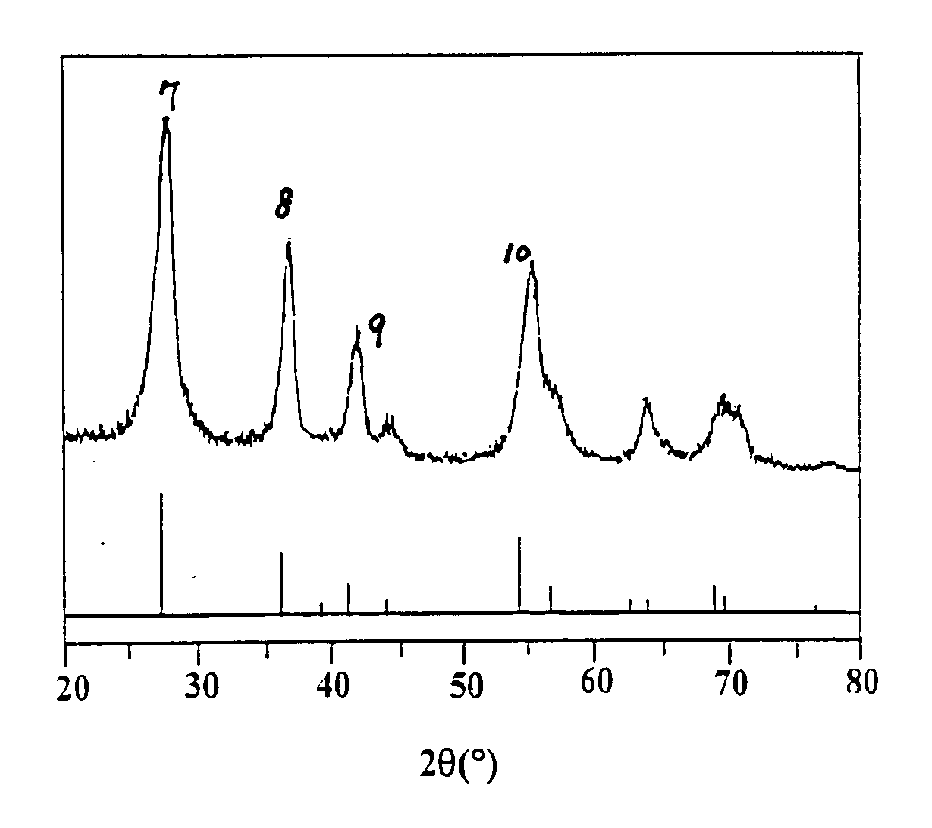
Figure 2 is an X-ray diffraction pattern of titanium oxide nanocrystals prepared by the method provided by the present invention. In the figure, the four main peaks 7, 8, 9, 10 correspond to rutile 2θ equal to 27.45°, 36.09°, 41.23° and 54.32, respectively. °The characteristic diffraction peak.
Figures 3 and 4 are transmission electron micrographs of granular and long columnar rutile prepared by the method provided by the present invention.
The outstanding features of the preparation method of rutile phase titanium dioxide nanocrystals provided by the present invention are: 1. The preparation process is simple, the process parameters are easy to control, and the large-scale industrial production is easy.
2. There is no need for heat treatment and crystal form conversion agent, it is rutile phase at room temperature and the particle size of the powder is smaller than that of the powder prepared by other existing hydrolysis processes.
3. In the preparation method provided by the present invention, the morphology and particle size of the crystal grains can be adjusted by process parameters, and granular and long columnar titanium oxide nanocrystals can be obtained; the purity of the product is high (greater than 99%).
The following examples are used to further clarify the outstanding features and significant progress of the present invention, which are only to illustrate the present invention and never limit the present invention.
Example 1: Add concentrated hydrochloric acid to water to make the pH of the aqueous solution 0.5, ice water bath, then add titanium tetrachloride, the concentration is 0.3 mol/L, add dispersant polyethylene glycol, its molecular weight is 3000, the amount added It is one thousandth (mass percentage, relative to water), hydrolyzed at 60°C for 3 hours, aging for 12 hours, filtered, washed with water and then washed with alcohol, vacuum dried, the particle size of the powder is 7 nanometers, and the powder absorbs near ultraviolet The light is slightly yellowish. X-ray diffraction analysis results show that the powder is rutile phase, without the diffraction peaks of anatase and brookite. The X-ray diffraction pattern is shown in Fig. 2, and the crystal grain morphology is shown in Fig. 3.
Example 2: Add concentrated nitric acid to water, adjust the pH to 0.8, add titanium tetrachloride, the concentration is 0.4 mol/L, no dispersant is added, the hydrolysis temperature is 90°C, the hydrolysis time is 2 hours, and the aging time is After 20 hours, filtered and dried in vacuum at 30°C, the obtained powder has a long columnar nanocrystal with a diameter of 15 nm and a length of 70 nm; it is rutile phase by X-ray diffraction analysis, and the crystal grain morphology is shown in Figure 4. The rest is the same as in Example 1.
Example 3: Add concentrated hydrochloric acid to water to make the pH of the aqueous solution 0 (hydrogen ion concentration is 1 mol/liter), ice water bath, then add titanium tetrachloride, the concentration is 0.08 mol/liter, add four thousandths Polyvinyl alcohol (molecular weight is about 5000), hydrolysis temperature is 90°C, hydrolysis time is 4 hours, aging time is 12 hours, filtered and dried under vacuum at 40°C to obtain dendritic aggregates, calcined at 400°C2 When it is small, the obtained nanocrystal has a particle size of 15 nanometers and the crystal grain size is uniform. The rest is the same as in Example 1.
1 sheet
Sheet 1
Every citation, both ways
| Document | Relation | Office | Cited during |
|---|---|---|---|
| CN100392023C | Cited by | China | Search report |
| CN101346313A | Cited by | China | Search report |
| CN100334261C | Cited by | China | Search report |
| CN101844805A | Cited by | China | Search report |
| CN1315731C | Cited by | China | Search report |
| CN100334000C | Cited by | China | Search report |
| CN103232066A | Cited by | China | Search report |
| CN100368301C | Cited by | China | Search report |
| CN102211788A | Cited by | China | Search report |
2 priority claims, no other members on record
Priority claims2
| Document | Office | Kind | Date |
|---|---|---|---|
| 99113693 | China | A | |
| CN1999113693 | – | – | – |
Numbers
- Publication
- 1248550
- Publication, DOCDB
- 1248550
- Publication, EPODOC
- CN1248550
- Application
- 99113693
- Application, DOCDB
- 99113693
- Application, EPODOC
- CN1999113693
Titles3
- English
- Method for preparing rutile phase titanium dioxide nano crystals at room temperature
- Chinese
- 室温下制备金红石相二氧化钛纳米晶的方法
- English
- Process for preparing titanic schorl phase titanium dioxide nanometer crystal under room temp.
Classification
- IPC, 4
- C01G23 053
- C01G23 08
- M01G23 053
- M01G23 08